manual transmission SUBARU IMPREZA 2006 2.G User Guide
[x] Cancel search | Manufacturer: SUBARU, Model Year: 2006, Model line: IMPREZA, Model: SUBARU IMPREZA 2006 2.GPages: 365, PDF Size: 7.09 MB
Page 254 of 365

Driving tips 8-27
heating of your vehicle s brakes. Do not
make sudden downshifts.
When driving uphill in hot weather, the
air conditioner may turn off automatically
to protect the engine from overheating.
When driving uphill in hot weather, pay
attention to the water temperature gauge
pointer (for all vehicles) and AT OIL TEMP
warning light (for AT vehicles) since the
engine and transmission are relatively
prone to overheating under these condi-
tions. If the water temperature gauge
pointer approaches the OVERHEAT zone
or the AT OIL TEMP warning light illumi-
nates, immediately switch off the air con-
ditioner and stop the vehicle at the nearest
safe place. Refer to the Engine overheat-
ing section in chapter 9, and Warning
and indicator lights section in chapter 3.
If your vehicle has an automatic trans-
mission, avoid using the accelerator pedal
to stay stationary on an uphill slope in-
stead of using the parking brake or foot
brake. That may cause the transmission
fluid to overheat.
If your vehicle has an automatic trans-
mission, place the selector lever as fol-
lows:
Uphill slopes: D position
Downhill slopes: A low-speed gear posi-
tion to use engine braking
Parking on a grade
Always block the wheels under both vehi-
cle and trailer when parking. Apply the
parking brake firmly. You should not park
on a hill or slope. But if parking on a hill or
slope cannot be avoided, you should take
the following steps:
1. Apply the brakes and hold the pedal
down.
2. Have someone place wheel blocks un-
der both the vehicle and trailer wheels.
3. When the wheel blocks are in place, re-
lease the regular brakes slowly until the
blocks absorb the load.
4. Apply the regular brakes and then ap-
ply the parking brake; slowly release the
regular brakes.
5. Shift into 1st or reverse gear (manual
transmission) or P (automatic transmis-
sion) and shut off the engine.
Page 259 of 365
9-4 In case of emergency
Flat tires
If you have a flat tire while driving, never
brake suddenly; keep driving straight
ahead while gradually reducing speed.
Then slowly pull off the road to a safe
place.
Changing a flat tire1. Park on a hard, level surface, whenev-
er possible, then stop the engine.
2. Set the parking brake securely and
shift a manual transmission vehicle in re-
verse or an automatic transmission vehi-
cle in the P (Park) position.
3. Turn on the hazard warning flasher and
have everyone get out of the vehicle.
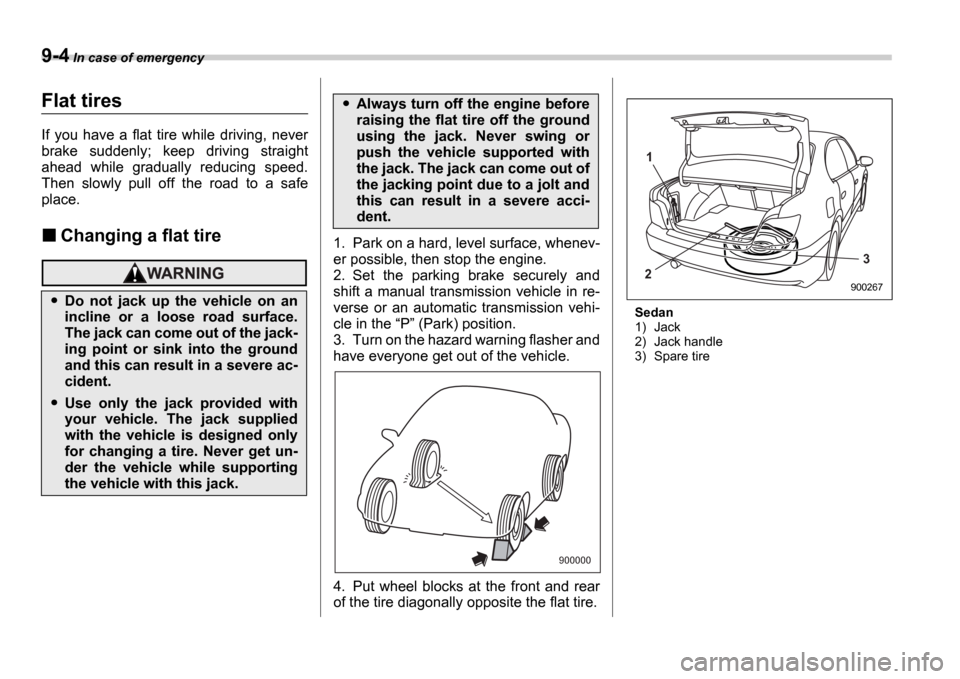
4. Put wheel blocks at the front and rear
of the tire diagonally opposite the flat tire.
Sedan
1) Jack
2) Jack handle
3) Spare tireDo not jack up the vehicle on an
incline or a loose road surface.
The jack can come out of the jack-
ing point or sink into the ground
and this can result in a severe ac-
cident.
Use only the jack provided with
your vehicle. The jack supplied
with the vehicle is designed only
for changing a tire. Never get un-
der the vehicle while supporting
the vehicle with this jack.
Always turn off the engine before
raising the flat tire off the ground
using the jack. Never swing or
push the vehicle supported with
the jack. The jack can come out of
the jacking point due to a jolt and
this can result in a severe acci-
dent.
900000
1
2 3
900267
Page 269 of 365
9-14 In case of emergency
or 1st for manual transmission vehicles.
2. Pull up the parking brake lever firmly.
3. Secure the vehicle onto the carrier
properly with safety chains. Each safety
chain should be equally tightened and
care must be taken not to pull the chains
so tightly that the suspension bottoms out.
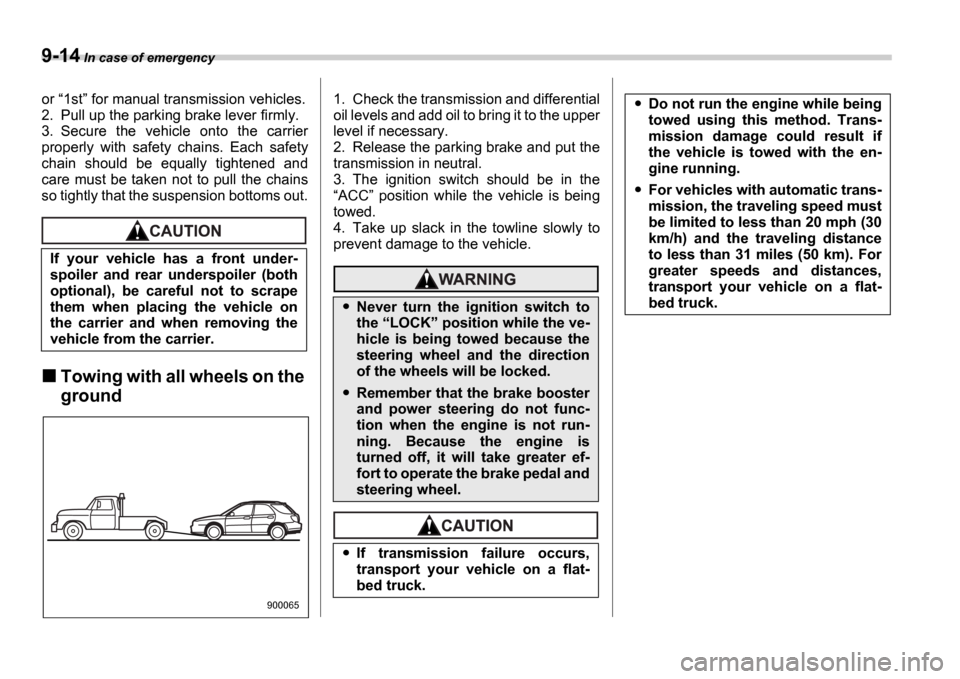
Towing with all wheels on the
ground
1. Check the transmission and differential
oil levels and add oil to bring it to the upper
level if necessary.
2. Release the parking brake and put the
transmission in neutral.
3. The ignition switch should be in the ACC position while the vehicle is being
towed.
4. Take up slack in the towline slowly to
prevent damage to the vehicle.
If your vehicle has a front under-
spoiler and rear underspoiler (both
optional), be careful not to scrape
them when placing the vehicle on
the carrier and when removing the
vehicle from the carrier.
900065
Never turn the ignition switch to
the LOCK position while the ve-
hicle is being towed because the
steering wheel and the direction
of the wheels will be locked.
Remember that the brake booster
and power steering do not func-
tion when the engine is not run-
ning. Because the engine is
turned off, it will take greater ef-
fort to operate the brake pedal and
steering wheel.
If transmission failure occurs,
transport your vehicle on a flat-
bed truck.
Do not run the engine while being
towed using this method. Trans-
mission damage could result if
the vehicle is towed with the en-
gine running.
For vehicles with automatic trans-
mission, the traveling speed must
be limited to less than 20 mph (30
km/h) and the traveling distance
to less than 31 miles (50 km). For
greater speeds and distances,
transport your vehicle on a flat-
bed truck.
Page 280 of 365

11
Maintenance and service
Maintenance schedule ....................................... 11-3
Maintenance precautions ........................... ....... 11-3
Before checking or servicing in the engine compartment ....................................... ................. 11-4
When you do checking or servicing in the engine
compartment while the engine is running ......... 11 -4
Engine hood ....................................... ................ 11-4
Engine compartment overview ....................... .. 11-6
Non-turbo models .................................. ................. 11-6
Turbo models ...................................... .................... 11-7
Engine oil ........................................ .................... 11-8
Checking the oil level ............................ ................. 11-8
Changing the oil and oil filter ................... ............. 11-8
Recommended grade and viscosity ................... .. 11-10
Recommended grade and viscosity under severe driving conditions ......................... ........... 11-11
Synthetic oil ..................................... ....................... 11-11
Cooling system .................................... .............. 11-12
Cooling fan, hose and connections ................. ..... 11-12
Engine coolant .................................... .................... 11-12
Air cleaner element ............................... ............. 11-15
Replacing the air cleaner element ................. ........ 11-15
Spark plugs ....................................... .................. 11-17
Recommended spark plugs ........................... ........ 11-17
Drive belts ....................................... .................... 11-18
Manual transmission oil ........................... ......... 11-18
Checking the oil level ............................ ................. 11-18
Recommended grade and viscosity ................... .. 11-19Automatic transmission fluid ......................
...... 11-20
Checking the fluid level .......................... ................ 11-20
Recommended fluid ................................. .............. 11-21
Front differential gear oil (AT vehicles) ......... ... 11-21
Checking the oil level ............................ ................. 11-21
Recommended grade and viscosity ................... .. 11-22
Rear differential gear oil ........................ ............ 11-22
Checking the gear oil level ....................... ............. 11-22
Recommended grade and viscosity ................... .. 11-23
Power steering fluid .............................. ............. 11-24
Checking the fluid level .......................... ................ 11-24
Recommended fluid ................................. .............. 11-24
Brake fluid ....................................... .................... 11-25
Checking the fluid level .......................... ................ 11-25
Recommended brake fluid ........................... .......... 11-25
Clutch fluid (MT vehicles) ........................ .......... 11-26
Checking the fluid level .......................... ................ 11-26
Recommended clutch fluid .......................... .......... 11-26
Brake booster ..................................... ................ 11-27
Brake pedal ....................................... .................. 11-27
Checking the brake pedal free play ................ ...... 11-27
Checking the brake pedal reserve distance ......... 11-27
Clutch pedal (MT vehicles) ........................ ........ 11-28
Checking the clutch function ...................... .......... 11-28
Checking the clutch pedal free play ............... ...... 11-28
Replacement of brake pad and lining ............... 11-28
Breaking-in of new brake pads and linings ......... . 11-29
Parking brake stroke .............................. ............ 11-29
Page 285 of 365
11-6 Maintenance and service
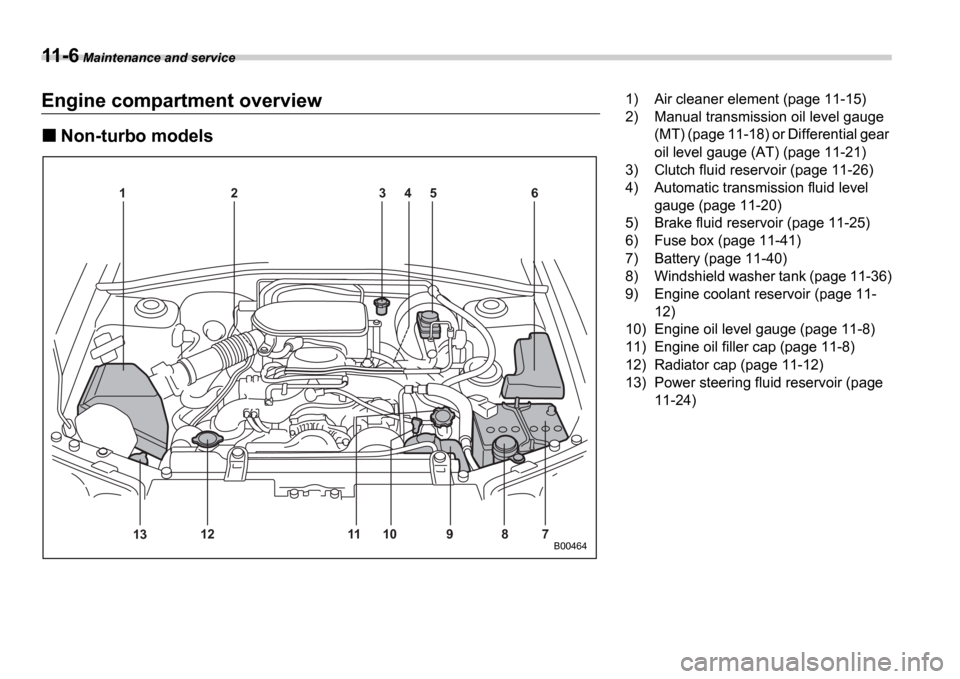
Engine compartment overview
Non-turbo models
1 2 3 4 5 6
7
8
9
10
11
13 12
B00464
1) Air cleaner element (page 11-15)
2) Manual transmission oil level gauge
(MT) (page 11-18) or Differential gear
oil level gauge (AT) (page 11-21)
3) Clutch fluid reservoir (page 11-26)
4) Automatic transmission fluid level gauge (page 11-20)
5) Brake fluid reservoir (page 11-25)
6) Fuse box (page 11-41)
7) Battery (page 11-40)
8) Windshield washer tank (page 11-36)
9) Engine coolant reservoir (page 11-
12)
10) Engine oil level gauge (page 11-8)
11) Engine oil filler cap (page 11-8)
12) Radiator cap (page 11-12)
13) Power steering fluid reservoir (page
11-24)
Page 286 of 365
Maintenance and service 11-7
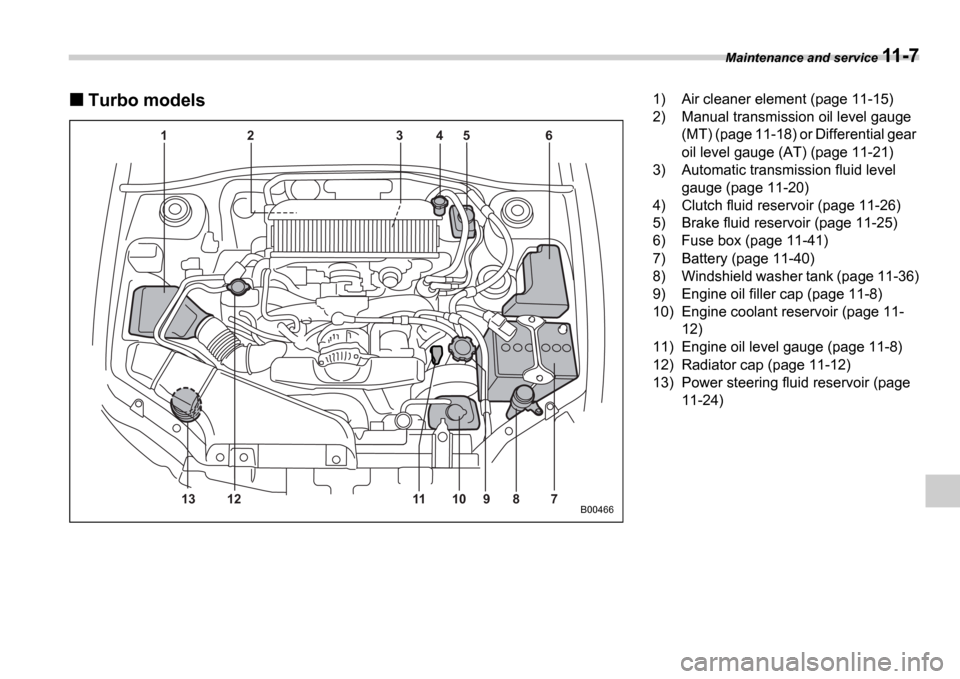
Turbo models
1 2 3 4 5 6
7
8
9
10
11
12
13
B00466
1) Air cleaner element (page 11-15)
2) Manual transmission oil level gauge
(MT) (page 11-18) or Differential gear
oil level gauge (AT) (page 11-21)
3) Automatic transmission fluid level gauge (page 11-20)
4) Clutch fluid reservoir (page 11-26)
5) Brake fluid reservoir (page 11-25)
6) Fuse box (page 11-41)
7) Battery (page 11-40)
8) Windshield washer tank (page 11-36)
9) Engine oil filler cap (page 11-8)
10) Engine coolant reservoir (page 11- 12)
11) Engine oil level gauge (page 11-8)
12) Radiator cap (page 11-12)
13) Power steering fluid reservoir (page
11-24)
Page 297 of 365
11-18 Maintenance and service
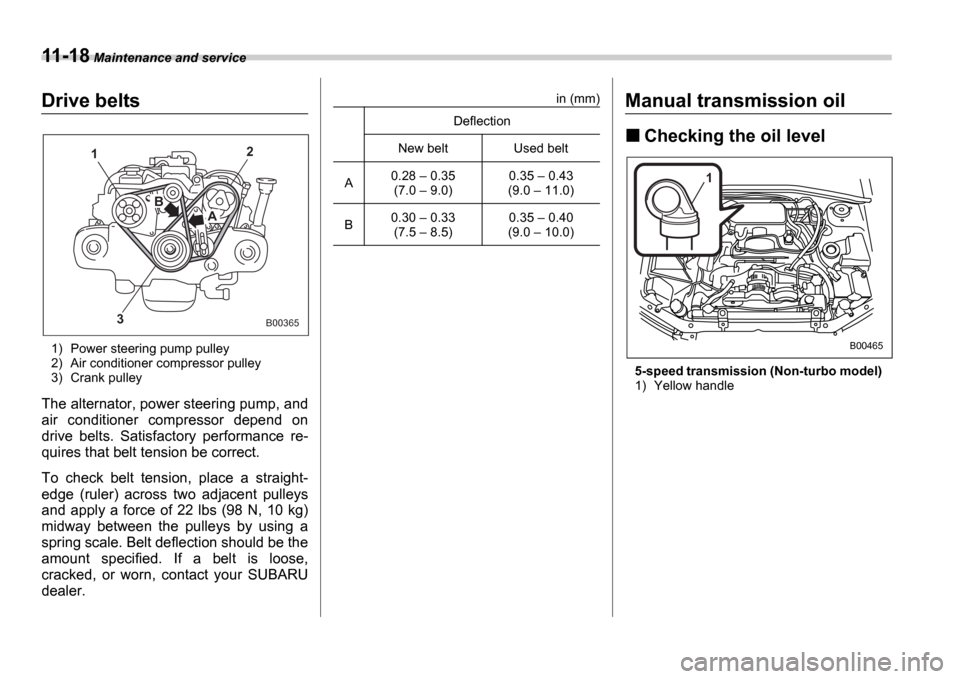
Drive belts
1) Power steering pump pulley
2) Air conditioner compressor pulley
3) Crank pulley
The alternator, power steering pump, and
air conditioner compressor depend on
drive belts. Satisfactory performance re-
quires that belt tension be correct.
To check belt tension, place a straight-
edge (ruler) across two adjacent pulleys
and apply a force of 22 lbs (98 N, 10 kg)
midway between the pulleys by using a
spring scale. Belt deflection should be the
amount specified. If a belt is loose,
cracked, or worn, contact your SUBARU
dealer.
in (mm)Manual transmission oil
Checking the oil level
5-speed transmission (Non-turbo model)
1) Yellow handle
A
B
2
3
1
B00365
Deflection
New belt Used belt
A 0.28
0.35
(7.0 9.0) 0.35
0.43
(9.0 11.0)
B 0.30
0.33
(7.5 8.5) 0.35
0.40
(9.0 10.0)
1
B00465
Page 298 of 365
Maintenance and service 11-19
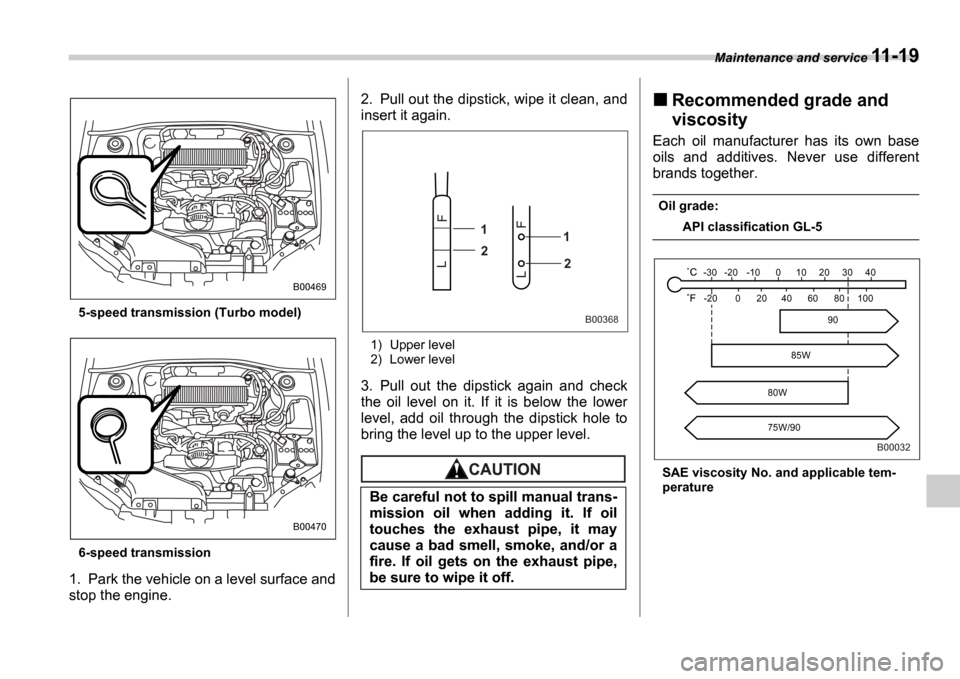
5-speed transmission (Turbo model)
6-speed transmission
1. Park the vehicle on a level surface and
stop the engine. 2. Pull out the dipstick, wipe it clean, and
insert it again.
1) Upper level
2) Lower level
3. Pull out the dipstick again and check
the oil level on it. If it is below the lower
level, add oil through the dipstick hole to
bring the level up to the upper level.
Recommended grade and
viscosity
Each oil manufacturer has its own base
oils and additives. Never use different
brands together.
Oil grade:
API classification GL-5
SAE viscosity No. and applicable tem-
perature
B00469
B00470
Be careful not to spill manual trans-
mission oil when adding it. If oil
touches the exhaust pipe, it may
cause a bad smell, smoke, and/or a
fire. If oil gets on the exhaust pipe,
be sure to wipe it off.
L F
F
L1
2 1
2
B00368
-30 -20 -10 0 10 20 30 40-20 0 60 20
80W
75W/90 80 100
40
85W 90
B00032
Page 333 of 365
12-2 Specifications
SpecificationsSpecifications
These specifications are subject to change without notice .
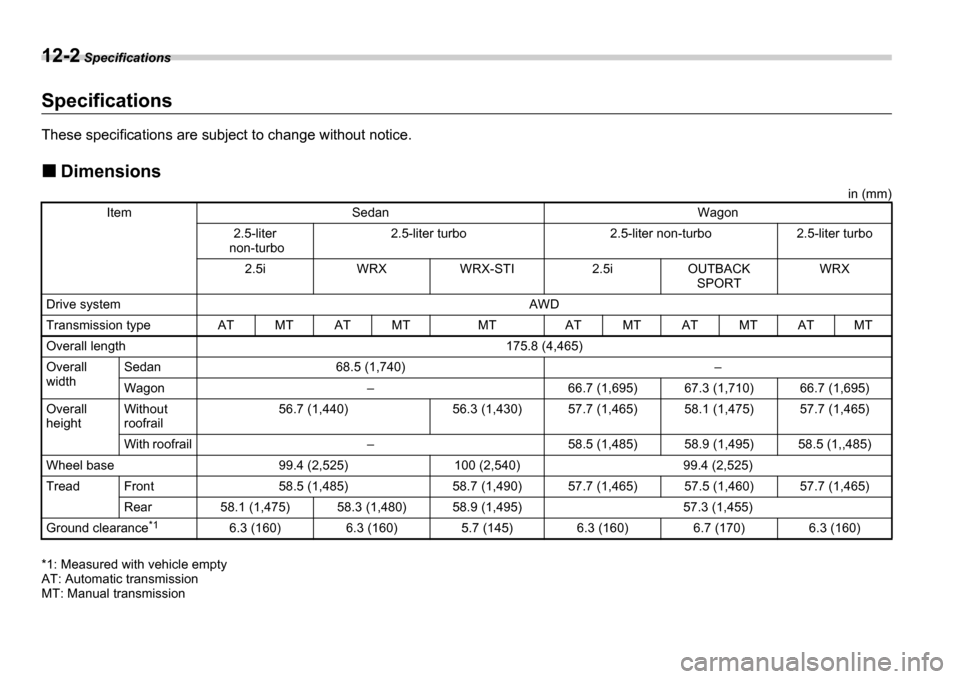
Dimensions
in (mm)
*1: Measured with vehicle empty
AT: Automatic transmission
MT: Manual transmission
ItemSedanWagon
2.5-liter
non-turbo2.5-liter turbo2.5-liter non-turbo2.5-liter turbo
2.5iWRXWRX-STI2.5iOUTBACK SPORTWRX
Drive systemAWD
Transmission typeATMTATMTMTATMTATMTATMT
Overall length175.8 (4,465)
Overall
widthSedan68.5 (1,740)
Wagon66.7 (1,695)67.3 (1,710)66.7 (1,695)
Overall
heightWithout
roofrail56.7 (1,440)56.3 (1,430)57.7 (1,465)58.1 (1,475)57.7 (1,465)
With roofrail58.5 (1,485)58.9 (1,495)58.5 (1,,485)
Wheel base99.4 (2,525)100 (2,540)99.4 (2,525)
TreadFront58.5 (1,485)58.7 (1,490)57.7 (1,465)57.5 (1,460)57.7 (1,465)
Rear58.1 (1,475)58.3 (1,480)58.9 (1,495)57.3 (1,455)
Ground clearance *16.3 (160)6.3 (160)5.7 (145)6.3 (160)6.7 (170)6.3 (160)
Page 334 of 365
Specifications 12-3
CONTINUED
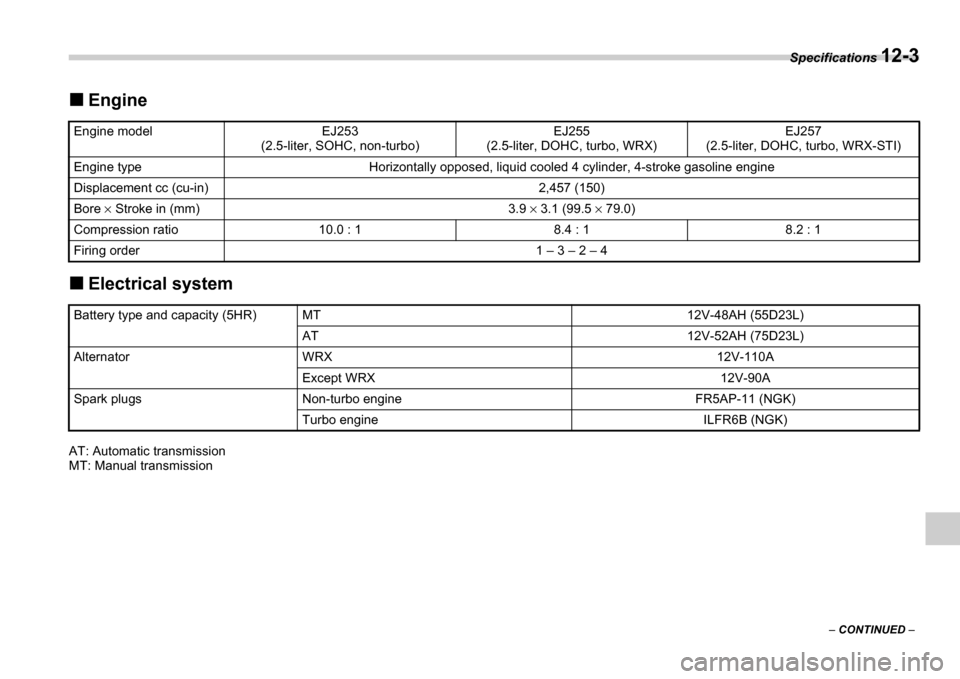
Engine
Electrical system
AT: Automatic transmission
MT: Manual transmission
Engine modelEJ253
(2.5-liter, SOHC, non-turbo)EJ255
(2.5-liter, DOHC, turbo, WRX)EJ257
(2.5-liter, DOHC, turbo, WRX-STI)
Engine typeHorizontally opposed, liquid cooled 4 cylinder, 4-s troke gasoline engine
Displacement cc (cu-in)2,457 (150)
Bore Stroke in (mm)3.9 3.1 (99.5 79.0)
Compression ratio10.0 : 18.4 : 18.2 : 1
Firing order1 3 2 4
Battery type and capacity (5HR)MT12V-48AH (55D23L)
AT12V-52AH (75D23L)
AlternatorWRX12V-110A
Except WRX12V-90A
Spark plugsNon-turbo engineFR5AP-11 (NGK)
Turbo engineILFR6B (NGK)