trailer SUBARU IMPREZA 2006 2.G User Guide
[x] Cancel search | Manufacturer: SUBARU, Model Year: 2006, Model line: IMPREZA, Model: SUBARU IMPREZA 2006 2.GPages: 365, PDF Size: 7.09 MB
Page 251 of 365
8-24 Driving tips
SUBARU hitch is available from your
SUBARU dealer.
If use of a non-genuine hitch is unavoid-
able, be sure the hitch is suited to your ve-
hicle and trailer. Consult with a profes-
sional hitch supplier to assist you in
choosing an appropriate hitch for your ve-
hicle. Be sure to follow all of the hitch man-
ufacturer s instructions for installation and
use.
Never use a hitch that mounts only to the
rear bumper. The bumper is not designed
to handle that type of load.
For all types of hitches, regularly check
that the hitch mounting bolts and nuts are
tight.
SEDAN
SUBARU does not offer accessory trailer
hitches. Consult with a professional hitch
supplier to assist you in choosing an ap-
propriate hitch for your vehicle. Be sure to
follow all of the hitch manufacturer s in-
structions for installation and use.
Never use a hitch that mounts only to the
rear bumper. The bumper is not designed
to handle that type of load.
Regularly check that the hitch mounting
bolts and nuts are tight.
Connecting a trailer
Trailer brakes
If your trailer s total weight (trailer weight
plus its cargo weight) exceeds 1,000 lbs
(453 kg), the trailer is required to be
equipped with its own brake system. Elec-
tric brakes or surge brakes are recom-
mended, and must be installed properly.
Check that your trailer s brakes conform
with Federal, state/province and/or other
applicable regulations. Your SUBARU s
brake system is not designed to be tapped
into the trailer s hydraulic brake system.
Please ask your SUBARU dealer and pro-
fessional trailer supplier for more informa-
tion about the trailer s brake system.
Trailer safety chains
In case the trailer hitch connector or hitch
ball should break or become disconnect-
ed, the trailer could get loose and create a
traffic safety hazard.
For safety, always connect the towing ve-
hicle and trailer with trailer safety chains.
Pass the chains crossing each other un-
der the trailer tongue to prevent the trailer
from dropping onto the ground in case the
trailer tongue should disconnect from the
hitch ball. Allow sufficient slack in the
chains taking tight-turn situations into ac-
count; however, be careful not to let them
drag on the ground.
For more information about the safety
chain connection, refer to the instructions
for your hitch and trailer.
Adequate size trailer brakes are
required when the trailer and its
cargo exceed 1,000 lbs (453 kg)
total weight.
Do not directly connect your trail-
er s hydraulic brake system to the
hydraulic brake system in your
vehicle. Direct connection would
cause the vehicle s brake perfor-
mance to deteriorate and could
lead to an accident.
Always use safety chains between
your vehicle and the trailer. Towing
a trailer without safety chains could
create a traffic safety hazard if the
trailer separates from the hitch due
to coupling damage or hitch ball
damage.
Page 252 of 365
Driving tips 8-25
CONTINUED
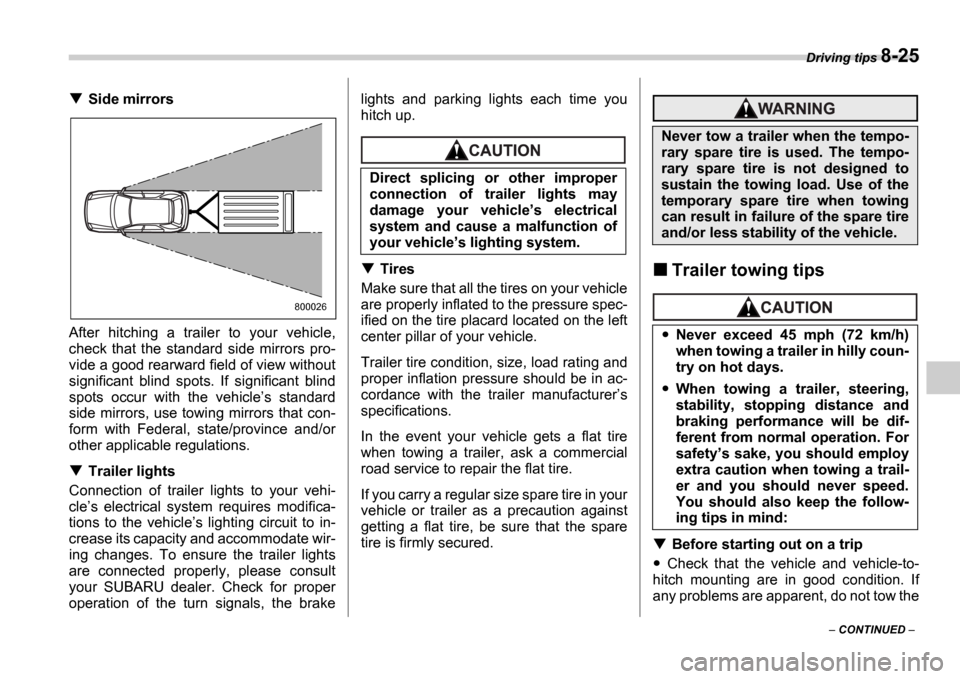
Side mirrors
After hitching a trailer to your vehicle,
check that the standard side mirrors pro-
vide a good rearward field of view without
significant blind spots. If significant blind
spots occur with the vehicle s standard
side mirrors, use towing mirrors that con-
form with Federal, state/province and/or
other applicable regulations.
Trailer lights
Connection of trailer lights to your vehi-
cle s electrical system requires modifica-
tions to the vehicle s lighting circuit to in-
crease its capacity and accommodate wir-
ing changes. To ensure the trailer lights
are connected properly, please consult
your SUBARU dealer. Check for proper
operation of the turn signals, the brake lights and parking lights each time you
hitch up.
Tires
Make sure that all the tires on your vehicle
are properly inflated to the pressure spec-
ified on the tire placard located on the left
center pillar of your vehicle.
Trailer tire condition, size, load rating and
proper inflation pressure should be in ac-
cordance with the trailer manufacturer s
specifications.
In the event your vehicle gets a flat tire
when towing a trailer, ask a commercial
road service to repair the flat tire.
If you carry a regular size spare tire in your
vehicle or trailer as a precaution against
getting a flat tire, be sure that the spare
tire is firmly secured.Trailer towing tips
Before starting out on a trip
Check that the vehicle and vehicle-to-
hitch mounting are in good condition. If
any problems are apparent, do not tow the
800026
Direct splicing or other improper
connection of trailer lights may
damage your vehicle s electrical
system and cause a malfunction of
your vehicle s lighting system.
Never tow a trailer when the tempo-
rary spare tire is used. The tempo-
rary spare tire is not designed to
sustain the towing load. Use of the
temporary spare tire when towing
can result in failure of the spare tire
and/or less stability of the vehicle.
Never exceed 45 mph (72 km/h)
when towing a trailer in hilly coun-
try on hot days.
When towing a trailer, steering,
stability, stopping distance and
braking performance will be dif-
ferent from normal operation. For
safety s sake, you should employ
extra caution when towing a trail-
er and you should never speed.
You should also keep the follow-
ing tips in mind:
Page 253 of 365
8-26 Driving tips
trailer.
Check that the vehicle sits horizontally
with the trailer attached. If the vehicle is
tipped sharply up at the front and down at
the rear, check the total trailer weight,
GVW, GAWs and tongue load again, then
confirm that the load and its distribution
are acceptable.
Check that the tire pressures are cor-
rect.
Check that the vehicle and trailer are
connected properly. Confirm that the trailer tongue is connected prop-
erly to the hitch ball. the trailer lights connector is connect-
ed properly and trailer s brake lights illu-
minate when the vehicle s brake pedal
is pressed, and that the trailer s turn sig-
nal lights flash when the vehicle s turn
signal lever is operated. the safety chains are connected prop-
erly. all cargo in the trailer is secured safe-
ty in position. the side mirrors provide a good rear-
ward field of view without a significant
blind spot.
Sufficient time should be taken to learn
the feel of the vehicle/trailer combination
before starting out on a trip. In an area free
of traffic, practice turning, stopping and
backing up.
Driving with a trailer
You should allow for considerably more
stopping distance when towing a trailer.
Avoid sudden braking because it may re-
sult in skidding or jackknifing and loss of
control.
Avoid abrupt starts and sudden acceler-
ations. If your vehicle has a manual trans-
mission, always start out in first gear and
release the clutch at moderate engine rev-
olution.
Avoid uneven steering, sharp turns and
rapid lane changes.
Slow down before turning. Make a long-
er than normal turning radius because the
trailer wheels will be closer than the vehi-
cle wheels to the inside of the turn. In a
tight turn, the trailer could hit your vehicle.
Crosswinds will adversely affect the
handling of your vehicle and trailer, caus-
ing sway. Crosswinds can be due to
weather conditions or the passing of large
tracks or buses. If swaying occurs, firmly
grip the steering wheel and slow down im-
mediately but gradually.
When passing other vehicles, consider-
able distance is required because of the
added weight and length caused by at-
taching the trailer to your vehicle.
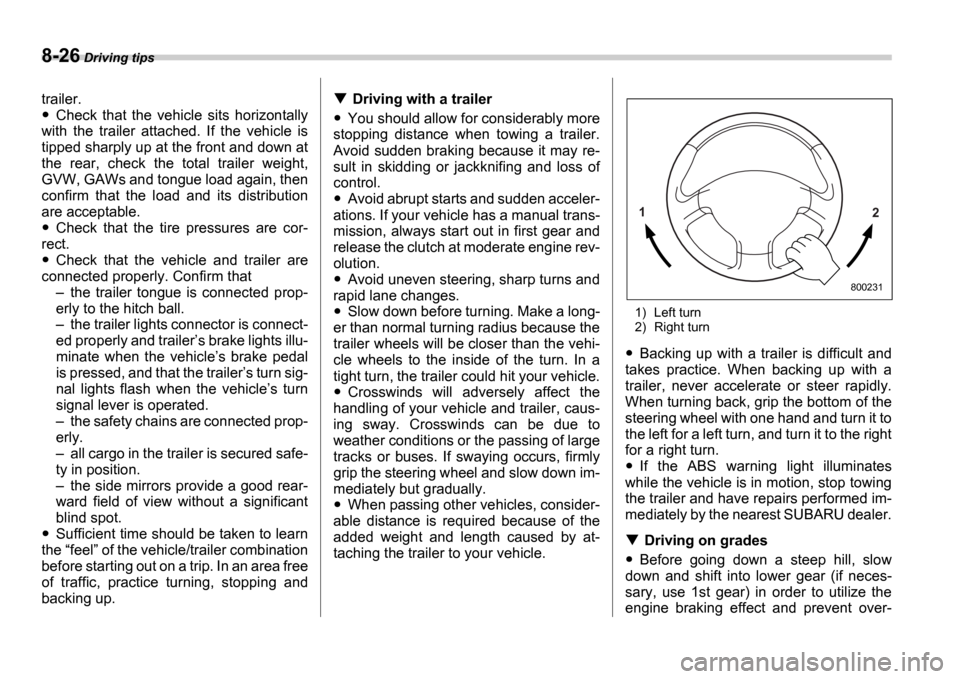
1) Left turn
2) Right turn
Backing up with a trailer is difficult and
takes practice. When backing up with a
trailer, never accelerate or steer rapidly.
When turning back, grip the bottom of the
steering wheel with one hand and turn it to
the left for a left turn, and turn it to the right
for a right turn.
If the ABS warning light illuminates
while the vehicle is in motion, stop towing
the trailer and have repairs performed im-
mediately by the nearest SUBARU dealer.
Driving on grades
Before going down a steep hill, slow
down and shift into lower gear (if neces-
sary, use 1st gear) in order to utilize the
engine braking effect and prevent over-
1 2
800231
Page 254 of 365

Driving tips 8-27
heating of your vehicle s brakes. Do not
make sudden downshifts.
When driving uphill in hot weather, the
air conditioner may turn off automatically
to protect the engine from overheating.
When driving uphill in hot weather, pay
attention to the water temperature gauge
pointer (for all vehicles) and AT OIL TEMP
warning light (for AT vehicles) since the
engine and transmission are relatively
prone to overheating under these condi-
tions. If the water temperature gauge
pointer approaches the OVERHEAT zone
or the AT OIL TEMP warning light illumi-
nates, immediately switch off the air con-
ditioner and stop the vehicle at the nearest
safe place. Refer to the Engine overheat-
ing section in chapter 9, and Warning
and indicator lights section in chapter 3.
If your vehicle has an automatic trans-
mission, avoid using the accelerator pedal
to stay stationary on an uphill slope in-
stead of using the parking brake or foot
brake. That may cause the transmission
fluid to overheat.
If your vehicle has an automatic trans-
mission, place the selector lever as fol-
lows:
Uphill slopes: D position
Downhill slopes: A low-speed gear posi-
tion to use engine braking
Parking on a grade
Always block the wheels under both vehi-
cle and trailer when parking. Apply the
parking brake firmly. You should not park
on a hill or slope. But if parking on a hill or
slope cannot be avoided, you should take
the following steps:
1. Apply the brakes and hold the pedal
down.
2. Have someone place wheel blocks un-
der both the vehicle and trailer wheels.
3. When the wheel blocks are in place, re-
lease the regular brakes slowly until the
blocks absorb the load.
4. Apply the regular brakes and then ap-
ply the parking brake; slowly release the
regular brakes.
5. Shift into 1st or reverse gear (manual
transmission) or P (automatic transmis-
sion) and shut off the engine.
Page 258 of 365
In case of emergency 9-3
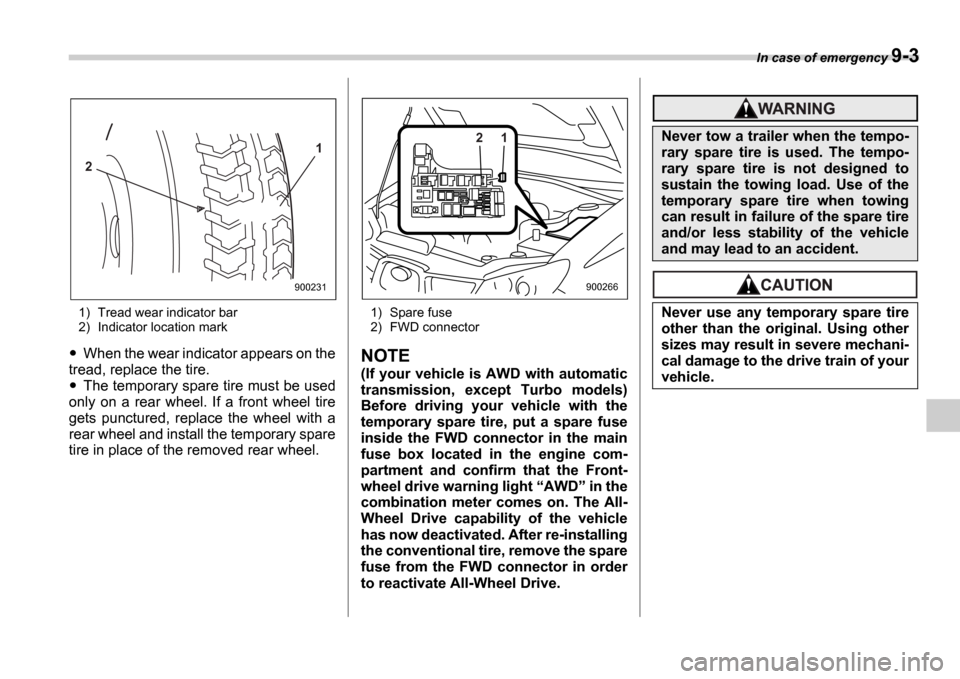
1) Tread wear indicator bar
2) Indicator location mark
When the wear indicator appears on the
tread, replace the tire.
The temporary spare tire must be used
only on a rear wheel. If a front wheel tire
gets punctured, replace the wheel with a
rear wheel and install the temporary spare
tire in place of the removed rear wheel.
1) Spare fuse
2) FWD connector
NOTE
(If your vehicle is AWD with automatic
transmission, except Turbo models)
Before driving your vehicle with the
temporary spare tire, put a spare fuse
inside the FWD connector in the main
fuse box located in the engine com-
partment and confirm that the Front-
wheel drive warning light AWD in the
combination meter comes on. The All-
Wheel Drive capability of the vehicle
has now deactivated. After re-installing
the conventional tire, remove the spare
fuse from the FWD connector in order
to reactivate All-Wheel Drive.
900231
1
22 1
900266
Never tow a trailer when the tempo-
rary spare tire is used. The tempo-
rary spare tire is not designed to
sustain the towing load. Use of the
temporary spare tire when towing
can result in failure of the spare tire
and/or less stability of the vehicle
and may lead to an accident.
Never use any temporary spare tire
other than the original. Using other
sizes may result in severe mechani-
cal damage to the drive train of your
vehicle.
Page 290 of 365
Maintenance and service 11-11
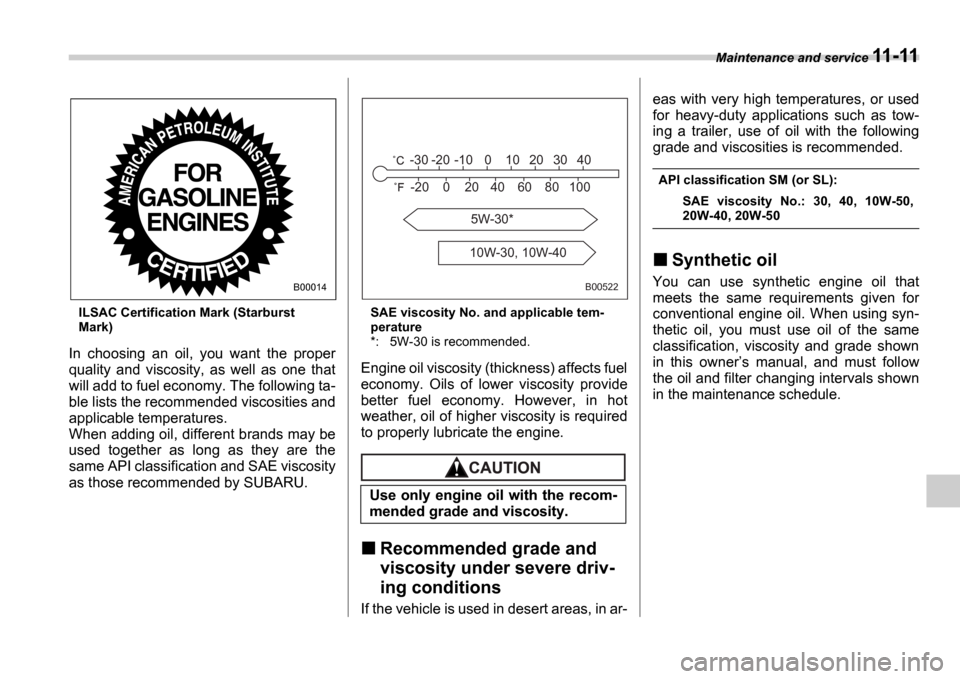
ILSAC Certification Mark (Starburst
Mark)
In choosing an oil, you want the proper
quality and viscosity, as well as one that
will add to fuel economy. The following ta-
ble lists the recommended viscosities and
applicable temperatures.
When adding oil, different brands may be
used together as long as they are the
same API classification and SAE viscosity
as those recommended by SUBARU.
SAE viscosity No. and applicable tem-
perature
*: 5W-30 is recommended.
Engine oil viscosity (thickness) affects fuel
economy. Oils of lower viscosity provide
better fuel economy. However, in hot
weather, oil of higher viscosity is required
to properly lubricate the engine.
Recommended grade and
viscosity under severe driv-
ing conditions
If the vehicle is used in desert areas, in ar- eas with very high temperatures, or used
for heavy-duty applications such as tow-
ing a trailer, use of oil with the following
grade and viscosities is recommended.
API classification SM (or SL):
SAE viscosity No.: 30, 40, 10W-50,
20W-40, 20W-50
Synthetic oil
You can use synthetic engine oil that
meets the same requirements given for
conventional engine oil. When using syn-
thetic oil, you must use oil of the same
classification, viscosity and grade shown
in this owner s manual, and must follow
the oil and filter changing intervals shown
in the maintenance schedule.B00014
Use only engine oil with the recom-
mended grade and viscosity.
B00522
5W-30*
10W-30, 10W-40
-30 -20 -10 0 10 20 30 40
-20 0 60 20 80 10040
Page 311 of 365
11-32 Maintenance and service
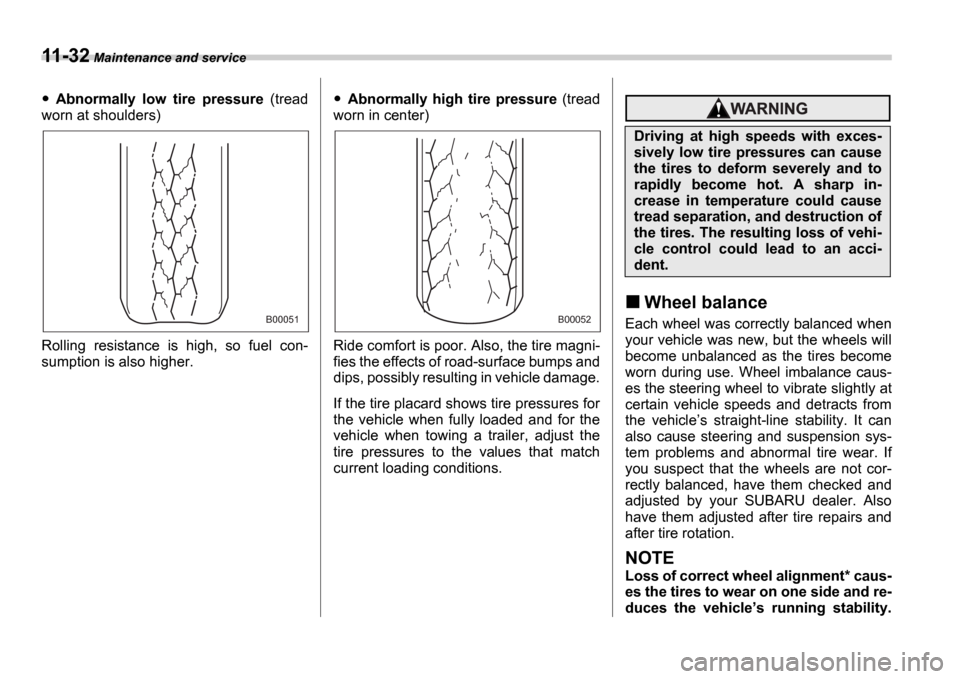
Abnormally low tire pressure (tread
worn at shoulders)
Rolling resistance is high, so fuel con-
sumption is also higher.Abnormally high tire pressure (tread
worn in center)
Ride comfort is poor. Also, the tire magni-
fies the effects of road-surface bumps and
dips, possibly resulting in vehicle damage.
If the tire placard shows tire pressures for
the vehicle when fully loaded and for the
vehicle when towing a trailer, adjust the
tire pressures to the values that match
current loading conditions.
Wheel balance
Each wheel was correctly balanced when
your vehicle was new, but the wheels will
become unbalanced as the tires become
worn during use. Wheel imbalance caus-
es the steering wheel to vibrate slightly at
certain vehicle speeds and detracts from
the vehicle s straight-line stability. It can
also cause steering and suspension sys-
tem problems and abnormal tire wear. If
you suspect that the wheels are not cor-
rectly balanced, have them checked and
adjusted by your SUBARU dealer. Also
have them adjusted after tire repairs and
after tire rotation.
NOTE
Loss of correct wheel alignment* caus-
es the tires to wear on one side and re-
duces the vehicle s running stability.
B00051B00052
Driving at high speeds with exces-
sively low tire pressures can cause
the tires to deform severely and to
rapidly become hot. A sharp in-
crease in temperature could cause
tread separation, and destruction of
the tires. The resulting loss of vehi-
cle control could lead to an acci-
dent.
Page 349 of 365
13-8 Consumer information and Reporting safety defects
Vehicle load limit how to de-
termine
The load capacity of your vehicle is
determined by weight, not by avail-
able cargo space. The load limit of
your vehicle is shown on the vehicle
placard attached to the driver s side
B-pillar. Locate the statement The
combined weight of occupants and
cargo should never exceed XXX kg or
XXX lbs on your vehicle s placard.
The vehicle placard also shows seat-
ing capacity of your vehicle.
The total load capacity includes the
total weight of driver and all passen-
gers and their belongings, any cargo,
any optional equipment such as a
trailer hitch, roof rack or bike carrier,
etc., and the tongue load of a trailer.
Therefore cargo capacity can be cal-
culated by the following method.
Cargo capacity = Load limit (total
weight of occupants + total weight of
optional equipment + tongue load of a
trailer (if applicable))
For towing capacity information and
weight limits, refer to Trailer towing
section in chapter 8.
Calculating total and load capac-
ities varying seating configura-
tions
Calculate the available load capacity
as shown in the following examples:
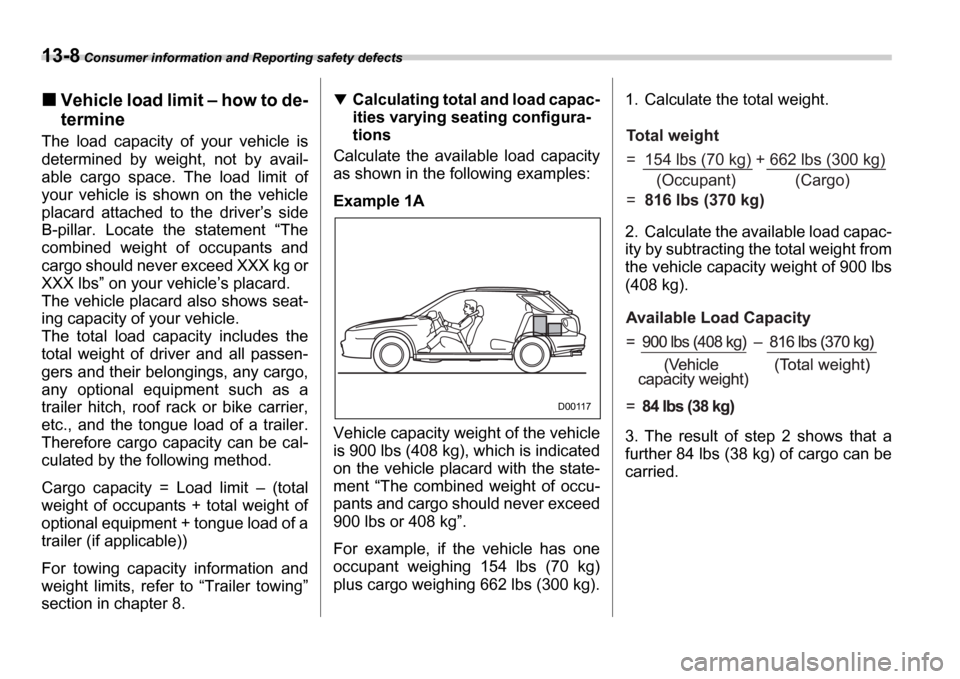
Example 1A
Vehicle capacity weight of the vehicle
is 900 lbs (408 kg), which is indicated
on the vehicle placard with the state-
ment The combined weight of occu-
pants and cargo should never exceed
900 lbs or 408 kg .
For example, if the vehicle has one
occupant weighing 154 lbs (70 kg)
plus cargo weighing 662 lbs (300 kg). 1. Calculate the total weight.
2. Calculate the available load capac-
ity by subtracting the total weight from
the vehicle capacity weight of 900 lbs
(408 kg).
3. The result of step 2 shows that a
further 84 lbs (38 kg) of cargo can be
carried.
D00117
Total weight
= 154 lbs (70 kg) + 662 lbs (300 kg)
=
816 lbs (370 kg)(Occupant) (Cargo)
Page 350 of 365
Consumer information and Reporting safety defects 13-9
CONTINUED
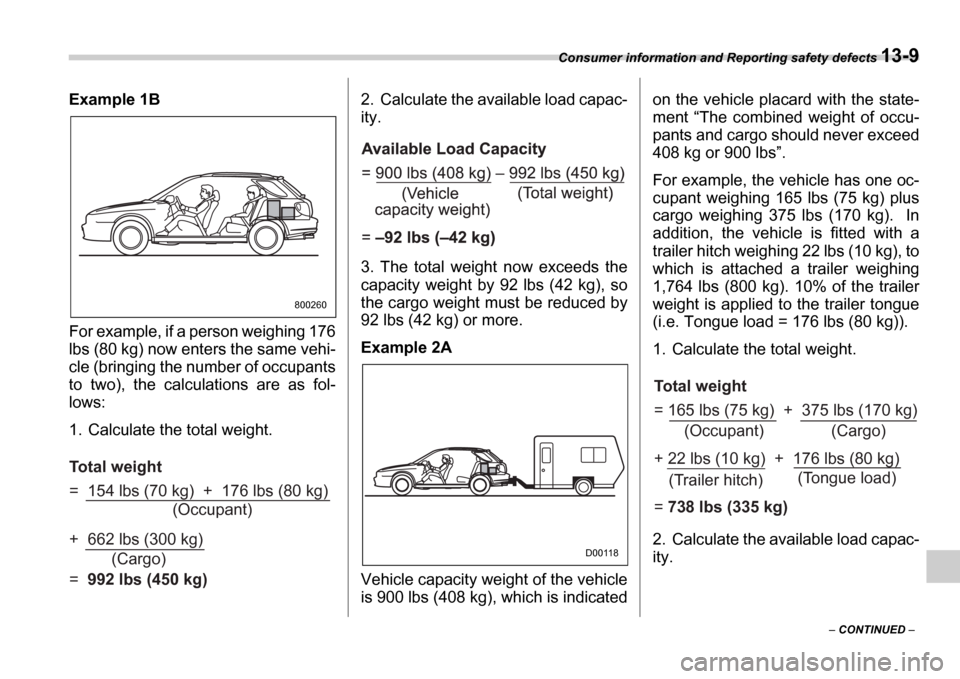
Example 1B
For example, if a person weighing 176
lbs (80 kg) now enters the same vehi-
cle (bringing the number of occupants
to two), the calculations are as fol-
lows:
1. Calculate the total weight.
2. Calculate the available load capac-
ity.
3. The total weight now exceeds the
capacity weight by 92 lbs (42 kg), so
the cargo weight must be reduced by
92 lbs (42 kg) or more.
Example 2A
Vehicle capacity weight of the vehicle
is 900 lbs (408 kg), which is indicatedon the vehicle placard with the state-
ment
The combined weight of occu-
pants and cargo should never exceed
408 kg or 900 lbs .
For example, the vehicle has one oc-
cupant weighing 165 lbs (75 kg) plus
cargo weighing 375 lbs (170 kg). In
addition, the vehicle is fitted with a
trailer hitch weighing 22 lbs (10 kg), to
which is attached a trailer weighing
1,764 lbs (800 kg). 10% of the trailer
weight is applied to the trailer tongue
(i.e. Tongue load = 176 lbs (80 kg)).
1. Calculate the total weight.
2. Calculate the available load capac-
ity.
800260
Total weight
= 154 lbs (70 kg) + 176 lbs (80 kg)
+ 662 lbs (300 kg)
= 992 lbs (450 kg) (Occupant)
(Cargo)
D00118
Total weight
= 165 lbs (75 kg) + 375 lbs (170 kg)
+ 22 lbs (10 kg) + 176 lbs (80 kg)
= 738 lbs (335 kg) (Occupant) (Cargo)
(Trailer hitch) (Tongue load)
Page 352 of 365

Consumer information and Reporting safety defects 13-11
suspension, axles and other parts of
the body.
Therefore, this means that the vehicle
cannot necessarily be loaded up to
the tires maximum load rating on the
tire sidewall.
Adverse safety consequenc-
es of overloading on handling
and stopping and on tires
Overloading could affect vehicle han-
dling, stopping distance, vehicle and
tire as shown in the following. This
could lead to an accident and possibly
result in severe personal injury.
Vehicle stability will deteriorate.
Heavy and/or high-mounted loads
could increase the risk of rollover.
Stopping distance will increase.
Brakes could overheat and fail.
Suspension, bearings, axles and
other body parts could break or expe-
rience accelerated wear that will
shorten vehicle life.
Tires could fail.
Tread separation could occur.
Tire could separate from its rim.
Steps for Determining Cor-
rect Load Limit
1. Locate the statement The com-
bined weight of occupants and cargo
should never exceed XXX pounds on
your vehicle s placard.
2. Determine the combined weight of
the driver and passengers that will be
riding in your vehicle.
3. Subtract the combined weight of
the driver and passengers from XXX
kilograms or XXX pounds.
4. The resulting figure equals the
available amount of cargo and lug-
gage load capacity. For example, if
the XXX amount equals 1,400 lbs
(635 kg) and there will be five- 150 lbs
(68 kg) passengers in your vehicle,
the amount of available cargo and
luggage load capacity is 650 lbs.
(1,400 750 (5
150) = 650 lbs.)
5. Determine the combined weight of
luggage and cargo being loaded on
the vehicle. That weight may not safe-
ly exceed the available cargo and lug-
gage load capacity calculated in Step
4.
6. If your vehicle will be towing a trail-
er, load from your trailer will be trans- ferred to your vehicle. Consult this
manual to determine how this reduc-
es the available cargo and luggage
load capacity of your vehicle.