trunk SUBARU IMPREZA 2006 2.G User Guide
[x] Cancel search | Manufacturer: SUBARU, Model Year: 2006, Model line: IMPREZA, Model: SUBARU IMPREZA 2006 2.GPages: 365, PDF Size: 7.09 MB
Page 104 of 365

Keys and doors 2-17
4. Before closing the doors, lock all doors
with the inside door lock levers.
5. Close the doors. The system will auto-
matically arm after one minute.
In the passive mode, the system can also
be armed with the remote transmitter or
with the power door locking switches. If
the remote transmitter or power door lock-
ing switch is used to lock the vehicle, arm-
ing will take place immediately regardless
of whether or not the passive mode has
been selected.
Disarming the system
To disarm the system, briefly press the
button on the transmitter.
Tripped sensor identification
The security indicator light flashes when
the alarm system has been triggered. Al-
so, the number of flashes indicates the lo-
cation of unauthorized intrusion or the se-
verity of impact on the vehicle.
When the ignition switch is turned to the
ON position, the indicator light will light
for 1 second and then flash as follows: When a door or rear gate (Wagon) or
the trunk (Sedan) was opened: 5 times
When the ignition switch was turned to
the ON position: 3 times
When a strong impact or multiple im-
pacts were sensed: twice (only vehicles
with shock sensors (dealer option))
When a light impact was sensed: once
(only vehicles with shock sensors (deal-
er option))
NOTE
Any of the above indicator light flash-
ings will recur each time the ignition
switch is turned to the ON position.
Rearming the alarm system cancels
the flashing.
Shock sensors (dealer op-
tion)
The shock sensors trigger the alarm sys-
tem when they sense impacts applied to the vehicle and when any of their electric
wires is cut. The alarm system causes the
horn to sound and the turn signal lights to
flash for a short time when the sensed im-
pact is weak, but it warns of a strong im-
pact or multiple impacts by sounding the
horn and flashing the turn signal lights,
both lasting approximately 30 seconds.
If you desire, your SUBARU dealer can
connect them and set them for activation
or deactivation.
NOTE
The shock sensors are not always
able to sense impacts caused by
breaking in, and cannot sense an im-
pact that does not cause vibration
(such as breaking the glass using a
rescue hammer).
The shock sensors may sense vibra-
tion like those shown in the following
and trigger the alarm system. Select
the settings of the alarm system and
shock sensors appropriately depend-
ing on where you usually park your ve-
hicle.
Example:
Vibration from construction site
Vibration in multistory car park
Vibration from trains
You can have the sensitivity of the
shock sensors adjusted to your prefer-
ence by your SUBARU dealer.
200817
Page 107 of 365
2-20 Keys and doors
dow switch cluster, located on the driver s
side door, is in the LOCK position, the
passengers windows cannot be operated
with the passengers switches.Trunk lid (Sedan)To open and close the trunk
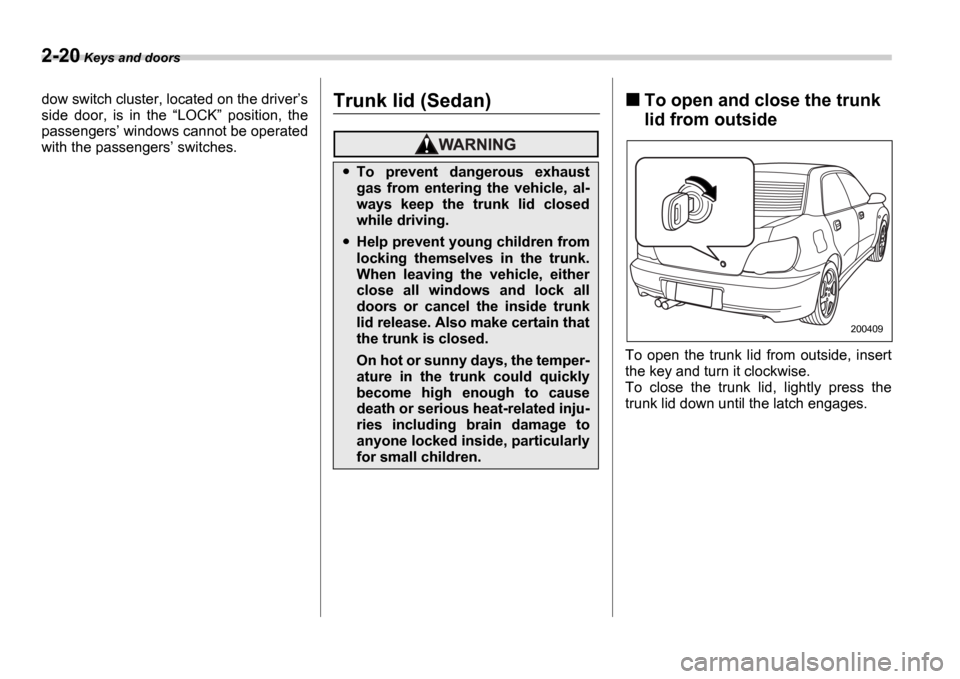
lid from outside
To open the trunk lid from outside, insert
the key and turn it clockwise.
To close the trunk lid, lightly press the
trunk lid down until the latch engages.
To prevent dangerous exhaust
gas from entering the vehicle, al-
ways keep the trunk lid closed
while driving.
Help prevent young children from
locking themselves in the trunk.
When leaving the vehicle, either
close all windows and lock all
doors or cancel the inside trunk
lid release. Also make certain that
the trunk is closed.
On hot or sunny days, the temper-
ature in the trunk could quickly
become high enough to cause
death or serious heat-related inju-
ries including brain damage to
anyone locked inside, particularly
for small children.
200409
Page 108 of 365
Keys and doors 2-21
CONTINUED
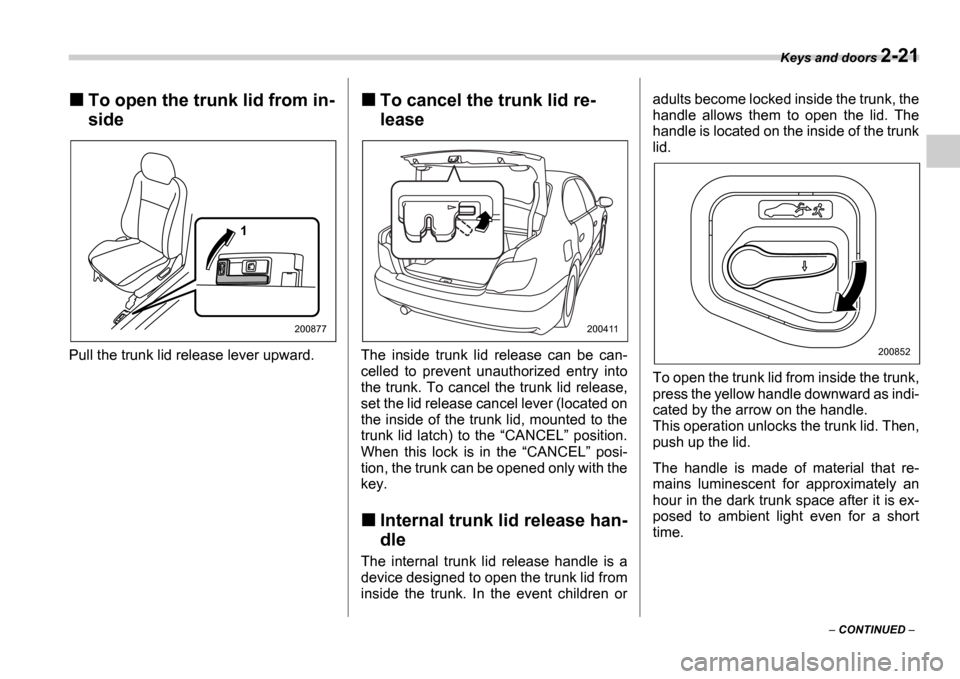
To open the trunk lid from in-
side
Pull the trunk lid release lever upward.
To cancel the trunk lid re-
lease
The inside trunk lid release can be can-
celled to prevent unauthorized entry into
the trunk. To cancel the trunk lid release,
set the lid release cancel lever (located on
the inside of the trunk lid, mounted to the
trunk lid latch) to the CANCEL position.
When this lock is in the CANCEL posi-
tion, the trunk can be opened only with the
key.
Internal trunk lid release han-
dle
The internal trunk lid release handle is a
device designed to open the trunk lid from
inside the trunk. In the event children or adults become locked inside the trunk, the
handle allows them to open the lid. The
handle is located on the inside of the trunk
lid.
To open the trunk lid from inside the trunk,
press the yellow handle downward as indi-
cated by the arrow on the handle.
This operation unlocks the trunk lid. Then,
push up the lid.
The handle is made of material that re-
mains luminescent for approximately an
hour in the dark trunk space after it is ex-
posed to ambient light even for a short
time.
1
200877200411
200852
Page 109 of 365

2-22 Keys and doors
Inspection
Perform the following steps at least twice
a year to check the release handle for cor-
rect operation.
1. Open the trunk lid.
2. Use a screwdriver with a thin blade.
Slide the screwdriver blade from the slit
aperture of the lock assembly fully to the
end until you hear a click. This places the latch in the locked posi-
tion.
3. Move the release handle, from outside
the vehicle, in the direction of the arrow to
check if the latch is released.
If the latch is not released, contact your
Never allow any child to get in the
trunk and play with the release han-
dle. If the driver starts the vehicle
without knowing that a child is in-
side the trunk and the child opens
the lid using the release handle, the
child could fall out and be killed or
seriously injured.
Do not close the lid while gripping
the release handle. The handle
may be damaged.
Do not use the handle as a hook to
fasten straps or ropes to secure
your cargo in the trunk. Such use
may result in damage of the han-
dle.
Load the trunk so that cargo can
not strike the release handle. If the
cargo hits the handle while the ve-
hicle is being driven, the handle
may be pushed down and the
trunk lid may open. That may
cause cargo to fall out of the
trunk, which could create a traffic
safety hazard.
200878
200879
200880
Page 110 of 365

Keys and doors 2-23
CONTINUED
SUBARU dealer.
In that case, use the key to release the
latch, then close the trunk lid.
Also, if the movement of the release han-
dle feels restricted or not entirely smooth
during operation, or the handle and/or
handle base is cracked, contact your
SUBARU dealer.
Rear gate (Wagon)
The rear gate can be locked and unlocked
using either the keyless entry system or
the power door locking switches.
Refer to the
Power door locking switches
and Remote keyless entry system sec-
tions in this chapter.
To open the rear gate, first unlock the rear
gate lock then pull the outside handle up.
Then, hold the rear gate and raise it as
high as it will go. To close the rear gate, lower it slowly and
push down firmly until the latch engages.
The rear gate can be lowered easily if you
pull down on the recessed grip.
200412
To prevent dangerous exhaust
gas from entering the vehicle, al-
ways keep the rear gate closed
while driving.
Do not attempt to shut the rear
gate while holding the recessed
grip. Also avoid closing the rear
gate by pulling on the recessed
grip from inside the cargo space.
There is a danger of your hand be-
ing caught and injured.
200413
Page 144 of 365
Instruments and controls 3-31
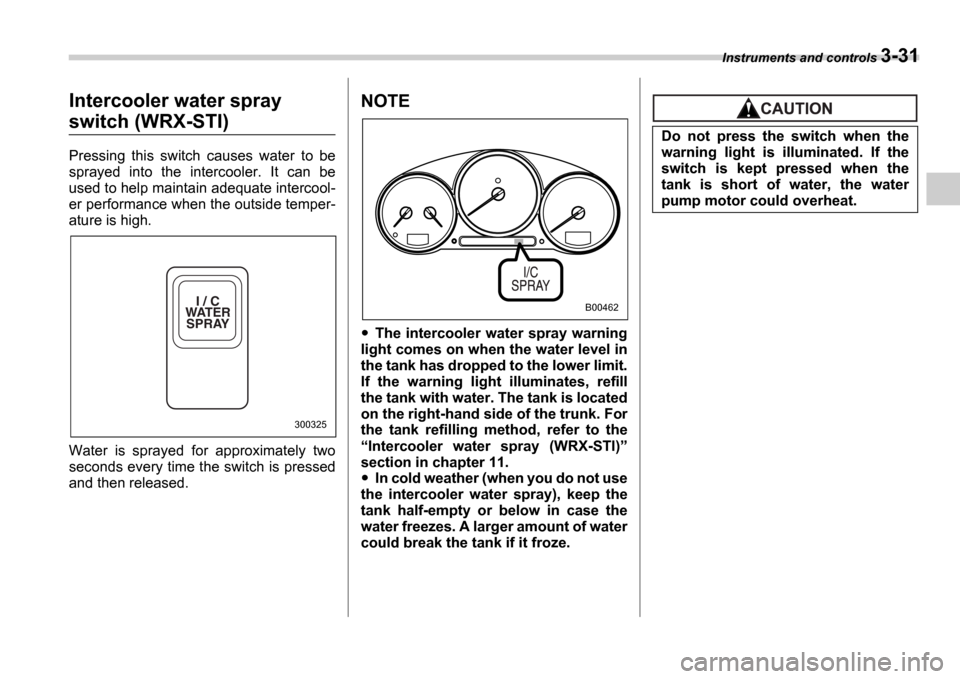
Intercooler water spray
switch (WRX-STI)
Pressing this switch causes water to be
sprayed into the intercooler. It can be
used to help maintain adequate intercool-
er performance when the outside temper-
ature is high.
Water is sprayed for approximately two
seconds every time the switch is pressed
and then released.
NOTE
The intercooler water spray warning
light comes on when the water level in
the tank has dropped to the lower limit.
If the warning light illuminates, refill
the tank with water. The tank is located
on the right-hand side of the trunk. For
the tank refilling method, refer to the Intercooler water spray (WRX-STI)
section in chapter 11.
In cold weather (when you do not use
the intercooler water spray), keep the
tank half-empty or below in case the
water freezes. A larger amount of water
could break the tank if it froze.
300325
B00462
Do not press the switch when the
warning light is illuminated. If the
switch is kept pressed when the
tank is short of water, the water
pump motor could overheat.
Page 203 of 365
7-6 Starting and operating
The EPA has issued regulations for in-
specting the On-Board Diagnostic (OBD)
system as part of the state emissions in-
spection. The OBD system is designed to
detect engine and transmission problems
that might cause vehicle emissions to ex-
ceed allowable limits. These inspections
apply to all 1996 model year and newer
passenger cars and light trucks. Over 30
states plus the District of Columbia have
implemented the OBD system inspection.
The inspection of the OBD system con-
sists of a visual operational check of the CHECK ENGINE warning light/malfunc-
tion indicator lamp (MIL) and an examina-
tion of the OBD system with an electronic
scan tool while the engine is running.
A vehicle passes the OBD system in-
spection if proper the CHECK ENGINE
warning light/MIL illumination is observed,
there is no stored diagnostic trouble
codes, and the OBD system readiness
monitors are complete.
A vehicle fails the OBD inspection if the
CHECK ENGINE warning light/MIL is
not properly operating or there is one or
more diagnostic trouble codes stored in
vehicle s computer with the CHECK EN-
GINE warning light/MIL illuminated.
A state emission inspection may reject
(not pass or fail) a vehicle if the number of
OBD system readiness monitors Not
Ready is greater than one. Under this
condition, the vehicle operator should be
instructed to drive his/her vehicle for a few
days to set the monitors and return for an
emission re-inspection.
Owners of rejected or failing vehicles
should contact their Subaru Dealer for
service.
Preparing to drive
You should perform the following checks
and adjustments every day before you
start driving.
1. Check that all windows, mirrors, and
lights are clean and unobstructed.
2. Check the appearance and condition of
the tires. Also check tires for proper infla-
tion.
3. Look under the vehicle for any sign of
leaks.
4. Check that the hood, trunk (Sedan)
and rear gate (Wagon) are fully closed.
5. Check the adjustment of the seat.
6. Check the adjustment of the inside and
outside mirrors.
7. Fasten your seatbelt. Check that your
passengers have fastened their seatbelts.
8. Check the operation of the warning and
indicator lights when the ignition switch is
turned to the ON position.
9. Check the gauges, indicator and warn-
ing lights after starting the engine.
NOTE
Engine oil, engine coolant, brake fluid,
washer fluid and other fluid levels
should be checked daily, weekly or at
fuel stops.
Resultant vehicle damage due to im-
proper testing is not covered under
the SUBARU Limited Warranty and
is the responsibility of the state in-
spection program or its contractors
or licensees.
Page 230 of 365
Driving tips 8-3
CONTINUED
NOTE
Due to the expansion and contraction
of the metals used in the manufacture
of the exhaust system, you may hear a
crackling sound coming from the ex-
haust system for a short time after the
engine has been shut off. This sound is
normal.
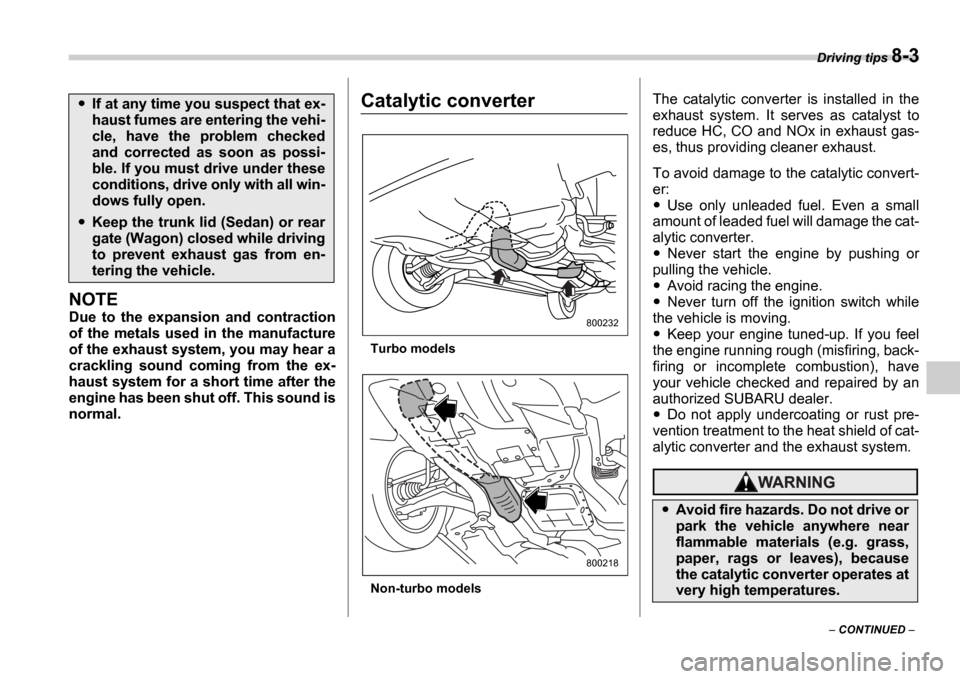
Catalytic converter
Turbo models
Non-turbo modelsThe catalytic converter is installed in the
exhaust system. It serves as catalyst to
reduce HC, CO and NOx in exhaust gas-
es, thus providing cleaner exhaust.
To avoid damage to the catalytic convert-
er:
Use only unleaded fuel. Even a small
amount of leaded fuel will damage the cat-
alytic converter.
Never start the engine by pushing or
pulling the vehicle.
Avoid racing the engine.
Never turn off the ignition switch while
the vehicle is moving.
Keep your engine tuned-up. If you feel
the engine running rough (misfiring, back-
firing or incomplete combustion), have
your vehicle checked and repaired by an
authorized SUBARU dealer.
Do not apply undercoating or rust pre-
vention treatment to the heat shield of cat-
alytic converter and the exhaust system.
If at any time you suspect that ex-
haust fumes are entering the vehi-
cle, have the problem checked
and corrected as soon as possi-
ble. If you must drive under these
conditions, drive only with all win-
dows fully open.
Keep the trunk lid (Sedan) or rear
gate (Wagon) closed while driving
to prevent exhaust gas from en-
tering the vehicle.
800232
800218
Avoid fire hazards. Do not drive or
park the vehicle anywhere near
flammable materials (e.g. grass,
paper, rags or leaves), because
the catalytic converter operates at
very high temperatures.
Page 239 of 365
8-12 Driving tips
pension.
When driving with tire chains, drive at
speeds below 19 mph (30 km/h).
When a temporary spare tire is on a front
wheel, replace the temporary spare tire
with the rear tire on the same side of the
vehicle, and then fit chains on the front
tires.
Always use the utmost care when driving
with tire chains overconfidence be-
cause you are driving with tire chains
could easily lead to a serious accident.
Rocking the vehicle
If you must rock the vehicle to free it from
snow, sand, or mud, depress the acceler-
ator pedal slightly and move the selector
lever back and forth between D and R
repeatedly. Do not race the engine. For
the best possible traction, avoid spinning
the wheels when trying to free the vehicle. When the road surface is extremely slip-
pery, you can obtain better traction by
starting the vehicle with the transmission
in 2nd than 1st (both for MT and AT).
Refer to the
Automatic transmission sec-
tion in chapter 7 for information on holding
the transmission in 2nd position.
Loading your vehicle
Tire chains cannot be used on tires
listed in the following because of
lack of clearance between the tires
and vehicle body.
225/45R17 tires for WRX-STI
215/45R17 tires for WRX
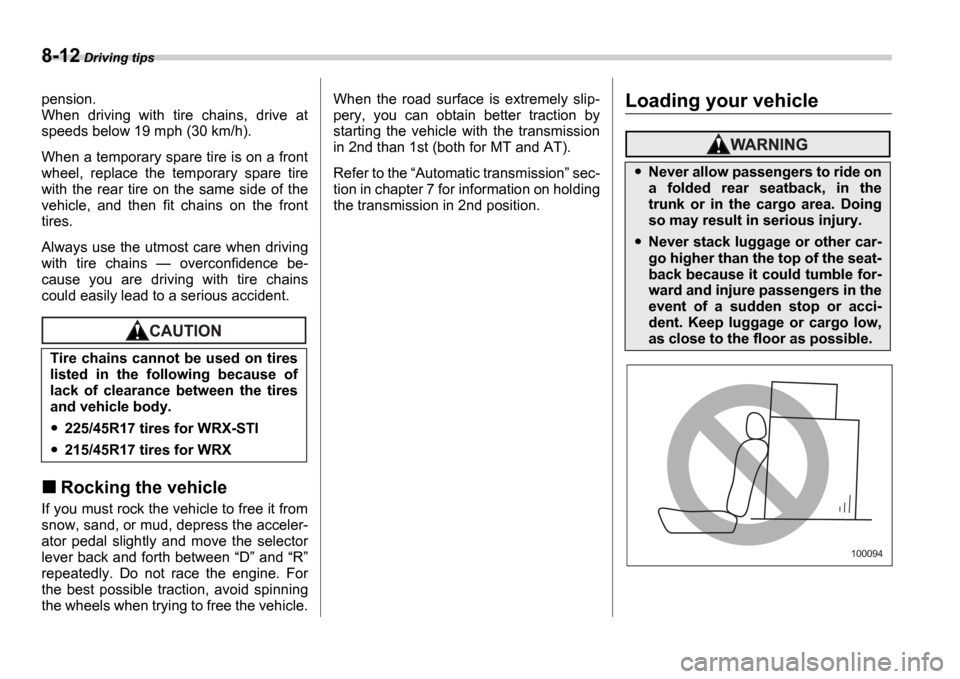
Never allow passengers to ride on
a folded rear seatback, in the
trunk or in the cargo area. Doing
so may result in serious injury.
Never stack luggage or other car-
go higher than the top of the seat-
back because it could tumble for-
ward and injure passengers in the
event of a sudden stop or acci-
dent. Keep luggage or cargo low,
as close to the floor as possible.
100094
Page 260 of 365
In case of emergency 9-5
CONTINUED
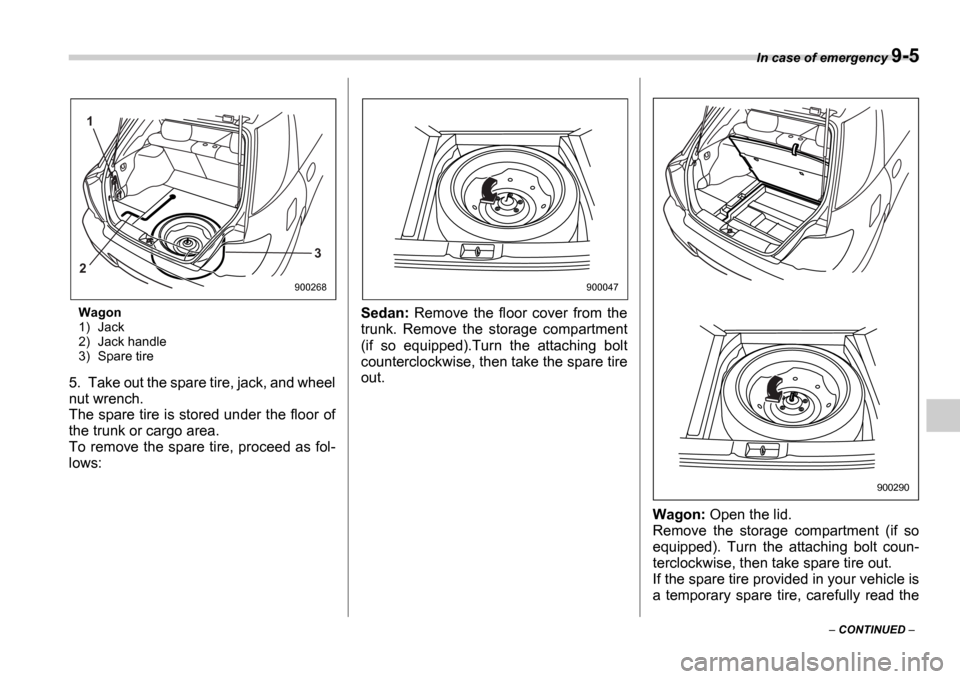
Wagon
1) Jack
2) Jack handle
3) Spare tire
5. Take out the spare tire, jack, and wheel
nut wrench.
The spare tire is stored under the floor of
the trunk or cargo area.
To remove the spare tire, proceed as fol-
lows: Sedan:
Remove the floor cover from the
trunk. Remove the storage compartment
(if so equipped).Turn the attaching bolt
counterclockwise, then take the spare tire
out.
Wagon: Open the lid.
Remove the storage compartment (if so
equipped). Turn the attaching bolt coun-
terclockwise, then take spare tire out.
If the spare tire provided in your vehicle is
a temporary spare tire, carefully read the
3
1
2
900268900047
900290