engine overheat SUBARU IMPREZA 2011 4.G User Guide
[x] Cancel search | Manufacturer: SUBARU, Model Year: 2011, Model line: IMPREZA, Model: SUBARU IMPREZA 2011 4.GPages: 458, PDF Size: 16.22 MB
Page 293 of 458
7-30Starting and operating
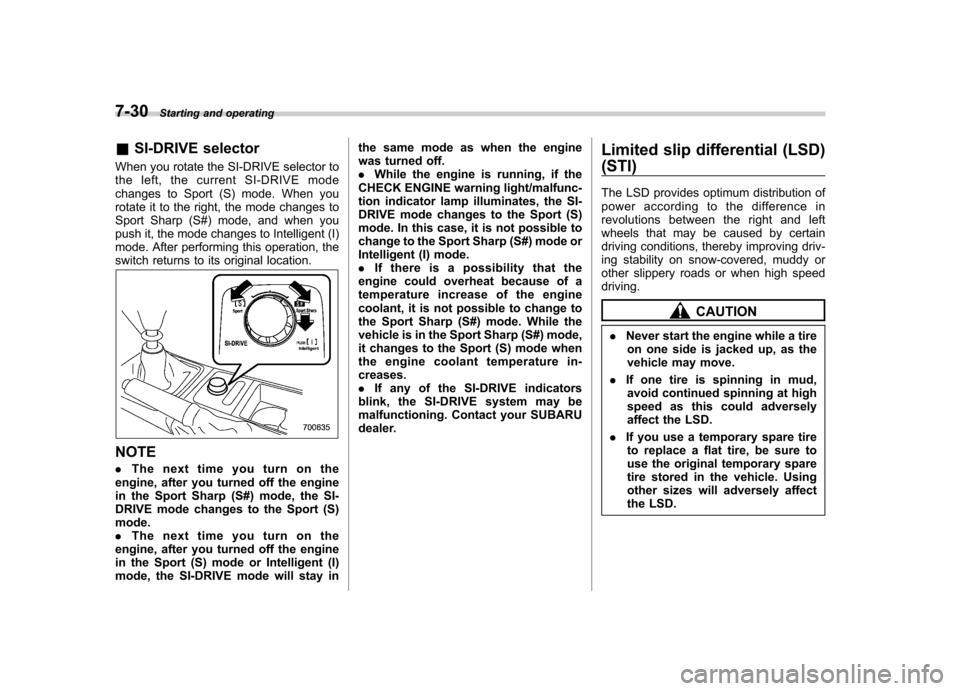
&SI-DRIVE selector
When you rotate the SI-DRIVE selector to
the left, the current SI-DRIVE mode
changes to Sport (S) mode. When you
rotate it to the right, the mode changes to
Sport Sharp (S#) mode, and when you
push it, the mode changes to Intelligent (I)
mode. After performing this operation, the
switch returns to its original location.
NOTE . The next time you turn on the
engine, after you turned off the engine
in the Sport Sharp (S#) mode, the SI-
DRIVE mode changes to the Sport (S)mode.. The next time you turn on the
engine, after you turned off the engine
in the Sport (S) mode or Intelligent (I)
mode, the SI-DRIVE mode will stay in the same mode as when the engine
was turned off..
While the engine is running, if the
CHECK ENGINE warning light/malfunc-
tion indicator lamp illuminates, the SI-
DRIVE mode changes to the Sport (S)
mode. In this case, it is not possible to
change to the Sport Sharp (S#) mode or
Intelligent (I) mode.. If there is a possibility that the
engine could overheat because of a
temperature increase of the engine
coolant, it is not possible to change to
the Sport Sharp (S#) mode. While the
vehicle is in the Sport Sharp (S#) mode,
it changes to the Sport (S) mode when
the engine coolant temperature in- creases.. If any of the SI-DRIVE indicators
blink, the SI-DRIVE system may be
malfunctioning. Contact your SUBARU
dealer. Limited slip differential (LSD) (STI)
The LSD provides optimum distribution of
power according to the difference in
revolutions between the right and left
wheels that may be caused by certain
driving conditions, thereby improving driv-
ing stability on snow-covered, muddy or
other slippery roads or when high speeddriving.
CAUTION
. Never start the engine while a tire
on one side is jacked up, as the
vehicle may move.
. If one tire is spinning in mud,
avoid continued spinning at high
speed as this could adversely
affect the LSD.
. If you use a temporary spare tire
to replace a flat tire, be sure to
use the original temporary spare
tire stored in the vehicle. Using
other sizes will adversely affect
the LSD.
Page 294 of 458
Power steering
The power steering system operates only
when the engine is running.
If you lose power steering assist because
the engine stops or the system fails to
function, you can steer but it will take
much more effort.
CAUTION
Do not hold the steering wheel at the
fully locked position left or right for
more than 5 seconds. This may
damage the power steering pump.
NOTE
Right after the engine has been started
and before it has warmed up, you may
hear a noise coming from areas adja-
cent to the power steering pump which
is located at the right-front area of the
engine compartment. This noise is
normal. It does not indicate power
steering system trouble. Braking &
Braking tips
WARNING
Never rest your foot on the brake
pedal while driving. This can cause
dangerous overheating of the
brakes and needless wear on the
brake pads and linings.
! When the brakes get wet
When driving in rain or after washing the
vehicle, the brakes may get wet. As a
result, brake stopping distance will be
longer. To dry the brakes, drive the vehicle
at a safe speed while lightly depressing
the brake pedal to heat up the brakes. ! Use of engine braking
Remember to make use of engine braking
in addition to foot braking. When descend-
ing a grade, if only the foot brake is used,
the brakes may start working improperly
because of brake fluid overheating,
caused by overheated brake pads. To
help prevent this, shift into a lower gear to
get stronger engine braking. ! Braking when a tire is punctured
Do not depress the brake pedal suddenly
when a tire is punctured. This could cause a loss of control of the vehicle. Keep
driving straight ahead while gradually
reducing speed. Then slowly pull off the
road to a safe place. &
Brake system
! Two separate circuits
Your vehicle has two separate circuit
brake systems. Each circuit works diag-
onally across the vehicle. If one circuit of
the brake system should fail, the other half
of the system still works. If one circuit fails,
the brake pedal will go down much closer
to the floor than usual and you will need to
press it down much harder. And a much
longer distance will be needed to stop thevehicle. ! Brake booster
The brake booster uses engine manifold
vacuum to assist braking force. Do not
turn off the engine while driving because
that will turn off the brake booster, result-
ing in poor braking power.
The brakes will continue to work even
when the brake booster completely stops
functioning. If this happens, however, you
will have to depress the pedal much
harder than normal and the braking dis-
tance will increase. Starting and operating
7-31
– CONTINUED –
Page 328 of 458
If you park your vehicle in case of anemergency ........................................................ 9-2
Temporary spare tire ........................................... 9-2
Precautions for AWD models with automatic transmission ..................................................... 9-3
Maintenance tools ............................................... 9-4
Tool bag. ............................................................. 9-4
Under the rear floor ............................................. 9-5
Flat tires ............................................................... 9-6
Changing a flat tire .............................................. 9-6
Tire pressure monitoring system (TPMS) (U.S.-spec. models) .......................................... 9-10
Jump starting ..................................................... 9-11
How to jump start ............................................... 9-11 Engine overheating
........................................... 9-13
If steam is coming from the engine compartment ................................................... 9-13
If no steam is coming from the engine compartment ................................................... 9-13
Towing ................................................................ 9-14
Towing and tie-down hooks. ............................... 9-14
Using a flat-bed truck. ........................................ 9-17
Towing with all wheels on the ground ................. 9-17
Rear gate –if the rear gate cannot be
unlocked .......................................................... 9-18
Moonroof –if moonroof cannot be closed ...... 9-19
In case of emergency
9
Page 340 of 458
Engine overheating
WARNING
Never attempt to remove the radia-
tor cap until the engine has been
shut off and has fully cooled down.
When the engine is hot, the coolant
is under pressure. Removing the
cap while the engine is still hot
could release a spray of boiling hot
coolant, which could burn you very
seriously.
If the engine overheats, safely pull off the
road and stop the vehicle in a safe place. & If steam is coming from the
engine compartment
Turn off the engine and get everyone
away from the vehicle until it cools down. & If no steam is coming from
the engine compartment
NOTE
For details about how to check the
coolant level or how to add coolant,
refer to “Engine coolant ”F 11-14.
1. Keep the engine running at idlingspeed. 2. Open the hood to ventilate the engine
compartment. Refer to
“Engine hood ”
F 11-5.
Confirm that the cooling fan is turning. If
the fan is not turning, immediately turn off
the engine and contact your authorized
dealer for repair.
3. After the engine coolant temperature
has dropped, turn off the engine.
If any of the following conditions occur,
turn off the engine. .The temperature gauge stays in the
overheated zone (turbo models). Referto “Temperature gauge (turbo models) ”
F 3-11.
. The coolant temperature high warn-
ing light remains illuminated (non-
turbo models). Refer to “Coolant tem-
perature low indicator light (non-turbo
models)/Coolant temperature high
warning light (non-turbo models) ”F 3-
17.
4. After the engine has fully cooled down,
check the coolant level in the reservetank.
If the coolant level is below the “LOW ”
mark, add coolant up to the “FULL ”mark.
5. If there is no coolant in the reserve
tank, add coolant to the reserve tank.
Then remove the radiator cap and fill the
radiator with coolant. If you remove the radiator cap from a hot
radiator, first wrap a thick cloth around the
radiator cap, then turn the cap counter-
clockwise slowly without pressing down
until it stops. Release the pressure from
the radiator. After the pressure has been
fully released, remove the cap by pressing
down and turning it.
In case of emergency
9-13
Page 452 of 458

LightBack-up (4-door) ................................................... 11-51
Back-up (5-door) ................................................... 11-52
Brake/Tail and rear side marker (4-door) .................. 11-51
Cargo area .............................................................. 6-2
Control switch ........................................................ 3-31
Dome ..................................................................... 6-2
Front fog ...................................................... 3-36, 11-50
Front position ........................................................ 3-32
High mount stop ................................................... 11-55
Ignition switch .......................................................... 3-5
License plate ........................................................ 11-53
Map ............................................................. 6-3, 11-53
Rear combination .................................................. 11-51
Trunk ................................................................... 11-55
Turn signal ......................................... 3-33, 11-50, 11-51
Limited slip differential (LSD) ....................................... 7-30
Loading your vehicle .................................................. 8-12
Low fuel warning light ......................................... 3-10, 3-22
Low tire pressure warning light .................................... 3-19
Lower and tether anchorage ........................................ 1-29
LSD (Limited slip differential) ....................................... 7-30
M
Main fuse ................................................................. 11-46
Maintenance
Precautions ........................................................... 11-3
Schedule .............................................................. 11-3
Seatbelt ................................................................ 1-19
Tools ...................................................................... 9-4 Malfunction indicator lamp (check engine warning
light) ...................................................................... 3-16
Manual
Climate control system ............................................. 4-3
Transmission oil ........................................... 11-21, 12-8
Transmission-5 speeds ........................................... 7-17
Transmission-6 speeds ........................................... 7-15
Map light ........................................................... 6-3, 11-53
Meters and gauges ...................................................... 3-6
Mirror defogger .......................................................... 3-48
Mirrors ...................................................................... 3-40
Moonroof ........................................................... 2-29, 9-19
N
New vehicle break-in driving ......................................... 8-2
O
Odometer/Trip meter .................................................... 3-8
Off road driving ........................................................... 8-6
Oil filter ................................................................... 11-11
Oil level
Engine ................................................................ 11-10
Front differential gear ............................................ 11-23
Manual transmission ............................................. 11-21
Rear differential gear ............................................ 11-24
Oil pressure warning light ............................................ 3-18
Outside Mirror defogger ...................................................... 3-48
Mirrors .................................................................. 3-47
Temperature indicator .............................................. 3-29
Overheating engine .................................................... 9-13 Index
14-7