fuel cap SUBARU IMPREZA 2011 4.G User Guide
[x] Cancel search | Manufacturer: SUBARU, Model Year: 2011, Model line: IMPREZA, Model: SUBARU IMPREZA 2011 4.GPages: 458, PDF Size: 16.22 MB
Page 324 of 458
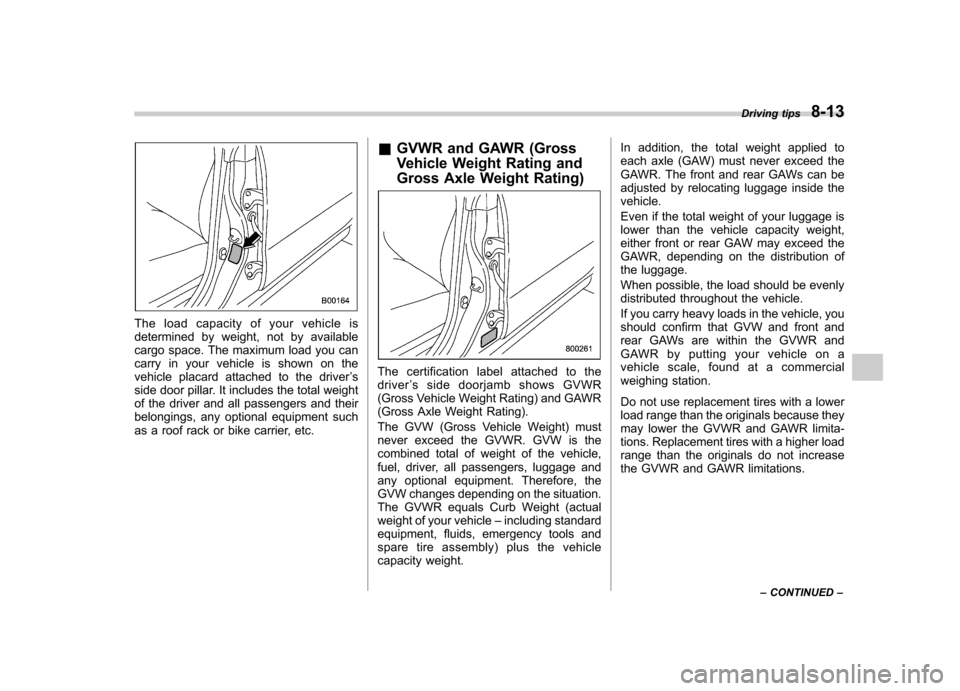
The load capacity of your vehicle is
determined by weight, not by available
cargo space. The maximum load you can
carry in your vehicle is shown on the
vehicle placard attached to the driver’s
side door pillar. It includes the total weight
of the driver and all passengers and their
belongings, any optional equipment such
as a roof rack or bike carrier, etc. &
GVWR and GAWR (Gross
Vehicle Weight Rating and
Gross Axle Weight Rating)
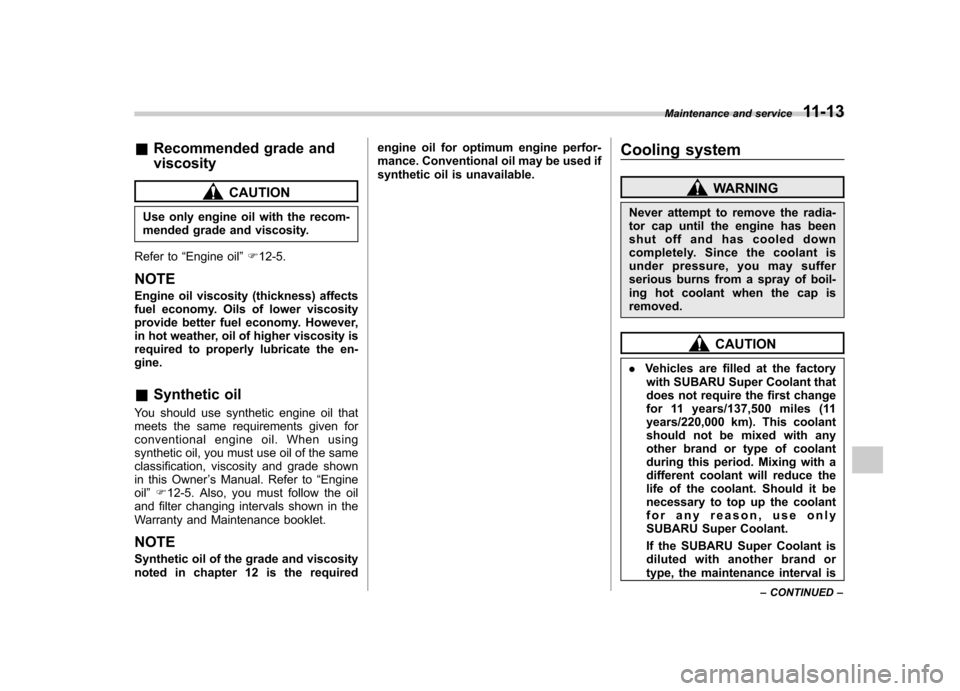
The certification label attached to the
driver ’s side doorjamb shows GVWR
(Gross Vehicle Weight Rating) and GAWR
(Gross Axle Weight Rating).
The GVW (Gross Vehicle Weight) must
never exceed the GVWR. GVW is the
combined total of weight of the vehicle,
fuel, driver, all passengers, luggage and
any optional equipment. Therefore, the
GVW changes depending on the situation.
The GVWR equals Curb Weight (actual
weight of your vehicle –including standard
equipment, fluids, emergency tools and
spare tire assembly) plus the vehicle
capacity weight. In addition, the total weight applied to
each axle (GAW) must never exceed the
GAWR. The front and rear GAWs can be
adjusted by relocating luggage inside thevehicle.
Even if the total weight of your luggage is
lower than the vehicle capacity weight,
either front or rear GAW may exceed the
GAWR, depending on the distribution of
the luggage.
When possible, the load should be evenly
distributed throughout the vehicle.
If you carry heavy loads in the vehicle, you
should confirm that GVW and front and
rear GAWs are within the GVWR and
GAWR by putting your vehicle on a
vehicle scale, found at a commercial
weighing station.
Do not use replacement tires with a lower
load range than the originals because they
may lower the GVWR and GAWR limita-
tions. Replacement tires with a higher load
range than the originals do not increase
the GVWR and GAWR limitations.
Driving tips
8-13
– CONTINUED –
Page 366 of 458
&Recommended grade and viscosity
CAUTION
Use only engine oil with the recom-
mended grade and viscosity.
Refer to “Engine oil ”F 12-5.
NOTE
Engine oil viscosity (thickness) affects
fuel economy. Oils of lower viscosity
provide better fuel economy. However,
in hot weather, oil of higher viscosity is
required to properly lubricate the en-gine. & Synthetic oil
You should use synthetic engine oil that
meets the same requirements given for
conventional engine oil. When using
synthetic oil, you must use oil of the same
classification, viscosity and grade shown
in this Owner ’s Manual. Refer to “Engine
oil ”F 12-5. Also, you must follow the oil
and filter changing intervals shown in the
Warranty and Maintenance booklet. NOTE
Synthetic oil of the grade and viscosity
noted in chapter 12 is the required engine oil for optimum engine perfor-
mance. Conventional oil may be used if
synthetic oil is unavailable.
Cooling systemWARNING
Never attempt to remove the radia-
tor cap until the engine has been
shut off and has cooled down
completely. Since the coolant is
under pressure, you may suffer
serious burns from a spray of boil-
ing hot coolant when the cap isremoved.
CAUTION
. Vehicles are filled at the factory
with SUBARU Super Coolant that
does not require the first change
for 11 years/137,500 miles (11
years/220,000 km). This coolant
should not be mixed with any
other brand or type of coolant
during this period. Mixing with a
different coolant will reduce the
life of the coolant. Should it be
necessary to top up the coolant
for any reason, use only
SUBARU Super Coolant.
If the SUBARU Super Coolant is
diluted with another brand or
type, the maintenance interval is Maintenance and service
11-13
– CONTINUED –
Page 367 of 458
11-14Maintenance and service
shortened to that of the mixing coolant.
. Do not splash the engine coolant
over painted parts. The alcohol
contained in the engine coolant
may damage the paint surface.
& Cooling fan, hose and con- nections
Your vehicle employs an electric cooling
fan which is thermostatically controlled to
operate when the engine coolant reaches
a specific temperature.
If the radiator cooling fan does not operate
even when the following conditions occur,
the cooling fan circuit may be defective. . For turbo models, the engine coolant
temperature gauge exceeds the normal
operating range. Refer to “Temperature
gauge (turbo models) ”F 3-11.
. For non-turbo models, the coolant
temperature high warning light blinks or
illuminates in RED. Refer to “Coolant
temperature low indicator light (non-turbo
models)/Coolant temperature high warn-
ing light (non-turbo models) ”F 3-17.
Check the fuse and replace it if necessary.
Refer to “Fuses ”F 11-45 and “Fuse panel
located in the engine compartment ”F 12-
14. If the fuse is not blown, have the cooling
system checked by your SUBARU dealer.
If frequent addition of coolant is neces-
sary, there may be a leak in the engine
cooling system. It is recommended that
the cooling system and connections be
checked for leaks, damage, or looseness.
& Engine coolant
! Checking the coolant level
WARNING
Never attempt to remove the radia-
tor cap until the engine has been
shut off and has cooled down
completely. Since the coolant is
under pressure, you may suffer
serious burns from a spray of boil-
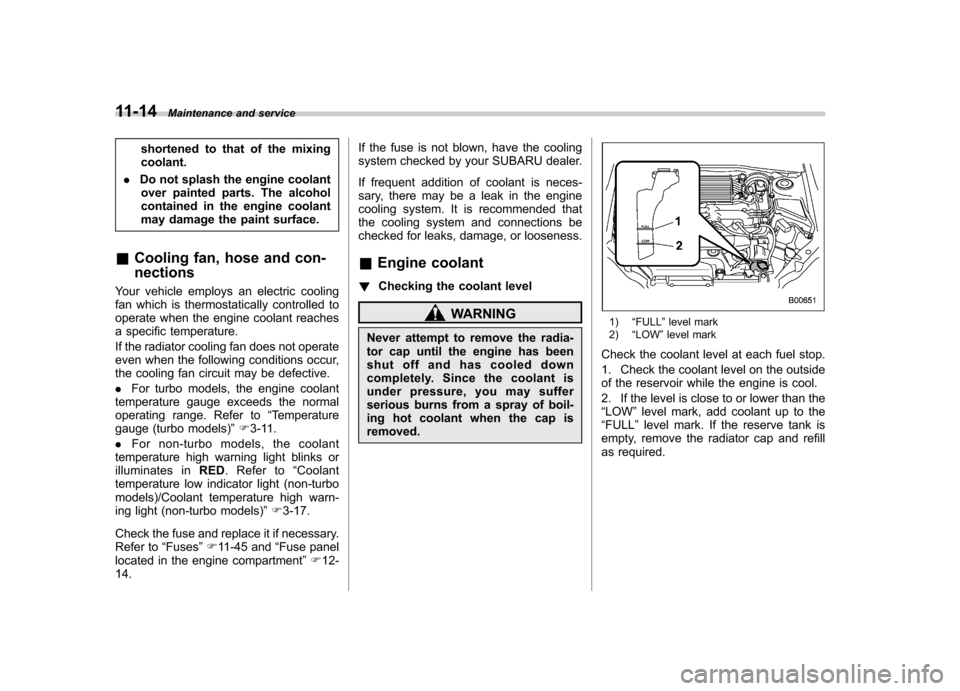
ing hot coolant when the cap isremoved.1) “FULL ”level mark
2) “LOW ”level mark
Check the coolant level at each fuel stop.
1. Check the coolant level on the outside
of the reservoir while the engine is cool.
2. If the level is close to or lower than the “ LOW ”level mark, add coolant up to the
“ FULL ”level mark. If the reserve tank is
empty, remove the radiator cap and refill
as required.
Page 413 of 458

12-4Specifications
&Fuel
NOTE
The engine is designed to operate using unleaded gasoline.
Model Fuel requirement Fuel tank capacities
Non-turbo 87 AKI (90 RON) or higher
16.9 US gal (64 liters, 14.1 Imp gal)
Turbo Except STI 91 AKI (95 RON) or higher*
1
STI
93 AKI (98 RON) or higher*2
*1: If unleaded gasoline with an octane rating of 91 AKI (95 RON) is not available, unleaded gasoline with an octane rating of 87 AKI (90 RON) or higher
may be temporarily used. For details, refer to
“Fuel ”F 7-3.
*2: If unleaded gasoline with an octane rating of 93 AKI (98 RON) is not available, unleaded gasoline with an octane rating of 91 AKI (95 RON) may be
used with no detriment to engine durability or driveability. For details, refer to “Fuel ”F 7-3.
Page 434 of 458

crease in temperature could cause
tread separation, and failure of the
tire(s). Possible resulting loss of
vehicle control could lead to anaccident. !Measuring and adjusting air
pressure to achieve proper in-
flation
Check and, if necessary, adjust the
pressure of each tire (including the
spare) at least once a month and
before any long journey. Check the
tire pressures when the tires are
cold. Use a pressure gauge to
adjust the tire pressures to the
specific values. Driving even a
short distance warms up the tires
and increases the tire pressures.
Also, the tire pressures are affected
by the outside temperature. It is
best to check tire pressure out-
doors before driving the vehicle.
When a tire becomes warm, the air
inside it expands, causing the tire
pressure to increase. Be careful not
to mistakenly release air from a
warm tire to reduce its pressure. &
Glossary of tire terminology
. Accessory weight
The combined weight (in excess of
those standard items which may be
replaced) of automatic transmis-
sion, power steering, power brakes,
power windows, power seats, radio,
and heater, to the extent that these
items are available as factory-in-
stalled equipment (whether in-
stalled or not). . Bead
The part of the tire that is made of
steel wires, wrapped or reinforced
by ply cords and that is shaped to fit
the rim.. Bead separation
A breakdown of the bond between
components in the bead.. Bias ply tire
A pneumatic tire in which the ply
cords that extend to the beads are
laid at alternate angles substantially
less than 90 degrees to the center-
line of the tread. . Carcass
The tire structure, except tread and sidewall rubber which, when in-
flated, bears the load. .
Chunking
The breaking away of pieces of the
tread or sidewall.. Cold tire pressure
The pressure in a tire that has been
driven less than 1 mile or has been
standing for three hours or more.. Cord
The strands forming the plies in the tire. . Cord separation
The parting of cords from adjacent
rubber compounds.. Cracking
Any parting within the tread, side-
wall, or inner liner of the tire
extending to cord material. . Curb weight
The weight of a motor vehicle with
standard equipment including the
maximum capacity of fuel, oil and
coolant, and if so equipped, air
conditioning and additional weight
optional engine.
Consumer information and Reporting safety defects
13-5
– CONTINUED –
Page 450 of 458

Exhaust gas (carbon monoxide)............................. 6, 8-2
Hood .................................................................... 11-5
Oil............................................................... 11-10, 12-5 Overheating .......................................................... 9-13
Starting ................................................................... 7-9
Stopping ............................................................... 7-10
Exterior care .............................................................. 10-2
F
Flat tires ..................................................................... 9-6
Floor mat .................................................................. 6-11
Fluid level Automatic transmission .......................................... 11-22
Brake .................................................................. 11-25
Clutch .................................................................. 11-26
Power steering ..................................................... 11-24
Fog light
Bulb .................................................................... 11-50
Indicator light ......................................................... 3-27
Switch .................................................................. 3-36
Folding mirror switch .................................................. 3-48
Front Differential gear oil ........................................ 11-23, 12-8
Fog light ...................................................... 3-36, 11-50
Fog light indicator light ............................................ 3-27
Seatbelt pretensioners ............................................ 1-19
Turn signal light .................................................... 11-50
Front seats .................................................................. 1-2
Active head restraint ................................................. 1-5
Forward and backward adjustment ............................. 1-3
Head restraint adjustment ......................................... 1-4 Reclining
................................................................ 1-3
Seat cushion height adjustment ... .............................. 1-4
Fuel ........................................................................... 7-3
Consumption indicator ............................................. 3-29
Economy hints ........................................................ 8-2
Filler lid and cap ...................................................... 7-4
Gauge ................................................................... 3-10
Requirements ................................................. 7-3, 12-4
Fuses ..................................................................... 11-45
Main fuse ............................................................ 11-46
Fuses and circuits .................................................... 12-12
G
GAWR (Gross Axle Weight Rating) .. ............................. 8-13
Glove box ................................................................... 6-5
GVWR (Gross Vehicle Weight Rating) ........................... 8-13
H
Hands-free system. ..................................................... 5-46
Hazard warning flasher .......................................... 3-5, 9-2
Head restraint adjustment
Front seat ............................................................... 1-4
Rear seat ............................................................... 1-8
Headlight Beam leveler. ......................................................... 3-34
Bulb replacement ................................................. 11-47
Bulb replacing ...................................................... 11-47
Bulb wattage ........................................................ 12-16
Control switch ........................................................ 3-31
Flasher .................................................................. 3-32
Indicator light ......................................................... 3-27 Index
14-5
Page 458 of 458

GAS STATION REFERENCE
& Fuel:
! Non-turbo models
Use only unleaded gasoline with an octane rating of 87 AKI
(90 RON) or higher .
! Turbo models except STI
Use premium unleaded gasoline with an octane rating of 91
AKI (95 RON) or higher . If premium unleaded gasoline with an
octane rating of 91 AKI (95 RON) is not available, regular
unleaded gasoline with octane rating of 87 AKI (90 RON) or
higher may be temporarily used. For optimum engine perfor-
mance and driveability, it is required that you use premium
grade unleaded gasoline with an octane rating of 91 AKI (95
RON) or higher. ! STI
The engine is designed to operate at maximum performance using unleaded gasoline with an octane rating of 93 AKI (98
RON) or higher . If 93 AKI (98 RON) fuel is not readily available
in your area, unleaded gasoline with an octane rating of 91 AKI
(95 RON) may be used with no detriment to engine durability or
driveability. However, you may notice a slight decrease in
maximum engine performance while using 91 AKI (95 RON)
fuel. Use of 91 AKI (95 RON) fuel will not affect your warrantycoverage. &
Fuel octane rating:
This octane rating is the average of the Research Octane and
Motor Octane numbers and is commonly referred to as the Anti
Knock Index (AKI). Refer to “Fuel octane rating ”F 7-3.
& Fuel capacity:
16.9 US gal (64 liters, 14.1 Imp gal) & Engine oil:
Use SUBARU approved motor oil or equivalent.
For the details, refer to “Engine oil ”F 12-5.
& Engine oil capacity:
4.4 US qt (4.2 liters, 3.7 Imp qt) & Cold tire pressure:
Refer to “Tires ”F 12-11.