airbag off SUBARU IMPREZA 2011 4.G Owners Manual
[x] Cancel search | Manufacturer: SUBARU, Model Year: 2011, Model line: IMPREZA, Model: SUBARU IMPREZA 2011 4.GPages: 458, PDF Size: 16.22 MB
Page 8 of 458
Safety precautions when driving &Seatbelt and SRS airbag
WARNING
. All persons in the vehicle should
fasten their seatbelts BEFORE
the vehicle starts to move. Other-
wise, the possibility of serious
injury becomes greater in the
event of a sudden stop or acci-dent.
. To obtain maximum protection in
the event of an accident, the
driver and all passengers in the
vehicle should always wear seat-
belts when the vehicle is moving.
The SRS (Supplemental Restraint
System) airbag does not do away
with the need to fasten seatbelts.
In combination with the seat-
belts, it offers the best combined
protection in case of a seriousaccident.
Not wearing a seatbelt increases
the chance of severe injury or
death in a crash even when the
vehicle has the SRS airbag. .
The SRS airbags deploy with
considerable speed and force.
Occupants who are out of proper
position when the SRS airbag
deploys could suffer very serious
injuries. Because the SRS airbag
needs enough space for deploy-
ment, the driver should always
sit upright and well back in the
seat as far from the steering
wheel as practical while still
maintaining full vehicle control
and the front passenger should
move the seat as far back as
possible and sit upright and well
back in the seat.
For instructions and precautions, carefully
read the following sections. . For the seatbelt system, refer to “Seat-
belts ”F 1-11.
. For the SRS airbag system, refer to
“ *SRS airbag (Supplemental Restraint
System airbag) ”F 1-35. &
Child safety
WARNING
. Never hold a child on your lap or
in your arms while the vehicle is
moving. The passenger cannot
protect the child from injury in a
collision, because the child will
be caught between the passen-
ger and objects inside the vehi-cle.
. While riding in the vehicle, in-
fants and small children should
always be placed in the REAR
seat in an infant or child restraint
system which is appropriate for
the child ’s age, height and
weight. If a child is too big for a
child restraint system, the child
should sit in the REAR seat and
be restrained using the seatbelts.
According to accident statistics,
children are safer when properly
restrained in the rear seating
positions than in the front seat-
ing positions. Never allow a child
to stand up or kneel on the seat.
. Put children aged 12 and under in
the REAR seat properly re-
strained at all times in a child
restraint device or in a seatbelt. 5
– CONTINUED –
Page 19 of 458

16 &Instrument panel
1) Door locks (page 2-4)
2) Outside mirror switch (page 3-47)
3) Illumination brightness control
(page 3-33)
4) Headlight beam leveler (page 3-34)
5) Light control switch (page 3-31)
6) Combination meter (page 3-6)
7) Wiper control lever (page 3-36)
8) Hazard warning flasher switch (page 3-5)
9) Audio (page 5-1)
10) Shift lever (MT) (page 7-15/page 7-17)/ Select lever (AT) (page 7-22)
11) Climate control (page 4-1)
12) Cruise control (page 7-44)
13) Horn (page 3-51)
14) SRS airbag (page 1-35)
15) Tilt/telescopic steering (page 3-50)
16) Hands-free switches (page 5-46)
17) Audio control buttons (page 5-42)
18) Fuse box (page 11-45)
19) Vehicle Dynamics Control OFF switch (page 7-37)/Vehicle Dynamics Control
mode switch (page 7-36)
20) Hood lock release knob (page 11-5)
21) Power windows (page 2-21)
Page 27 of 458

24
&Warning and indicator lights
Mark Name Page
Seatbelt warning light 3-14
Front passenger ’s
seatbelt warning light 3-14
SRS airbag system
warning light3-15
/Front passenger
’s
frontal airbag ON indi- cator 3-16
/Front passenger
’s
frontal airbag OFF in- dicator 3-16
CHECK ENGINE
warning light/Malfunc-
tion indicator lamp3-16
Coolant temperature
low indicator light
(non-turbo models)/
Coolant temperature
high warning light
(non-turbo models)3-17
Charge warning light 3-18
Oil pressure warning light
3-18Mark Name Page
AT OIL TEMP warning
light (AT models)
3-18
Rear differential oil
temperature warning
light (STI)3-19
ABS warning light 3-21
Brake system warning light
3-21
Door open warning light3-23
AWD warning light
(AT models)3-23
Hill start assist warn-
ing light (if equipped)/
Hill start assist OFF
indicator light (STI)3-22
Vehicle Dynamics
Control operation indi-
cator light
3-23
Vehicle Dynamics
Control warning light/
Vehicle Dynamics
Control OFF indicator
light/Traction Control
OFF indicator light (STI)3-23
Turn signal indicator lights
3-26Mark Name Page
High beam indicator light
3-26
Front fog light indicator
light (if equipped)3-27
Security indicator light 3-25
Headlight indicator
light (if equipped)
3-27
Cruise control indica-
tor light
3-26
Cruise control set in-
dicator light3-27
Low fuel warning light 3-22
Low tire pressure
warning light
(U.S.-spec. models)3-19
SPORT mode indica-
tor light (AT models)
3-25
Shift-up indicator light (STI)
3-26
Driver
’s control center
differential auto indi-
cator light (STI) 3-27
Page 37 of 458
1-6Seat, seatbelt and SRS airbags
Seat heater (if equipped)
The seat heater is equipped in the front seats.
The seat heater operates when the igni-
tion switch is either in the “Acc ”or “ON ”
position.
CAUTION
. There is a possibility that people
with delicate skin may suffer
slight burns even at low tempera-
tures if they use the seat heater
for a long period of time. When
using the heater, always be sure
to warn the persons concerned.
. Do not put anything on the seat
which insulates against heat,
such as a blanket, cushion, or
similar items. This may cause the
seat heater to overheat.
NOTE
Use of the seat heater for a long period
of time while the engine is not running
can cause battery discharge. &
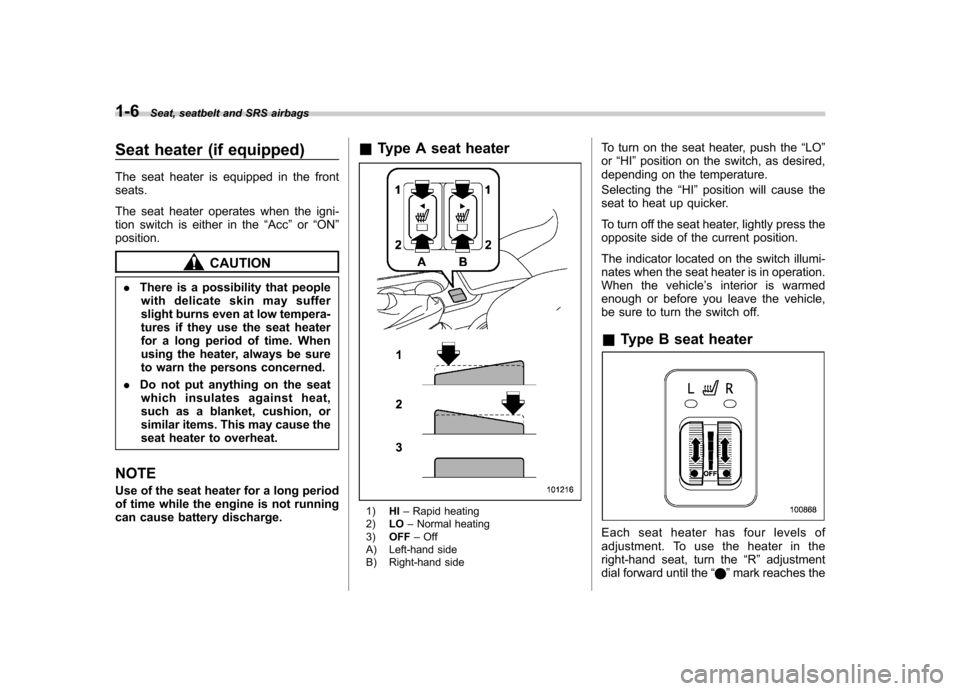
Type A seat heater
1) HI–Rapid heating
2) LO–Normal heating
3) OFF –Off
A) Left-hand side
B) Right-hand side To turn on the seat heater, push the
“LO ”
or “HI ”position on the switch, as desired,
depending on the temperature.
Selecting the “HI ”position will cause the
seat to heat up quicker.
To turn off the seat heater, lightly press the
opposite side of the current position.
The indicator located on the switch illumi-
nates when the seat heater is in operation.
When the vehicle ’s interior is warmed
enough or before you leave the vehicle,
be sure to turn the switch off.
& Type B seat heater
Each seat heater has four levels of
adjustment. To use the heater in the
right-hand seat, turn the “R ” adjustment
dial forward until the “
”mark reaches the
Page 38 of 458
desired position. To activate the heater in
the left-hand seat, turn the“L ” adjustment
dial forward until the “
”mark reaches the
desired position. Each heater warms the
seat most quickly with the “
”mark on the
adjustment dial in the furthest-forward
position. An indicator light next to the
adjustment dial for each seat heater
illuminates when that seat heater isactivated.
When the vehicle ’s interior is warmed
enough or before you leave the vehicle,
always turn the adjustment dial to the
most rearward position so that the “
”
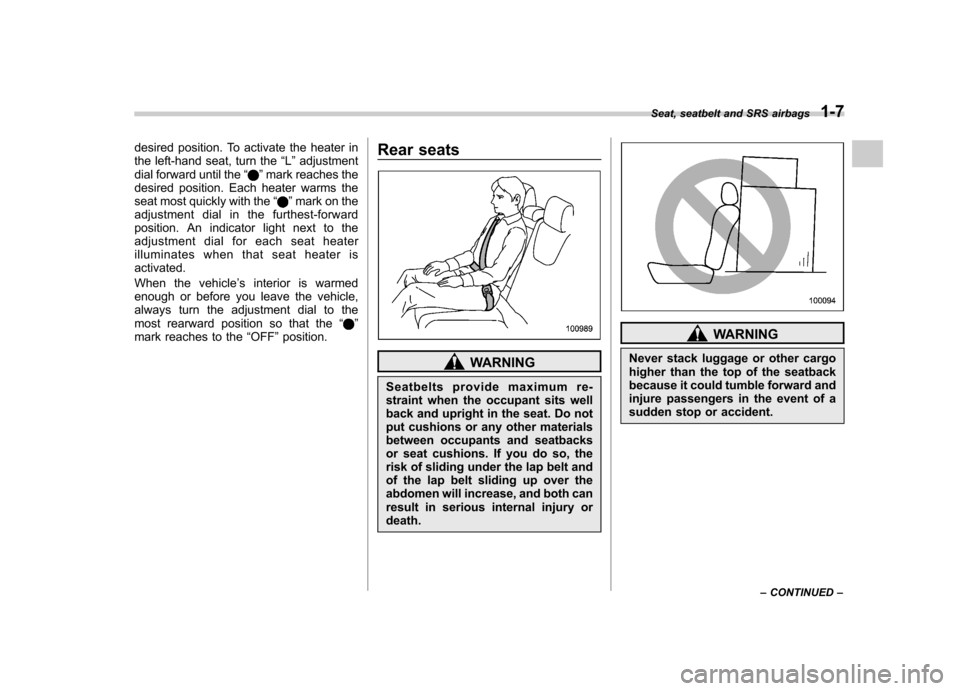
mark reaches to the “OFF ”position. Rear seats
WARNING
Seatbelts provide maximum re-
straint when the occupant sits well
back and upright in the seat. Do not
put cushions or any other materials
between occupants and seatbacks
or seat cushions. If you do so, the
risk of sliding under the lap belt and
of the lap belt sliding up over the
abdomen will increase, and both can
result in serious internal injury ordeath.
WARNING
Never stack luggage or other cargo
higher than the top of the seatback
because it could tumble forward and
injure passengers in the event of a
sudden stop or accident. Seat, seatbelt and SRS airbags
1-7
– CONTINUED –
Page 62 of 458
![SUBARU IMPREZA 2011 4.G Owners Manual 3. [If your child restraint system is of a
flexible attachment type (which uses
tether belts to connect the child restraint
system properly to the lower anchorages)]
While pushing the child restrain](/img/17/7237/w960_7237-61.png "SUBARU IMPREZA 2011 4.G Owners Manual 3. [If your child restraint system is of a
flexible attachment type (which uses
tether belts to connect the child restraint
system properly to the lower anchorages)]
While pushing the child restrain")
3. [If your child restraint system is of a
flexible attachment type (which uses
tether belts to connect the child restraint
system properly to the lower anchorages)]
While pushing the child restraint into the
seat cushion, pull both left and right lower
tether belts up to secure the child restraint
system firmly by taking up the slack in thebelt.
4. Connect the top tether hook to the
tether anchorage and firmly tighten the
tether. For information on how to set the
top tether, refer to“Top tether anchorages ”
F 1-31.5. Before seating a child in the child
restraint system, try to move it back and
forth and right and left to verify that it is
held securely in position.
6. To remove the child restraint system,
follow the reverse procedures of installa-tion.
If you have any question concerning this
type of child restraint system, ask your
SUBARU dealer. &
Top tether anchorages
Your vehicle is equipped with two or three
top tether anchorages so that a child
restraint system having a top tether can
be installed in the rear seat. When
installing a child restraint system using
top tether, proceed as follows, while
observing the instructions by the child
restraint system manufacturer.
Since a top tether can provide additional
stability by offering another connection
between a child restraint system and the
vehicle, we recommend that you use a top
tether whenever one is required or avail-able. Seat, seatbelt and SRS airbags
1-31
– CONTINUED –
Page 66 of 458
*SRS airbag (Supplemental
Restraint System airbag)
*SRS: This stands for supplemental re-
straint system. This name is used be-
cause the airbag system supplements thevehicle’s seatbelts.
Your vehicle is equipped with a crash
sensing and diagnostic module, which will
record the use of the seatbelt by the front
passenger when any of the SRS frontal,
side and curtain airbags deploys. & Models with SRS airbags and
lap/shoulder restraints for
driver, front passenger, and
window-side rear passengers
Your vehicle is equipped with a supple-
mental restraint system in addition to a
lap/shoulder belt at each front seating
position and each rear window-side seat-
ing positions. The supplemental restraint
system (SRS) consists of six airbags.
The configurations are as follows. . Driver ’s and front passenger ’s frontal
airbags . Driver ’s and front passenger ’s side
airbags. Curtain airbags (for driver, front pas-
senger, and window-side rear passen- gers)
These SRS airbags are designed only
as a supplement to the primary protec-
tion provided by the seatbelt.
The system also controls front seatbelt
pretensioners. For operation instructions
and precautions concerning the seatbelt
pretensioner, refer to
“Front seatbelt pre-
tensioners ”F 1-19.
WARNING
. To obtain maximum protection in
the event of an accident, the
driver and all passengers in the
vehicle should always wear seat-
belts when the vehicle is moving.
The SRS airbag is designed only
as a supplement to the primary
protection provided by the seat-
belt. It does not do away with the
need to fasten seatbelts. In com-
bination with the seatbelts, it
offers the best combined protec-
tion in case of a serious accident.
Not wearing a seatbelt increases
the chance of severe injury or
death in a crash even when the
vehicle has the SRS airbag.
For instructions and precautions
concerning the seatbelt system, refer to
“Seatbelts ”F 1-11.
. Do not sit or lean unnecessarily
close to the SRS airbag. Because
the SRS airbag deploys with
considerable speed –faster than
the blink of an eye –and force to
protect in high speed collisions,
the force of an airbag can injure
an occupant whose body is too
close to SRS airbag.
It is also important to wear your
seatbelt to help avoid injuries
that can result when the SRS
airbag contacts an occupant not
in proper position such as one
thrown forward during pre-acci-
dent braking.
Even when properly positioned,
there remains a possibility that
an occupant may suffer minor
injury such as abrasions and
bruises to the face or arms
because of the SRS airbag de-
ployment force.
. The SRS airbags deploy with
considerable speed and force.
Occupants who are out of proper
position when the SRS airbag
deploys could suffer very serious
injuries. Because the SRS airbag
needs enough space for deploy-
Seat, seatbelt and SRS airbags
1-35
– CONTINUED –
Page 69 of 458
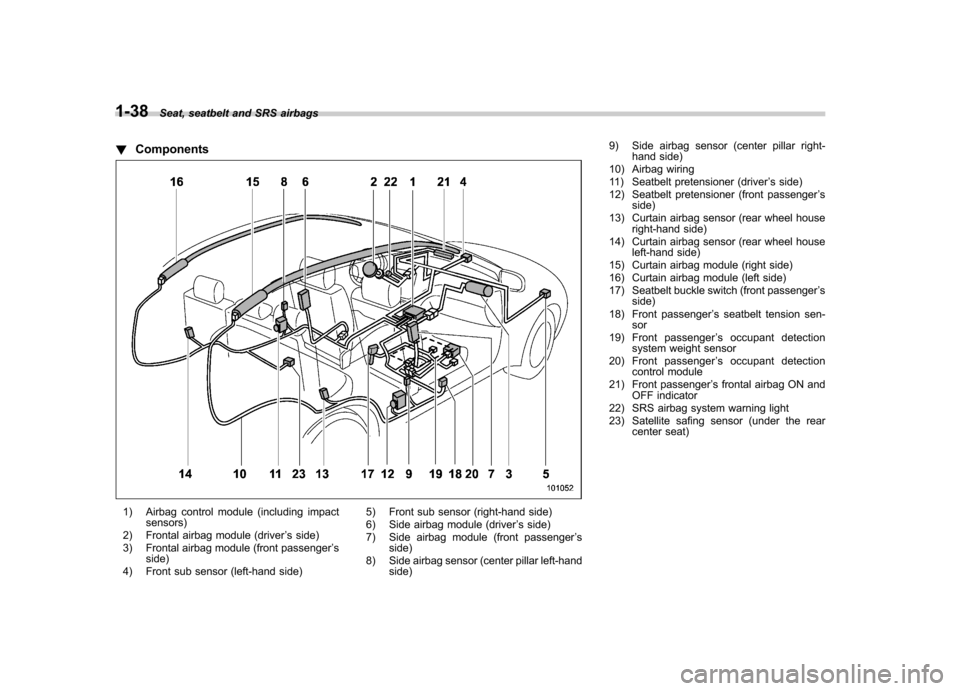
1-38Seat, seatbelt and SRS airbags
! Components
1) Airbag control module (including impact
sensors)
2) Frontal airbag module (driver ’s side)
3) Frontal airbag module (front passenger ’s
side)
4) Front sub sensor (left-hand side) 5) Front sub sensor (right-hand side)
6) Side airbag module (driver
’s side)
7) Side airbag module (front passenger ’s
side)
8) Side airbag sensor (center pillar left-hand side) 9) Side airbag sensor (center pillar right-
hand side)
10) Airbag wiring
11) Seatbelt pretensioner (driver ’s side)
12) Seatbelt pretensioner (front passenger ’s
side)
13) Curtain airbag sensor (rear wheel house right-hand side)
14) Curtain airbag sensor (rear wheel house left-hand side)
15) Curtain airbag module (right side)
16) Curtain airbag module (left side)
17) Seatbelt buckle switch (front passenger ’s
side)
18) Front passenger ’s seatbelt tension sen-
sor
19) Front passenger ’s occupant detection
system weight sensor
20) Front passenger ’s occupant detection
control module
21) Front passenger ’s frontal airbag ON and
OFF indicator
22) SRS airbag system warning light
23) Satellite safing sensor (under the rear center seat)
Page 72 of 458
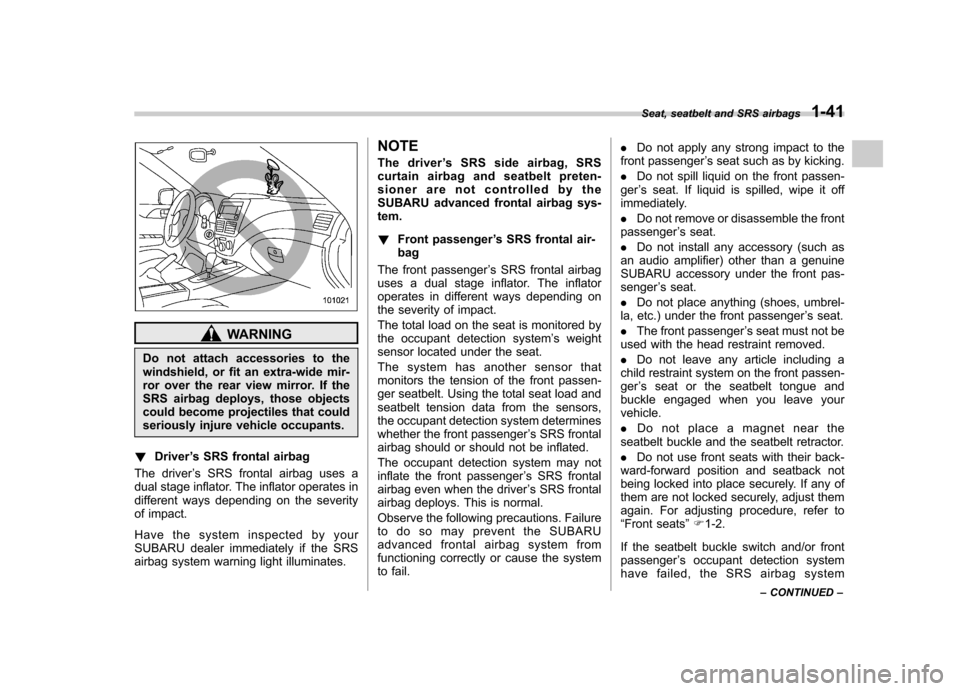
WARNING
Do not attach accessories to the
windshield, or fit an extra-wide mir-
ror over the rear view mirror. If the
SRS airbag deploys, those objects
could become projectiles that could
seriously injure vehicle occupants.
! Driver ’s SRS frontal airbag
The driver ’s SRS frontal airbag uses a
dual stage inflator. The inflator operates in
different ways depending on the severity
of impact.
Have the system inspected by your
SUBARU dealer immediately if the SRS
airbag system warning light illuminates. NOTE
The driver
’s SRS side airbag, SRS
curtain airbag and seatbelt preten-
sioner are not controlled by the
SUBARU advanced frontal airbag sys-tem. ! Front passenger ’s SRS frontal air-
bag
The front passenger ’s SRS frontal airbag
uses a dual stage inflator. The inflator
operates in different ways depending on
the severity of impact.
The total load on the seat is monitored by
the occupant detection system ’s weight
sensor located under the seat.
The system has another sensor that
monitors the tension of the front passen-
ger seatbelt. Using the total seat load and
seatbelt tension data from the sensors,
the occupant detection system determines
whether the front passenger ’s SRS frontal
airbag should or should not be inflated.
The occupant detection system may not
inflate the front passenger ’s SRS frontal
airbag even when the driver ’s SRS frontal
airbag deploys. This is normal.
Observe the following precautions. Failure
to do so may prevent the SUBARU
advanced frontal airbag system from
functioning correctly or cause the system
to fail. .
Do not apply any strong impact to the
front passenger ’s seat such as by kicking.
. Do not spill liquid on the front passen-
ger ’s seat. If liquid is spilled, wipe it off
immediately. . Do not remove or disassemble the front
passenger ’s seat.
. Do not install any accessory (such as
an audio amplifier) other than a genuine
SUBARU accessory under the front pas-senger ’s seat.
. Do not place anything (shoes, umbrel-
la, etc.) under the front passenger ’s seat.
. The front passenger ’s seat must not be
used with the head restraint removed. . Do not leave any article including a
child restraint system on the front passen- ger ’s seat or the seatbelt tongue and
buckle engaged when you leave yourvehicle. . Do not place a magnet near the
seatbelt buckle and the seatbelt retractor.. Do not use front seats with their back-
ward-forward position and seatback not
being locked into place securely. If any of
them are not locked securely, adjust them
again. For adjusting procedure, refer to“ Front seats ”F 1-2.
If the seatbelt buckle switch and/or frontpassenger ’s occupant detection system
have failed, the SRS airbag system Seat, seatbelt and SRS airbags
1-41
– CONTINUED –
Page 73 of 458
1-42Seat, seatbelt and SRS airbags
warning light will illuminate. Have the
system inspected by your SUBARU deal-
er immediately if the SRS airbag system
warning light illuminates.
If your vehicle has sustained impact, this
may affect the proper function of the
SUBARU advanced frontal airbag system.
Have your vehicle inspected at your
SUBARU dealer. NOTE
The front passenger ’s SRS side airbag,
SRS curtain airbag and seatbelt pre-
tensioner are not controlled by the
SUBARU advanced frontal airbag sys-tem. ! Passenger ’s frontal airbag ON and
OFF indicators
Refer to “Front passenger ’s frontal airbag
ON and OFF indicators ”F 3-16.
! Conditions in which front passen- ger’s SRS frontal airbag is not
activated
The front passenger ’s SRS frontal airbag
will not be activated when any of the
following conditions are met regarding the
front passenger ’s seat:
. The seat is empty.
. The seat is equipped with a rearward
facing child restraint system and an infant
is restrained with it. (See WARNING that follows.) .
The seat is equipped with a forward
facing child restraint system and a small
child is restrained with it. (See WARNING
that follows.) . The seat is equipped with a booster
seat and a small child is in the booster
seat. (See WARNING that follows.) . The seat is relieved of the occupant
load for a time exceeding the predeter-
mined monitoring time period. . The seat is occupied by a child who
has outgrown a child restraint system
(See WARNING that follows.) or by a
small adult. . The front passenger ’s occupant detec-
tion system is malfunctioning.
WARNING
NEVER INSTALL A REARWARD FA-
CING CHILD SEAT IN THE FRONT
PASSENGER ’S SEAT EVEN IF THE
FRONT PASSENGER ’S SRS FRON-
TAL AIRBAG IS DEACTIVATED. Be
sure to install it in the REAR seat in
a correct manner. Also, it is strongly
recommended that any forward fa-
cing child seat or booster seat be
installed in the REAR seat, and that
even children who have outgrown a
child restraint system be also seated in the REAR seat. This is
because children sitting in the frontpassenger
’s seat may be killed or
severely injured should the frontpassenger ’s SRS frontal airbag de-
ploy. REAR seats are the safest
place for children.
When the front passenger ’s seat is occu-
pied by a child, observe the following
precautions. Failure to do so may increase
the load on the front passenger ’s seat,
activating the front passenger ’sSRS
frontal airbag even though that seat is
occupied by a child. . Do not place any article on the seat
other than the child occupant and a child
restraint system. . Do not place more than one child on
the seat.. Do not install any accessory such as a
table or TV onto the seatback.. Do not store a heavy load in the
seatback pocket.. Do not allow the rear seat occupant to
place his/her hands or legs on the front passenger ’s seatback, or allow him/her to
pull the seatback.