flat towing SUBARU IMPREZA 2011 4.G Owners Manual
[x] Cancel search | Manufacturer: SUBARU, Model Year: 2011, Model line: IMPREZA, Model: SUBARU IMPREZA 2011 4.GPages: 458, PDF Size: 16.22 MB
Page 15 of 458

12
Illustrated index &Exterior1) Engine hood (page 11-5)
2) Headlight switch (page 3-32)
3) Replacing bulbs (page 11-47)
4) Wiper switch (page 3-38)
5) Moonroof (page 2-29)
6) Door locks (page 2-4)
7) Tire pressure (page 11-33)
8) Flat tires (page 9-6)
9) Snow tires (page 8-10)
10) Front fog light switch (page 3-36)
11) Tie-down hooks (page 9-14)
12) Towing hook (page 9-14)
Page 316 of 458
Driving tips for AWD models
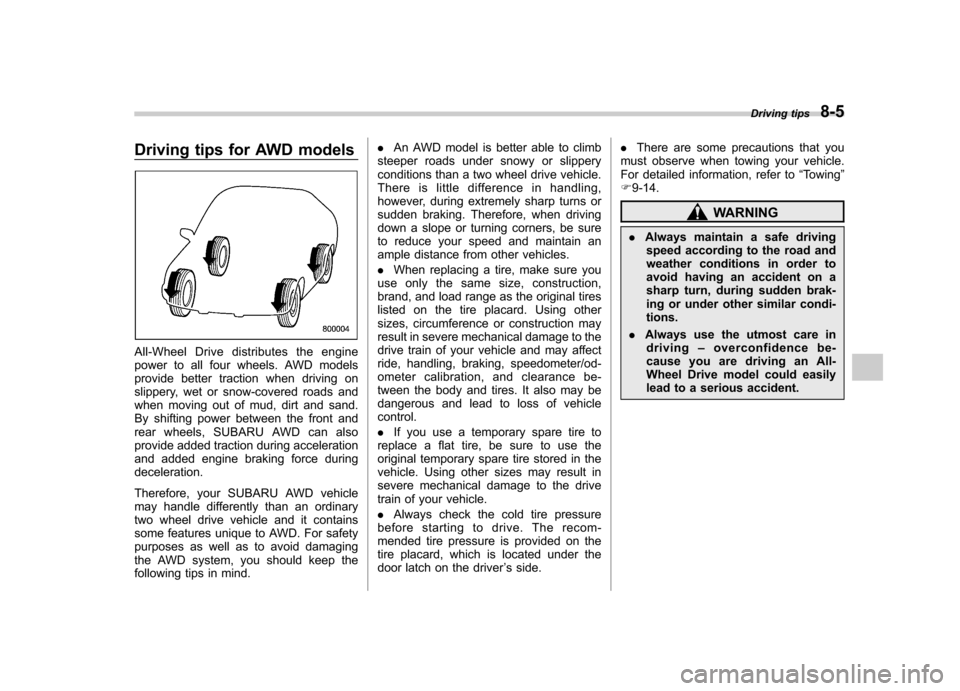
All-Wheel Drive distributes the engine
power to all four wheels. AWD models
provide better traction when driving on
slippery, wet or snow-covered roads and
when moving out of mud, dirt and sand.
By shifting power between the front and
rear wheels, SUBARU AWD can also
provide added traction during acceleration
and added engine braking force duringdeceleration.
Therefore, your SUBARU AWD vehicle
may handle differently than an ordinary
two wheel drive vehicle and it contains
some features unique to AWD. For safety
purposes as well as to avoid damaging
the AWD system, you should keep the
following tips in mind..
An AWD model is better able to climb
steeper roads under snowy or slippery
conditions than a two wheel drive vehicle.
There is little difference in handling,
however, during extremely sharp turns or
sudden braking. Therefore, when driving
down a slope or turning corners, be sure
to reduce your speed and maintain an
ample distance from other vehicles. . When replacing a tire, make sure you
use only the same size, construction,
brand, and load range as the original tires
listed on the tire placard. Using other
sizes, circumference or construction may
result in severe mechanical damage to the
drive train of your vehicle and may affect
ride, handling, braking, speedometer/od-
ometer calibration, and clearance be-
tween the body and tires. It also may be
dangerous and lead to loss of vehiclecontrol. . If you use a temporary spare tire to
replace a flat tire, be sure to use the
original temporary spare tire stored in the
vehicle. Using other sizes may result in
severe mechanical damage to the drive
train of your vehicle. . Always check the cold tire pressure
before starting to drive. The recom-
mended tire pressure is provided on the
tire placard, which is located under the
door latch on the driver ’s side. .
There are some precautions that you
must observe when towing your vehicle.
For detailed information, refer to “Towing ”
F 9-14.
WARNING
. Always maintain a safe driving
speed according to the road and
weather conditions in order to
avoid having an accident on a
sharp turn, during sudden brak-
ing or under other similar condi-tions.
. Always use the utmost care in
driving –overconfidence be-
cause you are driving an All-
Wheel Drive model could easily
lead to a serious accident. Driving tips
8-5
Page 328 of 458

If you park your vehicle in case of anemergency ........................................................ 9-2
Temporary spare tire ........................................... 9-2
Precautions for AWD models with automatic transmission ..................................................... 9-3
Maintenance tools ............................................... 9-4
Tool bag. ............................................................. 9-4
Under the rear floor ............................................. 9-5
Flat tires ............................................................... 9-6
Changing a flat tire .............................................. 9-6
Tire pressure monitoring system (TPMS) (U.S.-spec. models) .......................................... 9-10
Jump starting ..................................................... 9-11
How to jump start ............................................... 9-11 Engine overheating
........................................... 9-13
If steam is coming from the engine compartment ................................................... 9-13
If no steam is coming from the engine compartment ................................................... 9-13
Towing ................................................................ 9-14
Towing and tie-down hooks. ............................... 9-14
Using a flat-bed truck. ........................................ 9-17
Towing with all wheels on the ground ................. 9-17
Rear gate –if the rear gate cannot be
unlocked .......................................................... 9-18
Moonroof –if moonroof cannot be closed ...... 9-19
In case of emergency
9
Page 333 of 458
9-6In case of emergency
B) Except models with 16-inch wheel tires
The jack handle is stored under the floor of
the trunk (4-door) or the cargo area (5-
door). The jack and towing hook are
stored in the tool bucket that is located in
the recess of the spare tire wheel.
Also, the tools in the tool bag can be
stored in the tool bucket as illustrated.
For how to use the jack, refer to “Flat tires ”
F 9-6. Flat tires
If you have a flat tire while driving, never
brake suddenly; keep driving straight
ahead while gradually reducing speed.
Then slowly pull off the road to a safeplace. &
Changing a flat tire
WARNING
. Do not jack up the vehicle on an
incline or a loose road surface.
The jack can come out of the
jacking point or sink into the
ground and this can result in a
severe accident.
. Use only the jack provided with
your vehicle. The jack supplied
with the vehicle is designed only
for changing a tire. Never get
under the vehicle while support-
ing the vehicle with this jack. .
Always turn off the engine before
raising the flat tire off the ground
using the jack. Never swing or
push the vehicle supported with
the jack. The jack can come out
of the jacking point due to a jolt
and this can result in a severeaccident.
1. Park on a hard, level surface, when-
ever possible, then stop the engine.
2. Set the parking brake securely and
shift the shift lever in reverse (MT models)
or the select lever to the “P ” (Park)
position (AT models).
3. Turn on the hazard warning flasher
and have everyone get out of the vehicle.
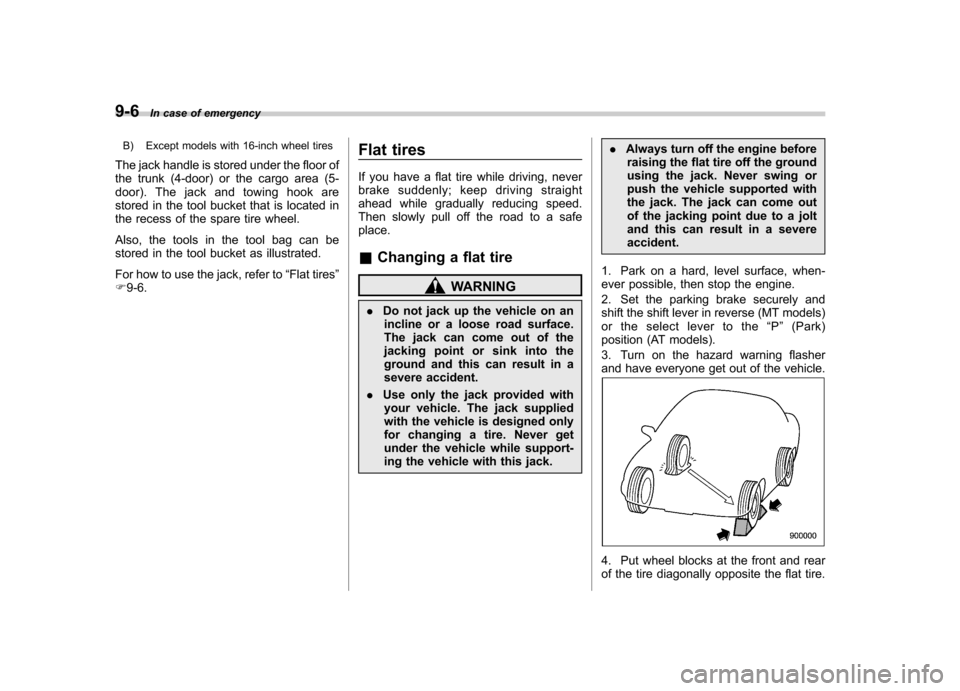
4. Put wheel blocks at the front and rear
of the tire diagonally opposite the flat tire.
Page 342 of 458
4. Tighten the towing hook securely
using the jack handle.
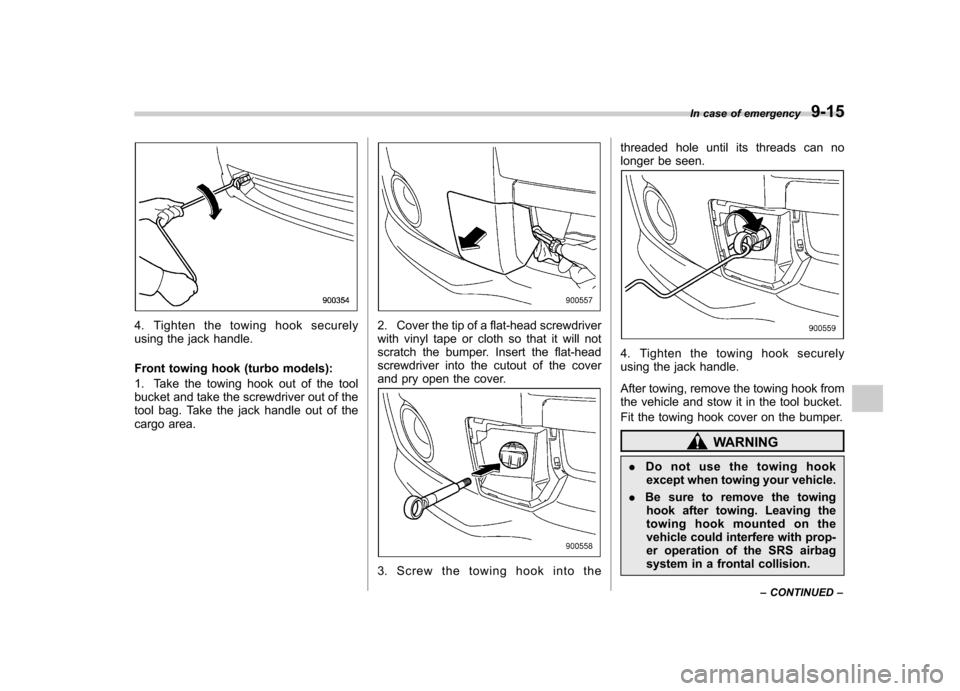
Front towing hook (turbo models):
1. Take the towing hook out of the tool
bucket and take the screwdriver out of the
tool bag. Take the jack handle out of the
cargo area.2. Cover the tip of a flat-head screwdriver
with vinyl tape or cloth so that it will not
scratch the bumper. Insert the flat-head
screwdriver into the cutout of the cover
and pry open the cover.
3. Screw the towing hook into thethreaded hole until its threads can no
longer be seen.
4. Tighten the towing hook securely
using the jack handle.
After towing, remove the towing hook from
the vehicle and stow it in the tool bucket.
Fit the towing hook cover on the bumper.
WARNING
. Do not use the towing hook
except when towing your vehicle.
. Be sure to remove the towing
hook after towing. Leaving the
towing hook mounted on the
vehicle could interfere with prop-
er operation of the SRS airbag
system in a frontal collision. In case of emergency
9-15
– CONTINUED –
Page 344 of 458
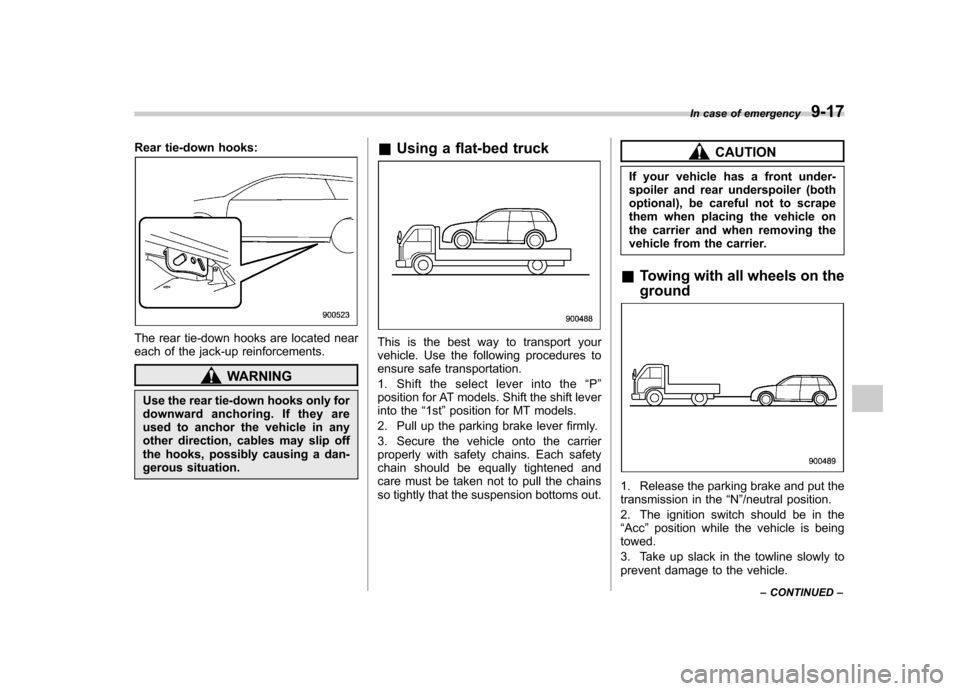
Rear tie-down hooks:
The rear tie-down hooks are located near
each of the jack-up reinforcements.
WARNING
Use the rear tie-down hooks only for
downward anchoring. If they are
used to anchor the vehicle in any
other direction, cables may slip off
the hooks, possibly causing a dan-
gerous situation. &
Using a flat-bed truck
This is the best way to transport your
vehicle. Use the following procedures to
ensure safe transportation.
1. Shift the select lever into the “P ”
position for AT models. Shift the shift lever
into the “1st ”position for MT models.
2. Pull up the parking brake lever firmly.
3. Secure the vehicle onto the carrier
properly with safety chains. Each safety
chain should be equally tightened and
care must be taken not to pull the chains
so tightly that the suspension bottoms out.
CAUTION
If your vehicle has a front under-
spoiler and rear underspoiler (both
optional), be careful not to scrape
them when placing the vehicle on
the carrier and when removing the
vehicle from the carrier.
& Towing with all wheels on the ground
1. Release the parking brake and put the
transmission in the “N ”/neutral position.
2. The ignition switch should be in the“ Acc ”position while the vehicle is being
towed.
3. Take up slack in the towline slowly to
prevent damage to the vehicle. In case of emergency
9-17
– CONTINUED –
Page 439 of 458

13-10Consumer information and Reporting safety defects
& Tire care –maintenance and
safety practices
. Check on a daily basis that the
tires are free from serious damage,
nails, and stones. At the same time,
check the tires for abnormal wear. . Inspect the tire tread regularly
and replace the tires before their
tread wear indicators become visi-
ble. When a tire ’streadwear
indicator becomes visible, the tire
is worn beyond the acceptable limit
and must be replaced immediately.
With a tire in this condition, driving
at even low speeds in wet weather
can cause the vehicle to hydro-
plane. Possible resulting loss of
vehiclecontrolcanleadtoanaccident. . To maximize the life of each tire
and ensure that the tires wear
uniformly, it is best to rotate the
tires every 7,500 miles (12,000 km).
For information about the tire rota-
tion order, refer to “Tire rotation ”
F 11-36 .
Replace any damaged or
unevenly worn tires at the time of rotation. After tire rotation, adjust
the tire pressures and make sure
the wheel nuts are correctly tigh-
tened. For information about the
tightening torque and tightening
sequence for the wheel nuts, refer to
“Flat tires ”F 9-6 .
& Vehicle load limit –how to
determine
The load capacity of your vehicle is
determined by weight, not by avail-
able cargo space. The load limit of
your vehicle is shown on the
vehicle placard attached to the
driver ’s side B-pillar. Locate the
statement “The combined weight
of occupants and cargo should
never exceed XXX kg or XXX lbs ”
on your vehicle ’s placard.
Thevehicleplacardalsoshows
seating capacity of your vehicle.
The total load capacity includes the
total weight of driver and all pas-
sengers and their belongings, any
cargo, any optional equipment such
as a trailer hitch, roof rack or bike carrier, etc., and the tongue load of
a trailer. Therefore cargo capacity
can be calculated by the following method.
Cargo capacity = Load limit
(total
weight of occupants + total weight
of optional equipment + tongue
load of a trailer (if applicable))
For information about vehicle load-
ing, refer to “Loading your vehicle ”
F 8-12 .
NOTE
Your vehicle is neither designed
nor intended to be used for
trailer towing. Therefore, never
tow a trailer with your vehicle.
Page 455 of 458

14-10Index
Tilt/telescopic ......................................................... 3-50
Stopping the engine ................................................... 7-10
Storage compartment ................................................... 6-4
Sun shade ................................................................ 2-30
Sun visors ................................................................... 6-4
Supplemental Restraint System airbag (SRS) ................ 1-35
Synthetic leather upholstery ........................................ 10-5
T
Tachometer ................................................................. 3-9
Temperature gauge .................................................... 3-11
Temperature warning light AT OIL TEMP ........................................................ 3-18
Coolant ................................................................. 3-17
Rear differential oil ................................................. 3-19
Temporary spare tire .................................................... 9-2
Tether (child restraint system) .............................. 1-29, 1-31
Tie-down hooks ......................................................... 9-14
Tire ............................................................... 11-31, 12-11
Chains .................................................................. 8-11
Inspection ............................................................ 11-33
Pressures and wear .............................................. 11-33
Replacement ........................................................ 11-37
Rotation ............................................................... 11-36
Size and pressure ................................................. 12-11
Types .................................................................. 11-31
Tire pressure monitoring system (TPMS). .... 7-38, 9-10, 11-31
Warning light ......................................................... 3-19
Tires and wheels. ...................................................... 11-31
Tools .......................................................................... 9-4
Top tether anchorages ........................................ 1-29, 1-31 Towing
...................................................................... 9-14
All wheels on the ground ......................................... 9-17
Flat-bed truck ......................................................... 9-17
Hooks ................................................................... 9-14
Trailer Towing .................................................................. 8-15
Trip meter ................................................................... 3-8
Trunk lid .................................................................... 2-25
Release handle ...................................................... 2-25
Trunk light ............................................................... 11-55
Turn signal
Indicator lights ........................................................ 3-26
Lever .................................................................... 3-33
U
Under-floor storage compartment .................................. 6-14
USB storage device operations .................................... 5-37
V
Valet mode ................................................................ 2-19
Vanity mirror ............................................................... 6-4
Vehicle Capacity weight ...................................................... 8-12
Identification ........................................................ 12-19
Symbols .................................................................... 3
Vehicle Dynamics Control
Mode switch .......................................................... 7-36
OFF indicator light .................................................. 3-23
OFF switch ............................................................ 7-37
Operation indicator light ........................................... 3-23
System .................................................................. 7-34