start stop button SUBARU IMPREZA 2016 5.G Owner's Manual
[x] Cancel search | Manufacturer: SUBARU, Model Year: 2016, Model line: IMPREZA, Model: SUBARU IMPREZA 2016 5.GPages: 594, PDF Size: 5.36 MB
Page 410 of 594
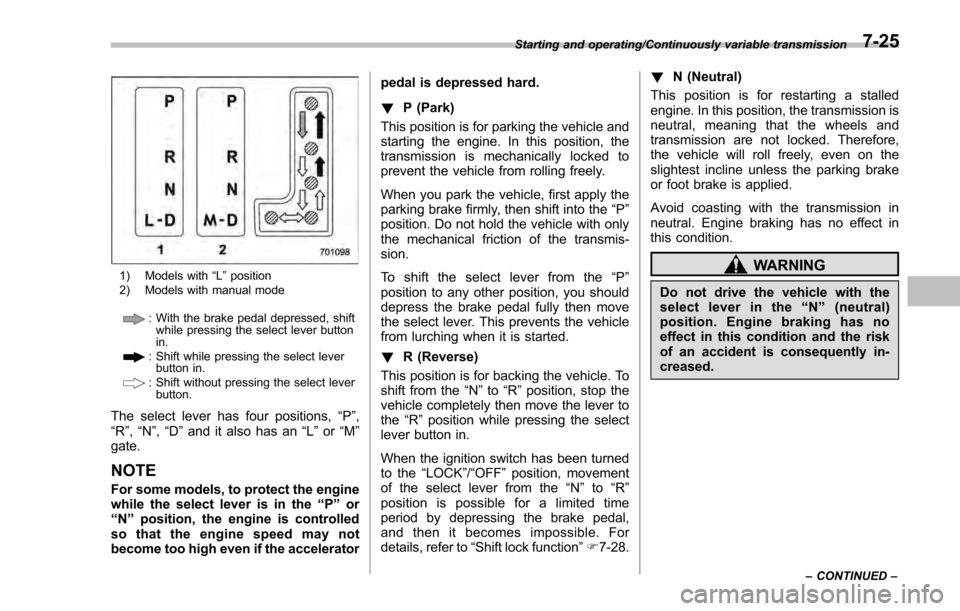
1) Models with“L ” position
2) Models with manual mode
: With the brake pedal depressed, shift while pressing the select lever button
in.
: Shift while pressing the select leverbutton in.
: Shift without pressing the select lever
button.
The select lever has four positions, “P”,
“R ”, “N ”,“D ”and it also has an “L”or “M”
gate.
NOTE
For some models, to protect the engine
while the select lever is in the “P ” or
“N ”position, the engine is controlled
so that the engine speed may not
become too high even if the accelerator pedal is depressed hard.
!
P (Park)
This position is for parking the vehicle and
starting the engine. In this position, the
transmission is mechanically locked to
prevent the vehicle from rolling freely.
When you park the vehicle, first apply the
parking brake firmly, then shift into the “P”
position. Do not hold the vehicle with only
the mechanical friction of the transmis-
sion.
To shift the select lever from the “P”
position to any other position, you should
depress the brake pedal fully then move
the select lever. This prevents the vehicle
from lurching when it is started.
! R (Reverse)
This position is for backing the vehicle. To
shift from the “N”to “R”position, stop the
vehicle completely then move the lever to
the “R”position while pressing the select
lever button in.
When the ignition switch has been turned
to the “LOCK”/“OFF ”position, movement
of the select lever from the “N ” to “R ”
position is possible for a limited time
period by depressing the brake pedal,
and then it becomes impossible. For
details, refer to “Shift lock function ”F 7-28. !
N (Neutral)
This position is for restarting a stalled
engine. In this position, the transmission is
neutral, meaning that the wheels and
transmission are not locked. Therefore,
the vehicle will roll freely, even on the
slightest incline unless the parking brake
or foot brake is applied.
Avoid coasting with the transmission in
neutral. Engine braking has no effect in
this condition.
WARNING
Do not drive the vehicle with the
select lever in the “N ” (neutral)
position. Engine braking has no
effect in this condition and the risk
of an accident is consequently in-
creased.
Starting and operating/Continuously variable transmission
–CONTINUED –7-25
Page 413 of 594
Starting and operating/Continuously variable transmission
sion.
.The transmission automatically se-
lects 1st gear when the vehicle stops
moving.
. If the temperature of the transmis-
sion fluid becomes too high, the “AT
OIL TEMP ”warning light on the combi-
nation meter will illuminate. Immedi-
ately stop the vehicle in a safe location
and let the engine idle until the warning
light turns off.
& Selection of “L ” (if equipped)
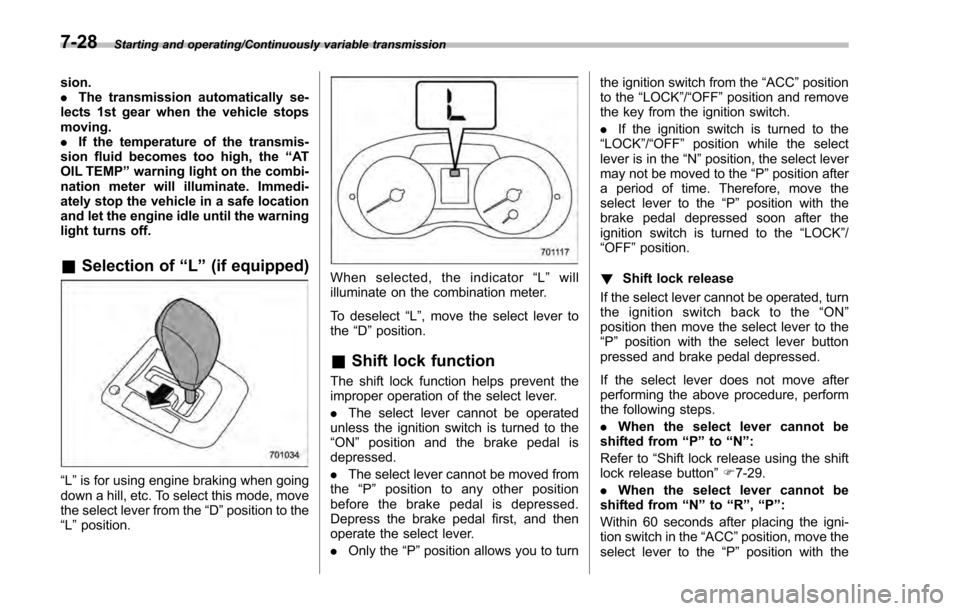
“L ”is for using engine braking when going
down a hill, etc. To select this mode, move
the select lever from the “D”position to the
“L ”position.
When selected, the indicator “L ” will
illuminate on the combination meter.
To deselect “L”, move the select lever to
the “D ”position.
& Shift lock function
The shift lock function helps prevent the
improper operation of the select lever.
. The select lever cannot be operated
unless the ignition switch is turned to the
“ ON ”position and the brake pedal is
depressed.
. The select lever cannot be moved from
the “P ” position to any other position
before the brake pedal is depressed.
Depress the brake pedal first, and then
operate the select lever.
. Only the “P”position allows you to turn the ignition switch from the
“ACC ”position
to the “LOCK”/ “OFF”position and remove
the key from the ignition switch.
. If the ignition switch is turned to the
“LOCK ”/“OFF ”position while the select
lever is in the “N”position, the select lever
may not be moved to the “P ”position after
a period of time. Therefore, move the
select lever to the “P ” position with the
brake pedal depressed soon after the
ignition switch is turned to the “LOCK”/
“OFF ”position.
! Shift lock release
If the select lever cannot be operated, turn
the ignition switch back to the “ON ”
position then move the select lever to the
“P ”position with the select lever button
pressed and brake pedal depressed.
If the select lever does not move after
performing the above procedure, perform
the following steps.
. When the select lever cannot be
shifted from “P”to “N ”:
Refer to “Shift lock release using the shift
lock release button ”F 7-29.
. When
the
select lever cannot be
shifted from “N”to “R”,“P ”:
Within 60 seconds after placing the igni-
tion switch in the “ACC”position, move the
select lever to the “P”position with the
7-28
Page 414 of 594
select lever button pressed and brake
pedal depressed.
If you must perform the above procedure,
the shift lock system (or the vehicle control
system) may be malfunctioning. Contact a
SUBARU dealer for an inspection as soon
as possible.
If the select lever does not move after
performing the above procedure, refer to
“Shift lock release using the shift lock
release button”F 7-29.
! Shift lock release using the shift
lock release button
Perform the following procedure to release
the shift lock.
1. Apply the parking brake and turn the
ignition switch to the “LOCK ”/“OFF ”posi-
tion.
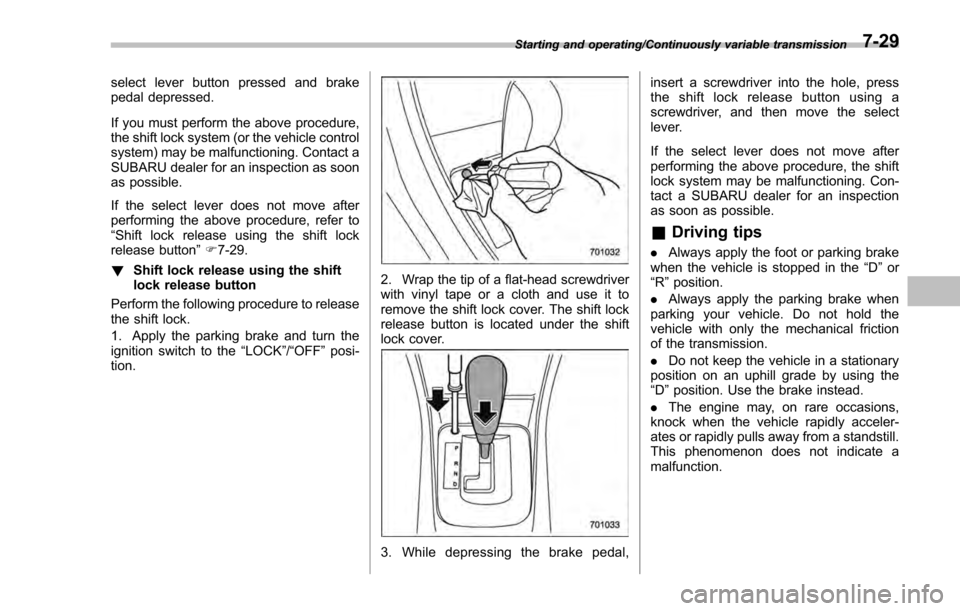
2. Wrap the tip of a flat-head screwdriver
with vinyl tape or a cloth and use it to
remove the shift lock cover. The shift lock
release button is located under the shift
lock cover.
3. While depressing the brake pedal, insert a screwdriver into the hole, press
the shift lock release button using a
screwdriver, and then move the select
lever.
If the select lever does not move after
performing the above procedure, the shift
lock system may be malfunctioning. Con-
tact a SUBARU dealer for an inspection
as soon as possible.
&
Driving tips
. Always apply the foot or parking brake
when the vehicle is stopped in the “D”or
“ R ”position.
. Always apply the parking brake when
parking your vehicle. Do not hold the
vehicle with only the mechanical friction
of the transmission.
. Do not keep the vehicle in a stationary
position on an uphill grade by using the
“ D ”position. Use the brake instead.
. The engine may, on rare occasions,
knock when the vehicle rapidly acceler-
ates or rapidly pulls away from a standstill.
This phenomenon does not indicate a
malfunction.
Starting and operating/Continuously variable transmission7-29
Page 432 of 594
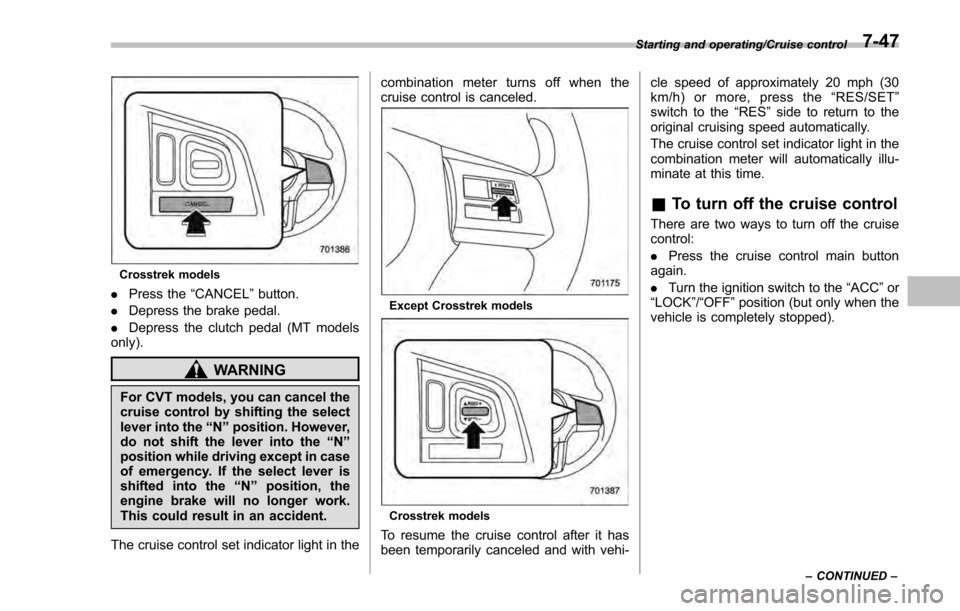
Crosstrek models
.Press the “CANCEL”button.
. Depress the brake pedal.
. Depress the clutch pedal (MT models
only).
WARNING
For CVT models, you can cancel the
cruise control by shifting the select
lever into the “N”position. However,
do not shift the lever into the “N”
position while driving except in case
of emergency. If the select lever is
shifted into the “N”position, the
engine brake will no longer work.
This could result in an accident.
The cruise control set indicator light in the combination meter turns off when the
cruise control is canceled.
Except Crosstrek models
Crosstrek models
To resume the cruise control after it has
been temporarily canceled and with vehi-cle speed of approximately 20 mph (30
km/h) or more, press the
“RES/SET ”
switch to the “RES ”side to return to the
original cruising speed automatically.
The cruise control set indicator light in the
combination meter will automatically illu-
minate at this time.
& To turn off the cruise control
There are two ways to turn off the cruise
control:
. Press the cruise control main button
again.
. Turn the ignition switch to the “ACC”or
“ LOCK ”/“OFF ”position (but only when the
vehicle is completely stopped).
Starting and operating/Cruise control
–CONTINUED –7-47
Page 489 of 594
In case of emergency/If your vehicle is involved in an accident
CAUTION
Never operate the rear gate open
lever with fingers because doing so
may cause an injury. Always use a
flat-head screwdriver or a similar
tool.
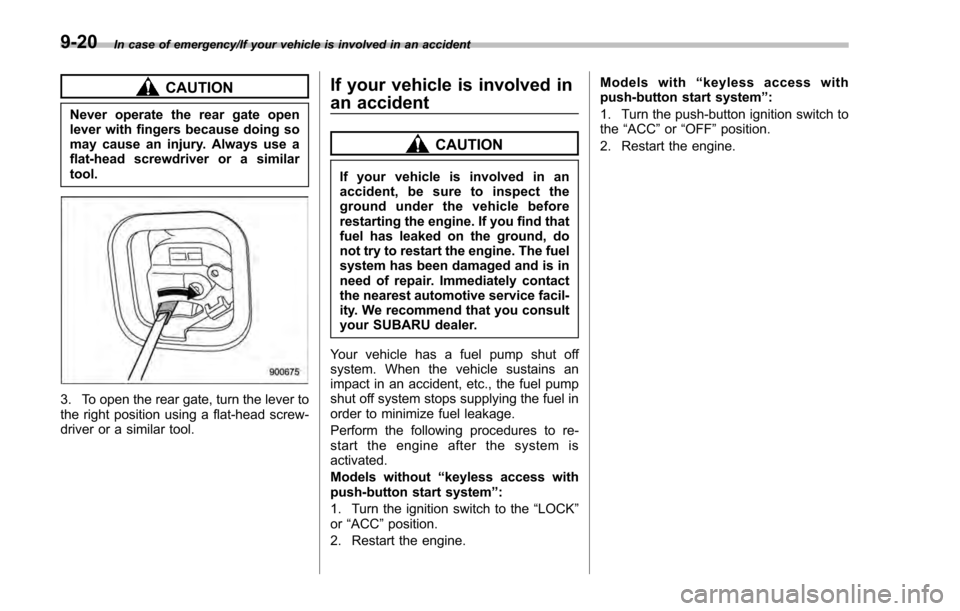
3. To open the rear gate, turn the lever to
the right position using a flat-head screw-
driver or a similar tool.
If your vehicle is involved in
an accident
CAUTION
If your vehicle is involved in an
accident, be sure to inspect the
ground under the vehicle before
restarting the engine. If you find that
fuel has leaked on the ground, do
not try to restart the engine. The fuel
system has been damaged and is in
need of repair. Immediately contact
the nearest automotive service facil-
ity. We recommend that you consult
your SUBARU dealer.
Your vehicle has a fuel pump shut off
system. When the vehicle sustains an
impact in an accident, etc., the fuel pump
shut off system stops supplying the fuel in
order to minimize fuel leakage.
Perform the following procedures to re-
start the engine after the system is
activated.
Models without “keyless access with
push-button start system ”:
1. Turn the ignition switch to the “LOCK”
or “ACC ”position.
2. Restart the engine. Models with
“keyless access with
push-button start system ”:
1. Turn the push-button ignition switch to
the “ACC ”or “OFF ”position.
2. Restart the engine.
9-20
Page 499 of 594
Maintenance and service/Maintenance precautions
erative. NEVER use a circuit
tester for this wiring. If your
SRS airbag or seatbelt preten-
sioner needs service, consult
your nearest SUBARU dealer.
NOTE
SUBARU does not endorse the use of
non-SUBARU approved flushing sys-
tems and strongly advises against
performing these services on a
SUBARU vehicle. Non-SUBARU ap-
proved flushing systems use chemi-
cals and/or solvents which have not
been tested or approved by SUBARU.
SUBARU warranties do not cover any
part of the vehicle which is damaged by
adding or applying chemicals and/or
solvents other than those approved or
recommended by SUBARU.
&Before checking or servicing
in the engine compartment
WARNING
. Always stop the engine and apply
the parking brake firmly to pre-
vent the vehicle from moving.
. Always let the engine cool down.
Engine parts become very hot when the engine is running and
remain hot for some time after
the engine has stopped.
. Do not spill engine oil, engine
coolant, brake fluid or any other
fluid on hot engine components.
This may cause a fire.
. When the ignition switch is in the
“ON ”position, the cooling fan
may operate suddenly even
when the engine is stopped. If
your body or clothes come into
contact with a rotating fan, that
could result in serious injury. To
avoid risk of injury, perform the
following precautions.
– Models with push-button start
system:
Always turn the push-button
ignition switch to the “OFF”
position and confirm that the
operation indicator on the
switch is turned off. Then take
the access key out from the
vehicle.
– Models without push-button
start system:
Always remove the key from
the ignition switch.
. Before performing any servicing
on a vehicle equipped with a remote engine start system (a
dealer option), temporarily place
the remote engine start system in
service mode to prevent it from
unexpectedly starting the engine.
&
When checking or servicing
in the engine compartment
CAUTION
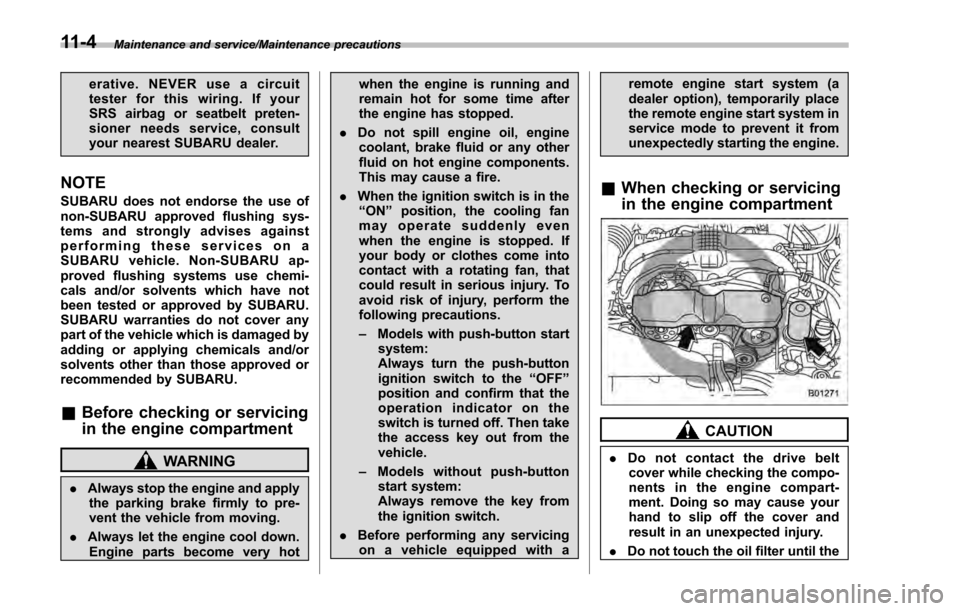
. Do not contact the drive belt
cover while checking the compo-
nents in the engine compart-
ment. Doing so may cause your
hand to slip off the cover and
result in an unexpected injury.
. Do not touch the oil filter until the
11-4
Page 585 of 594

14-8Index
Overheating engine.................................................... 9-13
P
Parking Brake ................................................................... 7-40
Brake stroke ......................................................... 11-21
Light .................................................................... 11-38
Tips...................................................................... 7-40
Periodic inspections ..................................................... 8-4
Petrol fuel ................................................................... 7-3
PIN Code Access ...................................................... 2-21
Power Door locking switch .................................................. 2-8
Outlets .................................................................... 6-8
Outside mirrors .................................................... 3-108
Steering ................................................................ 7-30
Steering warning light ............................................. 3-23
Windows ............................................................... 2-35
Precautions against vehicle modification ............... 1-24, 1-70
Preparing to drive ........................................................ 7-8
Push-button Ignition switch .......................................................... 3-6
Starting and stopping engine ................................... 7-12
R
Rear Combination lights ................................................. 11-38
Differential gear oil ........................................ 11-15, 12-6
Gate ............................................................. 2-41, 9-19
Turn signal light .................................................... 11-38
Rear seat .................................................................... 1-7 Armrest
.................................................................. 1-8
Folding down ......................................................... 1-10
Head restraint adjustment ......................................... 1-8
Rear view camera ...................................................... 6-15
How to adjust the rear view image ............................ 5-25
Rear window Defogger ............................................................. 3-108
Wiper and washer switch ......................................... 3-99
Wiper blades ........................................................ 11-32
Recommended Brake fluid ............................................................. 12-7
Continuously variable transmission fluid .................... 12-7
Engine oil .............................................................. 12-4
Front differential gear oil .......................................... 12-6
Rear differential gear oil .......................................... 12-6
Spark plugs ........................................................... 12-7
Refueling .................................................................... 7-5
Remote engine start system ........................................ 7-14
Remote keyless entry system ...................................... 2-23
Replacement Access key battery ............................................... 11-44
Air cleaner element ............................................... 11-13
Brake pad and lining ............................................. 11-20
Lost transmitters (remote keyless entry system) ......... 2-26
Remote engine start transmitter battery ..................... 7-20
Remote keyless entry transmitter battery ................. 11-45
Wiper blades ........................................................ 11-30
Replacing bulbs.............................................
11-36, 12-14
Backup light ......................................................... 11-38
Cargo area light ................................................... 11-42
Dome light ........................................................... 11-42