ESP SUBARU IMPREZA 2016 5.G Repair Manual
[x] Cancel search | Manufacturer: SUBARU, Model Year: 2016, Model line: IMPREZA, Model: SUBARU IMPREZA 2016 5.GPages: 594, PDF Size: 5.36 MB
Page 515 of 594
Maintenance and service/Replacement of brake pad and lining
Replacement of brake pad
and lining
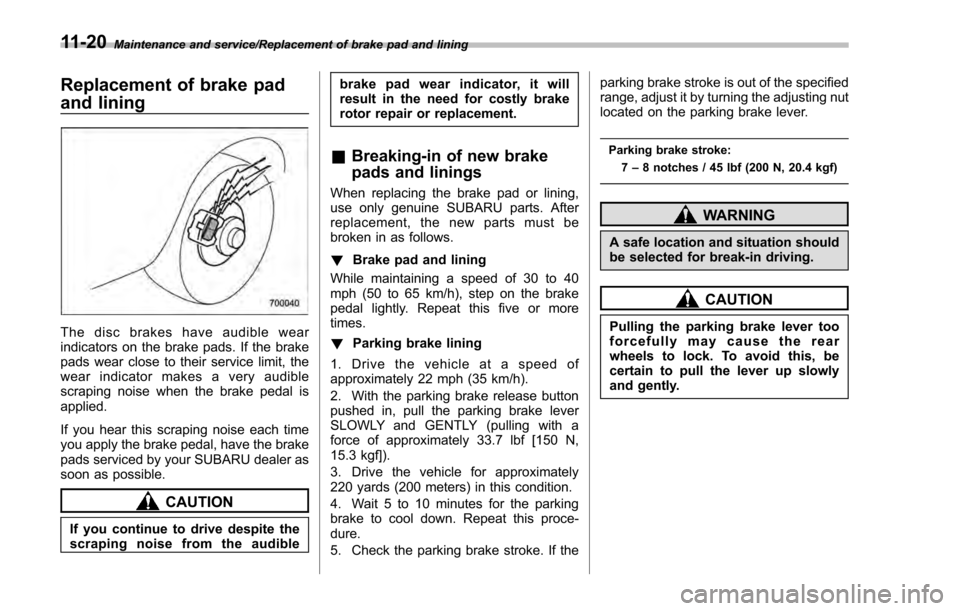
The disc brakes have audible wear
indicators on the brake pads. If the brake
pads wear close to their service limit, the
wear indicator makes a very audible
scraping noise when the brake pedal is
applied.
If you hear this scraping noise each time
you apply the brake pedal, have the brake
pads serviced by your SUBARU dealer as
soon as possible.
CAUTION
If you continue to drive despite the
scraping noise from the audiblebrake pad wear indicator, it will
result in the need for costly brake
rotor repair or replacement.
&
Breaking-in of new brake
pads and linings
When replacing the brake pad or lining,
use only genuine SUBARU parts. After
replacement, the new parts must be
broken in as follows.
! Brake pad and lining
While maintaining a speed of 30 to 40
mph (50 to 65 km/h), step on the brake
pedal lightly. Repeat this five or more
times.
! Parking brake lining
1. Drive the vehicle at a speed of
approximately 22 mph (35 km/h).
2. With the parking brake release button
pushed in, pull the parking brake lever
SLOWLY and GENTLY (pulling with a
force of approximately 33.7 lbf [150 N,
15.3 kgf]).
3. Drive the vehicle for approximately
220 yards (200 meters) in this condition.
4. Wait 5 to 10 minutes for the parking
brake to cool down. Repeat this proce-
dure.
5. Check the parking brake stroke. If the parking brake stroke is out of the specified
range, adjust it by turning the adjusting nut
located on the parking brake lever.
Parking brake stroke:
7–8 notches / 45 lbf (200 N, 20.4 kgf)
WARNING
A safe location and situation should
be selected for break-in driving.
CAUTION
Pulling the parking brake lever too
forcefully may cause the rear
wheels to lock. To avoid this, be
certain to pull the lever up slowly
and gently.
11-20
Page 517 of 594
Maintenance and service/Tires and wheels
temperature outside. By way of example,
the following table shows the required tire
pressures that correspond to various out-
side temperatures when the temperature
in the garage is 608F (15.6 8C).
Example:
Tire size: P205/55R16 89V and
P205/50R17 88V
Standard tire pressures:
Front: 33 psi (230 kPa, 2.3 kgf/cm
2)
Rear: 32 psi (220 kPa, 2.2 kgf/cm2)
Garage temperature: 60 8F (15.6 8C)
Outside
temperature Adjusted pressure
[psi (kPa, kgf/cm2)]
Front Rear
30 8F( −18C) 36 (250, 2.5) 35 (240, 2.4)
10 8F( −12 8C) 38
(265, 2.65) 37
(255, 2.55)
−10 8F( −23 8C) 40 (280, 2.8) 39 (270, 2.7)
If the low tire pressure warning light
illuminates when you drive the vehicle in
cold outside air after adjusting the tire
pressures in a warm garage, re-adjust the
tire pressures using the method described
above. Then, increase the vehicle speed
to at least 20 mph (32 km/h) and check to
see that the low tire pressure warning light
turns off a few minutes later. If the low tire
pressure warning light does not turn off, the tire pressure monitoring system may
not be functioning normally. In this event,
go to a SUBARU dealer to have the
system inspected as soon as possible.
While the vehicle is driven, friction be-
tween tires and the road surface causes
the tires to warm up. After illumination of
the low tire pressure warning light, any
increase in the tire pressures caused by
an increase in the outside air temperature
or by an increase in the temperature in the
tires can cause the low tire pressure
warning light to turn off.
System resetting is necessary when the
wheels are changed (for example, a
switch to snow tires) and new TPMS
valves are installed on the newly fitted
wheels. Have this work performed by a
SUBARU dealer following wheel replace-
ment.
It may not be possible to install TPMS
valves on certain wheels that are on the
market. Therefore, if you change the
wheels (for example, a switch to snow
tires), use wheels that have the same part
number as the standard-equipment
wheels. Without four operational TPMS
valve/sensors on the wheels, the TPMS
will not fully function and the warning light
on the combination meter will illuminate
steadily after blinking for approximatelyone minute.
When a tire is replaced, adjustments are
necessary to ensure continued normal
operation of the tire pressure monitoring
system. As with wheel replacement, there-
fore, you should have the work performed
by a SUBARU dealer.
WARNING
If the low tire pressure warning light
does not illuminate briefly after the
ignition switch is turned ON or the
light illuminates steadily after blink-
ing for approximately one minute,
you should have your Tire Pressure
Monitoring System checked at a
SUBARU dealer as soon as possi-
ble.
If this light illuminates while driving,
never brake suddenly and keep
driving straight ahead while gradu-
ally reducing speed. Then slowly
pull off the road to a safe place.
Otherwise an accident involving
serious vehicle damage and serious
personal injury could occur.
If this light still illuminates while
driving after adjusting the tire pres-
sure, a tire may have significant
damage and a fast leak that causes
the tire to lose air rapidly. If you have
11-22
Page 519 of 594
Maintenance and service/Tires and wheels
NOTE
.The air pressure in a tire increases
by approximately 4.3 psi (30 kPa, 0.3
kgf/cm
2) when the tire becomes warm.
. The tires are considered cold when
the vehicle has been parked for at least
three hours or has been driven less
than one mile (1.6 km).
WARNING
Do not let air out of warm tires to
adjust pressure. Doing so will result
in low tire pressure.
Incorrect tire pressures detract from con-
trollability and ride comfort, and they
cause the tires to wear abnormally. .
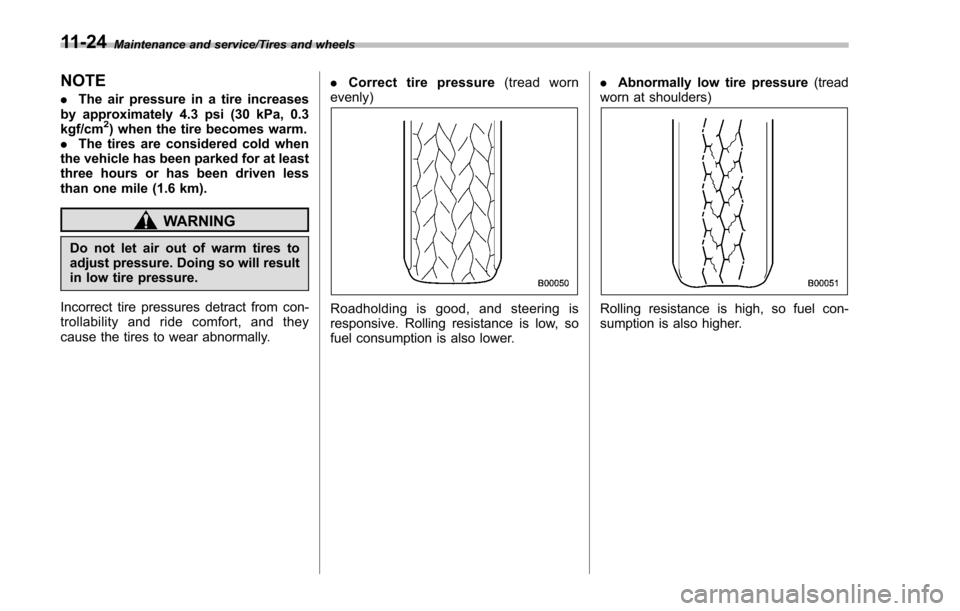
Correct tire pressure (tread worn
evenly)
Roadholding is good, and steering is
responsive. Rolling resistance is low, so
fuel consumption is also lower. .
Abnormally low tire pressure (tread
worn at shoulders)Rolling resistance is high, so fuel con-
sumption is also higher.
11-24
Page 530 of 594
Fuses
CAUTION
Never replace a fuse with one hav-
ing a higher rating or with material
other than a fuse because serious
damage or a fire could result.
The fuses are designed to melt during an
overload to prevent damage to the wiring
harness and electrical equipment. The
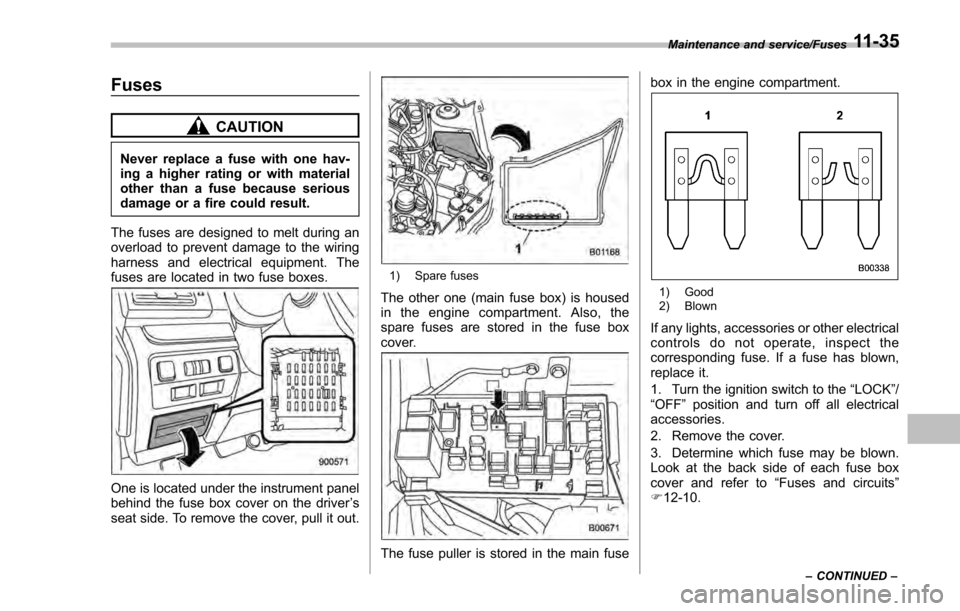
fuses are located in two fuse boxes.
One is located under the instrument panel
behind the fuse box cover on the driver ’s
seat side. To remove the cover, pull it out.
1) Spare fuses
The other one (main fuse box) is housed
in the engine compartment. Also, the
spare fuses are stored in the fuse box
cover.
The fuse puller is stored in the main fuse box in the engine compartment.
1) Good
2) Blown
If any lights, accessories or other electrical
controls do not operate, inspect the
corresponding fuse. If a fuse has blown,
replace it.
1. Turn the ignition switch to the
“LOCK”/
“OFF ”position and turn off all electrical
accessories.
2. Remove the cover.
3. Determine which fuse may be blown.
Look at the back side of each fuse box
cover and refer to “Fuses and circuits”
F 12-10.
Maintenance and service/Fuses
–CONTINUED –11-35
Page 557 of 594

Specifications/Bulb chartWattage Bulb No.
1) High beam headlight 12V-60W HB3
2) Low beam headlight
Models with HID light 12V-35W D2R
Models with halogen light 12V-55W H11
3) Map light 12V-8W–
4) Dome light 12V-8W–
5) Front side marker light 12V-5W W5W
6) Parking light 12V-5W W5W
7) Front turn signal light 12V-21W WY21W
8) Front fog light
Models without steering responsive fog lights system 12V-24W PSX24W
Models with steering responsive fog lights system 12V-55W H11
9) Trunk light (4-door) 12V-5W W5W
10) Stop light/Tail and rear side marker light (4-door) 12V-21/5W W21/5W
11 ) Rear turn signal light 12V-21W WY21W
12) Backup light 12V-16W W16W
13) License plate light 12V-5W W5W
14) Cargo area light (5-door) 12V-5W–
15) Rear side marker light (5-door) 12V-5W W5W
16) Stop light/Tail light (5-door) 12V-21/5W W21/5W
A) Side turn signal light (if equipped) ––
B) High-mounted stop light (4-door) ––
C) High-mounted stop light (5-door) ––12-16
Page 565 of 594

Consumer information and Reporting safety defects/Tire information
.Extra load tire
A tire designed to operate at higher
loads and higher inflation pressure
than the corresponding standard
tire.
.Groove
The space between two adjacent
tread ribs.
.Innerliner
The layer(s) forming the inside sur-
face of a tubeless tire that contains
the inflating medium within the tire.
.Innerliner separation
The parting of the innerliner from
cord material in the carcass.
.Intended outboard sidewall(1)The sidewall that contains a
whitewall, bears white lettering
or bears manufacturer, brand,
and/or model name molding that
is higher or deeper than the
same molding on the other side-
wall of the tire, or
(2)The outward facing sidewall
of an asymmetrical tire that has
a particular side that must al-
ways face outward when mount- ing on a vehicle.
.Light truck (LT) tire
A tire designated by its manufac-
turer as primarily intended for use
on lightweight trucks or multipur-
pose passenger vehicles.
.Load rating
The maximum load that a tire is
rated to carry for a given inflation
pressure.
.Maximum inflation pressure
The maximum cold inflation pres-
sure to which a tire may be inflated.
.Maximum load rating
The load rating for a tire at the
maximum permissible inflation
pressure for that tire.
.Maximum loaded vehicle weight
The sum of:
(a)Curb weight(b)Accessory weight(c)Vehicle capacity weight(d)Production options weight.Maximum permissible inflation
pressure
The maximum cold inflation pres-
sure to which a tire may be inflated.
.Measuring rim
The rim on which a tire is fitted for
physical dimension requirements.
.Normal occupant weight
150 lbs (68 kg) times the number of
occupants specified in the second
column of Table 1 that is appended
to the end of this section.
.Occupant distribution
Distribution of occupants in a vehi-
cle as specified in the third column
of Table 1 that is appended to the
end of this section.
.Open splice
Any parting at any junction of tread,
sidewall, or innerliner that extends
to cord material.
.Outer diameter
The overall diameter of an inflated
new tire.
.Overall width
The linear distance between the
exteriors of the sidewalls of an
inflated tire, including elevations
due to labeling, decorations, or
protective bands or ribs.
13-6
Page 566 of 594

.Passenger car tire
A tire intended for use on passen-
ger cars, multipurpose passenger
vehicles, and trucks, that have a
gross vehicle weight rating (GVWR)
of 10,000 lbs (4,535 kg) or less.
.Ply
A layer of rubber-coated parallel
cords.
.Ply separation
A parting of rubber compound
between adjacent plies.
.Pneumatic tire
A mechanical device made of rub-
ber, chemicals, fabric and steel or
other materials, that, when
mounted on an automotive wheel,
provides the traction and contains
the gas or fluid that sustains the
load.
.Production options weight
The combined weight of those
installed regular production options
weighing over 5.1 lbs (2.3 kg) in
excess of those standard items
which they replace, not previously
considered in curb weight or acces-sory weight, including heavy duty
brakes, ride levelers, roof rack,
heavy duty battery, and special
trim.
.Radial ply tire
A pneumatic tire in which the ply
cords that extend to the beads are
laid at substantially 90 degrees to
the centerline of the tread.
.Recommended inflation pres-
sure
The cold inflation pressure recom-
mended by a vehicle manufacturer.
.Reinforced tire
A tire designed to operate at higher
loads and at higher inflation pres-
sures than the corresponding stan-
dard tire.
.Rim
A metal support for a tire or a tire
and tube assembly upon which the
tire beads are seated.
.Rim diameter
Nominal diameter of the bead seat.
.Rim size designation
Rim diameter and width.
.Rim type designation
The industry of manufacturer ’s des-
ignation for a rim by style or code.
.Rim width
Nominal distance between rim
flanges.
.Section width
The linear distance between the
exteriors of the sidewalls of an
inflated tire, excluding elevations
due to labeling, decoration, or
protective bands.
.Sidewall
That portion of a tire between the
tread and bead.
.Sidewall separation
The parting of the rubber com-
pound from the cord material in
the sidewall.
.Test rim
The rim on which a tire is fitted for
testing, and it may be any rim listed
as appropriate for use with that tire.
.Tread
That portion of a tire that comes
into contact with the road.
Consumer information and Reporting safety defects/Tire information
–CONTINUED –13-7
Page 575 of 594
Consumer information and Reporting safety defects/Reporting safety defects (U.S.A.)
grade C corresponds to a level of
performance which all passenger
car tires must meet under the
Federal Motor Vehicle Safety Stan-
dards No. 109. Grades B and A
represent higher levels of perfor-
mance on the laboratory test wheel
than the minimum required by law.
WARNING
The temperature grade for this
tire is established for a tire
that is properly inflated and
not overloaded. Excessive
speed, underinflation, or ex-
cessive loading, either sepa-
rately or in combination, can
cause heat buildup and possi-
ble tire failure.
Reporting safety defects
(U.S.A.)
If you believe that your vehicle has
a defect which could cause a
crash or could cause injury or
death, you should immediately in-
form the National Highway Traffic
Safety Administration (NHTSA) in
addition to notifying Subaru of
America, Inc.
If NHTSA receives similar com-
plaints, it may open an investiga-
tion, and if it finds that a safety
defect exists in a group of vehi-
cles, it may order a recall and
remedy campaign. However,
NHTSA cannot become involved
in individual problems between
you, your dealer, or Subaru of
America, Inc. To contact NHTSA,
you may call the Vehicle Safety
Hotline toll-free at 1-888-327-4236
(TTY: 1-800-424-9153); go to
http://www.safercar.gov; or write
to: Administrator, NHTSA, 1200New Jersey Avenue, SE, West
Building, Washington, DC 20590.
You can also obtain other informa-
tion about motor vehicle safety
from http://www.safercar.gov.
13-16
Page 583 of 594

14-6Index
High beam indicator light............................................ 3-31
High/low beam change (dimmer) .................................. 3-91
Hill start assist .................................................. 7-41, 11-19
OFF indicator light .................................................. 3-23
Warning light ......................................................... 3-22
HomeLink
®.............................................................. 3-102
Hook Cargo tie-down ...................................................... 6-14
Coat ..................................................................... 6-11
Shopping bag ........................................................ 6-12
Towing and tie-down ............................................... 9-14
Horn ........................................................................\
3-111
Hose and connections ............................................... 11-11
I
Ignition switch .............................................................. 3-4
Light ....................................................................... 3-6
Illumination brightness control ...................................... 3-93
Immobilizer. ................................................................. 2-3
Indicator light (security indicator light) ....................... 3-30
Indicator light BSD/RCTA OFF. .................................................... 3-32
BSD/RCTA warning ................................................ 3-32
Coolant temperature low ......................................... 3-17
Cruise control ........................................................ 3-31
Cruise control set ................................................... 3-31
Front fog light ........................................................ 3-31
Headlight .............................................................. 3-32
High beam ............................................................ 3-31
Hill start assist OFF ................................................ 3-23
Immobilizer. ........................................................... 3-30 Security
................................................................. 3-30
Select lever/Gear position ........................................ 3-30
Steering responsive fog lights OFF ... ........................ 3-32
Turn signal ............................................................ 3-31
Vehicle Dynamics Control OFF ................................. 3-25
Vehicle Dynamics Control operation .......................... 3-24
Information display ...................................................... 3-32
Inside mirror .................................................. 3- 100, 3-102
Interior lights ............................................................... 6-2
Internal trunk lid release handle .................................... 2-39
J
Jack-up point .............................................................. 9-6
Jump starting ............................................................. 9-10
K
Key........................................................................\
.... 2-3 Number plate .......................................................... 2-3
Reminder chime ...................................................... 3-5
Replacement. .......................................................... 2-4
Keyless access entry function ...................................... 2-13
Keyless access with push-button start system ................. 2-9
Disabling keyless access functions ........................... 2-18
Locking and unlocking doors .................................... 2-13
Opening rear gate .................................................. 2-16
Opening trunk ........................................................ 2-16
Warning chimes and warning indicator ...................... 3-25
When access key does not operate properly .............. 9-18
Keyless entry system .................................................. 2-23
Page 586 of 594

Front fog light....................................................... 11-38
Front turn signal light ............................................. 11-38
Headlight ................................................... 11-36, 11-37
License plate light ................................................. 11-41
Map light .............................................................. 11-42
Parking light ......................................................... 11-38
Rear combination light ........................................... 11-38
Rear side marker light ........................................... 11-38
Rear turn signal light ............................................. 11-38
Stop light ............................................................. 11-38
Tail light ............................................................... 11-38
Trunk light ............................................................ 11-43
Rocking the vehicle .................................................... 8-11
Roof molding and crossbar ......................................... 8-15
Roof rails .................................................................. 8-14
S
Safety Precautions when driving ............................................. 4
Symbol ...................................................................... 2
Warnings ................................................................... 2
Seat Fabric ................................................................... 10-5
Front ...................................................................... 1-2
Heater .................................................................... 1-6
Rear ....................................................................... 1-7
Seatbelt ................................................................. 4, 1-11
Fastening .............................................................. 1-13
Maintenance .......................................................... 1-20
Pretensioners ........................................................ 1-20
Safety tips ............................................................. 1-11 Warning light and chime
.......................................... 3-14
Security Alarm system ......................................................... 2-27
Immobilizer ............................................................. 2-3
Indicator light ......................................................... 3-30
Shock sensors ....................................................... 2-34
Select lever Position indicator .................................................... 3-30
Shift lock function ................................................... 7-28
Shock sensors ........................................................... 2-34
Shopping bag hook ..................................................... 6-12
Shoulder pretensioners ............................................... 1-20
Snow tires ....................................................... 8-10, 11-21
Snowy and icy roads ................................................... 8-9
Sounding a panic alarm .............................................. 2-25
Spark plugs ..................................................... 11-14, 12-7
Specifications ............................................................. 12-2
Speedometer ............................................................. 3-10
SRS Curtain airbag ........................................................ 1-58
Frontal airbag ......................................................... 1-48
Side airbag ............................................................ 1-58
SRS airbag (Supplemental Restraint System airbag)... 4, 1-39
SRS airbag system Monitors ................................................................ 1-67
Servicing ...............................................................
1
-69
Warning light .......................................................... 3-15
Starting & stopping engine .................................... 7-9, 7-12
State emission testing (U.S. only) .................................. 7-7
Steering responsive fog lights system ........................... 3-95
OFF indicator ......................................................... 3-32
Index14-9