heating SUBARU IMPREZA WRX 2004 2.G User Guide
[x] Cancel search | Manufacturer: SUBARU, Model Year: 2004, Model line: IMPREZA WRX, Model: SUBARU IMPREZA WRX 2004 2.GPages: 491, PDF Size: 5.93 MB
Page 259 of 491
6-10
Interior equipment
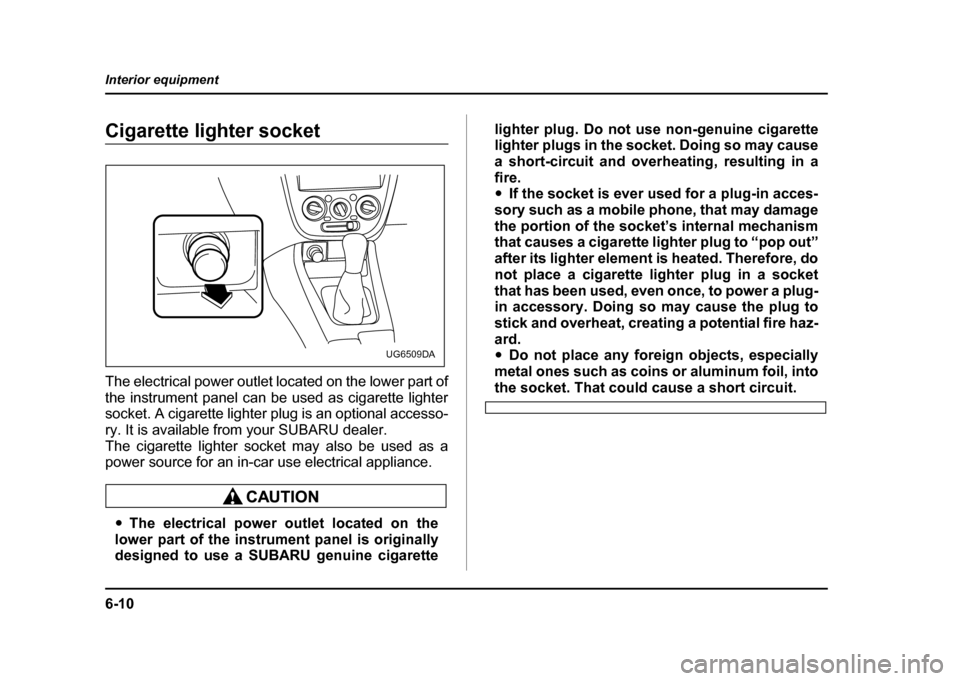
Cigarette lighter socket
The electrical power outlet located on the lower part of
the instrument panel can be used as cigarette lighter
socket. A cigarette lighter plug is an optional accesso-
ry. It is available from your SUBARU dealer.
The cigarette lighter socket may also be used as a
power source for an in-car use electrical appliance.
"
The electrical power outlet located on the
lower part of the instrument panel is originally
designed to use a SUBARU genuine cigarette lighter plug. Do not use non-genuine cigarette
lighter plugs in the socket. Doing so may cause
a short-circuit and overheating, resulting in afire. "
If the socket is ever used for a plug-in acces-
sory such as a mobile phone, that may damage
the portion of the socket’s internal mechanism
that causes a cigarette lighter plug to “pop out”
after its lighter element is heated. Therefore, do
not place a cigarette lighter plug in a socket
that has been used, even once, to power a plug-
in accessory. Doing so may cause the plug to
stick and overheat, creating a potential fire haz-
ard. " Do not place any foreign objects, especially
metal ones such as coins or aluminum foil, into
the socket. That could cause a short circuit.
UG6509DA
Page 260 of 491
6-11
Interior equipment
– CONTINUED –
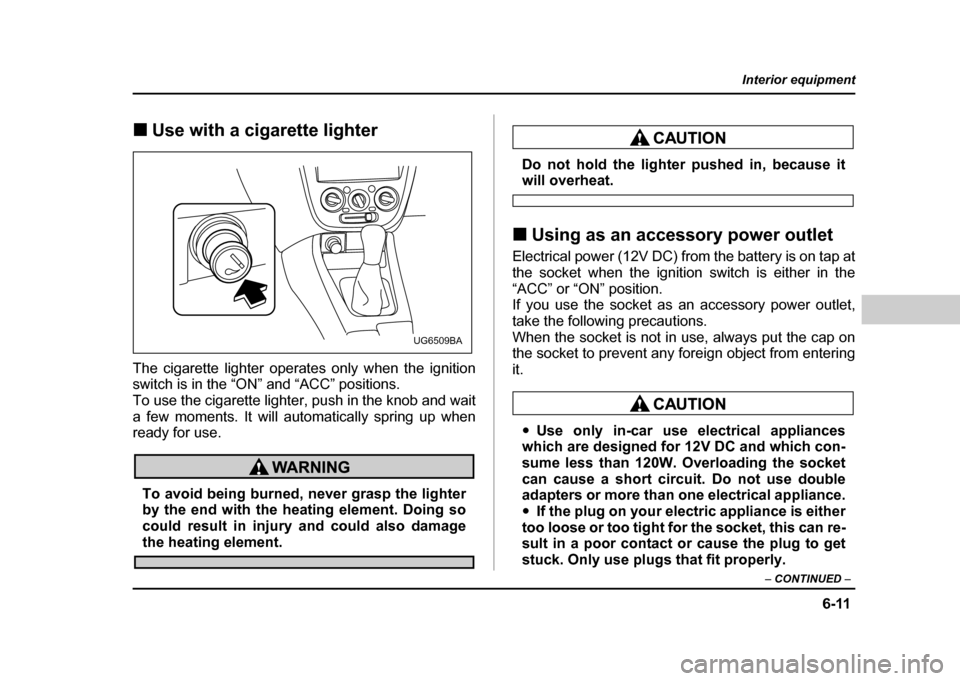
!Use with a cigarette lighter
The cigarette lighter operates only when the ignition
switch is in the “ON” and “ACC” positions.
To use the cigarette lighter, push in the knob and wait
a few moments. It will automatically spring up when
ready for use.
To avoid being burned, never grasp the lighter
by the end with the heating element. Doing so
could result in injury and could also damage
the heating element.
Do not hold the lighter pushed in, because itwill overheat.
! Using as an accessory power outlet
Electrical power (12V DC) from the battery is on tap at
the socket when the ignition switch is either in the
“ACC” or “ON” position.
If you use the socket as an accessory power outlet,
take the following precautions.
When the socket is not in use, always put the cap on
the socket to prevent any foreign object from entering it.
" Use only in-car use electrical appliances
which are designed for 12V DC and which con-
sume less than 120W. Overloading the socket
can cause a short circuit. Do not use double
adapters or more than one electrical appliance. " If the plug on your electric appliance is either
too loose or too tight for the socket, this can re-
sult in a poor contact or cause the plug to get
stuck. Only use plugs that fit properly.
UG6509BA
Page 297 of 491
7-28
Starting and operating
Power steering
The power steering system operates only when the
engine is running.
If you lose power steering assist because the engine
stops or the system fails to function, you can steer butit will take much more effort.
NOTE
Right after the engine has been started and before
it has warmed up, you may hear a noise coming
from areas adjacent to the power steering pump
which is located at the right-front area of the en-
gine compartment. This noise is normal. It does
not indicate power steering system trouble.
Do not hold the steering wheel at the fully
locked position left or right for more than five
seconds. This may damage the power steering
pump.
Braking !
Braking tips
Never rest your foot on the brake pedal while
driving. This can cause dangerous overheating
of the brakes and needless wear on the brake
pads and linings.
! When the brakes get wet
When driving in rain or after washing the vehicle, the
brakes may get wet. As a result, brake stopping dis-
tance will be longer. To dry the brakes, drive the vehi-
cle at a safe speed while lightly depressing the brake
pedal to heat up the brakes. ! Use of engine braking
Remember to make use of engine braking in addition
to foot braking. When descending a grade, if only the
foot brake is used, the brakes may start working im-
properly because of brake fluid overheating, caused
by overheated brake pads. To help prevent this, shift
into a lower gear to get stronger engine braking.
Page 350 of 491
8-39
Driving tips
– CONTINUED –
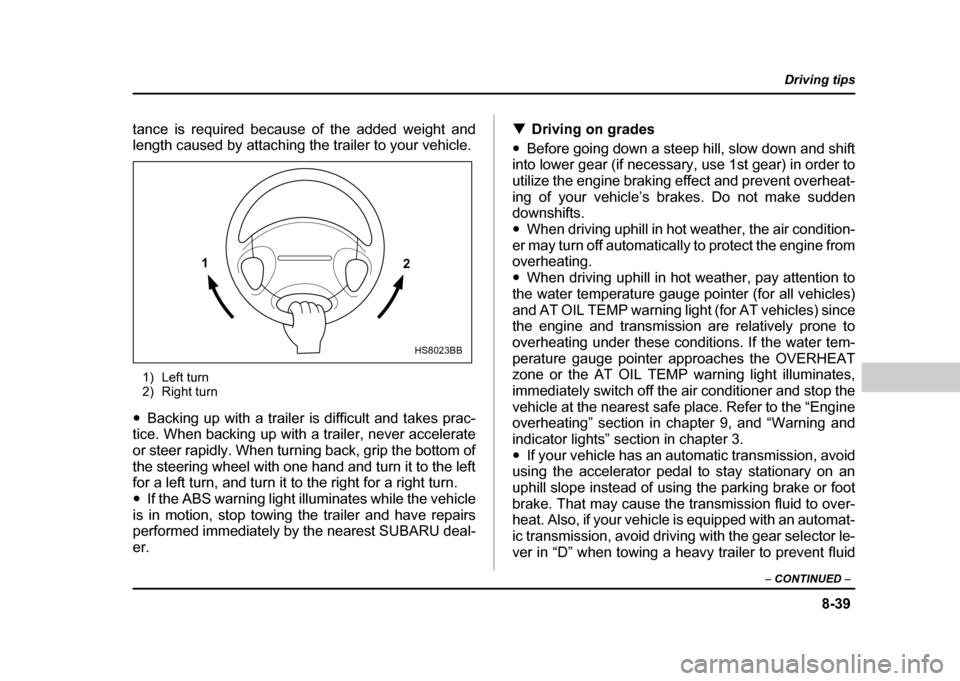
tance is required because of the added weight and
length caused by attaching the trailer to your vehicle.
1) Left turn
2) Right turn
" Backing up with a trailer is difficult and takes prac-
tice. When backing up with a trailer, never accelerate
or steer rapidly. When turning back, grip the bottom of
the steering wheel with one hand and turn it to the left
for a left turn, and turn it to the right for a right turn." If the ABS warning light illuminates while the vehicle
is in motion, stop towing the trailer and have repairs
performed immediately by the nearest SUBARU deal-er. !
Driving on grades
" Before going down a steep hill, slow down and shift
into lower gear (if necessary, use 1st gear) in order to
utilize the engine braking effect and prevent overheat-
ing of your vehicle’s brakes. Do not make sudden
downshifts. " When driving uphill in hot weather, the air condition-
er may turn off automatically to protect the engine from
overheating. " When driving uphill in hot weather, pay attention to
the water temperature gauge pointer (for all vehicles)
and AT OIL TEMP warning light (for AT vehicles) since
the engine and transmission are relatively prone to
overheating under these conditions. If the water tem-
perature gauge pointer approaches the OVERHEAT
zone or the AT OIL TEMP warning light illuminates,
immediately switch off the air conditioner and stop the
vehicle at the nearest safe place. Refer to the “Engine
overheating” section in chapter 9, and “Warning and
indicator lights” section in chapter 3." If your vehicle has an automatic transmission, avoid
using the accelerator pedal to stay stationary on an
uphill slope instead of using the parking brake or foot
brake. That may cause the transmission fluid to over-
heat. Also, if your vehicle is equipped with an automat-
ic transmission, avoid driving with the gear selector le-
ver in “D” when towing a heavy trailer to prevent fluid
1 2
HS8023BB
Page 351 of 491

8-40
Driving tips
overheating. A lower gear should be used. !
Parking on a grade
Always block the wheels under both vehicle and trailer
when parking. Apply the parking brake firmly. You
should not park on a hill or slope. But if parking on a
hill or slope cannot be avoided, you should take the
following steps:
1. Apply the brakes and hold the pedal down.
2. Have someone place wheel blocks under both the
vehicle and trailer wheels.
3. When the wheel blocks are in place, release the
regular brakes slowly until the blocks absorb the load.
4. Apply the regular brakes and then apply the park-
ing brake; slowly release the regular brakes.
5. Shift into 1st or reverse gear (manual transmission)
or “P” (automatic transmission) and shut off the en-
gine.
Page 352 of 491

9-1
9
In case of emergency
If you park your vehicle in case of an emergency ............................................ 9-2
Temporary spare tire .................................... 9-3
Flat tires ......................................................... 9-5 Changing a flat tire ........................................... 9-5
Jump starting ................................................ 9-14 How to jump start ............................................. 9-14
Engine overheating ....................................... 9-16 If steam is coming from the engine compartment .................................................. 9-16
If no steam is coming from the engine compartment .................................................. 9-16
Towing ........................................................... 9-17 Towing and tie-down hooks ............................ 9-18
Using a flat-bed truck ....................................... 9-20
Towing with all wheels on the ground ............ 9-21
Rear gate – if the rear gate cannot be unlocked ..................................................... 9-22
Moonroof – if the moonroof cannot be closed ......................................................... 9-23
Maintenance tools ......................................... 9-24 Jack and jack handle ........................................ 9-24
Page 367 of 491
9-16
In case of emergency
5. Start the engine of the vehicle with the booster bat-
tery and run it at moderate speed. Then start the en-
gine of the vehicle that has the discharged battery.
6. When finished, carefully disconnect the cables in
exactly the reverse order.Engine overheating
Never attempt to remove the radiator cap until
the engine has been shut off and has fully
cooled down. When the engine is hot, the cool-
ant is under pressure. Removing the cap while
the engine is still hot could release a spray of
boiling hot coolant, which could burn you very
seriously.
If the engine overheats, safely pull off the road and
stop the vehicle in a safe place. ! If steam is coming from the engine
compartment
Turn the engine off and get everyone away from the
vehicle until it cools down. ! If no steam is coming from the engine
compartment
1. Keep the engine running at idling speed.
2. Open the hood to ventilate the engine compart- ment.
Page 483 of 491

14-4
Index
Front
........................................................................... 11-33
Rear ............................................................................ 11-34
Dimensions .................................................................... 12-2
Disarming the system ................................................ 2-17
Disc brake pad wear warning indicators ............7-29
Dome light ............................................................ 6-2, 11-77
Door locks ....................................................................... 2-3
Door open warning lights .........................................3-25
Drive belts ....................................................................... 11-27
Driver’s control center differential ........................7-18
Auto indicator light ................................................ 3-26
Indicator light .......................................................... 3-27
Driving
Drinking ..................................................................... 8
Drugs .......................................................................... 9
Foreign countries .................................................. 8-6
Mobile phone .......................................................... 10
Pets ............................................................................. 10
Tips ........................................................... 7-14, 7-17, 8-7
Tired or sleepy ........................................................ 9
Snowy and icy roads ............................................ 8-13
E
EBD (Electronic brake force distribution) system ......................................................................... 7-32
Electrical system .......................................................... 12-3Electronic Brake force Distribution (EBD)
system .......................................................................... 7-32
Emergency Locking Retractor (ELR) ...................1-14
Engine Compartment overview ........................................11-8
Coolant ....................................................................... 11-19
Exhaust gas (Carbon monoxide) .....................8, 8-3
Hood ............................................................................ 11-5
Oil ................................................................................. 11-11
Overheating .............................................................. 9-16
Starting ....................................................................... 7-9
Stopping ..................................................................... 7-11
Exterior care ................................................................... 10-2
F
Flat tires ............................................................................ 9-5
Floor mat .......................................................................... 6-13
Fluid level
Automatic transmission .......................................11-31
Brake ........................................................................... 11-37
Clutch .......................................................................... 11-38
Power steering ........................................................ 11-36
Fog light switch ............................................................. 3-35
Folding down the rear seat .......................................1-12
Front Differential gear oil ................................................. 11-33
Fog light ..................................................................... 11-73
Page 485 of 491

14-6
Index
Keys
.................................................................................. 2-2
L
Leather seat materials ............................................... 10-6
Light control switch ..................................................... 3-29
Limited slip differential (LSD) .................................7-27
Loading your vehicle .................................................. 8-17
LSD (Limited slip differential) .................................7-27
M
Main fuse ........................................................................ 11-63
Maintenance Precautions .............................................................. 11-3
Schedule ................................................................... 11-3
Seatbelt ..................................................................... 1-27
Tools ........................................................................... 9-24
Manual climate control system ..............................4-4
Manual transmission 5 speed ..................................................................... 7-15
6 speed ..................................................................... 7-12
Manual transmission oil ............................................ 11-28
Map light ................................................................ 6-3, 11-77
Maximum load limits .................................................. 8-29
Meters and gauges .............................................. 3-7, 3-15
Mirrors .............................................................................. 3-44
Moonroof .............................................................. 2-31, 9-23N
New vehicle break-in driving –
the first 1,000 miles (1,600 km) ........................8-2
O
Odometer/Trip meter .......................................... 3-8, 3-15
Off road driving .............................................................. 8-8
Oil pressure warning light .........................................3-21
Oil filter .............................................................................. 11-12
Oil level
Engine ......................................................................... 11-11
Manual transmission ............................................. 11-28
Rear differential ...................................................... 11-34
Outside mirrors .............................................................. 3-47
Overheating engine ..................................................... 9-16
P
Parking Brake ........................................................................... 7-34
Brake stroke ............................................................. 11-44
Light switch ............................................................... 3-34
Tips .............................................................................. 7-35
Power
Door locking switches .......................................... 2-5
Steering ...................................................................... 7-28
Steering fluid ............................................................ 11-36