spare wheel SUBARU IMPREZA WRX 2004 2.G Owners Manual
[x] Cancel search | Manufacturer: SUBARU, Model Year: 2004, Model line: IMPREZA WRX, Model: SUBARU IMPREZA WRX 2004 2.GPages: 491, PDF Size: 5.93 MB
Page 14 of 491
11
–
CONTINUED –
!Driving with pets
Unrestrained pets can interfere with your driving and
distract your attention from driving. In a collision or
sudden stop, unrestrained pets or cages can be
thrown around inside the vehicle and hurt you or your
passengers. Besides, the pets can be hurt under
these situations. It is also for their own safety that pets
should be properly restrained in your vehicle. Restrain
a pet with a special traveling harness which can be se-
cured to the rear seat with a seatbelt or use a pet car-
rier which can be secured to the rear seat by routing a
seatbelt through the carrier’s handle. Never restrain
pets or pet carriers in the front passenger’s seat. For
further information, consult your veterinarian, local an-
imal protection society or pet shop. ! Tire pressures
Check and, if necessary, adjust the pressure of each
tire (including the spare) at least once a month and be-
fore any long journey.
Check the tire pressure when the tires are cold. Use a
pressure gauge to adjust the tire pressures to the val-
ues shown on the tire placard.
Refer to the “Tires and wheels” section in chapter 11
for detailed information.
Driving at high speeds with excessively low tire
pressures can cause the tires to deform severe-
ly and to rapidly become hot. A sharp increase
in temperature could cause tread separation,
and destruction of the tires. The resulting loss
of vehicle control could lead to an accident.
! California proposition 65 warning
Engine exhaust, some of its constituents, and
certain vehicle components contain or emit
chemicals known to the State of California to
cause cancer and birth defects or other repro-
ductive harm. In addition, certain fluids in vehi-
cles and certain components of product wear
contain or emit chemicals known to the State of
California to cause cancer and birth defects or
other reproductive harm.
Page 289 of 491
7-20
Starting and operating
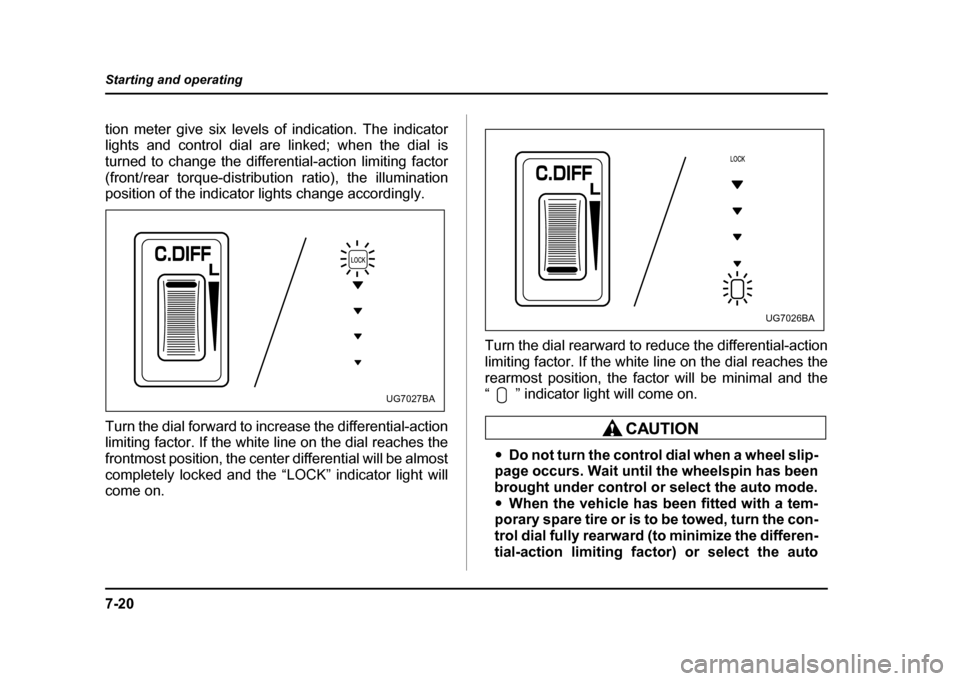
tion meter give six levels of indication. The indicator
lights and control dial are linked; when the dial is
turned to change the differential-action limiting factor
(front/rear torque-distribution ratio), the illumination
position of the indicator lights change accordingly.
Turn the dial forward to increase the differential-action
limiting factor. If the white line on the dial reaches the
frontmost position, the center differential will be almost
completely locked and the “LOCK” indicator light will come on.
Turn the dial rearward to reduce the differential-action
limiting factor. If the white line on the dial reaches the
rearmost position, the factor will be minimal and the
“ ” indicator light will come on.
"
Do not turn the control dial when a wheel slip-
page occurs. Wait until the wheelspin has been
brought under control or select the auto mode." When the vehicle has been fitted with a tem-
porary spare tire or is to be towed, turn the con-
trol dial fully rearward (to minimize the differen-
tial-action limiting factor) or select the auto
UG7027BA
UG7026BA
Page 296 of 491
7-27
Starting and operating
– CONTINUED –
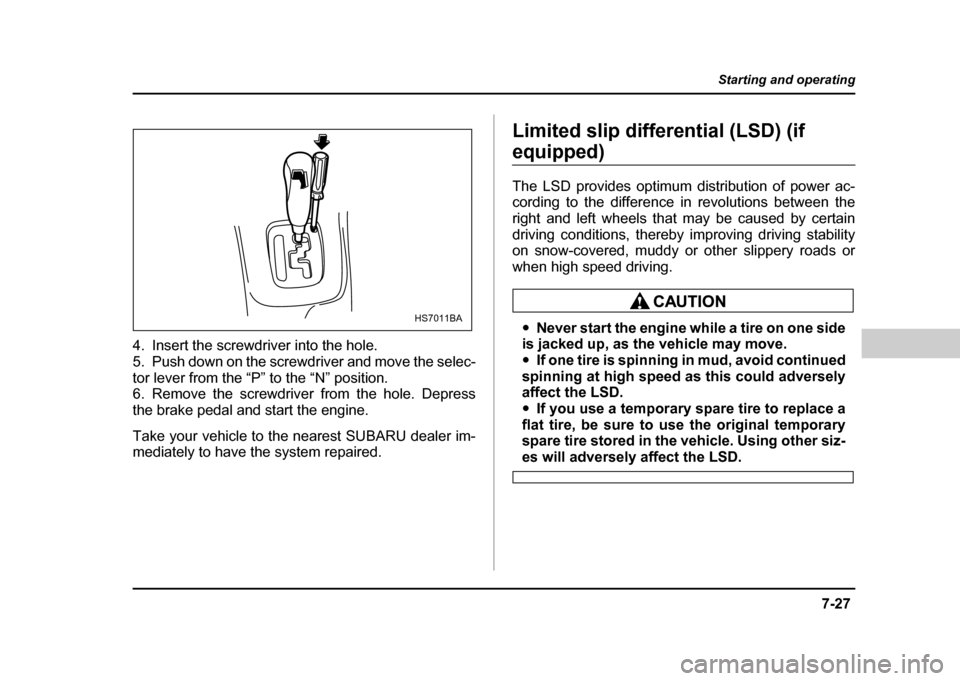
4. Insert the screwdriver into the hole.
5. Push down on the screwdriver and move the selec-
tor lever from the “P” to the “N” position.
6. Remove the screwdriver from the hole. Depress
the brake pedal and start the engine.
Take your vehicle to the nearest SUBARU dealer im-
mediately to have the system repaired. Limited slip differential (LSD) (if
equipped)
The LSD provides optimum distribution of power ac-
cording to the difference in revolutions between the
right and left wheels that may be caused by certain
driving conditions, thereby improving driving stability
on snow-covered, muddy or other slippery roads or
when high speed driving.
"
Never start the engine while a tire on one side
is jacked up, as the vehicle may move. " If one tire is spinning in mud, avoid continued
spinning at high speed as this could adversely
affect the LSD." If you use a temporary spare tire to replace a
flat tire, be sure to use the original temporary
spare tire stored in the vehicle. Using other siz-
es will adversely affect the LSD.
HS7011BA
Page 318 of 491
8-7
Driving tips
– CONTINUED –
Driving tips for AWD vehicles
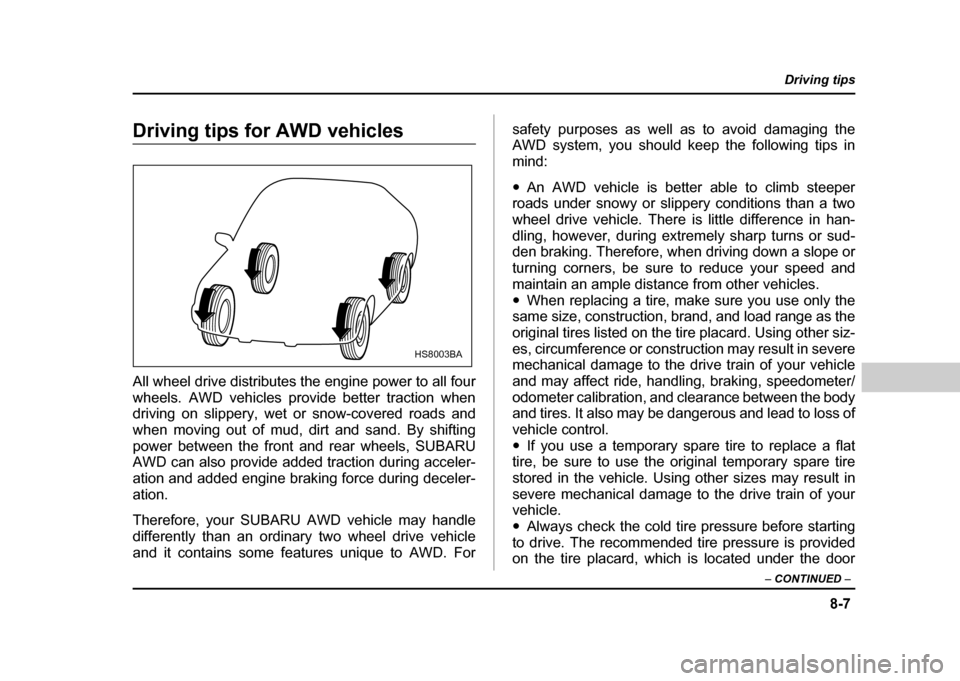
All wheel drive distributes the engine power to all four
wheels. AWD vehicles provide better traction when
driving on slippery, wet or snow-covered roads and
when moving out of mud, dirt and sand. By shifting
power between the front and rear wheels, SUBARU
AWD can also provide added traction during acceler-
ation and added engine braking force during deceler-
ation.
Therefore, your SUBARU AWD vehicle may handle
differently than an ordinary two wheel drive vehicle
and it contains some features unique to AWD. For safety purposes as well as to avoid damaging the
AWD system, you should keep the following tips in mind: "
An AWD vehicle is better able to climb steeper
roads under snowy or slippery conditions than a two
wheel drive vehicle. There is little difference in han-
dling, however, during extremely sharp turns or sud-
den braking. Therefore, when driving down a slope or
turning corners, be sure to reduce your speed and
maintain an ample distance from other vehicles." When replacing a tire, make sure you use only the
same size, construction, brand, and load range as the
original tires listed on the tire placard. Using other siz-
es, circumference or construction may result in severe
mechanical damage to the drive train of your vehicle
and may affect ride, handling, braking, speedometer/
odometer calibration, and clearance between the body
and tires. It also may be dangerous and lead to loss of
vehicle control." If you use a temporary spare tire to replace a flat
tire, be sure to use the original temporary spare tire
stored in the vehicle. Using other sizes may result in
severe mechanical damage to the drive train of your
vehicle. " Always check the cold tire pressure before starting
to drive. The recommended tire pressure is provided
on the tire placard, which is located under the door
HS8003BA
Page 327 of 491
8-16
Driving tips
dent.
Your vehicle is equipped with “summer tires” as origi-
nal equipment, which are inadequate for driving on
slippery roads such as on snow-covered or icy roads.
Compared with winter and all-season tires, summer
tires give significantly less grip on snowy and icy road
surfaces. Therefore, use of winter tires is strongly rec-
ommended when driving with such road conditions.
When you choose to install winter tires on your vehi-
cle, be sure to use the correct tire size and type. You
must install four winter tires that are of the same size,
construction, brand and load range and you should
never mix radial, belted bias or bias tires since this
may result in dangerous handling characteristics.
When you choose a tire, make sure that there is
enough clearance between the tire and vehicle body.
Remember to drive with care at all times regardless of
the type of tires on your vehicle. ! Tire chains
Driving on snowy grades or icy roads may require the
use of tire chains, in which case put the chains on the
front wheels only. Use only SAE class S type chains
that are of the correct size for your tires so as not to damage the vehicle body or suspension.
When driving with tire chains, drive at speeds below
19 mph (30 km/h).
When a temporary spare tire is on a front wheel, re-
place the temporary spare tire with the rear tire on the
same side of the vehicle, and then fit chains on the
front tires.
Always use the utmost care when driving with tire
chains — overconfidence because you are driving
with tire chains could easily lead to a serious accident.
Tire chains cannot be used on tires listed below
because of lack of clearance between the tires
and vehicle body. "
225/45R17 tires for WRX-STi
"Optional 215/45R17 tires for WRX
! Rocking the vehicle
If you must rock the vehicle to free it from snow, sand,
or mud, depress the accelerator pedal slightly and
move the selector lever back and forth between “D”
and “R” repeatedly. Do not race the engine. For the
best possible traction, avoid spinning the wheels when
Page 352 of 491

9-1
9
In case of emergency
If you park your vehicle in case of an emergency ............................................ 9-2
Temporary spare tire .................................... 9-3
Flat tires ......................................................... 9-5 Changing a flat tire ........................................... 9-5
Jump starting ................................................ 9-14 How to jump start ............................................. 9-14
Engine overheating ....................................... 9-16 If steam is coming from the engine compartment .................................................. 9-16
If no steam is coming from the engine compartment .................................................. 9-16
Towing ........................................................... 9-17 Towing and tie-down hooks ............................ 9-18
Using a flat-bed truck ....................................... 9-20
Towing with all wheels on the ground ............ 9-21
Rear gate – if the rear gate cannot be unlocked ..................................................... 9-22
Moonroof – if the moonroof cannot be closed ......................................................... 9-23
Maintenance tools ......................................... 9-24 Jack and jack handle ........................................ 9-24
Page 355 of 491
9-4
In case of emergency
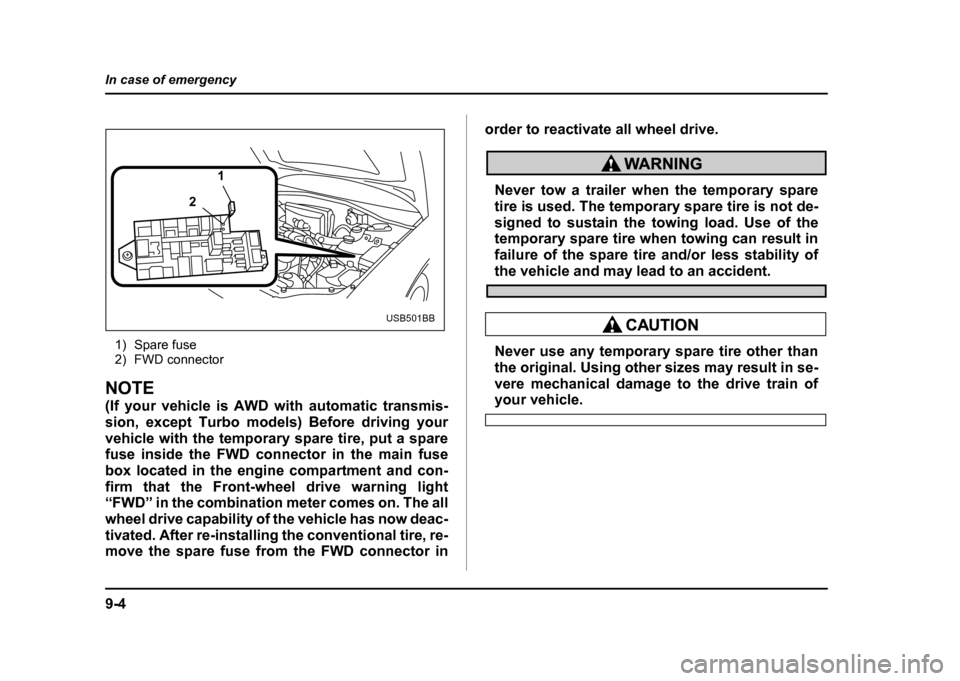
1) Spare fuse
2) FWD connector
NOTE
(If your vehicle is AWD with automatic transmis-
sion, except Turbo models) Before driving your
vehicle with the temporary spare tire, put a sparefuse inside the FWD connector in the main fuse
box located in the engine compartment and con-
firm that the Front-wheel drive warning light
“FWD” in the combination meter comes on. The all
wheel drive capability of the vehicle has now deac-
tivated. After re-installing the conventional tire, re-
move the spare fuse from the FWD connector in
order to reactivate all wheel drive.
Never tow a trailer when the temporary spare
tire is used. The temporary spare tire is not de-
signed to sustain the towing load. Use of the
temporary spare tire when towing can result in
failure of the spare tire and/or less stability of
the vehicle and may lead to an accident.
Never use any temporary spare tire other than
the original. Using other sizes may result in se-
vere mechanical damage to the drive train of
your vehicle.
1
2
USB501BB
Page 357 of 491
9-6
In case of emergency
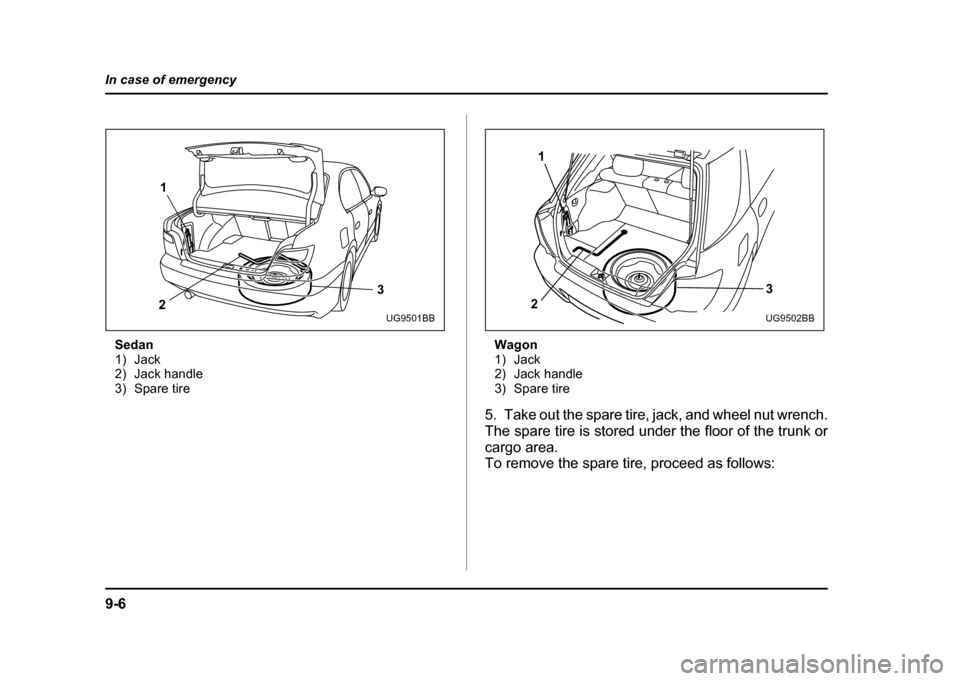
Sedan
1) Jack
2) Jack handle
3) Spare tire
Wagon
1) Jack
2) Jack handle
3) Spare tire
5. Take out the spare tire, jack, and wheel nut wrench.
The spare tire is stored under the floor of the trunk or
cargo area.
To remove the spare tire, proceed as follows:
1
2 3
UG9501BB
3
1
2
UG9502BB
Page 362 of 491
9-11
In case of emergency
– CONTINUED –
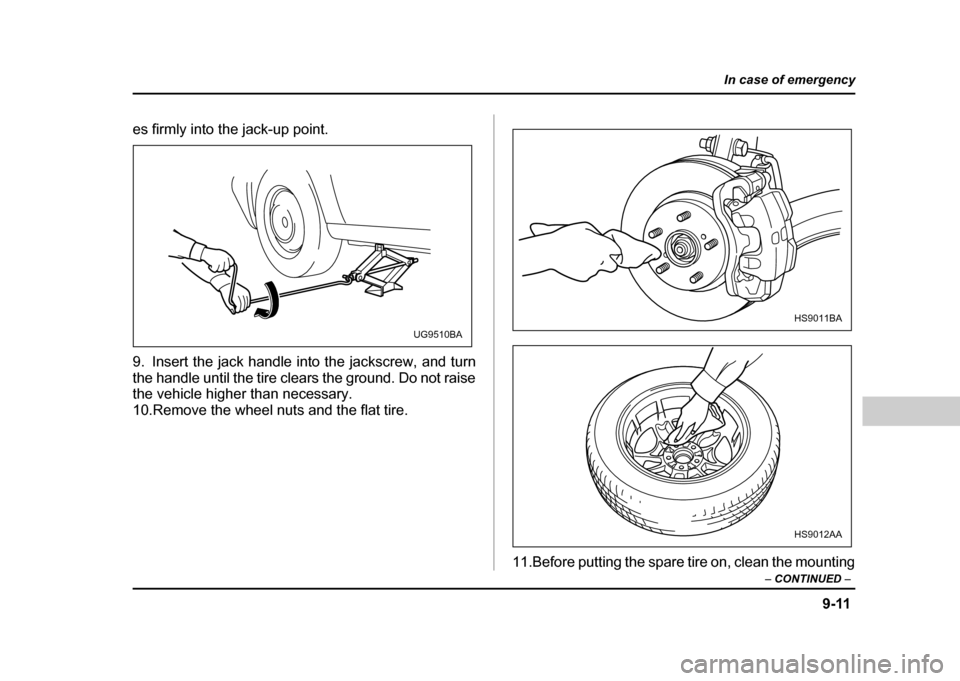
es firmly into the jack-up point.
9. Insert the jack handle into the jackscrew, and turn
the handle until the tire clears the ground. Do not raise
the vehicle higher than necessary.
10.Remove the wheel nuts and the flat tire.
11.Before putting the spare tire on, clean the mounting
UG9510BAHS9011BA
HS9012AA
Page 363 of 491
9-12
In case of emergency
surface of the wheel and hub with a cloth.
12.Put on the spare tire. Replace the wheel nuts.
Tighten them by hand.
Do not use oil or grease on the wheel studs or
nuts when the spare tire is installed. This could
cause the nuts to become loose and lead to an
accident.
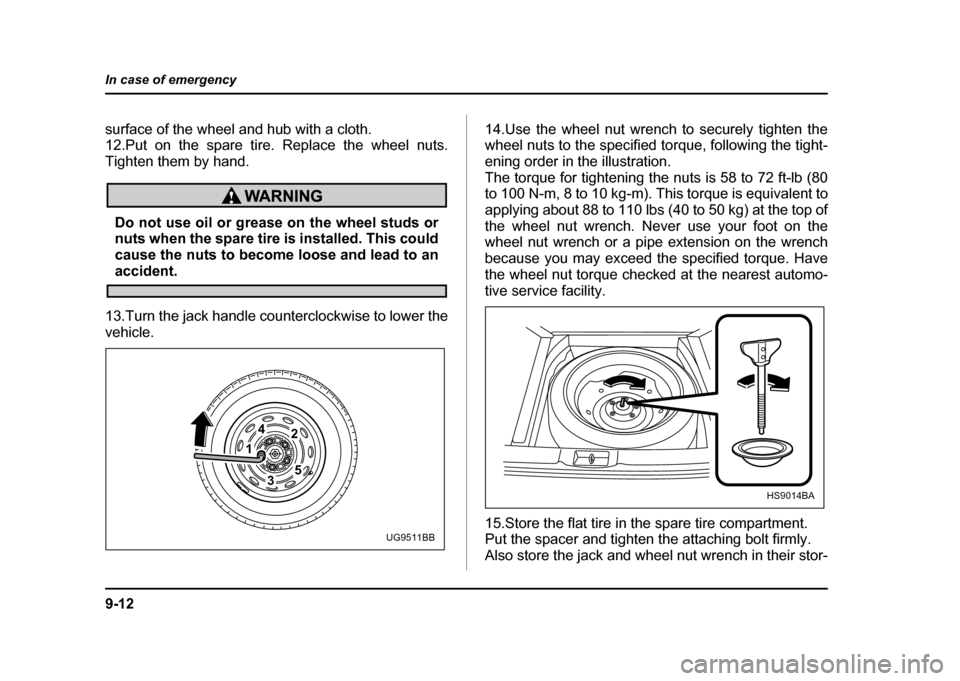
13.Turn the jack handle counterclockwise to lower the
vehicle. 14.Use the wheel nut wrench to securely tighten the
wheel nuts to the specified torque, following the tight-
ening order in the illustration.
The torque for tightening the nuts is 58 to 72 ft-lb (80
to 100 N-m, 8 to 10 kg-m). This torque is equivalent to
applying about 88 to 110 lbs (40 to 50 kg) at the top of
the wheel nut wrench. Never use your foot on the
wheel nut wrench or a pipe extension on the wrench
because you may exceed the specified torque. Have
the wheel nut torque checked at the nearest automo-
tive service facility.
15.Store the flat tire in the spare tire compartment.
Put the spacer and tighten the attaching bolt firmly.
Also store the jack and wheel nut wrench in their stor-
1
42
53
UG9511BB
HS9014BA