light SUBARU IMPREZA WRX 2007 3.G User Guide
[x] Cancel search | Manufacturer: SUBARU, Model Year: 2007, Model line: IMPREZA WRX, Model: SUBARU IMPREZA WRX 2007 3.GPages: 364, PDF Size: 11.91 MB
Page 22 of 364
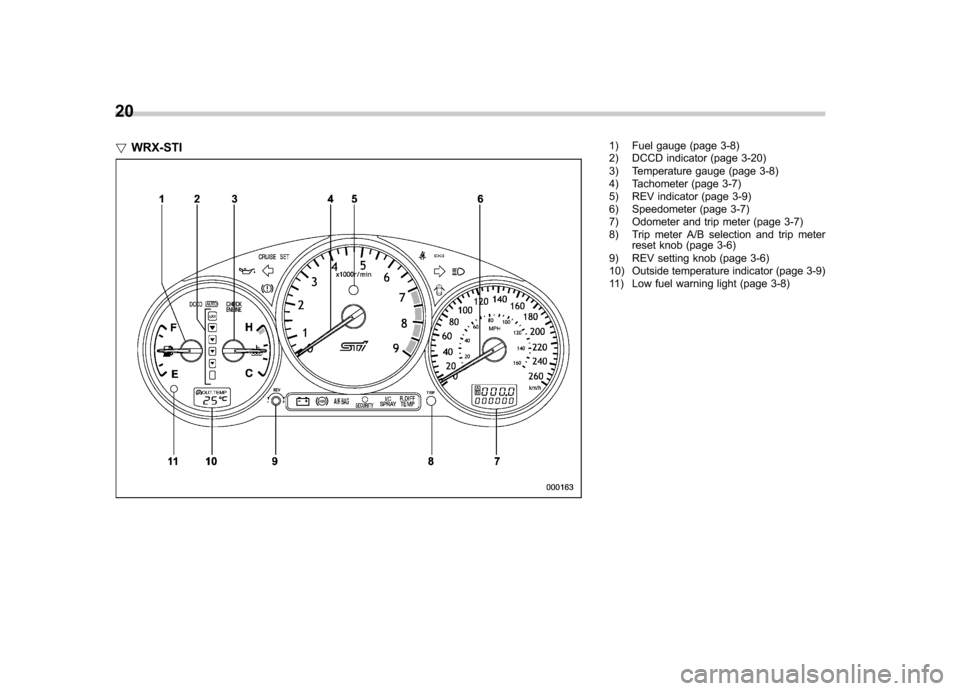
20 !WRX-STI
1) Fuel gauge (page 3-8)
2) DCCD indicator (page 3-20)
3) Temperature gauge (page 3-8)
4) Tachometer (page 3-7)
5) REV indicator (page 3-9)
6) Speedometer (page 3-7)
7) Odometer and trip meter (page 3-7)
8) Trip meter A/B selection and trip meter
reset knob (page 3-6)
9) REV setting knob (page 3-6)
10) Outside temperature indicator (page 3-9)
11) Low fuel warning light (page 3-8)
Page 23 of 364

!Except turbo models1) Fuel gauge (page 3-12)
2) Selector lever position indicator
(page 3-20)
3) Temperature gauge (page 3-13)
4) Speedometer (page 3-11)
5) Tachometer (page 3-12)
6) Trip meter A/B selection and trip meter reset knob (page 3-11)
7) Odometer and trip meter (page 3-11)
8) Outside temperature indicator (page 3-13)
9) Low fuel warning light (page 3-12) 21
– CONTINUED –
Page 24 of 364

22
&WARNING AND INDICATOR LIGHT
Mark Name Page
Seatbelt warning light 3-14
SRS airbag system
warning light 3-14
orPassenger airbag ON
indicator light3-15
orPassenger airbag OFF
indicator light3-15
CHECK ENGINE
warning light/Malfunction
indicator lamp3-16
Charge warning light 3-16
Oil pressure warning light
3-16
AT OIL temperature
warning light (if equipped)3-17Mark Name Page
orABS warning light 3-17
orBrake system warning light
3-18
Door open warning light 3-19
All-Wheel Drive warning
light (if equipped)3-19
Turn signal indicator lights3-20
High beam indicator light 3-20
Security indicator light
2-4,
2-13
Intercooler water spray
warning light (if
equipped) 3-19
Lights indicator light (if
equipped)
3-21
Cruise control indicator light3-20Mark Name Page
Cruise control set indi-
cator light
3-20
REV indicator light (if
equipped)3-21
Rear differential oil tem-
perature warning light (if
equipped)3-17
Driver
’s control center
differential auto indicator
light (if equipped) 3-20
Driver
’s control center
differential indicator light
(if equipped) 3-21
Driver
’s control center
differential indicator and
warning lights (if
equipped) 3-21
Page 26 of 364
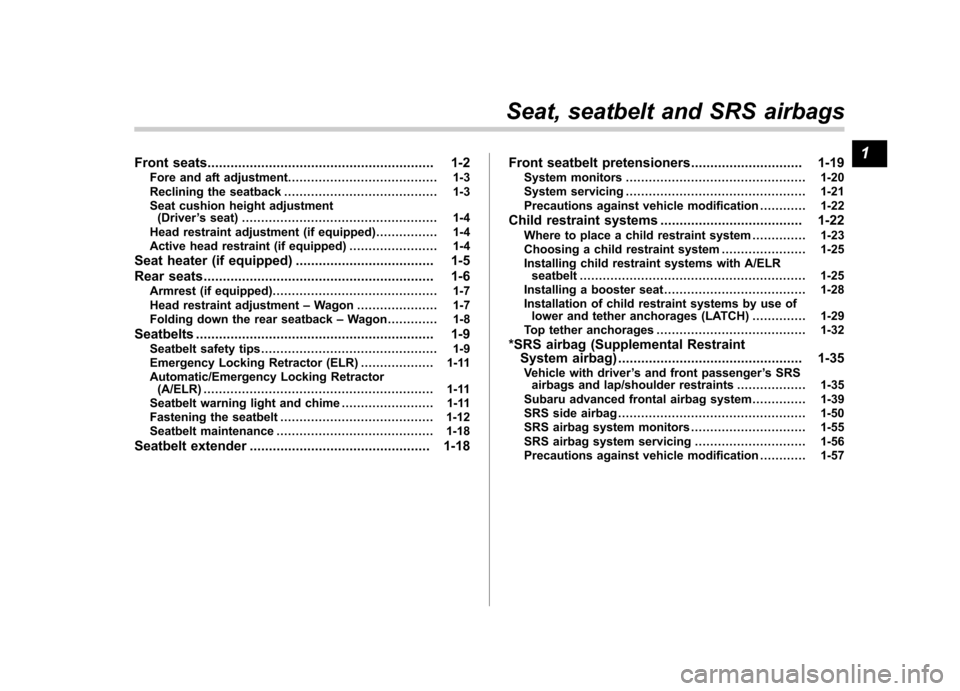
Front seats........................................................... 1-2
Fore and aft adjustment ....................................... 1-3
Reclining the seatback ........................................ 1-3
Seat cushion height adjustment (Driver ’s seat) ................................................... 1-4
Head restraint adjustment (if equipped) ................ 1-4
Active head restraint (if equipped) ....................... 1-4
Seat heater (if equipped) .................................... 1-5
Rear seats ............................................................ 1-6
Armrest (if equipped) ........................................... 1-7
Head restraint adjustment –Wagon ..................... 1-7
Folding down the rear seatback –Wagon. ............ 1-8
Seatbelts .............................................................. 1-9
Seatbelt safety tips .............................................. 1-9
Emergency Locking Retractor (ELR) ................... 1-11
Automatic/Emergency Locking Retractor (A/ELR) ............................................................ 1-11
Seatbelt warning light and chime ........................ 1-11
Fastening the seatbelt ........................................ 1-12
Seatbelt maintenance ......................................... 1-18
Seatbelt extender ............................................... 1-18 Front seatbelt pretensioners
............................. 1-19
System monitors ............................................... 1-20
System servicing ............................................... 1-21
Precautions against vehicle modification ............ 1-22
Child restraint systems ..................................... 1-22
Where to place a child restraint system .............. 1-23
Choosing a child restraint system ...................... 1-25
Installing child restraint systems with A/ELR seatbelt ........................................................... 1-25
Installing a booster seat ..................................... 1-28
Installation of child restraint systems by use of lower and tether anchorages (LATCH) .............. 1-29
Top tether anchorages ....................................... 1-32
*SRS airbag (Supplemental Restraint System airbag) ................................................ 1-35
Vehicle with driver ’s and front passenger ’s SRS
airbags and lap/shoulder restraints .................. 1-35
Subaru advanced frontal airbag system .............. 1-39
SRS side airbag ................................................. 1-50
SRS airbag system monitors .............................. 1-55
SRS airbag system servicing ... .......................... 1-56
Precautions against vehicle modification ............ 1-57
Seat, seatbelt and SRS airbags1
Page 27 of 364
1-2Seat, seatbelt and SRS airbags
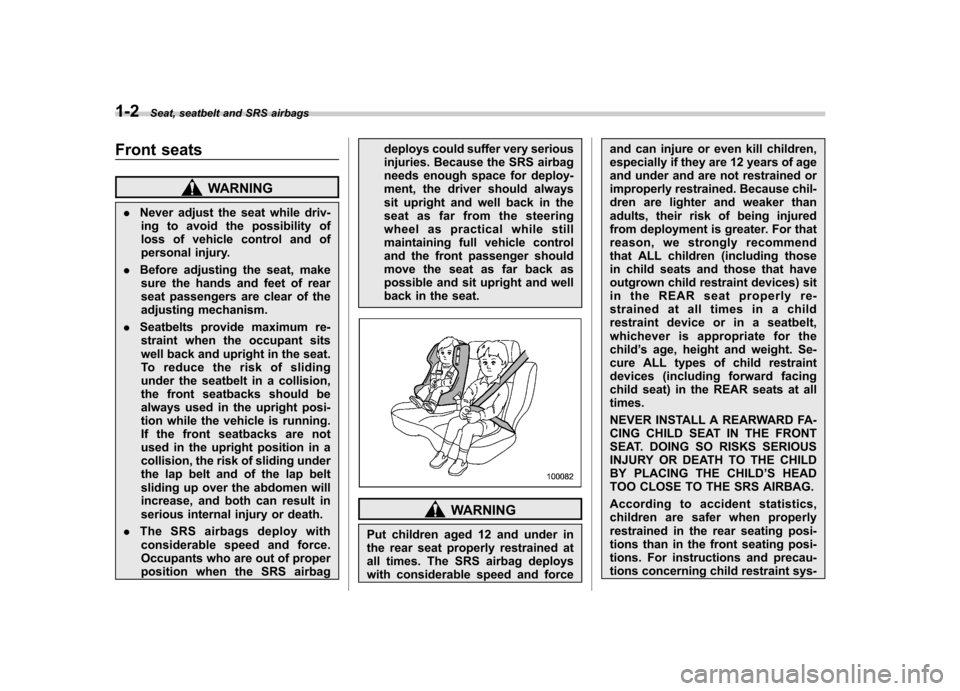
Front seats
WARNING
. Never adjust the seat while driv-
ing to avoid the possibility of
loss of vehicle control and of
personal injury.
. Before adjusting the seat, make
sure the hands and feet of rear
seat passengers are clear of the
adjusting mechanism.
. Seatbelts provide maximum re-
straint when the occupant sits
well back and upright in the seat.
To reduce the risk of sliding
under the seatbelt in a collision,
the front seatbacks should be
always used in the upright posi-
tion while the vehicle is running.
If the front seatbacks are not
used in the upright position in a
collision, the risk of sliding under
the lap belt and of the lap belt
sliding up over the abdomen will
increase, and both can result in
serious internal injury or death.
. The SRS airbags deploy with
considerable speed and force.
Occupants who are out of proper
position when the SRS airbag deploys could suffer very serious
injuries. Because the SRS airbag
needs enough space for deploy-
ment, the driver should always
sit upright and well back in the
seat as far from the steering
wheel as practical while still
maintaining full vehicle control
and the front passenger should
move the seat as far back as
possible and sit upright and well
back in the seat.
WARNING
Put children aged 12 and under in
the rear seat properly restrained at
all times. The SRS airbag deploys
with considerable speed and force and can injure or even kill children,
especially if they are 12 years of age
and under and are not restrained or
improperly restrained. Because chil-
dren are lighter and weaker than
adults, their risk of being injured
from deployment is greater. For that
reason, we strongly recommend
that ALL children (including those
in child seats and those that have
outgrown child restraint devices) sit
in the REAR seat properly re-
strained at all times in a child
restraint device or in a seatbelt,
whichever is appropriate for thechild
’s age, height and weight. Se-
cure ALL types of child restraint
devices (including forward facing
child seat) in the REAR seats at alltimes.
NEVER INSTALL A REARWARD FA-
CING CHILD SEAT IN THE FRONT
SEAT. DOING SO RISKS SERIOUS
INJURY OR DEATH TO THE CHILD
BY PLACING THE CHILD ’S HEAD
TOO CLOSE TO THE SRS AIRBAG.
According to accident statistics,
children are safer when properly
restrained in the rear seating posi-
tions than in the front seating posi-
tions. For instructions and precau-
tions concerning child restraint sys-
Page 28 of 364
tems, see the“Child restraint sys-
tems ”section in this chapter.
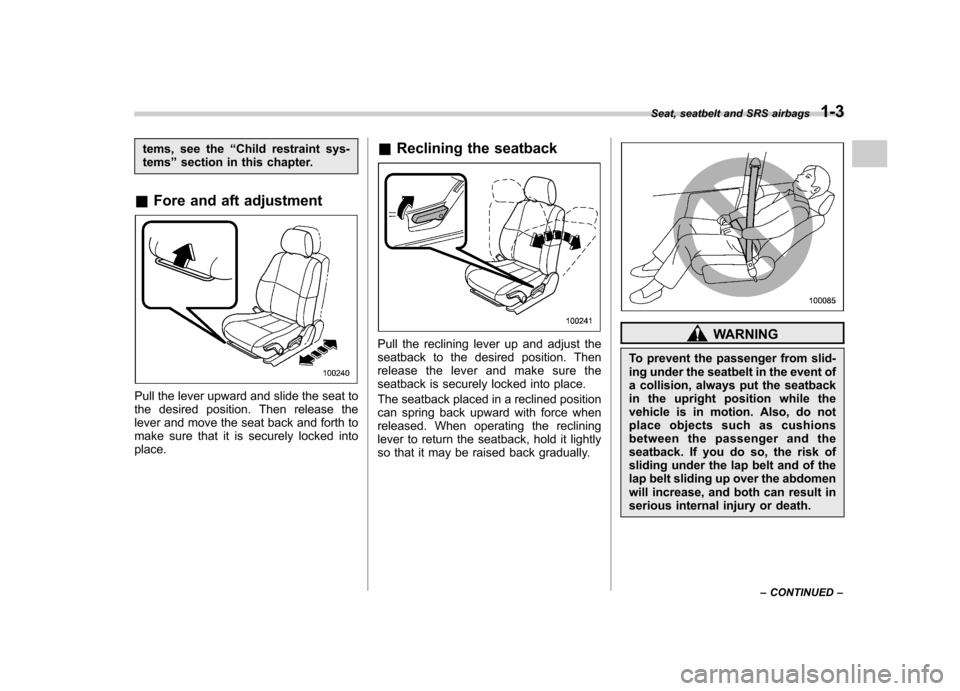
& Fore and aft adjustment
Pull the lever upward and slide the seat to
the desired position. Then release the
lever and move the seat back and forth to
make sure that it is securely locked intoplace. &
Reclining the seatback
Pull the reclining lever up and adjust the
seatback to the desired position. Then
release the lever and make sure the
seatback is securely locked into place.
The seatback placed in a reclined position
can spring back upward with force when
released. When operating the reclining
lever to return the seatback, hold it lightly
so that it may be raised back gradually.WARNING
To prevent the passenger from slid-
ing under the seatbelt in the event of
a collision, always put the seatback
in the upright position while the
vehicle is in motion. Also, do not
place objects such as cushions
between the passenger and the
seatback. If you do so, the risk of
sliding under the lap belt and of the
lap belt sliding up over the abdomen
will increase, and both can result in
serious internal injury or death. Seat, seatbelt and SRS airbags
1-3
– CONTINUED –
Page 29 of 364
1-4Seat, seatbelt and SRS airbags
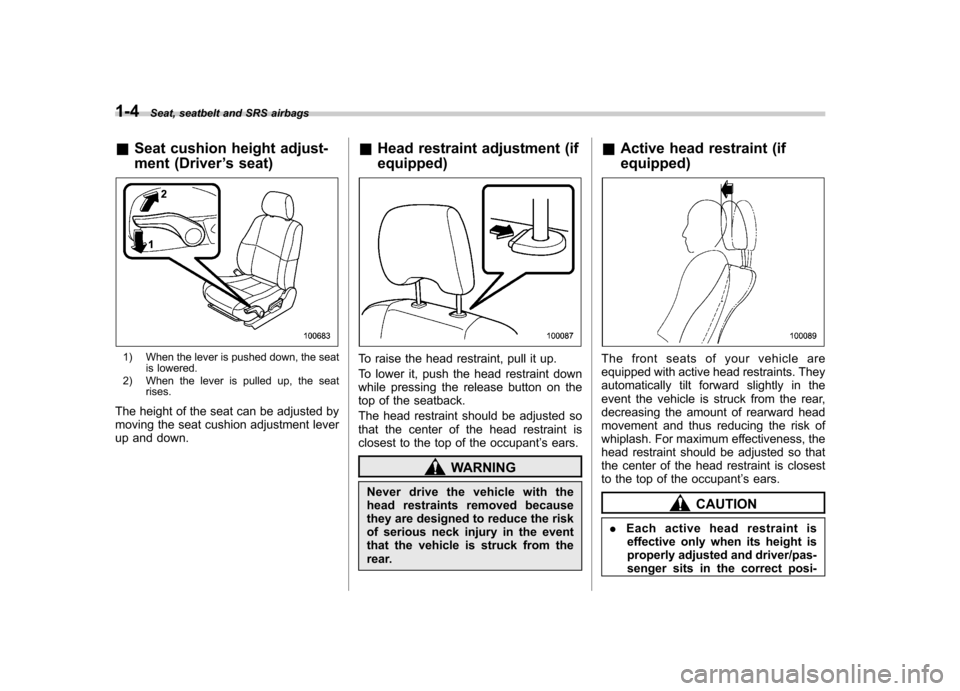
&Seat cushion height adjust-
ment (Driver ’s seat)
1) When the lever is pushed down, the seat
is lowered.
2) When the lever is pulled up, the seat rises.
The height of the seat can be adjusted by
moving the seat cushion adjustment lever
up and down. &
Head restraint adjustment (if equipped)To raise the head restraint, pull it up.
To lower it, push the head restraint down
while pressing the release button on the
top of the seatback.
The head restraint should be adjusted so
that the center of the head restraint is
closest to the top of the occupant ’s ears.
WARNING
Never drive the vehicle with the
head restraints removed because
they are designed to reduce the risk
of serious neck injury in the event
that the vehicle is struck from the
rear. &
Active head restraint (if equipped)
The front seats of your vehicle are
equipped with active head restraints. They
automatically tilt forward slightly in the
event the vehicle is struck from the rear,
decreasing the amount of rearward head
movement and thus reducing the risk of
whiplash. For maximum effectiveness, the
head restraint should be adjusted so that
the center of the head restraint is closest
to the top of the occupant ’s ears.
CAUTION
. Each active head restraint is
effective only when its height is
properly adjusted and driver/pas-
senger sits in the correct posi-
Page 30 of 364

tion on the seat.
. If your vehicle is involved in a
rear-end collision, have an
authorized SUBARU dealer in-
spect the active head restraints.
. The active head restraints may
not operate in the event the
vehicle experiences only a slight
impact in the rear.
. The active head restraints may be
damaged if they are pushed hard
from behind or subjected to
shock. As a result, they may not
function if the vehicle suffers a
rear impact. Seat heater (if equipped)
Driver
’s side
1) HI–Rapid heating
2) LO–Normal heating
Front passenger ’s side
1) HI–Rapid heating
2) LO–Normal heating
The seat heater operates when the igni-
tion switch is either in the “Acc ”or “ON ”
position.
To turn on the seat heater, push the “LO ”
or “HI ”position on the switch, as desired,
depending on the temperature. Selecting the “HI ”position will cause the seat to heat
up quicker.
The indicator located on the switch comes
on when the seat heater is in operation.
When the vehicle ’s interior is warmed
enough or before you leave the vehicle,
be sure to turn the switch off. Seat, seatbelt and SRS airbags
1-5
– CONTINUED –
Page 31 of 364
1-6Seat, seatbelt and SRS airbags
CAUTION
. There is a possibility that people
with delicate skin may suffer
slight burns even at low tempera-
tures if he/she uses the seat
heater for a long period of time.
When using the heater, always be
sure to warn the persons con-cerned.
. Do not put anything on the seat
which insulates against heat,
such as a blanket, cushion, or
similar items. This may cause the
seat heater to overheat.
NOTE
Use of the seat heater for a long period
of time while the engine is not running
can cause battery discharge. Rear seats
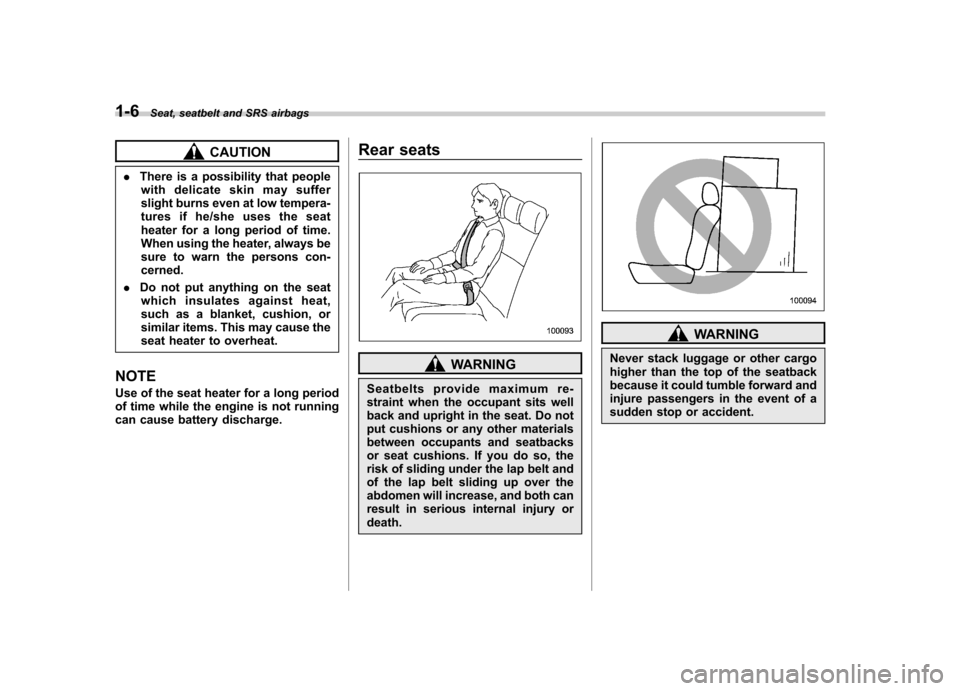
WARNING
Seatbelts provide maximum re-
straint when the occupant sits well
back and upright in the seat. Do not
put cushions or any other materials
between occupants and seatbacks
or seat cushions. If you do so, the
risk of sliding under the lap belt and
of the lap belt sliding up over the
abdomen will increase, and both can
result in serious internal injury ordeath.
WARNING
Never stack luggage or other cargo
higher than the top of the seatback
because it could tumble forward and
injure passengers in the event of a
sudden stop or accident.
Page 35 of 364
1-10Seat, seatbelt and SRS airbags
the rear seat properly restrained
at all times. The SRS airbag
deploys with considerable speed
and force and can injure or even
kill children, especially if they are
12 years of age and under and
are not restrained or improperly
restrained. Because children are
lighter and weaker than adults,
their risk of being injured from
deployment is greater. For that
reason, we strongly recommend
that ALL children (including
those in child seats and those
that have outgrown child re-
straint devices) sit in the REAR
seat properly restrained at all
times in a child restraint device
or in a seatbelt, whichever is
appropriate for the child ’s height
and weight.
Secure ALL types of child re-
straint devices (including for-
ward facing child seats) in the
REAR seats at all times.
NEVER INSTALL A REARWARD
FACING CHILD SEAT IN THE
FRONT SEAT. DOING SO RISKS
SERIOUS INJURY OR DEATH TO
THE CHILD BY PLACING THECHILD ’S HEAD TOO CLOSE TO
THE SRS AIRBAG. According to accident statistics,
children are safer when properly
restrained in the rear seating
positions than in the front seat-
ing positions. For instructions
and precautions concerning the
child restraint system, see the“
Child restraint systems ”section
in this chapter.
Your vehicle is equipped with a crash
sensing and diagnostic module, which will
record the use of the seatbelt(s) by the
driver and front passenger when any of
the SRS frontal and side airbags deploy. ! Infants or small children
Use a child restraint system that is
suitable for your vehicle. See informationon “Child restraint systems ”in this chap-
ter. ! Children
If a child is too big for a child restraint
system, the child should sit in the rear seat
and be restrained using the seatbelts.
According to accident statistics, children
are safer when properly restrained in the
rear seating positions than in the front
seating positions. Never allow a child to
stand up or kneel on the seat.
If the shoulder portion of the belt crosses the face or neck, adjust the shoulder belt
anchor height (window-side seating posi-
tions only) and then if necessary move the
child closer to the belt buckle to help
provide a good shoulder belt fit. Care must
be taken to securely place the lap belt as
low as possible on the hips and not on thechild
’s waist. If the shoulder portion of the
belt cannot be properly positioned, a child
restraint system should be used. Never
place the shoulder belt under the child ’s
arm or behind the child ’s back.
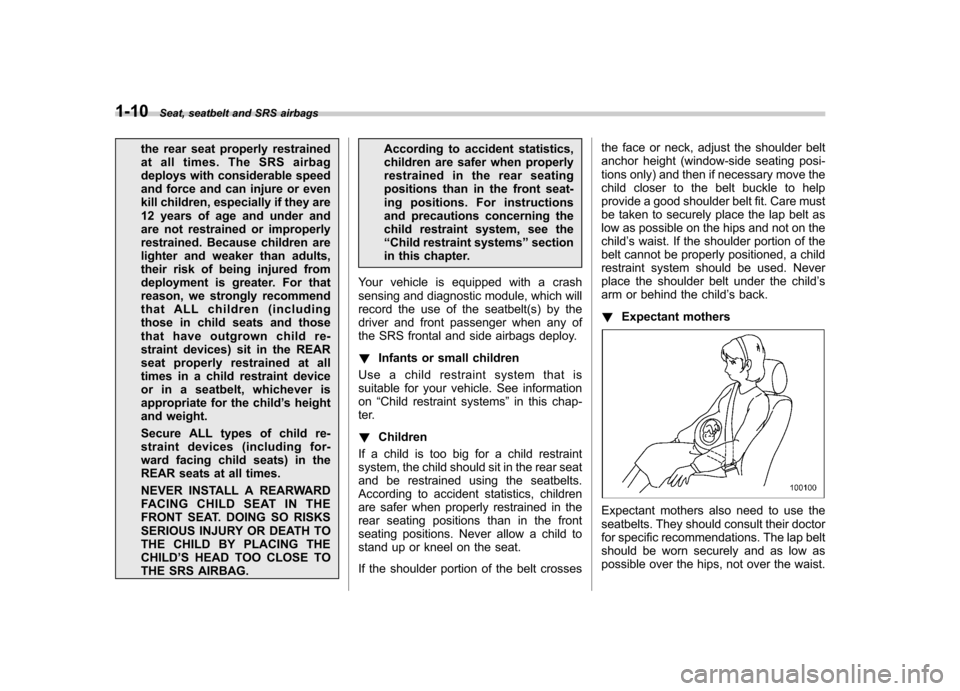
! Expectant mothers
Expectant mothers also need to use the
seatbelts. They should consult their doctor
for specific recommendations. The lap belt
should be worn securely and as low as
possible over the hips, not over the waist.