button SUBARU IMPREZA WRX 2007 3.G Owners Manual
[x] Cancel search | Manufacturer: SUBARU, Model Year: 2007, Model line: IMPREZA WRX, Model: SUBARU IMPREZA WRX 2007 3.GPages: 364, PDF Size: 11.91 MB
Page 12 of 364
10
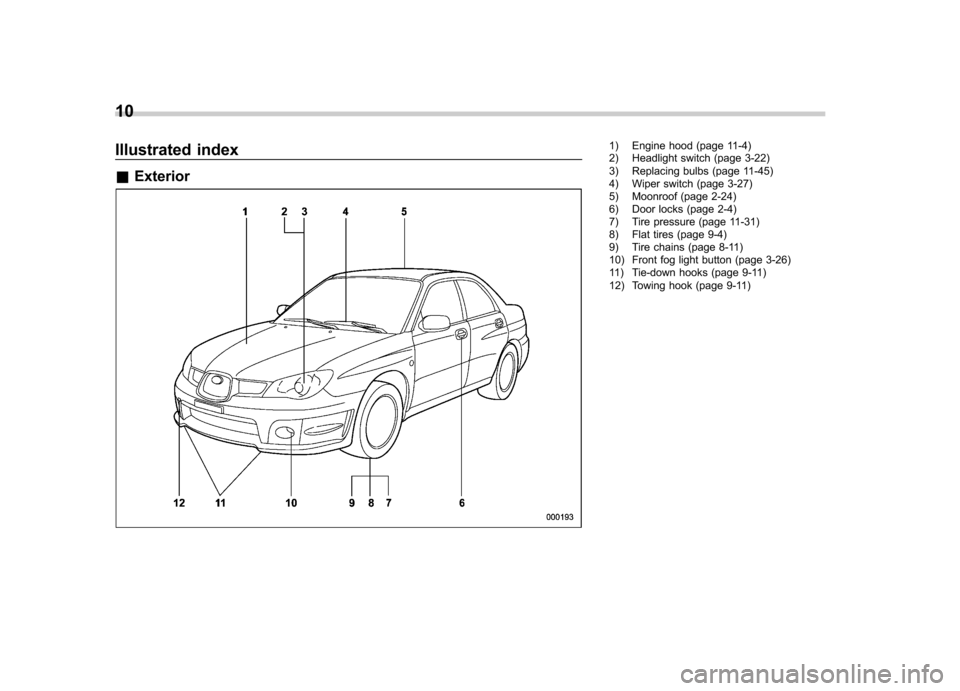
Illustrated index &Exterior1) Engine hood (page 11-4)
2) Headlight switch (page 3-22)
3) Replacing bulbs (page 11-45)
4) Wiper switch (page 3-27)
5) Moonroof (page 2-24)
6) Door locks (page 2-4)
7) Tire pressure (page 11-31)
8) Flat tires (page 9-4)
9) Tire chains (page 8-11)
10) Front fog light button (page 3-26)
11) Tie-down hooks (page 9-11)
12) Towing hook (page 9-11)
Page 13 of 364
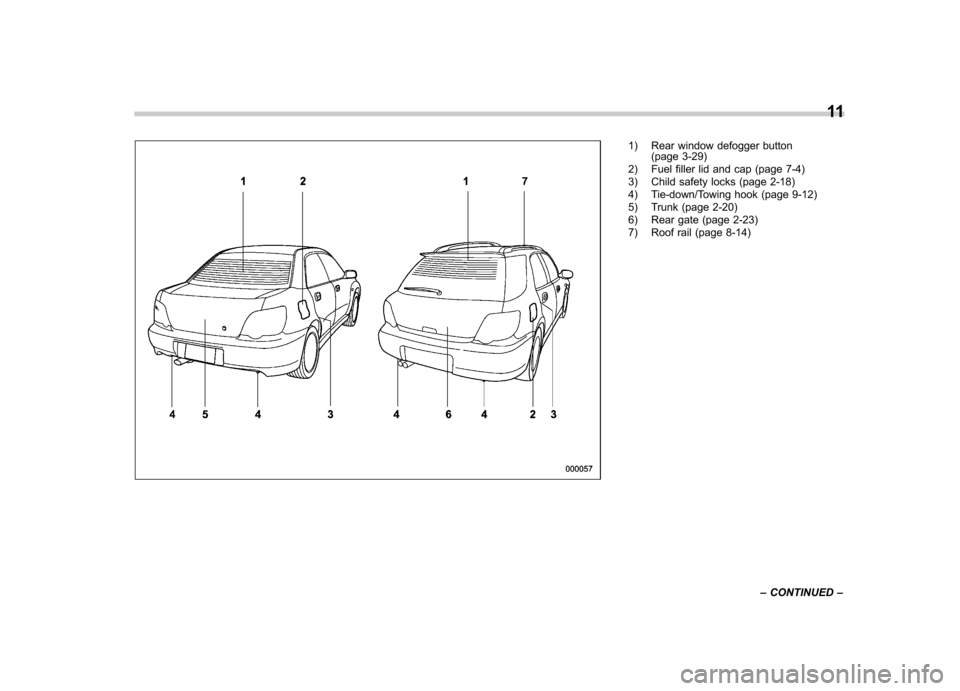
1) Rear window defogger button(page 3-29)
2) Fuel filler lid and cap (page 7-4)
3) Child safety locks (page 2-18)
4) Tie-down/Towing hook (page 9-12)
5) Trunk (page 2-20)
6) Rear gate (page 2-23)
7) Roof rail (page 8-14) 11
– CONTINUED –
Page 29 of 364
1-4Seat, seatbelt and SRS airbags
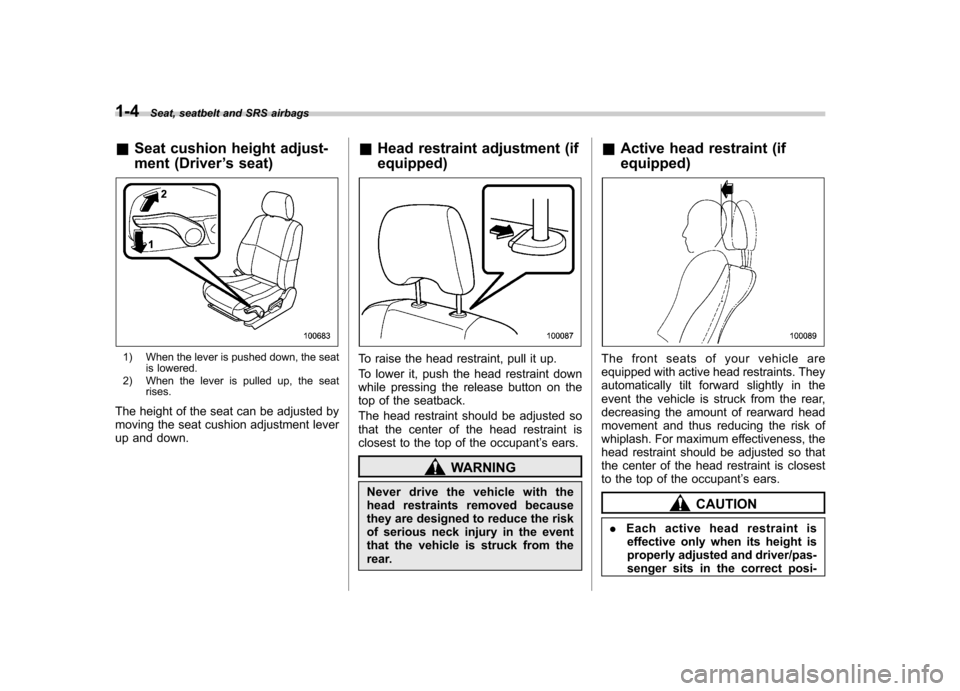
&Seat cushion height adjust-
ment (Driver ’s seat)
1) When the lever is pushed down, the seat
is lowered.
2) When the lever is pulled up, the seat rises.
The height of the seat can be adjusted by
moving the seat cushion adjustment lever
up and down. &
Head restraint adjustment (if equipped)To raise the head restraint, pull it up.
To lower it, push the head restraint down
while pressing the release button on the
top of the seatback.
The head restraint should be adjusted so
that the center of the head restraint is
closest to the top of the occupant ’s ears.
WARNING
Never drive the vehicle with the
head restraints removed because
they are designed to reduce the risk
of serious neck injury in the event
that the vehicle is struck from the
rear. &
Active head restraint (if equipped)
The front seats of your vehicle are
equipped with active head restraints. They
automatically tilt forward slightly in the
event the vehicle is struck from the rear,
decreasing the amount of rearward head
movement and thus reducing the risk of
whiplash. For maximum effectiveness, the
head restraint should be adjusted so that
the center of the head restraint is closest
to the top of the occupant ’s ears.
CAUTION
. Each active head restraint is
effective only when its height is
properly adjusted and driver/pas-
senger sits in the correct posi-
Page 33 of 364
1-8Seat, seatbelt and SRS airbags
!Rear windows side seating position
CAUTION
The head restraint is not intended to
be used at the lowest position.
Before sitting on the seat, raise the
head restraint to an appropriate
position depending on your sittingheight.
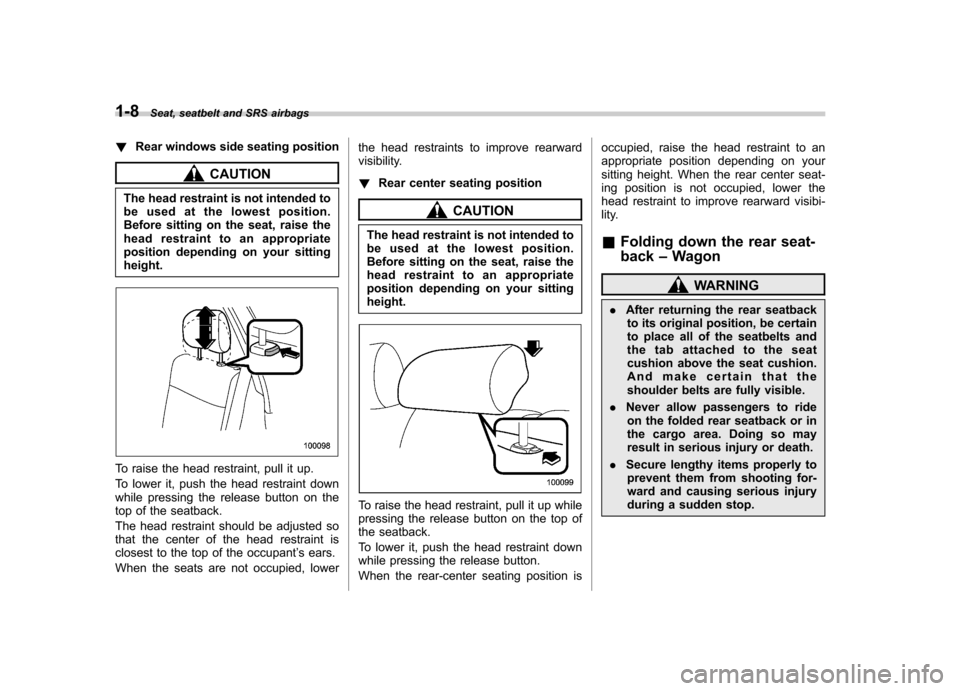
To raise the head restraint, pull it up.
To lower it, push the head restraint down
while pressing the release button on the
top of the seatback.
The head restraint should be adjusted so
that the center of the head restraint is
closest to the top of the occupant ’s ears.
When the seats are not occupied, lower the head restraints to improve rearward
visibility. !
Rear center seating position
CAUTION
The head restraint is not intended to
be used at the l owest position.
Before sitting on the seat, raise the
head restraint to an appropriate
position depending on your sittingheight.
To raise the head restraint, pull it up while
pressing the release button on the top of
the seatback.
To lower it, push the head restraint down
while pressing the release button.
When the rear-center seating position is occupied, raise the head restraint to an
appropriate position depending on your
sitting height. When the rear center seat-
ing position is not occupied, lower the
head restraint to improve rearward visibi-
lity. &
Folding down the rear seat- back –Wagon
WARNING
. After returning the rear seatback
to its original position, be certain
to place all of the seatbelts and
the tab attached to the seat
cushion above the seat cushion.
And make certain that the
shoulder belts are fully visible.
. Never allow passengers to ride
on the folded rear seatback or in
the cargo area. Doing so may
result in serious injury or death.
. Secure lengthy items properly to
prevent them from shooting for-
ward and causing serious injury
during a sudden stop.
Page 38 of 364
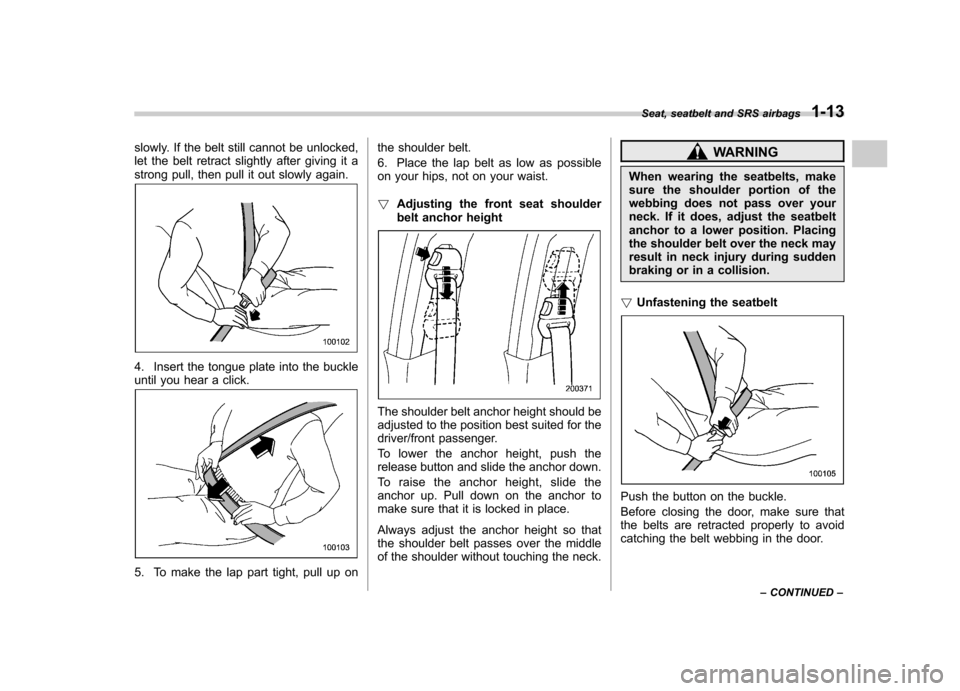
slowly. If the belt still cannot be unlocked,
let the belt retract slightly after giving it a
strong pull, then pull it out slowly again.
4. Insert the tongue plate into the buckle
until you hear a click.
5. To make the lap part tight, pull up onthe shoulder belt.
6. Place the lap belt as low as possible
on your hips, not on your waist. !
Adjusting the front seat shoulder
belt anchor height
The shoulder belt anchor height should be
adjusted to the position best suited for the
driver/front passenger.
To lower the anchor height, push the
release button and slide the anchor down.
To raise the anchor height, slide the
anchor up. Pull down on the anchor to
make sure that it is locked in place.
Always adjust the anchor height so that
the shoulder belt passes over the middle
of the shoulder without touching the neck.
WARNING
When wearing the seatbelts, make
sure the shoulder portion of the
webbing does not pass over your
neck. If it does, adjust the seatbelt
anchor to a lower position. Placing
the shoulder belt over the neck may
result in neck injury during sudden
braking or in a collision.
! Unfastening the seatbelt
Push the button on the buckle.
Before closing the door, make sure that
the belts are retracted properly to avoid
catching the belt webbing in the door. Seat, seatbelt and SRS airbags
1-13
– CONTINUED –
Page 39 of 364
1-14Seat, seatbelt and SRS airbags
! Rear seatbelts (except rear center
seatbelt on Wagon)
1. Sit well back in the seat.
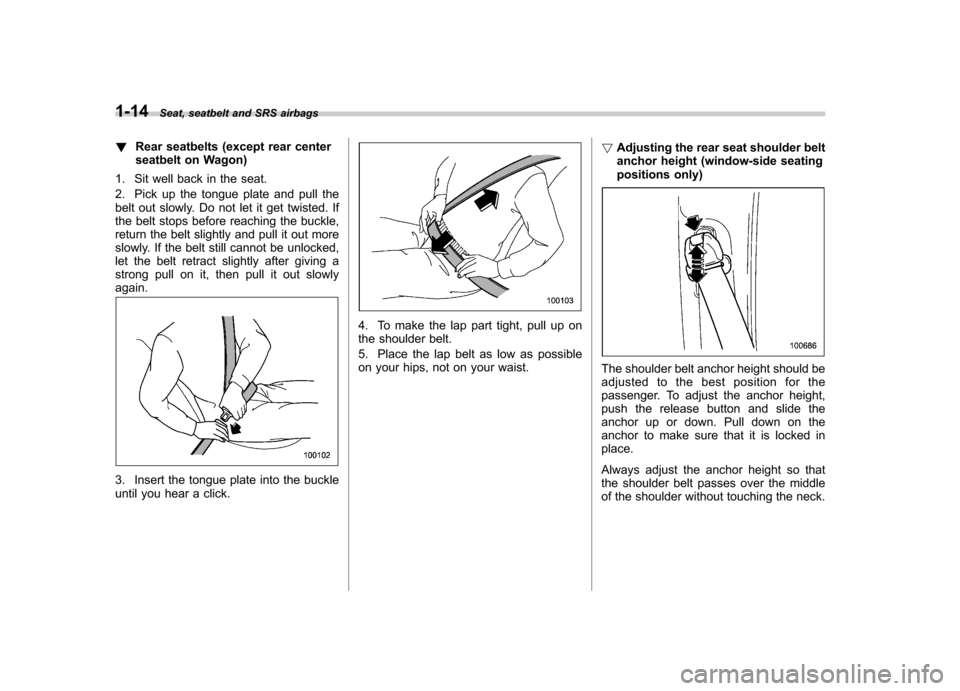
2. Pick up the tongue plate and pull the
belt out slowly. Do not let it get twisted. If
the belt stops before reaching the buckle,
return the belt slightly and pull it out more
slowly. If the belt still cannot be unlocked,
let the belt retract slightly after giving a
strong pull on it, then pull it out slowlyagain.
3. Insert the tongue plate into the buckle
until you hear a click.
4. To make the lap part tight, pull up on
the shoulder belt.
5. Place the lap belt as low as possible
on your hips, not on your waist. !
Adjusting the rear seat shoulder belt
anchor height (window-side seating
positions only)
The shoulder belt anchor height should be
adjusted to the best position for the
passenger. To adjust the anchor height,
push the release button and slide the
anchor up or down. Pull down on the
anchor to make sure that it is locked inplace.
Always adjust the anchor height so that
the shoulder belt passes over the middle
of the shoulder without touching the neck.
Page 40 of 364
WARNING
When wearing the seatbelts, make
sure the shoulder portion of the
webbing does not pass over your
neck. If it does, adjust the seatbelt
anchor to a lower position. Placing
the shoulder belt over the neck may
result in neck injury during sudden
braking or in a collision.
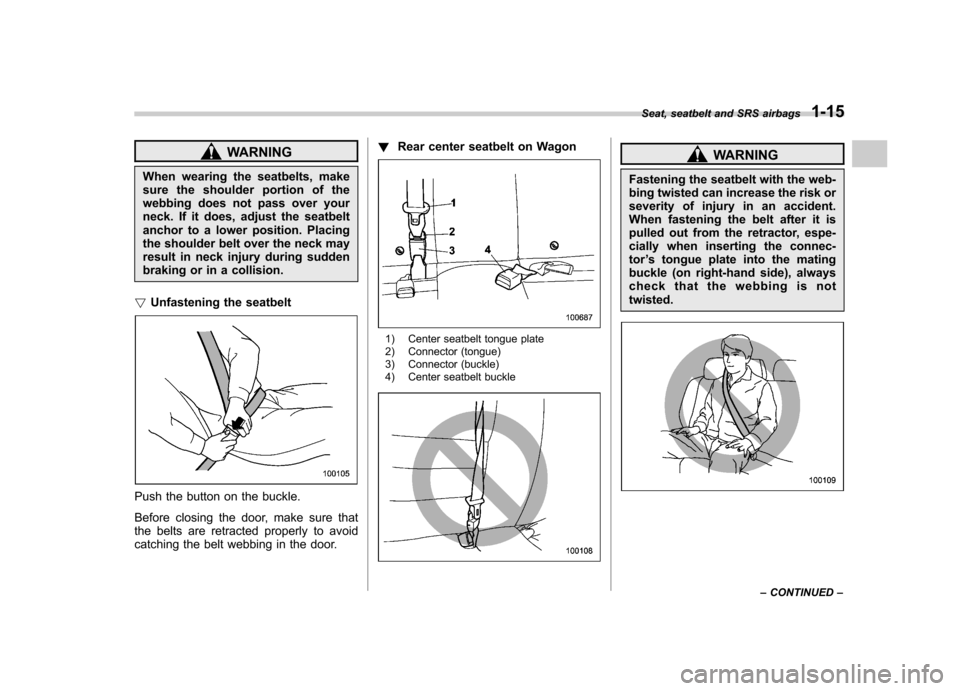
! Unfastening the seatbelt
Push the button on the buckle.
Before closing the door, make sure that
the belts are retracted properly to avoid
catching the belt webbing in the door. !
Rear center seatbelt on Wagon
1) Center seatbelt tongue plate
2) Connector (tongue)
3) Connector (buckle)
4) Center seatbelt buckle
WARNING
Fastening the seatbelt with the web-
bing twisted can increase the risk or
severity of injury in an accident.
When fastening the belt after it is
pulled out from the retractor, espe-
cially when inserting the connec-tor ’s tongue plate into the mating
buckle (on right-hand side), always
check that the webbing is nottwisted.
Seat, seatbelt and SRS airbags 1-15
– CONTINUED –
Page 42 of 364
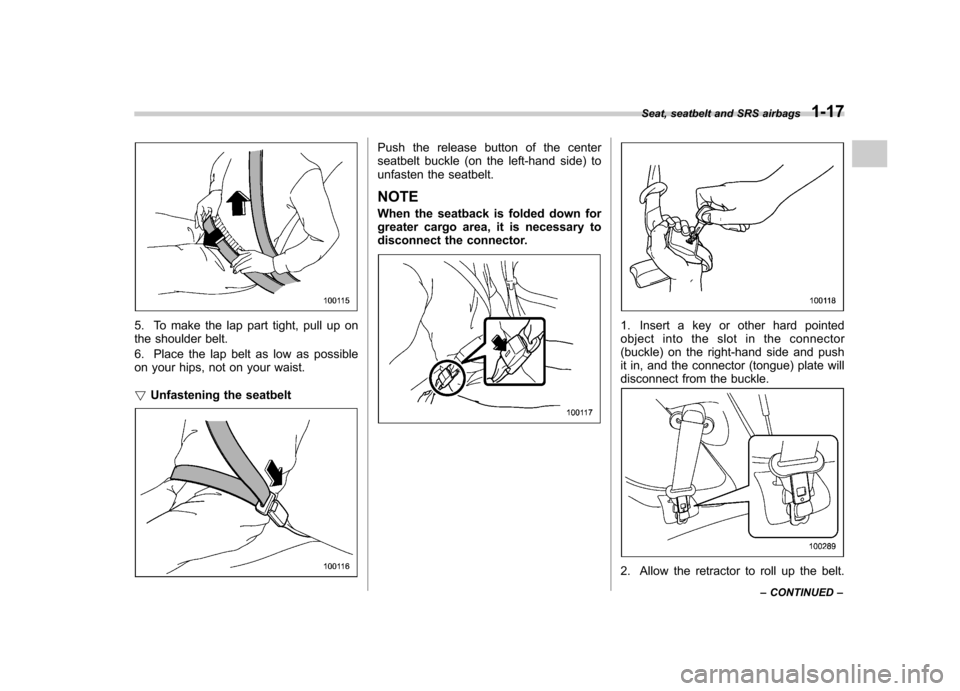
5. To make the lap part tight, pull up on
the shoulder belt.
6. Place the lap belt as low as possible
on your hips, not on your waist. !Unfastening the seatbelt
Push the release button of the center
seatbelt buckle (on the left-hand side) to
unfasten the seatbelt. NOTE
When the seatback is folded down for
greater cargo area, it is necessary to
disconnect the connector.
1. Insert a key or other hard pointed
object into the slot in the connector
(buckle) on the right-hand side and push
it in, and the connector (tongue) plate will
disconnect from the buckle.
2. Allow the retractor to roll up the belt. Seat, seatbelt and SRS airbags
1-17
– CONTINUED –
Page 44 of 364
and warnings could reduce the
effectiveness of the seatbelt and
result in more serious injury in the
event of a collision. .Never use the extender when the
belt itself is long enough to
permit it to be buckled properly.
If removal of heavy clothing is all
that is needed to permit the
seatbelt to be buckled properly,
remove the heavy clothing and
do not use the extender.
. Do not use the extender if the
buckle of the extender rests over
the abdomen.
. Do not let someone else use the
extender. Use of an extender
when it is not needed could
reduce the effectiveness of the
seatbelt and result in more ser-
ious injury in the event of acollision.
. Use the extender only for the
front seatbelts and only for the
model for which it was originally
provided. Never use the extender
for the rear seatbelts or for a
different model. NOTE
When the seatbelt extender is used by
a pregnant passenger, consult a doctor
to get approval in advance.
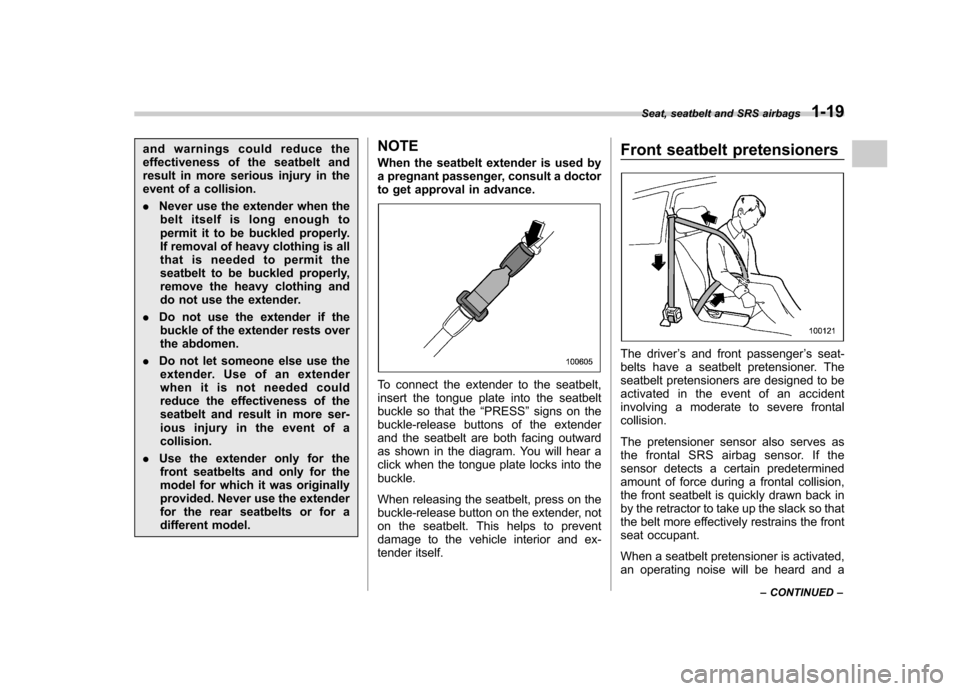
To connect the extender to the seatbelt,
insert the tongue plate into the seatbelt
buckle so that the
“PRESS ”signs on the
buckle-release buttons of the extender
and the seatbelt are both facing outward
as shown in the diagram. You will hear a
click when the tongue plate locks into thebuckle.
When releasing the seatbelt, press on the
buckle-release button on the extender, not
on the seatbelt. This helps to prevent
damage to the vehicle interior and ex-
tender itself. Front seatbelt pretensioners
The driver
’s and front passenger ’s seat-
belts have a seatbelt pretensioner. The
seatbelt pretensioners are designed to be
activated in the event of an accident
involving a moderate to severe frontalcollision.
The pretensioner sensor also serves as
the frontal SRS airbag sensor. If the
sensor detects a certain predetermined
amount of force during a frontal collision,
the front seatbelt is quickly drawn back in
by the retractor to take up the slack so that
the belt more effectively restrains the front
seat occupant.
When a seatbelt pretensioner is activated,
an operating noise will be heard and a Seat, seatbelt and SRS airbags
1-19
– CONTINUED –
Page 51 of 364
1-26Seat, seatbelt and SRS airbags
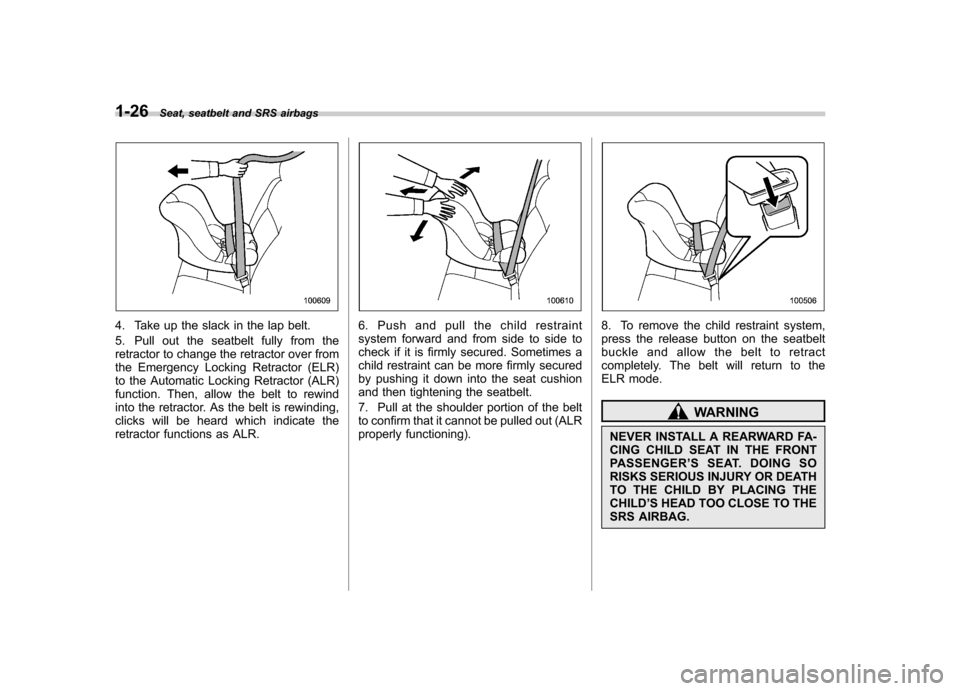
4. Take up the slack in the lap belt.
5. Pull out the seatbelt fully from the
retractor to change the retractor over from
the Emergency Locking Retractor (ELR)
to the Automatic Locking Retractor (ALR)
function. Then, allow the belt to rewind
into the retractor. As the belt is rewinding,
clicks will be heard which indicate the
retractor functions as ALR.6. Push and pull the child restraint
system forward and from side to side to
check if it is firmly secured. Sometimes a
child restraint can be more firmly secured
by pushing it down into the seat cushion
and then tightening the seatbelt.
7. Pull at the shoulder portion of the belt
to confirm that it cannot be pulled out (ALR
properly functioning).8. To remove the child restraint system,
press the release button on the seatbelt
buckle and allow the belt to retract
completely. The belt will return to the
ELR mode.
WARNING
NEVER INSTALL A REARWARD FA-
CING CHILD SEAT IN THE FRONT
PASSENGER ’SSEAT.DOINGSO
RISKS SERIOUS INJURY OR DEATH
TO THE CHILD BY PLACING THECHILD ’S HEAD TOO CLOSE TO THE
SRS AIRBAG.