towing capacity SUBARU IMPREZA WRX 2007 3.G Owners Manual
[x] Cancel search | Manufacturer: SUBARU, Model Year: 2007, Model line: IMPREZA WRX, Model: SUBARU IMPREZA WRX 2007 3.GPages: 364, PDF Size: 11.91 MB
Page 227 of 364

New vehicle break-in driving–the first
1,000 miles (1,600 km) ..................................... 8-2
Fuel economy hints ............................................ 8-2
Engine exhaust gas (Carbon monoxide) ........... 8-2
Catalytic converter .............................................. 8-3
Periodic inspections ........................................... 8-4
Driving in foreign countries ............................... 8-4
Driving tips for AWD vehicles ............................ 8-5
Off road driving ................................................... 8-6
All AWD models except OUTBACK SPORT .......... 8-6
OUTBACK SPORT ............................................... 8-6
Winter driving ...................................................... 8-8
Operation during cold weather ............................. 8-8
Driving on snowy and icy roads .......................... 8-9
Corrosion protection .......................................... 8-10
Snow tires ......................................................... 8-10
Tire chains ......................................................... 8-11 Rocking the vehicle
........................................... 8-12
Loading your vehicle ......................................... 8-12
Vehicle capacity weight ...................................... 8-13
GVWR and GAWR (Gross Vehicle Weight Rating and Gross Axle Weight Rating) ........................ 8-14
Roof rail and crossbar (if equipped) ................... 8-14
Trailer hitch (if equipped) .................................. 8-17
Connecting a trailer ........................................... 8-18
When you do not tow a trailer .. .......................... 8-19
Trailer towing ..................................................... 8-20
Warranties and maintenance .............................. 8-20
Maximum load limits .......................................... 8-20
Trailer hitches .................................................... 8-23
Connecting a trailer ........................................... 8-24
Trailer towing tips .............................................. 8-25
STI front lip spoiler (if equipped) ...................... 8-28Driving tips
8
Page 251 of 364
for your hitch and trailer.
WARNING
Always use safety chains between
your vehicle and the trailer. Towing a
trailer without safety chains could
create a traffic safety hazard if the
trailer separates from the hitch due
to coupling damage or hitch balldamage.
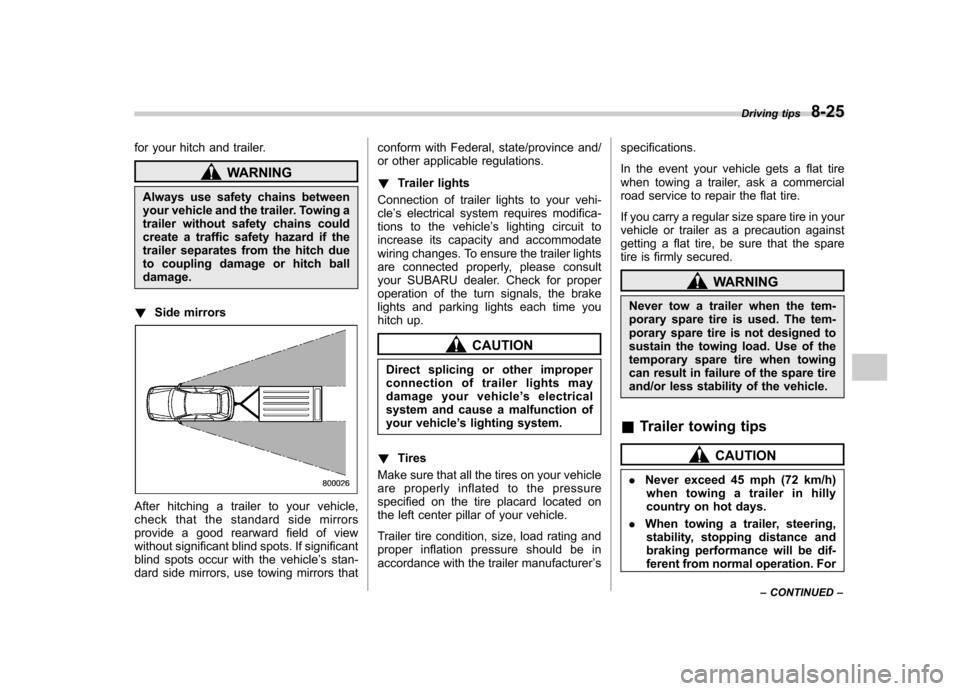
! Side mirrors
After hitching a trailer to your vehicle,
check that the standard side mirrors
provide a good rearward field of view
without significant blind spots. If significant
blind spots occur with the vehicle ’s stan-
dard side mirrors, use towing mirrors that conform with Federal, state/province and/
or other applicable regulations. !
Trailer lights
Connection of trailer lights to your vehi- cle ’s electrical system requires modifica-
tions to the vehicle ’s lighting circuit to
increase its capacity and accommodate
wiring changes. To ensure the trailer lights
are connected properly, please consult
your SUBARU dealer. Check for proper
operation of the turn signals, the brake
lights and parking lights each time you
hitch up.
CAUTION
Direct splicing or other improper
connection of trailer lights may
damage your vehicle ’s electrical
system and cause a malfunction of
your vehicle ’s lighting system.
! Tires
Make sure that all the tires on your vehicle
are properly inflated to the pressure
specified on the tire placard located on
the left center pillar of your vehicle.
Trailer tire condition, size, load rating and
proper inflation pressure should be in
accordance with the trailer manufacturer ’s specifications.
In the event your vehicle gets a flat tire
when towing a trailer, ask a commercial
road service to repair the flat tire.
If you carry a regular size spare tire in your
vehicle or trailer as a precaution against
getting a flat tire, be sure that the spare
tire is firmly secured.
WARNING
Never tow a trailer when the tem-
porary spare tire is used. The tem-
porary spare tire is not designed to
sustain the towing load. Use of the
temporary spare tire when towing
can result in failure of the spare tire
and/or less stability of the vehicle.
& Trailer towing tips
CAUTION
. Never exceed 45 mph (72 km/h)
when towing a trailer in hilly
country on hot days.
. When towing a trailer, steering,
stability, stopping distance and
braking performance will be dif-
ferent from normal operation. For Driving tips
8-25
– CONTINUED –
Page 348 of 364
13-8Consumer information and Reporting safety defects
cation and a tightening sequence
specification for the wheel nuts can
be found “Flat tires ”section in chapter
9. & Vehicle load limit –how to
determine
The load capacity of your vehicle is
determined by weight, not by avail-
able cargo space. The load limit of
your vehicle is shown on the vehicle
placard attached to the driver ’s side
B-pillar. Locate the statement “The
combined weight of occupants and
cargo should never exceed XXX kg or
XXX lbs ”on your vehicle ’s placard.
The vehicle placard also shows seat-
ing capacity of your vehicle.
The total load capacity includes the
total weight of driver and all passen-
gers and their belongings, any cargo,
any optional equipment such as a
trailer hitch, roof rack or bike carrier,
etc., and the tongue load of a trailer.
Therefore cargo capacity can be
calculated by the following method.
Cargo capacity = Load limit (total
weight of occupants + total weight of optional equipment + tongue load of a
trailer (if applicable))
For towing capacity information and
weight limits, refer to
“Trailer towing ”
section in chapter 8. ! Calculating total and load ca-
pacities varying seating con-
figurations
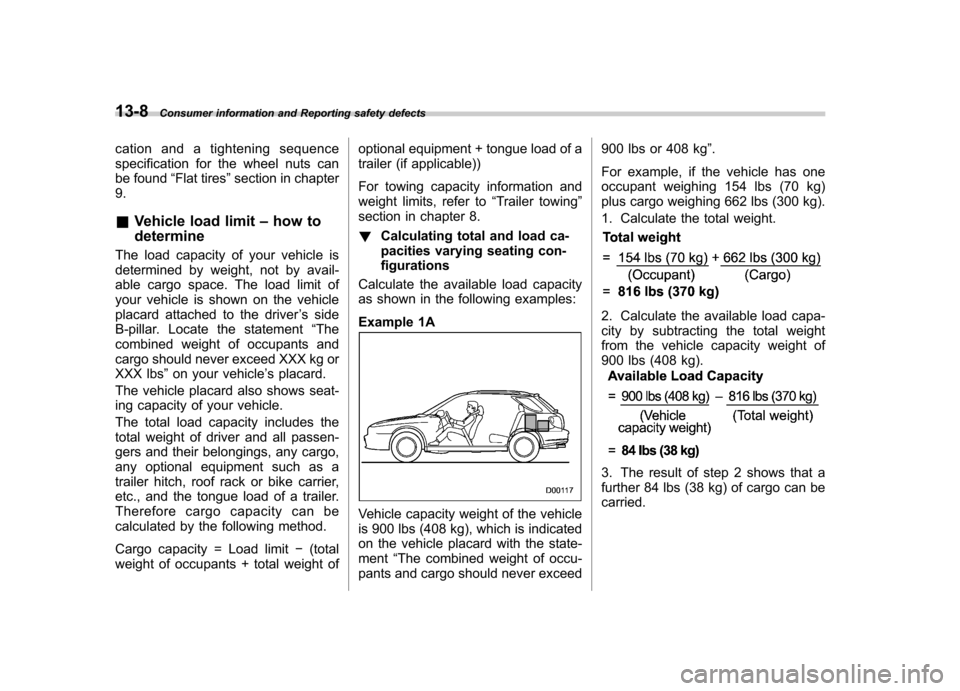
Calculate the available load capacity
as shown in the following examples:
Example 1A
Vehicle capacity weight of the vehicle
is 900 lbs (408 kg), which is indicated
on the vehicle placard with the state-ment “The combined weight of occu-
pants and cargo should never exceed 900 lbs or 408 kg
”.
For example, if the vehicle has one
occupant weighing 154 lbs (70 kg)
plus cargo weighing 662 lbs (300 kg).
1. Calculate the total weight.
2. Calculate the available load capa-
city by subtracting the total weight
from the vehicle capacity weight of
900 lbs (408 kg).
3. The result of step 2 shows that a
further 84 lbs (38 kg) of cargo can be
carried.
Page 351 of 364

the body.
Therefore, this means that the vehicle
cannot necessarily be loaded up to
the tire’s maximum load rating on the
tire sidewall. & Adverse safety conse-
quences of overloading on
handling and stopping and
on tires
Overloading could affect vehicle
handling, stopping distance, vehicle
and tire as shown in the following.
This could lead to an accident and
possibly result in severe personal
injury. . Vehicle stability will deteriorate.
. Heavy and/or high-mounted loads
could increase the risk of rollover. . Stopping distance will increase.
. Brakes could overheat and fail.
. Suspension, bearings, axles and
other body parts could break or
experience accelerated wear that will
shorten vehicle life. . Tires could fail.
. Tread separation could occur.
. Tire could separate from its rim. &
Steps for Determining Cor-
rect Load Limit
1. Locate the statement “The com-
bined weight of occupants and cargo
should never exceed XXX pounds ”on
your vehicle ’s placard.
2. Determine the combined weight of
the driver and passengers that will be
riding in your vehicle.
3. Subtract the combined weight of
the driver and passengers from XXX
kilograms or XXX pounds.
4. The resulting figure equals the
available amount of cargo and lug-
gage load capacity. For example, ifthe “XXX ”amount equals 1,400 lbs
(635 kg) and there will be five- 150 lbs
(68 kg) passengers in your vehicle,
the amount of available cargo and
luggage load capacity is 650 lbs. (1,400 750 (5 6150) = 650 lbs)
5. Determine the combined weight of
luggage and cargo being loaded on
the vehicle. That weight may not
safely exceed the available cargo
and luggage load capacity calculated
in Step 4.
6. If your vehicle will be towing a trailer, load from your trailer will be
transferred to your vehicle. Consult
this manual to determine how this
reduces the available cargo and
luggage load capacity of your vehicle.
Consumer information and Reporting safety defects
13-11