check engine SUBARU IMPREZA WRX 2014 4.G Service Manual
[x] Cancel search | Manufacturer: SUBARU, Model Year: 2014, Model line: IMPREZA WRX, Model: SUBARU IMPREZA WRX 2014 4.GPages: 414, PDF Size: 14.22 MB
Page 335 of 414
11-16Maintenance and service/Manual transmission oil
Manual transmission oil &Checking the oil level
NOTE
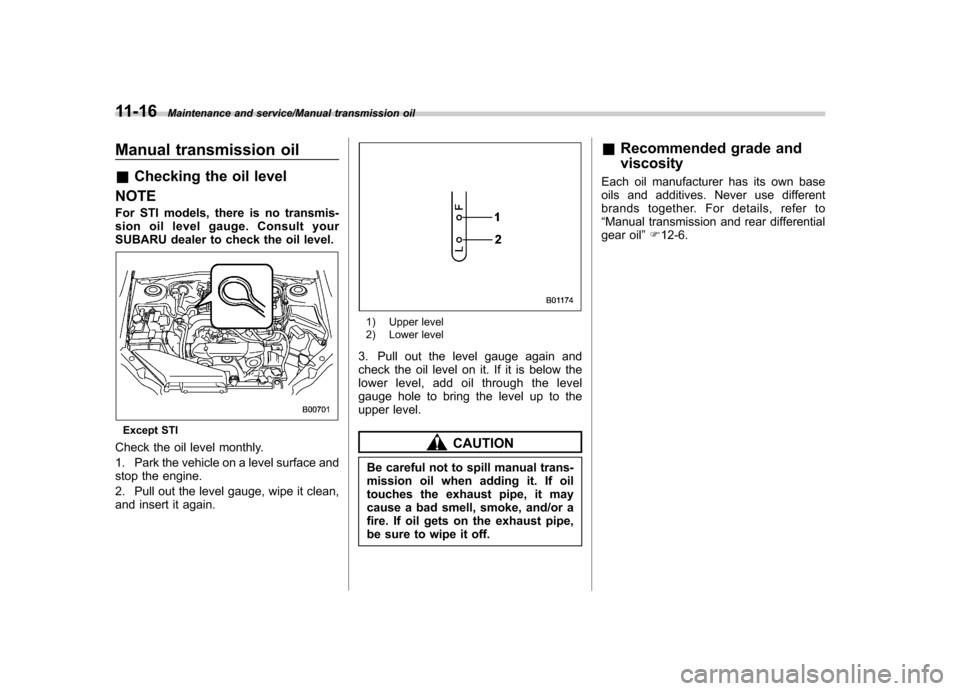
For STI models, there is no transmis-
sion oil level gauge. Consult your
SUBARU dealer to check the oil level.
Except STI
Check the oil level monthly.
1. Park the vehicle on a level surface and
stop the engine.
2. Pull out the level gauge, wipe it clean,
and insert it again.
1) Upper level
2) Lower level
3. Pull out the level gauge again and
check the oil level on it. If it is below the
lower level, add oil through the level
gauge hole to bring the level up to the
upper level.
CAUTION
Be careful not to spill manual trans-
mission oil when adding it. If oil
touches the exhaust pipe, it may
cause a bad smell, smoke, and/or a
fire. If oil gets on the exhaust pipe,
be sure to wipe it off. &
Recommended grade and viscosity
Each oil manufacturer has its own base
oils and additives. Never use different
brands together. For details, refer to“ Manual transmission and rear differential
gear oil ”F 12-6.
Page 336 of 414
Rear differential gear oil
There is no rear differential gear oil level
gauge. To check the rear differential gear
oil level, we recommend that you consult
your SUBARU dealer for inspection. &Recommended grade and viscosity
Each oil manufacturer has its own base
oils and additives. Never use different
brands together. For details, refer to“ Manual transmission and rear differential
gear oil ”F 12-6. Power steering fluid &
Checking the fluid level
The power steering fluid expands greatly
as its temperature rises; the fluid level
differs according to fluid temperature.
Therefore, the reservoir tank has two
different checking ranges for hot and cold fluids.
Check the power steering fluid level
monthly.
1. Park the vehicle on a level surface,
and stop the engine.
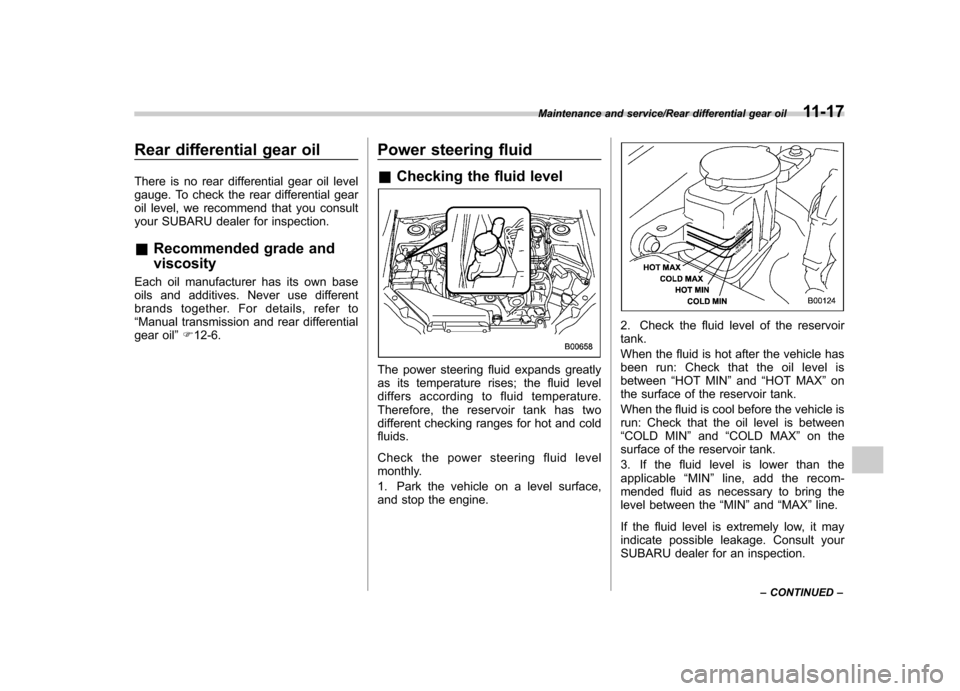
2. Check the fluid level of the reservoir tank.
When the fluid is hot after the vehicle has
been run: Check that the oil level isbetween “HOT MIN ”and “HOT MAX ”on
the surface of the reservoir tank.
When the fluid is cool before the vehicle is
run: Check that the oil level is between“ COLD MIN ”and “COLD MAX ”on the
surface of the reservoir tank.
3. If the fluid level is lower than the
applicable “MIN ”line, add the recom-
mended fluid as necessary to bring the
level between the “MIN ”and “MAX ”line.
If the fluid level is extremely low, it may
indicate possible leakage. Consult your
SUBARU dealer for an inspection.
Maintenance and service/Rear differential gear oil11-17
– CONTINUED –
Page 339 of 414

11-20Maintenance and service/Brake booster
&Recommended clutch fluid
Refer to “Fluids ”F 12-7.
CAUTION
Never use different brands of clutch
fluid together. Also, avoid mixing
DOT 3 and DOT 4 brake fluids even if
they are the same brand. Brake booster
If the brake booster does not operate as
described in the following, have it checked
by your SUBARU dealer.
1. With the engine off, depress the brake
pedal several times, applying the same
pedal force each time. The distance the
pedal travels should not vary.
2. With the brake pedal depressed, start
the engine. The pedal should move
slightly down to the floor.
3. With the brake pedal depressed, stop
the engine and keep the pedal depressed
for 30 seconds. The pedal height should
not change.
4. Start the engine again and run for
approximately one minute then turn it off.
Depress the brake pedal several times to
check the brake booster. The brake
booster operates properly if the pedal
stroke decreases with each depression. NOTE
For vehicles equipped with the brake
assist system, when you depress the
brake pedal strongly or suddenly, you
might feel that lighter depression of the
brake pedal generates a greater brak-
ing force. However, even though these
occur, they do not indicate any mal- functions, and the brake assist system
is operating properly.
Brake assist is not a system that brings
more braking ability to the vehicle
beyond its breaking capability.
Page 340 of 414
Brake pedal
Check the brake pedal free play and
reserve distance according to the main-
tenance schedule in the“Warranty and
Maintenance Booklet ”.
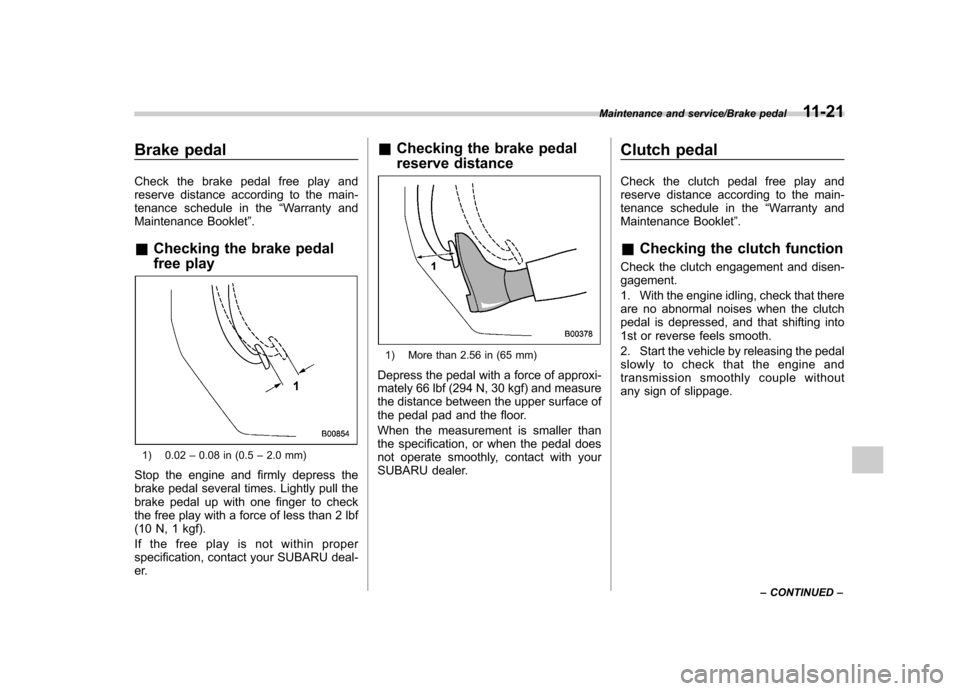
& Checking the brake pedal
free play
1) 0.02 –0.08 in (0.5 –2.0 mm)
Stop the engine and firmly depress the
brake pedal several times. Lightly pull the
brake pedal up with one finger to check
the free play with a force of less than 2 lbf
(10 N, 1 kgf).
If the free play is not within proper
specification, contact your SUBARU deal-
er. &
Checking the brake pedal
reserve distance
1) More than 2.56 in (65 mm)
Depress the pedal with a force of approxi-
mately 66 lbf (294 N, 30 kgf) and measure
the distance between the upper surface of
the pedal pad and the floor.
When the measurement is smaller than
the specification, or when the pedal does
not operate smoothly, contact with your
SUBARU dealer. Clutch pedal
Check the clutch pedal free play and
reserve distance according to the main-
tenance schedule in the
“Warranty and
Maintenance Booklet ”.
& Checking the clutch function
Check the clutch engagement and disen-gagement.
1. With the engine idling, check that there
are no abnormal noises when the clutch
pedal is depressed, and that shifting into
1st or reverse feels smooth.
2. Start the vehicle by releasing the pedal
slowly to check that the engine and
transmission smoothly couple without
any sign of slippage.
Maintenance and service/Brake pedal11-21
– CONTINUED –
Page 341 of 414
11-22Maintenance and service/Hill start assist system
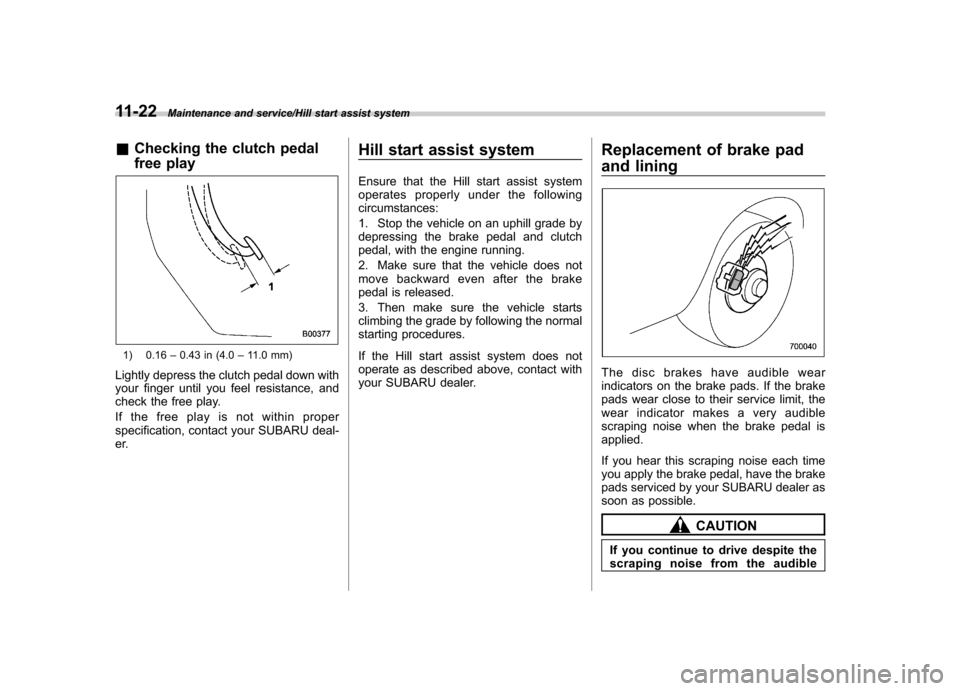
&Checking the clutch pedal
free play
1) 0.16 –0.43 in (4.0 –11.0 mm)
Lightly depress the clutch pedal down with
your finger until you feel resistance, and
check the free play.
If the free play is not within proper
specification, contact your SUBARU deal-
er. Hill start assist system
Ensure that the Hill start assist system
operates properly under the followingcircumstances:
1. Stop the vehicle on an uphill grade by
depressing the brake pedal and clutch
pedal, with the engine running.
2. Make sure that the vehicle does not
move backward even after the brake
pedal is released.
3. Then make sure the vehicle starts
climbing the grade by following the normal
starting procedures.
If the Hill start assist system does not
operate as described above, contact with
your SUBARU dealer.
Replacement of brake pad
and lining
The disc brakes have audible wear
indicators on the brake pads. If the brake
pads wear close to their service limit, the
wear indicator makes a very audible
scraping noise when the brake pedal isapplied.
If you hear this scraping noise each time
you apply the brake pedal, have the brake
pads serviced by your SUBARU dealer as
soon as possible.
CAUTION
If you continue to drive despite the
scraping noise from the audible
Page 351 of 414

11-32Maintenance and service/Replacement of wiper blades
level gauge or the“FULL ”mark on the
tank.
Use windshield washer fluid. If windshield
washer fluid is unavailable use clean
water.
In areas where water freezes in winter,
use an anti-freeze type windshield washer
fluid. SUBARU Windshield Washer Fluid
contains 58.5% methyl alcohol and 41.5%
surfactant, by volume. Its freezing tem-
perature varies according to how much it
is diluted, as indicated in the followingtable.
Washer Fluid
Concentration Freezing
Temperature
30% 10.48F( 12 8C)
50% 48F( 20 8C)
100% 49 8F( 45 8C)
CAUTION
Never use engine coolant as washer
fluid because it could cause paintdamage.
In order to prevent freezing of washer
fluid, check the freezing temperatures in
the table above when adjusting the fluid
concentration to the outside temperature.
If you fill the reservoir tank with a fluid with a different concentration from the one
used previously, purge the old fluid from
the piping between the reservoir tank and
washer nozzles by operating the washer
for a certain period of time. Otherwise, if
the concentration of the fluid remaining in
the piping is too low for the outside
temperature, it may freeze and block thenozzles.
CAUTION
. Adjust the washer fluid concen-
tration appropriately for the out-
side temperature. If the concen-
tration is inappropriate, sprayed
washer fluid may freeze on the
windshield and obstruct your
view, and the fluid may freeze in
the reservoir tank.
. State or local regulations on
volatile organic compounds may
restrict the use of methanol, a
common windshield washer anti-
freeze additive. Washer fluids
containing non-methanol anti-
freeze agents should be used
only if they provide cold weather
protection without damaging
your vehicle ’s paint, wiper blades
or washer system. Replacement of wiper blades
Grease, wax, insects, or other material on
the windshield or the wiper blade results in
jerky wiper operation and streaking on the
glass. If you cannot remove the streaks
after operating the windshield washer or if
the wiper operation is jerky, clean the
outer surface of the windshield (or rear
window) and the wiper blades using a
sponge or soft cloth with a neutral
detergent or mild-abrasive cleaner. After
cleaning, rinse the windshield and wiper
blades with clean water. The windshield is
clean if beads do not form when you rinse
the windshield with water.
CAUTION
. Do not clean the wiper blades
with gasoline or a solvent, such
as paint thinner or benzine. This
will cause deterioration of the
wiper blades.
. While removing the wiper blades
from the wiper arms, do not
return the wiper arms to the
original positions. Otherwise,
the windshield surface may bescratched.
. When returning the raised wiper
arms to the original positions,
Page 372 of 414
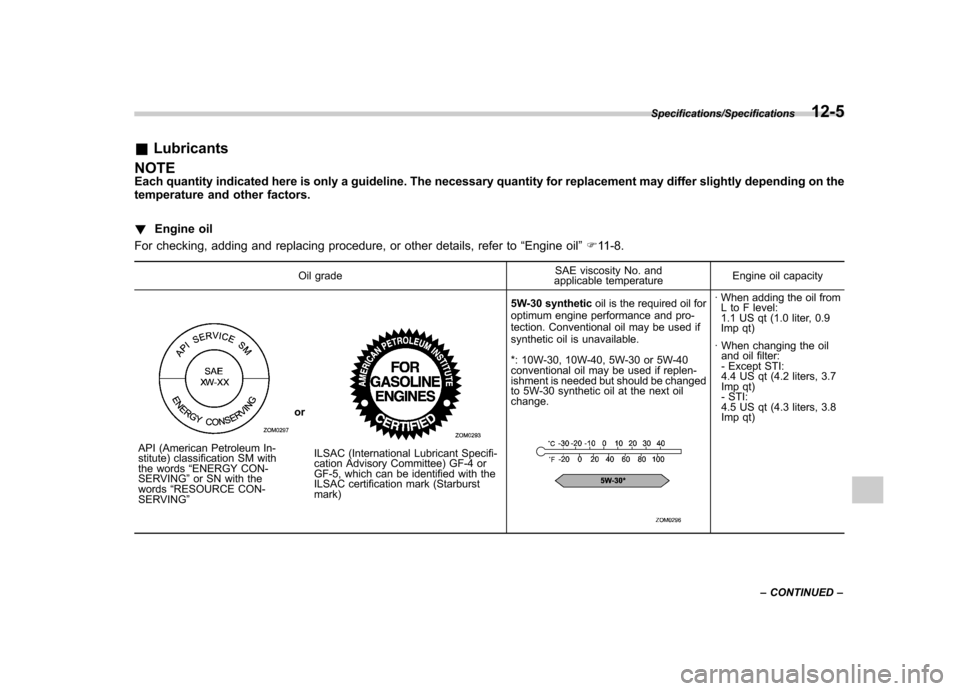
&Lubricants
NOTE
Each quantity indicated here is only a guideline. The necessary quantity for replacement may differ slightly depending on the
temperature and other factors. ! Engine oil
For checking, adding and replacing procedure, or other details, refer to “Engine oil ”F 11-8.
Oil grade SAE viscosity No. and
applicable temperature Engine oil capacity
API (American Petroleum In-
stitute) classification SM with
the words
“ENERGY CON-
SERVING ”or SN with the
words “RESOURCE CON-
SERVING ” orILSAC (International Lubricant Specifi-
cation Advisory Committee) GF-4 or
GF-5, which can be identified with the
ILSAC certification mark (Starburst mark) 5W-30 synthetic
oil is the required oil for
optimum engine performance and pro-
tection. Conventional oil may be used if
synthetic oil is unavailable.
*: 10W-30, 10W-40, 5W-30 or 5W-40
conventional oil may be used if replen-
ishment is needed but should be changed
to 5W-30 synthetic oil at the next oil change.
· When adding the oil from L to F level:
1.1 US qt (1.0 liter, 0.9
Imp qt)
· When changing the oil and oil filter:
- Except STI:
4.4 US qt (4.2 liters, 3.7
Imp qt)
- STI:
4.5 US qt (4.3 liters, 3.8
Imp qt)
Specifications/Specifications12-5
– CONTINUED –
Page 375 of 414

12-8Specifications/Specifications
&Engine coolant
NOTE
Each quantity indicated here is only a guideline. The necessary quantity for replacement may differ slightly depending on the
temperature and other factors.
Model Coolant capacity Coolant type
Turbo models Except STI 7.8 US qt (7.4 liters, 6.5 Imp qt)
SUBARU Super Coolant
STI 8.1 US qt (7.7 liters, 6.8 Imp qt)
For the checking, adding and replacing procedure, or other details, refer to “Cooling system ”F 11-11.
Page 390 of 414

crease in temperature could cause
tread separation, and failure of the
tire(s). Possible resulting loss of
vehicle control could lead to anaccident. !Measuring and adjusting air
pressure to achieve proper in-
flation
Check and, if necessary, adjust the
pressure of each tire (including the
spare) at least once a month and
before any long journey. Check the
tire pressures when the tires are
cold. Use a pressure gauge to
adjust the tire pressures to the
specific values. Driving even a
short distance warms up the tires
and increases the tire pressures.
Also, the tire pressures are affected
by the outside temperature. It is
best to check tire pressure out-
doors before driving the vehicle.
When a tire becomes warm, the air
inside it expands, causing the tire
pressure to increase. Be careful not
to mistakenly release air from a
warm tire to reduce its pressure. &
Glossary of tire terminology
. Accessory weight
The combined weight (in excess of
those standard items which may be
replaced) of automatic transmis-
sion, power steering, power brakes,
power windows, power seats, radio,
and heater, to the extent that these
items are available as factory-in-
stalled equipment (whether in-
stalled or not). . Bead
The part of the tire that is made of
steel wires, wrapped or reinforced
by ply cords and that is shaped to fit
the rim.. Bead separation
A breakdown of the bond between
components in the bead.. Bias ply tire
A pneumatic tire in which the ply
cords that extend to the beads are
laid at alternate angles substantially
less than 90 degrees to the center-
line of the tread. . Carcass
The tire structure, except tread and sidewall rubber which, when in-
flated, bears the load. .
Chunking
The breaking away of pieces of the
tread or sidewall.. Cold tire pressure
The pressure in a tire that has been
driven less than 1 mile or has been
standing for three hours or more.. Cord
The strands forming the plies in the tire. . Cord separation
The parting of cords from adjacent
rubber compounds.. Cracking
Any parting within the tread, side-
wall, or inner liner of the tire
extending to cord material. . Curb weight
The weight of a motor vehicle with
standard equipment including the
maximum capacity of fuel, oil and
coolant, and if so equipped, air
conditioning and additional weight
optional engine.
Consumer information and Reporting safety defects/Tire information13-5
– CONTINUED –
Page 404 of 414

Braking..................................................................... 7-24
Tips...................................................................... 7-24
Breaking-in of new brake pads and linings ................... 11-23
Bulb Chart .................................................................. 12-14
Replacing ............................................................. 11-39
C
Cargo area Cover ................................................................... 6-12
Light ............................................................. 6-2, 11-47
Tie-down hooks ..................................................... 6-13
Catalytic converter ....................................................... 8-3
Center Console .................................................................. 6-5
Ventilators ............................................................... 4-3
Center and side ventilators ............................................ 4-3
Changing Coolant ................................................................ 11-13
Flat tire ................................................................... 9-5
Oil and oil filter ...................................................... 11-9
Charge warning light .................................................. 3-16
CHECK ENGINE warning light/Malfunction indicator light ....................................................................... 3-15
Checking Brake pedal free play ............................................ 11-21
Brake pedal reserve distance ................................. 11-21
Clutch function ...................................................... 11-21
Clutch pedal free play ............................................ 11-22
Coolant level ........................................................ 11-12
Fluid level (brake fluid) .......................................... 11-18 Fluid level (clutch fluid)
.......................................... 11-19
Fluid level (power steering fluid) .. ........................... 11-17
Fluid level (washer fluid) ........................................ 11-31
Oil level (engine oil) ................................................ 11-8
Oil level (manual transmission oil) .......................... 11-16
Child restraint systems ................................................ 1-21
Installation of a booster seat .................................... 1-27
Installation with A/ELR seatbelt ... ............................. 1-24
Lower and tether anchorages ................................... 1-29
Top tether anchorages ............................................ 1-31
Child safety ................................................................... 5
Locks .................................................................... 2-20
Chime Key........................................................................ 3-4Light ..................................................................... 3-29
Seatbelt. ................................................................ 3-13
Cigarette lighter ........................................................... 6-9
Cleaning Aluminum wheels ................................................... 10-3
Interior .................................................................. 10-5
Ventilation grille ...................................................... 4-12
Climate control system
Automatic ............................................................... 4-8
Manual ................................................................... 4-3
Clock ........................................................................ 3-26
Clutch Fluid ........................................................... 11-19, 12-7
Pedal .................................................................. 11-21
Compass ........................................................... 3-38, 3-39
Console ..................................................................... 6-5
Coolant ........................................................... 11-12, 12-8 Index
14-3