oil temperature SUBARU IMPREZA WRX STI 2012 User Guide
[x] Cancel search | Manufacturer: SUBARU, Model Year: 2012, Model line: IMPREZA WRX STI, Model: SUBARU IMPREZA WRX STI 2012Pages: 463, PDF Size: 7.69 MB
Page 224 of 463
Black plate (180,1)
北米Model "A1130BE-A" EDITED: 2011/ 6/ 7
4-12
Climate control
properly and become damaged, the sys-
tem may not be able to control the interior
temperature correctly. To avoid damaging
the sensors, observe the following pre-
cautions.
– Do not subject the sensors to impact.
– Keep water away from the sensors.
– Do not cover the sensors.
The sensors are located as follows.
– Solar sensor: beside the windshield
defroster grille.
– Interior air temperature sensor: near
the ignition switch.
– Outside temperature sensor: behind
the front grille.
Operating tips for heater and
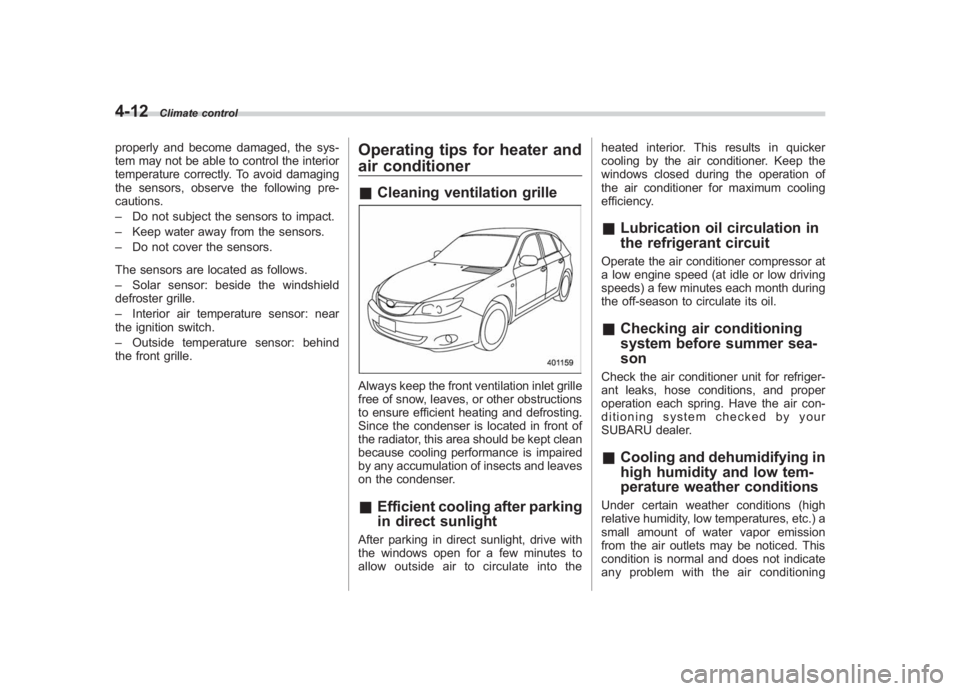
air conditioner& Cleaning ventilation grilleAlways keep the front ventilation inlet grille
free of snow, leaves, or other obstructions
to ensure efficient heating and defrosting.
Since the condenser is located in front of
the radiator, this area should be kept clean
because cooling performance is impaired
by any accumulation of insects and leaves
on the condenser.&Efficient cooling after parking
in direct sunlightAfter parking in direct sunlight, drive with
the windows open for a few minutes to
allow outside air to circulate into the heated interior. This results in quicker
cooling by the air conditioner. Keep the
windows closed during the operation of
the air conditioner for maximum cooling
efficiency.
&
Lubrication oil circulation in
the refrigerant circuitOperate the air conditioner compressor at
a low engine speed (at idle or low driving
speeds) a few minutes each month during
the off-season to circulate its oil.&Checking air conditioning
system before summer sea-
sonCheck the air conditioner unit for refriger-
ant leaks, hose conditions, and proper
operation each spring. Have the air con-
ditioning system checked by your
SUBARU dealer.&Cooling and dehumidifying in
high humidity and low tem-
perature weather conditionsUnder certain weather conditions (high
relative humidity, low temperatures, etc.) a
small amount of water vapor emission
from the air outlets may be noticed. This
condition is normal and does not indicate
any problem with the air conditioning
Page 336 of 463
Black plate (298,1)
北米Model "A1130BE-A" EDITED: 2011/ 6/ 7
8-6
Driving tips
Winter driving& Operation during cold
weatherCarry some emergency equipment, such
as a window scraper, a bag of sand,
flares, a small shovel and jumper cables.
Check the battery and cables. Cold
temperatures reduce battery capacity.
The battery must be in good condition to
provide enough power for cold winter
starts.
It normally takes longer to start the engine
in very cold weather conditions. Use an
engine oil of a proper grade and viscosity
for cold weather. Using heavy summer oil
will make it harder to start the engine.
Keep the door locks from freezing by squirting them with deicer or glycerin.
Forcing a frozen door open may damage
or separate the rubber weather strips
around the door. If the door is frozen,
use hot water to melt the ice, and after-
wards thoroughly wipe the water away.
Use a windshield washer fluid that con-
tains an antifreeze solution. Do not use
engine antifreeze or other substitutes
because they may damage the paint of
the vehicle.
SUBARU Windshield Washer Fluid con-
tains 58.5% methyl alcohol and 41.5%
surfactant, by volume. Its freezing tem-
perature varies according to how much it
is diluted, as indicated in the following
table.
Washer Fluid Con-
centration Freezing Temperature
30% 10.4 8F( 12 8C)
50% 48F( 20 8C)
100% 49
8F( 45 8C)In order to prevent freezing of washer
fluid, check the freezing temperatures in
the table above when adjusting the fluid
concentration to the outside temperature.
If you fill the reservoir tank with a fluid with
a different concentration from the one used previously, purge the old fluid from
the piping between the reservoir tank and
washer nozzles by operating the washer
for a certain period of time. Otherwise, if
the concentration of the fluid remaining in
the piping is too low for the outside
temperature, it may freeze and block the
nozzles.
CAUTION
.
Adjust the washer fluid concen-
tration appropriately for the out-
side temperature. If the concen-
tration is inappropriate, sprayed
washer fluid may freeze on the
windshield and obstruct your
view, and the fluid may freeze in
the reservoir tank.
. State or local regulations on
volatile organic compounds may
restrict the use of methanol, a
common windshield washer anti-
freeze additive. Washer fluids
containing non-methanol anti-
freeze agents should be used
only if they provide cold weather
protection without damaging
your vehicle ’s paint, wiper blades
or washer system.
Page 356 of 463
Black plate (318,1)
北米Model "A1130BE-A" EDITED: 2011/ 6/ 7
9-12
In case of emergency
Engine overheating
WARNING
Never attempt to remove the radia-
tor cap until the engine has been
shut off and has fully cooled down.
When the engine is hot, the coolant
is under pressure. Removing the
cap while the engine is still hot
could release a spray of boiling hot
coolant, which could burn you very
seriously.
If the engine overheats, safely pull off the
road and stop the vehicle in a safe place.& If steam is coming from the
engine compartmentTurn off the engine and get everyone
away from the vehicle until it cools down.&If no steam is coming from
the engine compartment
NOTEFor details about how to check the
coolant level or how to add coolant,
refer to “Engine coolant ”F 11-12.
1. Keep the engine running at idling
speed. 2. Open the hood to ventilate the engine
compartment. Refer to
“Engine hood ”
F 11-5.
Confirm that the cooling fan is turning. If
the fan is not turning, immediately turn off
the engine and contact your authorized
dealer for repair.
3. After the engine coolant temperature
has dropped, turn off the engine.
If temperature gauge stays in the over-
heated zone, turn off the engine. Refer to
“Temperature gauge ”F 3-10.
4. After the engine has fully cooled down,
check the coolant level in the reserve
tank.
If the coolant level is below the “LOW”
mark, add coolant up to the “FULL”mark.
5. If there is no coolant in the reserve
tank, add coolant to the reserve tank.
Then remove the radiator cap and fill the
radiator with coolant.
If you remove the radiator cap from a hot
radiator, first wrap a thick cloth around the
radiator cap, then turn the cap counter-
clockwise slowly without pressing down
until it stops. Release the pressure from
the radiator. After the pressure has been
fully released, remove the cap by pressing
down and turning it.
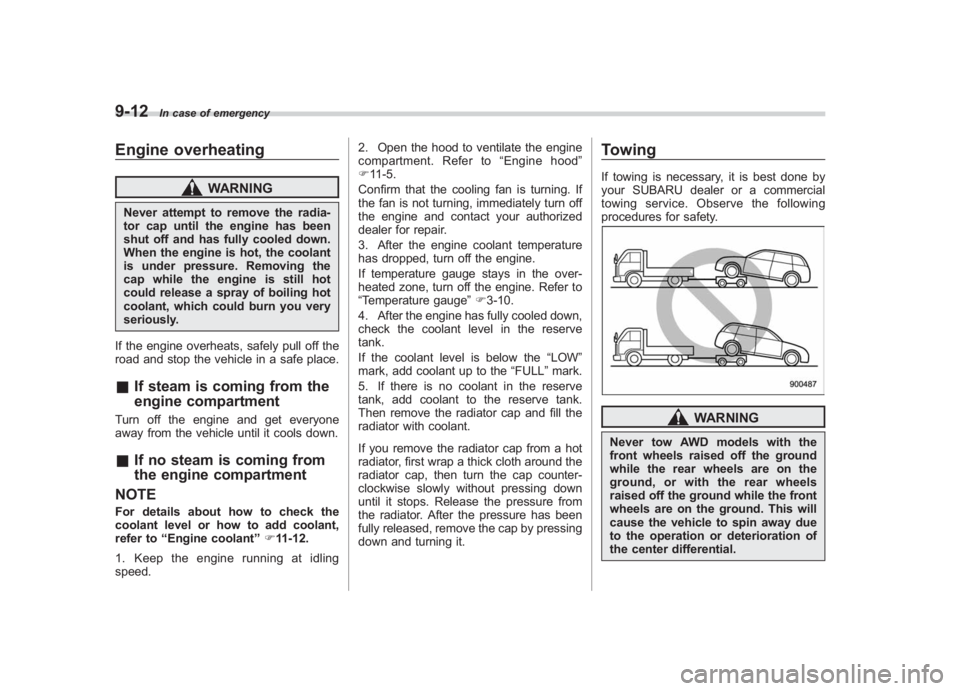
TowingIf towing is necessary, it is best done by
your SUBARU dealer or a commercial
towing service. Observe the following
procedures for safety.
WARNING
Never tow AWD models with the
front wheels raised off the ground
while the rear wheels are on the
ground, or with the rear wheels
raised off the ground while the front
wheels are on the ground. This will
cause the vehicle to spin away due
to the operation or deterioration of
the center differential.
Page 378 of 463
Black plate (340,1)
北米Model "A1130BE-A" EDITED: 2011/ 6/ 7
11-10
Maintenance and service
thin coat of engine oil to the seal.
9. Clean the rubber seal seating area of
the bottom of engine and install the oil
filter by hand turning. Be careful not to
twist or damage the seal.
10. Tighten the oil filter by the amount
indicated in the following table after the
seal makes contact with the bottom of
engine.Oil filter color Part number Amount of
rotation
Black 15208AA100 1 rotation
Blue 15208AA12A 7/8
rotation
CAUTION
. Never over tighten the oil filter
because that can result in an oil
leak.
. Thoroughly wipe off any engine
oil that has spilled over the
exhaust pipe and/or under-cover.
If spilled oil is not promptly
wiped up, the oil could cause a
fire.
11. Reinstall under cover.
12. Pour engine oil through the filler neck.
For the oil capacity (guideline), refer to “Engine oil
”F 12-5.
The oil quantity indicated above is only
guideline.
The necessary quantity of oil depends on
the quantity of oil that has been drained.
The quantity of drained oil differs slightly
depending on the temperature of the oil
and the time the oil is left flowing out. After
refilling the engine with oil, therefore, you
must use the level gauge to confirm that
the level is correct.
13. Start the engine and make sure that no
oil leaks appear around the filter ’s rubber
seal and drain plug.
14. Run the engine until it reaches the
normal operating temperature. Then stop
the engine and wait a few minutes to allow
the oil drain back. Check the oil level
again and if necessary, add more engine
oil.
CAUTION
Be careful not to spill engine oil
when adding it. If oil touches the
exhaust pipe, it may cause a bad
smell, smoke, and/or a fire.
& Recommended grade and
viscosity
CAUTION
Use only engine oil with the recom-
mended grade and viscosity.
Refer to “Engine oil ”F 12-5.NOTEEngine oil viscosity (thickness) affects
fuel economy. Oils of lower viscosity
provide better fuel economy. However,
in hot weather, oil of higher viscosity is
required to properly lubricate the en-
gine.& Synthetic oilYou should use synthetic engine oil that
meets the same requirements given for
conventional engine oil. When using
synthetic oil, you must use oil of the same
classification, viscosity and grade shown
in this Owner ’s Manual. Refer to “Engine
oil ”F 12-5. Also, you must follow the oil
and filter changing intervals shown in the
Warranty and Maintenance booklet.NOTESynthetic oil of the grade and viscosity
noted in chapter 12 is the recom-
Page 379 of 463
Black plate (341,1)
北米Model "A1130BE-A" EDITED: 2011/ 6/ 7
mended engine oil for optimum engine
performance. Conventional oil may be
used if synthetic oil is unavailable.
Cooling system
WARNING
Never attempt to remove the radia-
tor cap until the engine has been
shut off and has cooled down
completely. Since the coolant is
under pressure, you may suffer
serious burns from a spray of boil-
ing hot coolant when the cap is
removed.
CAUTION
. Vehicles are filled at the factory
with SUBARU Super Coolant that
does not require the first change
for 11 years/137,500 miles (11
years/220,000 km). This coolant
should not be mixed with any
other brand or type of coolant
during this period. Mixing with a
different coolant will reduce the
life of the coolant. Should it be
necessary to top up the coolant
for any reason, use only
SUBARU Super Coolant.
If the SUBARU Super Coolant is
diluted with another brand or
type, the maintenance interval is shortened to that of the mixing
coolant.
. Do not splash the engine coolant
over painted parts. The alcohol
contained in the engine coolant
may damage the paint surface.
& Cooling fan, hose and con-
nectionsYour vehicle employs an electric cooling
fan which is thermostatically controlled to
operate when the engine coolant reaches
a specific temperature.
If the radiator cooling fan does not operate
even when the engine coolant tempera-
ture gauge exceeds the normal operating
range, the cooling fan circuit may be
defective. Refer to “Temperature gauge ”
F 3-10.
Check the fuse and replace it if necessary.
Refer to “Fuses”F 11-37 and “Fuse panel
located in the engine compartment” F12-
12.
If the fuse is not blown, have the cooling
system checked by your SUBARU dealer.
If frequent addition of coolant is neces-
sary, there may be a leak in the engine
cooling system. It is recommended that
the cooling system and connections be
checked for leaks, damage, or looseness.
Maintenance and service
11-11
– CONTINUED –
11
Page 385 of 463
Black plate (347,1)
北米Model "A1130BE-A" EDITED: 2011/ 6/ 7
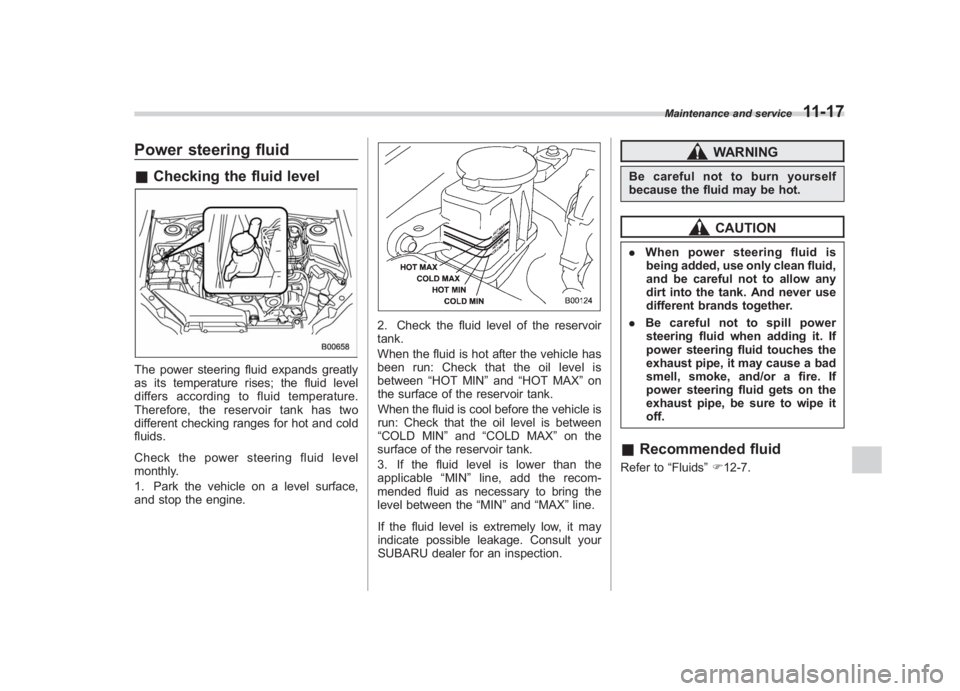
Power steering fluid& Checking the fluid levelThe power steering fluid expands greatly
as its temperature rises; the fluid level
differs according to fluid temperature.
Therefore, the reservoir tank has two
different checking ranges for hot and cold
fluids.
Check the power steering fluid level
monthly.
1. Park the vehicle on a level surface,
and stop the engine.
2. Check the fluid level of the reservoir
tank.
When the fluid is hot after the vehicle has
been run: Check that the oil level is
between “HOT MIN ”and “HOT MAX ”on
the surface of the reservoir tank.
When the fluid is cool before the vehicle is
run: Check that the oil level is between
“COLD MIN ”and “COLD MAX ”on the
surface of the reservoir tank.
3. If the fluid level is lower than the
applicable “MIN ”line, add the recom-
mended fluid as necessary to bring the
level between the “MIN”and “MAX ”line.
If the fluid level is extremely low, it may
indicate possible leakage. Consult your
SUBARU dealer for an inspection.
WARNING
Be careful not to burn yourself
because the fluid may be hot.
CAUTION
. When power steering fluid is
being added, use only clean fluid,
and be careful not to allow any
dirt into the tank. And never use
different brands together.
. Be careful not to spill power
steering fluid when adding it. If
power steering fluid touches the
exhaust pipe, it may cause a bad
smell, smoke, and/or a fire. If
power steering fluid gets on the
exhaust pipe, be sure to wipe it
off.& Recommended fluidRefer to “Fluids”F 12-7.
Maintenance and service
11-17
11
Page 421 of 463
Black plate (383,1)
北米Model "A1130BE-A" EDITED: 2011/ 6/ 7
& Lubricants
NOTEEach quantity indicated here is only a guideline. The necessary quantity for replacement may differ slightly depending on the
temperature and other factors.
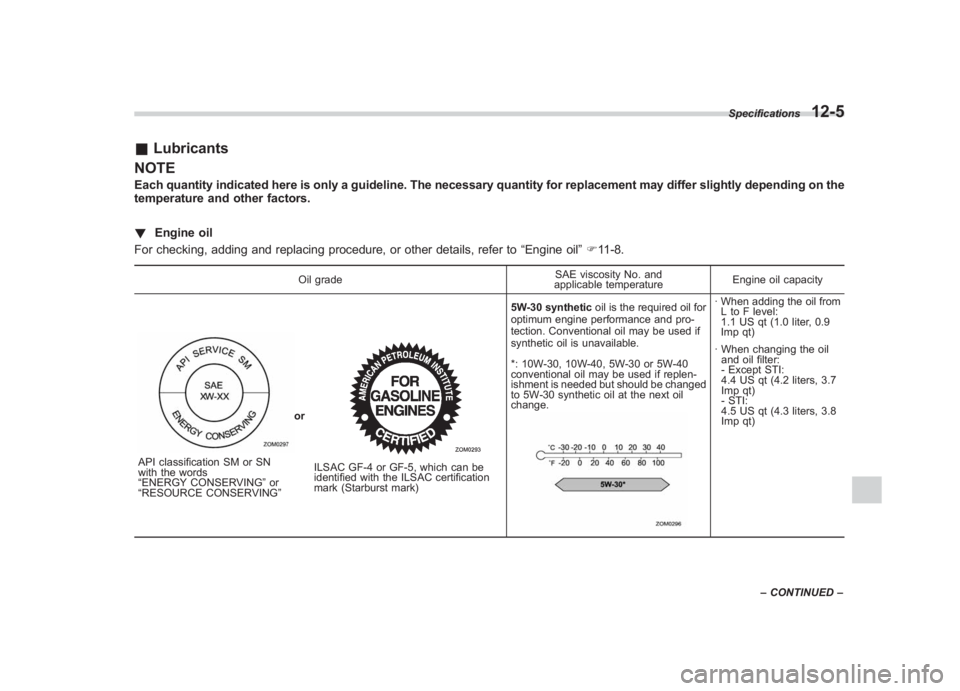
! Engine oil
For checking, adding and replacing procedure, or other details, refer to “Engine oil”F 11-8.
Oil grade SAE viscosity No. and
applicable temperature Engine oil capacity
API classification SM or SN
with the words
“
ENERGY CONSERVING ”or
“ RESOURCE CONSERVING ”or
ILSAC GF-4 or GF-5, which can be
identified with the ILSAC certification
mark (Starburst mark) 5W-30 synthetic
oil is the required oil for
optimum engine performance and pro-
tection. Conventional oil may be used if
synthetic oil is unavailable.
*: 10W-30, 10W-40, 5W-30 or 5W-40
conventional oil may be used if replen-
ishment is needed but should be changed
to 5W-30 synthetic oil at the next oil
change.
· When adding the oil from L to F level:
1.1 US qt (1.0 liter, 0.9
Imp qt)
· When changing the oil and oil filter:
- Except STI:
4.4 US qt (4.2 liters, 3.7
Imp qt)
- STI:
4.5 US qt (4.3 liters, 3.8
Imp qt) Specifications
12-5
–
CONTINUED –
12
Page 422 of 463
Black plate (384,1)
北米Model "A1130BE-A" EDITED: 2011/ 6/ 7
12-6
Specifications
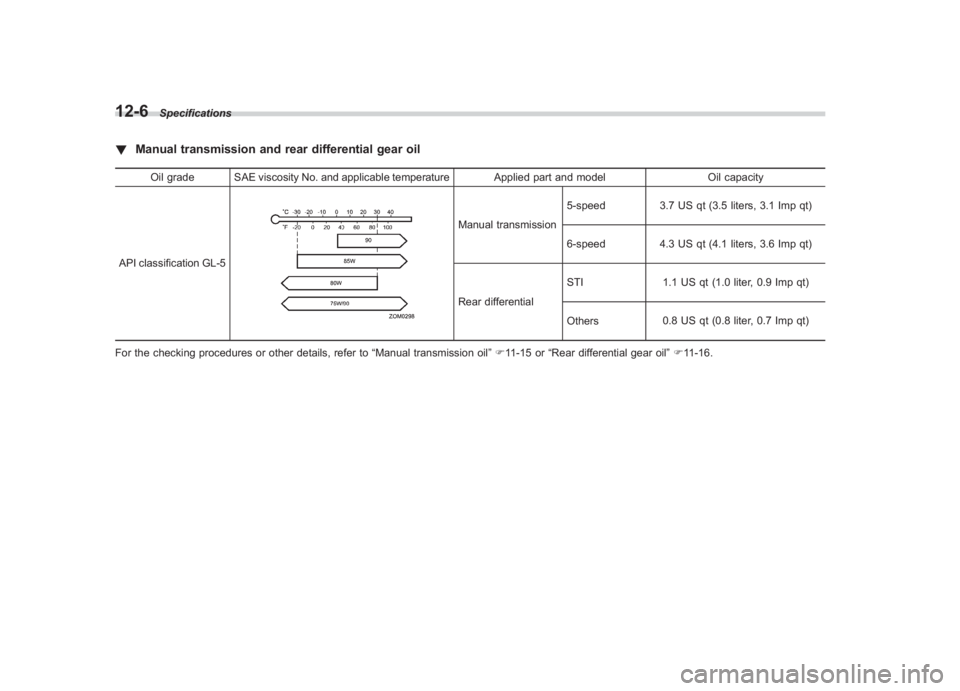
! Manual transmission and rear differential gear oil
Oil grade SAE viscosity No. and applicable temperature Applied part and model Oil capacity
API classification GL-5
Manual transmission 5-speed 3.7 US qt (3.5 liters, 3.1 Imp qt)
6-speed 4.3 US qt (4.1 liters, 3.6 Imp qt)
Rear differential STI 1.1 US qt (1.0 liter, 0.9 Imp qt)
Others
0.8 US qt (0.8 liter, 0.7 Imp qt)
For the checking procedures or other details, refer to “Manual transmission oil ”F 11-15 or “Rear differential gear oil ”F 11-16.
Page 439 of 463
Black plate (401,1)
北米Model "A1130BE-A" EDITED: 2011/ 6/ 7
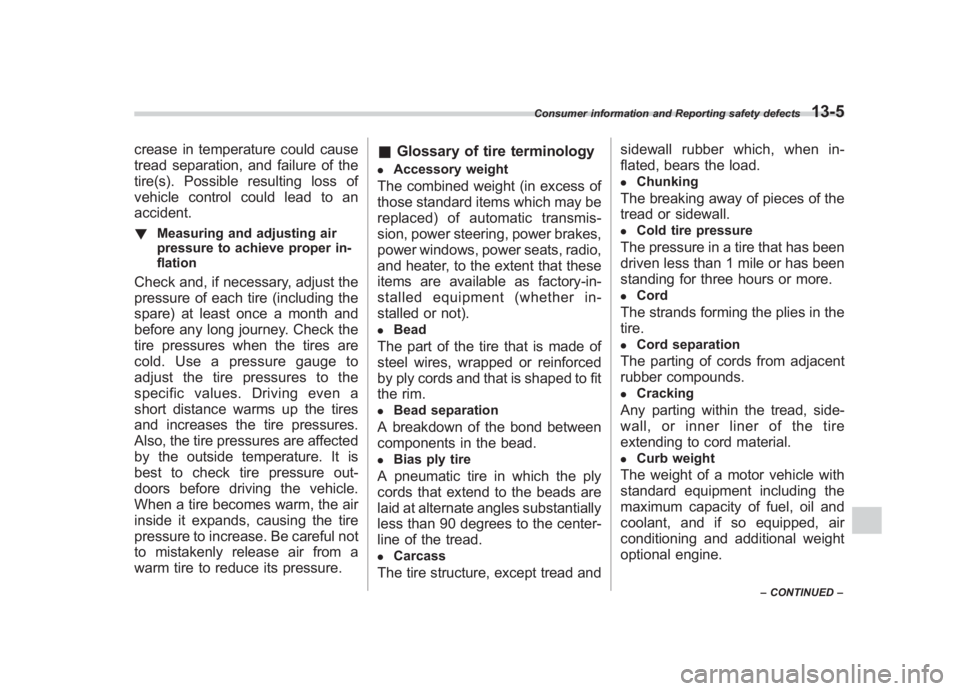
crease in temperature could cause
tread separation, and failure of the
tire(s). Possible resulting loss of
vehicle control could lead to an
accident.! Measuring and adjusting air
pressure to achieve proper in-
flationCheck and, if necessary, adjust the
pressure of each tire (including the
spare) at least once a month and
before any long journey. Check the
tire pressures when the tires are
cold. Use a pressure gauge to
adjust the tire pressures to the
specific values. Driving even a
short distance warms up the tires
and increases the tire pressures.
Also, the tire pressures are affected
by the outside temperature. It is
best to check tire pressure out-
doors before driving the vehicle.
When a tire becomes warm, the air
inside it expands, causing the tire
pressure to increase. Be careful not
to mistakenly release air from a
warm tire to reduce its pressure.
&Glossary of tire terminology.
Accessory weight
The combined weight (in excess of
those standard items which may be
replaced) of automatic transmis-
sion, power steering, power brakes,
power windows, power seats, radio,
and heater, to the extent that these
items are available as factory-in-
stalled equipment (whether in-
stalled or not)..
Bead
The part of the tire that is made of
steel wires, wrapped or reinforced
by ply cords and that is shaped to fit
the rim..
Bead separation
A breakdown of the bond between
components in the bead..
Bias ply tire
A pneumatic tire in which the ply
cords that extend to the beads are
laid at alternate angles substantially
less than 90 degrees to the center-
line of the tread..
Carcass
The tire structure, except tread and sidewall rubber which, when in-
flated, bears the load.
.
Chunking
The breaking away of pieces of the
tread or sidewall..
Cold tire pressure
The pressure in a tire that has been
driven less than 1 mile or has been
standing for three hours or more..
Cord
The strands forming the plies in the
tire..
Cord separation
The parting of cords from adjacent
rubber compounds..
Cracking
Any parting within the tread, side-
wall, or inner liner of the tire
extending to cord material..
Curb weight
The weight of a motor vehicle with
standard equipment including the
maximum capacity of fuel, oil and
coolant, and if so equipped, air
conditioning and additional weight
optional engine.
Consumer information and Reporting safety defects
13-5
–
CONTINUED –
13
Page 457 of 463
Black plate (7,1)
北米Model "A1130BE-A" EDITED: 2011/ 6/ 3
Loading your vehicle .................................................. 8-10
Low fuel warning light ................................................. 3-20
Low tire pressure warning light .................................... 3-16
Lower and tether anchorage ........................................ 1-29
LSD (Limited slip differential) ....................................... 7-24
Lubricants ................................................................. 12-5
M
Maintenance Precautions ........................................................... 11-3
Schedule .............................................................. 11-3
Seatbelt ................................................................ 1-19
Tools ...................................................................... 9-3
Malfunction indicator light (check engine warning light) ... 3-15
Manual Climate control system ............................................. 4-3
Transmission oil ............................................ 11-15, 12-6
Transmission-5 speeds ........................................... 7-16
Transmission-6 speeds ........................................... 7-14
Map light ........................................................... 6-3, 11-46
Meters and gauges ...................................................... 3-5
Mirror defogger .......................................................... 3-45
Mirrors ...................................................................... 3-37
Moonroof .......................................................... 2-27, 9-17
N
New vehicle break-in driving .......................................... 8-2
O
Odometer/Trip meter .................................................... 3-7
Oil filter ..................................................................... 11-9 Oil level
Engine .................................................................. 11-8
Manual transmission ............................................. 11-15
Rear differential gear ............................................ 11-16
Oil pressure warning light ............................................ 3-16
Outside Mirror defogger ...................................................... 3-45
Mirrors .................................................................. 3-44
Temperature indicator .............................................. 3-27
Overheating engine .................................................... 9-12
P
Parking Brake .................................................................... 7-33
Brake stroke ........................................................ 11-23
Tips ...................................................................... 7-33
Periodic inspections ..................................................... 8-4
Petrol fuel ................................................................... 7-3
Power Door locking switch .................................................. 2-6
Outside mirrors .............................................. 3-44, 3-45
Steering ................................................................ 7-24
Steering fluid ................................................ 11-17, 12-7
Windows ............................................................... 2-20
Precautions against vehicle modification ................ 1-21, 1-57
Preparing to drive ........................................................ 7-8
R
Rear Combination lights ................................................ 11-43
Differential gear oil ........................................ 11-16, 12-6
Index
14-7