warning SUBARU IMPREZA WRX STI 2012 User Guide
[x] Cancel search | Manufacturer: SUBARU, Model Year: 2012, Model line: IMPREZA WRX STI, Model: SUBARU IMPREZA WRX STI 2012Pages: 463, PDF Size: 7.69 MB
Page 58 of 463
Black plate (10,1)
北米Model "A1130BE-A" EDITED: 2011/ 6/ 7
8& Driving when tired or sleepy
WARNING
When you are tired or sleepy, your
reaction time will be delayed and
your perception, judgment and at-
tentiveness will be impaired. If you
drive when tired or sleepy, your,
your passengers ’and other per-
sons ’chances of being involved in
a serious accident may increase.
Please do not continue to drive but
instead find a safe place to rest if you
are tired or sleepy. On long trips, you
should make periodic rest stops to refresh
yourself before continuing on your journey.
When possible, you should share the
driving with others.& Modification of your vehicle
CAUTION
Your vehicle should not be modified
other than with genuine SUBARU
parts and accessories. Other types
of modifications could affect its
performance, safety or durability,
and may even violate governmental
regulations. In addition, damage or performance problems resulting
from modification may not be cov-
ered under warranties.
&
Car phone/cell phone and
driving
CAUTION
Do not use a car phone/cell phone
while driving; it may distract your
attention from driving and can lead
to an accident. If you use a car
phone/cell phone, pull off the road
and park in a safe place before
using your phone. In some States/
Provinces, only hands-free phones
may legally be used while driving.&Driving vehicles equipped
with navigation system
WARNING
Do not allow the monitor to distract
your attention from driving. Also, do
not operate the controls of the
navigation system while driving.
The loss of attention to driving
could lead to an accident. If you wish to operate the controls of the
navigation system, first take the
vehicle off the road and stop it in a
safe place.
&
Driving with petsUnrestrained pets can interfere with your
driving and distract your attention from
driving. In a collision or sudden stop,
unrestrained pets or cages can be thrown
around inside the vehicle and hurt you or
your passengers. Besides, the pets can
be hurt under these situations. It is also for
their own safety that pets should be
properly restrained in your vehicle. Re-
strain a pet with a special traveling
harness which can be secured to the rear
seat with a seatbelt or use a pet carrier
which can be secured to the rear seat by
routing a seatbelt through the carrier ’s
handle. Never restrain pets or pet carriers
in the front passenger ’s seat. For further
information, consult your veterinarian,
local animal protection society or pet
shop.
Page 59 of 463
Black plate (11,1)
北米Model "A1130BE-A" EDITED: 2011/ 6/ 7
& Tire pressuresCheck and, if necessary, adjust the
pressure of each tire (including the spare)
at least once a month and before any long
journey.
Check the tire pressure when the tires are
cold. Use a pressure gauge to adjust the
tire pressures to the values shown on the
tire placard. For detailed information, refer
to“Tires and wheels” F11-23.
WARNING
Driving at high speeds with exces-
sively low tire pressures can cause
the tires to deform severely and to
rapidly become hot. A sharp in-
crease in temperature could cause
tread separation, and destruction of
the tires. The resulting loss of
vehicle control could lead to an
accident.
& California proposition 65
warning
WARNING
Engine exhaust, some of its consti-
tuents, and certain vehicle compo-
nents contain or emit chemicals
known to the State of California to
cause cancer and birth defects or
other reproductive harm. In addi-
tion, certain fluids in vehicles and
certain components of product wear
contain or emit chemicals known to
the State of California to cause
cancer and birth defects or other
reproductive harm.&California Perchlorate Advi-
soryCertain vehicle components such as air-
bag modules, seatbelt pretensioners and
keyless entry transmitter batteries may
contain perchlorate material. Special
handling may apply for service or vehicle
end of life disposal. See www.dtsc.ca.gov/
hazardouswaste/perchlorate.
General information&Noise from under the vehicle
NOTEYou may hear a noise from under the
vehicle approximately 5 hours after the
engine is turned off. However, this does
not indicate a malfunction. This noise
is caused by operation of the fuel
evaporation leakage checking system
and is normal. The noise will stop after
approximately 15 minutes.
9
0
Page 66 of 463
Black plate (18,1)
北米Model "A1130BE-A" EDITED: 2011/ 6/ 7
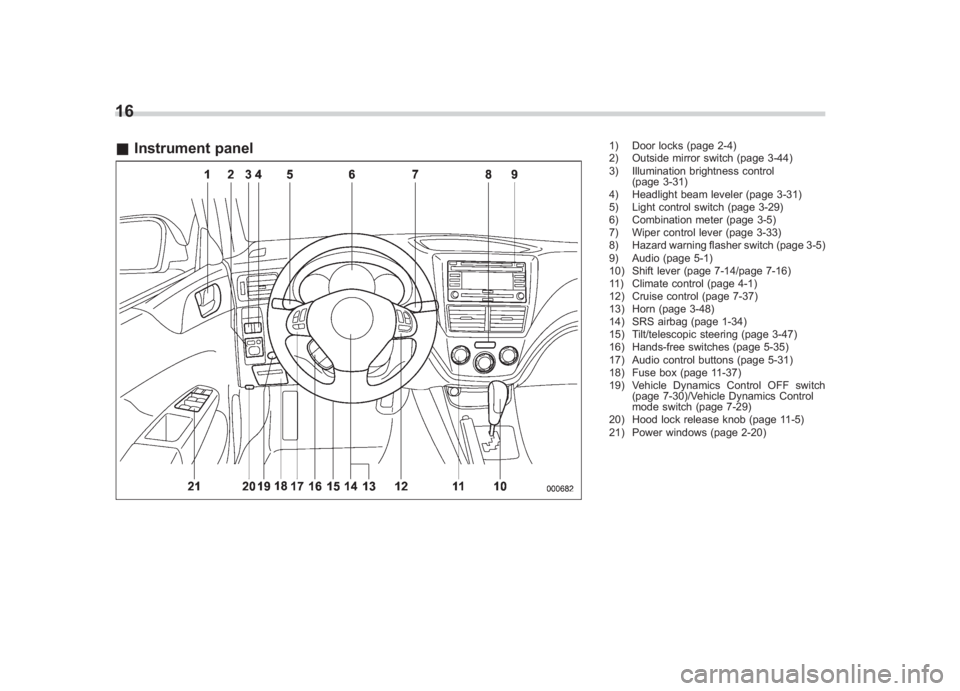
16& Instrument panel
1) Door locks (page 2-4)
2) Outside mirror switch (page 3-44)
3) Illumination brightness control
(page 3-31)
4) Headlight beam leveler (page 3-31)
5) Light control switch (page 3-29)
6) Combination meter (page 3-5)
7) Wiper control lever (page 3-33)
8) Hazard warning flasher switch (page 3-5)
9) Audio (page 5-1)
10) Shift lever (page 7-14/page 7-16)
11) Climate control (page 4-1)
12) Cruise control (page 7-37)
13) Horn (page 3-48)
14) SRS airbag (page 1-34)
15) Tilt/telescopic steering (page 3-47)
16) Hands-free switches (page 5-35)
17) Audio control buttons (page 5-31)
18) Fuse box (page 11-37)
19) Vehicle Dynamics Control OFF switch (page 7-30)/Vehicle Dynamics Control
mode switch (page 7-29)
20) Hood lock release knob (page 11-5)
21) Power windows (page 2-20)
Page 72 of 463
Black plate (24,1)
北米Model "A1130BE-A" EDITED: 2011/ 6/ 7
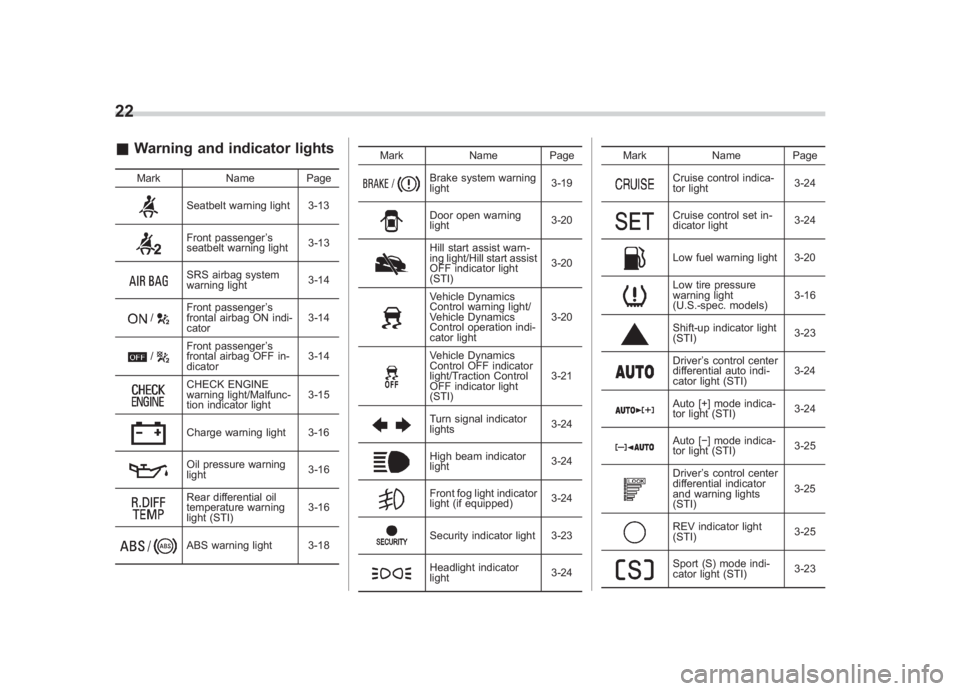
22& Warning and indicator lights
Mark Name Page
Seatbelt warning light 3-13Front passenger’s
seatbelt warning light 3-13SRS airbag system
warning light3-14
/
Front passenger
’s
frontal airbag ON indi-
cator 3-14
/
Front passenger
’s
frontal airbag OFF in-
dicator 3-14CHECK ENGINE
warning light/Malfunc-
tion indicator light3-15Charge warning light 3-16Oil pressure warning
light
3-16Rear differential oil
temperature warning
light (STI)3-16ABS warning light 3-18 Mark Name Page
Brake system warning
light
3-19Door open warning
light3-20Hill start assist warn-
ing light/Hill start assist
OFF indicator light
(STI)3-20Vehicle Dynamics
Control warning light/
Vehicle Dynamics
Control operation indi-
cator light3-20Vehicle Dynamics
Control OFF indicator
light/Traction Control
OFF indicator light
(STI)3-21Turn signal indicator
lights
3-24High beam indicator
light3-24Front fog light indicator
light (if equipped)3-24Security indicator light 3-23Headlight indicator
light
3-24Mark Name Page
Cruise control indica-
tor light
3-24Cruise control set in-
dicator light3-24Low fuel warning light 3-20Low tire pressure
warning light
(U.S.-spec. models)3-16Shift-up indicator light
(STI)
3-23Driver
’s control center
differential auto indi-
cator light (STI) 3-24Auto [+] mode indica-
tor light (STI)
3-24Auto [] mode indica-
tor light (STI) 3-25Driver
’s control center
differential indicator
and warning lights
(STI) 3-25REV indicator light
(STI)
3-25Sport (S) mode indi-
cator light (STI)3-23
Page 74 of 463
Black plate (26,1)
北米Model "A1130BE-A" EDITED: 2011/ 6/ 7
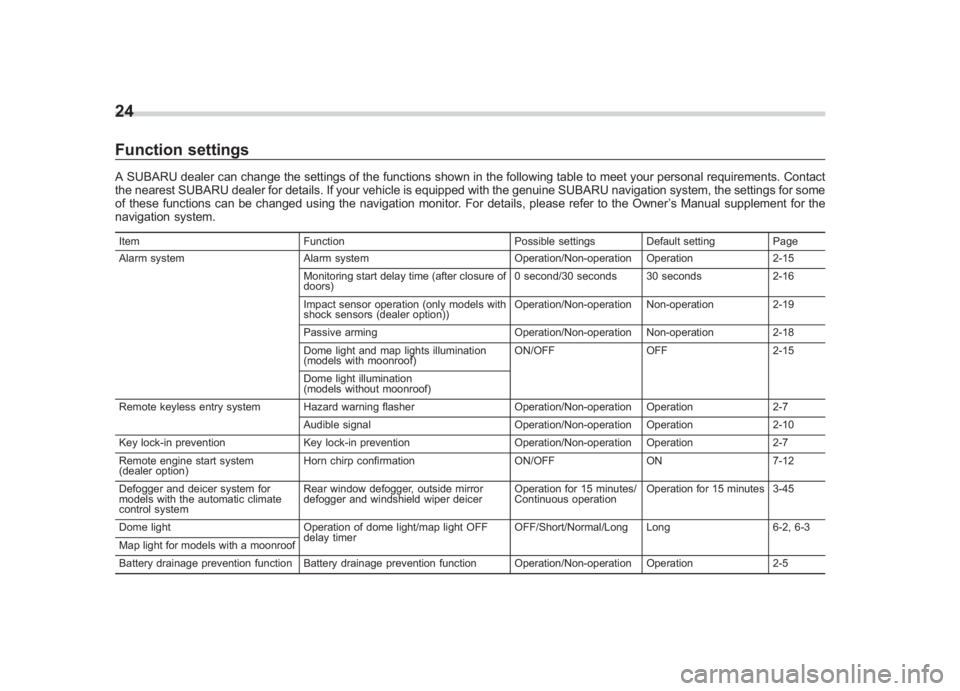
24Function settingsA SUBARU dealer can change the settings of the functions shown in the following table to meet your personal requirements. Contact
the nearest SUBARU dealer for details. If your vehicle is equipped with the genuine SUBARU navigation system, the settings for some
of these functions can be changed using the navigation monitor. For details, please refer to the Owner ’s Manual supplement for the
navigation system.Item Function Possible settings Default setting Page
Alarm system Alarm system Operation/Non-operation Operation 2-15
Monitoring start delay time (after closure of
doors) 0 second/30 seconds 30 seconds
2-16
Impact sensor operation (only models with
shock sensors (dealer option)) Operation/Non-operation Non-operation
2-19
Passive arming Operation/Non-operation Non-operation 2-18
Dome light and map lights illumination
(models with moonroof) ON/OFF
OFF2-15
Dome light illumination
(models without moonroof)
Remote keyless entry system Hazard warning flasher Operation/Non-operation Operation2-7
Audible signal Operation/Non-operation Operation 2-10
Key lock-in prevention Key lock-in prevention Operation/Non-operation Operation 2-7
Remote engine start system
(dealer option) Horn chirp confirmation
ON/OFFON7-12
Defogger and deicer system for
models with the automatic climate
control system Rear window defogger, outside mirror
defogger and windshield wiper deicer
Operation for 15 minutes/
Continuous operationOperation for 15 minutes 3-45
Dome light Operation of dome light/map light OFF
delay timer OFF/Short/Normal/Long Long
6-2, 6-3
Map light for models with a moonroof
Battery drainage prevention function Battery drainage prevention function Operation/Non-operation Operation 2-5
Page 75 of 463
Black plate (27,1)
北米Model "A1130BE-A" EDITED: 2011/ 6/ 7
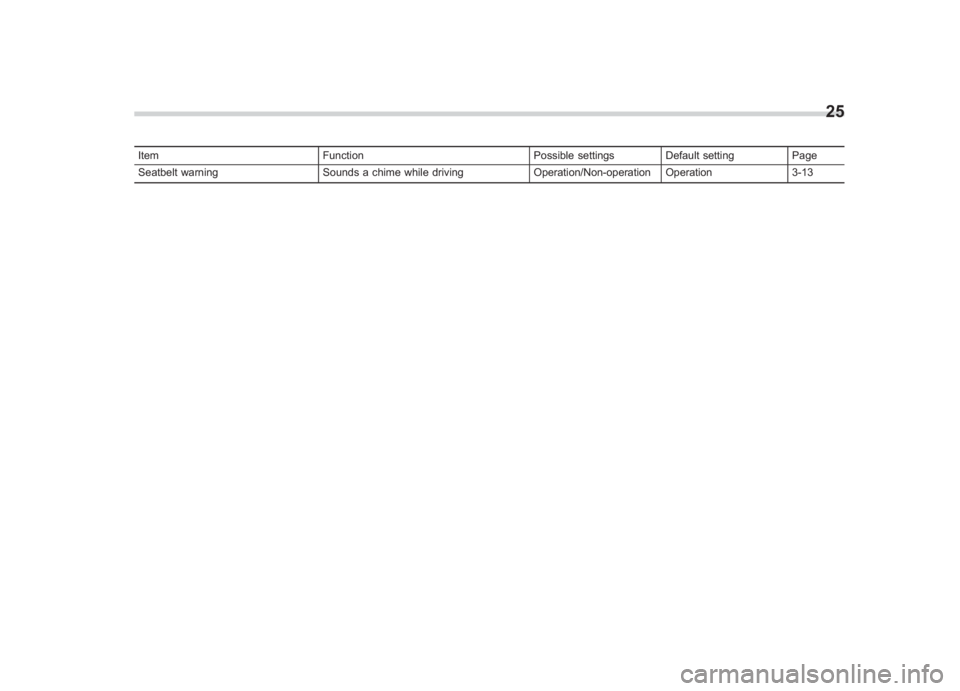
Item Function Possible settings Default setting Page
Seatbelt warning Sounds a chime while driving Operation/Non-operation Operation 3-13
25
0
Page 77 of 463
Black plate (1,1)
北米Model "A1130BE-A" EDITED: 2011/ 6/ 2
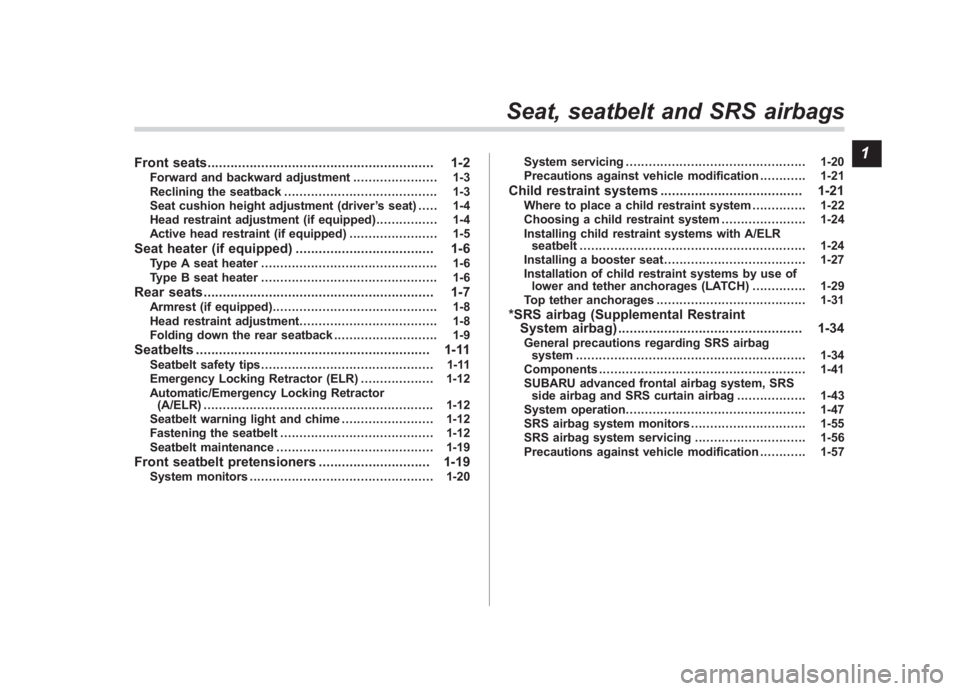
Front seats ........................................................... 1-2
Forward and backward adjustment ...................... 1-3
Reclining the seatback ........................................ 1-3
Seat cushion height adjustment (driver ’s seat) ..... 1-4
Head restraint adjustment (if equipped) ................ 1-4
Active head restraint (if equipped) ....................... 1-5
Seat heater (if equipped).................................... 1-6
Type A seat heater.............................................. 1-6
Type B seat heater .............................................. 1-6
Rear seats............................................................ 1-7
Armrest (if equipped) ........................................... 1-8
Head restraint adjustment .................................... 1-8
Folding down the rear seatback ........................... 1-9
Seatbelts............................................................. 1-11
Seatbelt safety tips ............................................. 1-11
Emergency Locking Retractor (ELR) ................... 1-12
Automatic/Emergency Locking Retractor (A/ELR) ............................................................ 1-12
Seatbelt warning light and chime ........................ 1-12
Fastening the seatbelt ........................................ 1-12
Seatbelt maintenance ......................................... 1-19
Front seatbelt pretensioners ............................. 1-19
System monitors................................................ 1-20 System servicing
............................................... 1-20
Precautions against vehicle modification ............ 1-21
Child restraint systems..................................... 1-21
Where to place a child restraint system .............. 1-22
Choosing a child restraint system ...................... 1-24
Installing child restraint systems with A/ELR seatbelt ........................................................... 1-24
Installing a booster seat ..................................... 1-27
Installation of child restraint systems by use of lower and tether anchorages (LATCH) .............. 1-29
Top tether anchorages ....................................... 1-31
*SRS airbag (Supplemental Restraint
System airbag) ................................................ 1-34
General precautions regarding SRS airbag
system ............................................................ 1-34
Components ...................................................... 1-41
SUBARU advanced frontal airbag system, SRS side airbag and SRS curtain airbag .................. 1-43
System operation ............................................... 1-47
SRS airbag system monitors .............................. 1-55
SRS airbag system servicing ... .......................... 1-56
Precautions against vehicle modification ............ 1-57
Seat, seatbelt and SRS airbags
1
Page 78 of 463
Black plate (30,1)
北米Model "A1130BE-A" EDITED: 2011/ 6/ 7
1-2
Seat, seatbelt and SRS airbags
Front seats
WARNING
. Never adjust the seat while driv-
ing to avoid loss of vehicle con-
trol and personal injury.
. Before adjusting the seat, make
sure the hands and feet of rear
seat passengers and cargo are
clear of the adjusting mechan-
ism.
. After adjusting the seat, push it
slightly to make sure it is se-
curely locked. If the seat is not
securely locked, it may move or
the seatbelt may not operate
properly.
. Do not put objects under the front
seats. They may interfere with
front seat locking and cause an
accident.
. Seatbelts provide maximum re-
straint when the occupant sits
well back and upright in the seat.
To reduce the risk of sliding
under the seatbelt in a collision,
the front seatbacks should be
always used in the upright posi-
tion while the vehicle is running.
If the front seatbacks are not used in the upright position in a
collision, the risk of sliding under
the lap belt and of the lap belt
sliding up over the abdomen will
increase, and both can result in
serious internal injury or death.
. The SRS airbags deploy with
considerable speed and force.
Occupants who are out of proper
position when the SRS airbag
deploys could suffer very serious
injuries. Because the SRS airbag
needs enough space for deploy-
ment, the driver should always
sit upright and well back in the
seat as far from the steering
wheel as practical while still
maintaining full vehicle control
and the front passenger should
move the seat as far back as
possible and sit upright and well
back in the seat.
WARNING
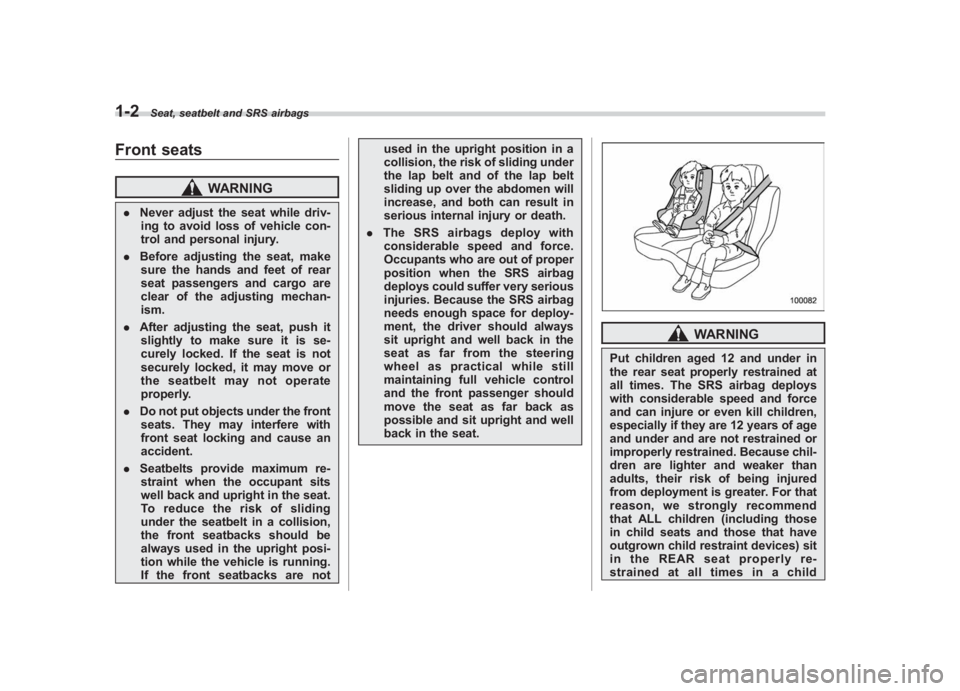
Put children aged 12 and under in
the rear seat properly restrained at
all times. The SRS airbag deploys
with considerable speed and force
and can injure or even kill children,
especially if they are 12 years of age
and under and are not restrained or
improperly restrained. Because chil-
dren are lighter and weaker than
adults, their risk of being injured
from deployment is greater. For that
reason, we strongly recommend
that ALL children (including those
in child seats and those that have
outgrown child restraint devices) sit
in the REAR seat properly re-
strained at all times in a child
Page 80 of 463
Black plate (32,1)
北米Model "A1130BE-A" EDITED: 2011/ 6/ 7
1-4
Seat, seatbelt and SRS airbags
WARNING
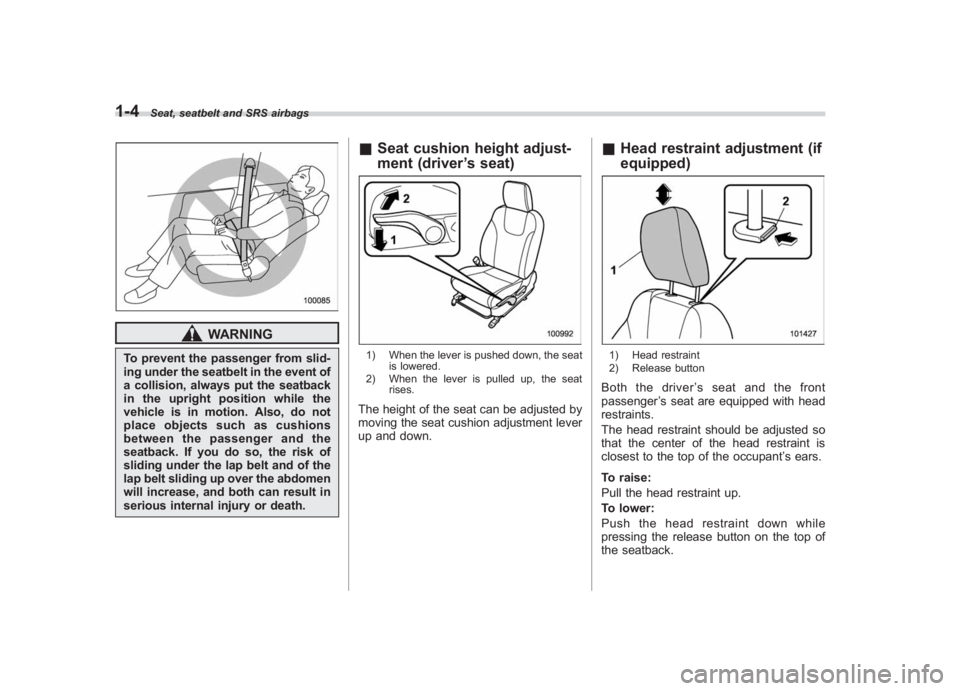
To prevent the passenger from slid-
ing under the seatbelt in the event of
a collision, always put the seatback
in the upright position while the
vehicle is in motion. Also, do not
place objects such as cushions
between the passenger and the
seatback. If you do so, the risk of
sliding under the lap belt and of the
lap belt sliding up over the abdomen
will increase, and both can result in
serious internal injury or death.
& Seat cushion height adjust-
ment (driver ’s seat)1) When the lever is pushed down, the seat
is lowered.
2) When the lever is pulled up, the seat rises.The height of the seat can be adjusted by
moving the seat cushion adjustment lever
up and down.
&Head restraint adjustment (if
equipped)1) Head restraint
2) Release buttonBoth the driver ’s seat and the front
passenger ’s seat are equipped with head
restraints.
The head restraint should be adjusted so
that the center of the head restraint is
closest to the top of the occupant ’s ears.
To raise:
Pull the head restraint up.
To lower:
Push the head restraint down while
pressing the release button on the top of
the seatback.
Page 81 of 463
Black plate (33,1)
北米Model "A1130BE-A" EDITED: 2011/ 6/ 7
To remove:
While pressing the release button, pull out
the head restraint.
To install:
Install the head restraint into the holes that
are located on the top of the seatback until
the head restraint locks.
WARNING
. Never drive the vehicle with the
head restraints removed because
they are designed to reduce the
risk of serious neck injury in the
event that the vehicle is struck
from the rear. Therefore, when
you remove the head restraints,
you must reinstall all head re-
straints to protect vehicle occu-
pants.
. All occupants, including the dri-
ver, should not operate a vehicle
or sit in a vehicle ’s seat until the
head restraints are placed in their
proper positions in order to mini-
mize the risk of neck injury in the
event of a crash.
& Active head restraint (if
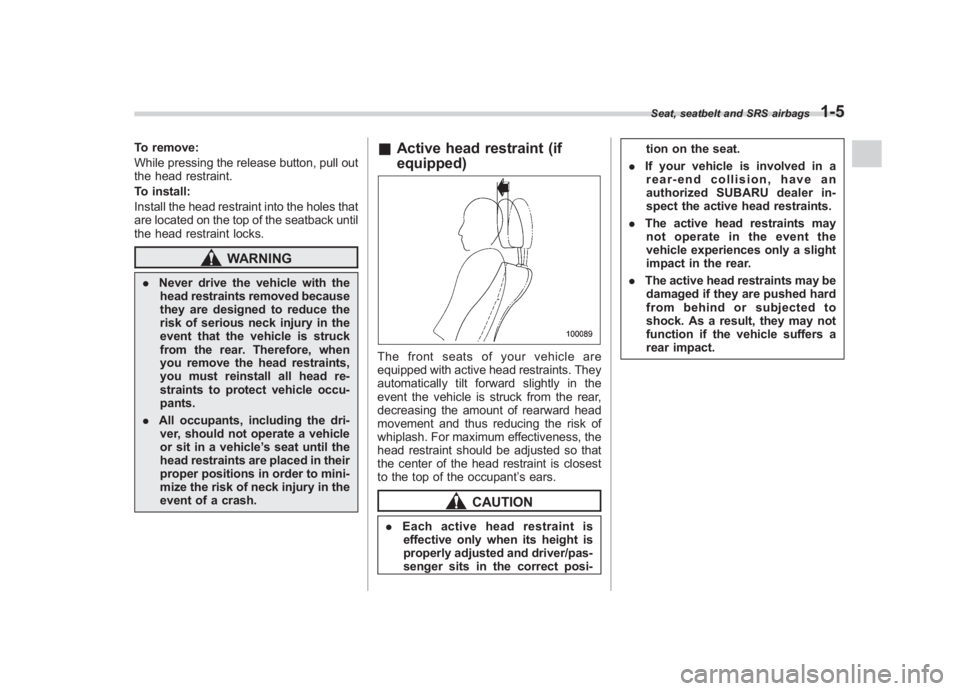
equipped)The front seats of your vehicle are
equipped with active head restraints. They
automatically tilt forward slightly in the
event the vehicle is struck from the rear,
decreasing the amount of rearward head
movement and thus reducing the risk of
whiplash. For maximum effectiveness, the
head restraint should be adjusted so that
the center of the head restraint is closest
to the top of the occupant ’s ears.
CAUTION
. Each active head restraint is
effective only when its height is
properly adjusted and driver/pas-
senger sits in the correct posi- tion on the seat.
. If your vehicle is involved in a
rear-end collision, have an
authorized SUBARU dealer in-
spect the active head restraints.
. The active head restraints may
not operate in the event the
vehicle experiences only a slight
impact in the rear.
. The active head restraints may be
damaged if they are pushed hard
from behind or subjected to
shock. As a result, they may not
function if the vehicle suffers a
rear impact.
Seat, seatbelt and SRS airbags
1-5
1