diff SUBARU LEGACY 1999 Service Repair Manual
[x] Cancel search | Manufacturer: SUBARU, Model Year: 1999, Model line: LEGACY, Model: SUBARU LEGACY 1999Pages: 1456, PDF Size: 59.93 MB
Page 1089 of 1456
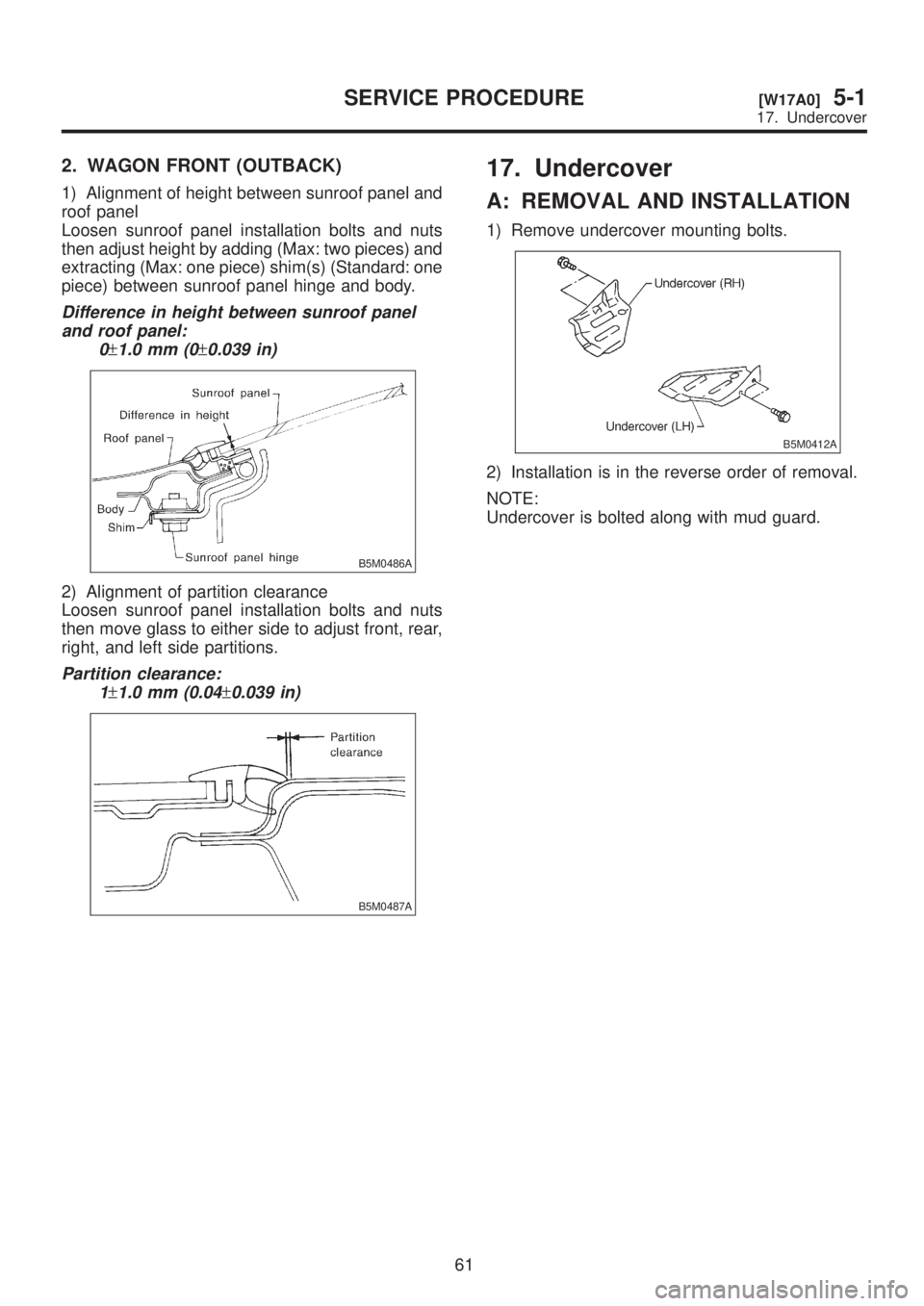
2. WAGON FRONT (OUTBACK)
1) Alignment of height between sunroof panel and
roof panel
Loosen sunroof panel installation bolts and nuts
then adjust height by adding (Max: two pieces) and
extracting (Max: one piece) shim(s) (Standard: one
piece) between sunroof panel hinge and body.
Difference in height between sunroof panel
and roof panel:
0
±1.0 mm (0±0.039 in)
B5M0486A
2) Alignment of partition clearance
Loosen sunroof panel installation bolts and nuts
then move glass to either side to adjust front, rear,
right, and left side partitions.
Partition clearance:
1
±1.0 mm (0.04±0.039 in)
B5M0487A
17. Undercover
A: REMOVAL AND INSTALLATION
1) Remove undercover mounting bolts.
B5M0412A
2) Installation is in the reverse order of removal.
NOTE:
Undercover is bolted along with mud guard.
61
[W17A0]5-1SERVICE PROCEDURE
17. Undercover
Page 1090 of 1456
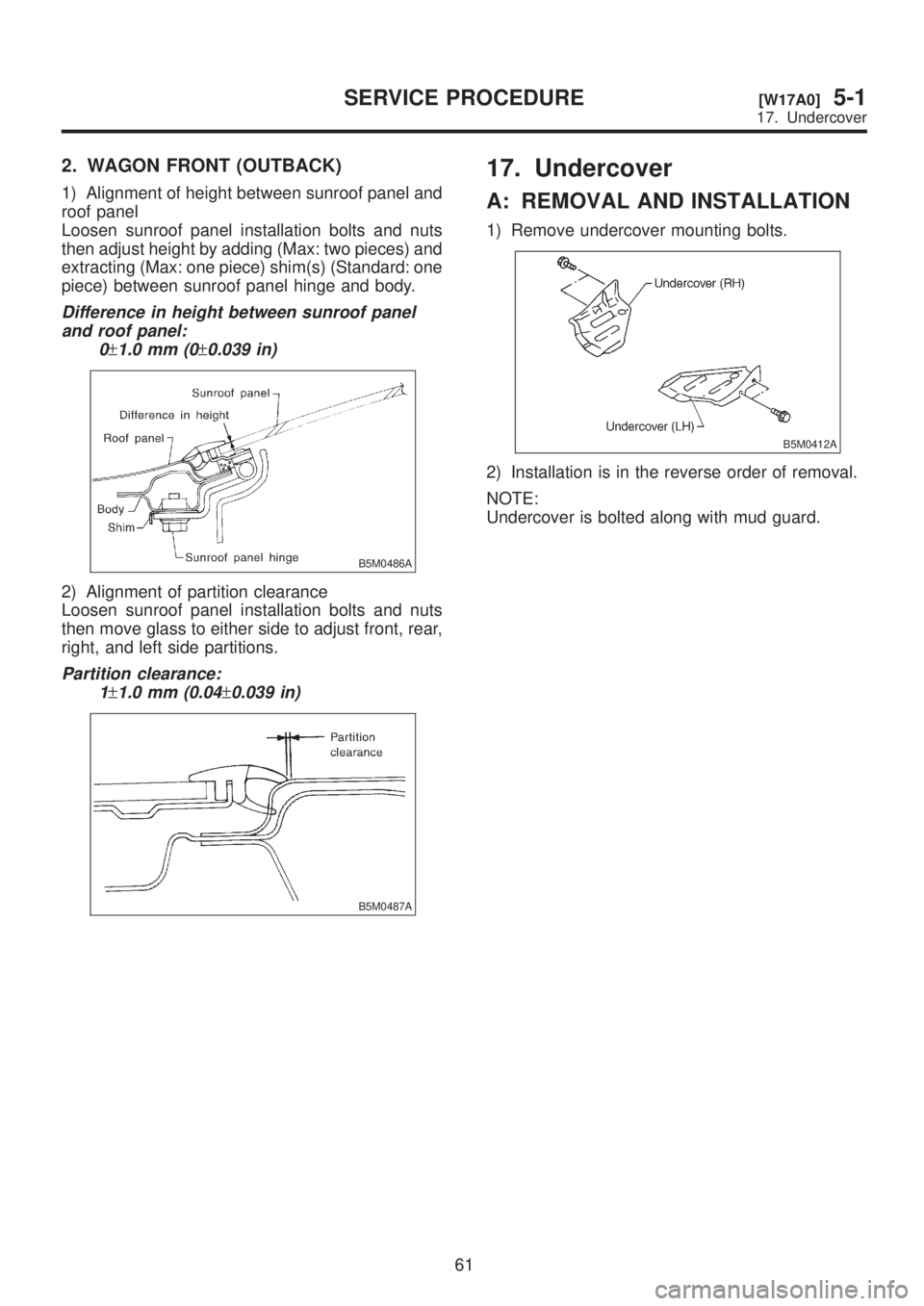
2. WAGON FRONT (OUTBACK)
1) Alignment of height between sunroof panel and
roof panel
Loosen sunroof panel installation bolts and nuts
then adjust height by adding (Max: two pieces) and
extracting (Max: one piece) shim(s) (Standard: one
piece) between sunroof panel hinge and body.
Difference in height between sunroof panel
and roof panel:
0
±1.0 mm (0±0.039 in)
B5M0486A
2) Alignment of partition clearance
Loosen sunroof panel installation bolts and nuts
then move glass to either side to adjust front, rear,
right, and left side partitions.
Partition clearance:
1
±1.0 mm (0.04±0.039 in)
B5M0487A
17. Undercover
A: REMOVAL AND INSTALLATION
1) Remove undercover mounting bolts.
B5M0412A
2) Installation is in the reverse order of removal.
NOTE:
Undercover is bolted along with mud guard.
61
[W17A0]5-1SERVICE PROCEDURE
17. Undercover
Page 1123 of 1456
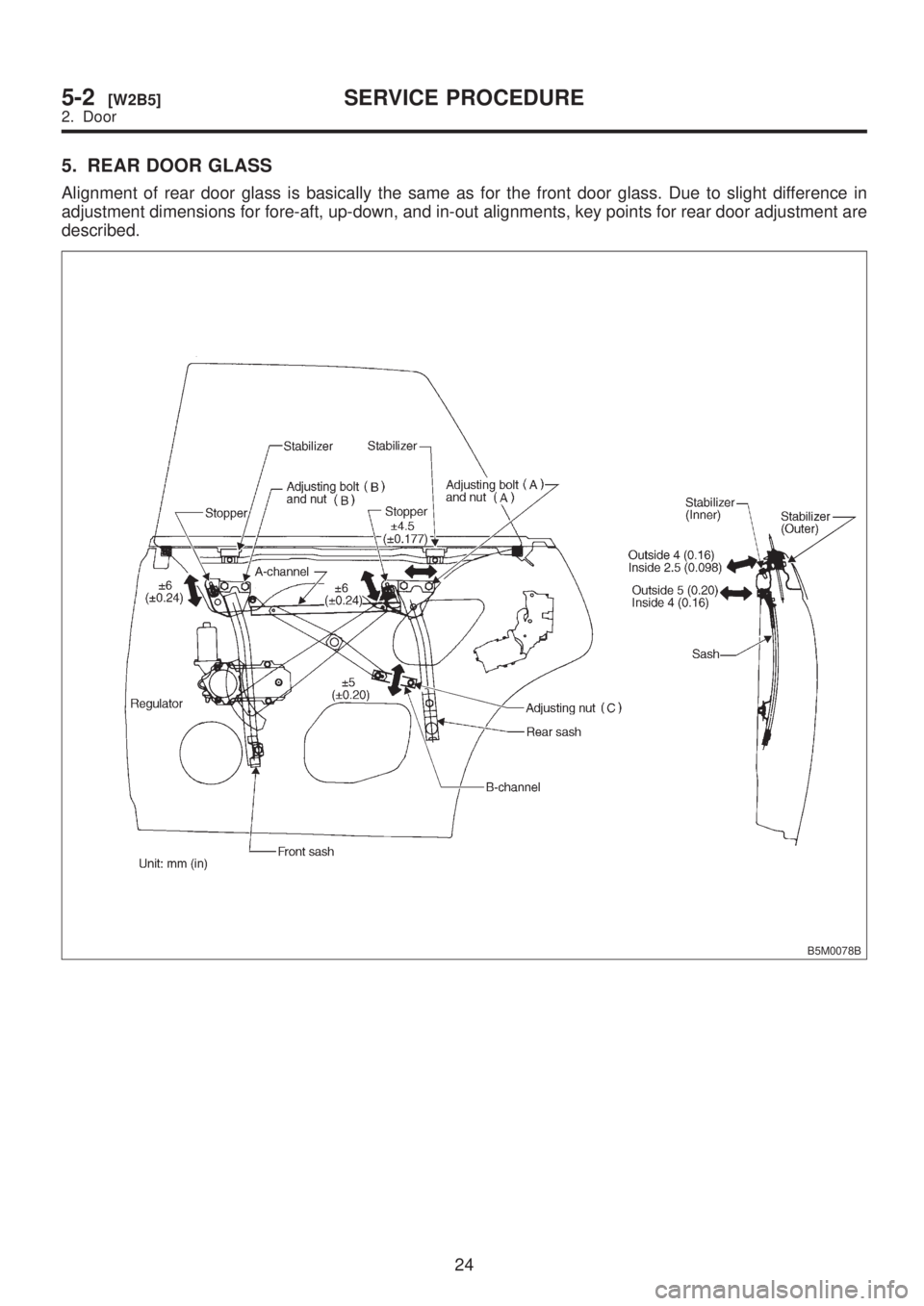
5. REAR DOOR GLASS
Alignment of rear door glass is basically the same as for the front door glass. Due to slight difference in
adjustment dimensions for fore-aft, up-down, and in-out alignments, key points for rear door adjustment are
described.
B5M0078B
24
5-2[W2B5]SERVICE PROCEDURE
2. Door
Page 1152 of 1456
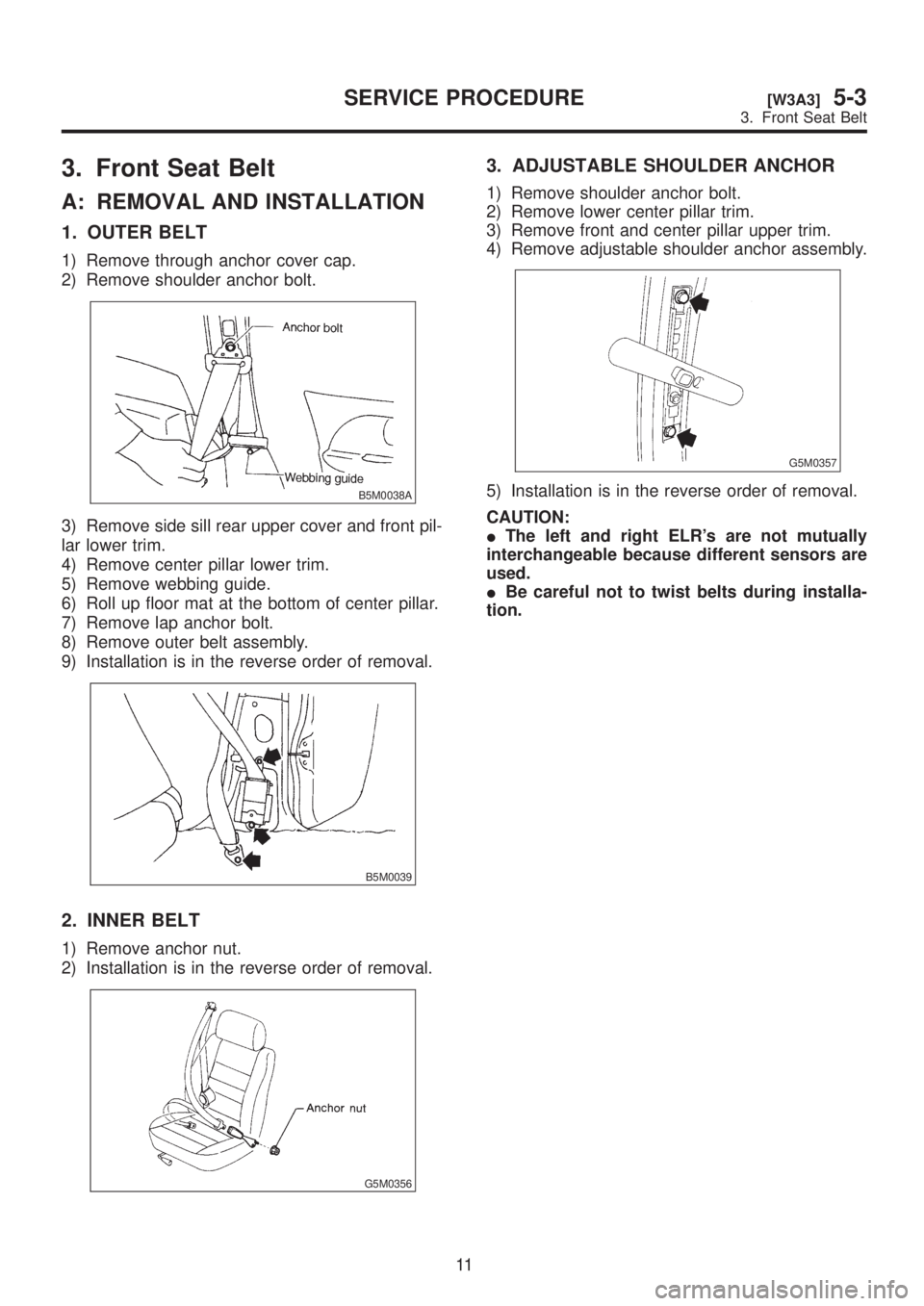
3. Front Seat Belt
A: REMOVAL AND INSTALLATION
1. OUTER BELT
1) Remove through anchor cover cap.
2) Remove shoulder anchor bolt.
B5M0038A
3) Remove side sill rear upper cover and front pil-
lar lower trim.
4) Remove center pillar lower trim.
5) Remove webbing guide.
6) Roll up floor mat at the bottom of center pillar.
7) Remove lap anchor bolt.
8) Remove outer belt assembly.
9) Installation is in the reverse order of removal.
B5M0039
2. INNER BELT
1) Remove anchor nut.
2) Installation is in the reverse order of removal.
G5M0356
3. ADJUSTABLE SHOULDER ANCHOR
1) Remove shoulder anchor bolt.
2) Remove lower center pillar trim.
3) Remove front and center pillar upper trim.
4) Remove adjustable shoulder anchor assembly.
G5M0357
5) Installation is in the reverse order of removal.
CAUTION:
IThe left and right ELR's are not mutually
interchangeable because different sensors are
used.
IBe careful not to twist belts during installa-
tion.
11
[W3A3]5-3SERVICE PROCEDURE
3. Front Seat Belt
Page 1156 of 1456
CAUTION:
IThe left and right ELR's are not mutually
interchangeable because different sensors are
used.
IBe careful not to twist belts during installa-
tion.
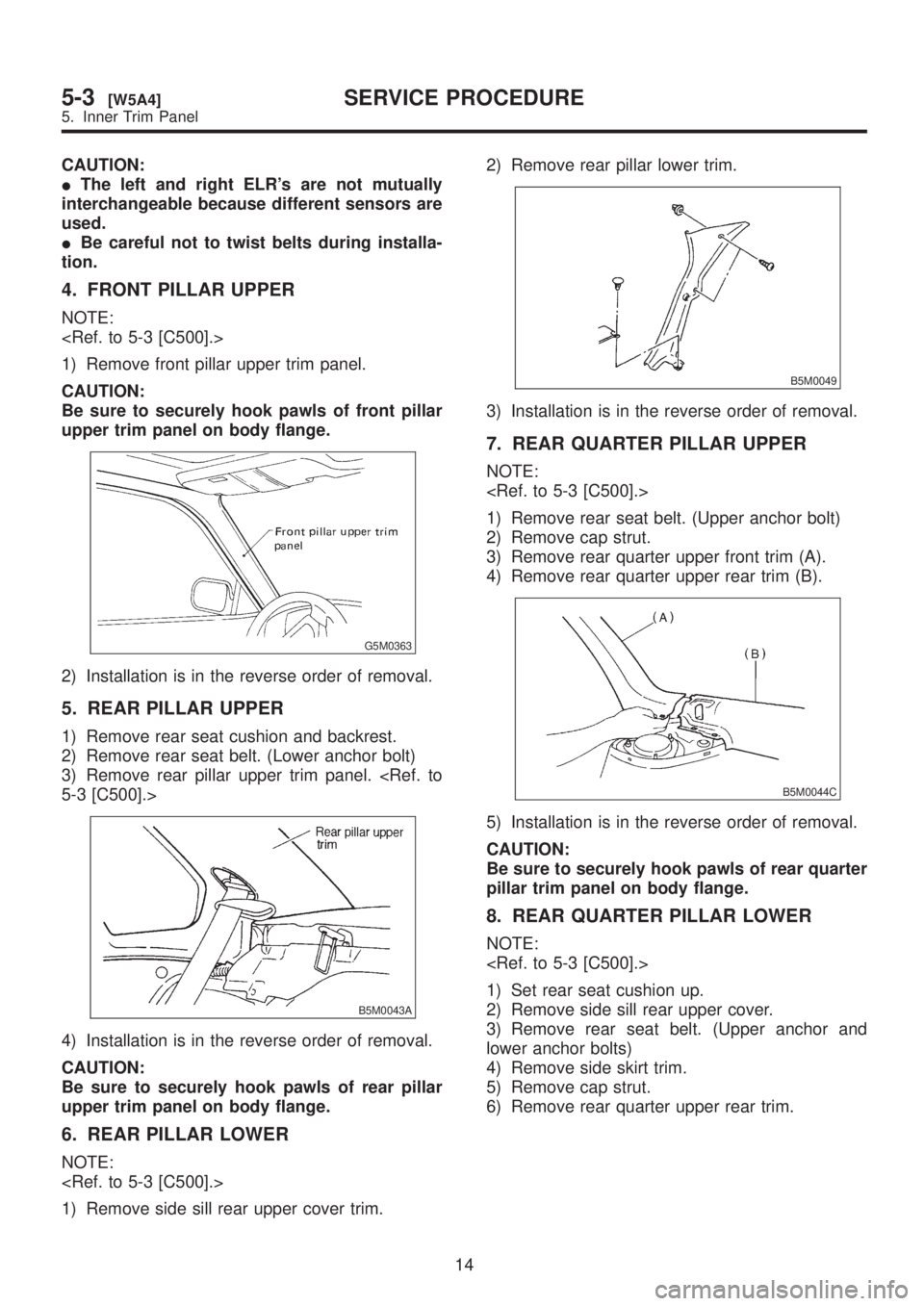
4. FRONT PILLAR UPPER
NOTE:
1) Remove front pillar upper trim panel.
CAUTION:
Be sure to securely hook pawls of front pillar
upper trim panel on body flange.
G5M0363
2) Installation is in the reverse order of removal.
5. REAR PILLAR UPPER
1) Remove rear seat cushion and backrest.
2) Remove rear seat belt. (Lower anchor bolt)
3) Remove rear pillar upper trim panel.
B5M0043A
4) Installation is in the reverse order of removal.
CAUTION:
Be sure to securely hook pawls of rear pillar
upper trim panel on body flange.
6. REAR PILLAR LOWER
NOTE:
1) Remove side sill rear upper cover trim.2) Remove rear pillar lower trim.
B5M0049
3) Installation is in the reverse order of removal.
7. REAR QUARTER PILLAR UPPER
NOTE:
1) Remove rear seat belt. (Upper anchor bolt)
2) Remove cap strut.
3) Remove rear quarter upper front trim (A).
4) Remove rear quarter upper rear trim (B).
B5M0044C
5) Installation is in the reverse order of removal.
CAUTION:
Be sure to securely hook pawls of rear quarter
pillar trim panel on body flange.
8. REAR QUARTER PILLAR LOWER
NOTE:
1) Set rear seat cushion up.
2) Remove side sill rear upper cover.
3) Remove rear seat belt. (Upper anchor and
lower anchor bolts)
4) Remove side skirt trim.
5) Remove cap strut.
6) Remove rear quarter upper rear trim.
14
5-3[W5A4]SERVICE PROCEDURE
5. Inner Trim Panel
Page 1211 of 1456
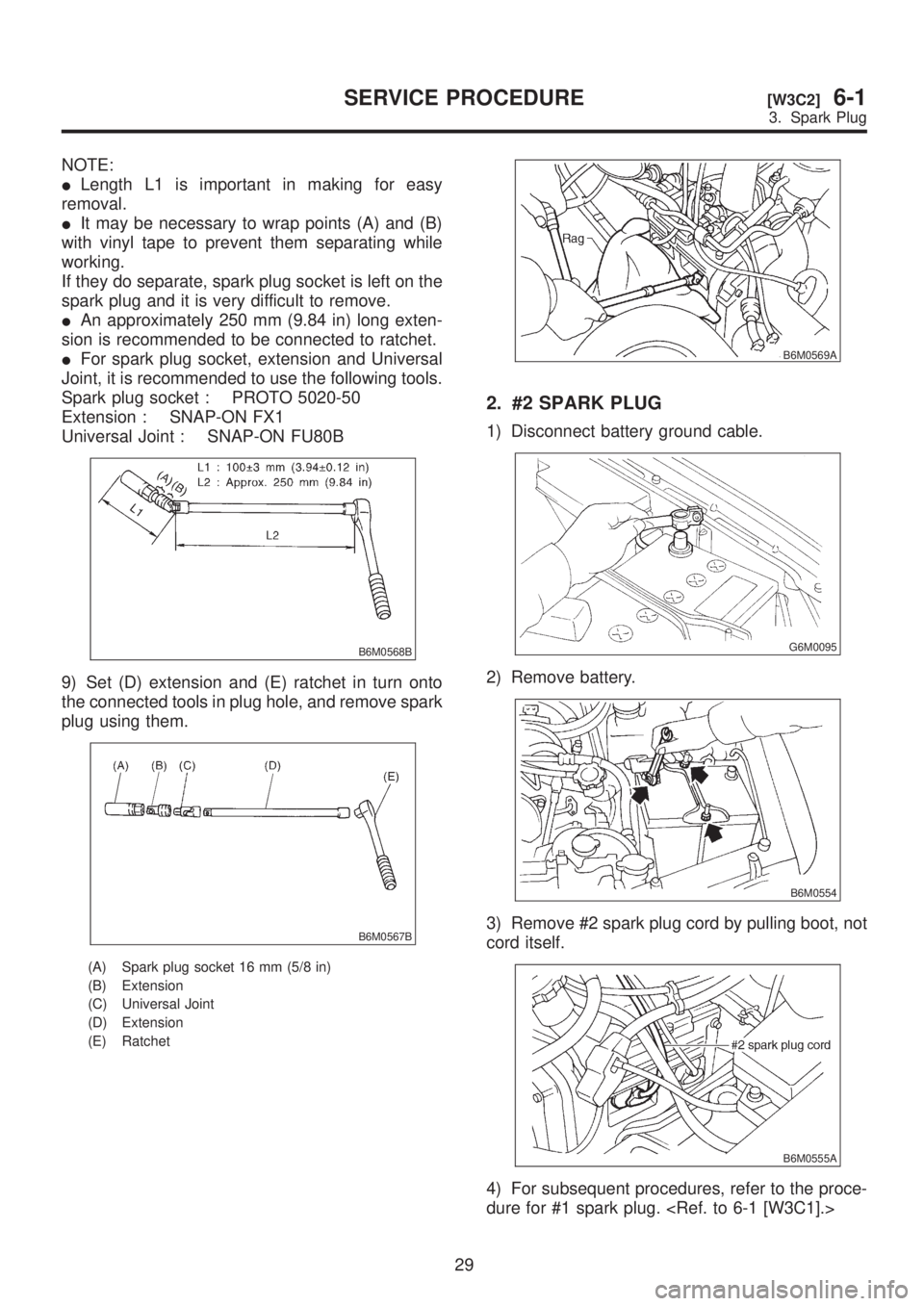
NOTE:
ILength L1 is important in making for easy
removal.
IIt may be necessary to wrap points (A) and (B)
with vinyl tape to prevent them separating while
working.
If they do separate, spark plug socket is left on the
spark plug and it is very difficult to remove.
IAn approximately 250 mm (9.84 in) long exten-
sion is recommended to be connected to ratchet.
IFor spark plug socket, extension and Universal
Joint, it is recommended to use the following tools.
Spark plug socket : PROTO 5020-50
Extension : SNAP-ON FX1
Universal Joint : SNAP-ON FU80B
B6M0568B
9) Set (D) extension and (E) ratchet in turn onto
the connected tools in plug hole, and remove spark
plug using them.
B6M0567B
(A) Spark plug socket 16 mm (5/8 in)
(B) Extension
(C) Universal Joint
(D) Extension
(E) Ratchet
B6M0569A
2. #2 SPARK PLUG
1) Disconnect battery ground cable.
G6M0095
2) Remove battery.
B6M0554
3) Remove #2 spark plug cord by pulling boot, not
cord itself.
B6M0555A
4) For subsequent procedures, refer to the proce-
dure for #1 spark plug.
29
[W3C2]6-1SERVICE PROCEDURE
3. Spark Plug
Page 1214 of 1456
D: INSTALLATION (2500 cc
OUTBACK MODEL)
1. #1 SPARK PLUG
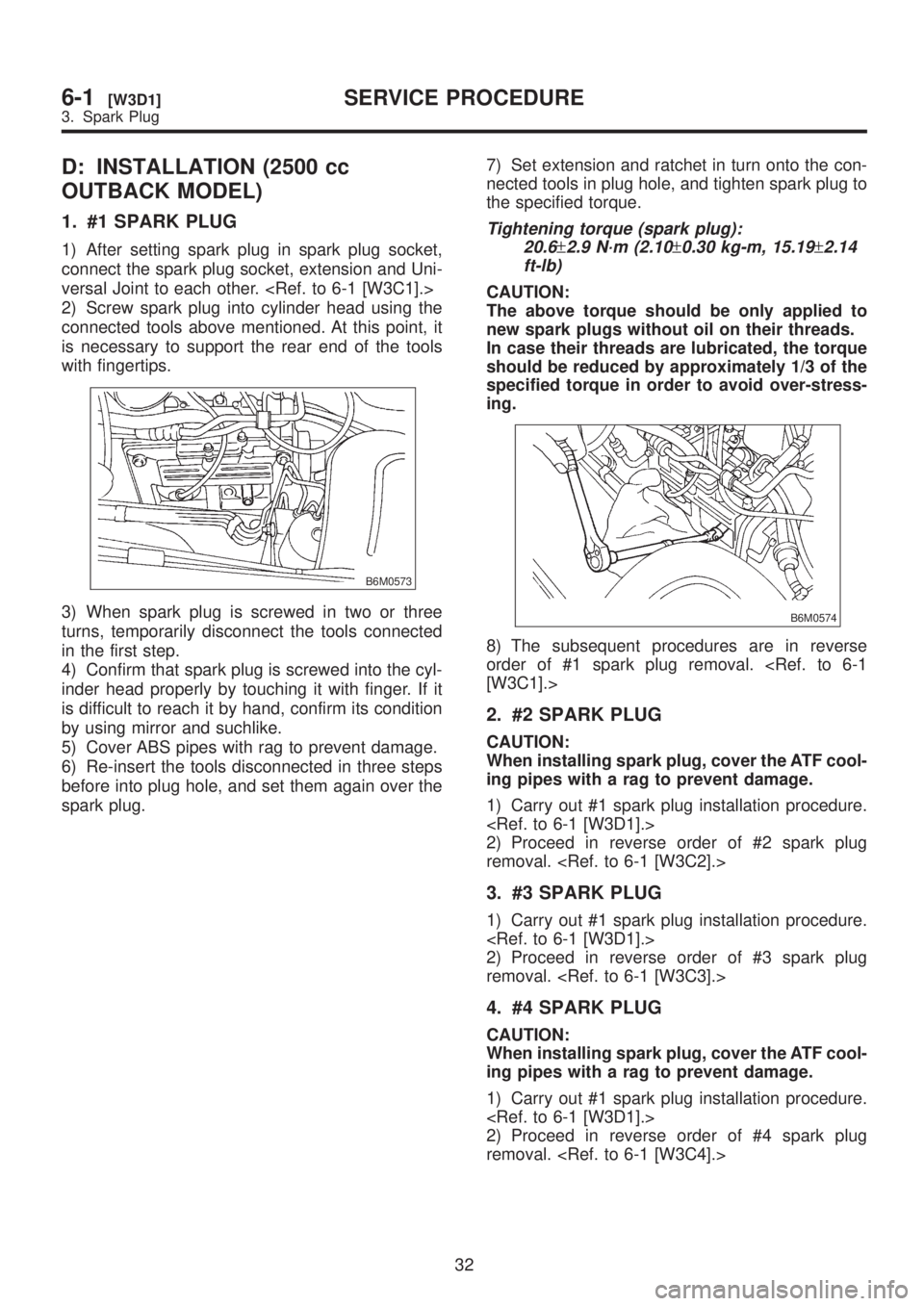
1) After setting spark plug in spark plug socket,
connect the spark plug socket, extension and Uni-
versal Joint to each other.
2) Screw spark plug into cylinder head using the
connected tools above mentioned. At this point, it
is necessary to support the rear end of the tools
with fingertips.
B6M0573
3) When spark plug is screwed in two or three
turns, temporarily disconnect the tools connected
in the first step.
4) Confirm that spark plug is screwed into the cyl-
inder head properly by touching it with finger. If it
is difficult to reach it by hand, confirm its condition
by using mirror and suchlike.
5) Cover ABS pipes with rag to prevent damage.
6) Re-insert the tools disconnected in three steps
before into plug hole, and set them again over the
spark plug.7) Set extension and ratchet in turn onto the con-
nected tools in plug hole, and tighten spark plug to
the specified torque.
Tightening torque (spark plug):
20.6
±2.9 N´m (2.10±0.30 kg-m, 15.19±2.14
ft-lb)
CAUTION:
The above torque should be only applied to
new spark plugs without oil on their threads.
In case their threads are lubricated, the torque
should be reduced by approximately 1/3 of the
specified torque in order to avoid over-stress-
ing.
B6M0574
8) The subsequent procedures are in reverse
order of #1 spark plug removal.
2. #2 SPARK PLUG
CAUTION:
When installing spark plug, cover the ATF cool-
ing pipes with a rag to prevent damage.
1) Carry out #1 spark plug installation procedure.
2) Proceed in reverse order of #2 spark plug
removal.
3. #3 SPARK PLUG
1) Carry out #1 spark plug installation procedure.
2) Proceed in reverse order of #3 spark plug
removal.
4. #4 SPARK PLUG
CAUTION:
When installing spark plug, cover the ATF cool-
ing pipes with a rag to prevent damage.
1) Carry out #1 spark plug installation procedure.
2) Proceed in reverse order of #4 spark plug
removal.
32
6-1[W3D1]SERVICE PROCEDURE
3. Spark Plug
Page 1281 of 1456
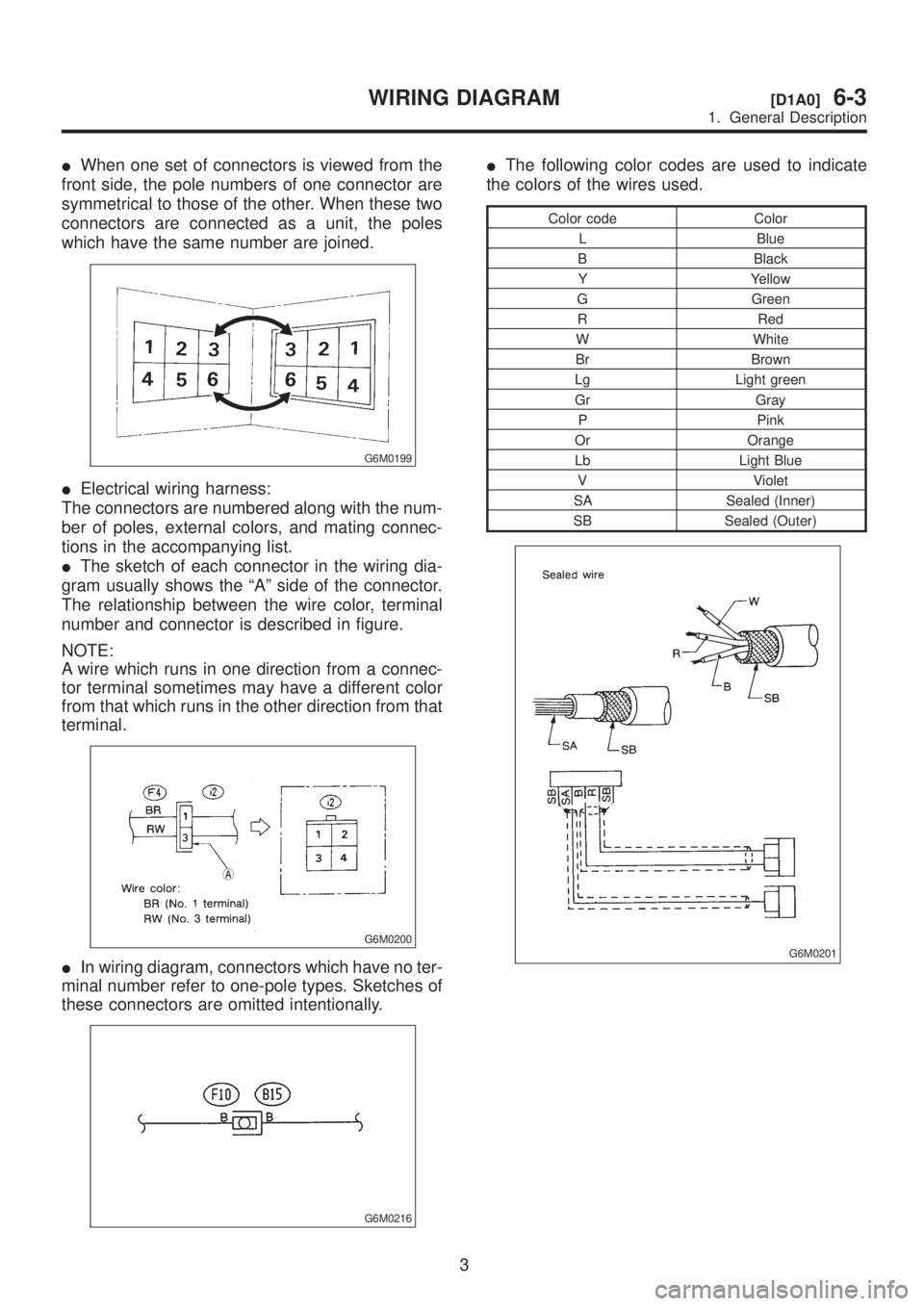
IWhen one set of connectors is viewed from the
front side, the pole numbers of one connector are
symmetrical to those of the other. When these two
connectors are connected as a unit, the poles
which have the same number are joined.
G6M0199
IElectrical wiring harness:
The connectors are numbered along with the num-
ber of poles, external colors, and mating connec-
tions in the accompanying list.
IThe sketch of each connector in the wiring dia-
gram usually shows the ªAº side of the connector.
The relationship between the wire color, terminal
number and connector is described in figure.
NOTE:
A wire which runs in one direction from a connec-
tor terminal sometimes may have a different color
from that which runs in the other direction from that
terminal.
G6M0200
IIn wiring diagram, connectors which have no ter-
minal number refer to one-pole types. Sketches of
these connectors are omitted intentionally.
G6M0216
IThe following color codes are used to indicate
the colors of the wires used.
Color code Color
L Blue
B Black
Y Yellow
G Green
R Red
W White
Br Brown
Lg Light green
Gr Gray
P Pink
Or Orange
Lb Light Blue
V Violet
SA Sealed (Inner)
SB Sealed (Outer)
G6M0201
3
[D1A0]6-3WIRING DIAGRAM
1. General Description
Page 1282 of 1456
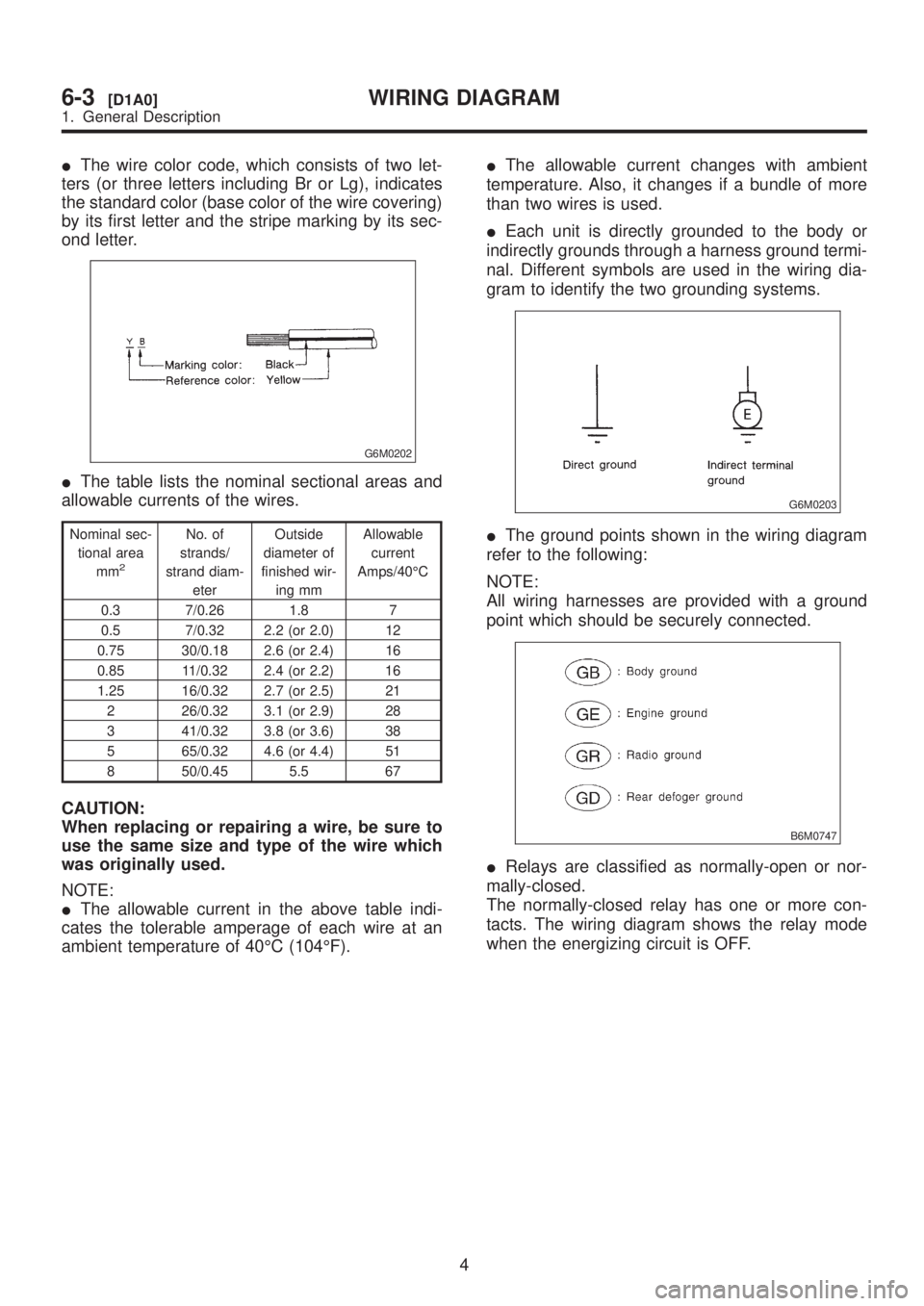
IThe wire color code, which consists of two let-
ters (or three letters including Br or Lg), indicates
the standard color (base color of the wire covering)
by its first letter and the stripe marking by its sec-
ond letter.
G6M0202
IThe table lists the nominal sectional areas and
allowable currents of the wires.
Nominal sec-
tional area
mm
2
No. of
strands/
strand diam-
eterOutside
diameter of
finished wir-
ing mmAllowable
current
Amps/40ÉC
0.3 7/0.26 1.8 7
0.5 7/0.32 2.2 (or 2.0) 12
0.75 30/0.18 2.6 (or 2.4) 16
0.85 11/0.32 2.4 (or 2.2) 16
1.25 16/0.32 2.7 (or 2.5) 21
2 26/0.32 3.1 (or 2.9) 28
3 41/0.32 3.8 (or 3.6) 38
5 65/0.32 4.6 (or 4.4) 51
8 50/0.45 5.5 67
CAUTION:
When replacing or repairing a wire, be sure to
use the same size and type of the wire which
was originally used.
NOTE:
IThe allowable current in the above table indi-
cates the tolerable amperage of each wire at an
ambient temperature of 40ÉC (104ÉF).IThe allowable current changes with ambient
temperature. Also, it changes if a bundle of more
than two wires is used.
IEach unit is directly grounded to the body or
indirectly grounds through a harness ground termi-
nal. Different symbols are used in the wiring dia-
gram to identify the two grounding systems.
G6M0203
IThe ground points shown in the wiring diagram
refer to the following:
NOTE:
All wiring harnesses are provided with a ground
point which should be securely connected.
B6M0747
IRelays are classified as normally-open or nor-
mally-closed.
The normally-closed relay has one or more con-
tacts. The wiring diagram shows the relay mode
when the energizing circuit is OFF.
4
6-3[D1A0]WIRING DIAGRAM
1. General Description