replacement SUBARU LEGACY 1999 Service User Guide
[x] Cancel search | Manufacturer: SUBARU, Model Year: 1999, Model line: LEGACY, Model: SUBARU LEGACY 1999Pages: 1456, PDF Size: 59.93 MB
Page 790 of 1456
10. Installation of Wheel
Assembly to Vehicle
1) Attach the wheel to the hub by aligning the
wheel bolt hole with the hub bolt.
2) Temporarily attach the wheel nuts to the hub
bolts. (In the case of aluminum wheel, use
SUBARU genuine wheel nut for aluminum wheel.)
3) Manually tighten the nuts making sure the
wheel hub hole is aligned correctly to the guide
portion of hub.
4) Tighten the wheel nuts in a diagonal selection
to the specified torque. Use a wheel nut wrench.
Wheel nut tightening torque:
88
±10 N´m (9±1 kg-m, 65±7 ft-lb)
CAUTION:
ITighten the wheel nuts in two or three steps
by gradually increasing the torque and working
diagonally, until the specified torque is
reached. For drum brake models, excess tight-
ening of wheel nuts may cause wheels to ªjud-
derº.
IDo not depress the wrench with a foot;
Always use both hands when tightening.
IMake sure the bolt, nut and the nut seating
surface of the wheel are free from oils.
5) If a wheel is removed for replacement or for
repair of a puncture, retighten the wheel nuts to the
specified torque after running 1,000 km (600
miles).
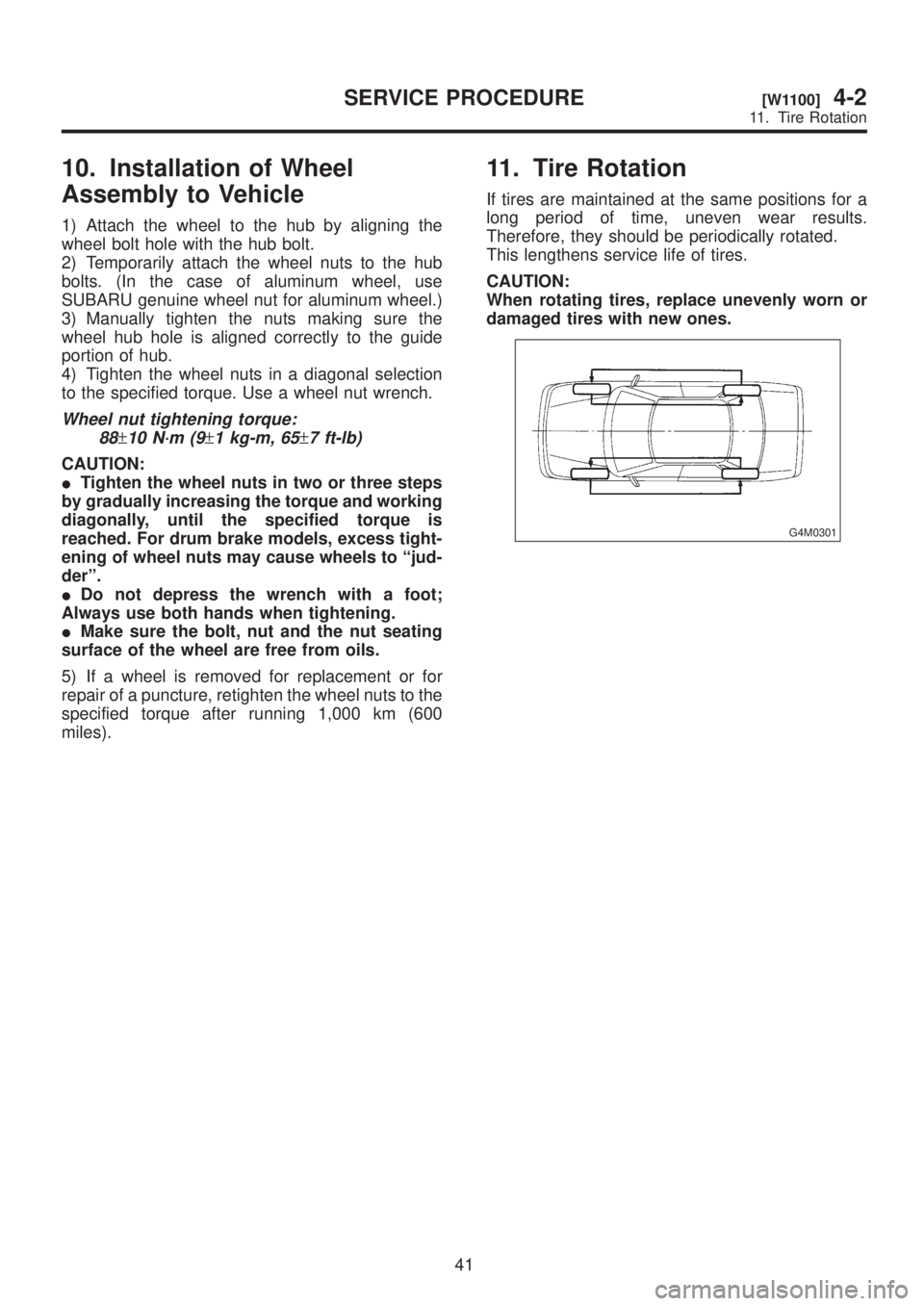
11. Tire Rotation
If tires are maintained at the same positions for a
long period of time, uneven wear results.
Therefore, they should be periodically rotated.
This lengthens service life of tires.
CAUTION:
When rotating tires, replace unevenly worn or
damaged tires with new ones.
G4M0301
41
[W1100]4-2SERVICE PROCEDURE
11. Tire Rotation
Page 791 of 1456
10. Installation of Wheel
Assembly to Vehicle
1) Attach the wheel to the hub by aligning the
wheel bolt hole with the hub bolt.
2) Temporarily attach the wheel nuts to the hub
bolts. (In the case of aluminum wheel, use
SUBARU genuine wheel nut for aluminum wheel.)
3) Manually tighten the nuts making sure the
wheel hub hole is aligned correctly to the guide
portion of hub.
4) Tighten the wheel nuts in a diagonal selection
to the specified torque. Use a wheel nut wrench.
Wheel nut tightening torque:
88
±10 N´m (9±1 kg-m, 65±7 ft-lb)
CAUTION:
ITighten the wheel nuts in two or three steps
by gradually increasing the torque and working
diagonally, until the specified torque is
reached. For drum brake models, excess tight-
ening of wheel nuts may cause wheels to ªjud-
derº.
IDo not depress the wrench with a foot;
Always use both hands when tightening.
IMake sure the bolt, nut and the nut seating
surface of the wheel are free from oils.
5) If a wheel is removed for replacement or for
repair of a puncture, retighten the wheel nuts to the
specified torque after running 1,000 km (600
miles).
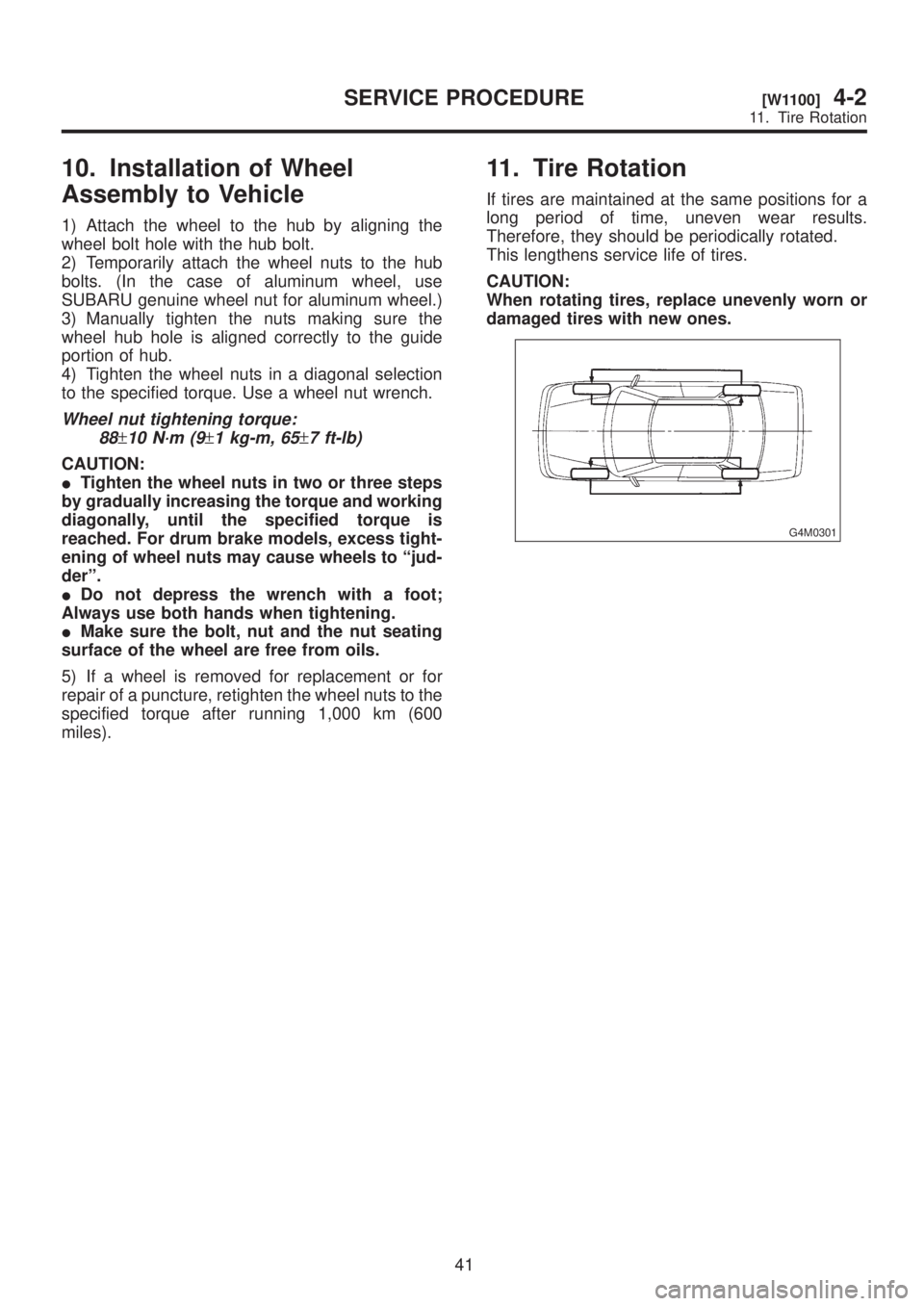
11. Tire Rotation
If tires are maintained at the same positions for a
long period of time, uneven wear results.
Therefore, they should be periodically rotated.
This lengthens service life of tires.
CAUTION:
When rotating tires, replace unevenly worn or
damaged tires with new ones.
G4M0301
41
[W1100]4-2SERVICE PROCEDURE
11. Tire Rotation
Page 813 of 1456
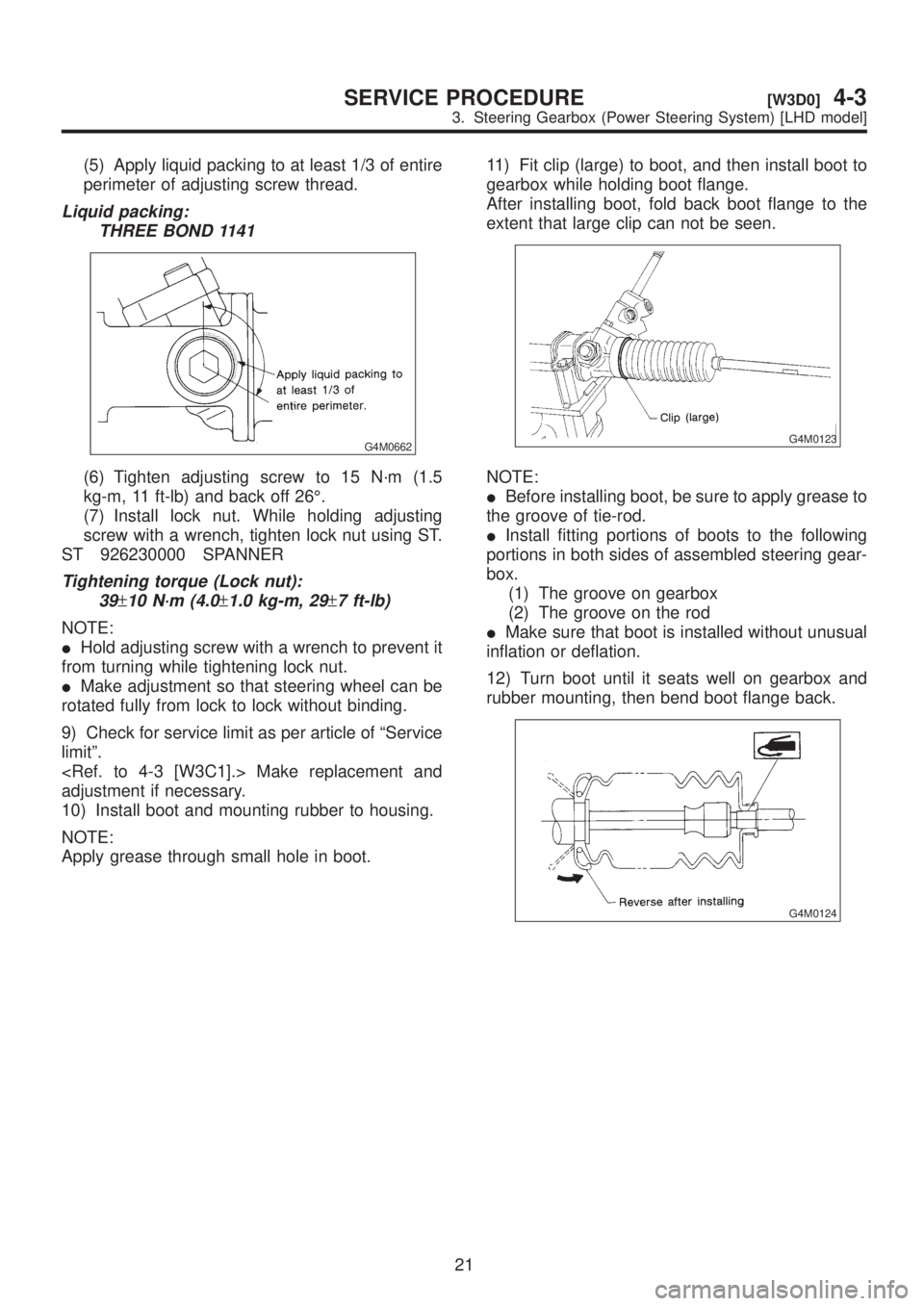
(5) Apply liquid packing to at least 1/3 of entire
perimeter of adjusting screw thread.
Liquid packing:
THREE BOND 1141
G4M0662
(6) Tighten adjusting screw to 15 N´m (1.5
kg-m, 11 ft-lb) and back off 26É.
(7) Install lock nut. While holding adjusting
screw with a wrench, tighten lock nut using ST.
ST 926230000 SPANNER
Tightening torque (Lock nut):
39
±10 N´m (4.0±1.0 kg-m, 29±7 ft-lb)
NOTE:
IHold adjusting screw with a wrench to prevent it
from turning while tightening lock nut.
IMake adjustment so that steering wheel can be
rotated fully from lock to lock without binding.
9) Check for service limit as per article of ªService
limitº.
adjustment if necessary.
10) Install boot and mounting rubber to housing.
NOTE:
Apply grease through small hole in boot.11) Fit clip (large) to boot, and then install boot to
gearbox while holding boot flange.
After installing boot, fold back boot flange to the
extent that large clip can not be seen.
G4M0123
NOTE:
IBefore installing boot, be sure to apply grease to
the groove of tie-rod.
IInstall fitting portions of boots to the following
portions in both sides of assembled steering gear-
box.
(1) The groove on gearbox
(2) The groove on the rod
IMake sure that boot is installed without unusual
inflation or deflation.
12) Turn boot until it seats well on gearbox and
rubber mounting, then bend boot flange back.
G4M0124
21
[W3D0]4-3SERVICE PROCEDURE
3. Steering Gearbox (Power Steering System) [LHD model]
Page 827 of 1456
![SUBARU LEGACY 1999 Service User Guide 5. Control Valve (Power Steering Gearbox) [LHD model]
A: CHECKING OIL LEAKING POINTS
B4M1132A
(1) Power cylinder
(2) Cylinder
(3) Rack piston
(4) Rack axle
(5) Input shaft(6) Torsion bar
(7) Valve hou](/img/17/57435/w960_57435-826.png "SUBARU LEGACY 1999 Service User Guide 5. Control Valve (Power Steering Gearbox) [LHD model]
A: CHECKING OIL LEAKING POINTS
B4M1132A
(1) Power cylinder
(2) Cylinder
(3) Rack piston
(4) Rack axle
(5) Input shaft(6) Torsion bar
(7) Valve hou")
5. Control Valve (Power Steering Gearbox) [LHD model]
A: CHECKING OIL LEAKING POINTS
B4M1132A
(1) Power cylinder
(2) Cylinder
(3) Rack piston
(4) Rack axle
(5) Input shaft(6) Torsion bar
(7) Valve housing
(8) Valve body
(9) Control valve
(10) Pipe B(11) Pipe A
(12) Pinion
(13) Pinion axle
1. OIL LEAKING POINTS
1) If leak point is other than a, b, c, or d, perform
check step 5) in ªOIL LEAK CHECK PROCEDURE
AND REPLACEMENT PARTSº before dismounting
gearbox from vehicle.
gearbox is dismounted without confirming where
the leak is, it must be mounted again to locate the
leak point.
2) Even if the location of the leak can be easily
found by observing the leaking condition, it is nec-
essary to thoroughly remove the oil from the sus-
pected portion and turn the steering wheel from
lock to lock about 30 to 40 times with engine
running, then make comparison of the suspected
portion between immediately after and several
hours after this operation.
3) Before starting oil leak repair work, be sure to
clean the gearbox, hoses, pipes, and surrounding
parts. After completing repair work, clean these
areas again.
2. OIL LEAK CHECK PROCEDURE AND
REPLACEMENT PARTS
NOTE:
Parts requiring replacement are described in the
smallest unit of spare parts including damaged
parts and spare parts damaged. In actual disas-sembly work, accidental damage as well as inevi-
table damage to some related parts must be taken
into account, and spare parts for them must also
be prepared. However, it is essential to pinpoint the
cause of trouble, and limit the number of replace-
ment parts as much as possible.
1) Leakage from ªaº
The oil seal is damaged. Replace valve assembly
with a new one.
2) Leakage from ªbº
The torsion bar O-ring is damaged. Replace valve
assembly with a new one.
3) Leakage from ªcº
The oil seal is damaged. Replace valve assembly
with a new one.
4) Leakage from ªdº
The pipe is damaged. Replace the faulty pipe or
O-ring.
5) If leak is other than a, b, c, or d, and if oil is
leaking from the gearbox, move the right and left
boots toward tie-rod end side, respectively, with the
gearbox mounted to the vehicle, and remove oil
from the surrounding portions. Then, turn the steer-
ing wheel from lock to lock 30 to 40 times with the
engine running, then make comparison of the
leaked portion immediately after and several hours
after this operation.
35
[W5A2]4-3SERVICE PROCEDURE
5. Control Valve (Power Steering Gearbox) [LHD model]
Page 829 of 1456
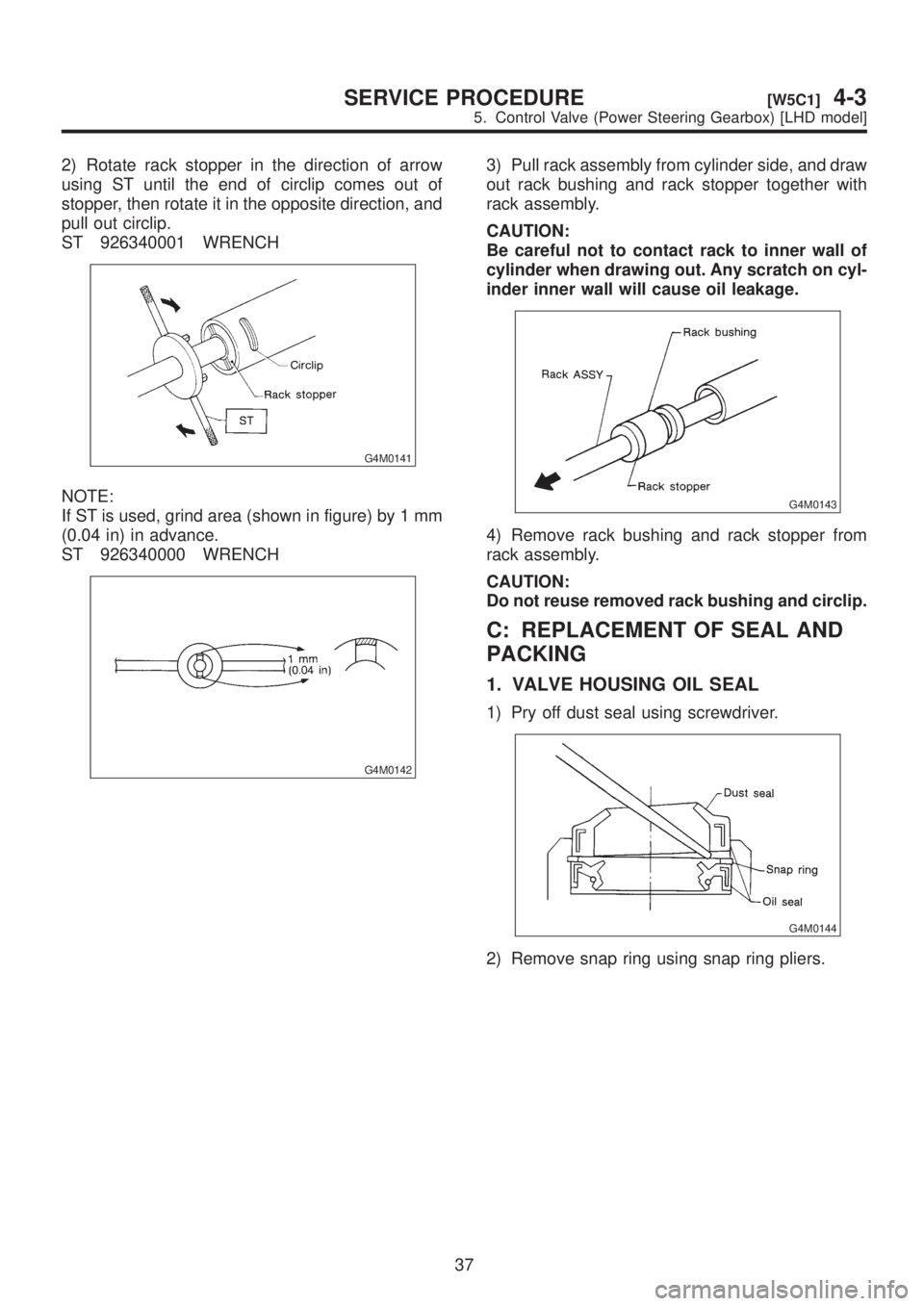
2) Rotate rack stopper in the direction of arrow
using ST until the end of circlip comes out of
stopper, then rotate it in the opposite direction, and
pull out circlip.
ST 926340001 WRENCH
G4M0141
NOTE:
If ST is used, grind area (shown in figure) by 1 mm
(0.04 in) in advance.
ST 926340000 WRENCH
G4M0142
3) Pull rack assembly from cylinder side, and draw
out rack bushing and rack stopper together with
rack assembly.
CAUTION:
Be careful not to contact rack to inner wall of
cylinder when drawing out. Any scratch on cyl-
inder inner wall will cause oil leakage.
G4M0143
4) Remove rack bushing and rack stopper from
rack assembly.
CAUTION:
Do not reuse removed rack bushing and circlip.
C: REPLACEMENT OF SEAL AND
PACKING
1. VALVE HOUSING OIL SEAL
1) Pry off dust seal using screwdriver.
G4M0144
2) Remove snap ring using snap ring pliers.
37
[W5C1]4-3SERVICE PROCEDURE
5. Control Valve (Power Steering Gearbox) [LHD model]
Page 834 of 1456
![SUBARU LEGACY 1999 Service User Guide 6. Control Valve (Power Steering Gearbox) [RHD model]
A: CHECKING OIL LEAKING POINTS
B4M0668A
1. OIL LEAKING POINTS
1) If leak point is other than a, b, c, or d, perform
check step 5) in ªOIL LEAK CH](/img/17/57435/w960_57435-833.png "SUBARU LEGACY 1999 Service User Guide 6. Control Valve (Power Steering Gearbox) [RHD model]
A: CHECKING OIL LEAKING POINTS
B4M0668A
1. OIL LEAKING POINTS
1) If leak point is other than a, b, c, or d, perform
check step 5) in ªOIL LEAK CH")
6. Control Valve (Power Steering Gearbox) [RHD model]
A: CHECKING OIL LEAKING POINTS
B4M0668A
1. OIL LEAKING POINTS
1) If leak point is other than a, b, c, or d, perform
check step 5) in ªOIL LEAK CHECK PROCEDURE
AND REPLACEMENT PARTSº before dismounting
gearbox from vehicle.
gearbox is dismounted without confirming where
the leak is, it must be mounted again to locate the
leak point.
2) Even if the location of the leak can be easily
found by observing the leaking condition, it is nec-
essary to thoroughly remove the oil from the sus-
pected portion and turn the steering wheel from
lock to lock about 30 to 40 times with engine
running, then make comparison of the suspected
portion between immediately after and several
hours after this operation.
3) Before starting oil leak repair work, be sure to
clean the gearbox, hoses, pipes, and surrounding
parts. After completing repair work, clean these
areas again.
2. OIL LEAK CHECK PROCEDURE AND
REPLACEMENT PARTS
NOTE:
Parts requiring replacement are described in the
smallest unit of spare parts including damaged
parts and spare parts damaged. In actual disas-
sembly work, accidental damage as well as inevi-
table damage to some related parts must be taken
into account, and spare parts for them must also
be prepared. However, it is essential to pinpoint the
cause of trouble, and limit the number of replace-
ment parts as much as possible.
1) Leakage from ªaº
The oil seal is damaged. Replace valve assembly
with a new one.
2) Leakage from ªbº
The torsion bar O-ring is damaged. Replace valve
assembly with a new one.
3) Leakage from ªcº
The oil seal is damaged. Replace valve assembly
with a new one.
4) Leakage from ªdº
The pipe is damaged. Replace the faulty pipe or
O-ring.
5) If leak is other than a, b, c, or d, and if oil is
leaking from the gearbox, move the right and left
42
4-3[W6A0]SERVICE PROCEDURE
6. Control Valve (Power Steering Gearbox) [RHD model]
Page 837 of 1456
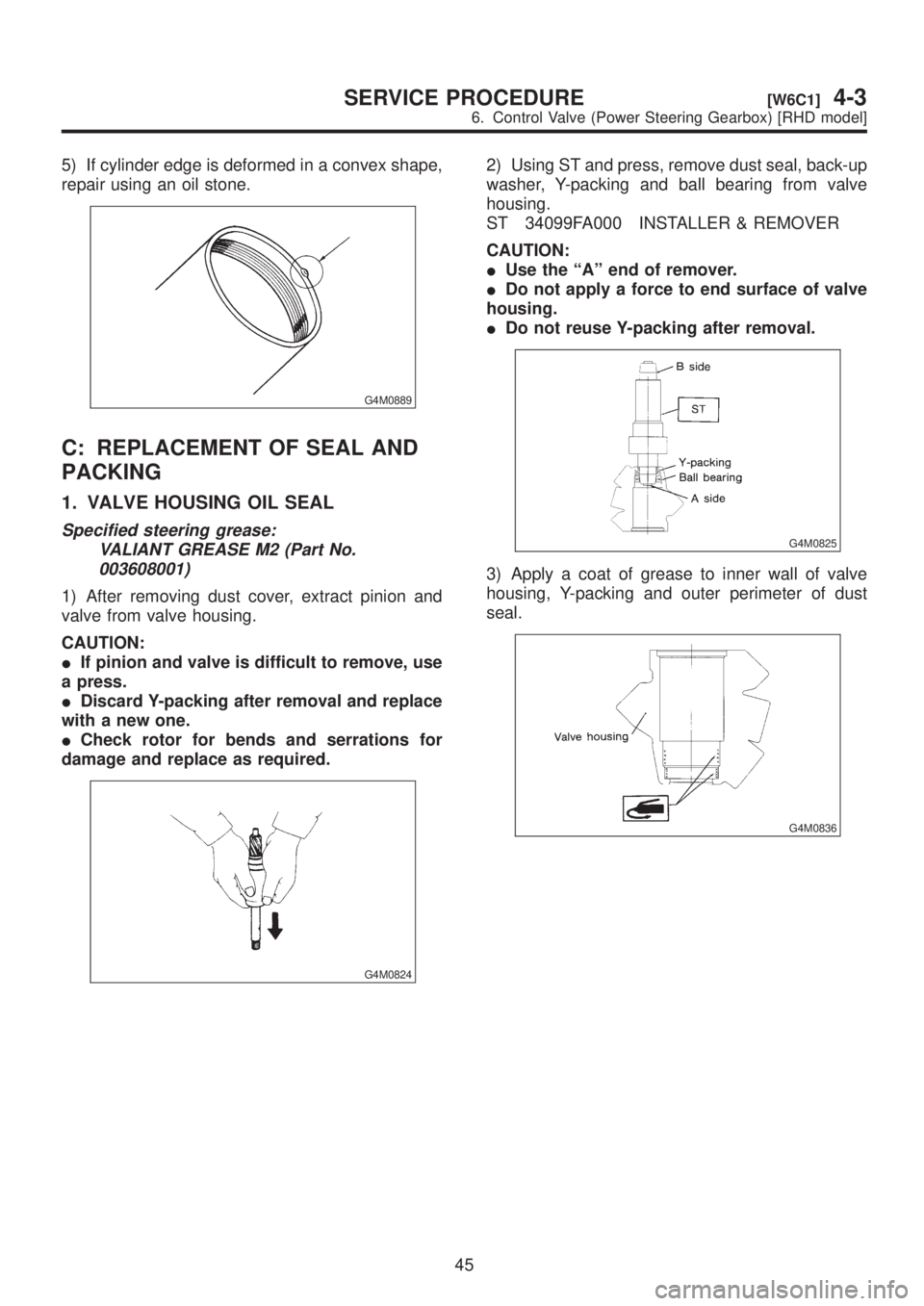
5) If cylinder edge is deformed in a convex shape,
repair using an oil stone.
G4M0889
C: REPLACEMENT OF SEAL AND
PACKING
1. VALVE HOUSING OIL SEAL
Specified steering grease:
VALIANT GREASE M2 (Part No.
003608001)
1) After removing dust cover, extract pinion and
valve from valve housing.
CAUTION:
IIf pinion and valve is difficult to remove, use
a press.
IDiscard Y-packing after removal and replace
with a new one.
ICheck rotor for bends and serrations for
damage and replace as required.
G4M0824
2) Using ST and press, remove dust seal, back-up
washer, Y-packing and ball bearing from valve
housing.
ST 34099FA000 INSTALLER & REMOVER
CAUTION:
IUse the ªAº end of remover.
IDo not apply a force to end surface of valve
housing.
IDo not reuse Y-packing after removal.
G4M0825
3) Apply a coat of grease to inner wall of valve
housing, Y-packing and outer perimeter of dust
seal.
G4M0836
45
[W6C1]4-3SERVICE PROCEDURE
6. Control Valve (Power Steering Gearbox) [RHD model]
Page 853 of 1456
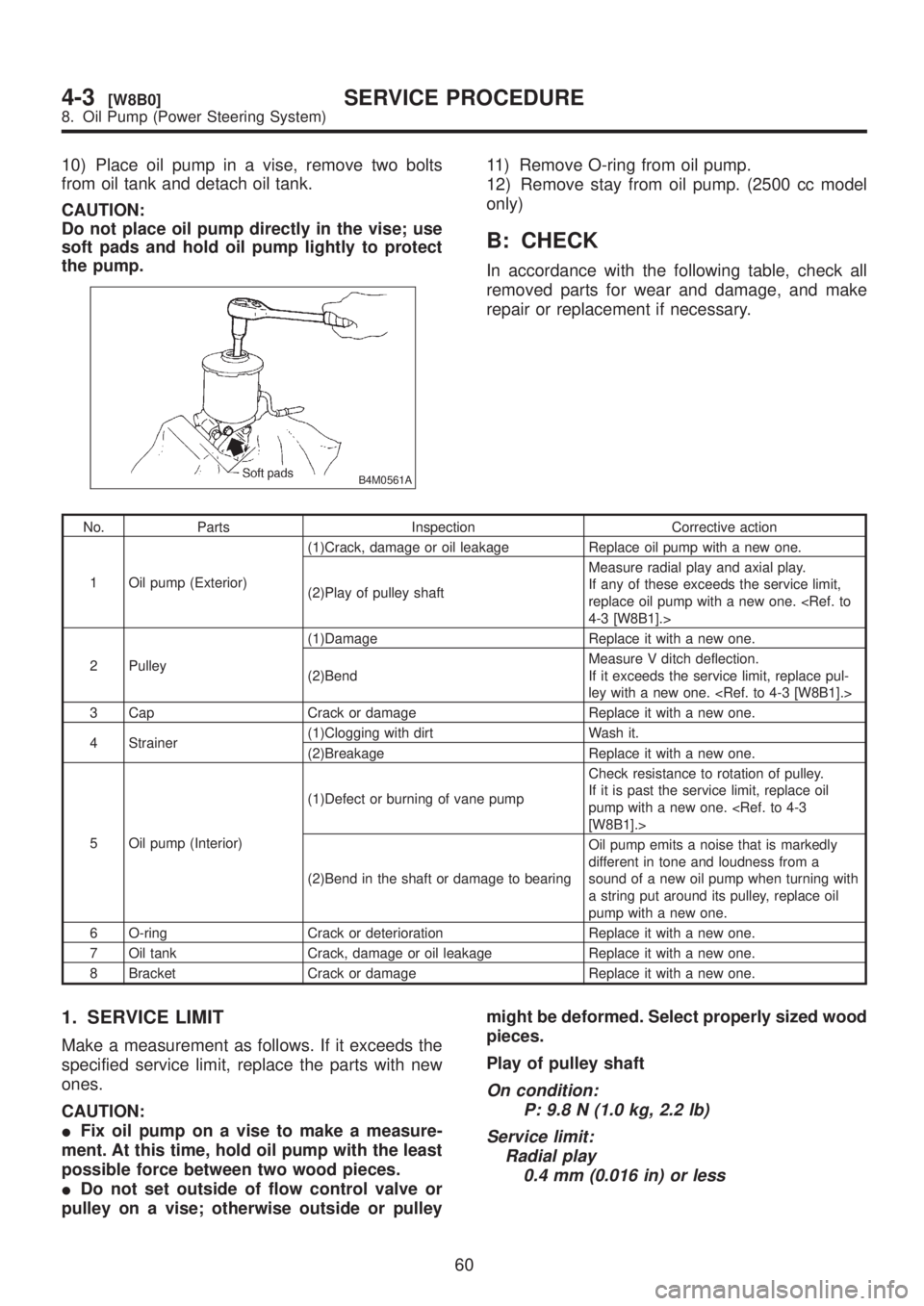
10) Place oil pump in a vise, remove two bolts
from oil tank and detach oil tank.
CAUTION:
Do not place oil pump directly in the vise; use
soft pads and hold oil pump lightly to protect
the pump.
B4M0561A
11) Remove O-ring from oil pump.
12) Remove stay from oil pump. (2500 cc model
only)
B: CHECK
In accordance with the following table, check all
removed parts for wear and damage, and make
repair or replacement if necessary.
No. Parts Inspection Corrective action
1 Oil pump (Exterior)(1)Crack, damage or oil leakage Replace oil pump with a new one.
(2)Play of pulley shaftMeasure radial play and axial play.
If any of these exceeds the service limit,
replace oil pump with a new one.
2 Pulley(1)Damage Replace it with a new one.
(2)BendMeasure V ditch deflection.
If it exceeds the service limit, replace pul-
ley with a new one.
3 Cap Crack or damage Replace it with a new one.
4 Strainer(1)Clogging with dirt Wash it.
(2)Breakage Replace it with a new one.
5 Oil pump (Interior)(1)Defect or burning of vane pumpCheck resistance to rotation of pulley.
If it is past the service limit, replace oil
pump with a new one.
(2)Bend in the shaft or damage to bearingOil pump emits a noise that is markedly
different in tone and loudness from a
sound of a new oil pump when turning with
a string put around its pulley, replace oil
pump with a new one.
6 O-ring Crack or deterioration Replace it with a new one.
7 Oil tank Crack, damage or oil leakage Replace it with a new one.
8 Bracket Crack or damage Replace it with a new one.
1. SERVICE LIMIT
Make a measurement as follows. If it exceeds the
specified service limit, replace the parts with new
ones.
CAUTION:
IFix oil pump on a vise to make a measure-
ment. At this time, hold oil pump with the least
possible force between two wood pieces.
IDo not set outside of flow control valve or
pulley on a vise; otherwise outside or pulleymight be deformed. Select properly sized wood
pieces.
Play of pulley shaft
On condition:
P: 9.8 N (1.0 kg, 2.2 lb)
Service limit:
Radial play
0.4 mm (0.016 in) or less
60
4-3[W8B0]SERVICE PROCEDURE
8. Oil Pump (Power Steering System)
Page 889 of 1456
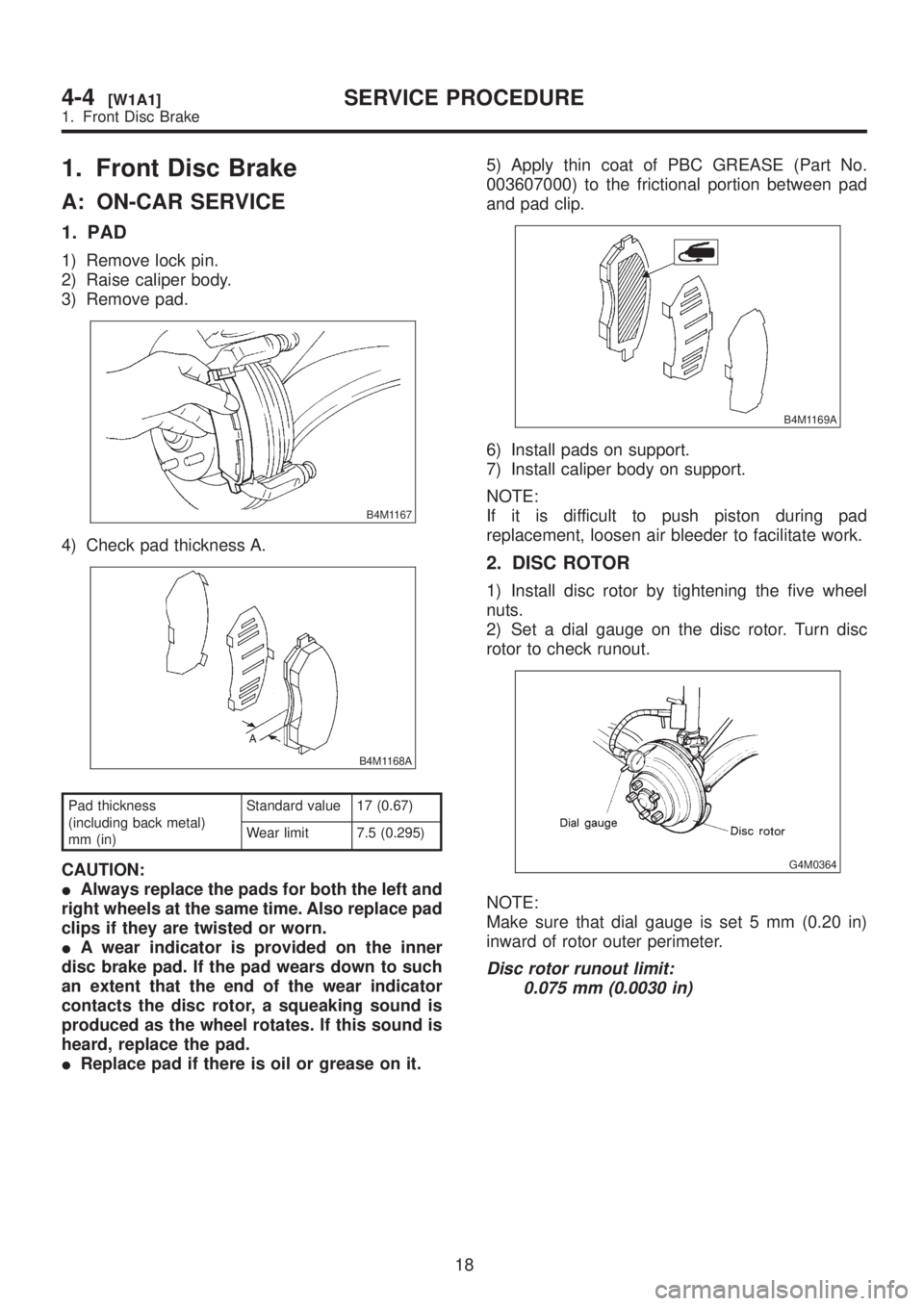
1. Front Disc Brake
A: ON-CAR SERVICE
1. PAD
1) Remove lock pin.
2) Raise caliper body.
3) Remove pad.
B4M1167
4) Check pad thickness A.
B4M1168A
Pad thickness
(including back metal)
mm (in)Standard value 17 (0.67)
Wear limit 7.5 (0.295)
CAUTION:
IAlways replace the pads for both the left and
right wheels at the same time. Also replace pad
clips if they are twisted or worn.
IA wear indicator is provided on the inner
disc brake pad. If the pad wears down to such
an extent that the end of the wear indicator
contacts the disc rotor, a squeaking sound is
produced as the wheel rotates. If this sound is
heard, replace the pad.
IReplace pad if there is oil or grease on it.5) Apply thin coat of PBC GREASE (Part No.
003607000) to the frictional portion between pad
and pad clip.
B4M1169A
6) Install pads on support.
7) Install caliper body on support.
NOTE:
If it is difficult to push piston during pad
replacement, loosen air bleeder to facilitate work.
2. DISC ROTOR
1) Install disc rotor by tightening the five wheel
nuts.
2) Set a dial gauge on the disc rotor. Turn disc
rotor to check runout.
G4M0364
NOTE:
Make sure that dial gauge is set 5 mm (0.20 in)
inward of rotor outer perimeter.
Disc rotor runout limit:
0.075 mm (0.0030 in)
18
4-4[W1A1]SERVICE PROCEDURE
1. Front Disc Brake
Page 898 of 1456
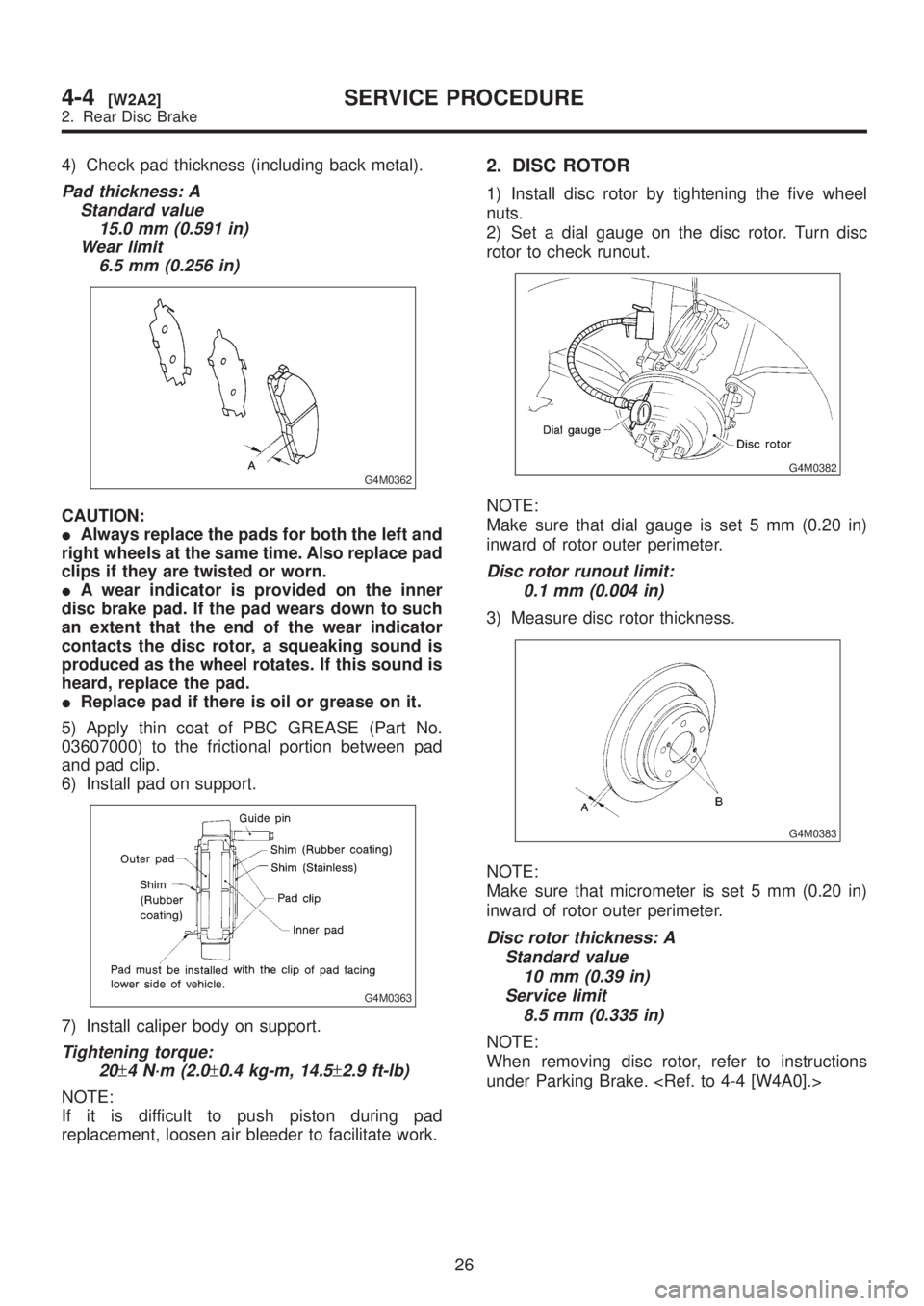
4) Check pad thickness (including back metal).
Pad thickness: A
Standard value
15.0 mm (0.591 in)
Wear limit
6.5 mm (0.256 in)
G4M0362
CAUTION:
IAlways replace the pads for both the left and
right wheels at the same time. Also replace pad
clips if they are twisted or worn.
IA wear indicator is provided on the inner
disc brake pad. If the pad wears down to such
an extent that the end of the wear indicator
contacts the disc rotor, a squeaking sound is
produced as the wheel rotates. If this sound is
heard, replace the pad.
IReplace pad if there is oil or grease on it.
5) Apply thin coat of PBC GREASE (Part No.
03607000) to the frictional portion between pad
and pad clip.
6) Install pad on support.
G4M0363
7) Install caliper body on support.
Tightening torque:
20
±4 N´m (2.0±0.4 kg-m, 14.5±2.9 ft-lb)
NOTE:
If it is difficult to push piston during pad
replacement, loosen air bleeder to facilitate work.
2. DISC ROTOR
1) Install disc rotor by tightening the five wheel
nuts.
2) Set a dial gauge on the disc rotor. Turn disc
rotor to check runout.
G4M0382
NOTE:
Make sure that dial gauge is set 5 mm (0.20 in)
inward of rotor outer perimeter.
Disc rotor runout limit:
0.1 mm (0.004 in)
3) Measure disc rotor thickness.
G4M0383
NOTE:
Make sure that micrometer is set 5 mm (0.20 in)
inward of rotor outer perimeter.
Disc rotor thickness: A
Standard value
10 mm (0.39 in)
Service limit
8.5 mm (0.335 in)
NOTE:
When removing disc rotor, refer to instructions
under Parking Brake.
26
4-4[W2A2]SERVICE PROCEDURE
2. Rear Disc Brake