turn signal SUBARU LEGACY 1999 Service Repair Manual
[x] Cancel search | Manufacturer: SUBARU, Model Year: 1999, Model line: LEGACY, Model: SUBARU LEGACY 1999Pages: 1456, PDF Size: 59.93 MB
Page 332 of 1456
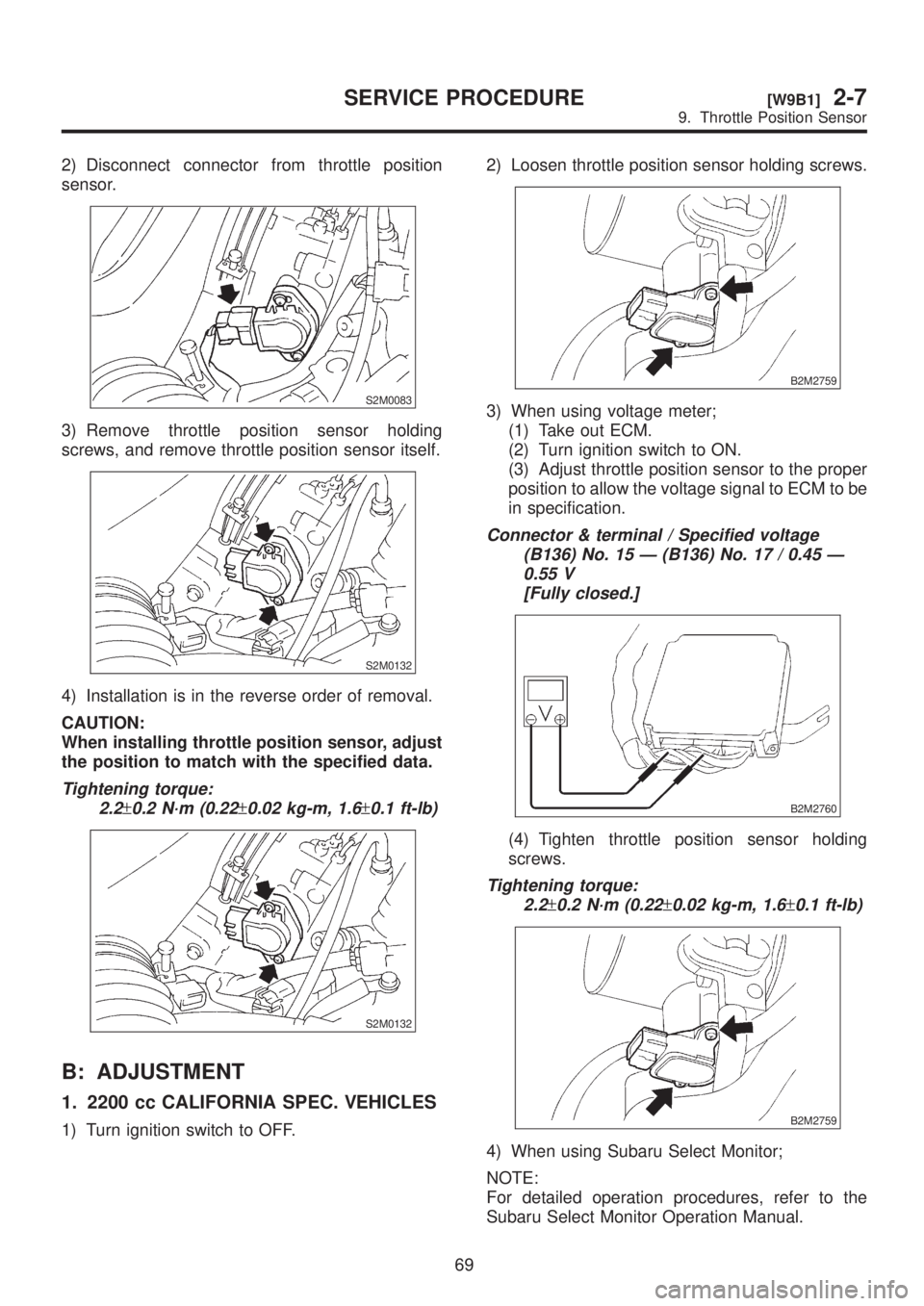
2) Disconnect connector from throttle position
sensor.
S2M0083
3) Remove throttle position sensor holding
screws, and remove throttle position sensor itself.
S2M0132
4) Installation is in the reverse order of removal.
CAUTION:
When installing throttle position sensor, adjust
the position to match with the specified data.
Tightening torque:
2.2
±0.2 N´m (0.22±0.02 kg-m, 1.6±0.1 ft-lb)
S2M0132
B: ADJUSTMENT
1. 2200 cc CALIFORNIA SPEC. VEHICLES
1) Turn ignition switch to OFF.2) Loosen throttle position sensor holding screws.
B2M2759
3) When using voltage meter;
(1) Take out ECM.
(2) Turn ignition switch to ON.
(3) Adjust throttle position sensor to the proper
position to allow the voltage signal to ECM to be
in specification.
Connector & terminal / Specified voltage
(B136) No. 15 Ð (B136) No. 17 / 0.45 Ð
0.55 V
[Fully closed.]
B2M2760
(4) Tighten throttle position sensor holding
screws.
Tightening torque:
2.2
±0.2 N´m (0.22±0.02 kg-m, 1.6±0.1 ft-lb)
B2M2759
4) When using Subaru Select Monitor;
NOTE:
For detailed operation procedures, refer to the
Subaru Select Monitor Operation Manual.
69
[W9B1]2-7SERVICE PROCEDURE
9. Throttle Position Sensor
Page 333 of 1456
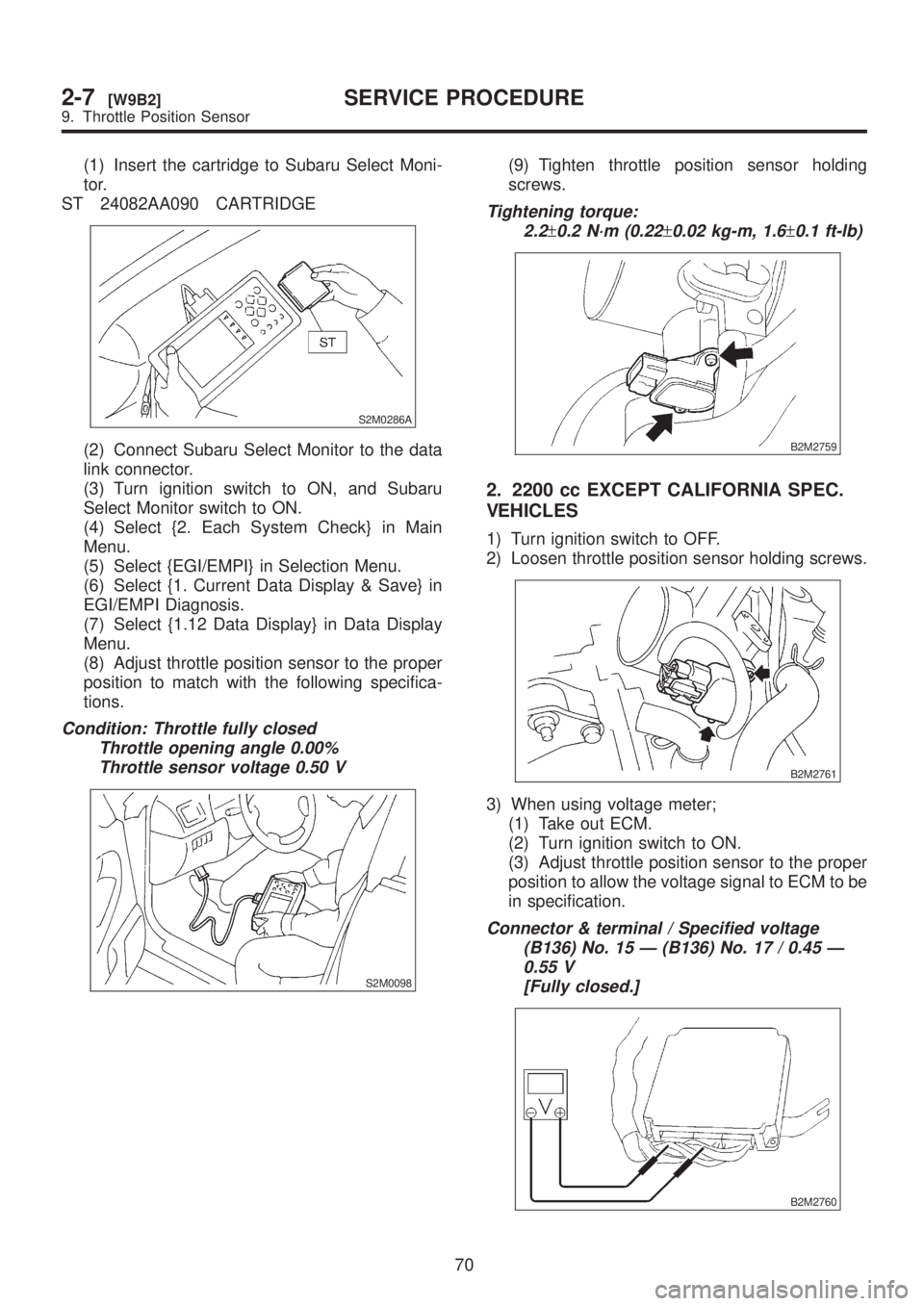
(1) Insert the cartridge to Subaru Select Moni-
tor.
ST 24082AA090 CARTRIDGE
S2M0286A
(2) Connect Subaru Select Monitor to the data
link connector.
(3) Turn ignition switch to ON, and Subaru
Select Monitor switch to ON.
(4) Select {2. Each System Check} in Main
Menu.
(5) Select {EGI/EMPI} in Selection Menu.
(6) Select {1. Current Data Display & Save} in
EGI/EMPI Diagnosis.
(7) Select {1.12 Data Display} in Data Display
Menu.
(8) Adjust throttle position sensor to the proper
position to match with the following specifica-
tions.
Condition: Throttle fully closed
Throttle opening angle 0.00%
Throttle sensor voltage 0.50 V
S2M0098
(9) Tighten throttle position sensor holding
screws.
Tightening torque:
2.2
±0.2 N´m (0.22±0.02 kg-m, 1.6±0.1 ft-lb)
B2M2759
2. 2200 cc EXCEPT CALIFORNIA SPEC.
VEHICLES
1) Turn ignition switch to OFF.
2) Loosen throttle position sensor holding screws.
B2M2761
3) When using voltage meter;
(1) Take out ECM.
(2) Turn ignition switch to ON.
(3) Adjust throttle position sensor to the proper
position to allow the voltage signal to ECM to be
in specification.
Connector & terminal / Specified voltage
(B136) No. 15 Ð (B136) No. 17 / 0.45 Ð
0.55 V
[Fully closed.]
B2M2760
70
2-7[W9B2]SERVICE PROCEDURE
9. Throttle Position Sensor
Page 335 of 1456
(3) Adjust throttle position sensor to the proper
position to allow the voltage signal to ECM to be
in specification.
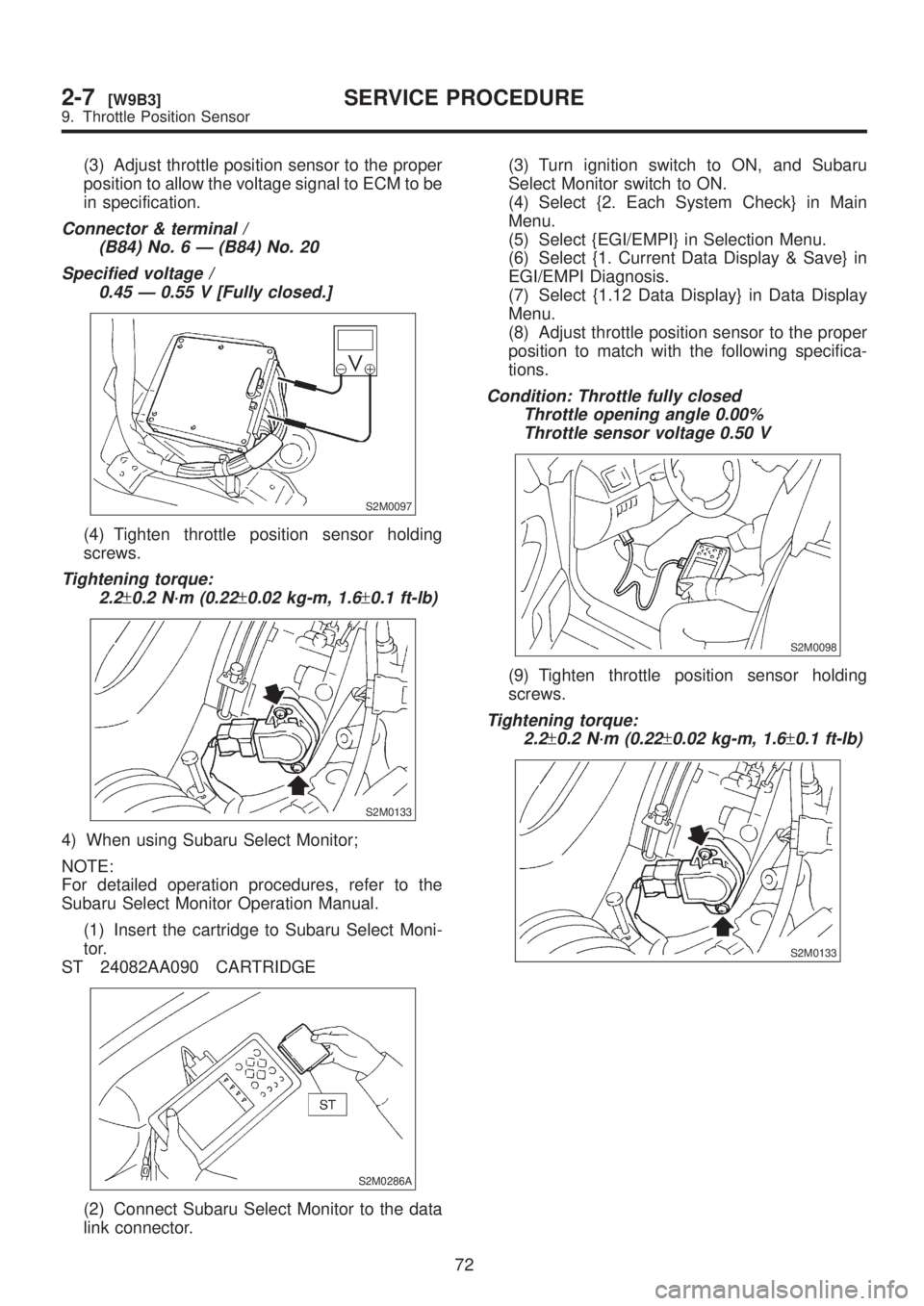
Connector & terminal /
(B84) No. 6 Ð (B84) No. 20
Specified voltage /
0.45 Ð 0.55 V [Fully closed.]
S2M0097
(4) Tighten throttle position sensor holding
screws.
Tightening torque:
2.2
±0.2 N´m (0.22±0.02 kg-m, 1.6±0.1 ft-lb)
S2M0133
4) When using Subaru Select Monitor;
NOTE:
For detailed operation procedures, refer to the
Subaru Select Monitor Operation Manual.
(1) Insert the cartridge to Subaru Select Moni-
tor.
ST 24082AA090 CARTRIDGE
S2M0286A
(2) Connect Subaru Select Monitor to the data
link connector.(3) Turn ignition switch to ON, and Subaru
Select Monitor switch to ON.
(4) Select {2. Each System Check} in Main
Menu.
(5) Select {EGI/EMPI} in Selection Menu.
(6) Select {1. Current Data Display & Save} in
EGI/EMPI Diagnosis.
(7) Select {1.12 Data Display} in Data Display
Menu.
(8) Adjust throttle position sensor to the proper
position to match with the following specifica-
tions.
Condition: Throttle fully closed
Throttle opening angle 0.00%
Throttle sensor voltage 0.50 V
S2M0098
(9) Tighten throttle position sensor holding
screws.
Tightening torque:
2.2
±0.2 N´m (0.22±0.02 kg-m, 1.6±0.1 ft-lb)
S2M0133
72
2-7[W9B3]SERVICE PROCEDURE
9. Throttle Position Sensor
Page 555 of 1456
2. Inhibitor Switch
A: INSPECTION
When driving condition or starter motor operation
is erroneous, first check the shift linkage for
improper operation. If the shift linkage is function-
ing properly, check the inhibitor switch.
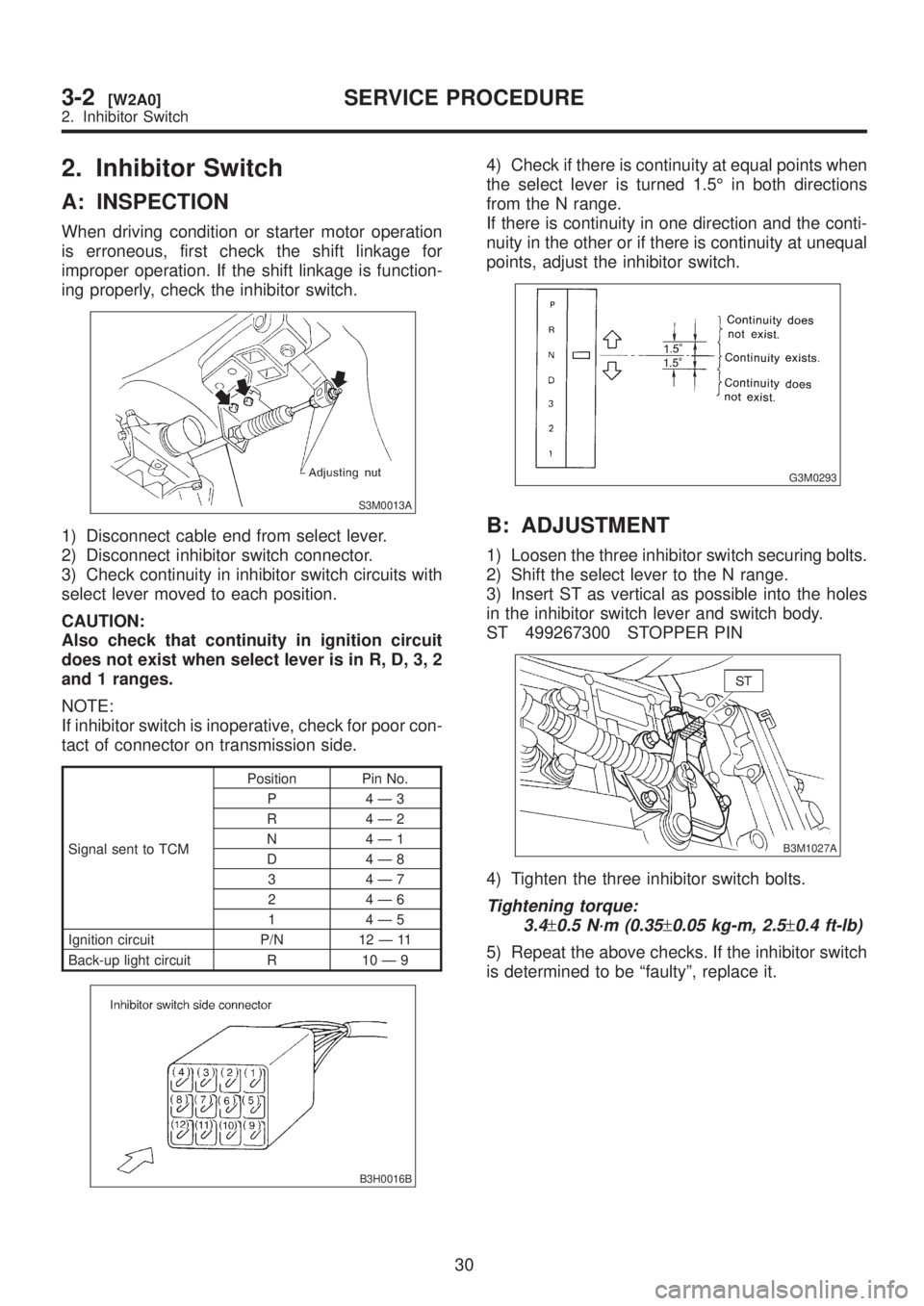
S3M0013A
1) Disconnect cable end from select lever.
2) Disconnect inhibitor switch connector.
3) Check continuity in inhibitor switch circuits with
select lever moved to each position.
CAUTION:
Also check that continuity in ignition circuit
does not exist when select lever is in R, D, 3, 2
and 1 ranges.
NOTE:
If inhibitor switch is inoperative, check for poor con-
tact of connector on transmission side.
Signal sent to TCMPosition Pin No.
P 4Ð3
R 4Ð2
N 4Ð1
D 4Ð8
3 4Ð7
2 4Ð6
1 4Ð5
Ignition circuit P/N 12 Ð 11
Back-up light circuit R 10 Ð 9
B3H0016B
4) Check if there is continuity at equal points when
the select lever is turned 1.5É in both directions
from the N range.
If there is continuity in one direction and the conti-
nuity in the other or if there is continuity at unequal
points, adjust the inhibitor switch.
G3M0293
B: ADJUSTMENT
1) Loosen the three inhibitor switch securing bolts.
2) Shift the select lever to the N range.
3) Insert ST as vertical as possible into the holes
in the inhibitor switch lever and switch body.
ST 499267300 STOPPER PIN
B3M1027A
4) Tighten the three inhibitor switch bolts.
Tightening torque:
3.4
±0.5 N´m (0.35±0.05 kg-m, 2.5±0.4 ft-lb)
5) Repeat the above checks. If the inhibitor switch
is determined to be ªfaultyº, replace it.
30
3-2[W2A0]SERVICE PROCEDURE
2. Inhibitor Switch
Page 995 of 1456
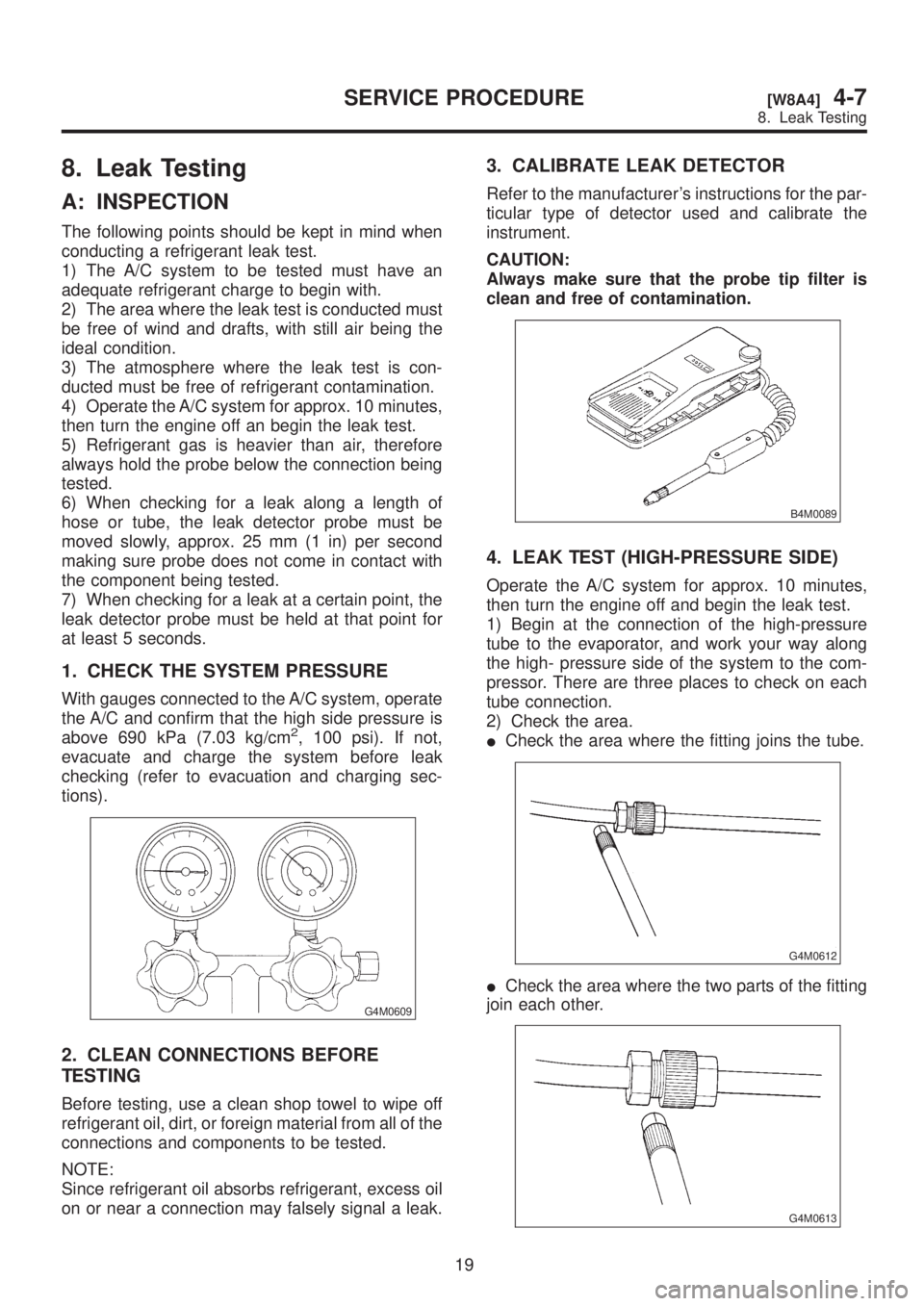
8. Leak Testing
A: INSPECTION
The following points should be kept in mind when
conducting a refrigerant leak test.
1) The A/C system to be tested must have an
adequate refrigerant charge to begin with.
2) The area where the leak test is conducted must
be free of wind and drafts, with still air being the
ideal condition.
3) The atmosphere where the leak test is con-
ducted must be free of refrigerant contamination.
4) Operate the A/C system for approx. 10 minutes,
then turn the engine off an begin the leak test.
5) Refrigerant gas is heavier than air, therefore
always hold the probe below the connection being
tested.
6) When checking for a leak along a length of
hose or tube, the leak detector probe must be
moved slowly, approx. 25 mm (1 in) per second
making sure probe does not come in contact with
the component being tested.
7) When checking for a leak at a certain point, the
leak detector probe must be held at that point for
at least 5 seconds.
1. CHECK THE SYSTEM PRESSURE
With gauges connected to the A/C system, operate
the A/C and confirm that the high side pressure is
above 690 kPa (7.03 kg/cm
2, 100 psi). If not,
evacuate and charge the system before leak
checking (refer to evacuation and charging sec-
tions).
G4M0609
2. CLEAN CONNECTIONS BEFORE
TESTING
Before testing, use a clean shop towel to wipe off
refrigerant oil, dirt, or foreign material from all of the
connections and components to be tested.
NOTE:
Since refrigerant oil absorbs refrigerant, excess oil
on or near a connection may falsely signal a leak.
3. CALIBRATE LEAK DETECTOR
Refer to the manufacturer's instructions for the par-
ticular type of detector used and calibrate the
instrument.
CAUTION:
Always make sure that the probe tip filter is
clean and free of contamination.
B4M0089
4. LEAK TEST (HIGH-PRESSURE SIDE)
Operate the A/C system for approx. 10 minutes,
then turn the engine off and begin the leak test.
1) Begin at the connection of the high-pressure
tube to the evaporator, and work your way along
the high- pressure side of the system to the com-
pressor. There are three places to check on each
tube connection.
2) Check the area.
ICheck the area where the fitting joins the tube.
G4M0612
ICheck the area where the two parts of the fitting
join each other.
G4M0613
19
[W8A4]4-7SERVICE PROCEDURE
8. Leak Testing
Page 1226 of 1456
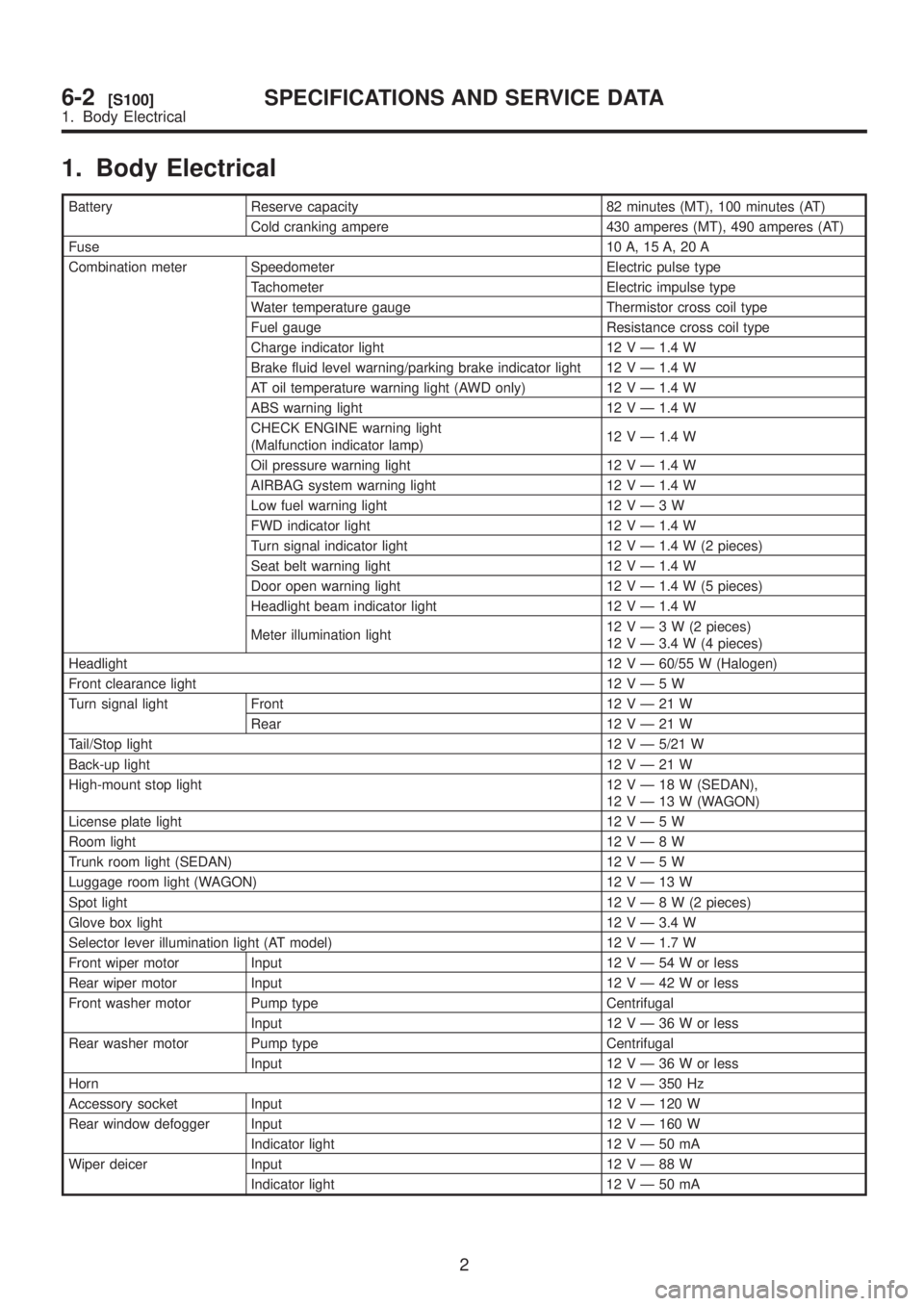
1. Body Electrical
Battery Reserve capacity 82 minutes (MT), 100 minutes (AT)
Cold cranking ampere 430 amperes (MT), 490 amperes (AT)
Fuse10 A, 15 A, 20 A
Combination meter Speedometer Electric pulse type
Tachometer Electric impulse type
Water temperature gauge Thermistor cross coil type
Fuel gauge Resistance cross coil type
Charge indicator light 12 V Ð 1.4 W
Brake fluid level warning/parking brake indicator light 12 V Ð 1.4 W
AT oil temperature warning light (AWD only) 12 V Ð 1.4 W
ABS warning light 12 V Ð 1.4 W
CHECK ENGINE warning light
(Malfunction indicator lamp)12 V Ð 1.4 W
Oil pressure warning light 12 V Ð 1.4 W
AIRBAG system warning light 12 V Ð 1.4 W
Low fuel warning light 12VÐ3W
FWD indicator light 12 V Ð 1.4 W
Turn signal indicator light 12 V Ð 1.4 W (2 pieces)
Seat belt warning light 12 V Ð 1.4 W
Door open warning light 12 V Ð 1.4 W (5 pieces)
Headlight beam indicator light 12 V Ð 1.4 W
Meter illumination light12VÐ3W(2pieces)
12 V Ð 3.4 W (4 pieces)
Headlight12 V Ð 60/55 W (Halogen)
Front clearance light 12VÐ5W
Turn signal light Front 12VÐ21W
Rear 12VÐ21W
Tail/Stop light12 V Ð 5/21 W
Back-up light12VÐ21W
High-mount stop light 12VÐ18W(SEDAN),
12VÐ13W(WAGON)
License plate light 12VÐ5W
Room light12VÐ8W
Trunk room light (SEDAN) 12VÐ5W
Luggage room light (WAGON) 12VÐ13W
Spot light12VÐ8W(2pieces)
Glove box light 12 V Ð 3.4 W
Selector lever illumination light (AT model) 12 V Ð 1.7 W
Front wiper motor Input 12VÐ54Worless
Rear wiper motor Input 12VÐ42Worless
Front washer motor Pump type Centrifugal
Input 12VÐ36Worless
Rear washer motor Pump type Centrifugal
Input 12VÐ36Worless
Horn12 V Ð 350 Hz
Accessory socket Input 12 V Ð 120 W
Rear window defogger Input 12 V Ð 160 W
Indicator light 12VÐ50mA
Wiper deicer Input 12VÐ88W
Indicator light 12VÐ50mA
2
6-2[S100]SPECIFICATIONS AND SERVICE DATA
1. Body Electrical
Page 1231 of 1456
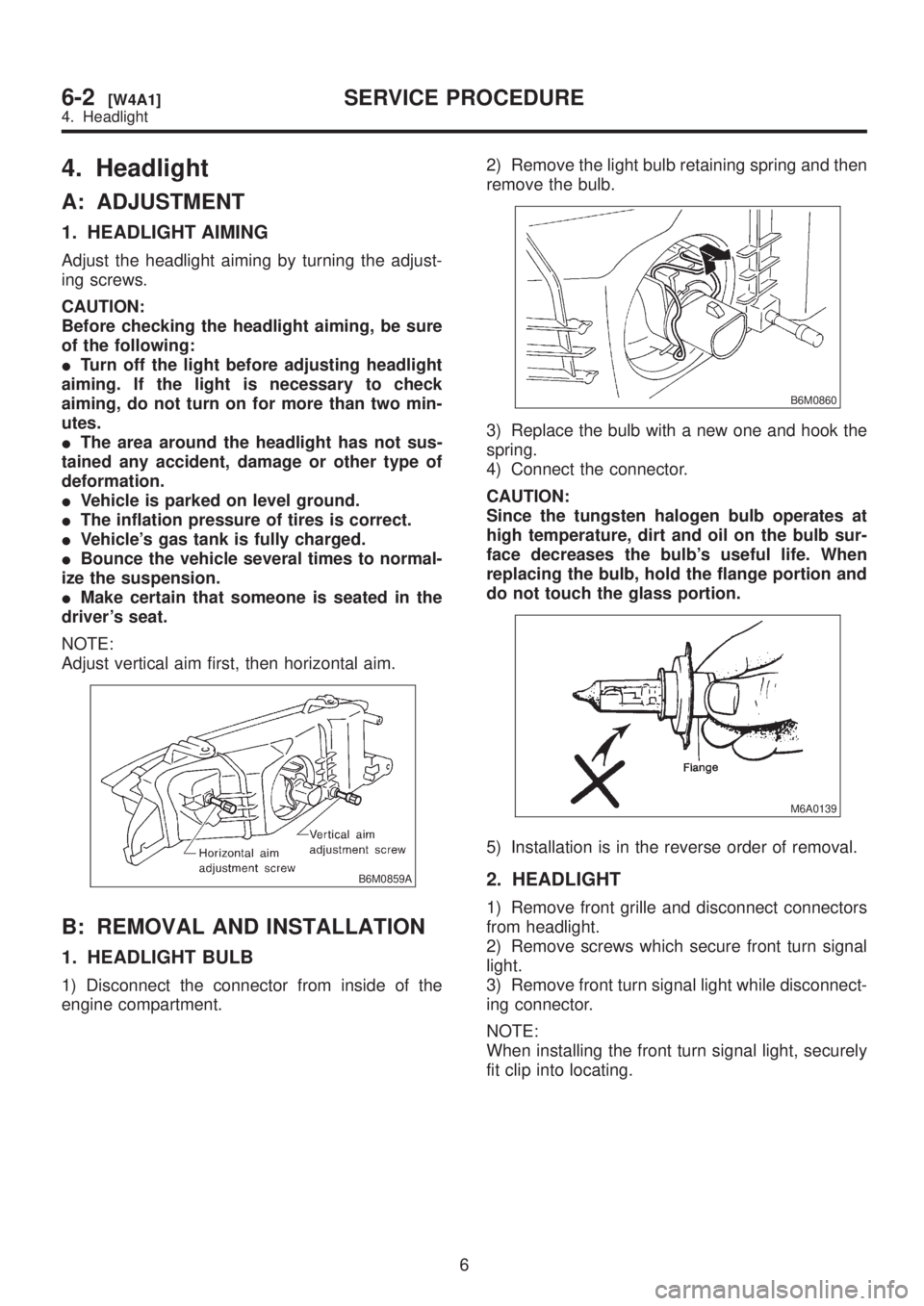
4. Headlight
A: ADJUSTMENT
1. HEADLIGHT AIMING
Adjust the headlight aiming by turning the adjust-
ing screws.
CAUTION:
Before checking the headlight aiming, be sure
of the following:
ITurn off the light before adjusting headlight
aiming. If the light is necessary to check
aiming, do not turn on for more than two min-
utes.
IThe area around the headlight has not sus-
tained any accident, damage or other type of
deformation.
IVehicle is parked on level ground.
IThe inflation pressure of tires is correct.
IVehicle's gas tank is fully charged.
IBounce the vehicle several times to normal-
ize the suspension.
IMake certain that someone is seated in the
driver's seat.
NOTE:
Adjust vertical aim first, then horizontal aim.
B6M0859A
B: REMOVAL AND INSTALLATION
1. HEADLIGHT BULB
1) Disconnect the connector from inside of the
engine compartment.2) Remove the light bulb retaining spring and then
remove the bulb.
B6M0860
3) Replace the bulb with a new one and hook the
spring.
4) Connect the connector.
CAUTION:
Since the tungsten halogen bulb operates at
high temperature, dirt and oil on the bulb sur-
face decreases the bulb's useful life. When
replacing the bulb, hold the flange portion and
do not touch the glass portion.
M6A0139
5) Installation is in the reverse order of removal.
2. HEADLIGHT
1) Remove front grille and disconnect connectors
from headlight.
2) Remove screws which secure front turn signal
light.
3) Remove front turn signal light while disconnect-
ing connector.
NOTE:
When installing the front turn signal light, securely
fit clip into locating.
6
6-2[W4A1]SERVICE PROCEDURE
4. Headlight
Page 1240 of 1456
![SUBARU LEGACY 1999 Service Repair Manual 7. Turn Signal and Hazard
Warning Light
A: REMOVAL AND INSTALLATION
1. FRONT TURN SIGNAL LIGHT
Remove and install front turn signal light. <Ref. to
6-2 [W4B2].>
NOTE:
The front turn signal light is un](/img/17/57435/w960_57435-1239.png "SUBARU LEGACY 1999 Service Repair Manual 7. Turn Signal and Hazard
Warning Light
A: REMOVAL AND INSTALLATION
1. FRONT TURN SIGNAL LIGHT
Remove and install front turn signal light. <Ref. to
6-2 [W4B2].>
NOTE:
The front turn signal light is un")
7. Turn Signal and Hazard
Warning Light
A: REMOVAL AND INSTALLATION
1. FRONT TURN SIGNAL LIGHT
Remove and install front turn signal light.
NOTE:
The front turn signal light is united with headlight
assembly.
2. REAR COMBINATION LIGHT
Remove and install rear combination light.
3. COMBINATION SWITCH
Remove and install combination switch.
4. HAZARD SWITCH
1) Remove center panel from instrument panel.
2) Disconnect connector of hazard switch from
body harness.
3) Remove hazard switch from center panel.
B6M0063
4) Installation is in the reverse order of removal.
5. TURN SIGNAL AND HAZARD UNIT
1) Remove instrument panel lower cover.
2) Remove engine hood opener lever bracket.
3) Disconnect connector of turn signal and hazard
unit.4) Remove screw, and then remove turn signal
and hazard unit from bracket.
B6M0343A
5) Installation is in the reverse order of removal.
B: DISASSEMBLY AND ASSEMBLY
1. COMBINATION SWITCH
Disassemble and assemble combination switch.
C: INSPECTION
1. COMBINATION SWITCH (ON-CAR)
1) Remove instrument panel lower cover.
2) Remove lower column cover.
3) Unfasten holddown clip which secures harness,
and disconnect connectors from body harness.
4) Move combination switch to respective posi-
tions and check continuity between terminals.
B6M0702
14
6-2[W7A1]SERVICE PROCEDURE
7. Turn Signal and Hazard Warning Light
Page 1256 of 1456
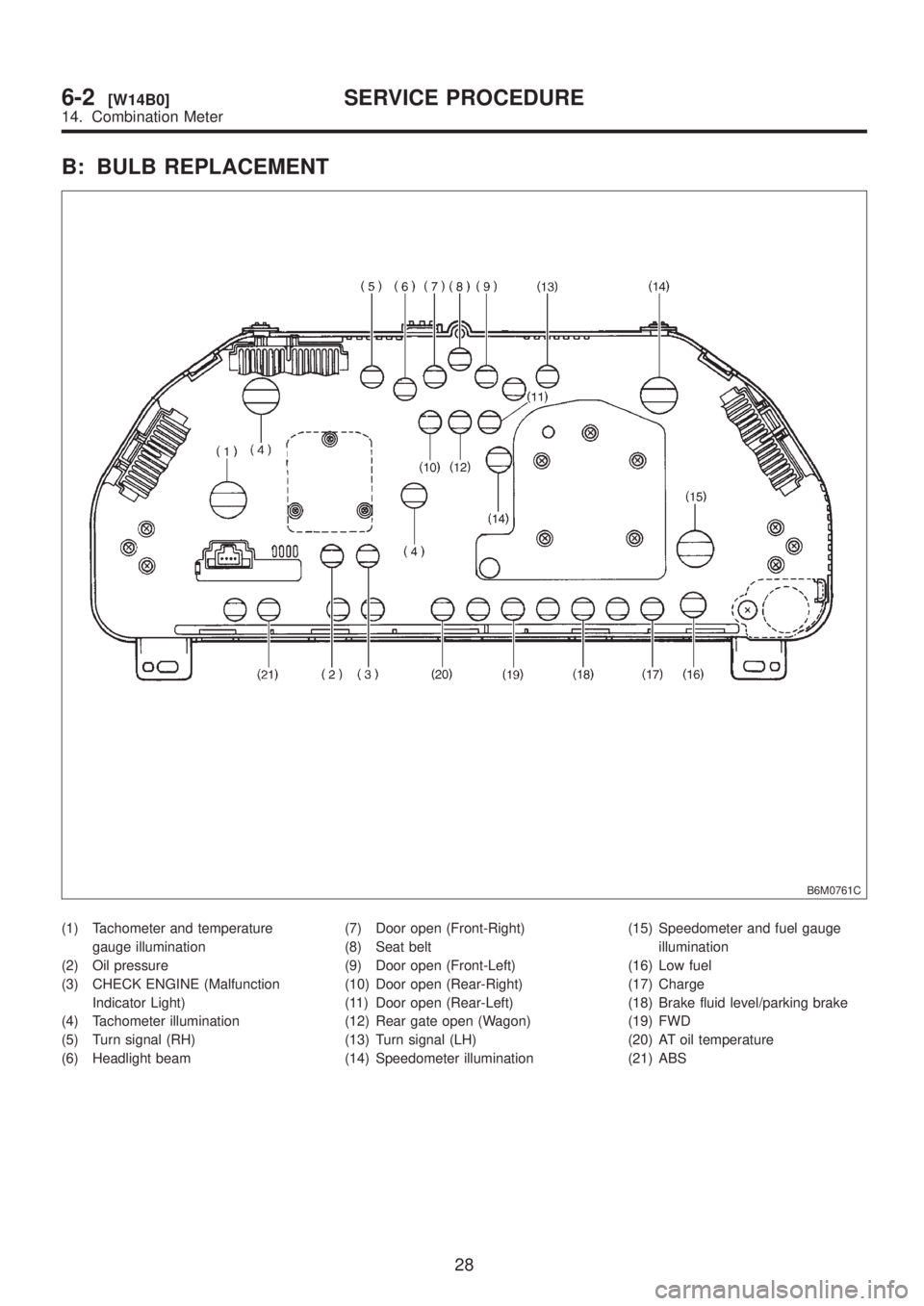
B: BULB REPLACEMENT
B6M0761C
(1) Tachometer and temperature
gauge illumination
(2) Oil pressure
(3) CHECK ENGINE (Malfunction
Indicator Light)
(4) Tachometer illumination
(5) Turn signal (RH)
(6) Headlight beam(7) Door open (Front-Right)
(8) Seat belt
(9) Door open (Front-Left)
(10) Door open (Rear-Right)
(11) Door open (Rear-Left)
(12) Rear gate open (Wagon)
(13) Turn signal (LH)
(14) Speedometer illumination(15) Speedometer and fuel gauge
illumination
(16) Low fuel
(17) Charge
(18) Brake fluid level/parking brake
(19) FWD
(20) AT oil temperature
(21) ABS
28
6-2[W14B0]SERVICE PROCEDURE
14. Combination Meter
Page 1378 of 1456
![SUBARU LEGACY 1999 Service Repair Manual V: LIGHTING SYSTEM (TURN SIGNAL LIGHT AND HAZARD LIGHT)
1. LHD MODEL
98
6-3[D6V1]WIRING DIAGRAM
6. Wiring Diagram](/img/17/57435/w960_57435-1377.png "SUBARU LEGACY 1999 Service Repair Manual V: LIGHTING SYSTEM (TURN SIGNAL LIGHT AND HAZARD LIGHT)
1. LHD MODEL
98
6-3[D6V1]WIRING DIAGRAM
6. Wiring Diagram")
V: LIGHTING SYSTEM (TURN SIGNAL LIGHT AND HAZARD LIGHT)
1. LHD MODEL
98
6-3[D6V1]WIRING DIAGRAM
6. Wiring Diagram