tire SUBARU LEGACY 2003 3.G Owner's Manual
[x] Cancel search | Manufacturer: SUBARU, Model Year: 2003, Model line: LEGACY, Model: SUBARU LEGACY 2003 3.GPages: 472, PDF Size: 4.33 MB
Page 265 of 472
7
Starting and operating7-15
–
CONTINUED –
When it is necessary to reduce vehicle speed due to slow traffic, turn-
ing corners, or driving up steep hills, downshift to a lower gear before
the engine starts to labor.
On steep downgrades, downshift the transmission to 4th, 3rd or 2nd
gear as necessary; this helps to maintain a safe speed and to extendbrake pad life.
In this way, the engine provides a braking effect. Remember, if you
“ride”
(over use) the brakes while descending a hill, they may over-
heat and not work properly.
The engine may, on rare occasions, knock when the vehicle rapidly
accelerates or rapidly pulls away from a standstill. This phenomenondoes not indicate a fault.
Automatic transmission (Brighton, L, Outback)
WARNING
Do not shift from the “P” or “N” position into the “D”, “3”, “2”,
“1” or “R” position while depressing the accelerator pedal. This
may cause the vehicle to jump forward or backward.
CAUTION
Shift into the “P” or “R” position only after the vehicle is com-
pletely stopped. Shifting while the vehicle is moving may cause
damage to the transmission. Do not race the engine for more than five seconds in any posi-
tion except the “N” or “P” position when the brake is set or the
tires are on blocks. This may cause the automatic transmissionfluid to overheat. Avoid shifting from one of the forward driving positions into
the “R” position or vice versa until the vehicle has completely
stopped. Such shifting may cause damage to the transmission.
The automatic transmission is electronically controlled with 4-forward
Page 280 of 472
7-304. Insert the screwdriver into the hole.
5. Push down on the screwdriver, push down the button and move the
selector lever from the
“P” to the “N” position.
6. Remove the screwdriver from the hole. Depress the brake pedal and
start the engine.
Take your vehicle to the nearest SUBARU dealer immediately to have the
system repaired.
Rear viscous limited slip differential (LSD) (if equipped)
CAUTION
Never start the engine while a tire on one side is jacked up, as
the vehicle may move. If one rear tire is spinning in mud, avoid continued spinning at
high speed as this could adversely affect the LSD. If a different size rear tire is temporarily used (as in an emer-
gency), it will adversely affect the LSD. Always replace it with aregular size tire as soon as possible.
The LSD provides optimum distribution of power according to the differ-
ence in revolutions between the right and left rear wheels that may be
caused by certain driving conditions, thereby improving driving stability
on snow-covered, muddy or other slippery roads.
Page 282 of 472
7-32When descending a grade, if only the foot brake is used, the brakes
may start working improperly because of brake fluid overheating,
caused by overheated brake pads. To help prevent this, shift into a
lower gear to get stronger engine braking.
Braking when a tire is punctured
Do not depress the brake pedal suddenly when a tire is punctured.
This could cause a loss of control of the vehicle. Keep driving straight
ahead while gradually reducing speed. Then slowly pull off the roadto a safe place.
Brake system Two separate circuits
Your vehicle has two separate circuit brake systems. Each circuit
works diagonally across the vehicle. If one circuit of the brake system
should fail, the other half of the system still works. If one circuit fails,
the brake pedal will go down much closer to the floor than usual and
you will need to press it down much harder. And a much longer dis-
tance will be needed to stop the vehicle. Brake booster
The brake booster uses engine manifold vacuum to assist braking
force. Do not turn off the engine while driving because that will turn off
the brake booster, resulting in poor braking power.The brakes will continue to work even when the brake booster com-
pletely stops functioning. If this happens, however, you will have to
push the pedal much harder than normal and the braking distance
will increase.
Page 286 of 472
7-36VDC (Vehicle Dynamics Control) system (if equipped)
WARNING
Always use the utmost care in driving — overconfidence because
you are driving with a VDC system equipped vehicle could easily lead to a serious accident.
CAUTION
Even if your vehicle is equipped with VDC, winter tires should
be used when driving on snow-covered or icy roads; in addition,
vehicle speed should be reduced considerably. Simply having a
VDC system does not guarantee that the vehicle will be able toavoid accidents in any situation. Activation of the VDC system is an indication that the road
being travelled on has a slippery surface; since having VDC is no
guarantee that full vehicle control will be maintained at all timesand under all conditions, its activation should be seen as a sign
that the speed of the vehicle should be reduced considerably. Whenever suspension components, steering components, or
an axle are removed from a vehicle equipped with VDC, have anauthorized SUBARU dealer perform an inspection of that system. The following precautions should be observed in order to
ensure that the VDC system is operating properly:
–All four wheels should be fitted with tires of the same size,
type, and brand. Furthermore, the amount of wear should bethe same for all four tires.– Keep the tire pressure at the proper level as shown on the
label attached to the vehicle ’s door pillar.
– Use only the special temporary spare tire to replace a flat
tire. With a temporary spare tire, the effectiveness of the VDC
system is reduced and this should be taken into account whendriving with vehicle.
Page 288 of 472
7-38
when the vehicle is fitted with snow tires or winter tires
Activation of the VDC system will cause operation of the steering
wheel to feel slightly different compared to that for normal condi- tions. Even if the vehicle is equipped with a VDC system, it is important
that winter tires be used when driving on snow-covered or icyroads. (All four wheels should be fitted with tires of the same sizeand brand). It is always important to reduce speed when approaching a cor-
ner, even if the vehicle is equipped with VDC. All four wheels should be fitted with tires of the same size, type,
and brand; furthermore, the amount of wear should be the same for
all four tires. If these precautions are not observed and non-match-ing tires are used, it is quite possible that the VDC system will beunable to operate correctly as intended. Always turn off the engine before replacing a tire as failure to do
so may render the VDC system unable to operate correctly.
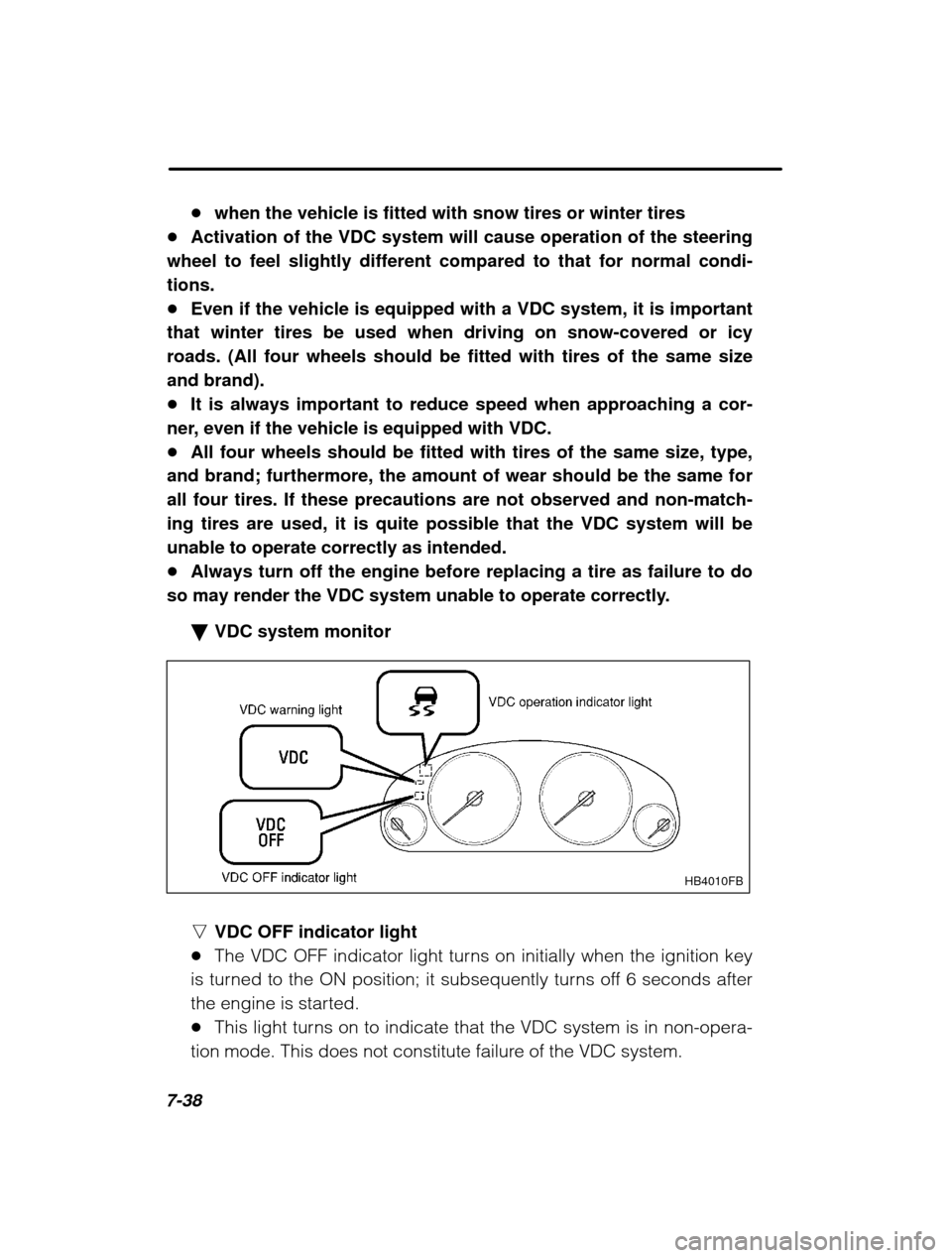
VDC system monitor
HB4010FB
nVDC OFF indicator light
The VDC OFF indicator light turns on initially when the ignition key
is turned to the ON position; it subsequently turns off 6 seconds after
the engine is started. This light turns on to indicate that the VDC system is in non-opera-
tion mode. This does not constitute failure of the VDC system.
Page 299 of 472
8
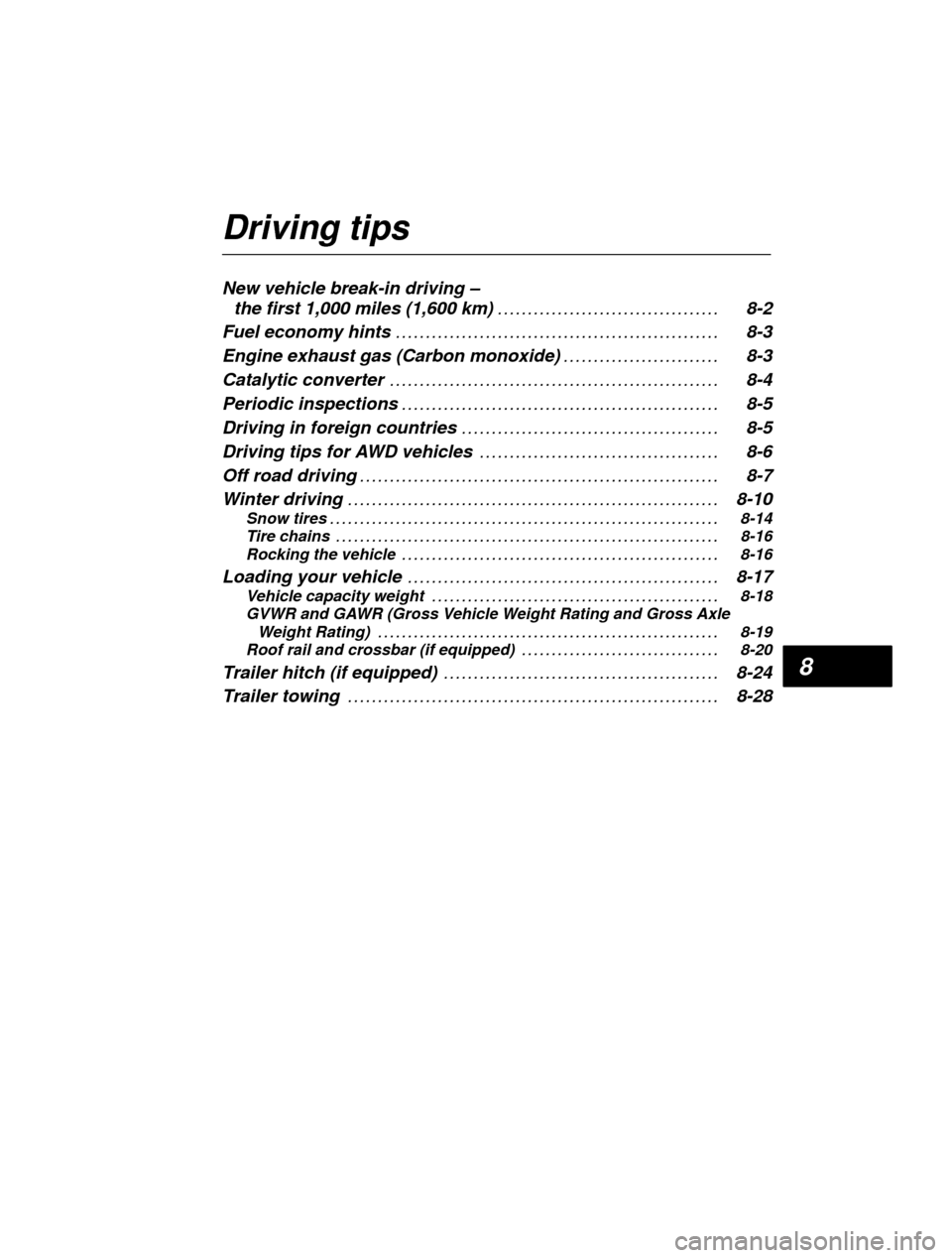
Driving tips New vehicle break-in driving –
the first 1,000 miles (1,600 km) 8-2 . . . . . . . . . . . . . . . . . . . . . . . . . . . . . . . . . . . . .
Fuel economy hints 8-3
. . . . . . . . . . . . . . . . . . . . . . . . . . . . . . . . . . . . . . . . . . . . . . . . . . . . . .
Engine exhaust gas (Carbon monoxide) 8-3 . . . . . . . . . . . . . . . . . . . . . . . . . .
Catalytic converter 8-4
. . . . . . . . . . . . . . . . . . . . . . . . . . . . . . . . . . . . . . . . . . . . . . . . . . . . . . .
Periodic inspections 8-5
. . . . . . . . . . . . . . . . . . . . . . . . . . . . . . . . . . . . . . . . . . . . . . . . . . . . .
Driving in foreign countries 8-5 . . . . . . . . . . . . . . . . . . . . . . . . . . . . . . . . . . . . . . . . . . .
Driving tips for AWD vehicles 8-6 . . . . . . . . . . . . . . . . . . . . . . . . . . . . . . . . . . . . . . . .
Off road driving 8-7
. . . . . . . . . . . . . . . . . . . . . . . . . . . . . . . . . . . . . . . . . . . . . . . . . . . . . . . . . . . .
Winter driving 8-10
. . . . . . . . . . . . . . . . . . . . . . . . . . . . . . . . . . . . . . . . . . . . . . . . . . . . . . . . . . . . . .
Snow tires 8-14
. . . . . . . . . . . . . . . . . . . . . . . . . . . . . . . . . . . . . . . . . . . . . . . . . . . . . . . . . . . . . . . . .
Tire chains 8-16
. . . . . . . . . . . . . . . . . . . . . . . . . . . . . . . . . . . . . . . . . . . . . . . . . . . . . . . . . . . . . . . .
Rocking the vehicle 8-16
. . . . . . . . . . . . . . . . . . . . . . . . . . . . . . . . . . . . . . . . . . . . . . . . . . . . .
Loading your vehicle 8-17
. . . . . . . . . . . . . . . . . . . . . . . . . . . . . . . . . . . . . . . . . . . . . . . . . . . .
Vehicle capacity weight 8-18
. . . . . . . . . . . . . . . . . . . . . . . . . . . . . . . . . . . . . . . . . . . . . . . .
GVWR and GAWR (Gross Vehicle Weight Rating and Gross Axle Weight Rating) 8-19
. . . . . . . . . . . . . . . . . . . . . . . . . . . . . . . . . . . . . . . . . . . . . . . . . . . . . . . . .
Roof rail and crossbar (if equipped) 8-20 . . . . . . . . . . . . . . . . . . . . . . . . . . . . . . . . .
Trailer hitch (if equipped) 8-24
. . . . . . . . . . . . . . . . . . . . . . . . . . . . . . . . . . . . . . . . . . . . . .
Trailer towing 8-28
. . . . . . . . . . . . . . . . . . . . . . . . . . . . . . . . . . . . . . . . . . . . . . . . . . . . . . . . . . . . . .
Page 301 of 472
8
Driving tips8-3
–
CONTINUED –
Fuel economy hints The following suggestions will help to save your fuel.
Select the proper gear position for the speed and road conditions.
Avoid sudden acceleration or deceleration. Always accelerate gently
until you reach the desired speed. Then try to maintain that speed for as long as possible. Do not pump the accelerator and avoid racing the engine.
Avoid unnecessary engine idling.
Keep the engine properly tuned.
Keep the tires inflated to the correct pressure shown on the tire plac-
ard, which is located under the door latch on the driver ’s side. Low pres-
sure will increase tire wear and fuel consumption. Use the air conditioner only when necessary.
Keep the front and rear wheels in proper alignment.
Avoid carrying unnecessary luggage or cargo.
Engine exhaust gas (Carbon monoxide)
WARNING
Never inhale engine exhaust gas. Engine exhaust gas contains
carbon monoxide, a colorless and odorless gas which is danger-ous, or even lethal, if inhaled. Always properly maintain the engine exhaust system to pre-
vent engine exhaust gas from entering the vehicle. Never run the engine in a closed space, such as a garage, ex-
cept for the brief time needed to drive the vehicle in or out of it. Avoid remaining in a parked vehicle for a lengthy time while
the engine is running. If that is unavoidable, then use the ventila-tion fan to force fresh air into the vehicle. Always keep the front ventilator inlet grille free from snow,
leaves or other obstructions to ensure that the ventilation system
always works properly.
Page 305 of 472
8
Driving tips8-7
–
CONTINUED –
ing. Therefore, when driving down a slope or turning corners, be sure to
reduce your speed and maintain an ample distance from other vehicles.
When replacing a tire, make sure you use only the same size, circum-
ference, construction, brand, and load range as the original tires listed on
the tire placard. Using other sizes, circumferences or construction may re-
sult in severe mechanical damage to the drive train of your vehicle and
may affect ride, handling, braking, speedometer/odometer calibration, and
clearance between the body and tires. It also may be dangerous and lead
to loss of vehicle control. If you use a temporary spare tire to replace a flat tire, be sure to use
the original temporary spare tire stored in the vehicle. Using other sizes
may result in severe mechanical damage to the drive train of your vehicle. Always check the cold tire pressure before starting to drive. The rec-
ommended tire pressure is provided on the tire placard, which is locatedunder the door latch on the driver ’s side.
Tire chains should always be placed on the front wheels only.
There are some precautions that you must observe when towing your
vehicle. For detail information, see “Towing” section in chapter 9.
Off road driving
WARNING
Always maintain a safe driving speed according to the road
and weather conditions in order to avoid having an accident on asharp turn, during sudden braking or under other similar condi-tions. Always use the utmost care in driving – overconfidence
because you are driving an all wheel drive vehicle could easilylead to a serious accident.
All AWD models except OUTBACK
Your AWD vehicle is neither a conventional off-road vehicle nor an all
terrain vehicle. It is a passenger car designed primarily for on-road
use. The AWD feature gives it some limited off-road capabilities in sit-
uations in which driving surfaces a relatively level, obstruction-free
Page 307 of 472
8
Driving tips8-9
–
CONTINUED –
bump could jerk the wheel and injure your hands. Instead drive with your fingers and thumbs on the outside of the rim.
If driving through water, such as when crossing shallow streams,
first check the depth of the water and the bottom of the stream bed
for firmness and ensure that the bed of the stream is flat. Drive slowly
and completely through the stream. The water should be shallow
enough that it does not reach the vehicle ’s undercarriage. Water en-
tering the engine air intake or the exhaust pipe or water splashing
onto electrical parts may damage your vehicle and may cause it to
stall. Never attempt to drive through rushing water; regardless of its
depth, it can wash away the ground from under your tires, resulting in
possible loss of traction and even vehicle rollover. Always check your brakes for effectiveness immediately after driv-
ing in sand, mud or water. Do this by driving slowly and stepping on
the brake pedal. Repeat that process several times to dry out thebrake discs and brake pads. Do not drive or park over or near flammable materials such as dry
grass or fallen leaves, as they may burn easily. The exhaust system is
very hot while the engine is running and right after engine stops. This
could create a fire hazard. After driving through tall grass, mud, rock, sand, rivers, etc., check
that there is no grass, bush, paper, rags, stones, sand, etc. adhering
to or trapped on the underbody. Clear off any such matter from the
underbody. If the vehicle is used with these materials trapped or ad-
hering to the underbody, a mechanical breakdown or fire could occur. Secure all cargo carried inside the vehicle and make certain that it
is not piled higher than the seatbacks. During sudden stops or jolts,
unsecured cargo could be thrown around in the vehicle and cause
injury. Do not pile heavy loads on the roof. Those loads raise the ve-
hicle’ s center of gravity and make it more prone to tip over.
If you must rock the vehicle to free it from sand or mud, depress
the accelerator pedal slightly and move the selector lever back and
forth between “D” and “R” repeatedly. Do not race the engine. For the
best possible traction, avoid spinning the wheels when trying to freethe vehicle. When the road surface is extremely slippery, you can obtain better
Page 308 of 472
8-10traction by starting the vehicle with the transmission in 2nd than 1st
(both for MT and AT).
Never equip your vehicle with tires larger than those specified in
this manual. Frequent driving of an AWD vehicle under hard-driving conditions
such as rough roads or off roads will necessitate more frequent re-
placement of engine oil, brake fluid and transmission oil than that spe-
cified in the maintenance schedule described in the “Warranty and
Maintenance Booklet ”.
Remember that damage done to your Subaru while operating it off-
road and not using common sense precautions such as those listedabove is not eligible for warranty coverage.
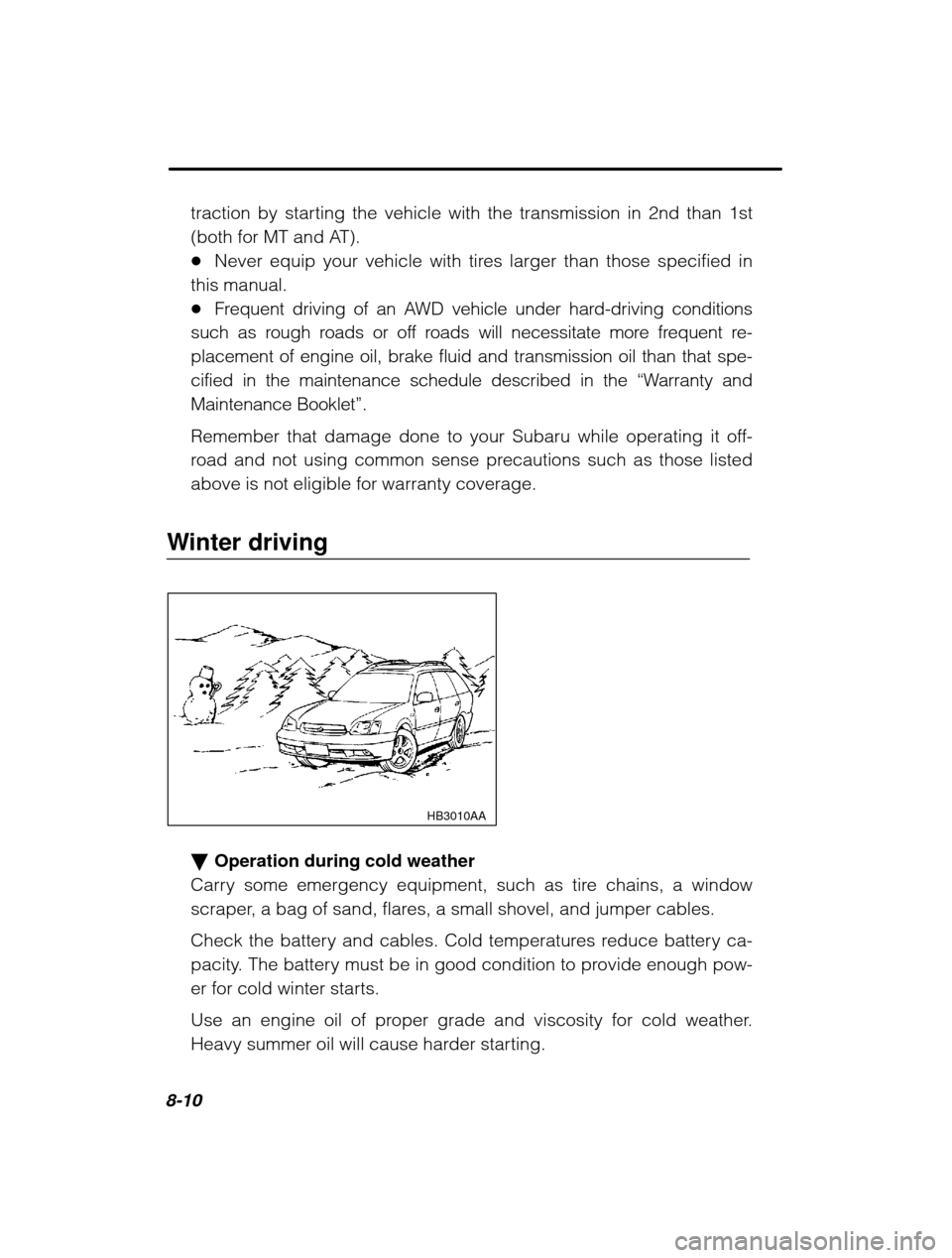
Winter driving
HB3010AA
Operation during cold weather
Carry some emergency equipment, such as tire chains, a window
scraper, a bag of sand, flares, a small shovel, and jumper cables.
Check the battery and cables. Cold temperatures reduce battery ca-
pacity. The battery must be in good condition to provide enough pow-
er for cold winter starts.
Use an engine oil of proper grade and viscosity for cold weather.
Heavy summer oil will cause harder starting.