wheel SUBARU LEGACY 2005 4.G User Guide
[x] Cancel search | Manufacturer: SUBARU, Model Year: 2005, Model line: LEGACY, Model: SUBARU LEGACY 2005 4.GPages: 627, PDF Size: 6.42 MB
Page 96 of 627
1-65
Seat, seatbelt and SRS airbags
– CONTINUED –
!Subaru advanced frontal airbag sys- tem
Your vehicle is equipped with a Subaru advanced
frontal airbag system that complies with the new ad-
vanced frontal airbag requirements in the amended
Federal Motor Vehicle Safety Standard (FMVSS) No.
208.
The Subaru advanced frontal airbag system automat-
ically determines the deployment force of the driver’s
SRS frontal airbag at the time of deployment as well as
whether or not to activate the front passenger’s SRS
frontal airbag and, if activated, the deployment force of
the SRS frontal airbag at the time of deployment.
Your vehicle has warning labels on the driver’s and
front passenger’s sun visors beginning with the phrase
“EVEN WITH ADVANCED AIR BAGS” and a tag at-
tached to the glove box lid beginning with the phrase
“Even with Advanced Air Bags”. Make sure that you
carefully read the instructions on the warning labels
and tag.
Always wear your seatbelt. Subaru advanced frontal
airbag system is a supplemental restraint system and
must be used in combination with a seatbelt. All occu-
pants should wear a seatbelt or be seated in an appro-
priate child restraint system.
The driver’s SRS frontal airbag is stowed in the center
portion of the steering wheel. The front passenger’s SRS frontal airbag is stowed near the top of the dash-
board under an “SRS AIRBAG” mark.
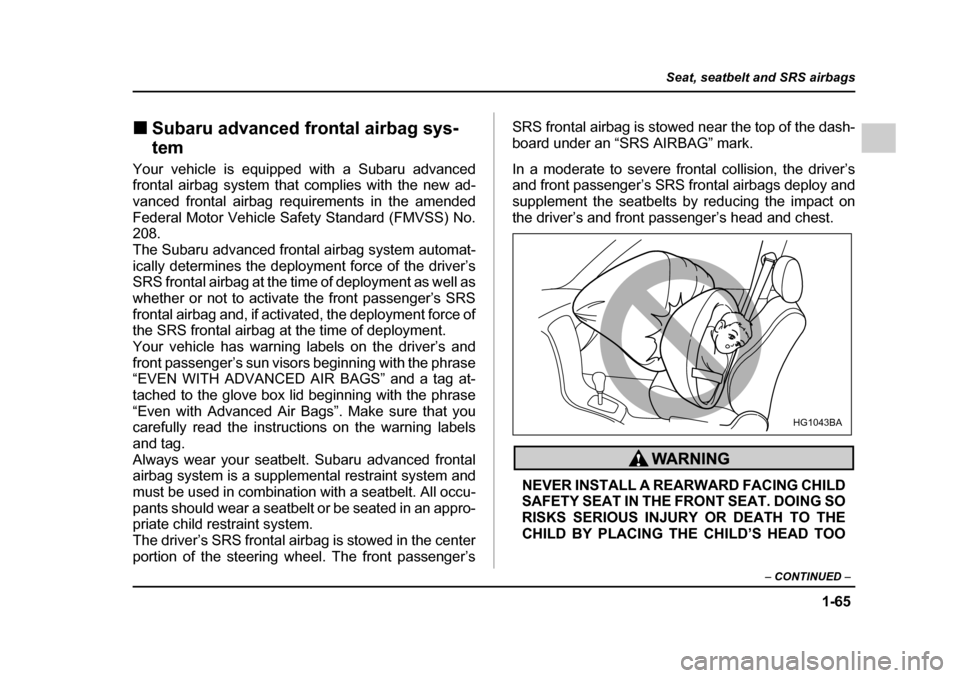
In a moderate to severe frontal collision, the driver’s
and front passenger’s SRS frontal airbags deploy and
supplement the seatbelts by reducing the impact on
the driver’s and front passenger’s head and chest.
NEVER INSTALL A REARWARD FACING CHILD
SAFETY SEAT IN THE FRONT SEAT. DOING SO
RISKS SERIOUS INJURY OR DEATH TO THE
CHILD BY PLACING THE CHILD’S HEAD TOO
HG1043BA
Page 98 of 627
1-67
Seat, seatbelt and SRS airbags
– CONTINUED –
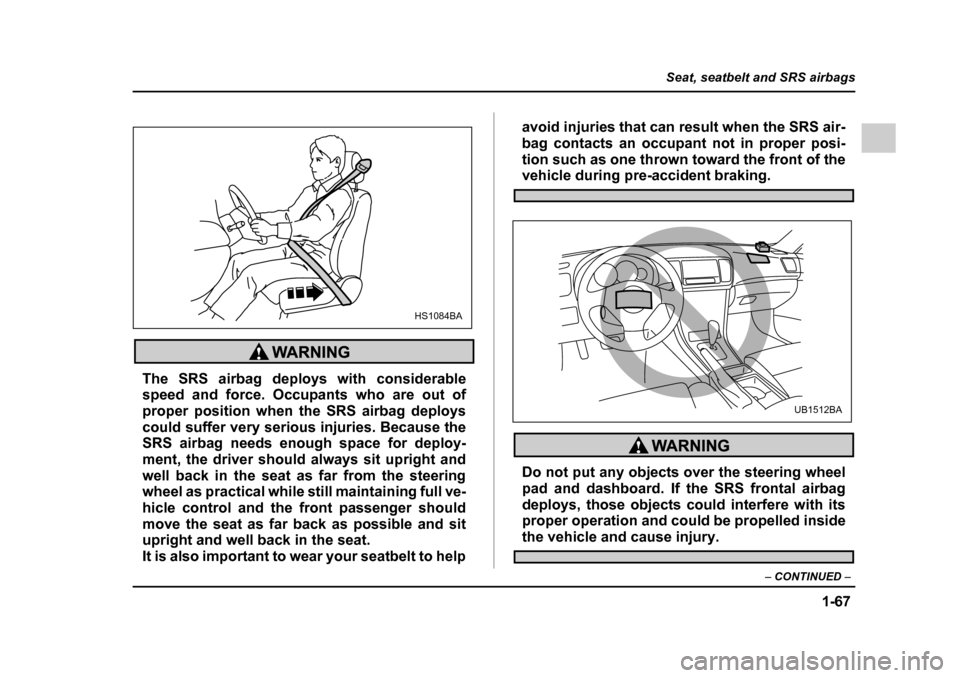
The SRS airbag deploys with considerable
speed and force. Occupants who are out of
proper position when the SRS airbag deploys
could suffer very serious injuries. Because the
SRS airbag needs enough space for deploy-
ment, the driver should always sit upright and
well back in the seat as far from the steering
wheel as practical while still maintaining full ve-
hicle control and the front passenger should
move the seat as far back as possible and sit
upright and well back in the seat.
It is also important to wear your seatbelt to help avoid injuries that can result when the SRS air-
bag contacts an occupant not in proper posi-
tion such as one thrown toward the front of the
vehicle during pre-accident braking.
Do not put any objects over the steering wheel
pad and dashboard. If the SRS frontal airbag
deploys, those objects could interfere with its
proper operation and could be propelled inside
the vehicle and cause injury.
HS1084BA
UB1512BA
Page 105 of 627

1-74
Seat, seatbelt and SRS airbags
the side of the seat. "
Ensure that the backward-forward position and
seatback of front passenger’s seat are locked into
place securely by moving the seat back and forth.
(Models equipped with manual seats only)" Next, turn the ignition switch to the “ON” position
and let the system complete the self check. Now, the
ON indicator should illuminate while the OFF indicator
remains extinguished.
If the OFF indicator still illuminates while the ON indi-
cator remains extinguished, ask the occupant to move
to the rear seat and immediately contact your SUBA-
RU dealer for an inspection. ! Effect vehicle modifications made for persons
with disabilities may have on Subaru advanced
frontal airbag system operation (U.S. only)
Changing or moving any parts of the front seats, seat
belts, front bumper, front side frame, instrument panel,
combination meter, steering wheel, steering column,
tire, suspension or floor panel can affect the operation of the Subaru advanced airbag system. If you have
any questions, you may contact the following Subaru
distributors:
Subaru of America, Inc.
Customer Dealer Services Department P.O. Box 6000
Cherry Hill, NJ 08034-6000
1-800-SUBARU3 (1-800-782-2783)
Schuman Carriage Motors, Inc.
1234 South Beretania Street, Honolulu, HI 96814
808-592-4497
Triple J Enterprises, Inc.
P. O. Box 6066, Tamuning, Guam 96931
671-646-9126
Trebol Subaru of Puerto Rico, Inc.
P. O. Box 11204, San Juan, Puerto Rico 00910
787-793-2828
There are no Subaru distributors in any other U.S. ter-
ritories as of May 2004. If you are in such an area,
please contact the Subaru distributor or dealer from
which you bought your vehicle.
Page 107 of 627
1-76
Seat, seatbelt and SRS airbags
from detecting impact to the deflation of the SRS air-
bag after deployment is shorter than the blink of aneye.
Both when only the driver’s SRS frontal airbag deploys
and the driver’s and front passenger’s SRS frontal air-
bags deploy, the driver’s and front passenger’s seat-
belt pretensioners operate at the same time.
Although it is highly unlikely that the SRS airbag would
activate in a non-accident situation, should it occur,
the SRS airbag will deflate quickly, not obscuring vi-
sion and will not interfere with the driver’s ability to
maintain control of the vehicle.
When the SRS airbag deploys, a sudden, fairly loud
inflation noise will be heard and some smoke will be
released. These occurrences are normal result of the
deployment. This smoke does not indicate a fire in the
vehicle.
Do not touch the SRS airbag system compo-
nents around the steering wheel and dash-
board with bare hands right after deployment.
Doing so can cause burns because the compo-
nents can be very hot as a result of deployment.
Driver’s SRS frontal airbag and front passenger’s SRS
frontal airbag are designed to deploy in the event of an
accident involving a moderate to severe frontal colli-
sion. It is basically not designed to deploy in lesser
frontal impacts because the necessary protection can
be achieved by the seatbelt alone. Also, they are basi-
cally not designed to deploy in side or rear impacts or
in roll-over accidents because deployment of only the
driver’s SRS frontal airbag or both driver’s and front
passenger’s SRS frontal airbags would not help the
occupant in those situations. The driver’s and front
passenger’s SRS frontal airbags are designed to func-
tion on a one-time-only basis.
SRS airbag deployment depends on the level of force
experienced in the passenger compartment during a
collision. That level differs from one type of collision to
another, and it may have no bearing on the visible
damage done to the vehicle itself.
Page 116 of 627
1-85
Seat, seatbelt and SRS airbags
– CONTINUED –
!Operation
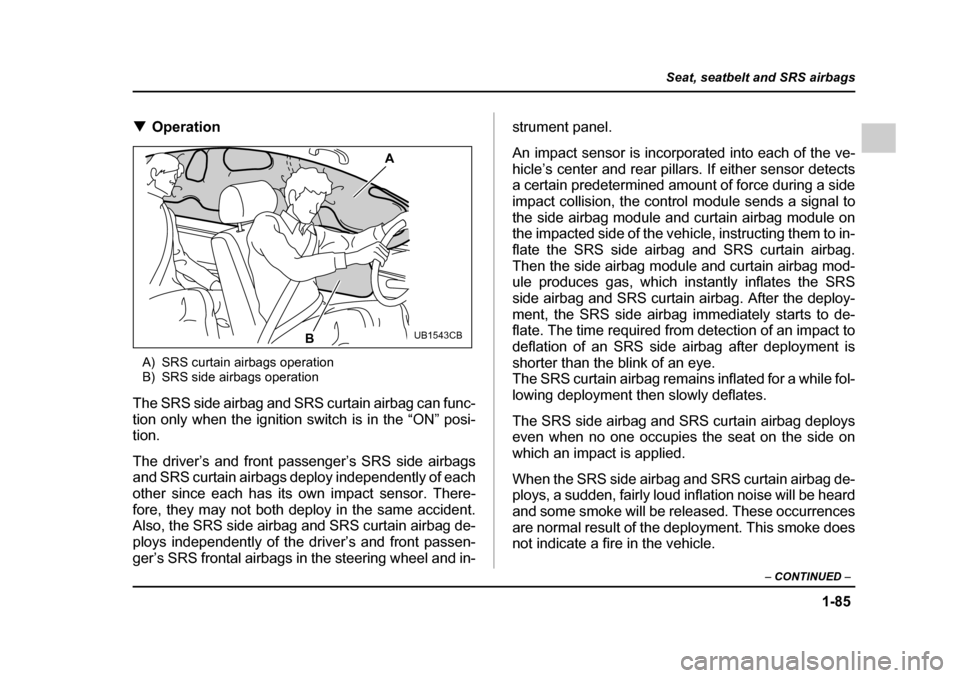
A) SRS curtain airbags operation
B) SRS side airbags operation
The SRS side airbag and SRS curtain airbag can func-
tion only when the ignition switch is in the “ON” posi-tion.
The driver’s and front passenger’s SRS side airbags
and SRS curtain airbags deploy independently of each
other since each has its own impact sensor. There-
fore, they may not both deploy in the same accident.
Also, the SRS side airbag and SRS curtain airbag de-
ploys independently of the driver’s and front passen-
ger’s SRS frontal airbags in the steering wheel and in- strument panel.
An impact sensor is incorporated into each of the ve-
hicle’s center and rear pillars. If either sensor detects
a certain predetermined amount of force during a side
impact collision, the control module sends a signal to
the side airbag module and curtain airbag module on
the impacted side of the vehicle, instructing them to in-
flate the SRS side airbag and SRS curtain airbag.
Then the side airbag module and curtain airbag mod-
ule produces gas, which instantly inflates the SRS
side airbag and SRS curtain airbag. After the deploy-
ment, the SRS side airbag immediately starts to de-
flate. The time required from detection of an impact to
deflation of an SRS side airbag after deployment is
shorter than the blink of an eye.
The SRS curtain airbag remains inflated for a while fol-
lowing deployment then slowly deflates.
The SRS side airbag and SRS curtain airbag deploys
even when no one occupies the seat on the side on
which an impact is applied.
When the SRS side airbag and SRS curtain airbag de-
ploys, a sudden, fairly loud inflation noise will be heard
and some smoke will be released. These occurrences
are normal result of the deployment. This smoke does
not indicate a fire in the vehicle.
A
B
UB1543CB
Page 121 of 627
1-90
Seat, seatbelt and SRS airbags
position.
The following components are monitored by the indi- cator: "
Front sub sensor (Right hand side)
" Front sub sensor (Left hand side)
" Airbag control module (including impact sensors)
" Frontal airbag module (Driver’s side)
" Frontal airbag module (Front passenger’s side)
" Side airbag sensor (Center pillar right hand side)
" Side airbag sensor (Center pillar left hand side)
" Side airbag module (Driver’s side)
" Side airbag module (Front passenger’s side)
" Side airbag sensor (Rear wheel house right hand
side) " Side airbag sensor (Rear wheel house left hand
side)" Curtain airbag module (Right side)
" Curtain airbag module (Left side)
" Seatbelt pretensioner (Driver’s side)
" Seatbelt pretensioner (Front passenger’s side)
" Seatbelt buckle switch (Driver’s side)
" Seatbelt buckle switch (Front passenger’s side)
" Driver’s seat position sensor
" Front passenger’s occupant detection system
weight sensor" Front passenger’s occupant detection control mod-
ule "
Front passenger’s frontal airbag ON and OFF indi-
cator" All related wiring
If the warning light exhibits any of the following
conditions, there may be a malfunction in the
seatbelt pretensioners and/or SRS airbag sys-
tem. Immediately take your vehicle to your
nearest SUBARU dealer to have the system
checked. Unless checked and properly re-
paired, the seatbelt pretensioners and/or SRS
airbags will operate improperly (e.g. SRS air-
bags may inflate in a very minor collision or not
inflate in a severe collision), which may in-
crease the risk of injury. "Flashing or flickering of the indicator light
" No illumination of the warning light when the
ignition switch is first turned to the “ON” posi- tion " Continuous illumination of the warning light
"Illumination of the warning light while driving
Page 122 of 627
1-91
Seat, seatbelt and SRS airbags
– CONTINUED –
!SRS airbag system servicing
"When discarding an airbag module or scrap-
ping the entire vehicle damaged by a collision,
consult your SUBARU dealer. " The SRS airbag has no user-serviceable
parts. Do not use electrical test equipment on
any circuit related to the SRS airbag system.
For required servicing of the SRS airbag, see
your nearest SUBARU dealer. Tampering with
or disconnecting the system’s wiring could re-
sult in accidental inflation of the SRS airbag or
could make the system inoperative, which may
result in serious injury. The wiring harnesses of
the SRS airbag system are covered with yellow
insulation and system connectors are yellow
for easy identification.
If you need service or repair in areas listed be-
low, have an authorized SUBARU dealer per-
form the work. The SRS airbag control module,
impact sensors and airbag modules are stored
in these areas. "
Under the center console
" Inside each front fender
" Steering wheel and column and nearby areas
" Top of the dashboard on front passenger’s
side and nearby areas" Each front seat and nearby area
" Inside each center pillar
" In each roof side (from the front pillar to a
point over the rear seat) " Between the rear seat cushion and rear wheel
house on each side
In the event that the SRS airbag is deployed, re-
placement of the system should be performed
only by an authorized SUBARU dealer. When the
components of the SRS airbag system are re-
placed, use only genuine SUBARU parts.
NOTE
In the following cases, contact your SUBARU deal-
er as soon as possible. " The front part of the vehicle was involved in an
accident in which the only the driver’s SRS frontal
airbag or both driver’s and front passenger’s SRS
frontal airbags did not deploy." The pad of the steering wheel, the cover over the
front passenger’s SRS frontal airbag, or either
Page 123 of 627
1-92
Seat, seatbelt and SRS airbags
roof side (from the front pillar to a point over the
rear seat) is scratched, cracked, or otherwise dam-
aged. "
Either center pillar and rear wheel house or a
nearby area of the vehicle was involved in an acci-
dent in which the SRS side airbag and SRS curtain
airbag did not deploy. " The fabric or leather of either front seatback is
cut, frayed, or otherwise damaged. ! Precautions against vehicle modifica- tion
"To avoid accidental activation of the system
or rendering the system inoperative, which may
result in serious injury, no modifications
should be made to any components or wiring of
the SRS airbag system.
This includes following modifications: "Installation of custom steering wheels
" Attachment of additional trim materials to
the dashboard " Installation of custom seats
" Replacement of seat fabric or leather
" Installation of additional fabric or leather on the front seat "
Attachment of a hands-free microphone or
any other accessory to a front pillar, a center
pillar, a rear pillar, the windshield, a side win-
dow, an assist grip, or any other cabin sur-
face that would be near a deploying SRS cur-
tain airbag.
" Installation of additional electrical/electronic
equipment such as a mobile two-way radio on
or near the SRS airbag system components
and/or wiring is not advisable. This could inter-
fere with proper operation of the SRS airbag
system.
Do not perform any of the following modifica-
tions. Such modifications can interfere with
proper operation of the SRS airbag system. " Attachment of any equipment (bush bar,
winches, snow plow, skid plate, etc.) other than
genuine SUBARU accessory parts. " Modification of the suspension system or
front end structure. " Installation of a tire of different size and con-
struction from the tires specified on the vehicle
Page 172 of 627

3-1
3
Instruments and controls
Ignition switch .............................................. 3-3 LOCK .................................................................. 3-4
ACC .................................................................... 3-4
ON ....................................................................... 3-4
START ................................................................ 3-5
Key reminder chime .......................................... 3-6
Ignition switch light .......................................... 3-6
Hazard warning flasher ................................ 3-7
Meters and gauges (Turbo models) ............ 3-7 Combination meter illumination ...................... 3-7
Canceling the function for meter/gauge needle movement and combination meter
sequential illumination upon turning on the
ignition switch ................................................ 3-8
Speedometer ..................................................... 3-9
Odometer ........................................................... 3-9
Double trip meter .............................................. 3-10
Tachometer ........................................................ 3-11
Fuel gauge ......................................................... 3-11
Temperature gauge ........................................... 3-13
Meters and gauges (Non-turbo models) ..... 3-14 Combination meter illumination ...................... 3-14
Canceling the function for meter/gauge needle movement upon turning on the
ignition switch ................................................ 3-15
Speedometer ..................................................... 3-15
Odometer ........................................................... 3-16
Double trip meter .............................................. 3-16
Tachometer ........................................................ 3-17
Fuel gauge ......................................................... 3-18
Temperature gauge ........................................... 3-19 Warning and indicator lights ....................... 3-20
Seatbelt warning light and chime .................... 3-21
SRS airbag system warning light .................... 3-24
Front passenger’s frontal airbag ON and OFF indicators ........................................................ 3-24
CHECK ENGINE warning light/Malfunction indicator lamp ................................................. 3-25
Charge warning light ........................................ 3-26
Oil pressure warning light ............................... 3-26
AT OIL TEMPerature warning light (AT vehicles) ................................................... 3-27
Low tire pressure warning light (if equipped) .................................................... 3-27
ABS warning light ............................................. 3-28
Brake system warning light ............................. 3-29
Low fuel warning light ...................................... 3-30
Door open warning light .................................. 3-31
All-wheel drive warning light (AT vehicles) .... 3-31
Vehicle Dynamics Control operation indicator light (if equipped) ........................................... 3-31
Vehicle Dynamics Control warning light (if equipped)/Vehicle Dynamics Control OFF
indicator light (if equipped) ........................... 3-32
Security indicator light ..................................... 3-33
SPORT mode indicator light (AT vehicles) ..... 3-34
Selector lever position indicator (AT vehicles) ................................................... 3-34
Gear position indicator (AT vehicles) ............. 3-34
Turn signal indicator lights .............................. 3-34
High beam indicator light ................................. 3-35
Cruise control indicator light ........................... 3-35
Cruise control set indicator light .................... 3-35
Page 173 of 627

3-2
Instruments and controls
Headlight indicator light .................................. 3-35
Front fog light indicator light .......................... 3-35
Clock ............................................................. 3-36
Information display (if equipped) ................ 3-37 Outside temperature indicator ........................ 3-37
Current fuel consumption ................................ 3-39
Average fuel consumption .............................. 3-40
Driving range on remaining fuel ..................... 3-41
Journey time ..................................................... 3-43
Light control switch ..................................... 3-44 Headlights ......................................................... 3-45
High/low beam change (dimmer) .................... 3-45
Headlight flasher .............................................. 3-46
Daytime running light system ......................... 3-46
Turn signal lever ........................................... 3-47
Illumination brightness control ................... 3-47
Bright switch (Night illumination dimness cancellation) .............................................. 3-48
Parking light switch ..................................... 3-49
Fog light switch (if equipped) ..................... 3-50
Wiper and washer ......................................... 3-51 Windshield wiper and washer switches ......... 3-52
Rear window wiper and washer switch (Station wagon) .............................................. 3-55
Windshield wiper deicer (if equipped) ........ 3-56
Rear window defogger button ..................... 3-57
Mirrors ........................................................... 3-59 Inside mirror ...................................................... 3-59
Auto-dimming mirror/compass (if equipped) ................................................... 3-59
Outside mirrors ................................................. 3-61 Tilt steering wheel ........................................ 3-63
Horn ............................................................... 3-64