lock SUBARU LEGACY 2005 4.G Owner's Manual
[x] Cancel search | Manufacturer: SUBARU, Model Year: 2005, Model line: LEGACY, Model: SUBARU LEGACY 2005 4.GPages: 627, PDF Size: 6.42 MB
Page 56 of 627
1-25
Seat, seatbelt and SRS airbags
– CONTINUED –
retracted properly to avoid catching the belt webbing
in the door. !Rear seatbelts (except rear center seatbelt on
Station wagon)
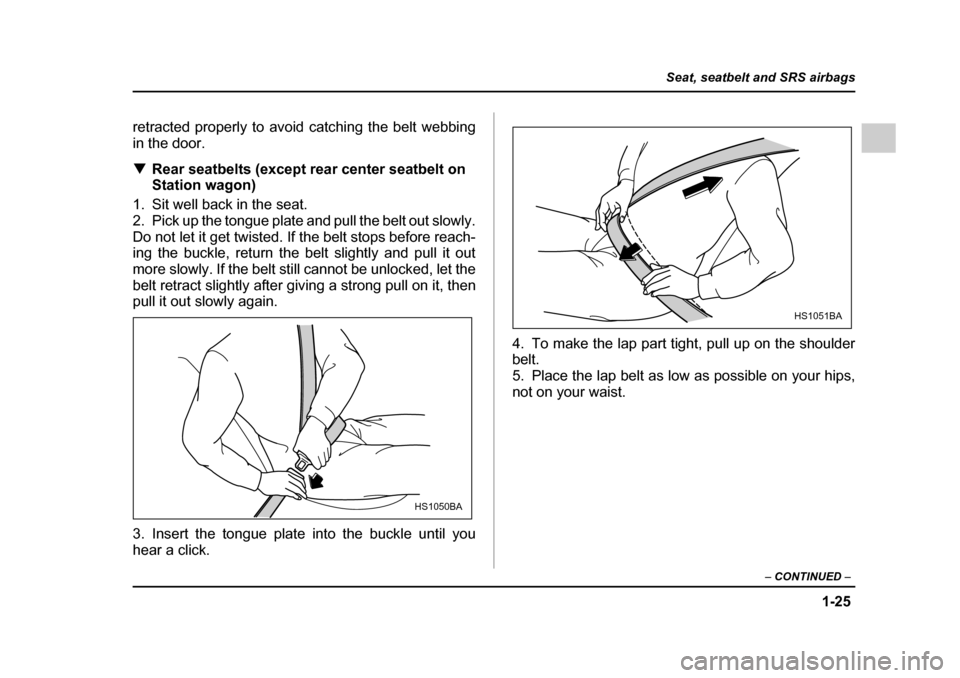
1. Sit well back in the seat.
2. Pick up the tongue plate and pull the belt out slowly.
Do not let it get twisted. If the belt stops before reach-
ing the buckle, return the belt slightly and pull it out
more slowly. If the belt still cannot be unlocked, let the
belt retract slightly after giving a strong pull on it, then
pull it out slowly again.
3. Insert the tongue plate into the buckle until you
hear a click. 4. To make the lap part tight, pull up on the shoulder
belt.
5. Place the lap belt as low as possible on your hips,
not on your waist.
HS1050BA
HS1051BA
Page 60 of 627
1-29
Seat, seatbelt and SRS airbags
– CONTINUED –
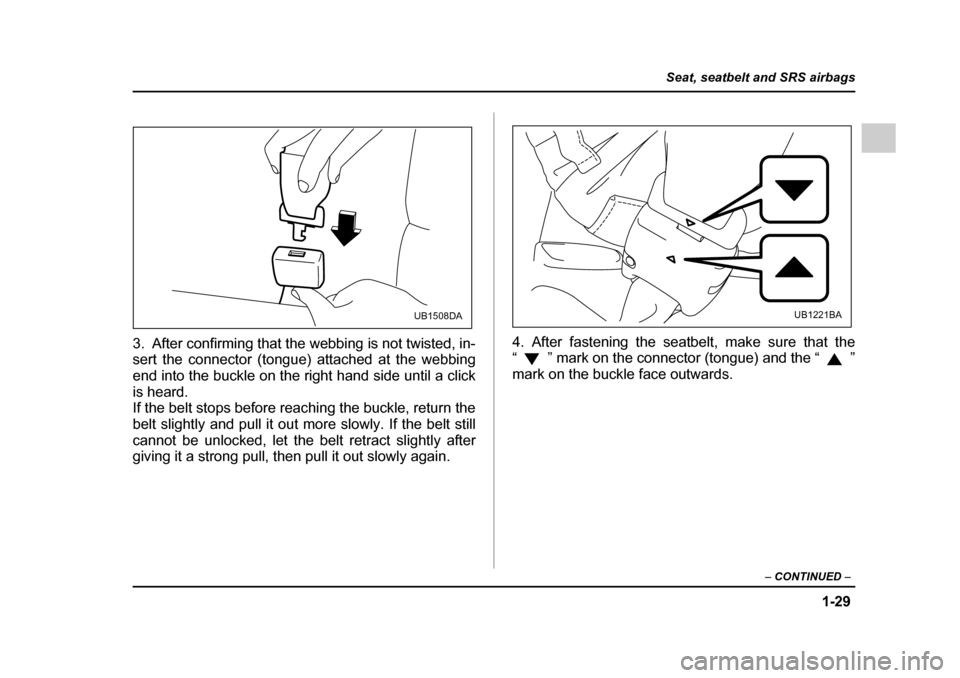
3. After confirming that the webbing is not twisted, in-
sert the connector (tongue) attached at the webbing
end into the buckle on the right hand side until a click
is heard.
If the belt stops before reaching the buckle, return the
belt slightly and pull it out more slowly. If the belt still
cannot be unlocked, let the belt retract slightly after
giving it a strong pull, then pull it out slowly again. 4. After fastening the seatbelt, make sure that the
“ ” mark on the connector (tongue) and the “ ”
mark on the buckle face outwards.
UB1508DAUB1221BA
Page 65 of 627
1-34
Seat, seatbelt and SRS airbags
ing noise will be heard and a small amount of smoke
will be released. These occurrences are normal and
not harmful. This smoke does not indicate a fire in the
vehicle.
Once the seatbelt pretensioner has been activated,
the seatbelt retractor remains locked. Consequently,
the seatbelt can not be pulled out and retracted and
therefore must be replaced.
NOTE "
Seatbelt pretensioners are not designed to acti-
vate in minor frontal impacts, in side or rear im-
pacts or in roll-over accidents. " The driver’s seat and passenger’s seat preten-
sioners and frontal airbag operate simultaneous- ly. " Pretensioners are designed to function on a
one-time-only basis. In the event that a preten-
sioner is activated, both the driver’s and front pas-
senger’s seatbelt retractor assemblies must be re-
placed and only by an authorized SUBARU dealer.
When replacing seatbelt retractor assemblies, use
only genuine SUBARU parts. " If either front seatbelt does not retract or cannot
be pulled out due to a malfunction or activation of
the pretensioner, contact your SUBARU dealer as
soon as possible. "
If the front seatbelt retractor assembly or sur-
rounding area has been damaged, contact your
SUBARU dealer as soon as possible. " When you sell your vehicle, we urge you to ex-
plain to the buyer that it has seatbelt pretension-
ers by alerting him to the contents of this section." To obtain maximum protection, occupants
should sit in an upright position with their seat-
belts properly fastened. Refer to “Seatbelts”
section in this chapter." Do not modify, remove or strike the front
seatbelt retractor assemblies or surrounding
area. This could result in accidental activation
of the seatbelt pretensioners or could make the
system inoperative, possibly resulting in seri-
ous injury. Seatbelt pretensioners have no
user-serviceable parts. For required servicing
of front seatbelt retractors equipped with seat-
belt pretensioners, see your nearest SUBARU
dealer." When discarding front seatbelt retractor as-
semblies or scrapping the entire vehicle due to
collision damage or for other reasons, consult
Page 71 of 627
1-40
Seat, seatbelt and SRS airbags
!
Where to place a child restraint system
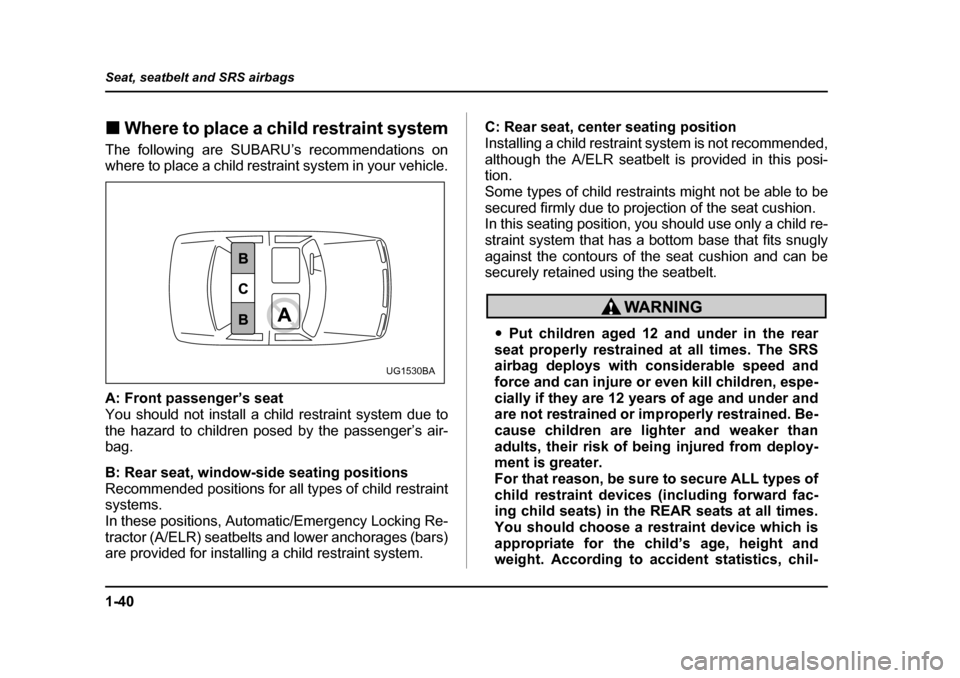
The following are SUBARU’s recommendations on
where to place a child restraint system in your vehicle.
A: Front passenger’s seat
You should not install a child restraint system due to
the hazard to children posed by the passenger’s air-
bag.
B: Rear seat, window-side seating positions
Recommended positions for all types of child restraint
systems.
In these positions, Automatic/Emergency Locking Re-
tractor (A/ELR) seatbelts and lower anchorages (bars)
are provided for installing a child restraint system. C: Rear seat, center seating position
Installing a child restraint system is not recommended,
although the A/ELR seatbelt is provided in this posi- tion.
Some types of child restraints might not be able to be
secured firmly due to projection of the seat cushion.
In this seating position, you should use only a child re-
straint system that has a bottom base that fits snugly
against the contours of the seat cushion and can be
securely retained using the seatbelt.
"
Put children aged 12 and under in the rear
seat properly restrained at all times. The SRS
airbag deploys with considerable speed and
force and can injure or even kill children, espe-
cially if they are 12 years of age and under and
are not restrained or improperly restrained. Be-
cause children are lighter and weaker than
adults, their risk of being injured from deploy-
ment is greater.
For that reason, be sure to secure ALL types of
child restraint devices (including forward fac-
ing child seats) in the REAR seats at all times.
You should choose a restraint device which is
appropriate for the child’s age, height and
weight. According to accident statistics, chil-
UG1530BA
Page 72 of 627

1-41
Seat, seatbelt and SRS airbags
– CONTINUED –
dren are safer when properly restrained in the
rear seating positions than in the front seating
positions.
SINCE YOUR VEHICLE IS EQUIPPED WITH A
PASSENGER’S SRS AIRBAG, DO NOT IN-
STALL A REARWARD FACING CHILD SAFETY
SEAT IN THE FRONT PASSENGER’S SEAT.
DOING SO RISKS SERIOUS INJURY OR DEATH
TO THE CHILD BY PLACING THE CHILD’S
HEAD TOO CLOSE TO THE SRS AIRBAG.
! Choosing a child restraint system
Choose a child restraint system that is appropriate for
the child’s age and size (weight and height) in order to
provide the child with proper protection. The child re-
straint system should meet all applicable requirements
of Federal Motor Vehicle Safety Standards for United
States or Canada Motor Vehicle Safety Standards for
Canada. It can be identified by locking for the label on
the child restraint system or the manufacture’s state-
ment of compliance in the document attached to the
HG1043BAUGS507AA
Page 74 of 627

1-43
Seat, seatbelt and SRS airbags
– CONTINUED –
hear a click.
4. Take up the slack in the lap belt.
5. Pull out the seatbelt fully from the retractor to
change the retractor over from the Emergency Lock-
ing Retractor (ELR) to the Automatic Locking Retrac-
tor (ALR) function. Then, allow the belt to rewind into
the retractor. As the belt is rewinding, clicks will be
heard which indicate the retractor functions as ALR. 6. Push and pull the child restraint system forward
and from side to side to check if it is firmly secured.
Sometimes a child restraint can be more firmly se-
cured by pushing it down into the seat cushion and
then tightening the seatbelt.
7. Pull at the shoulder portion of the belt to confirm
that it cannot be pulled out (ALR properly functioning).
UGS509BA
UGS510BA
Page 76 of 627

1-45
Seat, seatbelt and SRS airbags
– CONTINUED –
4. Take up the slack in the lap belt.
5. Pull out the seatbelt fully from the retractor to
change the retractor over from the Emergency Lock-
ing Retractor (ELR) to the Automatic Locking Retrac-
tor (ALR) function. Then, allow the belt to rewind into
the retractor. As the belt is rewinding, clicks will be
heard which indicate the retractor functions as ALR. 6. Before having a child sit in the child restraint sys-
tem, move it back and forth and right and left to check
if it is firmly secured. Sometimes a child restraint can
be more firmly secured by pushing it down into the
seat cushion and then tightening the seatbelt.
7. Pull at the shoulder portion of the belt to confirm
that it cannot be pulled out (ALR properly functioning).
US1582BAUS1583BA
Page 100 of 627
1-69
Seat, seatbelt and SRS airbags
– CONTINUED –
NOTE
The driver’s SRS side airbag, SRS curtain airbag
and seatbelt pretensioner are not controlled by the
Subaru advanced frontal airbag system. !Front passenger’s SRS frontal airbag
The front passenger’s SRS frontal airbag uses a dual
stage inflator. The inflator operates in different ways
depending on the severity of impact and the total load
on the seat.
The total load on the seat is monitored by the passen-
ger’s occupant detection system weight sensor under
the seat.
The detection system monitors the total load on the
seat and, based on this, determines as to whether or
not the front passenger’s SRS frontal airbag should be
activated.
Depending on the weight sensor output, only the driv-
er’s SRS frontal airbag may deploy. This is normal.
Observe the following precautions. Failure to do so
may prevent the Subaru advanced frontal airbag sys-
tem from functioning correctly or cause the system to fail." Do not apply any strong impact to the front passen-
ger’s seat such as by kicking." Do not spill liquid on the front passenger’s seat. If
liquid is spilt, wipe it off immediately. "
Do not remove or disassemble the front passen-
ger’s seat." Do not install any accessory (such as an audio am-
plifier) other than a genuine SUBARU accessory un-
der the front passenger’s seat." Do not place anything (shoes, umbrella, etc.) under
the front passenger’s seat." The front passenger’s seat must not be used with
the head restraint removed. " Do not leave any article including a child restraint
system on the front passenger’s seat or the seatbelt
tongue and buckle engaged when you leave your ve-
hicle. " Do not place a magnet near the seatbelt buckle.
" Do not use front seats with their backward-forward
position and seatback not being locked into place se-
curely. If any of them are not locked securely, adjust
them again. For adjusting procedure, refer to the
“Manual seat” in the front seats section in Chapter 1 in
this owner’s manual. (Models equipped with manualseats only)
If the seatbelt buckle switch and/or passenger’s occu-
pant detection system weight sensor have failed, the
SRS airbag system warning light will illuminate. Have
the system inspected by your SUBARU dealer imme-
diately if the SRS airbag system warning light comeson.
Page 101 of 627
1-70
Seat, seatbelt and SRS airbags
If your vehicle has sustained impact, this may affect
the proper function of the Subaru advanced frontal air-
bag system. Have your vehicle inspected at your SUB-
ARU dealer.
NOTE
The front passenger’s SRS side airbag, SRS cur-
tain airbag and seatbelt pretensioner are not con-
trolled by the Subaru advanced frontal airbag sys-tem.
!
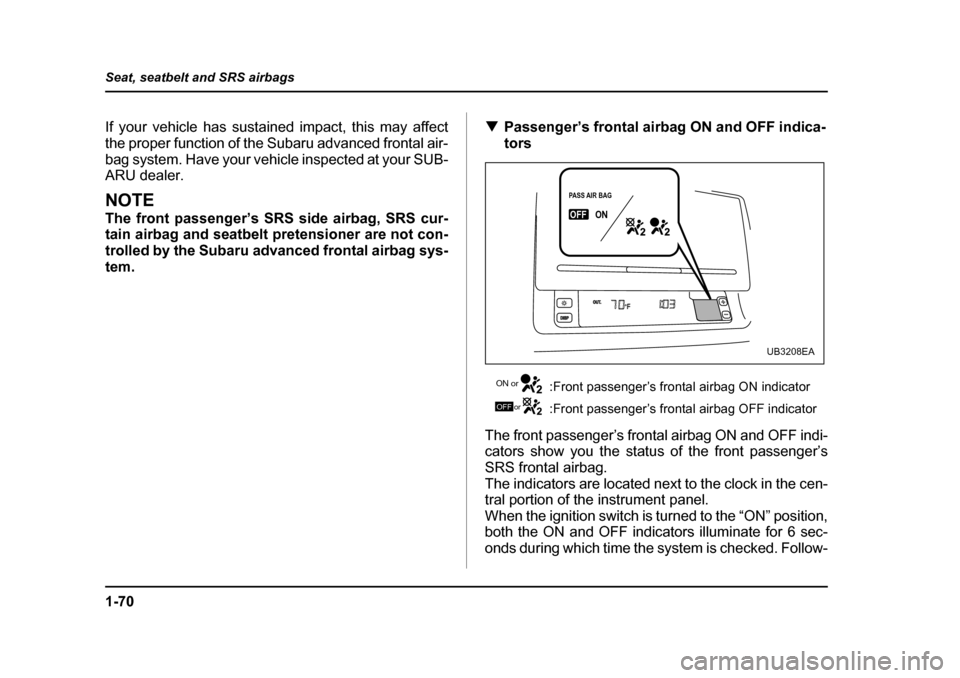
Passenger’s frontal airbag ON and OFF indica-tors
:Front passenger’s frontal airbag ON indicator
:Front passenger’s frontal airbag OFF indicator
The front passenger’s frontal airbag ON and OFF indi-
cators show you the status of the front passenger’s
SRS frontal airbag.
The indicators are located next to the clock in the cen-
tral portion of the instrument panel.
When the ignition switch is turned to the “ON” position,
both the ON and OFF indicators illuminate for 6 sec-onds during which time the system is checked. Follow-
PASS AIR BAGPASS AIR BAGONONONOUT.DISPOFF
PASS AIR BAG
OFFON
UB3208EA
ON or
OFF or
Page 103 of 627
1-72
Seat, seatbelt and SRS airbags
seat, activating the front passenger’s SRS frontal air-
bag even though that seat is occupied by a child."
Do not place any article on the seat other than the
child occupant and a child restraint system." Do not place more than one child on the seat.
" Do not install any accessory such as a table or TV
onto the seatback." Do not store a heavy load in the seatback pocket.
" Do not allow the rear seat occupant to place his/her
hands or legs on the front passenger’s seatback, or al-
low him/her to pull the seatback. " If the front passenger’s frontal airbag ON indi-
cator illuminates and the OFF indicator extin-
guishes even when an infant or a small child is
in a child restraint system (including booster
seat)
Turn the ignition switch to the “OFF” position if the
front passenger’s frontal airbag ON indicator illumi-
nates and the OFF indicator extinguishes even when
an infant or a small child is in a child restraint system
(including booster seat). Remove the child restraint
system from the seat. By referring to the child restraint
manufacturer’s recommendations as well as the child
restraint system installation procedures in the “Child
restraint systems” section in this chapter, correctly in-
stall the child restraint system. Turn the ignition switch
to the “ON” position and make sure that the front pas- senger’s frontal airbag ON indicator goes out and the
OFF indicator comes on.
If still the ON indicator illuminates while the OFF indi-
cator extinguishes, take the following actions. "
Ensure that no article is placed on the seat other
than the child restraint system and the child occupant. " Ensure that there is no article left in the seatback
pocket. " Ensure that the backward-forward position and
seatback of front passenger’s seat are locked into
place securely by moving the seat back and forth.
(Models equipped with manual seats only)
If the ON indicator still illuminates while the OFF indi-
cator extinguishes after taking relevant corrective ac-
tions described above, relocate the child restraint sys-
tem to the rear seat and immediately contact your
SUBARU dealer for an inspection.
NOTE
When a child who has outgrown a child restraint
system or a small adult is seated in the front pas-
senger’s seat, the Subaru advanced frontal airbag
system may or may not activate the front passen-
ger’s SRS frontal airbag depending on the occu-
pant’s seating posture. If the front passenger’s
SRS frontal airbag is activated (the ON indicator il-
luminates while the OFF indicator extinguishes),