ECO mode SUBARU LEGACY 2007 Owners Manual
[x] Cancel search | Manufacturer: SUBARU, Model Year: 2007, Model line: LEGACY, Model: SUBARU LEGACY 2007Pages: 442, PDF Size: 6.32 MB
Page 339 of 442
Black plate (344,1)
北米Model "A2420BE-B" EDITED: 2006/ 7/ 26
10-2
Appearance care
Exterior care& Washing
CAUTION
. When washing the vehicle, the
brakes may get wet. As a result,
the brake stopping distance will
be longer. To dry the brakes,
drive the vehicle at a safe speed
while lightly pressing the brake
pedal to heat up the brakes.
. Do not wash the engine compart-
ment and areas adjacent to it. If
water enters the engine air in-
take, electrical parts or the power
steering fluid reservoir, it will
cause engine trouble or faulty
power steering respectively. .
Since your vehicle is equipped
with a rear wiper, automatic car-
wash brushes could become
tangled around it, damaging the
wiper arm and other compo-
nents. Ask the automatic car-
wash operator not to let the
brushes touch the wiper arm or
to fix the wiper arm on the rear
window glass with adhesive tape
before operating the machine.
(Station wagon models only)
NOTEWhen having your vehicle washed in
an automatic car wash, make sure
beforehand that the car wash is of
suitable type.
The best way to preserve your vehicle’ s
beauty is frequent washing. Wash the
vehicle at least once a month to avoid
contamination by road grime.
Wash dirt off with a wet sponge and plenty
of lukewarm or cold water. Do not wash
the vehicle with hot water and in direct
sunlight.
Salt, chemicals, insects, tar, soot, tree
sap, and bird droppings should be washed
off by using a light detergent, as required.
If you use a light detergent, make certain that it is a neutral detergent. Do not use
strong soap or chemical detergents. All
cleaning agents should be promptly
flushed from the surface and not allowed
to dry there. Rinse the vehicle thoroughly
with plenty of lukewarm water. Wipe the
remaining water off with a chamois or soft
cloth.
!
Washing the underbody
Chemicals, salts and gravel used for
deicing road surfaces are extremely cor-
rosive, accelerating the corrosion of un-
derbody components, such as the exhaust
system, fuel and brake lines, brake
cables, floor pan and fenders, and sus-
pension.
Thoroughly flush the underbody and in-
side of the fenders with lukewarm or cold
water at frequent intervals to reduce the
harmful effects of such agents.
Mud and sand adhering to the underbody
components may accelerate their corro-
sion.
After driving off-road or muddy or sandy
roads, wash the mud and sand off the
underbody.
Carefully flush the suspension and axle
parts, as they are particularly prone to
mud and sand buildup. Do not use a
sharp-edged tool to remove caked mud.
ProCarManuals.com
Page 340 of 442
Black plate (345,1)
北米Model "A2420BE-B" EDITED: 2006/ 7/ 26
NOTEBe careful not to damage brake hoses,
sensor harnesses, and other parts
when washing suspension compo-
nents.
! Using a warm water washer
. Keep a good distance of 12 in (30 cm)
or more between the washer nozzle and
the vehicle.
. Do not wash the same area continu-
ously.
. If a stain will not come out easily, wash
by hand. Some warm water washers are
of the high temperature, high pressure
type, and they can damage or deform the
resin parts such as mouldings, or cause
water to leak into the vehicle.& Waxing and polishingAlways wash and dry the vehicle before
waxing and polishing.
Use a good quality polish and wax and
apply them according to the manufac-
turer ’s instructions. Wax or polish when
the painted surface is cool.
Be sure to polish and wax the chrome trim,
as well as the painted surfaces. Loss of
wax on a painted surface leads to loss of
the original luster and also quickens the
deterioration of the surface. It is recom- mended that a coat of wax be applied at
least once a month, or whenever the
surface no longer repels water.
If the appearance of the paint has dimin-
ished to the point where the luster or tone
cannot be restored, lightly polish the
surface with a fine-grained compound.
Never polish just the affected area, but
include the surrounding area as well.
Always polish in only one direction. A
No. 2000 grain compound is recom-
mended. Never use a coarse-grained
compound. Coarser grained compounds
have a smaller grain-size number and
could damage the paint. After polishing
with a compound, coat with wax to restore
the original luster. Frequent polishing with
acompoundoranincorrectpolishing
technique will result in removing the paint
layer and exposing the undercoat. When
in doubt, it is always best to contact your
SUBARU dealer or an auto paint specia-
list.
NOTEBe careful not to block the windshield
washer nozzles with wax when waxing
the vehicle.&
Cleaning aluminum wheels. Promptly wipe the aluminum wheels clean of any kind of grime or agent. If dirt
is left on too long, it may be difficult to
clean off.
.
Do not use soap containing grit to
clean the wheels. Be sure to use a neutral
cleaning agent, and later rinse thoroughly
with water. Do not clean the wheels with a
stiff brush or expose them to a high-speed
washing device.
. Clean the vehicle (including the alumi-
num wheels) with water as soon as
possible when it has been splashed with
sea water, exposed to sea breezes, or
driven on roads treated with salt or other
agents.
Appearance care
10-3
10
ProCarManuals.com
Page 341 of 442
Black plate (346,1)
北米Model "A2420BE-B" EDITED: 2006/ 7/ 26
10-4
Appearance care
Corrosion protectionYour SUBARU has been designed and
built to resist corrosion. Special materials
and protective finishes have been used on
most parts of the vehicle to help maintain
fine appearance, strength, and reliable
operation.& Most common causes of
corrosionThe most common causes of corrosion
are:
1. The accumulation of moisture retain-
ing dirt and debris in body panel sections,
cavities, and other areas.
2. Damage to paint and other protective
coatings caused by gravel and stone
chips or minor accidents.
Corrosion is accelerated on the vehicle
when:
1. It is exposed to road salt or dust
control chemicals, or used in coastal
areas where there is more salt in the air,
or in areas where there is considerable
industrial pollution.
2. It is driven in areas of high humidity,
especially when temperatures range just
above freezing.
3. Dampness in certain parts of the
vehicle remains for a long time, even though other parts of the vehicle may be
dry.
4. High temperatures will cause corro-
sion to parts of the vehicle which cannot
dry quickly due to lack of proper ventila-
tion.
&
To help prevent corrosionWash the vehicle regularly to prevent
corrosion of the body and suspension
components. Also, wash the vehicle
promptly after driving on any of the
following surfaces:
. roads that have been salted to prevent
them from freezing in winter
. mud, sand, or gravel
. coastal roads
After the winter has ended, it is recom-
mended that the underbody be given a
very thorough washing.
Before the beginning of winter, check the
condition of underbody components, such
as the exhaust system, fuel and brake
lines, brake cables, suspension, steering
system, floor pan, and fenders. If any of
them are found to be rusted, they should
be given an appropriate rust prevention
treatment or should be replaced. Contact
your SUBARU dealer to perform this kind
of maintenance and treatment if you need assistance.
Repair chips and scratches in the paint as
soon as you find them.
Check the interior of the vehicle for water
and dirt accumulation under the floor mats
because that could cause corrosion.
Occasionally check under the mats to
make sure the area is dry.
Keep your garage dry. Do not park your
vehicle in a damp, poorly ventilated
garage. In such a garage, corrosion can
be caused by dampness. If you wash the
vehicle in the garage or put the vehicle
into the garage when wet or covered with
snow, that can cause dampness.
If your vehicle is operated in cold weather
and/or in areas where road salts and other
corrosive materials are used, the door
hinges and locks, trunk lid lock, and hood
latch should be inspected and lubricated
periodically.
ProCarManuals.com
Page 342 of 442
Black plate (347,1)
北米Model "A2420BE-B" EDITED: 2006/ 7/ 26
Cleaning the interiorUse a soft, damp cloth to clean the climate
control panel, audio equipment, instru-
ment panel, center console, combination
meter panel, and switches. (Do not use
organic solvents.)& Seat fabricRemove loose dirt, dust or debris with a
vacuum cleaner. If the dirt is caked on the
fabric or hard to remove with a vacuum
cleaner, use a soft blush then vacuum it.
Wipe the fabric surface with a tightly
wrung cloth and dry the seat fabric
thoroughly. If the fabric is still dirty, wipe
using a solution of mild soap and luke-
warm water then dry thoroughly.
If the stain does not come out, try a
commercially-available fabric cleaner. Use
the cleaner on a hidden place and make
sure it does not affect the fabric adversely.
Use the cleaner according to its instruc-
tions.NOTEWhen cleaning the seat, do not use
benzine, paint thinner, or any similar
materials.
&Leather seat materialsThe leather used by SUBARU is a high
quality natural product which will retain its
distinctive appearance and feel for many
years with proper care.
Allowing dust or road dirt to build up on the
surface can cause the material to become
brittle and to wear prematurely. Regular
cleaning with a soft, moist, natural fiber
cloth should be performed monthly, taking
care not to soak the leather or allow water
to penetrate the stitched seams.
A mild detergent suitable for cleaning
woolen fabrics may be used to remove
difficult dirt spots, rubbing with a soft, dry
cloth afterwards to restore the luster. If
your SUBARU is to be parked for a long
time in bright sunlight, it is recommended
that the seats and headrests be covered,
or the windows shaded, to prevent fading
or shrinkage.
Minor surface blemishes or bald patches
may be treated with a commercial leather
spray lacquer. You will discover that each
leather seat section will develop soft folds
or wrinkles, which is characteristic of
genuine leather.&Synthetic leather upholsteryThe synthetic leather material used on the
SUBARU may be cleaned using mild soap or detergent and water, after first vacuum-
ing or brushing away loose dirt. Allow the
soap to soak in for a few minutes and wipe
off with a clean, damp cloth. Commercial
foam-type cleaners suitable for synthetic
leather materials may be used when
necessary.
NOTEStrong cleaning agents such as sol-
vents, paint thinners, window cleaner
or gasoline must never be used on
leather or synthetic interior materials.&
Climate control panel, audio
panel, instrument panel,
console panel, switches,
combination meter, and other
plastic surfaceUse a soft, damp cloth to clean the climate
control panel, audio equipment, instru-
ment panel, center console, combination
meter panel, and switches.NOTEDo not use organic solvents such as
paint thinners or gasoline, or strong
cleaning agents that contain those
solvents.
Appearance care
10-5
10
ProCarManuals.com
Page 344 of 442
Black plate (21,1)
北米Model "A2420BE-B" EDITED: 2006/ 7/ 31
Maintenance schedule ....................................... 11-3
Maintenance precautions ................................... 11-3
Before checking or servicing in the engine
compartment .................................................... 11-4
When you do checking or servicing in the engine compartment while the engine is running .......... 11-4
Engine hood....................................................... 11-4
Engine compartment overview .......................... 11-6
2.5-liter non-turbo models................................... 11-6
2.5-liter turbo models ......................................... 11-7
3.0-liter models .................................................. 11-8
Engine oil............................................................ 11-9
Checking the oil level ......................................... 11-9
Changing the oil and oil filter ............................ 11-10
Recommended grade and viscosity .................. 11-12
Recommended grade and viscosity under severe driving conditions .......................................... 11-13
Cooling system................................................ 11-13
Hose and connections ...................................... 11-14
Engine coolant ................................................. 11-14
Air cleaner element .......................................... 11-17
Replacing the air cleaner element ..................... 11-17
Spark plugs...................................................... 11-20
Recommended spark plugs .............................. 11-20
Drive belts........................................................ 11-20
2.5-liter models ................................................ 11-20
3.0-liter models ................................................ 11-21
Manual transmission oil .................................. 11-21
Checking the oil level....................................... 11-21
Recommended grade and viscosity .................. 11-22
Automatic transmission fluid.......................... 11-22
Checking the fluid level.................................... 11-22
Recommended fluid ......................................... 11-23
Front differential gear oil (AT vehicles) .......... 11-24
Checking the oil level...................................... 11-24
Recommended grade and viscosity .................. 11-25
Rear differential gear oil.................................. 11-25
Checking the gear oil level ............................... 11-25
Recommended grade and viscosity .................. 11-27
Power steering fluid........................................ 11-28
Checking the fluid level .................................... 11-28
Recommended fluid ......................................... 11-28
Brake fluid........................................................ 11-29
Checking the fluid level .................................... 11-29
Recommended brake fluid ............................... 11-29
Clutch fluid (MT vehicles)............................... 11-30
Checking the fluid level.................................... 11-30
Recommended clutch fluid ............................... 11-30
Brake booster.................................................. 11-31
Brake pedal ...................................................... 11-31
Checking the brake pedal free play .................. 11-31
Checking the brake pedal reserve distance ........................................................ 11-31
Clutch pedal (Manual transmission
vehicles) ........................................................ 11-32
Checking the clutch function ............................ 11-32
Checking the clutch pedal free play .................. 11-32
Replacement of brake pad and lining ............ 11-32
Breaking-in of new brake pads and
linings ........................................................... 11-33
Maintenance and service
11
ProCarManuals.com
Page 346 of 442
Black plate (351,1)
北米Model "A2420BE-B" EDITED: 2006/ 7/ 26
Maintenance scheduleThe scheduled maintenance items re-
quired to be serviced at regular intervals
are shown in the “Warranty and Main-
tenance Booklet ”.
For details of your maintenance schedule,
read the separate “Warranty and Main-
tenance Booklet ”.
Maintenance precautionsWhen maintenance and service are re-
quired, it is recommended that all work be
done by an authorized SUBARU dealer.
If you perform maintenance and service
by yourself, you should familiarize yourself
with the information provided in this
section on general maintenance and
service for your SUBARU.
Incorrect or incomplete service could
cause improper or unsafe vehicle opera-
tion. Any problems caused by improper
maintenance and service performed by
you are not eligible for warranty coverage.
WARNING
.Testing of an All-Wheel Drive
vehicle must NEVER be per-
formed on a single two-wheel
dynamometer or similar appara-
tus. Attempting to do so will
result in transmission damage
and in uncontrolled vehicle
movement and may cause an
accident or injuries to persons
nearby.
. Always select a safe area when
performing maintenance on your
vehicle. .
Always be very careful to avoid
injury when working on the vehi-
cle. Remember that some of the
materials in the vehicle may be
hazardous if improperly used or
handled, for example, battery
acid.
. Your vehicle should only be ser-
viced by persons fully competent
to do so. Serious personal injury
may result to persons not experi-
enced in servicing vehicles.
. Always use the proper tools and
make certain that they are well
maintained.
. Never get under the vehicle sup-
ported only by a jack. Always use
a safety stands to support the
vehicle.
. Never keep the engine running in
a poorly ventilated area, such as
a garage or other closed areas.
. Do not smoke or allow open
flames around the fuel or battery.
This will cause a fire.
. Because the fuel system is under
pressure, replacement of the fuel
filter should be performed only
by your SUBARU dealer.
. Wear adequate eye protection to
Maintenance and service
11-3
–CONTINUED –
11
ProCarManuals.com
Page 347 of 442
Black plate (352,1)
北米Model "A2420BE-B" EDITED: 2006/ 7/ 26
11-4
Maintenance and service
guard against getting oil or fluids
in your eyes. If something does
get in your eyes, thoroughly
wash them out with clean water.
. Do not tamper with the wiring of
the SRS airbag system or seat-
belt pretensioner system, or at-
tempt to take its connectors
apart, as that may activate the
system or it can render it inop-
erative. The wiring and connec-
tors of these systems are yellow
for easy identification. NEVER
use a circuit tester for these
wiring.
If your SRS airbag or seatbelt
pretensioner needs service, con-
sult your nearest SUBARU deal-
er.
& Before checking or servicing
in the engine compartment
WARNING
. Always stop the engine and set
the parking brake firmly to pre-
vent the vehicle from moving.
. Always let the engine cool down.
Engine parts become very hot
when the engine is running and remain hot for some time after
the engine is stopped.
. Do not spill engine oil, engine
coolant, brake fluid or any other
fluid on hot engine components.
This may cause a fire.
. Always remove the key from the
ignition switch. When the ignition
switch is in the “ON ”position,
thecoolingfanmayoperate
suddenly even when the engine
is stopped.
& When you do checking or
servicing in the engine com-
partment while the engine is
running
WARNING
A running engine can be dangerous.
Keep your fingers, hands, clothing,
hair and tools away from the cooling
fan, belts and any other moving
engine parts. Removing rings,
watches and ties is advisable.
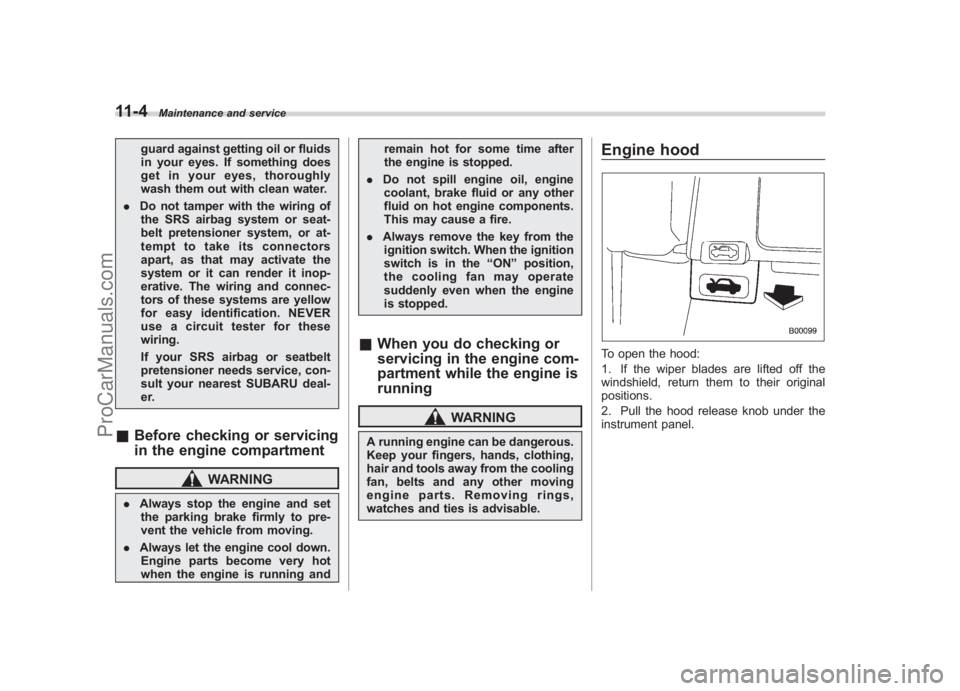
Engine hoodTo open the hood:
1. If the wiper blades are lifted off the
windshield, return them to their original
positions.
2. Pull the hood release knob under the
instrument panel.
ProCarManuals.com
Page 348 of 442
Black plate (353,1)
北米Model "A2420BE-B" EDITED: 2006/ 7/ 26
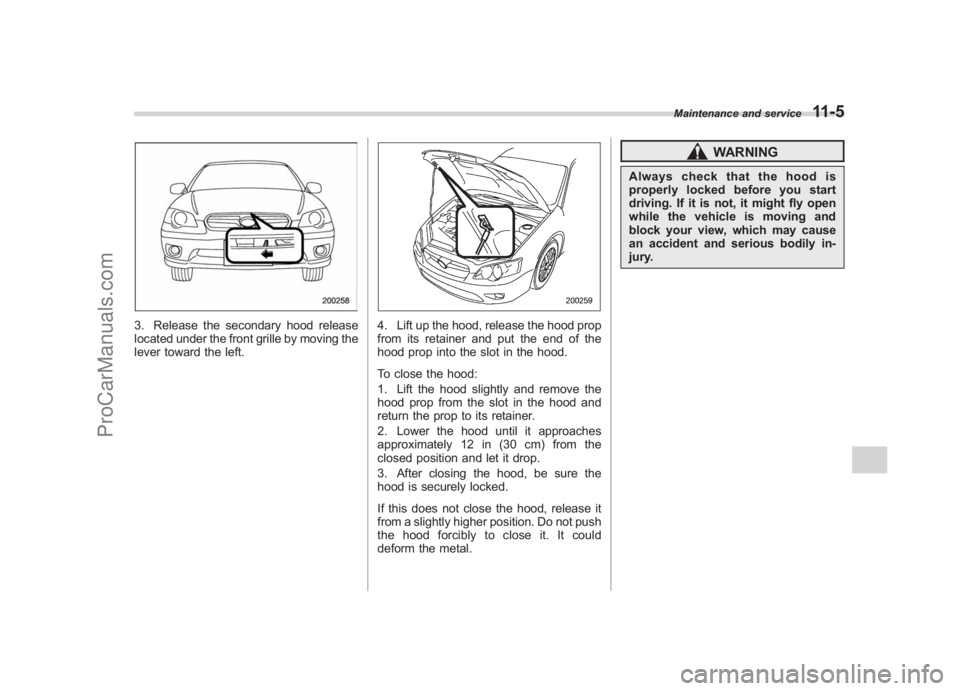
3. Release the secondary hood release
located under the front grille by moving the
lever toward the left.
4. Lift up the hood, release the hood prop
from its retainer and put the end of the
hood prop into the slot in the hood.
To close the hood:
1. Lift the hood slightly and remove the
hood prop from the slot in the hood and
return the prop to its retainer.
2. Lower the hood until it approaches
approximately 12 in (30 cm) from the
closed position and let it drop.
3. After closing the hood, be sure the
hood is securely locked.
If this does not close the hood, release it
from a slightly higher position. Do not push
the hood forcibly to close it. It could
deform the metal.
WARNING
Always check that the hood is
properly locked before you start
driving. If it is not, it might fly open
while the vehicle is moving and
block your view, which may cause
an accident and serious bodily in-
jury.
Maintenance and service
11-5
11
ProCarManuals.com
Page 352 of 442
Black plate (357,1)
北米Model "A2420BE-B" EDITED: 2006/ 7/ 26
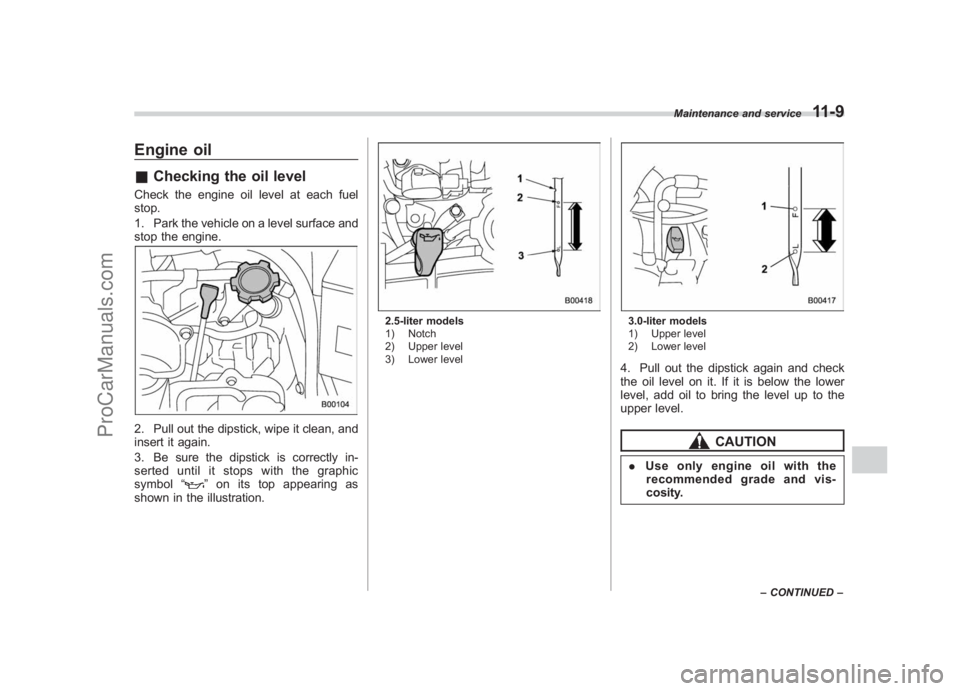
Engine oil& Checking the oil levelCheck the engine oil level at each fuel
stop.
1. Park the vehicle on a level surface and
stop the engine.2. Pull out the dipstick, wipe it clean, and
insert it again.
3. Be sure the dipstick is correctly in-
serted until it stops with the graphic
symbol “
”on its top appearing as
shown in the illustration.
2.5-liter models
1) Notch
2) Upper level
3) Lower level
3.0-liter models
1) Upper level
2) Lower level4. Pull out the dipstick again and check
the oil level on it. If it is below the lower
level, add oil to bring the level up to the
upper level.
CAUTION
. Use only engine oil with the
recommended grade and vis-
cosity.
Maintenance and service
11-9
– CONTINUED –
11
ProCarManuals.com
Page 355 of 442
Black plate (360,1)
北米Model "A2420BE-B" EDITED: 2006/ 7/ 26
11-12
Maintenance and service
Oil capacity (Guideline):
2.5-liter models: 4.2 US qt (4.0 liters, 3.5
Imp qt)
3.0-liter models: 5.8 US qt (5.5 liters, 4.8
Imp qt)The oil quantity indicated above is only a
guideline. The necessary quantity of oil
depends on the quantity of oil that has
been drained. The quantity of drained oil
differs slightly depending on the tempera-
ture of the oil and the time the oil is left
flowing out. After refilling the engine with
oil, therefore, you must use the dipstick to
confirm that the level is correct.
13. Start the engine and make sure that no
oil leaks appear around the filter ’s rubber
seal and drain plug.
14. Run the engine until it reaches the
normal operating temperature. Then stop
the engine and wait a few minutes to allow
the oil drain back. Check the oil level
again and if necessary, add more engine
oil.
& Recommended grade and
viscosity
CAUTION
Use only engine oil with the recom-
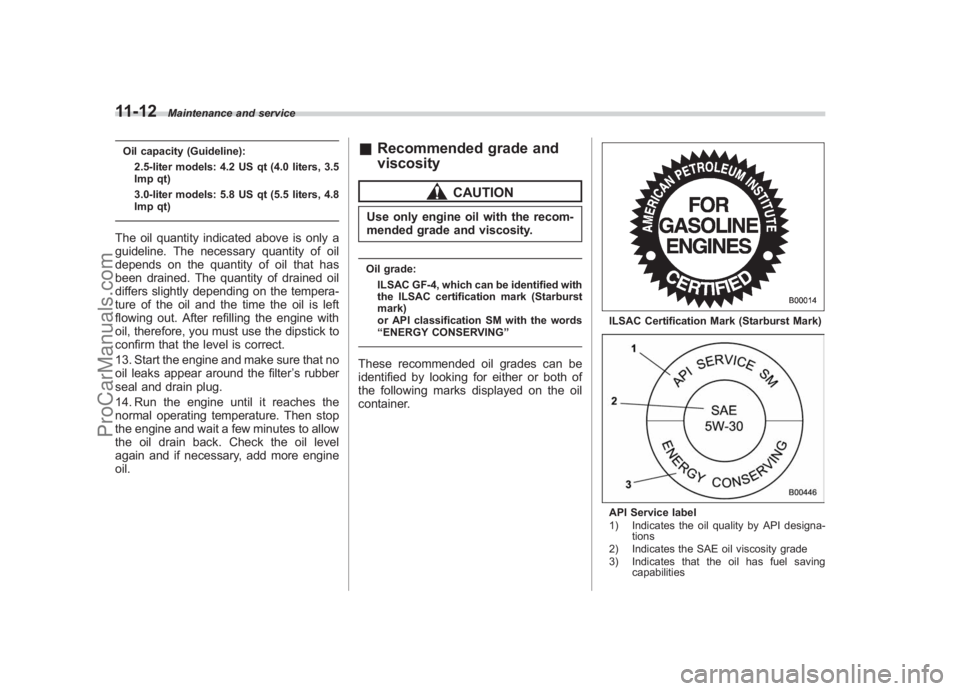
mended grade and viscosity.Oil grade:
ILSAC GF-4, which can be identified with
the ILSAC certification mark (Starburst
mark)
or API classification SM with the words
“ENERGY CONSERVING ”These recommended oil grades can be
identified by looking for either or both of
the following marks displayed on the oil
container.
ILSAC Certification Mark (Starburst Mark)API Service label
1) Indicates the oil quality by API designa-
tions
2) Indicates the SAE oil viscosity grade
3) Indicates that the oil has fuel saving capabilities
ProCarManuals.com