climate control SUBARU LEGACY 2010 5.G Owner's Manual
[x] Cancel search | Manufacturer: SUBARU, Model Year: 2010, Model line: LEGACY, Model: SUBARU LEGACY 2010 5.GPages: 448, PDF Size: 7.36 MB
Page 174 of 448
4-16Climate control
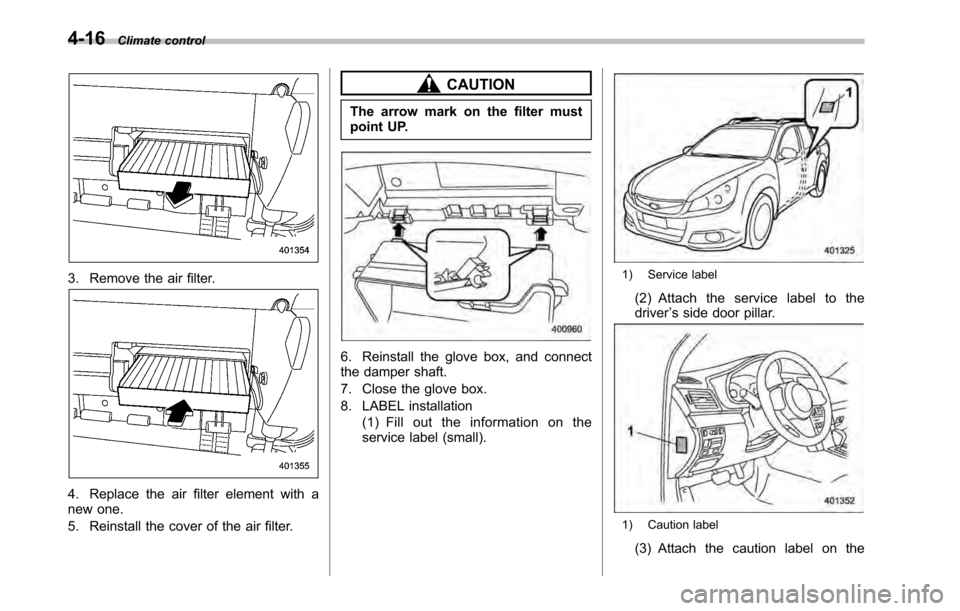
3. Remove the air filter.
4. Replace the air filter element with a
new one.
5. Reinstall the cover of the air filter.
CAUTION
The arrow mark on the filter must
point UP.
6. Reinstall the glove box, and connect
the damper shaft.
7. Close the glove box.
8. LABEL installation (1) Fill out the information on the
service label (small).
1) Service label
(2) Attach the service label to the driver ’s side door pillar.
1) Caution label
(3) Attach the caution label on the
Page 175 of 448

driver’s side of the instrument panel as
shown in the illustration. Climate control
4-17
Page 228 of 448
6-10Interior equipment
trim can be used to hold beverage bottles
and other items. Accessory power outlets
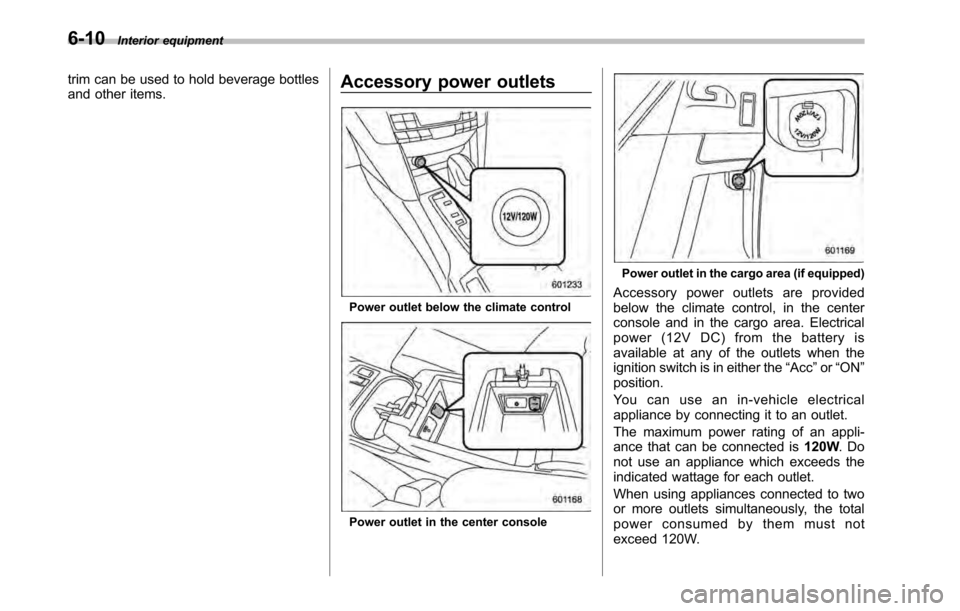
Power outlet below the climate control
Power outlet in the center console
Power outlet in the cargo area (if equipped)
Accessory power outlets are provided
below the climate control, in the center
console and in the cargo area. Electrical
power (12V DC) from the battery is
available at any of the outlets when the
ignition switch is in either the “Acc ”or “ON ”
position.
You can use an in-vehicle electrical
appliance by connecting it to an outlet.
The maximum power rating of an appli-
ance that can be connected is 120W.Do
not use an appliance which exceeds the
indicated wattage for each outlet.
When using appliances connected to two
or more outlets simultaneously, the total
power consumed by them must not
exceed 120W.
Page 255 of 448

Transmitter flash sequence Feature description
Flashes when button is pressed Indicates that the system is transmitting an RF signal.
Two long flashes following re-
mote start activation (transmit-
ter button is pressed two times
within 3 seconds) Indicates that the transmitter did not receive the remote start
activation confirmation from the vehicle system. The transmitter
will automatically send one additional remote start activation
attempt. This usually occurs when the operational range is at its
limit or has been exceeded.
One flash following remote
start activation (transmitter
button is pressed two times
within 3 seconds) Indicates that the engine is running via remote start. If the
transmitter is moved outside of the operating range of the
system, this sequence will timeout after the normal 15-minute
vehicle run cycle.
2 flashes every 5 seconds Indicates that the engine is running via remote start. If the
transmitter is removed outside of the operating range of the
system, this sequence will timeout after the normal 15-minute
vehicle run cycle.
3 flashes Indicates that the engine has turned off due to a remote start
system 15-minute timeout, vehicle safety parameter or normal shutdown. &
Entering the vehicle follow-
ing remote engine start shut- down
An alarm trigger may occur if the vehicle is
opened by the remote keyless entry
transmitter within a few seconds immedi-
ately following remote engine start shut-down. & Pre-heating or pre-cooling
the interior of the vehicle
Models with automatic climate control system:
After the system starts the engine, the
automatic climate control system will
activate the “FULL AUTO ”mode and heat
or cool the interior to the predetermined
median (room) temperature. No pre-
setting of controls is necessary.
Models with manual climate control system:
Before exiting the vehicle, set the tem-
perature controls to the desired setting
and operation. After the system starts the
engine, the heater or air conditioning will
activate and heat or cool the interior to
your setting. Starting and operating
7-13
– CONTINUED –
Page 294 of 448

8-10Driving tips
leading to loss of vehicle control.
An anti-lock brake system (ABS) en-
hances your vehicle ’s braking perfor-
mance on snowy and icy roads. For
information about braking on slippery
surfaces, refer to “ABS (Anti-lock Brake
System) ”F 7-25 and “Vehicle Dynamics
Control system ”F 7-28.
! Wiper operation when snowing
Before driving in cold weather, make sure
the wiper blades are not frozen to the
windshield or rear window.
If the wiper blades are frozen to the
windshield or rear window, perform the
following procedure. . To thaw the windshield wiper blades,
use the defroster with the airflow selection in “
”and the temperature set for
maximum warmth until the wiper blades
are completely thawed. Refer to “Climate
control ”F 4-1.
. If your vehicle is equipped with a wiper
deicer, use it. It is helpful to thaw the
windshield wiper blades. Refer to “Defog-
ger and deicer ”F 3-34.
. To thaw the rear wiper blade, use the
rear window defogger. Refer to “Defogger
and deicer ”F 3-34.
When driving in snow, if frozen snow starts
to stick on the surface of the windshield despite wiper operation, use the defroster
with the airflow selection in
“
”and the
temperature set for maximum warmth.
After the windshield gets warmed enough
to melt the frozen snow on it, wash it away
using the windshield washer. Refer to“ Windshield washer ”F 3-33
Snow stuck on the wiper arm prevents the
wiper from working effectively. If snow is
stuck on the wiper arm, pull off the road to
a safe place, then remove it. If you stop
the vehicle at road side, use the hazard
warning flasher to alert other drivers.
Refer to “Hazard warning flasher ”F 3-5.
We recommend use of non-freezing type
wiper blades (winter blades) during the
seasons you could have snow and freez-
ing temperatures. Blades of this type give
superior wiping performance in snowy
conditions. Be sure to use blades that
are suitable for your vehicle.
CAUTION
During high-speed driving, non-
freezing type wiper blades may not
perform as well as standard wiper
blades. If this happens, reduce the
vehicle speed. NOTE
When the season requiring non-freez-
ing type wiper blades is over, replace
them with standard wiper blades. &
Corrosion protection
Refer to “Corrosion protection ”F 10-4.
& Snow tires
WARNING
. When replacing original tires with
winter (snow) tires, make sure
you use only the same size,
construction and load range as
the original tires listed on the tire
placard. Using other sizes and
construction may affect speed-
ometer/odometer calibration and
clearance between the body and
tires. It also may be dangerous
and lead to loss of vehicle con-trol.
. You must install four winter tires
that are of the same size, circum-
ferences, construction, brand,
andloadrange.Mixingother
sizes, circumferences or con-
structions may result in severe
mechanical damage to the drive
Page 331 of 448

Exterior care....................................................... 10-2
Washing ............................................................. 10-2
Waxing and polishing ......................................... 10-3
Cleaning aluminum wheels ................................. 10-3
Corrosion protection .......................................... 10-4
Most common causes of corrosion ..................... 10-4
To help prevent corrosion ................................... 10-4 Cleaning the interior
.......................................... 10-5
Seat fabric ......................................................... 10-5
Leather seat materials ........................................ 10-5
Synthetic leather upholstery ............................... 10-5
Climate control panel, audio panel, instrument panel, console panel, switches, combination
meter, and other plastic surface ....................... 10-5
Navigation monitor (if equipped) ........................ 10-6
Appearance care
10
Page 335 of 448

Cleaning the interior
Use a soft, damp cloth to clean the climate
control panel, audio equipment, instru-
ment panel, center console, combination
meter panel, and switches. (Do not use
organic solvents.) &Seat fabric
Remove loose dirt, dust or debris with a
vacuum cleaner. If the dirt is caked on the
fabric or hard to remove with a vacuum
cleaner, use a soft brush then vacuum it.
Wipe the fabric surface with a tightly
wrung cloth and dry the seat fabric
thoroughly. If the fabric is still dirty, wipe
using a solution of mild soap and luke-
warm water then dry thoroughly.
If the stain does not come out, try a
commercially-available fabric cleaner. Use
the cleaner on a hidden place and make
sure it does not affect the fabric adversely.
Use the cleaner according to its instruc-tions. NOTE
When cleaning the seat, do not use
benzine, paint thinner, or any similarmaterials. &
Leather seat materials
The leather used by SUBARU is a high
quality natural product which will retain its
distinctive appearance and feel for many
years with proper care.
Allowing dust or road dirt to build up on the
surface can cause the material to become
brittle and to wear prematurely. Regular
cleaning with a soft, moist, natural fiber
cloth should be performed monthly, taking
care not to soak the leather or allow water
to penetrate the stitched seams.
A mild detergent suitable for cleaning
woolen fabrics may be used to remove
difficult dirt spots, rubbing with a soft, dry
cloth afterwards to restore the luster. If
your SUBARU is to be parked for a long
time in bright sunlight, it is recommended
that the seats and headrests be covered,
or the windows shaded, to prevent fading
or shrinkage.
Minor surface blemishes or bald patches
may be treated with a commercial leather
spray lacquer. You will discover that each
leather seat section will develop soft folds
or wrinkles, which is characteristic of
genuine leather. & Synthetic leather upholstery
The synthetic leather material used on the
SUBARU may be cleaned using mild soap or detergent and water, after first vacuum-
ing or brushing away loose dirt. Allow the
soap to soak in for a few minutes and wipe
off with a clean, damp cloth. Commercial
foam-type cleaners suitable for synthetic
leather materials may be used when
necessary.
NOTE
Strong cleaning agents such as sol-
vents, paint thinners, window cleaner
or gasoline must never be used on
leather or synthetic interior materials. & Climate control panel, audio
panel, instrument panel,
console panel, switches,
combination meter, and other
plastic surface
Use a soft, damp cloth to clean the climate
control panel, audio equipment, instru-
ment panel, center console, combination
meter panel, and switches. NOTE
Do not use organic solvents such as
paint thinners or gasoline, or strong
cleaning agents that contain thosesolvents. Appearance care
10-5
– CONTINUED –
Page 426 of 448
13-16Consumer information and Reporting safety defects
form to Federal Safety Require-
ments in addition to these grades. &Treadwear
The treadwear grade is a compara-
tive rating based on the wear rate of
the tire when tested under con-
trolled conditions on a specified
government test course.
For example, a tire graded 150
would wear one and one-half (1-
1/2) times as well on the govern-
ment course as a tire graded 100.
The relative performance of tires
depends upon the actual conditions
of their use, however, and may
depart significantly from the norm
due to variations in driving habits,
service practices and differences in
road characteristics and climate. & Traction AA, A, B, C
The traction grades, from highest to
lowest, are AA, A, B and C. Those
grades represent the tire ’s ability to
stop on wet pavement as measured
under controlled conditions on spe- cified government test surfaces of
asphalt and concrete. A tire marked
C may have poor traction perfor- mance.
WARNING
The traction grade assigned to
this tire is based on straight-
ahead braking traction tests,
and does not include accel-
eration, cornering, hydroplan-
ing, or peak traction charac-teristics.
& Temperature A, B, C
The temperature grades are A (the
highest), B, and C, representing thetire ’s resistance to the generation of
heat and its ability to dissipate heat
when tested under controlled con-
ditions on a specified indoor labora-
tory test wheel. Sustained high
temperature can cause the material
of the tire to degenerate and reduce
tire life, and excessive temperature
can lead to sudden tire failure. The grade C corresponds to a level of
performance which all passenger
car tires must meet under the
Federal Motor Vehicle Safety Stan-
dards No. 109. Grades B and A
represent higher levels of perfor-
mance on the laboratory test wheel
than the minimum required by law.
WARNING
The temperature grade for this
tire is established for a tire
that is properly inflated and
not overloaded. Excessive
speed, underinflation, or ex-
cessive loading, either sepa-
rately or in combination, can
cause heat buildup and possi-
ble tire failure.
Page 430 of 448

14-2Index
A
ABS (Anti-lock Brake System) ..................................... 7-25
Warning light ................................................. 3-16, 7-25
Accessories ....................................................... 5-4, 11-50
Accessory power outlet ............................................... 6-10
Air cleaner element ................................................... 11-20
Air conditioner Automatic climate control system ............................. 4-12
Manual climate control system ................................... 4-7
Air filtration system ..................................................... 4-15
Air flow selection .......................................................... 4-2
Automatic climate control system ............................. 4-12
Manual climate control system ................................... 4-5
Alarm system ............................................................ 2-16
All-Wheel Drive warning light ....................................... 3-20
Aluminum wheel ....................................................... 11-42
Cleaning ............................................................... 10-3
Antenna system ........................................................... 5-2
Anti-lock Brake System (ABS) ..................................... 7-25
Arming the system ..................................................... 2-17
Armrest ..................................................................... 1-12
Ashtray ..................................................................... 6-12
AT OIL TEMP warning light ......................................... 3-15
Audio Antenna system ....................................................... 5-2
AUX unit operation ................................................. 5-28
CD player operation ............................................... 5-18
Control button ........................................................ 5-30
FM/AM radio operation ........................................... 5-10
Power and sound controls ......................................... 5-7
Satellite radio operations ......................................... 5-14 Set ........................................................................ 5-4XM
TMsatellite radio reception
................................... 5-2
Auto on/off headlights ................................................. 3-27
Sensor .................................................................. 3-28
Auto-dimming mirror/compass ...................................... 3-36
Automatic climate control system ................................... 4-8
Automatic transmission ............................................... 7-18
Capacities ............................................................. 12-4
Fluid ................................................................... 11-24
Manual mode ......................................................... 7-21
Oil temperature warning light (AT OIL TEMP) ............. 3-15
Select lever ........................................................... 7-19
Shift lock function ................................................... 7-20
Automatic/Emergency Locking Retractor (A/ELR) ........... 1-13
AUX unit operation ..................................................... 5-28
B Battery .................................................................... 11-47
Drainage prevention function ..................................... 2-6
Jump starting ......................................................... 9-10
Replacement (remote engine start transmitter) ........... 7-14
Replacement (remote keyless entry system) .............. 2-11
Booster seat .............................................................. 1-31
Bottle holder ............................................................... 6-9
Brake Assist .................................................................... 7-24
Booster ....................................................... 7-24, 11-32
Fluid ................................................................... 11-30
Pad and lining ...................................................... 11-34
Parking ................................................................. 7-34
Pedal .................................................................. 11-33
Page 432 of 448

14-4Index
Climate control system Automatic ................................................................ 4-8
Manual ................................................................... 4-4
Clock ........................................................................ 3-24
Clutch Fluid .................................................................... 11-31
Pedal .................................................................. 11-33
Coat hook ................................................................. 6-13
Continuously variable transmission ............................... 7-18
Capacities ............................................................. 12-4
Fluid .................................................................... 11-26
Manual mode ........................................................ 7-21
Oil temperature warning light (AT OIL TEMP) ............ 3-15
Select lever ........................................................... 7-19
Shift lock function ................................................... 7-20
Coolant .................................................................... 11-18
Temperature high warning light ................................ 3-13
Temperature low indicator light. ................................ 3-13
Cooling system ......................................................... 11-17
Corrosion protection ................................................... 10-4
Crossbars ................................................................. 8-14
Cruise control ............................................................ 7-38
Indicator light ................................................. 3-23, 7-41
Set indicator light ........................................... 3-23, 7-41
Cup holder .................................................................. 6-8
Front passenger ’s .................................................... 6-9
Rear passenger ’s..................................................... 6-9
D
Daytime running light system ....................................... 3-29
Defogger ................................................................... 3-34 Deicer
....................................................................... 3-34
Differential gear oil
Front ................................................................... 11-26
Rear ................................................................... 11-27
Dimensions ................................................................ 12-2
Disarming the alarm system ......................................... 2-18
Disc brake pad wear warning indicators ........................ 7-24
Dome light ......................................................... 6-2, 11-58
Door
Locks ..................................................................... 2-5
Open indicator light ................................................. 3-20
Open warning light. ................................................. 3-20
Step light ............................................................. 11-60
Double trip meter ......................................................... 3-6
Drive belts ............................................................... 11-23
Driving
All-Wheel Drive warning light ................................... 3-20
AWD vehicles ......................................................... 8-5
Car phone/cell phone .................................................. 7
Drinking. .................................................................... 6
Drugs ........................................................................ 7
Foreign countries ..................................................... 8-4
Off road .................................................................. 8-6
Pets .......................................................................... 8
Snowy and icy roads ............................................... 8-9
Tips ................................................. 7-17, 7-23, 8-2, 8-5
Tired or sleepy ........................................................... 7
Winter .................................................................... 8-8
E
ECO gauge ................................................................ 3-8