belt SUBARU LEGACY 2016 6.G Owners Manual
[x] Cancel search | Manufacturer: SUBARU, Model Year: 2016, Model line: LEGACY, Model: SUBARU LEGACY 2016 6.GPages: 572
Page 449 of 572
Jump starting
WARNING
.Battery fluid is SULFURIC ACID.
Do not let it come in contact with
the eyes, skin, clothing or the
vehicle.
If battery fluid gets on you,
thoroughly flush the exposed
area with water immediately. Get
medical help if the fluid has
entered your eyes.
If battery fluid is accidentally
swallowed, immediately drink a
large amount of milk or water,
and obtain immediate medical
help.
Keep everyone including chil-
dren away from the battery.
.The gas generated by a battery
explodes if a flame or spark is
brought near it. Do not smoke or
light a match while jump starting.
.Never attempt jump starting if the
discharged battery is frozen. It
could cause the battery to burst
or explode.
.Whenever working on or around
a battery, always wear suitableeye protectors, and remove metal
objects such as rings, bands or
other metal jewelry.
.Be sure the jumper cables and
clamps on them do not have
loose or missing insulation.
.Do not jump start unless cables
in suitable condition are avail-
able.
.A running engine can be danger-
ous. Keep your fingers, hands,
clothing, hair and tools away
from the cooling fan, belts and
any other moving engine parts.
Removing rings, watches and
ties is advisable.
.Jump starting is dangerous if it is
done incorrectly. If you are un-
sure about the proper procedure
for jump starting, consult a com-
petent mechanic.
When your vehicle does not start due to a
run down (discharged) battery, the vehicle
may be jump started by connecting your
battery to another battery (called the
booster battery) with jumper cables.
&How to jump start
1. Make sure the booster battery is 12
volts and the negative terminal is
grounded.
2. If the booster battery is in another
vehicle, do not let the two vehicles touch.
3. Turn off all unnecessary lights and
accessories.
4. Connect the jumper cables exactly in
the sequence illustrated.
In case of emergency/Jump starting
–CONTINUED–9-11
Page 469 of 572

Maintenance schedule....................................... 11-3
Maintenance precautions................................... 11-3
Before checking or servicing in the engine
compartment.................................................... 11-4
When checking or servicing in the engine
compartment (2.5 L models)............................. 11-5
When checking or servicing in the engine
compartment while the engine is running.......... 11-5
Maintenance tips................................................ 11-5Removing and reinstalling clips.......................... 11-5
Engine hood....................................................... 11-7
Engine compartment overview.......................... 11-9
2.5 L models...................................................... 11-9
3.6 L models.................................................... 11-10
Engine oil.......................................................... 11-11Engine oil consumption.................................... 11-11
Checking the oil level....................................... 11-11
Changing the oil and oil filter............................ 11-13
Recommended grade and viscosity.................. 11-13
Synthetic oil..................................................... 11-13
Cooling system................................................ 11-14
Cooling fan, hose and connections................... 11-14
Engine coolant................................................. 11-14
Air cleaner element.......................................... 11-15Replacing the air cleaner element..................... 11-15
Spark plugs...................................................... 11-18Recommended spark plugs.............................. 11-18
Drive belts........................................................ 11-18
Manual transmission oil.................................. 11-18
Recommended grade and viscosity.................. 11-18
Continuously variable transmission fluid...... 11-19
Front differential gear oil (CVT models) and
rear differential gear oil................................ 11-19
Recommended grade and viscosity.................. 11-19
Brake fluid........................................................ 11-19Checking the fluid level.................................... 11-19
Recommended brake fluid............................... 11-21
Clutch fluid (MT models)................................. 11-21Checking the fluid level.................................... 11-21
Recommended clutch fluid............................... 11-22
Brake booster.................................................. 11-22
Brake pedal...................................................... 11-22
Checking the brake pedal free play.................. 11-22
Checking the brake pedal reserve distance....... 11-23
Clutch pedal (MT models)............................... 11-23Checking the clutch function............................ 11-23
Checking the clutch pedal free play.................. 11-23
Replacement of brake pad.............................. 11-24Breaking-in of new brake pads ......................... 11-24
Tires and wheels.............................................. 11-24Types of tires................................................... 11-24
Tire pressure monitoring system (TPMS) (if
equipped)...................................................... 11-25
Tire inspection................................................. 11-26
Tire pressures and wear.................................. 11-27
Wheel balance................................................. 11-28
Wear indicators............................................... 11-29
Tire rotation direction mark.............................. 11-29
Tire rotation..................................................... 11-29
Tire replacement.............................................. 11-30
Maintenance and service
11
Page 472 of 572
Maintenance and service/Maintenance precautions
guard against getting oil or fluids
in your eyes. If something does
get in your eyes, thoroughly
wash them out with clean water.
.Do not tamper with the wiring of
the SRS airbag system or seat-
belt pretensioner system, or at-
tempt to take its connectors
apart, as that may activate the
system or it can render it inop-
erative. NEVER use a circuit
tester for these wiring. If your
SRS airbag or seatbelt preten-
sioner needs service, consult
your nearest SUBARU dealer.
NOTE
SUBARU does not endorse the use of
non-SUBARU approved flushing sys-
tems and strongly advises against
performing these services on a
SUBARU vehicle. Non-SUBARU ap-
proved flushing systems use chemi-
cals and/or solvents which have not
been tested or approved by SUBARU.
SUBARU warranties do not cover any
part of the vehicle which is damaged by
adding or applying chemicals and/or
solvents other than those approved or
recommended by SUBARU.
&Before checking or servicing
in the engine compartment
WARNING
.Always stop the engine and apply
the parking brake to prevent the
vehicle from moving.
.Always let the engine cool down.
Engine parts become very hot
when the engine is running and
remain hot for some time after
the engine is stopped.
.Do not spill engine oil, engine
coolant, brake fluid or any other
fluid on hot engine components.
This may cause a fire.
.When the ignition switch is in the
“ON”position, the cooling fan
may operate suddenly even
when the engine is stopped. If
your body or clothes come into
contact with a rotating fan, that
could result in serious injury. To
avoid risk of injury, perform the
following precautions.
–Models with push-button start
system:
Always turn the push-button
ignition switch to the“OFF”
position and confirm that theoperation indicator on the
switch is turned off. Then take
the access key out from the
vehicle.
–Models without push-button
start system:
Always remove the key from
the ignition switch.
.Before performing any servicing
on a vehicle equipped with a
remote engine start system tem-
porarily place that system in the
service mode to prevent it from
unexpectedly starting the engine.
11-4
Page 473 of 572
&When checking or servicing
in the engine compartment
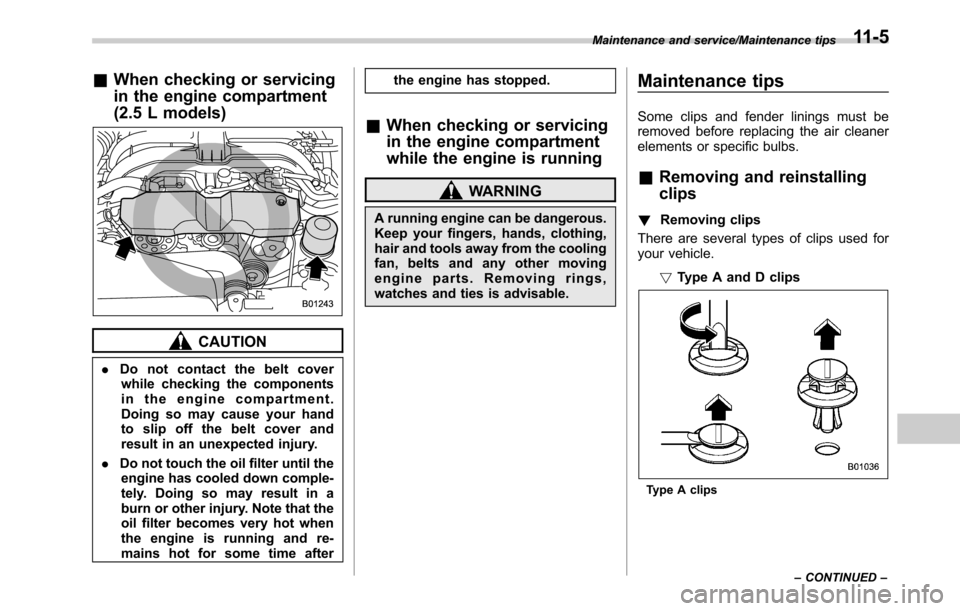
(2.5 L models)
CAUTION
.Do not contact the belt cover
while checking the components
in the engine compartment.
Doing so may cause your hand
to slip off the belt cover and
result in an unexpected injury.
.Do not touch the oil filter until the
engine has cooled down comple-
tely. Doing so may result in a
burn or other injury. Note that the
oil filter becomes very hot when
the engine is running and re-
mains hot for some time afterthe engine has stopped.
&When checking or servicing
in the engine compartment
while the engine is running
WARNING
A running engine can be dangerous.
Keep your fingers, hands, clothing,
hair and tools away from the cooling
fan, belts and any other moving
engine parts. Removing rings,
watches and ties is advisable.
Maintenance tips
Some clips and fender linings must be
removed before replacing the air cleaner
elements or specific bulbs.
&Removing and reinstalling
clips
!Removing clips
There are several types of clips used for
your vehicle.
!Type A and D clips
Type A clips Maintenance and service/Maintenance tips
–CONTINUED–
11-5
Page 486 of 572

Maintenance and service/Spark plugs
Spark plugs
It may be difficult to replace the spark
plugs. It is recommended that you have
the spark plugs replaced by your
SUBARU dealer.
The spark plugs should be replaced
according to the maintenance schedule
in the“Warranty and Maintenance Book-
let”.
&Recommended spark plugs
Refer to“Electrical system”F12-9.
Drive belts
It is unnecessary to check the deflection of
the drive belt periodically because your
engine is equipped with an automatic belt
tension adjuster. However, replacement of
the belt should be done according to the
maintenance schedule in the“Warranty
and Maintenance Booklet”. Consult your
SUBARU dealer for replacement.
If the belt is loose, cracked or worn,
contact your SUBARU dealer.
Manual transmission oil
It is unnecessary to check the manual
transmission oil level. However, if neces-
sary, consult your SUBARU dealer for
inspection.
&Recommended grade and
viscosity
Each oil manufacturer has its own base
oils and additives. Never use different
brands together. For details, refer to
“Manual transmission, front differential
and rear differential gear oil”F12-7.
11-18
Page 499 of 572
calibration
—Clearance between the body
and tires
It also may be dangerous and
lead to loss of vehicle control,
and it can lead to an accident.
.Use only radial tires. Do not use
radial tires together with belted
bias tires and/or bias-ply tires.
Doing so can dangerously re-
duce controllability, resulting in
an accident.
&Wheel replacement
When replacing wheels due, for example,
to damage, make sure the replacement
wheels match the specifications of the
wheels that are fitted as standard equip-
ment. Replacement wheels are available
from SUBARU dealers.
WARNING
Use only those wheels that are
specified for your vehicle. Wheels
not meeting specifications could
interfere with brake caliper opera-
tion and may cause the tires to rub
against the wheel well housing dur-
ing turns. The resulting loss ofvehicle control could lead to an
accident.
Aluminum wheels
Aluminum wheels can be scratched and
damaged easily. Handle them carefully to
maintain their appearance, performance,
and safety.
.When any of the wheels is removed
and replaced for tire rotation or to change
a flat, always check the tightness of the
wheel nuts after driving approximately 600
miles (1,000 km). If any nut is loose,
tighten it to the specified torque.
.Never apply oil to the threaded parts,
wheel nuts, or tapered surface of the
wheel.
.Never let the wheel rub against sharp
protrusions or curbs.
.When wheel nuts, balance weights, or
the center cap is replaced, be sure to
replace them with genuine SUBARU parts
designed for aluminum wheels.
Maintenance and service/Aluminum wheels11-31
Page 542 of 572
Consumer information and Reporting safety defects/Tire information
!Maximum load rating
The load rating at the maximum
permissible weight load for this tire.
For example,“MAX. LOAD 615 kg
(1,356 LBS) @ 350 kPa (51 PSI)
MAX. PRESS.”
WARNING
Maximum load rating applies
only to the tire, not to the
vehicle. Putting a load rated
tire on any vehicle does not
mean the vehicle can be
loaded up to the tire’s rated
load.
!Construction type
Applicable construction of this tire.
For example,“TUBELESS STEEL
BELTED RADIAL”
!Construction
The generic name of each cord
material used in the plies (both
sidewall and tread area) of this tire.
For example,“PLIES: TREAD 2STEEL + 2 POLYESTER + 1
NYLON SIDEWALL 2 POLYE-
STER”
!Uniform Tire Quality Grading
(UTQG)
For details, refer to“Uniform tire
quality grading standards”F13-14
.
&Recommended tire inflation
pressure
!Recommended cold tire infla-
tion pressure
For the recommended cold tire
inflation pressure for your vehicle’s
tires, refer to“Tires”F12-9
.
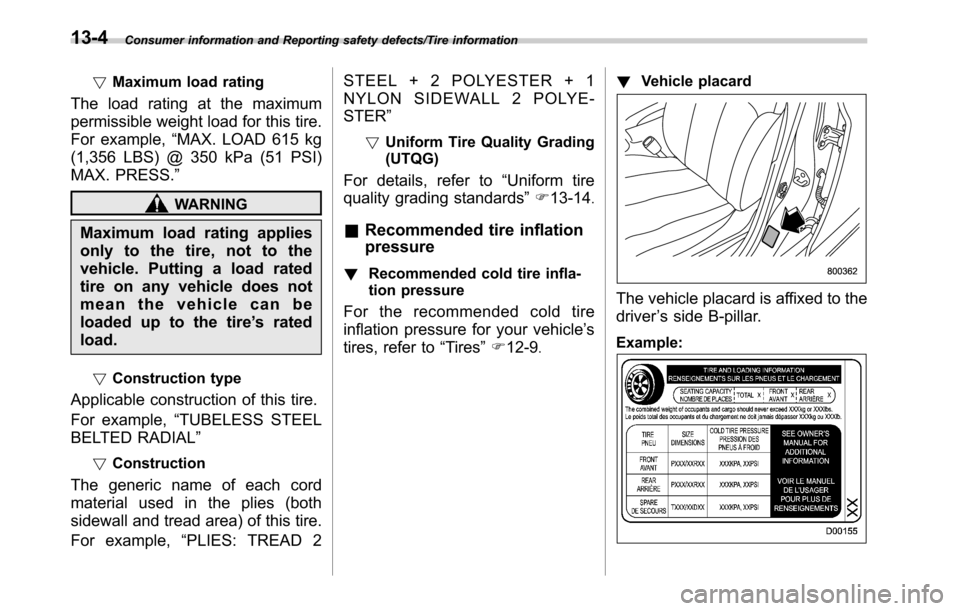
!Vehicle placard
The vehicle placard is affixed to the
driver’s side B-pillar.
Example:
13-4
Page 557 of 572

Booster seat.............................................................. 1-34
Bottle holder................................................................ 6-9
Brake
Assist................................................................... 7-32
Booster........................................................ 7-32, 11-22
Disc..................................................................... 12-9
Fluid............................................................ 11-19, 12-8
Pad ..................................................................... 11-24
Parking................................................................. 7-42
Pedal.................................................................. 11-22
System................................................................. 7-32
Brake pedal
Free play............................................................. 11-22
Reserve distance.................................................. 11-23
Brake system............................................................ 7-32
Warning light......................................................... 3-18
Braking..................................................................... 7-32
Tips...................................................................... 7-32
Breaking-in of new brake pads................................... 11-24
BSD/RCTA................................................................ 7-53
Approach indicator light/warning buzzer.................... 7-56
OFF indicator........................................ 3-31, 3-38, 7-56
OFF switch........................................................... 7-59
Warning indicator................................... 3-31, 3-38, 7-58
Warning volume..................................................... 3-42
Bulb
Chart.................................................................. 12-14
Replacing............................................................. 11-40C
Cargo area
Cover.................................................................... 6-16
Light............................................................. 6-3, 11-49
Tie-down hooks...................................................... 6-19
Catalytic converter....................................................... 8-3
Center
Console................................................................. 6-6
Changing
Coolant............................................................... 11-15
Flat tire.................................................................. 9-5
Oil and oil filter..................................................... 11-13
Charge warning light................................................... 3-15
CHECK ENGINE warning light/Malfunction indicator
light....................................................................... 3-15
Checking
Brake pedal free play............................................ 11-22
Brake pedal reserve distance................................. 11-23
Clutch function..................................................... 11-23
Clutch pedal free play........................................... 11-23
Coolant level........................................................ 11-14
Fluid level (brake fluid).......................................... 11-19
Fluid level (clutch fluid).......................................... 11-21
Fluid level (washer fluid)........................................ 11-32
Oil level (engine oil).............................................. 11-11
Child restraint systems................................................ 1-27
Installation of a booster seat.................................... 1-34
Installation with A/ELR seatbelt................................ 1-30
Lower and tether anchorages
................................... 1-35
Top tether anchorages............................................ 1-38
Child safety................................................................... 4
Index14-3
Page 558 of 572

14-4Index
Locks................................................................... 2-33
Chime
Key ........................................................................ 3-4
Light..................................................................... 3-43
Seatbelt................................................................ 3-12
Cleaning
Aluminum wheels................................................... 10-3
Interior.................................................................. 10-5
Ventilation grille....................................................... 4-9
Climate control system................................................. 4-3
Automatic................................................................ 4-5
Manual................................................................... 4-6
Clock........................................................................ 3-32
Clutch
Fluid............................................................ 11-21, 12-8
Pedal.................................................................. 11-23
Coat hook................................................................. 6-13
Console...................................................................... 6-6
Continuously variable transmission (CVT)..................... 7-25
Fluid............................................................ 11-19, 12-8
Oil temperature warning light (AT OIL TEMP)............ 3-16
Coolant............................................................ 11-14, 12-8
Cooling system......................................................... 11-14
Corrosion protection................................................... 10-4
Crossbars................................................................. 8-14
Cruise control............................................................ 7-49
Indicator................................................................ 3-30
Set indicator.......................................................... 3-30
Cup holder.................................................................. 6-8
Front passenger’s .................................................... 6-8
Rear passenger’s..................................................... 6-9D
Daytime running light system....................................... 3-46
Defogger................................................................... 3-54
Defrosting................................................................... 4-9
Deicer....................................................................... 3-54
Differential gear oil
Front........................................................... 11-19, 12-7
Rear........................................................... 11-19, 12-7
Dimensions................................................................ 12-2
Disarming the alarm system......................................... 2-32
Disc brake pad wear warning indicators........................ 7-33
Dome light......................................................... 6-2, 11-48
Door
Locks..................................................................... 2-6
Open indicator light................................................. 3-22
Step light............................................................. 11-48
Unlock selection function................................. 2-17, 3-42
Double trip meter......................................................... 3-9
Drive belts............................................................... 11-18
Driving
All-Wheel Drive warning light................................... 3-22
AWD vehicles......................................................... 8-5
Car phone/cell phone
.................................................. 7
Drinking..................................................................... 6
Drugs........................................................................ 6
Foreign countries..................................................... 8-4
Off road.................................................................. 8-6
Pets.......................................................................... 7
Snowy and icy roads.............................................. 8-10
Tips ................................................. 7-24, 7-30, 8-2, 8-5
Tired or sleepy........................................................... 6
Page 559 of 572

Winter.................................................................... 8-8
E
ECO gauge............................................................... 3-11
Electrical system........................................................ 12-9
Electronic Brake Force Distribution (EBD) system.......... 7-34
Warning................................................................ 3-19
Electronic parking brake.............................................. 7-42
Automatic release function by accelerator pedal......... 7-44
Hill Holder............................................................. 7-45
Indicator light......................................................... 3-20
Warning........................................................ 3-20, 7-47
Emergency Locking Retractor (ELR)............................. 1-17
Engine
Compartment overview........................................... 11-9
Coolant........................................................ 11-14, 12-8
Exhaust gas (carbon monoxide)............................. 5, 8-2
Hood.................................................................... 11-7
Low oil level warning indicator................................. 3-16
Oil............................................................... 11-11, 12-4
Overheating.......................................................... 9-13
Starting & stopping........................................... 7-9, 7-12
Event data recorder......................................................... 8
Exterior care.............................................................. 10-2
F
Flat tires..................................................................... 9-5
Floor mat.................................................................. 6-15
Fluid level
Brake.................................................................. 11-19
Clutch.................................................................. 11-21Continuously variable transmission......................... 11-19
Fog light
Bulb.......................................................... 11-42, 12-14
Indicator light......................................................... 3-31
Steering responsive fog lights system....................... 3-49
Switch................................................................... 3-49
Front
Differential gear oil........................................ 11-19, 12-7
Seatbelt pretensioners............................................ 1-24
Side marker light.................................................. 11-42
Turn signal light.................................................... 11-42
Front seats................................................................. 1-2
Forward and backward adjustment............................ 1-4
Head restraint adjustment......................................... 1-8
Memory function...................................................... 1-6
Power seat............................................................. 1-5
Reclining................................................................ 1-4
Seat height adjustment (driver’s seat)........................ 1-4
Fuel........................................................................... 7-3
Consumption indicator............................................. 3-36
Economy hints........................................................ 8-2
Filler lid and cap...................................................... 7-4
Gauge................................................................... 3-10
Requirements................................................. 7-3, 12-3
Fuses
..................................................................... 11-38
Fuses and circuits.................................................... 12-10
G
GAWR (Gross Axle Weight Rating) ............................... 8-14
Glove box................................................................... 6-6
GVWR (Gross Vehicle Weight Rating)........................... 8-14
Index14-5