ABS SUBARU LEGACY 2016 6.G User Guide
[x] Cancel search | Manufacturer: SUBARU, Model Year: 2016, Model line: LEGACY, Model: SUBARU LEGACY 2016 6.GPages: 572
Page 385 of 572
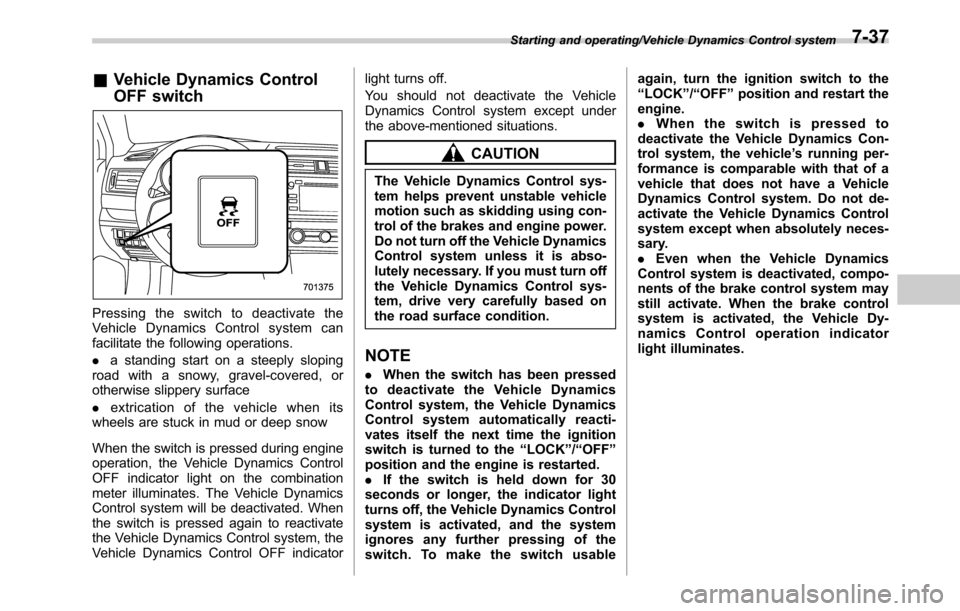
&Vehicle Dynamics Control
OFF switch
Pressingtheswitchtodeactivatethe
Vehicle Dynamics Control system can
facilitate the following operations.
.a standing start on a steeply sloping
road with a snowy, gravel-covered, or
otherwise slippery surface
.extrication of the vehicle when its
wheels are stuck in mud or deep snow
When the switch is pressed during engine
operation, the Vehicle Dynamics Control
OFF indicator light on the combination
meter illuminates. The Vehicle Dynamics
Control system will be deactivated. When
the switch is pressed again to reactivate
the Vehicle Dynamics Control system, the
Vehicle Dynamics Control OFF indicatorlight turns off.
You should not deactivate the Vehicle
Dynamics Control system except under
the above-mentioned situations.
CAUTION
The Vehicle Dynamics Control sys-
tem helps prevent unstable vehicle
motion such as skidding using con-
trol of the brakes and engine power.
Do not turn off the Vehicle Dynamics
Control system unless it is abso-
lutely necessary. If you must turn off
the Vehicle Dynamics Control sys-
tem, drive very carefully based on
the road surface condition.
NOTE
.When the switch has been pressed
to deactivate the Vehicle Dynamics
Control system, the Vehicle Dynamics
Control system automatically reacti-
vates itself the next time the ignition
switch is turned to the“LOCK”/“OFF”
position and the engine is restarted.
.If the switch is held down for 30
seconds or longer, the indicator light
turns off, the Vehicle Dynamics Control
system is activated, and the system
ignores any further pressing of the
switch. To make the switch usableagain, turn the ignition switch to the
“LOCK”/“OFF”position and restart the
engine.
.Whentheswitchispressedto
deactivate the Vehicle Dynamics Con-
trol system, the vehicle’s running per-
formance is comparable with that of a
vehicle that does not have a Vehicle
Dynamics Control system. Do not de-
activate the Vehicle Dynamics Control
system except when absolutely neces-
sary.
.Even when the Vehicle Dynamics
Control system is deactivated, compo-
nents of the brake control system may
still activate. When the brake control
system is activated, the Vehicle Dy-
namics Control operation indicator
light illuminates.
Starting and operating/Vehicle Dynamics Control system7-37
Page 387 of 572
.Hill descent control function:
Using the hill descent control function, you
can keep the vehicle at a consistent speed
driving downhill. If the vehicle speed is
likely to increase, the brake control system
will be activated to adjust the vehicle
speed.
.Driving ability control:
This mode increases the hill-climbing
ability and driving ability as well as
enabling smooth application of torque for
easier control of the steering wheel.
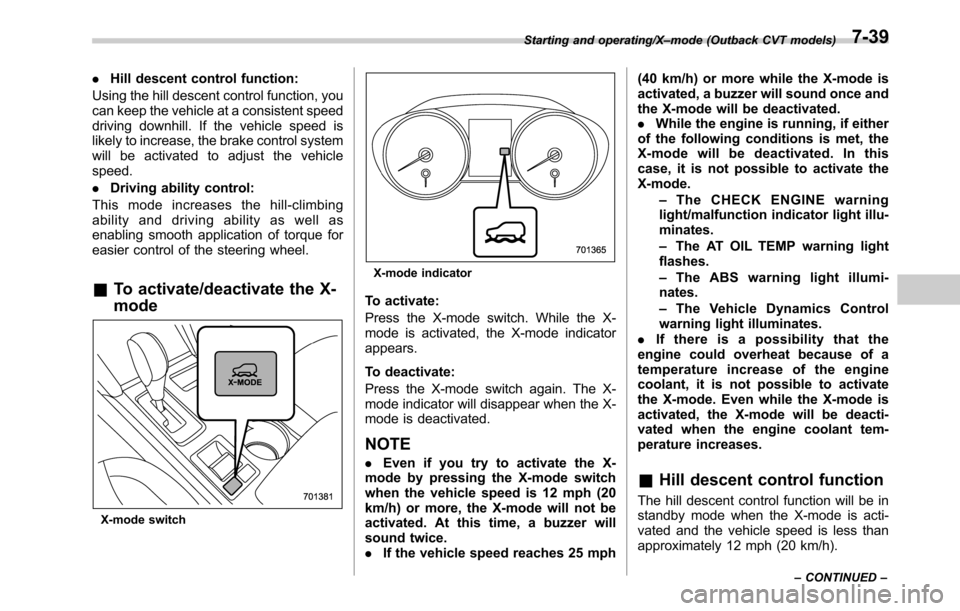
&To activate/deactivate the X-
mode
X-mode switch
X-mode indicator
To activate:
Press the X-mode switch. While the X-
mode is activated, the X-mode indicator
appears.
To deactivate:
Press the X-mode switch again. The X-
mode indicator will disappear when the X-
mode is deactivated.
NOTE
.Even if you try to activate the X-
mode by pressing the X-mode switch
when the vehicle speed is 12 mph (20
km/h) or more, the X-mode will not be
activated. At this time, a buzzer will
sound twice.
.If the vehicle speed reaches 25 mph(40 km/h) or more while the X-mode is
activated, a buzzer will sound once and
the X-mode will be deactivated.
.While the engine is running, if either
of the following conditions is met, the
X-mode will be deactivated. In this
case, it is not possible to activate the
X-mode.
–The CHECK ENGINE warning
light/malfunction indicator light illu-
minates.
–The AT OIL TEMP warning light
flashes.
–The ABS warning light illumi-
nates.
–The Vehicle Dynamics Control
warning light illuminates.
.If there is a possibility that the
engine could overheat because of a
temperature increase of the engine
coolant, it is not possible to activate
the X-mode. Even while the X-mode is
activated, the X-mode will be deacti-
vated when the engine coolant tem-
perature increases.
&Hill descent control function
The hill descent control function will be in
standby mode when the X-mode is acti-
vated and the vehicle speed is less than
approximately 12 mph (20 km/h).
Starting and operating/X–mode (Outback CVT models)
–CONTINUED–7-39
Page 419 of 572
side temperature. If the concen-
tration is inappropriate, sprayed
washer fluid may freeze on the
windshield and obstruct your
view, and the fluid may freeze in
the reservoir tank.
.State or local regulations on
volatile organic compounds may
restrict the use of methanol, a
common windshield washer anti-
freeze additive. Washer fluids
containing non-methanol anti-
freeze agents should be used
only if they provide cold weather
protection without damaging
your vehicle’s paint, wiper blades
or washer system.
!Before driving your vehicle
Before entering the vehicle, remove any
snow or ice from your shoes because that
could make the pedals slippery and
driving dangerous.
While warming up the vehicle before
driving, check that the accelerator pedal,
brake pedal, and all other controls operate
smoothly.
Clear away ice and snow that has
accumulated under the fenders to avoid
making steering difficult. During severewinter driving, stop when and where it is
safe to do so and check under the fenders
periodically.
!Parking in cold weather
WARNING
Snow can trap dangerous exhaust
gases under your vehicle. Keep
snow clear of the exhaust pipe and
from around your vehicle if you park
the vehicle in snow with the engine
running.
CAUTION
.Do not use the parking brake
when parking for long periods in
cold weather since it could freeze
in that position.
.When the vehicle is parked in
snow or when it snows, raise the
wiper blades off the glass to
prevent damage to them.
.When the vehicle has been left
parked after use on roads heavily
covered with snow, or has been
left parked during a snowstorm,
icing may develop on the brake
system, which could cause poor
braking action. Check for snowor ice buildup on the suspension,
disc brakes and brake hoses
underneath the vehicle. If there
is caked snow or ice, remove it,
being careful not to damage the
disc brakes and brake hoses and
ABS harness.
When parking for long periods in cold
weather, you should observe the following
tips.
1. For MT models, place the shift lever in
the“1”or“R”position. For CVT models,
place the select lever in the“P”position.
2. Use tire stops under the tires to
prevent the vehicle from moving.
!Refueling in cold weather
To help prevent moisture from forming in
the fuel system and the risk of its freezing,
use of an antifreeze additive in the fuel
tank is recommended during cold weather.
Use only additives that are specifically
designed for this purpose. When an
antifreeze additive is used, its effect lasts
longer if the tank is refilled whenever the
fuel level reaches half empty.
If your SUBARU is not going to be used
for an extended period, it is best to have
the fuel tank filled to capacity.
Driving tips/Winter driving
–CONTINUED–8-9
Page 420 of 572
Driving tips/Winter driving
&Driving on snowy and icy
roads
WARNING
Do not use the cruise control on
slippery roads such as snowy or icy
roads. This may cause loss of
vehicle control.
CAUTION
Avoid prolonged continuous driving
in snowstorms. Snow will enter the
engine’s intake system and may
hinder the airflow, which could re-
sult in engine shutdown or even
breakdown.
To prevent skidding and slipping, avoid
sudden braking, abrupt acceleration, high-
speed driving, and sharp turning when
driving on snowy or icy roads.
Always maintain ample distance between
your vehicle and the vehicle ahead of you
to avoid the need for sudden braking.
To supplement the foot brake, use the
engine brake effectively to control the
vehicle speed. (Shift into a lower gear
when necessary.)
Avoid shifting down abruptly. Such beha-vior can cause the wheels to lock, possibly
leading to loss of vehicle control.
An anti-lock brake system (ABS) en-
hances your vehicle’s braking perfor-
mance on snowy and icy roads. For
information about braking on slippery
surfaces, refer to“ABS (Anti-lock Brake
System)”F7-33 and“Vehicle Dynamics
Control system”F7-35.
!Wiper operation when snowing
Before driving in cold weather, make sure
the wiper blades are not frozen to the
windshield or rear window.
If the wiper blades are frozen to the
windshield or rear window, perform the
following procedure.
.To thaw the windshield wiper blades,
use the defroster with the airflow selection
in“
”and the temperature set for
maximum warmth until the wiper blades
are completely thawed. Refer to“Climate
control”F4-1.
.If your vehicle is equipped with a wiper
deicer, use it. It is helpful to thaw the
windshield wiper blades. Refer to“Defog-
ger and deicer”F3-54.
.To thaw the rear wiper blade, use the
rear window defogger. Refer to“Defogger
and deicer”F3-54.When driving in snow, if frozen snow starts
to stick on the surface of the windshield
despite wiper operation, use the defroster
with the airflow selection in“
”and the
temperature set for maximum warmth.
After the windshield gets warmed enough
to melt the frozen snow on it, wash it away
using the windshield washer. Refer to
“Windshield washer”F3-52.
Snow stuck on the wiper arm prevents the
wiper from working effectively. If snow is
stuck on the wiper arm, pull off the road to
a safe place, then remove it. If you stop
the vehicle at road side, use the hazard
warning flasher to alert other drivers.
Refer to“Hazard warning flasher”F3-7.
We recommend use of non-freezing type
wiper blades (winter blades) during the
seasons you could have snow and freez-
ing temperatures. Blades of this type give
superior wiping performance in snowy
conditions. Be sure to use blades that
are suitable for your vehicle.
8-10
Page 438 of 572

Driving tips/Trailer towing (Outback)
1) Left turn
2) Right turn
.Backing up with a trailer is difficult and
takes practice. When backing up with a
trailer, never accelerate or steer rapidly.
When turning back, grip the bottom of the
steering wheel with one hand and turn it to
the left for a left turn, and turn it to the right
for a right turn.
.If the ABS warning light illuminates
while the vehicle is in motion, stop towing
the trailer and have repairs performed
immediately by your nearest SUBARU
dealer.
!Driving on grades
.Before going down a steep hill, slow
down and shift into lower gear (if neces-
sary, use 1st gear) in order to utilize theengine braking effect and prevent over-
heating of your vehicle’s brakes. Do not
make sudden downshifts.
.When driving uphill in hot weather, the
air conditioner may turn off automatically
to protect the engine from overheating.
.When driving uphill in hot weather,
because the engine and transmission are
relatively prone to overheating, pay atten-
tion to the following items.
–Temperature gauge
–AT OIL TEMP warning light (CVT
models)
.If any of the following conditions occur,
immediately turn off the air conditioner and
stop the vehicle in the nearest safe
location. Refer to“If you park your vehicle
in an emergency”F9-2 and“Engine
overheating”F9-13.
–Temperature gauge needle ap-
proaches the OVERHEAT zone. Refer
to“Temperature gauge”F3-11.
–AT OIL TEMP warning light illumi-
nates (CVT models). Refer to“AT OIL
TEMP warning light (CVT models)”
F3-16.
.For CVT models, do not use the
accelerator pedal to stay stationary on
an uphill slope instead of using the
parking brake or foot brake. That may
cause the transmission fluid to overheat.!Parking on a grade
Always block the wheels under both
vehicle and trailer when parking. Apply
the parking brake. You should not park on
a hill or slope. If parking on a hill or slope
cannot be avoided, you should take the
following steps:
1. Apply the brakes and hold the pedal
down.
2. Have someone place wheel blocks
under both the vehicle and trailer wheels.
3. When the wheel blocks are in place,
release the regular brakes slowly until the
blocks absorb the load.
4. Apply the regular brakes and then
apply the parking brake; slowly release
the regular brakes.
5. Shift into 1st or reverse gear (MT
models) or“P”(CVT models) and shut
off the engine.
8-28
Page 459 of 572
using a flat-head screwdriver or a similar
tool. Then the rear gate will open.Power rear gate - if power
rear gate does not operate
properly
&When the power rear gate is
deactivated
CAUTION
When operating the power rear gate
manually, do not use excessive
force. Doing so may cause a mal-
function.
NOTE
While the power rear gate is tempora-
rily deactivated, if it is struck by body
parts or objects and sustains a strong
impact, the temporary deactivation
may be canceled. The purpose of this
is to absorb the impact of the collision
and it is not a malfunction. In this case,
the rear gate will not open or close
automatically.
If the power rear gate senses a malfunc-
tion, an electronic chirp will sound and the
rear gate will stop opening or closing.
In order for the rear gate to open and close
automatically, carry out the following
operation. If the rear gate does not openand close automatically after carrying out
this operation, we recommend that you
have the vehicle checked at a SUBARU
dealer.
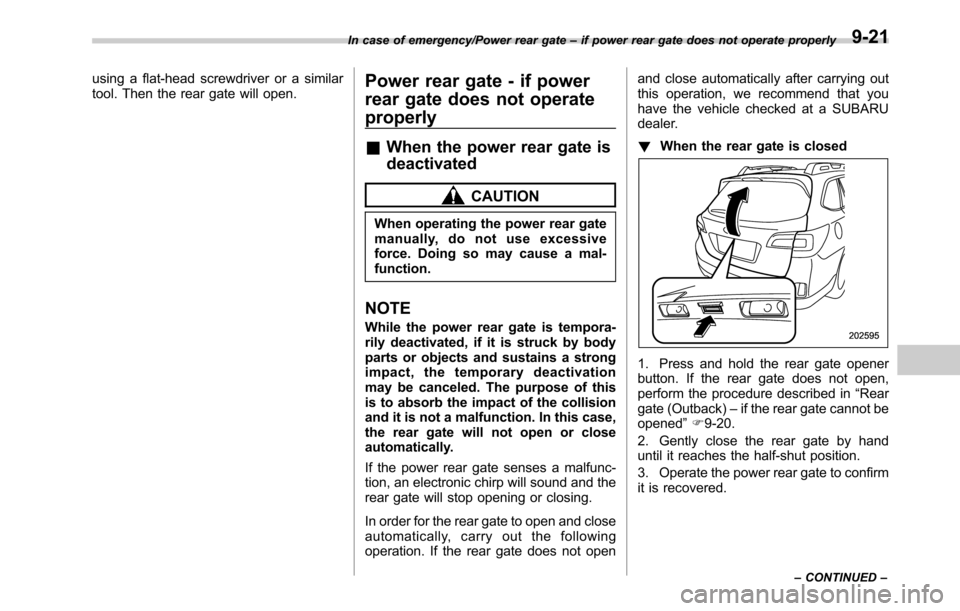
!When the rear gate is closed
1. Press and hold the rear gate opener
button. If the rear gate does not open,
perform the procedure described in“Rear
gate (Outback)–if the rear gate cannot be
opened”F9-20.
2. Gently close the rear gate by hand
until it reaches the half-shut position.
3. Operate the power rear gate to confirm
it is recovered.
In case of emergency/Power rear gate–if power rear gate does not operate properly
–CONTINUED–9-21
Page 487 of 572
Continuously variable trans-
mission fluid
There is no fluid level gauge. It is
unnecessary to check the continuously
variable transmission fluid level. However,
if necessary, consult your SUBARU dealer
for inspection.
Front differential gear oil
(CVT models) and rear differ-
ential gear oil
It is not necessary to check the gear oil
level. Check that there are no cracks,
damage or leakage. However, the oil
inspection should be performed according
to the maintenance schedule in the
“Warranty and Maintenance Booklet”.
Consult your SUBARU dealer for details.
&Recommended grade and
viscosity
Each oil manufacturer has its own base
oils and additives. Never use different
brands together. For details, refer to
“Manual transmission, front differential
and rear differential gear oil”F12-7.
CAUTION
Using a differential gear oil other
than the specified oil may cause a
decline in vehicle performance.
Brake fluid
&Checking the fluid level
WARNING
.Never let brake fluid contact your
eyes because brake fluid can be
harmful to your eyes. If brake
fluid gets in your eyes, immedi-
ately flush them thoroughly with
clean water. For safety, when
performing this work, wearing
eye protection is advisable.
.Brake fluid absorbs moisture
from the air. Any absorbed moist-
ure can cause a dangerous loss
of braking performance.
.If the vehicle requires frequent
refilling, there may be a leak. If
you suspect a problem, have the
vehicle checked at your SUBARU
dealer.
CAUTION
.When adding brake fluid, be care-
ful not to allow any dirt into the
reservoir.
.Never splash the brake fluid over
painted surfaces or rubber parts.
Maintenance and service/Continuously variable transmission fluid
–CONTINUED–11-19
Page 489 of 572
&Recommended brake fluid
Refer to“Fluids”F12-8.
CAUTION
Never use different brands of brake
fluid together. Also, avoid mixing
DOT 3 and DOT 4 brake fluids even if
they are the same brand.
Clutch fluid (MT models)
&Checking the fluid level
WARNING
Never let clutch fluid contact your
eyes because clutch fluid can be
harmful to your eyes. If clutch fluid
gets in your eyes, immediately flush
them thoroughly with clean water.
For safety, when performing this
work, wearing eye protection is
advisable.
CAUTION
.Clutch fluid absorbs moisture
from the air. Any absorbed moist-
ure can cause improper clutch
operation.
.If the vehicle requires frequent
refilling, there may be a leak. If
you suspect a problem, have the
vehicle checked at your SUBARU
dealer.
.When clutch fluid is added, be
careful not to allow any dirt into
the tank.
.Never splash the clutch fluid over
painted surfaces or rubber parts.Alcohol contained in the clutch
fluid may damage them.
.Be careful not to spill clutch fluid
when adding it. If clutch fluid
touches the exhaust pipe, it may
cause a bad smell, smoke, and/or
a fire. If clutch fluid gets on the
exhaust pipe, be sure to wipe it
off.
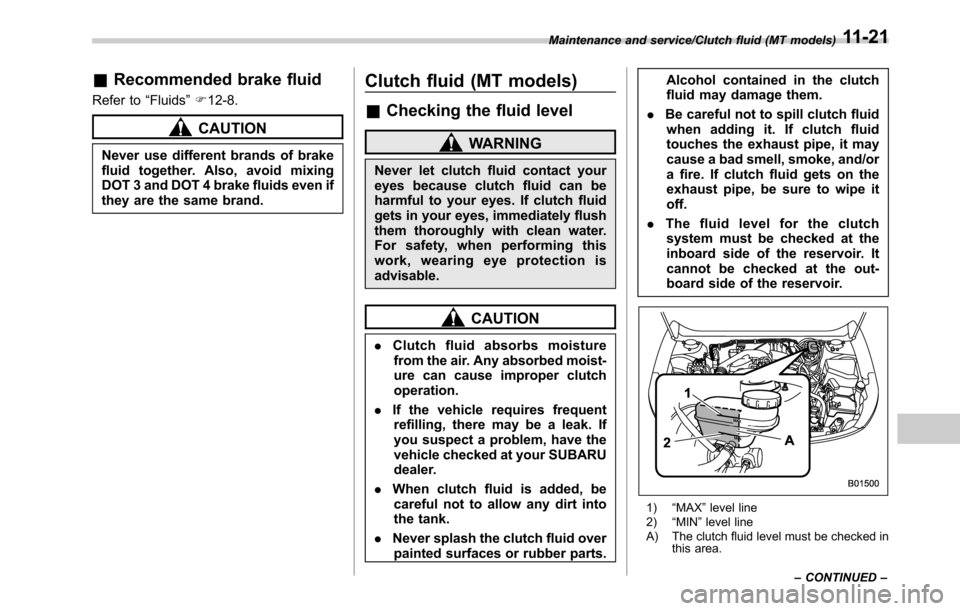
.The fluid level for the clutch
system must be checked at the
inboard side of the reservoir. It
cannot be checked at the out-
board side of the reservoir.
1)“MAX”level line
2)“MIN”level line
A) The clutch fluid level must be checked in
this area. Maintenance and service/Clutch fluid (MT models)
–CONTINUED–
11-21
Page 533 of 572

Fuse
panelFuse
ratingCircuit
20 15A E/G1
21 15A AVCS
22 15A INJ
23 7.5A CVT SSR
24 20A TCU
25 30A BACKUP
26 7.5A ACTGS
27 25A SUB FAN
28 25A MAIN FAN
29 30A ABS SOL
30 20A AUDIO
31 25A R.DEF
32 15A BLOWER
33 15A BLOWER
34 10A F.FOG RH
35 10A F.FOG LH
36 15A R.WIPER
37 15A F.WASH
38 30A F.WIPERSpecifications/Fuses and circuits
12-13
Page 556 of 572

14-2Index
A
Abbreviation................................................................... 3
ABS (Anti-lock Brake System)..................................... 7-33
Warning light......................................................... 3-18
Access key............................................................... 2-10
Warning indicator................................................... 3-24
Accessories.............................................................. 11-40
Accessory power outlet............................................... 6-10
Air cleaner element................................................... 11-15
Air conditioner
Automatic climate control system............................... 4-5
Manual climate control system................................... 4-6
Air filtration system..................................................... 4-10
Airflow selection........................................................... 4-6
Alarm system............................................................ 2-28
All-Wheel Drive warning light....................................... 3-22
Aluminum wheel....................................................... 11-31
Cleaning............................................................... 10-3
Antenna...................................................................... 5-2
Anti-lock Brake System (ABS)..................................... 7-33
Arming the system..................................................... 2-29
Armrest..................................................................... 1-15
Ashtray..................................................................... 6-12
AT OIL TEMP warning light......................................... 3-16
Audio
aha
TMby HARMAN................................................ 5-44
AM/FM radio......................................................... 5-28
AUX ..................................................................... 5-61
Base display audio set.............................................. 5-4
Basic operation...................................................... 5-18
Bluetooth audio...................................................... 5-58CD ....................................................................... 5-53
iPod...................................................................... 5-56
Pandora
®.............................................................. 5-50
SiriusXM Satellite Radio.......................................... 5-37
STARLINK............................................................. 5-26
Steering switches for audio...................................... 5-63
SUBARU STARLINK
TMMultimedia Plus audio set ....... 5-6
Unit setting............................................................ 5-19
USB memory......................................................... 5-55
Auto on/off headlights................................................. 3-44
Sensor.................................................................. 3-45
Vehicle setting........................................................ 3-42
Automatic climate control system................................... 4-5
Automatic headlight beam leveler
Warning light.......................................................... 3-30
Automatic/Emergency Locking Retractor (A/ELR)........... 1-17
B
Battery
Drainage prevention function..................................... 2-8
Jump starting......................................................... 9-11
Replacement (access key)..................................... 11-50
Replacement (remote engine start transmitter)........... 7-21
Replacement (transmitter)...................................... 11-51
Vehicle battery..................................................... 11-37
Bluetooth
®
Audio.................................................................... 5-58
Hands-free phone system........................................ 5-71
Settings................................................................. 5-66
Troubleshooting...................................................... 5-88
Bluetooth
®settings..................................................... 5-66