tires SUBARU OUTBACK 2001 3.G Owner's Guide
[x] Cancel search | Manufacturer: SUBARU, Model Year: 2001, Model line: OUTBACK, Model: SUBARU OUTBACK 2001 3.GPages: 453
Page 435 of 453

12
Specifications Specifications12-2
. . . . . . . . . . . . . . . . . . . . . . . . . . . . . . . . . . . . . . . . . . . . . . . . . . . . . . . . . . . . . .
Dimensions 12-2
. . . . . . . . . . . . . . . . . . . . . . . . . . . . . . . . . . . . . . . . . . . . . . . . . . . . . . . . . . . . . . .
Engine 12-3
. . . . . . . . . . . . . . . . . . . . . . . . . . . . . . . . . . . . . . . . . . . . . . . . . . . . . . . . . . . . . . . . . . . . .
Electrical system 12-3
. . . . . . . . . . . . . . . . . . . . . . . . . . . . . . . . . . . . . . . . . . . . . . . . . . . . . . . .
Capacities 12-4
. . . . . . . . . . . . . . . . . . . . . . . . . . . . . . . . . . . . . . . . . . . . . . . . . . . . . . . . . . . . . . . . .
Tires 12-4
. . . . . . . . . . . . . . . . . . . . . . . . . . . . . . . . . . . . . . . . . . . . . . . . . . . . . . . . . . . . . . . . . . . . . . . .
Wheel alignment 12-5
. . . . . . . . . . . . . . . . . . . . . . . . . . . . . . . . . . . . . . . . . . . . . . . . . . . . . . . . .
Fuses and circuits 12-6
. . . . . . . . . . . . . . . . . . . . . . . . . . . . . . . . . . . . . . . . . . . . . . . . . . . . . . . .
Fuse panel located behind the coin tray 12-6 . . . . . . . . . . . . . . . . . . . . . . . . . . . .
Fuse panel located in the engine compartment 12-10 . . . . . . . . . . . . . . . . . . .
Bulb chart 12-14
. . . . . . . . . . . . . . . . . . . . . . . . . . . . . . . . . . . . . . . . . . . . . . . . . . . . . . . . . . . . . . . . . . .
Vehicle identification 12-15
. . . . . . . . . . . . . . . . . . . . . . . . . . . . . . . . . . . . . . . . . . . . . . . . . . . .
Page 438 of 453

12-4Sp ark p lug s typ e RC10YC4 (Champion)
RC8YC4 (Champ ion)
BKR6E-11 (NGK)
K20PR-U11 (NIPPONDENSO)
3.0 liter
Battery typ e and c ap ac ity 75D23L
Alternator 12V-100A
Sp ark p lug s typ e PLFR6A-11 (NGK)
Capacities
Fuel tank 16.9 US g al (64 liters, 14.1 Imp g al)
Eng ine oil 2.5 liter 4.2 US q t (4.0 liters, 3.5 Imp q t)
3.0 liter 6.0 US q t (5.7 liters, 5.0 Imp q t)
Transmission oil (MT) 3.7 US q t (3.5 liters, 3.1 Imp q t)
Transmission fluid (AT) 9.8 US q t (9.3 liters, 8.2 I mp q t)
AT d ifferential g ear oil 1.3 US q t (1.2 liters, 1.1 Imp q t)
Rear d ifferential g ear oil 0.8 US q t (0.8 liter, 0.7 Imp q t)
Power steering g ear fluid 0.7 US q t (0.7 liter, 0.6 Imp q t)
Eng ine c oolant 2.5 liter MT 7.2 US q t (6.8 liters, 6.0 Imp q t)
AT 7.1 US q t (6.7 liters, 5.9 Imp q t)
3.0 liter 8.1 US q t (7.7 liters, 6.7 Imp q t)
Tires Legacy
Typ e Steel b elted rad ial, Tub eless
Size Brig hton P195/60R15 87H L P205/60R15 90H
GT P205/55R16 89H
Temp orary sp are T135/70D16
Pressure Front Brig hton 33 p si (230 kPa, 2.3 kg /c m 2
)
GT, L 32 p si (220 kPa, 2.2 kg /c m 2
)
Rear Brig hton 32 p si (220 kPa, 2.2 kg /c m 2
)
GT, L 30 p si (210 kPa, 2.1 kg /c m 2
)
Temp orary sp are 60 p si (420 kPa, 4.2 kg /c m 2
)
Page 451 of 453

13-2For U.S.A.
The following information has b een c omp iled ac c ord i
ng to Cod e of Fed -
eral Reg ulations “Title 49, Part 575 ”.
Uniform tire quality grading standards
This information ind ic ates the relative p erformanc e of p asseng er c ar tires
in the area of tread wear, trac tion, and temp erature resistanc e. This is to
aid the c onsumer in making an informed c hoic e in th e p urc hase of tires.
Quality g rad es c an b e found where ap p lic ab le on the tire sid ewall b e-
tween tread should er and maximum sec tion wid th. For examp le:
Treadwear 200 Traction AA Temperature A
The q uality g rad es ap p ly to new p neumatic tires for use on p asseng er
c ars. However, they d o not ap p ly to d eep tread , win ter typ e snow tires,
sp ac e-saver or temp orary use sp are tires, tires wit h nominal rim d iame-
ters of 12 inc hes or less, or to some limited p rod u c tion tires.
All p asseng er c ar tires must c onfirm to Fed eral Saf ety Req uirements in
ad d ition to these g rad es. Treadwear
The tread wear g rad e is a c omp arative rating b ased o n the wear rate of
the tire when tested und er c ontrolled c ond itions on a sp ec ified g overn-
ment test c ourse.
For examp le, a tire g rad ed 150 would wear one and o ne-half (1-1/2)
times as well on the g overnment c ourse as a tire g r ad ed 100. The rela-
tive p erformanc e of tires d ep end s up on the ac tual c ond itions of their
use, however, and may d ep art sig nific antly from the norm d ue to varia-
tions in d riving hab its, servic e p rac tic es and d iff erenc es in road c harac -
teristic s and c limate. Traction AA, A, B, C
The trac tion g rad es, from hig hest to lowest, are AA , A, B and C. Those
g rad es rep resent the tire ’s ab ility to stop on wet p avement as measured
und er c ontrolled c ond itions on sp ec ified g overnment test surfac es of as-
Page 452 of 453
Consumer information and Reporting safety defects13-3
–
CONTINUED –
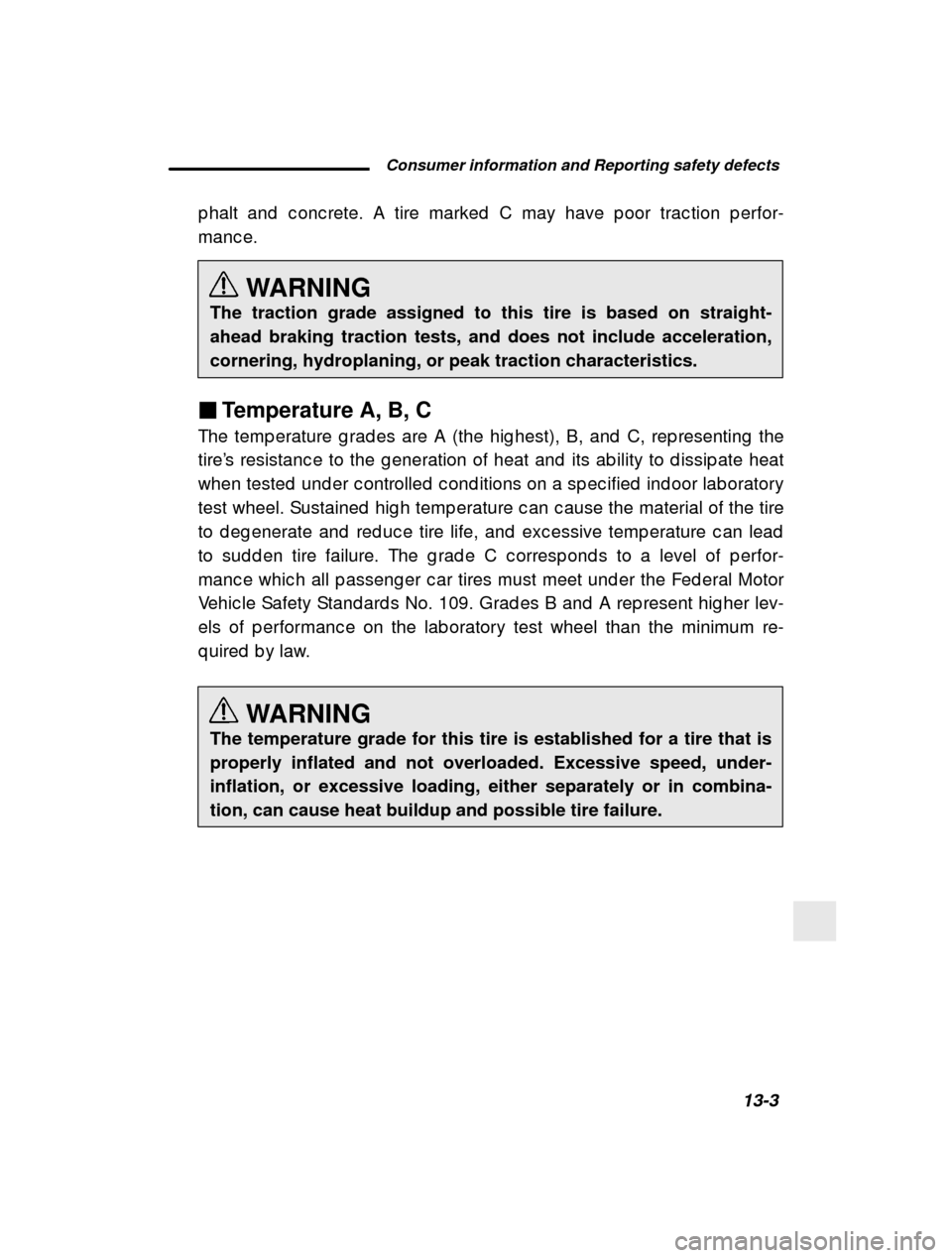
p halt and c onc rete. A tire marked C may have p oor t
rac tion p erfor-
manc e.
WARNING
The traction grade assigned to this tire is based on straight-
ahead braking traction tests, and does not include acceleration,cornering, hydroplaning, or peak traction characteristics.
Temperature A, B, C
The temp erature g rad es are A (the hig hest), B, and C, rep resenting the
tire ’s resistanc e to the g eneration of heat and its ab il ity to d issip ate heat
when tested und er c ontrolled c ond itions on a sp ec if ied ind oor lab oratory
test wheel. Sustained hig h temp erature c an c ause th e material of the tire
to d eg enerate and red uc e tire life, and exc essive t emp erature c an lead
to sud d en tire failure. The g rad e C c orresp ond s to a level of p erfor-
manc e whic h all p asseng er c ar tires must meet und er the Fed eral Motor
Vehic le Safety Stand ard s No. 109. Grad es B and A re p resent hig her lev-
els of p erformanc e on the lab oratory test wheel tha n the minimum re-
q uired b y law.
WARNING
The temperature grade for this tire is established for a tire that isproperly inflated and not overloaded. Excessive speed, under-inflation, or excessive loading, either separately or in combina-tion, can cause heat buildup and possible tire failure.