ABS SUBARU OUTBACK 2003 3.G User Guide
[x] Cancel search | Manufacturer: SUBARU, Model Year: 2003, Model line: OUTBACK, Model: SUBARU OUTBACK 2003 3.GPages: 472, PDF Size: 4.33 MB
Page 290 of 472

7-40The following situations could indicate a malfunction of the VDC sys-
tem; if any should occur, have an authorized SUBARU dealer carry
out an inspection of the system at the first available opportunity.
The VDC warning light does not turn on when the ignition key is
turned to the ON position. The VDC warning light does not turn off either when the engine is
started or when the vehicle reaches a speed of approximately 8 mph(12 km/h). The VDC warning light turns on while the vehicle is being driven.
When a malfunction has occurred in the VDC electrical system,
only the VDC warning light will turn on. In such an event, the ABS will
still be operating normally. The VDC warning light will also turn on when a problem occurs
with the ABS or VDC electronic control systems.
Because the VDC system controls each brake through the ABS,
whenever the ABS stops operating due to a malfunction in that electri-
cal system, the VDC will also become unable to control all four
brakes. Thus VDC system operation halts and the VDC warning light
turns on. Although both the VDC system and the ABS will be inoper-able in this situation, it will still be possible to stop the vehicle using
normal braking. The VDC system and the ABS do not adversely affect
operation of the vehicle in any way when they are inoperable; how-
ever should such a situation occur, drive with care and have an autho-
rized SUBARU dealer carry out an inspection of those systems at the
first available opportunity. NOTE
When the VDC warning light turns on and off in the following way,
it indicates that the VDC system is operating normally. Although turning on after the engine has been started, the
warning light quickly turns off and stays off. The warning light turns on after the engine is started and does
not turn off until the vehicle reaches a speed of 8 mph (12 km/h). The warning light turns on when the vehicle is being driven; it
then turns off and stays off.
Page 310 of 472
8-12When the vehicle has been left parked after use on roads heavily cov-
ered with snow, or has been left parked during a snowstorm, icingmay develop on the brake system, which could cause poor braking
action. Check for snow or ice buildup on the suspension, disc brakes
and brake hoses underneath the vehicle.
If there is caked snow or ice, remove it, being careful not to damage
the disc brakes and brake hoses and ABS harness. n
Refueling in cold weather
To help prevent moisture from forming in the fuel system and the risk
of its freezing, use of an antifreeze additive in the fuel tank is recom-
mended during cold weather.
Use only additives that are specifically designed for this purpose.
When an antifreeze additive is used, its effect lasts longer if the tank is
refilled whenever the fuel level reaches half empty. If your SUBARU is not going to be used for an extended period, it is
best to have the fuel tank filled to capacity. Driving on snowy and icy roads
WARNING
Do not use the cruise control on slippery roads such as snowy or icy roads. This may cause loss of vehicle control.
To prevent skidding and slipping, avoid sudden braking, abrupt ac-
celeration, high-speed driving, and sharp turning when driving on
snowy or icy roads.Always maintain ample distance between your vehicle and the vehicleahead of you to avoid the need for sudden braking.
To supplement the foot brake, use the engine brake effectively to con-
trol the vehicle speed. (Shift into a lower gear when necessary.)
Avoid shifting down abruptly. Such behavior can cause the wheels to
lock, possibly leading to loss of vehicle control.
An anti-lock brake system (ABS) enhances your vehicle ’s braking per-
formance on snowy and icy roads. Refer to the “ABS (Anti-Lock Brake
System)” and “VDC (Vehicle Dynamics Control) system ” section in
chapter 7 for information on braking on slippery surfaces.
Page 336 of 472

8-38n
Driving with a trailer
You should allow for considerably more stopping distance when
towing a trailer. Avoid sudden braking because it may result in skid-
ding or jackknifing and loss of control. Avoid abrupt starts and sudden accelerations. If your vehicle has a
manual transmission, always start out in first gear and release the
clutch at moderate engine revolution. Avoid uneven steering, sharp turns and rapid lane changes.
Slow down before turning. Make a longer than normal turning
radius because the trailer wheels will be closer than the vehicle
wheels to the inside of the turn. In a tight turn, the trailer could hit yourvehicle. Crosswinds will adversely affect the handling of your vehicle and
trailer, causing sway. Crosswinds can be due to weather conditions or
the passing of large trucks or buses. If swaying occurs, firmly grip the
steering wheel and slow down immediately but gradually. When passing other vehicles, considerable distance is required
because of the added weight and length caused by attaching the
trailer to your vehicle. Backing up with a trailer is difficult and takes practice. When back-
ing up with a trailer, never accelerate or steer rapidly. When turning
back, grip the bottom of the steering wheel with one hand and turn it
to the left for a left turn, and turn it to the right for a right turn.
Left turn Right turn
OM-H2791
If the ABS warning light illuminates while the vehicle is in motion,
stop towing the trailer and have repairs performed immediately by the
Page 337 of 472
8
Driving tips8-39
–
CONTINUED –
nearest SUBARU dealer. n
Driving on grades
Before going down a steep hill, slow down and shift into lower gear
(if necessary, use 1st gear) in order to utilize the engine braking effect
and prevent overheating of your vehicle ’s brakes. Do not make sud-
den downshifts. When driving uphill in hot weather, the air conditioner may turn off
automatically to protect the engine from overheating. When driving uphill in hot weather, pay attention to the water tem-
perature gauge pointer (for all vehicles) and AT OIL TEMP warning
light (for AT vehicles) since the engine and transmission are relatively
prone to overheating under these conditions. If the water temperature
gauge pointer approaches the OVERHEAT zone or the AT OIL TEMP
warning light illuminates, immediately switch off the air conditioner
and stop the vehicle at the nearest safe place. Refer to the “Engine
overheat” section in chapter 9, and “Warning and indicator lights ”
section in chapter 3. If your vehicle has an automatic transmission, avoid using the
accelerator pedal to stay stationary on an uphill slope instead of usingthe parking brake or foot brake. That may cause the transmission fluidto overheat. Also, if your vehicle is equipped with an automatic trans-mission, avoid driving with the gear selector lever in “D” when towing
a heavy trailer to prevent fluid overheating. A lower gear should beused. n Parking on a grade
Always block the wheels under both vehicle and trailer when parking.
Apply the parking brake firmly. You should not park on a hill or slope.But if parking on a hill or slope cannot be avoided, you should takethe following steps:
1. Apply the brakes and hold the pedal down.
2. Have someone place wheel blocks under both the vehicle and
trailer wheels.
3. When the wheel blocks are in place, release the regular brakes
slowly until the blocks absorb the load.
4. Apply the regular brakes and then apply the parking brake; slowly
Page 402 of 472
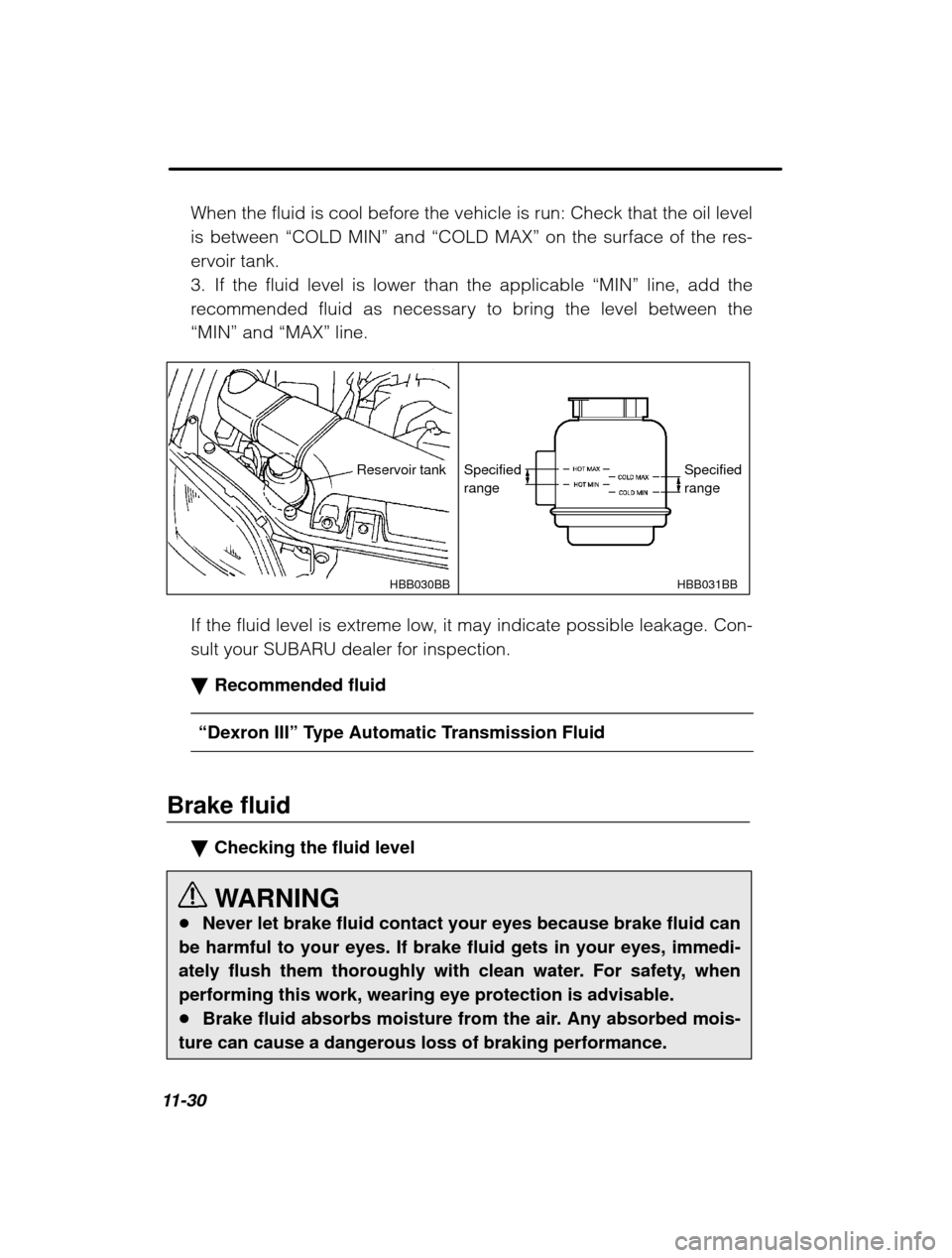
11-30When the fluid is cool before the vehicle is run: Check that the oil level is between
“COLD MIN ” and “COLD MAX ” on the surface of the res-
ervoir tank.
3. If the fluid level is lower than the applicable “MIN” line, add the
recommended fluid as necessary to bring the level between the
“MIN” and “MAX” line.
HBB031BB
HBB030BB
Specified range SpecifiedrangeReservoir tank
If the fluid level is extreme low, it may indicate possible leakage. Con- sult your SUBARU dealer for inspection. Recommended fluid
“ Dexron III ” Type Automatic Transmission Fluid
Brake fluid
Checking the fluid level
WARNING
Never let brake fluid contact your eyes because brake fluid can
be harmful to your eyes. If brake fluid gets in your eyes, immedi-
ately flush them thoroughly with clean water. For safety, whenperforming this work, wearing eye protection is advisable. Brake fluid absorbs moisture from the air. Any absorbed mois-
ture can cause a dangerous loss of braking performance.
Page 404 of 472
11-32Clutch fluid (MT vehicles)
Checking the fluid level
WARNING
Never let clutch fluid contact your eyes because clutch fluid can
be harmful to your eyes. If clutch fluid gets in your eyes, immedi-
ately flush them thoroughly with clean water. For safety, whenperforming this work, wearing eye protection is advisable.
CAUTION
Clutch fluid absorbs moisture from the air. Any absorbed
moisture can cause improper clutch operation. If the vehicle requires frequent refilling, there may be a leak. If
you suspect a problem, have the vehicle checked at your
SUBARU dealer. Never use different brands of clutch fluid together.
When clutch fluid is added, be careful not to allow any dirt into
the tank.
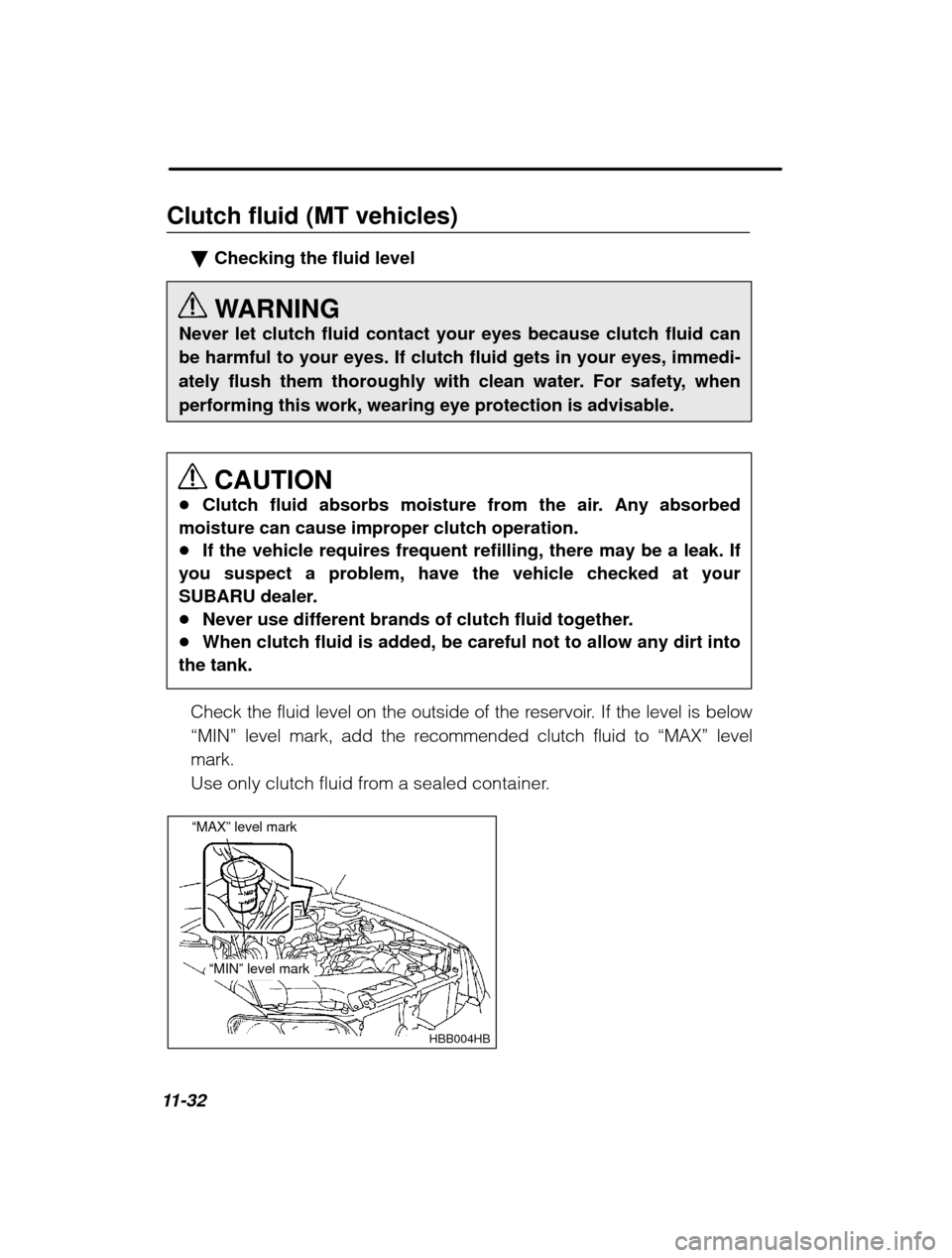
Check the fluid level on the outside of the reservoir. If the level is below “MIN ” level mark, add the recommended clutch fluid to “MAX ” level
mark.
Use only clutch fluid from a sealed container.
“ MIN ” level mark
“MAX ” level mark
HBB004HB
Page 447 of 472
12
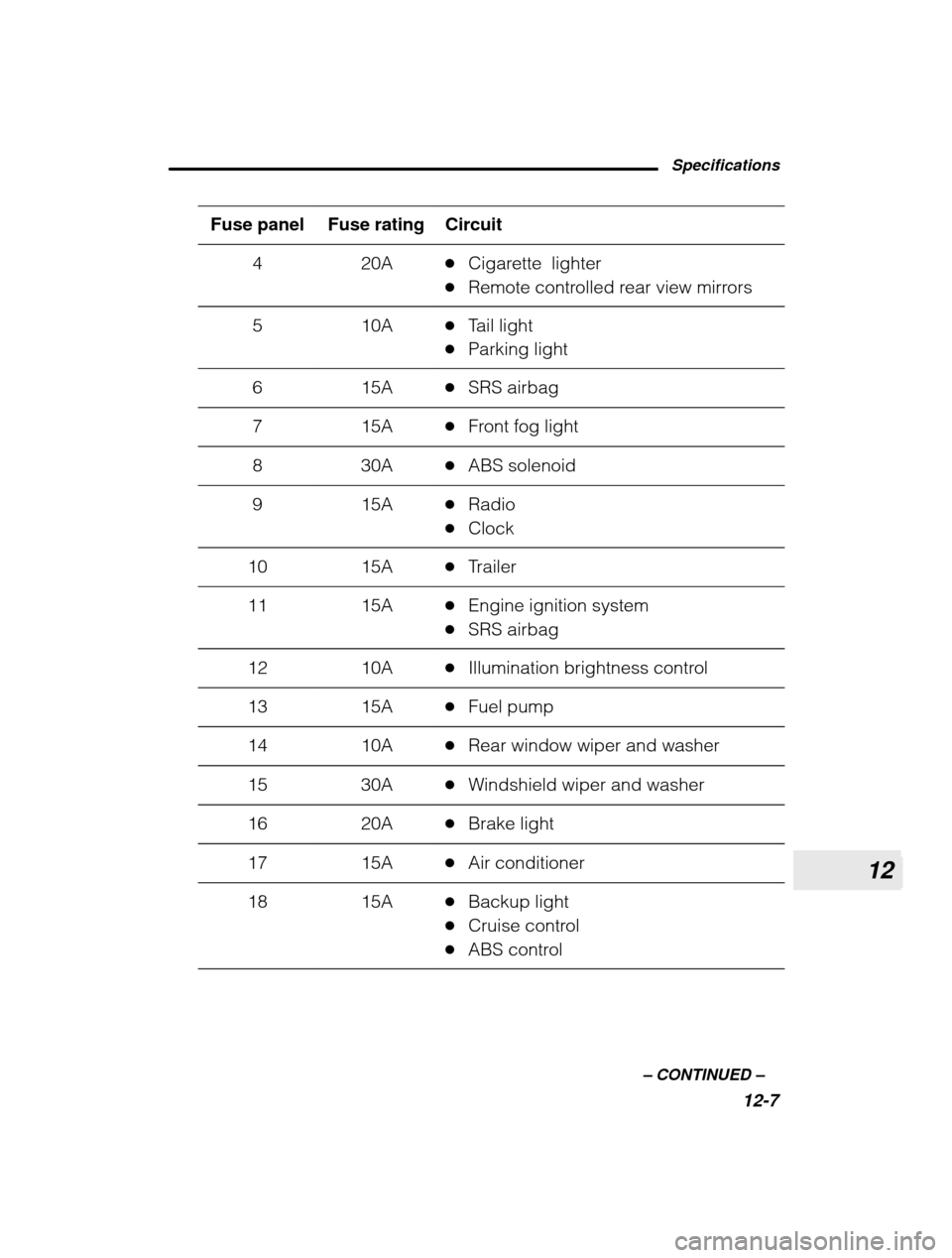
Specifications12-7
–
CONTINUED –
Fuse panel Circuit
Fuse rating
420ACigarette lighter
Remote controlled rear view mirrors
510ATail light
Parking light
615ASRS airbag
715AFront fog light
830AABS solenoid
915ARadio
Clock
1015ATrailer
1115AEngine ignition system
SRS airbag
1210AIllumination brightness control
1315AFuel pump
1410ARear window wiper and washer
1530AWindshield wiper and washer
1620ABrake light
1715AAir conditioner
1815ABackup light
Cruise control
ABS control
Page 449 of 472
12
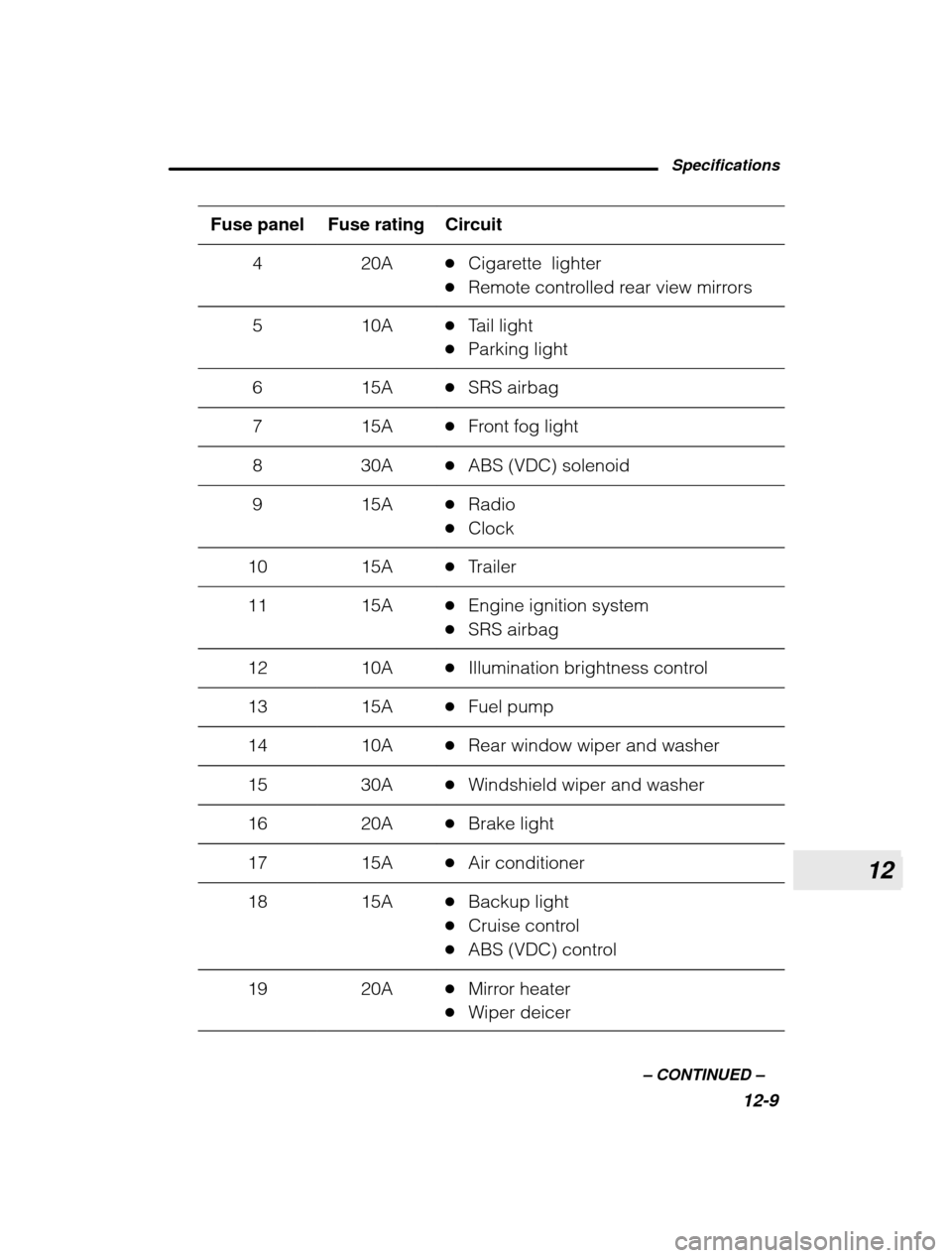
Specifications12-9
–
CONTINUED –
Fuse panel Circuit
Fuse rating
420ACigarette lighter
Remote controlled rear view mirrors
510ATail light
Parking light
615ASRS airbag
715AFront fog light
830AABS (VDC) solenoid
915ARadio
Clock
1015ATrailer
1115AEngine ignition system
SRS airbag
1210AIllumination brightness control
1315AFuel pump
1410ARear window wiper and washer
1530AWindshield wiper and washer
1620ABrake light
1715AAir conditioner
1815ABackup light
Cruise control
ABS (VDC) control
1920AMirror heater
Wiper deicer
Page 450 of 472
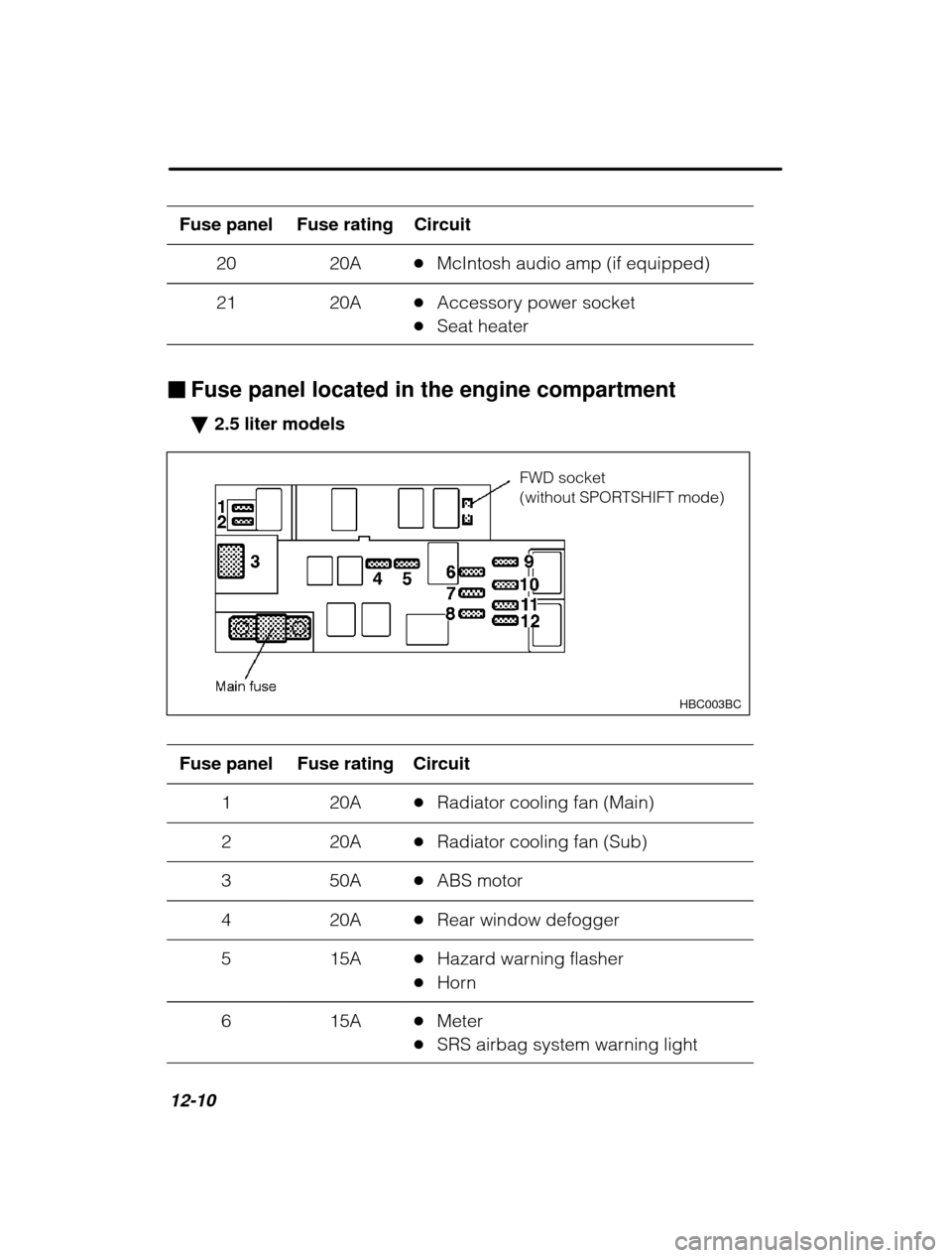
12-10Fuse panel Circuit
Fuse rating
2020AMcIntosh audio amp (if equipped)
2120AAccessory power socket
Seat heater
Fuse panel located in the engine compartment 2.5 liter models
HBC003BC
FWD socket
(without SPORTSHIFT mode)
Fuse panel
Fuse ratingCircuit
120A Radiator cooling fan (Main)
220ARadiator cooling fan (Sub)
350AABS motor
420ARear window defogger
515AHazard warning flasher
Horn
615AMeter
SRS airbag system warning light
Page 451 of 472

12
Specifications12-11
–
CONTINUED –
Fuse panel Circuit
Fuse rating
710AAutomatic transmission control unit
ABS UNIT
810AAlternator
915AHeadlight (right side)
1015AHeadlight (left side)
1120ALighting switch
1215AClock
Interior light