brake light SUBARU OUTBACK 2004 4.G User Guide
[x] Cancel search | Manufacturer: SUBARU, Model Year: 2004, Model line: OUTBACK, Model: SUBARU OUTBACK 2004 4.GPages: 525, PDF Size: 5.68 MB
Page 283 of 525
7-10
Starting and operating
Starting the engine
Do not operate the starter motor continuously
for more than ten seconds. If the engine fails to
start after operating the starter for five to ten
seconds, wait for ten seconds or more before
trying again.
„ Starting the engine for a manual trans-
mission vehicle
1. Apply the parking brake.
2. Turn off unnecessary lights and accessories.
3. Press the clutch pedal to the floor and shift the shift
lever into neutral.
Hold the clutch pedal to the floor while starting the en-
gine. The starter motor will only operate when the
clutch pedal is pressed fully to the floor.
4. Turn the ignition switch to the “ON” position and
check the operation of the warning and indicator lights.
Refer to the “Warning and indicator lights” section
(chapter 3).
5. Turn the ignition switch to the “START” position
without depressing the accelerator pedal. Release the key immediately after the engine has started.
If the engine does not start within ten seconds, wait a
while and then turn the ignition switch to the “START”
position again while depressing the accelerator pedal
half way down.
6. Confirm that all warning and indicator lights have
gone off after the engine has started. The fuel injection
system automatically lowers the idle speed as the en-
gine warms up.
„ Starting the engine for an automatic
transmission vehicle
If you restart the engine while the vehicle is
moving, shift the selector lever into the “N” po-
sition. Do not attempt to place the selector lever
of a moving vehicle into the “P” position.
1. Apply the parking brake.
2. Turn off unnecessary lights and accessories.
3. Shift the selector lever to the “P” or “N” position
(preferably “P” position). The starter will only operate
when the select lever is at the “P” or “N” position.
4. Turn the ignition switch to the “ON” position and
Page 284 of 525

7-11
Starting and operating
– CONTINUED –
check the operation of the warning and indicator lights.
Refer to the “Warning and indicator lights” section
(chapter 3).
5. Turn the ignition switch to the “START” position
without depressing the accelerator pedal. Release
the key immediately after the engine has started.
If the engine does not start within ten seconds, wait a
while and then turn the ignition switch to the “START”
position again while depressing the accelerator pedal
half way down.
6. Confirm that all warning and indicator lights have
gone out after the engine has started. The fuel injec-
tion system automatically lowers the idle speed as the
engine warms up.
While the engine is warming up, make sure that the
selector lever is at the “P” or “N” position and that the
parking brake is applied. „ Starting the engine during cold weath- er below –4 °F (–20 °C)
If the engine is difficult to start using the normal meth-
od (without depressing the accelerator pedal), turn the
ignition switch to the “START” position while slightly
depressing the accelerator pedal. „
Starting a flooded engine
If the engine does not start, it may be flooded (exces-
sive fuel in the engine).
In case of a flooded engine, turn the starter motor for
five seconds with the accelerator pedal fully de-
pressed. Repeat this two or three times until the en-
gine starts. Release the ignition switch and accelera-
tor pedal as soon as the engine starts.
Page 290 of 525
7-17
Starting and operating
– CONTINUED –
A shift interlock function is employed in the automatic
transmission system to ensure safe starting of the ve-
hicle.
To shift the selector lever from the “P” to the any other
position, you have to depress the brake pedal fully
when the ignition switch is in the “ON” position. This
prevents the vehicle from lurching when it is started.
If the shift lever does not move from the “P” position
with the brake pedal depressed, refer to the “Shift lock
release” section in this chapter. TR (Reverse)
This position is for backing the vehicle.
To shift from “N” to “R” position, first stop the vehicle
completely then move the lever to the “R” position. T N (Neutral)
Do not drive the vehicle with the selector lever
in the “N” (neutral) position. Engine braking
has no effect in this condition and the risk of an
accident is consequently increased.
This position is for restarting a stalled engine. In this position the wheels and transmission are not
locked. In this position, the transmission is neutral; the
vehicle will roll freely, even on the slightest incline un-
less the parking brake or foot brake is on.
Avoid coasting with the transmission neutral.
During coasting, the engine braking does not act. T
D (Drive)
This position is for normal driving.
The transmission automatically shifts into a suitable
gear from 1st to 4th according to the vehicle speed
and the acceleration you require.
When more acceleration is required in this position,
press the accelerator pedal fully to the floor and hold
that position. The transmission will automatically
downshift to 3rd, 2nd or 1st gear. When you release
the pedal, the transmission will return to the original
gear position. V While climbing a grade
When driving up a hill, undesired upshift to 4th gear is
prevented from taking place when the accelerator is
released. This minimizes the chance of subsequent
downshifting to a lower gear when accelerating again.
This prevents repeated upshifting and downshifting re-
sulting in a smoother operation of the vehicle.
Page 296 of 525
7-23
Starting and operating
– CONTINUED –
locked to prevent the vehicle from rolling freely.
When you park the vehicle, first set the parking brake
fully, then shift into the “P” position. Do not hold the ve-
hicle with only the transmission.
A shift interlock function is employed in the automatic
transmission system to ensure safe starting of the ve-
hicle.
To shift the selector lever from the “P” to any other po-
sition, you have to depress the brake pedal fully then
push the release button on the selector lever when the
ignition switch is in the “ON” position. This prevents
the vehicle from lurching when it is started.
If the shift lever does not move from the “P” position
with the brake pedal depressed, the release button
pushed in, and the ignition switch in the ON position,
refer to the “Shift lock release” section in this chapter. TR (Reverse)
This position is for backing the vehicle.
To shift from the “N” to “R” position, first stop the vehi-
cle completely then move the lever to the “R” position
while pushing the release button. T
N (Neutral)
Do not drive the vehicle with the selector lever
in the “N” (neutral) position. Engine braking
has no effect in this condition and the risk of an
accident is consequently increased.
This position is for restarting a stalled engine.
In this position the wheels and transmission are not
locked. In this position, the transmission is neutral; the
vehicle will roll freely, even on the slightest incline un-
less the parking brake or foot brake is on.
Avoid coasting with the transmission neutral.
During coasting, there is no engine braking effect. T D (Drive)
This position is for normal driving.
The transmission automatically shifts into a suitable
gear from 1st to 4th according to the vehicle speed
and the acceleration you require.
When more acceleration is required in this position,
press the accelerator pedal fully to the floor and hold
that position. The transmission will automatically
downshift to 3rd, 2nd or 1st gear. When you release
Page 303 of 525
7-30
Starting and operating
Power steering
Do not hold the steering wheel at the fully
locked position left or right for more than five
seconds. This may damage the power steering
pump.
The power steering system operates only when the
engine is running.
If you lose power steering assist because the engine
stops or the system fails to function, you can steer but it will take much more effort.
NOTE
Right after the engine has been started and before
it has warmed up, you may hear a noise coming
from areas adjacent to the power steering pump
which is located at the right-front area of the en-
gine compartment. This noise is normal. It does
not indicate power steering system trouble.
Braking „ Braking tips
Never rest your foot on the brake pedal while
driving. This can cause dangerous overheating
of the brakes and needless wear on the brake
pads and linings.
T When the brakes get wet
When driving in rain or after washing the vehicle, the
brakes may get wet. As a result, brake stopping dis-
tance will be longer. To dry the brakes, drive the vehi-
cle at a safe speed while lightly depressing the brake
pedal to heat up the brakes. T Use of engine braking
Remember to make use of engine braking in addition
to foot braking. When descending a grade, if only the
foot brake is used, the brakes may start working im-
properly because of brake fluid overheating, caused
by overheated brake pads. To help prevent this, shift
into a lower gear to get stronger engine braking.
Page 305 of 525
7-32
Starting and operating
ABS (Anti-lock Brake System)
Always use the utmost care in driving – over-
confidence because you are driving with an
ABS equipped vehicle could easily lead to a se-
rious accident.
y
The ABS system does not always decrease
stopping distance. You should always maintain
a safe following distance from other vehicles. y When driving on badly surfaced roads, gravel
roads, icy road, or over deep newly fallen snow,
stopping distances may be longer for a vehicle
with the ABS system than one without. When
driving under these conditions, therefore, re-
duce your speed and leave ample distance from
other vehicles. y When you feel the ABS system operating,
you should maintain constant brake pedal pres-
sure. Do not pump the brake pedal since doing
so may defeat the operation of the ABS system. The ABS system prevents the lock-up of wheels which
may occur during sudden braking or braking on slip-
pery road surfaces. This helps prevent the loss of
steering control and directional stability caused by
wheel lock-up.
When the ABS system is operating, you may hear a
chattering noise or feel a slight vibration in the brake
pedal. This is normal when the ABS operates.
The ABS system will not operate when the vehicle
speed is below approximately 6 mph (10 km/h). „
ABS system self-check
You may feel a slight shock in the brake pedal and hear the operating sound of ABS from the engine com-
partment just after the vehicle is started. This is
caused by an automatic functional test of the ABS sys-
tem being carried out and does not indicate any abnor-
mal condition.
Page 306 of 525
7-33
Starting and operating
– CONTINUED –
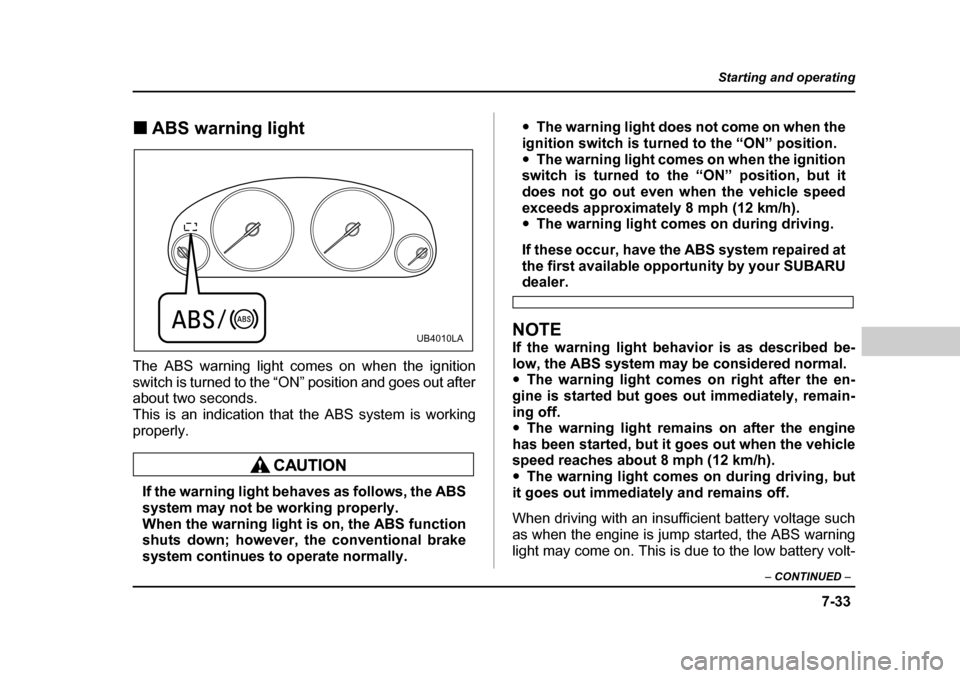
„ABS warning light
The ABS warning light comes on when the ignition
switch is turned to the “ON” position and goes out after
about two seconds.
This is an indication that the ABS system is working
properly.
If the warning light behaves as follows, the ABS
system may not be working properly.
When the warning light is on, the ABS function
shuts down; however, the conventional brake
system continues to operate normally. y
The warning light does not come on when the
ignition switch is turned to the “ON” position.y The warning light comes on when the ignition
switch is turned to the “ON” position, but it
does not go out even when the vehicle speed
exceeds approximately 8 mph (12 km/h). y The warning light comes on during driving.
If these occur, have the ABS system repaired at
the first available opportunity by your SUBARU
dealer.
NOTE
If the warning light behavior is as described be-
low, the ABS system may be considered normal. y The warning light comes on right after the en-
gine is started but goes out immediately, remain-
ing off. y The warning light remains on after the engine
has been started, but it goes out when the vehicle
speed reaches about 8 mph (12 km/h). y The warning light comes on during driving, but
it goes out immediately and remains off.
When driving with an insufficient battery voltage such as when the engine is jump started, the ABS warning
light may come on. This is due to the low battery volt-UB4010LA
Page 308 of 525
7-35
Starting and operating
– CONTINUED –
yWhenever suspension components, steering
components, or an axle are removed from a ve-
hicle equipped with VDC, have an authorized
SUBARU dealer perform an inspection of that
system.y The following precautions should be ob-
served in order to ensure that the VDC system
is operating properly:
– All four wheels should be fitted with tires of
the same size, type, and brand. Furthermore,
the amount of wear should be the same for allfour tires.
– Keep the tire pressure at the proper level as
shown on the placard attached to the vehi-
cle’s door pillar.
– Use only the special temporary spare tire to
replace a flat tire. With a temporary spare tire,
the effectiveness of the VDC system is re-
duced and this should be taken into account
when driving with vehicle.
In the event of wheelspin and/or skidding on a slippery
road surface and/or during cornering and/or an eva-
sive maneuver, the VDC system adjusts the engine’s
output and the wheels’ respective braking forces to
help maintain traction and directional control. y
Traction Control Function
The traction control function is designed to prevent
spinning of the driving wheels on slippery road surfac-
es, thereby helping to maintain traction and directional
control. Activation of this function is shown by steady
illumination of the VDC operation indicator light. y Skid Suppression Function
The skid suppression function is designed to help
maintain directional stability by suppressing the
wheels’ tendency to slide sideways during steering op-
erations. Activation of this function is shown by flash-
ing of the VDC operation indicator light.
NOTE y Slight twitching of the brake pedal may be felt
when the VDC-system operates; a small degree of
vehicle or steering wheel shaking may also be no-
ticed in this situation. These are normal character-
istics of VDC operation and are no cause for
alarm. y When driving off immediately after starting the
engine, a short-lived operation noise may be no-
ticed coming from the engine compartment. This
noise is generated as a result of a check being per-
formed on the VDC system and is normal.y Depending on the timing of activation of the
brakes, certain situations may occur just after
Page 309 of 525
7-36
Starting and operating
driving off where the brake pedal seems to exhibit
a jolting motion. This too is a consequence of the
VDC operational check and is normal. y
In the circumstances listed below, the vehicle
may be more unstable than it feels to the driver.
The Vehicle Dynamics Control System may there-
fore operate. Such operation does not indicate a
system fault.
yon gravel-covered or rutted roads
y on unfinished roads
y when the vehicle is towing a trailer
y when the vehicle is fitted with snow tires or
winter tires
y Activation of the VDC system will cause opera-
tion of the steering wheel to feel slightly different
compared to that for normal conditions. y Even if the vehicle is equipped with a VDC sys-
tem, it is important that winter tires be used when
driving on snow-covered or icy roads. (All four
wheels should be fitted with tires of the same size
and brand). y It is always important to reduce speed when ap-
proaching a corner, even if the vehicle is equipped with VDC. y All four wheels should be fitted with tires of the
same size, type, and brand; furthermore, the
amount of wear should be the same for all four tires. If these precautions are not observed and
non-matching tires are used, it is quite possible
that the VDC system will be unable to operate cor-
rectly as intended. y
Always turn off the engine before replacing a
tire as failure to do so may render the VDC system
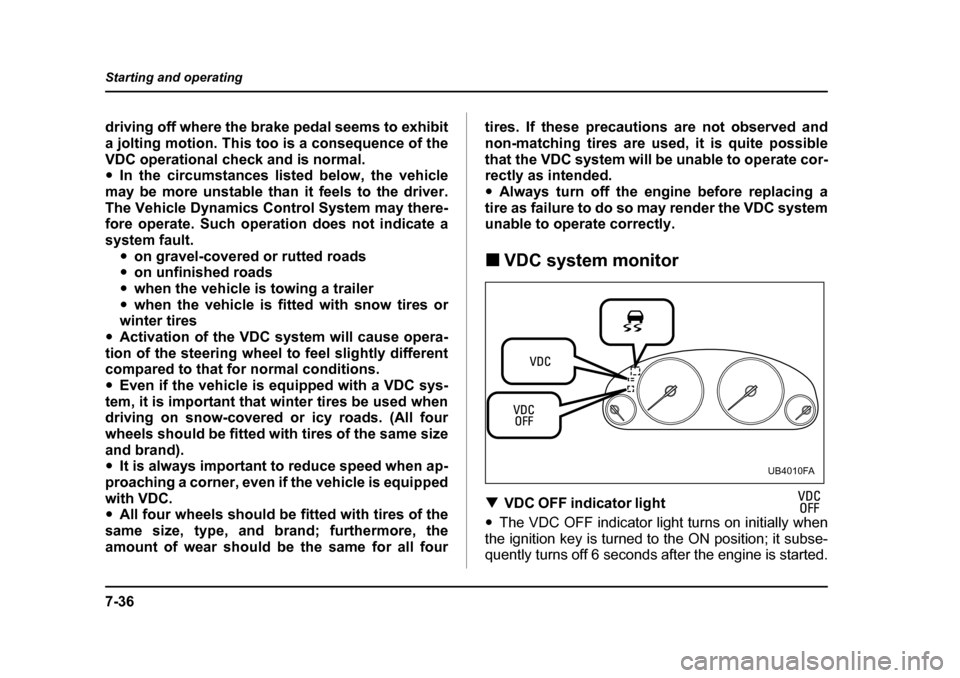
unable to operate correctly. „ VDC system monitor
T V D C O F F i n d i c a t o r l i g h t
y The VDC OFF indicator light turns on initially when
the ignition key is turned to the ON position; it subse-
quently turns off 6 seconds after the engine is started.
UB4010FA
Page 311 of 525
7-38
Starting and operating
speed of approximately 8 mph (12 km/h). y
The VDC warning light turns on while the vehicle is
being driven. y When a malfunction has occurred in the VDC elec-
trical system, only the VDC warning light will turn on.
In such an event, the ABS will still be operating nor-
mally. y The VDC warning light will also turn on when a prob-
lem occurs with the ABS or VDC electronic control
systems.
Because the VDC system controls each brake throughthe ABS, whenever the ABS stops operating due to a
malfunction in that electrical system, the VDC will also
become unable to control all four brakes. Thus VDC
system operation halts and the VDC warning light
turns on. Although both the VDC system and the ABS
will be inoperable in this situation, it will still be possi-
ble to stop the vehicle using normal braking. The VDC
system and the ABS do not adversely affect operation
of the vehicle in any way when they are inoperable;however should such a situation occur, drive with care
and have an authorized SUBARU dealer carry out an
inspection of those systems at the first available op-
portunity.
NOTE
When the VDC warning light turns on and off in the
following way, it indicates that the VDC system is operating normally.y
Although turning on after the engine has been
started, the warning light quickly turns off and
stays off. y The warning light turns on after the engine is
started and does not turn off until the vehicle
reaches a speed of 8 mph (12 km/h). y The warning light turns on when the vehicle is
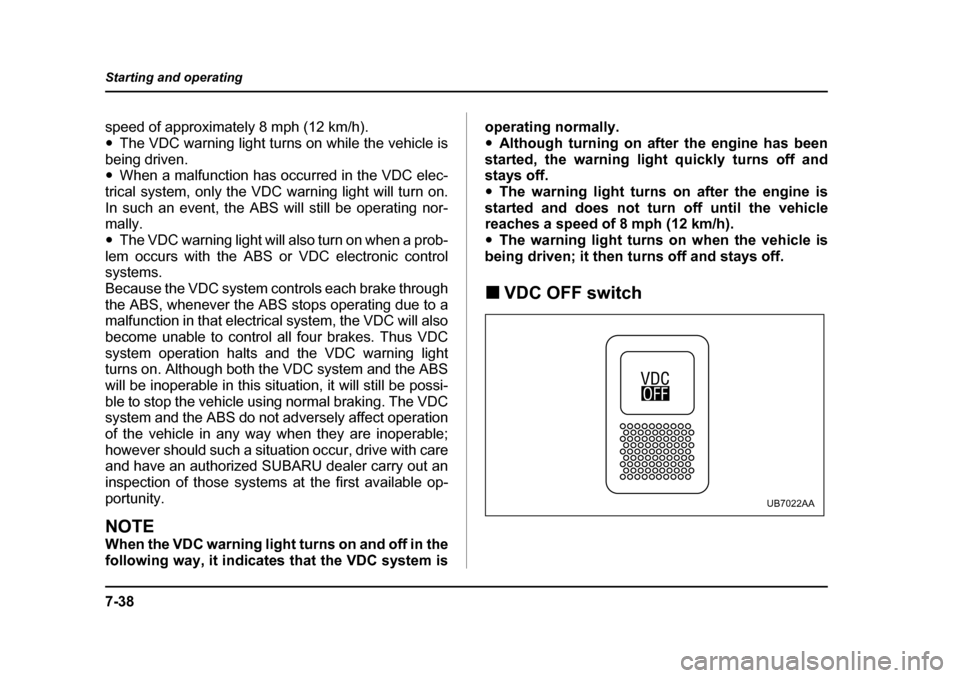
being driven; it then turns off and stays off. „ VDC OFF switch
UB7022AA