tire size SUBARU OUTBACK 2004 4.G User Guide
[x] Cancel search | Manufacturer: SUBARU, Model Year: 2004, Model line: OUTBACK, Model: SUBARU OUTBACK 2004 4.GPages: 525, PDF Size: 5.68 MB
Page 362 of 525
9-3
In case of emergency
– CONTINUED –
Temporary spare tire
Never tow a trailer when the temporary spare
tire is used. The temporary spare tire is not de-
signed to sustain the towing load. Use of the
temporary spare tire when towing can result in
failure of the spare tire and/or less stability of
the vehicle and may lead to an accident.
Never use any temporary spare tire other than
the original. Using other sizes may result in se-
vere mechanical damage to the drive train of
your vehicle.
The temporary spare tire is smaller and lighter than a
conventional tire and is designed for emergency use
only. Remove the temporary spare tire and re-install
the conventional tire as soon as possible because the
spare tire is designed only for temporary use.
Check the inflation pressure of the temporary spare
tire periodically to keep the tire ready for use. The cor- rect pressure is
60 psi (420 kPa, 4.2 kg/cm 2
).
When using the temporary spare tire, note the follow-
ing: y Do not exceed 50 mph (80 km/h).
y Do not put a tire chain on the temporary spare tire.
Because of the smaller tire size, a tire chain will not fit
properly. y Do not use two or more temporary spare tires at the
same time. y Do not drive over obstacles. This tire has a smaller
diameter, so road clearance is reduced.
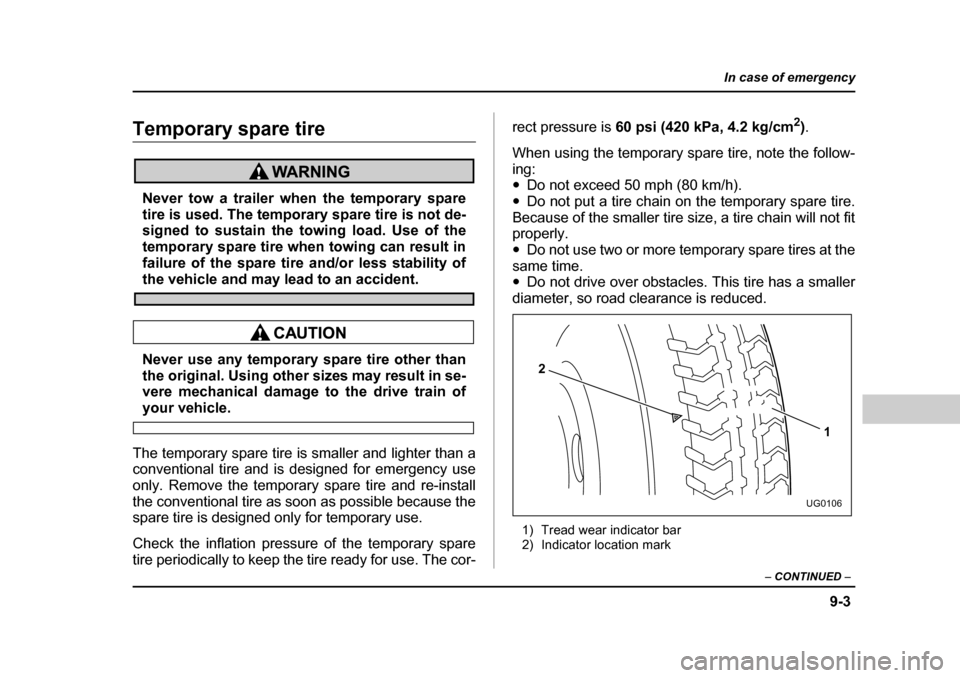
1) Tread wear indicator bar
2) Indicator location mark
1
2
UG0106
Page 449 of 525
11 - 4 8
2Maintenance and service
ible, the tire is worn beyond the acceptable limit
and must be replaced immediately. With a tire
in this condition, driving at high speeds in wet
weather can cause the vehicle to hydroplane.
The resulting loss of vehicle control can lead to
an accident.
NOTE
For safety, inspect the tire tread regularly and re-
place the tires before their tread wear indicators
become visible. „
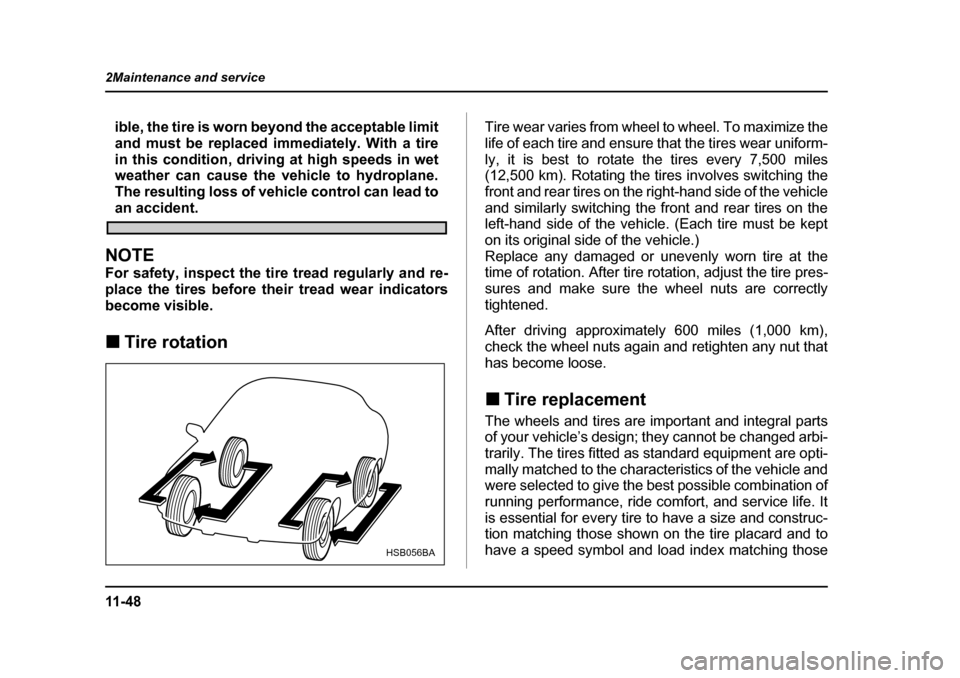
Tire rotation Tire wear varies from wheel to wheel. To maximize the
life of each tire and ensure that the tires wear uniform-
ly, it is best to rotate the tires every 7,500 miles
(12,500 km). Rotating the tires involves switching the
front and rear tires on the right-hand side of the vehicle
and similarly switching the front and rear tires on the
left-hand side of the vehicle. (Each tire must be kept
on its original side of the vehicle.)
Replace any damaged or unevenly worn tire at the
time of rotation. After tire rotation, adjust the tire pres-
sures and make sure the wheel nuts are correctly
tightened.
After driving approximately 600 miles (1,000 km),
check the wheel nuts again and retighten any nut that
has become loose. „
Tire replacement
The wheels and tires are important and integral parts
of your vehicle’s design; they cannot be changed arbi-
trarily. The tires fitted as standard equipment are opti-
mally matched to the characteristics of the vehicle and
were selected to give the best possible combination of
running performance, ride comfort, and service life. It
is essential for every tire to have a size and construc-
tion matching those shown on the tire placard and to
have a speed symbol and load index matching those
HSB056BA
Page 450 of 525
11 -4 9
2Maintenance and service
– CONTINUED –
shown on the tire placard.
Using tires of a non-specified size detracts from con-
trollability, ride comfort, braking performance, speed-
ometer accuracy and odometer accuracy. It also cre-
ates incorrect body-to-tire clearances and inappropri-
ately changes the vehicle’s ground clearance.
All four tires must be the same in terms of manufactur-
er, brand (tread pattern), construction, and size. You
are advised to replace the tires with new ones that are
identical to those fitted as standard equipment.
For safe vehicle operation, SUBARU recommends re-
placing all four tires at the same time.
yAll four tires must be the same in terms of
manufacturer, brand (tread pattern), construc-
tion, degree of wear, speed symbol, load index
and size. Mixing tires of different types, sizes or
degrees of wear can result in damage to the ve-
hicle’s power train. Use of different types or siz-
es of tires can also dangerously reduce control-
lability and braking performance and can lead
to an accident. y Use only radial tires. Do not use radial tires
together with belted bias tires and/or bias-ply tires. Doing so can dangerously reduce control-
lability, resulting in an accident.
„ Wheel replacement
When replacing wheels due, for example, to damage,
make sure the replacement wheels match the specifi-
cations of the wheels that are fitted as standard equip-
ment. Replacement wheels are available from
SUBARU dealers.
Use only those wheels that are specified for
your vehicle. Wheels not meeting specifica-
tions could interfere with brake caliper opera-
tion and may cause the tires to rub against the
wheel well housing during turns. The resulting
loss of vehicle control could lead to an acci-
dent.
Page 486 of 525
12-5
Specifications
– CONTINUED –
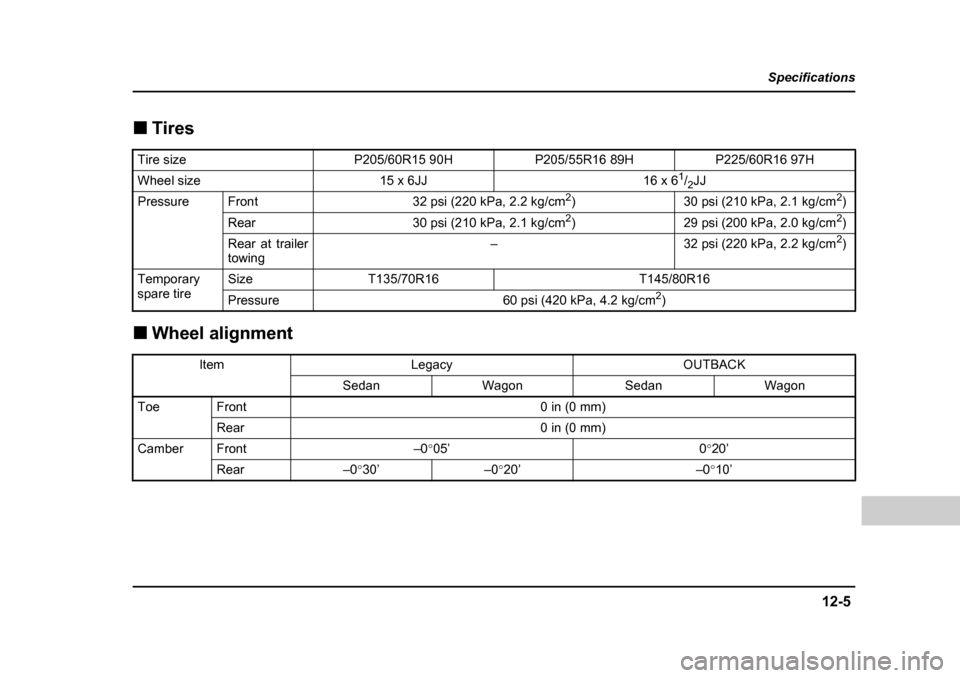
„Tires
„ Wheel alignment
Tire sizeP205/60R15 90HP205/55R16 89HP225/60R16 97H
Wheel size15 x 6JJ16 x 6 1
/2 JJ
PressureFront32 psi (220 kPa, 2.2 kg/cm 2
)30 psi (210 kPa, 2.1 kg/cm 2
)
Rear30 psi (210 kPa, 2.1 kg/cm 2
)29 psi (200 kPa, 2.0 kg/cm 2
)
Rear at trailer
towing–32 psi (220 kPa, 2.2 kg/cm 2
)
Temporary
spare tireSizeT135/70R16T145/80R16
Pressure60 psi (420 kPa, 4.2 kg/cm 2
)
ItemLegacyOUTBACK
SedanWagonSedanWagon
ToeFront0 in (0 mm)
Rear0 in (0 mm)
CamberFront–0 °05’0 °20’
Rear–0 °30’–0 °20’–0 °10’
Page 497 of 525
13-2
Consumer information and Reporting safety defects
Consumer information and Reporting safety defectsFor U.S.A.
The following information has been compiled accord-
ing to Code of Federal Regulations “Title 49, Part
575”.
Tire information „
Tire labeling
Many markings (e.g. Tire size, Tire Identification
Number or TIN) are placed on the sidewall of a
tire by tire manufacturers. These marking can
provide you with useful information on the tire. T Tire size
Your vehicle comes equipped with P-Metric tire
size. It is important to understand the sizing sys-
tem in selecting the proper tire for your vehicles.
Here is a brief review of the tire sizing system
with a breakdown of its individual elements. V P Metric
With the P-Metric system, Section Width is mea-
sured in millimeters. To convert millimeters into
inches, divide by 25.4. The Aspect Ratio (Sec-
tion Height divided by Section Width) helps pro- vide more dimensional information about the tire
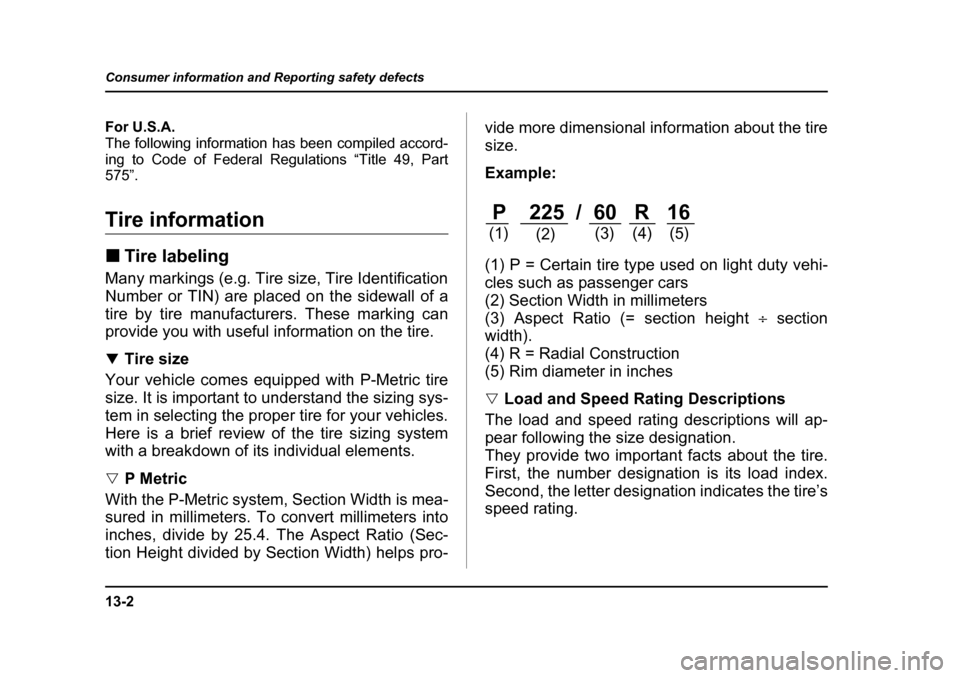
size. Example:
(1) P = Certain tire type used on light duty vehi-
cles such as passenger cars (2) Section Width in millimeters
(3) Aspect Ratio (= section height
÷ section
width).
(4) R = Radial Construction
(5) Rim diameter in inches V Load and Speed Rating Descriptions
The load and speed rating descriptions will ap-
pear following the size designation.
They provide two important facts about the tire.
First, the number designation is its load index.
Second, the letter designation indicates the tire’s
speed rating.P 225 / 60 R 16
(1) (2) (3) (4) (5)
Page 498 of 525
13-3
Consumer information and Reporting safety defects
– CONTINUED –
Example:
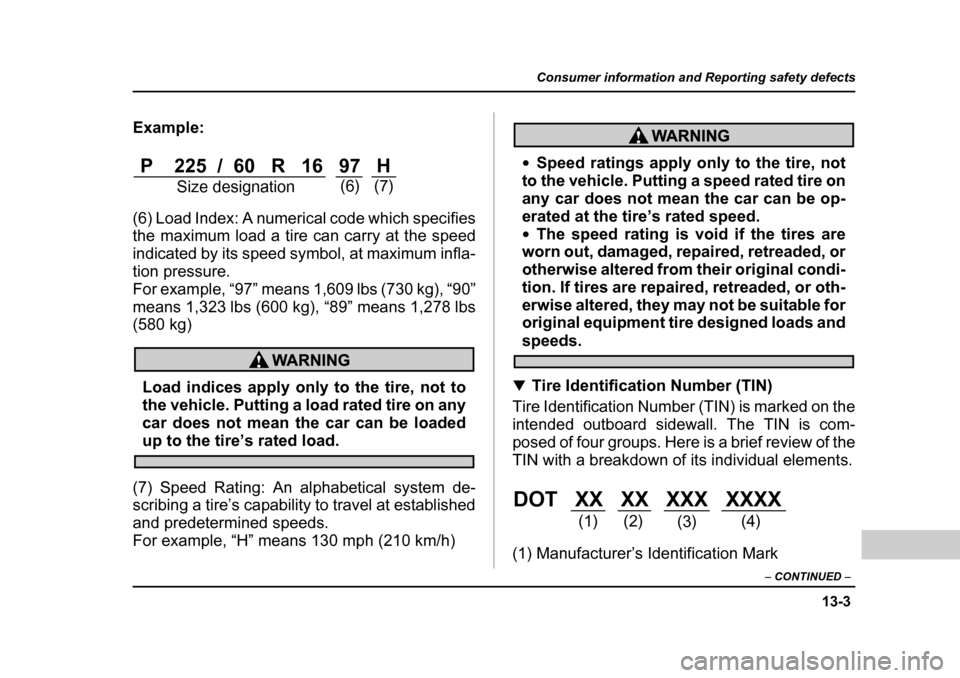
(6) Load Index: A numerical code which specifies
the maximum load a tire can carry at the speed
indicated by its speed symbol, at maximum infla-
tion pressure.
For example, “97” means 1,609 lbs (730 kg), “90”
means 1,323 lbs (600 kg), “89” means 1,278 lbs (580 kg)
Load indices apply only to the tire, not to
the vehicle. Putting a load rated tire on any
car does not mean the car can be loaded
up to the tire’s rated load.
(7) Speed Rating: An alphabetical system de-
scribing a tire’s capability to travel at established
and predetermined speeds.
For example, “H” means 130 mph (210 km/h)
y Speed ratings apply only to the tire, not
to the vehicle. Putting a speed rated tire on
any car does not mean the car can be op-
erated at the tire’s rated speed. y The speed rating is void if the tires are
worn out, damaged, repaired, retreaded, or
otherwise altered from their original condi-
tion. If tires are repaired, retreaded, or oth-
erwise altered, they may not be suitable for
original equipment tire designed loads and
speeds.
T Tire Identification Number (TIN)
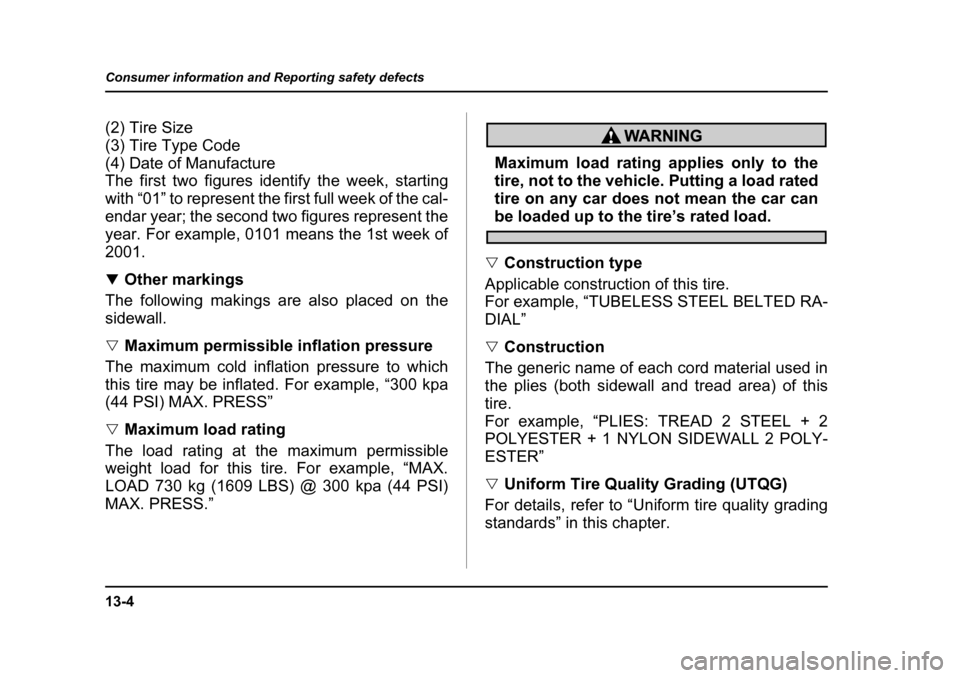
Tire Identification Number (TIN) is marked on the
intended outboard sidewall. The TIN is com-
posed of four groups. Here is a brief review of the
TIN with a breakdown of its individual elements.
(1) Manufacturer’s Identification Mark
P 225 / 60 R 16 97 H Size designation (6) (7)
DOT XX XX XXX XXXX
(1) (2) (3)(4)
Page 499 of 525
13-4
Consumer information and Reporting safety defects
(2) Tire Size
(3) Tire Type Code (4) Date of Manufacture
The first two figures identify the week, starting
with “01” to represent the first full week of the cal-
endar year; the second two figures represent the
year. For example, 0101 means the 1st week of
2001. T
Other markings
The following makings are also placed on the
sidewall. V Maximum permissible inflation pressure
The maximum cold inflation pressure to which
this tire may be inflated. For example, “300 kpa
(44 PSI) MAX. PRESS” V Maximum load rating
The load rating at the maximum permissible
weight load for this tire. For example, “MAX.
LOAD 730 kg (1609 LBS) @ 300 kpa (44 PSI) MAX. PRESS.”
Maximum load rating applies only to the
tire, not to the vehicle. Putting a load rated
tire on any car does not mean the car can
be loaded up to the tire’s rated load.
V Construction type
Applicable construction of this tire.
For example, “TUBELESS STEEL BELTED RA-
DIAL” V Construction
The generic name of each cord material used in
the plies (both sidewall and tread area) of this
tire.
For example, “PLIES: TREAD 2 STEEL + 2
POLYESTER + 1 NYLON SIDEWALL 2 POLY-
ESTER” V Uniform Tire Quality Grading (UTQG)
For details, refer to “Uniform tire quality grading
standards” in this chapter.
Page 500 of 525

13-5
Consumer information and Reporting safety defects
– CONTINUED –
„Recommended tire inflation pressure
T Recommended cold tire inflation pressure
Recommended cold tire inflation pressure for your vehicle’s tires is as follows,
Tire size P205/60R15 90H P205/55R16 89H P225/60R16 97H
Wheel size 15 x 6JJ 16 x 6 1/2JJ
Pressure Front 32 psi (220 kpa, 2.2 kg/cm 2
)3 0 p si
(210 kpa, 2.1 kg/cm 2
)
Rear 30psi (210 kpa, 2.1 kg/cm 2
)2 9 p si
(200 kpa, 2.0 kg/cm 2
)
Rear at trailer
towing –3
2 p si
(220 kpa, 2.2 kg/cm 2
)
Temporary
spare tire Size T135/70R16 T145/80R16
Pressure 60 psi (420 kpa, 4.2 kg/cm
2
)
Page 501 of 525
13-6
Consumer information and Reporting safety defects
T
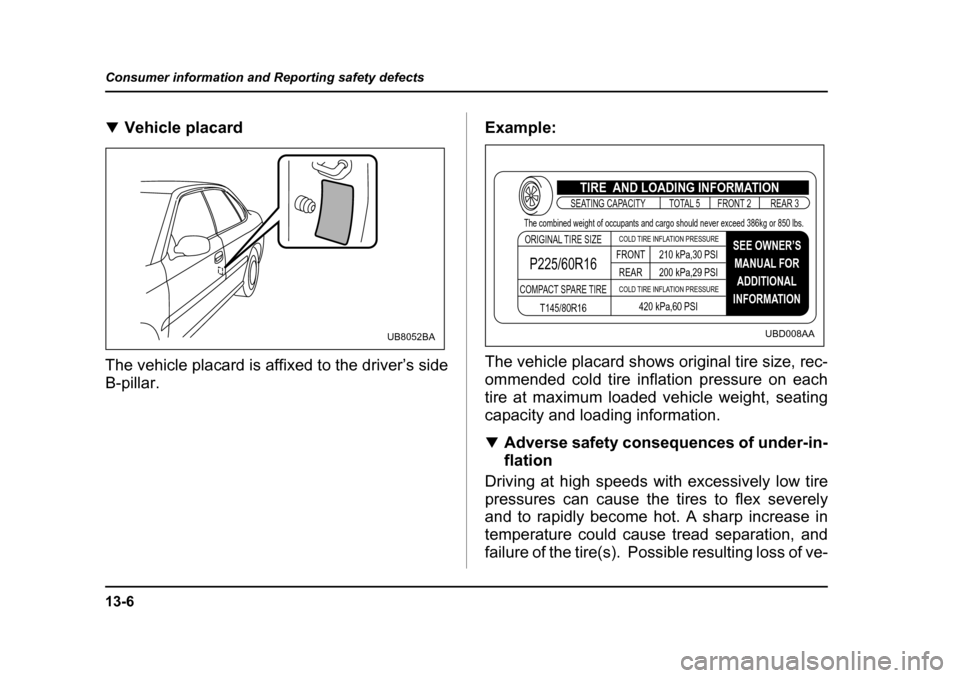
Vehicle placard
The vehicle placard is affixed to the driver’s side B-pillar. Example:
The vehicle placard shows original tire size, rec-
ommended cold tire inflation pressure on each
tire at maximum loaded vehicle weight, seating
capacity and loading information. T
Adverse safety consequences of under-in-
flation
Driving at high speeds with excessively low tire
pressures can cause the tires to flex severely
and to rapidly become hot. A sharp increase in
temperature could cause tread separation, and
failure of the tire(s). Possible resulting loss of ve-
UB8052BA
TIRE AND LOADING INFORMATION
SEE OWNER’S MANUAL FOR ADDITIONAL
INFORMATION
SEATING CAPACITY
ORIGINAL TIRE SIZE
COLD TIRE INFLATION PRESSURE
COLD TIRE INFLATION PRESSURE
FRONT REAR 210 kPa,30 PSI 200 kPa,29 PSI
420 kPa,60 PSI
COMPACT SPARE TIRE
T145/80R16
P225/60R16
The combined weight of occupants and cargo should never exceed 386kg or 850 lbs.
TOTAL 5 FRONT 2 REAR 3
UBD008AA
Page 525 of 525

GAS STATION REFERENCE
Fuel: T2.5 Liter models
Use only unleaded gasoline with an octane rating of
87 AKI or higher. T 3.0 Liter models
Use premium unleaded gasoline with an octane rat-
ing of 91 AKI or higher. Regular unleaded gasoline
with an octane rating of 87 AKI may be used if nec-
essary. For optimum engine performance and drive-
ability, it is recommended that you use premium
grade unleaded gasoline. „ Fuel octane rating
This octane rating is the average of the Research
Octane and Motor Octane numbers and is common-
ly referred to as the Anti Knock Index (AKI). Refer to “Fuel” section in this manual. Fuel capacity:
16.9 US gal (64 liters, 14.1 Imp gal) Engine oil:
Use only API classification SL with the words “EN-
ERGY CONSERVING” and the New API certifica-
tion mark (starburst mark) displayed on the contain-er. Engine oil capacity:
2.5 liter models: 4.2 US qt (4.0 liters, 3.5 Imp qt)
3.0 liter models: 5.6 US qt (5.3 liters, 4.6 Imp qt)
Cold tire pressure: Tire size P205/60R15 90H P205/55R16 89H P225/60R16 97H
Wheel size 15 x 6JJ 16 x 6 1
/2 JJ
Pressure Front 32 psi (220 kPa, 2.2 kg/cm 2
) 30 psi (210 kPa, 2.1 kg/cm 2
)
Rear 30 psi (210 kPa, 2.1 kg/cm 2
) 29 psi (200 kPa, 2.0 kg/cm 2
)
Rear at trailer towing – 32 psi (220 kPa, 2.2 kg/cm
2
)
Temporary
spare tire Size T135/70R16 T145/80R16
Pressure
60 psi (420 kPa, 4.2 kg/cm2
)