tires SUBARU OUTBACK 2004 4.G Owner's Manual
[x] Cancel search | Manufacturer: SUBARU, Model Year: 2004, Model line: OUTBACK, Model: SUBARU OUTBACK 2004 4.GPages: 525, PDF Size: 5.68 MB
Page 353 of 525
8-34
Driving tips
F: Front
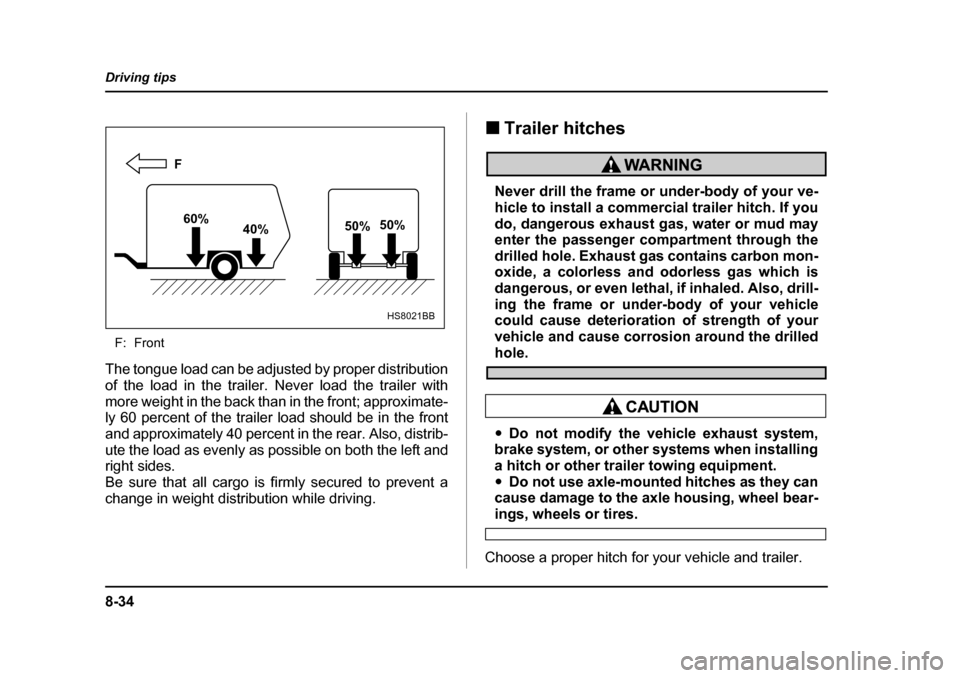
The tongue load can be adjusted by proper distribution
of the load in the trailer. Never load the trailer with
more weight in the back than in the front; approximate-
ly 60 percent of the trailer load should be in the front
and approximately 40 percent in the rear. Also, distrib-
ute the load as evenly as possible on both the left and
right sides.
Be sure that all cargo is firmly secured to prevent a
change in weight distribution while driving. „
Trailer hitches
Never drill the frame or under-body of your ve-
hicle to install a commercial trailer hitch. If you
do, dangerous exhaust gas, water or mud may
enter the passenger compartment through the
drilled hole. Exhaust gas contains carbon mon-
oxide, a colorless and odorless gas which is
dangerous, or even lethal, if inhaled. Also, drill-
ing the frame or under-body of your vehicle
could cause deterioration of strength of your
vehicle and cause corrosion around the drilled
hole.
yDo not modify the vehicle exhaust system,
brake system, or other systems when installing
a hitch or other trailer towing equipment. y Do not use axle-mounted hitches as they can
cause damage to the axle housing, wheel bear-
ings, wheels or tires.
Choose a proper hitch for your vehicle and trailer.
F
60% 40% 50%
50%
HS8021BB
Page 356 of 525
8-37
Driving tips
– CONTINUED –
cal system and cause a malfunction of your ve-
hicle’s lighting system.
Connection of trailer lights to your vehicle’s electrical
system requires modifications to the vehicle’s lighting
circuit to increase its capacity and accommodate wir-
ing changes. To ensure the trailer lights are connected
properly, please consult your SUBARU dealer. Check
for proper operation of the turn signals, the brake
lights and parking lights each time you hitch up. T Tires
Never tow a trailer when the temporary spare
tire is used. The temporary spare tire is not de-
signed to sustain the towing load. Use of the
temporary spare tire when towing can result in
failure of the spare tire and/or less stability of
the vehicle.
Make sure that all the tires on your vehicle are properly
inflated.
The recommended cold tire pressure under trailer tow-
ing conditions is shown in chapter 12, “Specifications” and in “GAS STATION REFERENCE” at the end of
this manual. Adjust the rear tire pressure to the recom-
mended pressure when the tires are cold. Normal
pressure should be maintained in the front tires.
Trailer tire condition, size, load rating and proper infla-
tion pressure should be in accordance with the trailer
manufacturer’s specifications.
In the event your vehicle gets a flat tire when towing a
trailer, ask a commercial road service to repair the flat
tire.
If you carry a regular size spare tire in your vehicle or
trailer as a precaution against getting a flat tire, be
sure that the spare tire is firmly secured. „
Trailer towing tipsyNever exceed 45 mph (72 km/h) when towing
a trailer in hilly country on hot days. y When towing a trailer, steering, stability,
stopping distance and braking performance
will be different from normal operation. For
safety’s sake, you should employ extra caution
when towing a trailer and you should never
Page 360 of 525

9-1
9
In case of emergency
If you park your vehicle in an emergency .. 9-2
Temporary spare tire .................................... 9-3
Flat tires ......................................................... 9-5
Jump starting ................................................ 9-15 How to jump start ............................................. 9-16
Engine overheating ....................................... 9-19 If steam is coming from the engine compartment .................................................. 9-19
If no steam is coming from the engine compartment .................................................. 9-19
Towing ........................................................... 9-20 Towing and tie-down hooks ............................ 9-21
Using a flat-bed truck ....................................... 9-27
Towing with all wheels on the ground ............ 9-28
Moonroof – if the moonroof cannot be closed ......................................................... 9-29
Maintenance tools ......................................... 9-31 Jack and jack handle ........................................ 9-32
Page 362 of 525
9-3
In case of emergency
– CONTINUED –
Temporary spare tire
Never tow a trailer when the temporary spare
tire is used. The temporary spare tire is not de-
signed to sustain the towing load. Use of the
temporary spare tire when towing can result in
failure of the spare tire and/or less stability of
the vehicle and may lead to an accident.
Never use any temporary spare tire other than
the original. Using other sizes may result in se-
vere mechanical damage to the drive train of
your vehicle.
The temporary spare tire is smaller and lighter than a
conventional tire and is designed for emergency use
only. Remove the temporary spare tire and re-install
the conventional tire as soon as possible because the
spare tire is designed only for temporary use.
Check the inflation pressure of the temporary spare
tire periodically to keep the tire ready for use. The cor- rect pressure is
60 psi (420 kPa, 4.2 kg/cm 2
).
When using the temporary spare tire, note the follow-
ing: y Do not exceed 50 mph (80 km/h).
y Do not put a tire chain on the temporary spare tire.
Because of the smaller tire size, a tire chain will not fit
properly. y Do not use two or more temporary spare tires at the
same time. y Do not drive over obstacles. This tire has a smaller
diameter, so road clearance is reduced.
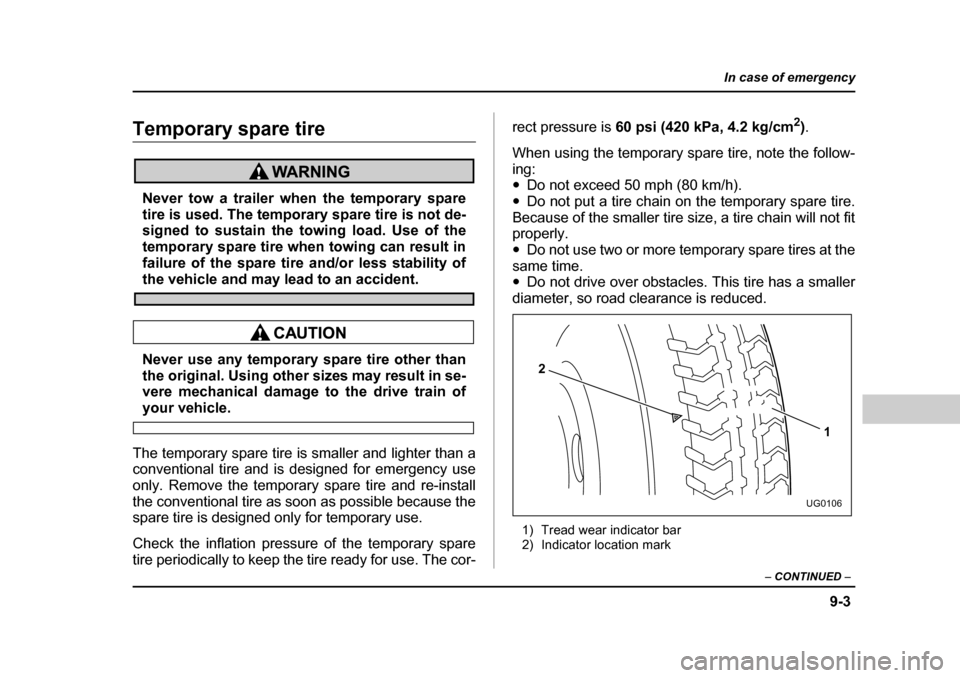
1) Tread wear indicator bar
2) Indicator location mark
1
2
UG0106
Page 364 of 525
9-5
In case of emergency
– CONTINUED –
Flat tires
yDo not jack up the vehicle on an incline or a
loose road surface. The jack can come out of
the jacking point or sink into the ground and
this can result in a severe accident. y Use only the jack provided with your vehicle.
The jack supplied with the vehicle is designed
only for changing a tire. Never get under the ve-
hicle while supporting the vehicle with thisjack. y Always turn the engine off before raising the
flat tire off the ground using the jack. Never
swing or push the vehicle supported with the
jack. The jack can come out of the jacking point
due to a jolt and this can result in a severe acci-
dent. y Do not use oil or grease on the wheel studs or
nuts when the spare tire is installed. This could
cause the nuts to become loose and lead to an
accident.
If you have a flat tire while driving, never brake sud-
denly; keep driving straight ahead while gradually re- ducing speed. Then slowly pull off the road to a safe
place.
1. Park on a hard, level surface, whenever possible,
then stop the engine.
2. Set the parking brake securely and shift a manual
transmission vehicle in reverse or an automatic trans-
mission vehicle in the “P” (Park) position.
3. Turn on the hazard warning flasher and have ev-
eryone get out of the vehicle.
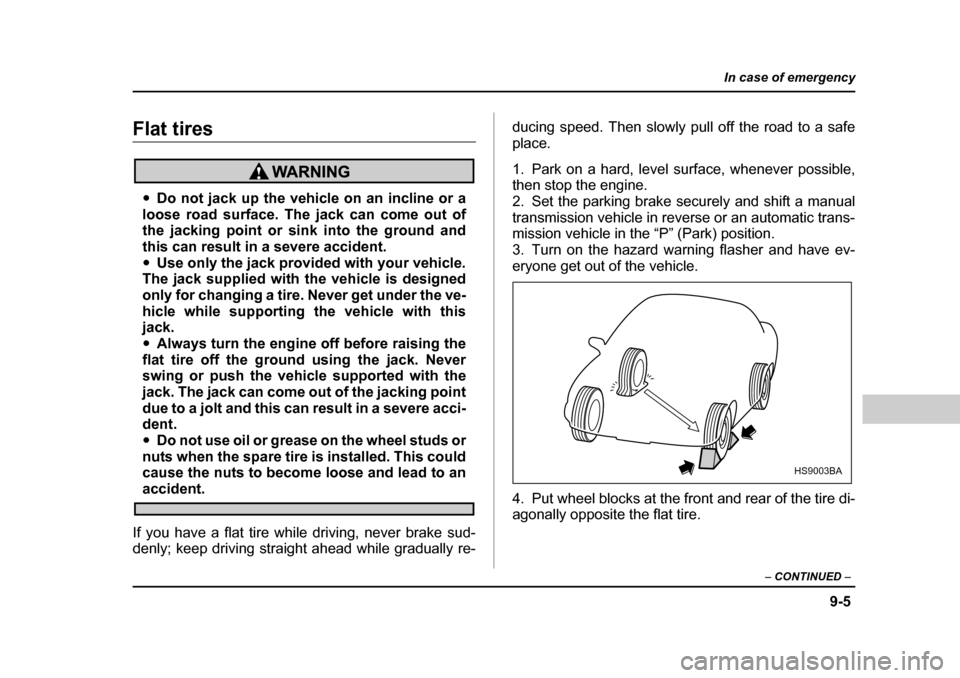
4. Put wheel blocks at the front and rear of the tire di-
agonally opposite the flat tire.
HS9003BA
Page 392 of 525
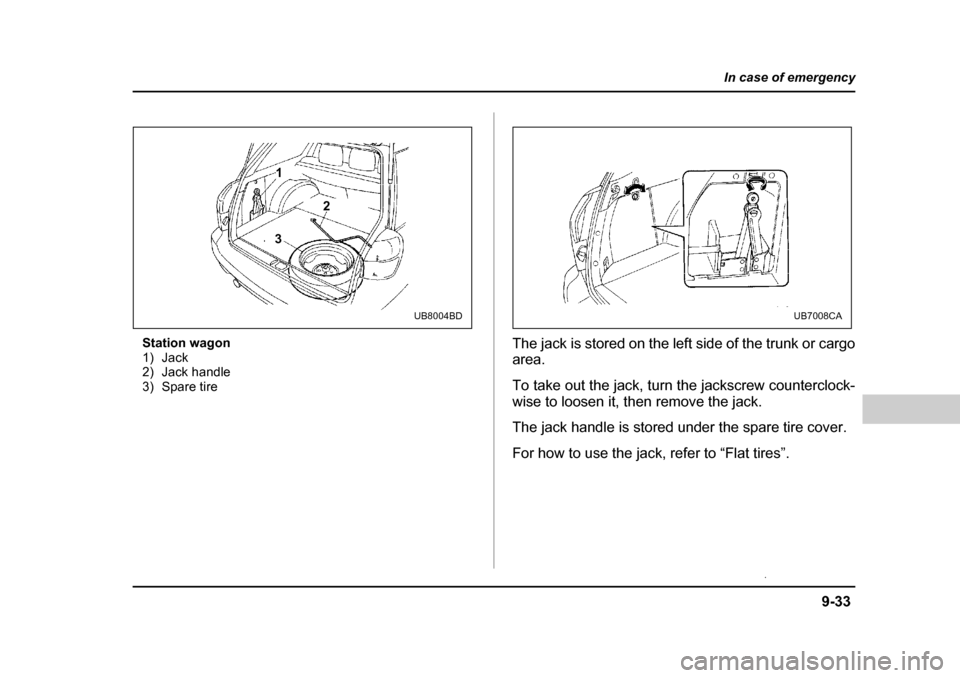
9-33
In case of emergency
– CONTINUED –
Station wagon
1) Jack
2) Jack handle
3) Spare tire The jack is stored on the left side of the trunk or cargo
area.
To take out the jack, turn the jackscrew counterclock-
wise to loosen it, then remove the jack.
The jack handle is stored under the spare tire cover.
For how to use the jack, refer to “Flat tires”.
1
2
3
UB8004BDUB7008CA
Page 403 of 525

11 - 2
Maintenance and service
Parking brake stroke .................................... 11-43
Tires and wheels .......................................... 11-43Types of tires .................................................... 11-43
Tire inspection .................................................. 11-44
Tire pressures and wear .................................. 11-44
Wheel balance ................................................... 11-47
Wear indicators ................................................. 11-47
Tire rotation ....................................................... 11-48
Tire replacement ............................................... 11-48
Wheel replacement ........................................... 11-49
Wheel covers .................................................... 11-50
Aluminum wheels (if equipped) .................. 11-51
Windshield washer fluid .............................. 11-51
Replacement of wiper blades ...................... 11-52 Replacement wiper blade assembly ............... 11-53
Replacement wiper blade rubber .................... 11-53
Battery ........................................................... 11-58
Fuses ............................................................. 11-59
Main fuse ....................................................... 11-61
Installation of accessories .......................... 11-62
Replacing bulbs ............................................ 11-63 Headlight ........................................................... 11-65
Front fog light (if equipped) ............................. 11-69
Front turn signal light, parking light and side marker light .................................................... 11-69
Rear combination lights ................................... 11-71
License plate light ............................................ 11-76
Map light, dome light, luggage compartment light and door step light ................................ 11-76
Trunk light ......................................................... 11-79
High mount stop light ...................................... 11-79
Page 444 of 525
11 -4 3
2Maintenance and service
– CONTINUED –
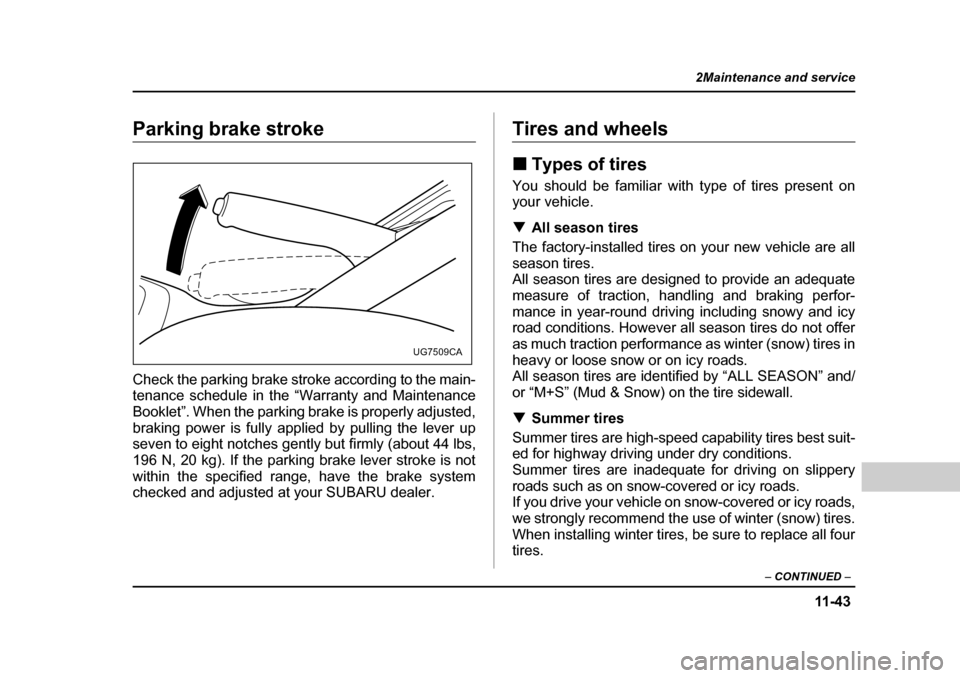
Parking brake stroke
Check the parking brake stroke according to the main-
tenance schedule in the “Warranty and Maintenance
Booklet”. When the parking brake is properly adjusted,
braking power is fully applied by pulling the lever up
seven to eight notches gently but firmly (about 44 lbs,
196 N, 20 kg). If the parking brake lever stroke is not
within the specified range, have the brake system
checked and adjusted at your SUBARU dealer.Tires and wheels „Types of tires
You should be familiar with type of tires present on
your vehicle. T All season tires
The factory-installed tires on your new vehicle are all
season tires.
All season tires are designed to provide an adequate
measure of traction, handling and braking perfor-
mance in year-round driving including snowy and icy
road conditions. However all season tires do not offer
as much traction performance as winter (snow) tires in
heavy or loose snow or on icy roads.
All season tires are identified by “ALL SEASON” and/
or “M+S” (Mud & Snow) on the tire sidewall. T Summer tires
Summer tires are high-speed capability tires best suit-
ed for highway driving under dry conditions.
Summer tires are inadequate for driving on slippery
roads such as on snow-covered or icy roads.
If you drive your vehicle on snow-covered or icy roads,
we strongly recommend the use of winter (snow) tires.
When installing winter tires, be sure to replace all four
tires.
UG7509CA
Page 445 of 525
11 - 4 4
2Maintenance and service
T
Winter (snow) tires
Winter tires are best suited for driving on snow-cov-
ered and icy roads. However winter tires do not per-
form as well as summer tires and all season tires on
roads other than snow-covered and icy roads. „ Tire inspection
Check on a daily basis that the tires are free from se-
rious damage, nails, and stones. At the same time,
check the tires for abnormal wear.
Contact your SUBARU dealer immediately if you find
any problem.
NOTE y When the wheels and tires strike curbs or are
subjected to harsh treatment as when the vehicle
is driven on a rough surface, they can suffer dam-
age that cannot be seen with the naked eye. This
type of damage does not become evident until
time has passed. Try not to drive over curbs, pot-
holes or on other rough surfaces. If doing so is un-
avoidable, keep the vehicle’s speed down to a
walking pace or less, and approach the curbs as
squarely as possible. Also, make sure the tires are
not pressed against the curb when you park the
vehicle. y If you feel unusual vibration while driving or find it difficult to steer the vehicle in a straight line, one
of the tires and/or wheels may be damaged. Drive
slowly to the nearest authorized SUBARU dealer
and have the vehicle inspected. „
Tire pressures and wear
Maintaining the correct tire pressures helps to maxi-
mize the tires’ service lives and is essential for good
running performance. Check and, if necessary, adjust
the pressure of each tire (including the spare) at least
once a month (for example, during a fuel stop) and be-
fore any long journey.
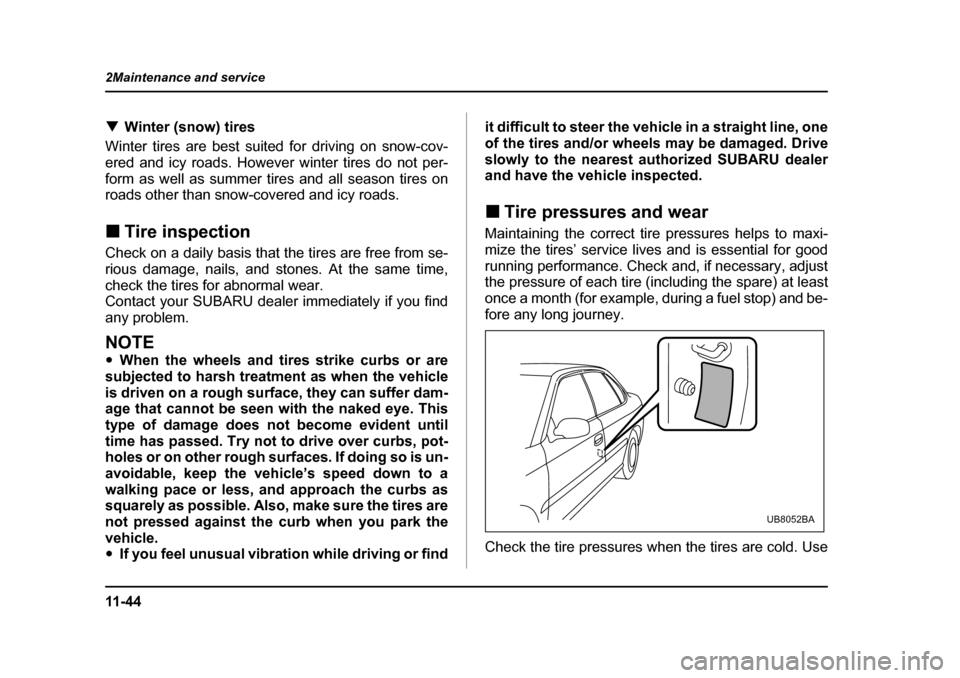
Check the tire pressures when the tires are cold. Use
UB8052BA
Page 446 of 525
11 -4 5
2Maintenance and service
– CONTINUED –
a pressure gauge to adjust the tire pressures to the
values shown on the tire placard. The tire placard is lo-
cated on the door pillar on the driver’s side.
Driving even a short distance warms up the tires and
increases the tire pressures. Also, the tire pressures
are affected by the ambient temperature. It is best to
check tire pressure outdoors before driving the vehi- cle.
When a tire becomes warm, the air inside it expands,
causing the tire pressure to increase. Be careful not to
mistakenly release air from a warm tire to reduce itspressure.
NOTE yThe air pressure in a tire increases by approxi-
mately 4.3 psi (30 kPa, 0.3 kg/cm 2
) when the tire
becomes warm. y The tires are considered cold when the vehicle
has been parked for at least three hours or has
been driven less than one mile (1.6 km).
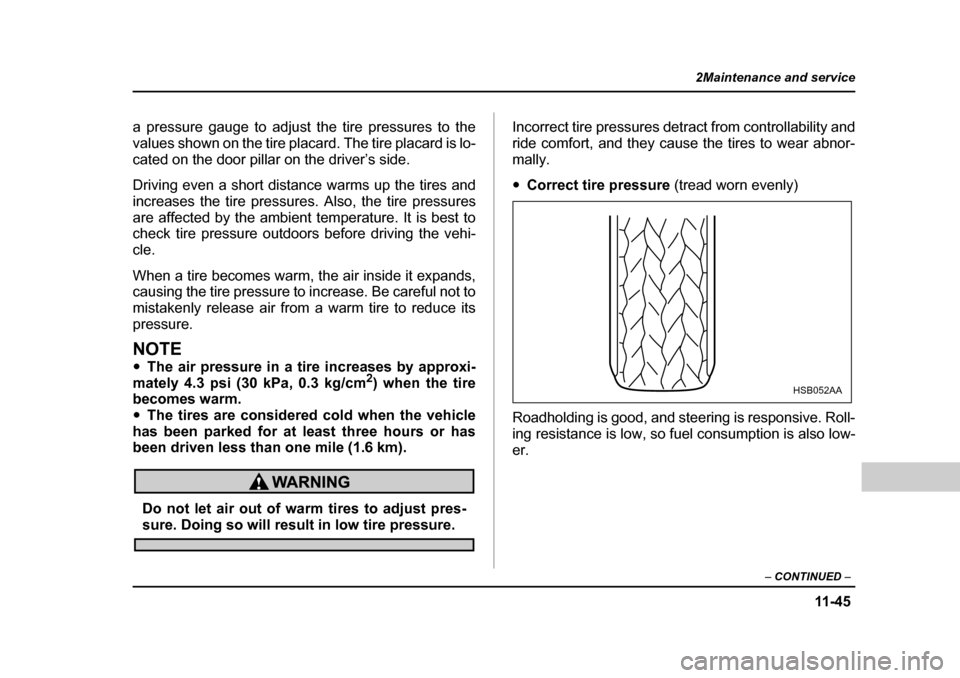
Do not let air out of warm tires to adjust pres-sure. Doing so will result in low tire pressure. Incorrect tire pressures detract from controllability and
ride comfort, and they cause the tires to wear abnor-mally. y
Correct tire pressure (tread worn evenly)
Roadholding is good, and steering is responsive. Roll-
ing resistance is low, so fuel consumption is also low-er.
HSB052AA