ESP SUBARU OUTBACK 2004 4.G Owner's Guide
[x] Cancel search | Manufacturer: SUBARU, Model Year: 2004, Model line: OUTBACK, Model: SUBARU OUTBACK 2004 4.GPages: 525, PDF Size: 5.68 MB
Page 328 of 525

8-9
Driving tips
– CONTINUED –
next section (applicable to the OUTBACK) for general
guidance. But please keep in mind that your vehicle’s
off-road capabilities are more limited than those of the
OUTBACK.
Never attempt to drive through pools and puddles, or
roads flooded with water. Water entering the engine
air intake or the exhaust pipe or water splashing onto
electrical parts may damage your vehicle and may
cause it to stall. TOUTBACK
Because of the AWD feature and higher ground clear-
ance, your SUBARU can be driven on ordinary roads
or off-road. But please keep in mind that an AWD
SUBARU is a passenger car and is neither a conven-
tional off-road vehicle nor an all-terrain vehicle. If you
do take your SUBARU off-road, certain common
sense precautions such as the following should be taken: y Make certain that you and all of your passengers
are wearing seat belts. y Carry some emergency equipment, such as a tow-
ing rope or chain, a shovel, wheel blocks, first aid kit
and portable phone or citizens band radio. y Drive carefully. Do not take unnecessary risks by
driving in dangerous areas or over rough terrain. y Slow down and employ extra caution at all times. When driving off-road, you will not have the benefit of
marked traffic lanes, banked curves, traffic signs and
the like. y
Do not drive across steep slopes. Instead, drive ei-
ther straight up or straight down the slopes. A vehicle
can much more easily tip over sideways than it can
end over end. Avoid driving straight up or down slopes
that are too steep.y Avoid sharp turning maneuvers, especially at higher
speeds. y Do not grip the inside or spokes of the steering
wheel. A bad bump could jerk the wheel and injure
your hands. Instead drive with your fingers and
thumbs on the outside of the rim.y If driving through water, such as when crossing
shallow streams, first check the depth of the water and
the bottom of the stream bed for firmness and ensure
that the bed of the stream is flat. Drive slowly and com-
pletely through the stream. The water should be shal-
low enough that it does not reach the vehicle’s under-
carriage. Water entering the engine air intake or the
exhaust pipe or water splashing onto electrical parts
may damage your vehicle and may cause it to stall.
Never attempt to drive through rushing water; regard-
less of its depth, it can wash away the ground from un-
der your tires, resulting in possible loss of traction and
even vehicle rollover.
Page 332 of 525

8-13
Driving tips
– CONTINUED –
ing, abrupt acceleration, high-speed driving, and
sharp turning when driving on snowy or icy roads.
Always maintain ample distance between your vehicle
and the vehicle ahead of you to avoid the need for sud-
den braking.
To supplement the foot brake, use the engine brake
effectively to control the vehicle speed. (Shift into a
lower gear when necessary.)
Avoid shifting down abruptly. Such behavior can
cause the wheels to lock, possibly leading to loss of vehicle control.
An anti-lock brake system (ABS) enhances your vehi-
cle’s braking performance on snowy and icy roads.
Refer to the “ABS (Anti-lock Brake System)” and “VDC
(Vehicle Dynamics Control) system (if equipped)” sec-
tion in chapter 7 for information on braking on slippery surfaces. TWiper operation when snowing
Before driving in cold weather, make sure the wiper
blades are not frozen to the windshield or rear window.
If the wiper blades are frozen to the windshield or rear
window, use the defroster with the airflow control but-
ton/dial in the “ ” position and the temperature
control dial set for maximum warmth until the wiper
blades are completely thawed out. If your vehicle is
equipped with a wiper deicer, it is helpful to thaw the windshield wiper blades. To thaw out the rear wiper
blade, use the rear window defogger.
When driving in snow, if frozen snow starts to stick on
the surface of the windshield despite wiper operation,
use the defroster with the airflow control button/dial in
“ ” and the temperature control dial set for maxi-
mum warmth. After the windshield gets warmed
enough to melt the frozen snow on it, wash it away us-
ing the windshield washer.
Snow stuck on the wiper arm prevents the wiper from working effectively. If snow is stuck on the wiper arm,
pull off the road to a safe place, then remove it. If you
stop the car at road side, use the hazard warning
flasher to alert other drivers.
We recommend use of non-freezing type wiper blades
(winter blades) during the seasons you could have
snow and sub-zero temperatures. Blades of this type
give superior wiping performance in snowy conditions.
Be sure to use blades that are suitable for your vehi- cle. „
Corrosion protection
Refer to the “Corrosion protection” section (chapter 10).
Page 347 of 525

8-28
Driving tips
and insert the receiver cover onto the hitch receiver tube.y
Place the dust cap over the four-pin connector of the
hitch wire harness to protect against possible damage.y Occasionally lubricate terminals of the four-pin con-
nector using the terminal grease.Trailer towing
Your car is designed and intended to be used primarily
as a passenger-carrying vehicle. Towing a trailer puts
additional loads on your car’s engine, drivetrain,
brakes, tires and suspension and has an adverse ef-
fect on fuel economy.
If you do decide to tow a trailer, your safety and satis-
faction depend upon proper use of correct equipment
and cautious operation of your vehicle. Seek the ad-
vice of your SUBARU dealer to assist you in purchas-
ing a hitch and other necessary towing equipment ap-
propriate for your vehicle. In addition, be sure to follow
the instructions on correct installation and use provid-
ed by the trailer and other towing equipment manufac- turers.
SUBARU assumes no responsibility for injuries or ve-
hicle damage that result from trailer towing equipment,
or from any errors or omissions in the instructions ac-
companying such equipment or for your failure to fol-
low the proper instructions. „ Warranties and maintenance
SUBARU warranties do not apply to vehicle damage
or malfunction caused by trailer towing. If you use your
vehicle to tow a trailer, more frequent maintenance will
be required due to the additional load. (Refer to “Main-
Page 352 of 525
8-33
Driving tips
– CONTINUED –
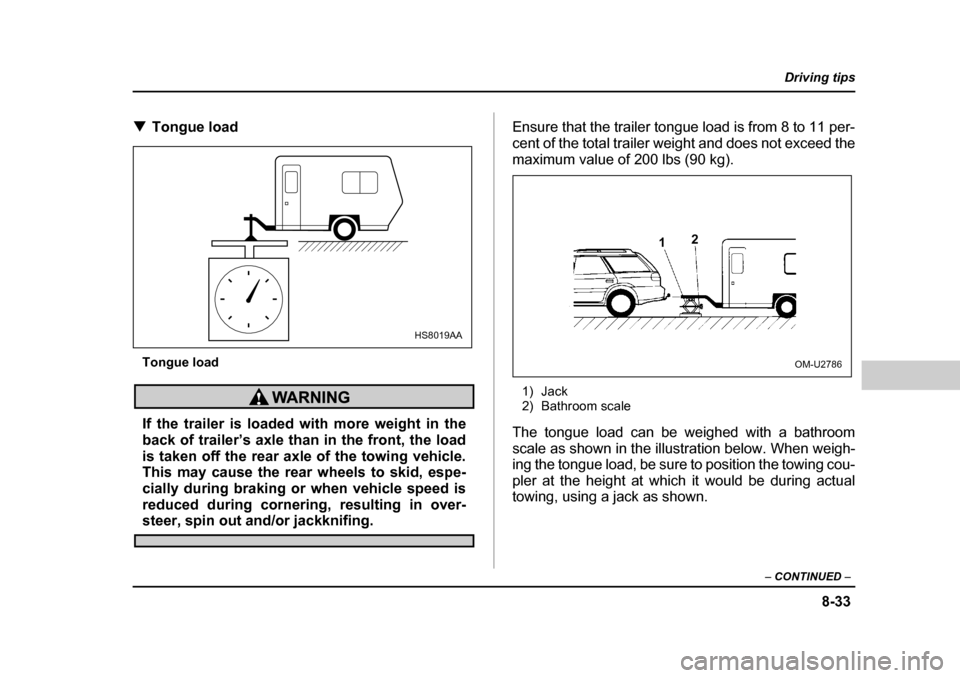
TTongue load
Tongue load
If the trailer is loaded with more weight in the
back of trailer’s axle than in the front, the load
is taken off the rear axle of the towing vehicle.
This may cause the rear wheels to skid, espe-
cially during braking or when vehicle speed is
reduced during cornering, resulting in over-
steer, spin out and/or jackknifing. Ensure that the trailer tongue load is from 8 to 11 per-
cent of the total trailer weight and does not exceed the
maximum value of 200 lbs (90 kg).
1) Jack
2) Bathroom scale
The tongue load can be weighed with a bathroom
scale as shown in the illustration below. When weigh-
ing the tongue load, be sure to position the towing cou-
pler at the height at which it would be during actual
towing, using a jack as shown.
HS8019AA
1 2
OM-U2786
Page 395 of 525
10-2
Appearance care
Appearance careExterior care „
Washing
yWhen washing the vehicle, the brakes may
get wet. As a result, the brake stopping dis-
tance will be longer. To dry the brakes, drive the
vehicle at a safe speed while lightly pressing
the brake pedal to heat up the brakes.y Do not wash the engine compartment and ar-
eas adjacent to it. If water enters the engine air
intake, electrical parts or the power steering flu-
id reservoir, it will cause engine trouble or
faulty power steering respectively.
The best way to preserve your vehicle’s beauty is fre-
quent washing. Wash the vehicle at least once a
month to avoid contamination by road grime.
Wash dirt off with a wet sponge and plenty of luke-
warm or cold water. Do not wash the vehicle with hot
water and in direct sunlight.
Salt, chemicals, insects, tar, soot and bird droppings
should be washed off by using a light detergent, as re- quired. If you use a light detergent, make certain that
it is a neutral detergent. Do not use strong soap or
chemical detergents. All cleaning agents should be
promptly flushed from the surface and not allowed to
dry there. Rinse the vehicle thoroughly with plenty of
lukewarm water. Wipe the remaining water off with a
chamois or soft cloth.
NOTE y
Before having your vehicle washed in an auto-
matic car wash, retract the pillar mounted antenna
to prevent it from being damaged.y When having your vehicle washed in an auto-
matic car wash, make sure beforehand that the car
wash is of suitable type. Automatic car wash
brushes or other equipment may damage the rear
wiper and rear/roof spoiler (if equipped). T Washing the underbody
Chemicals, salts and gravel used for deicing road sur-
faces are extremely corrosive, accelerating the corro-
sion of underbody components, such as the exhaust
system, fuel and brake lines, brake cables, floor pan
and fenders, and suspension.
Thoroughly flush the underbody and inside of the
fenders with lukewarm or cold water at frequent inter-
vals to reduce the harmful effects of such agents.
Page 398 of 525

10-5
Appearance care
– CONTINUED –
Finally, check that the protector’s horizontal bars are
parallel with the fog light’s horizontal center line.Corrosion protection
Your SUBARU has been designed and built to resist
corrosion. Special materials and protective finishes
have been used on most parts of the vehicle to help
maintain fine appearance, strength, and reliable oper-
ation. „Most common causes of corrosion
The most common causes of corrosion are:
1. The accumulation of moisture retaining dirt and de-
bris in body panel sections, cavities, and other areas.
2. Damage to paint and other protective coatings
caused by gravel and stone chips or minor accidents.
Corrosion is accelerated on the vehicle when:
1. It is exposed to road salt or dust control chemicals,
or used in coastal areas where there is more salt in the
air, or in areas where there is considerable industrial
pollution.
2. It is driven in areas of high humidity, especially
when temperatures range just above freezing.
3. Dampness in certain parts of the vehicle remains
for a long time, even though other parts of the vehicle
may be dry.
4. High temperatures will cause corrosion to parts of
the vehicle which cannot dry quickly due to lack of
Page 442 of 525
11 -4 1
2Maintenance and service
– CONTINUED –
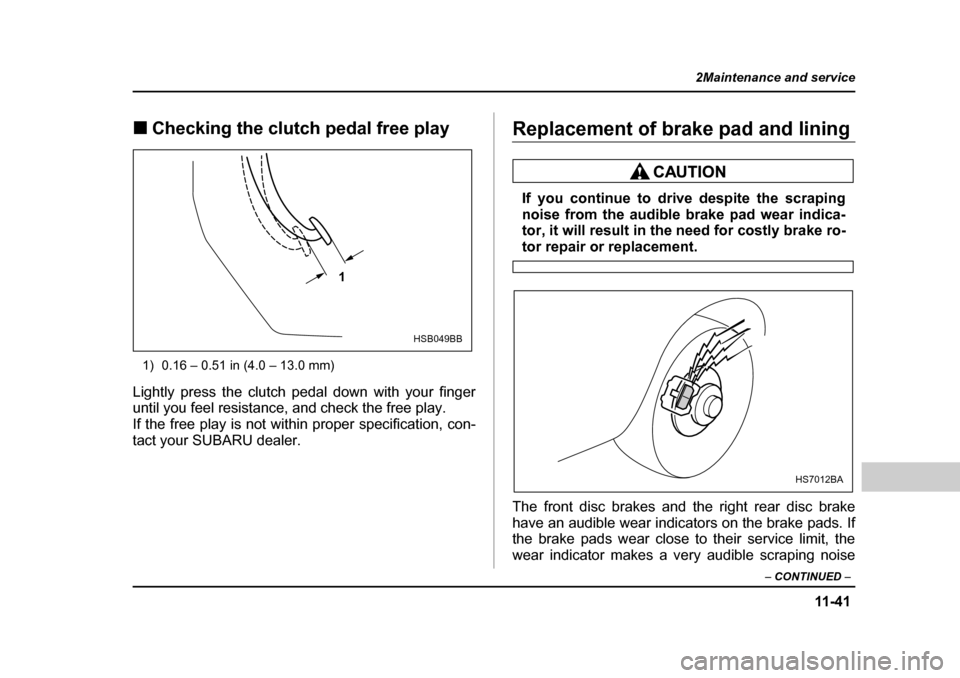
„Checking the clutch pedal free play
1) 0.16 – 0.51 in (4.0 – 13.0 mm)
Lightly press the clutch pedal down with your finger
until you feel resistance, and check the free play.
If the free play is not within proper specification, con-
tact your SUBARU dealer.Replacement of brake pad and lining
If you continue to drive despite the scraping
noise from the audible brake pad wear indica-
tor, it will result in the need for costly brake ro-
tor repair or replacement.
The front disc brakes and the right rear disc brake
have an audible wear indicators on the brake pads. If
the brake pads wear close to their service limit, the
wear indicator makes a very audible scraping noise
1
HSB049BB
HS7012BA
Page 446 of 525
11 -4 5
2Maintenance and service
– CONTINUED –
a pressure gauge to adjust the tire pressures to the
values shown on the tire placard. The tire placard is lo-
cated on the door pillar on the driver’s side.
Driving even a short distance warms up the tires and
increases the tire pressures. Also, the tire pressures
are affected by the ambient temperature. It is best to
check tire pressure outdoors before driving the vehi- cle.
When a tire becomes warm, the air inside it expands,
causing the tire pressure to increase. Be careful not to
mistakenly release air from a warm tire to reduce itspressure.
NOTE yThe air pressure in a tire increases by approxi-
mately 4.3 psi (30 kPa, 0.3 kg/cm 2
) when the tire
becomes warm. y The tires are considered cold when the vehicle
has been parked for at least three hours or has
been driven less than one mile (1.6 km).
Do not let air out of warm tires to adjust pres-sure. Doing so will result in low tire pressure. Incorrect tire pressures detract from controllability and
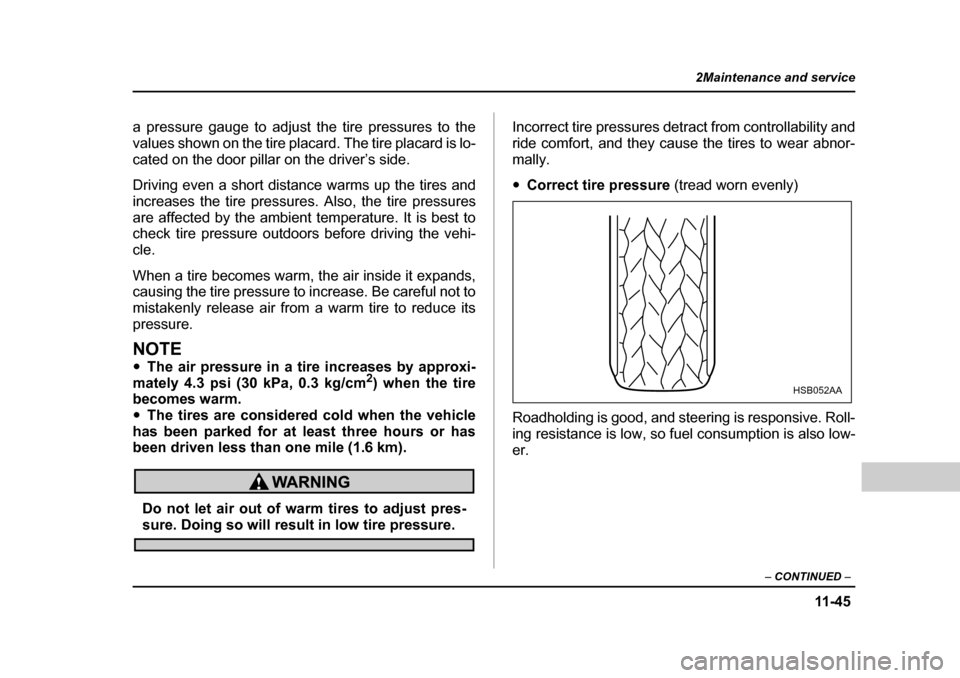
ride comfort, and they cause the tires to wear abnor-mally. y
Correct tire pressure (tread worn evenly)
Roadholding is good, and steering is responsive. Roll-
ing resistance is low, so fuel consumption is also low-er.
HSB052AA
Page 461 of 525
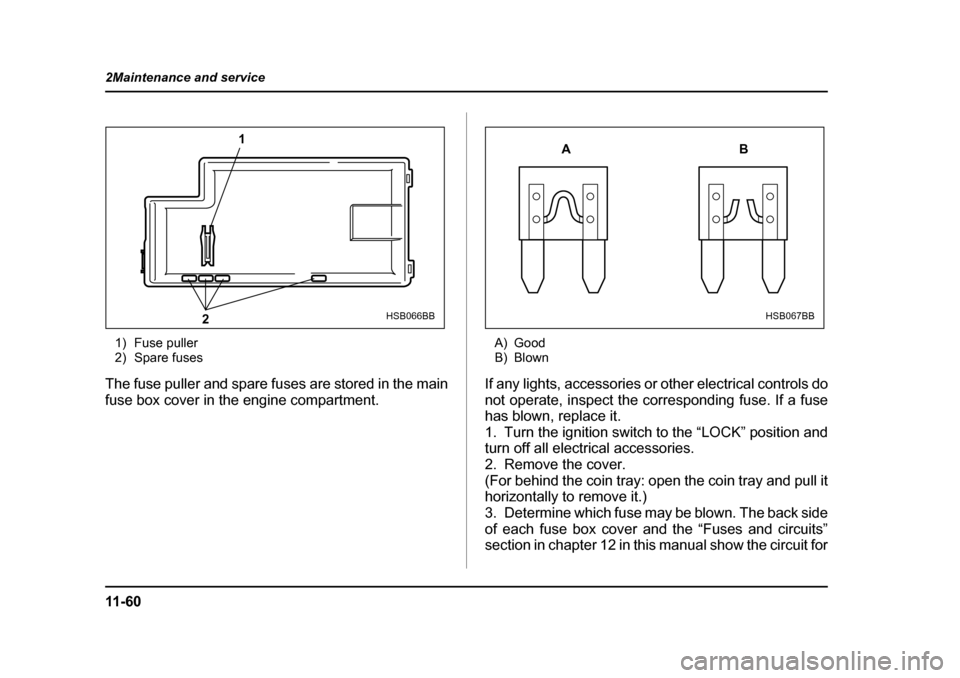
11 - 6 0
2Maintenance and service
1) Fuse puller
2) Spare fuses
The fuse puller and spare fuses are stored in the main
fuse box cover in the engine compartment. A) Good
B) Blown
If any lights, accessories or other electrical controls do
not operate, inspect the corresponding fuse. If a fuse
has blown, replace it.
1. Turn the ignition switch to the “LOCK” position and
turn off all electrical accessories.
2. Remove the cover.
(For behind the coin tray: open the coin tray and pull it
horizontally to remove it.)
3. Determine which fuse may be blown. The back side
of each fuse box cover and the “Fuses and circuits”
section in chapter 12 in this manual show the circuit for
1
2
HSB066BB
AB
HSB067BB
Page 511 of 525

13-16
Consumer information and Reporting safety defects
tests, and does not include acceleration,
cornering, hydroplaning, or peak traction
characteristics.
„ Temperature A, B, C
The temperature grades are A (the highest), B,
and C, representing the tire’s resistance to the
generation of heat and its ability to dissipate heat
when tested under controlled conditions on a
specified indoor laboratory test wheel. Sustained
high temperature can cause the material of the
tire to degenerate and reduce tire life, and exces-
sive temperature can lead to sudden tire failure.
The grade C corresponds to a level of perfor-
mance which all passenger car tires must meet
under the Federal Motor Vehicle Safety Stan-
dards No. 109. Grades B and A represent higher
levels of performance on the laboratory test
wheel than the minimum required by law.
The temperature grade for this tire is es-
tablished for a tire that is properly inflated and not overloaded. Excessive speed, un-
derinflation, or excessive loading, either
separately or in combination, can cause
heat buildup and possible tire failure.