lock SUBARU OUTBACK 2005 4.G Owners Manual
[x] Cancel search | Manufacturer: SUBARU, Model Year: 2005, Model line: OUTBACK, Model: SUBARU OUTBACK 2005 4.GPages: 627, PDF Size: 6.42 MB
Page 440 of 627
8-27
Driving tips
– CONTINUED –
Trailer hitch (if equipped)
"Never exceed the maximum weight specified
for the trailer hitch. Exceeding the maximum
weight could cause an accident resulting in se-
rious personal injuries. Permissible trailer
weight changes depending on the situation. Re-
fer to the next section “Trailer towing” for pos-
sible recommendations and limitations. " Trailer brakes are required when the towing
load exceeds 1,000 lbs (453 kg). Be sure your
trailer has safety chains and that each chain
will hold the trailer’s maximum gross weight.
Towing trailers without safety chains could cre-
ate a traffic safety hazard if the trailer separates
from the hitch due to coupling damage or hitch
ball damage. " Be sure to check the hitch pin and safety pin
for positive locking placement before towing a
trailer. If the ball mount comes off the hitch re-
ceiver, the trailer could get loose and create a
traffic safety hazard." Use only the ball mount supplied with this
hitch. Use the hitch only as a weight carrying
hitch. Do not use with any type of weight dis-
tributing hitch.
The trailer hitch is designed to tow a Class 1 rated
load. The maximum gross trailer weight and maximum
gross tongue weight are indicated in the following ta-
ble.
When you tow a trailer, follow the instructions in the
next section “Trailer towing”. ! Connecting a trailer
1. Remove the receiver cover from the hitch receiver
tube. Then insert the ball mount into the hitch receiver
tube. Maximum gross
trailer weight
Maximum gross
tongue weight
3.0-liter models 3,000 lbs (1,360 kg)
200 lbs (90 kg)
All models
other than
3.0-liter models 2,700 lbs
(1,224 kg)
Page 455 of 627
8-42
Driving tips
!
Driving on grades
" Before going down a steep hill, slow down and shift
into lower gear (if necessary, use 1st gear) in order to
utilize the engine braking effect and prevent overheat-
ing of your vehicle’s brakes. Do not make sudden
downshifts." When driving uphill in hot weather, the air condition-
er may turn off automatically to protect the engine from
overheating." When driving uphill in hot weather, pay attention to
the water temperature gauge pointer (for all vehicles)
and AT OIL TEMP warning light (for AT vehicles) since
the engine and transmission are relatively prone to
overheating under these conditions. If the water tem-
perature gauge pointer approaches the OVERHEAT
zone or the AT OIL TEMP warning light illuminates,
immediately switch off the air conditioner and stop the
vehicle at the nearest safe place. Refer to the “Engine
overheating” section in chapter 9, and “Warning and
indicator lights” section in chapter 3.
NOTE
With AT vehicles, the temperature of engine cool-
ant is less likely to rise to the OVERHEAT zone in
the “D” position than in the manual mode position. " If your vehicle has an automatic transmission, avoid
using the accelerator pedal to stay stationary on an uphill slope instead of using the parking brake or foot
brake. That may cause the transmission fluid to over-
heat. !
Parking on a grade
Always block the wheels under both vehicle and trailer
when parking. Apply the parking brake firmly. You
should not park on a hill or slope. But if parking on a
hill or slope cannot be avoided, you should take the
following steps:
1. Apply the brakes and hold the pedal down.
2. Have someone place wheel blocks under both the
vehicle and trailer wheels.
3. When the wheel blocks are in place, release the
regular brakes slowly until the blocks absorb the load.
4. Apply the regular brakes and then apply the park-
ing brake; slowly release the regular brakes.
5. Shift into 1st or reverse gear (manual transmission)
or “P” (automatic transmission) and shut off the en-
gine.
Page 456 of 627

9-1
9
In case of emergency
If you park your vehicle in an emergency .. 9-2
Temporary spare tire .................................... 9-3
Flat tires ......................................................... 9-5 Changing a flat tire ........................................... 9-5
Tire pressure monitoring system (TPMS) (if equipped) .................................................... 9-16
Jump starting ................................................ 9-17 How to jump start ............................................. 9-18
Engine overheating ....................................... 9-20 If steam is coming from the engine compartment .................................................. 9-20
If no steam is coming from the engine compartment .................................................. 9-20
Towing ........................................................... 9-21 Towing and tie-down hooks ............................ 9-22
Using a flat-bed truck ....................................... 9-27
Towing with all wheels on the ground ............ 9-28
Rear gate – if the rear gate cannot be unlocked ..................................................... 9-29
Moonroof – if the moonroof cannot be closed ......................................................... 9-30
Maintenance tools ......................................... 9-33 Jack .................................................................... 9-33
Jack handle ....................................................... 9-34
Other maintenance tools .................................. 9-35
Page 460 of 627
9-5
In case of emergency
– CONTINUED –
Flat tires
If you have a flat tire while driving, never brake sud-
denly; keep driving straight ahead while gradually re-
ducing speed. Then slowly pull off the road to a safe
place. !Changing a flat tire
"Do not jack up the vehicle on an incline or a
loose road surface. The jack can come out of
the jacking point or sink into the ground and
this can result in a severe accident." Use only the jack provided with your vehicle.
The jack supplied with the vehicle is designed
only for changing a tire. Never get under the ve-
hicle while supporting the vehicle with this jack. " Always turn the engine off before raising the
flat tire off the ground using the jack. Never
swing or push the vehicle supported with the
jack. The jack can come out of the jacking point
due to a jolt and this can result in a severe acci-
dent. 1. Park on a hard, level surface, whenever possible,
then stop the engine.
2. Set the parking brake securely and shift a manual
transmission vehicle in reverse or an automatic trans-
mission vehicle in the “P” (Park) position.
3. Turn on the hazard warning flasher and have ev-
eryone get out of the vehicle.
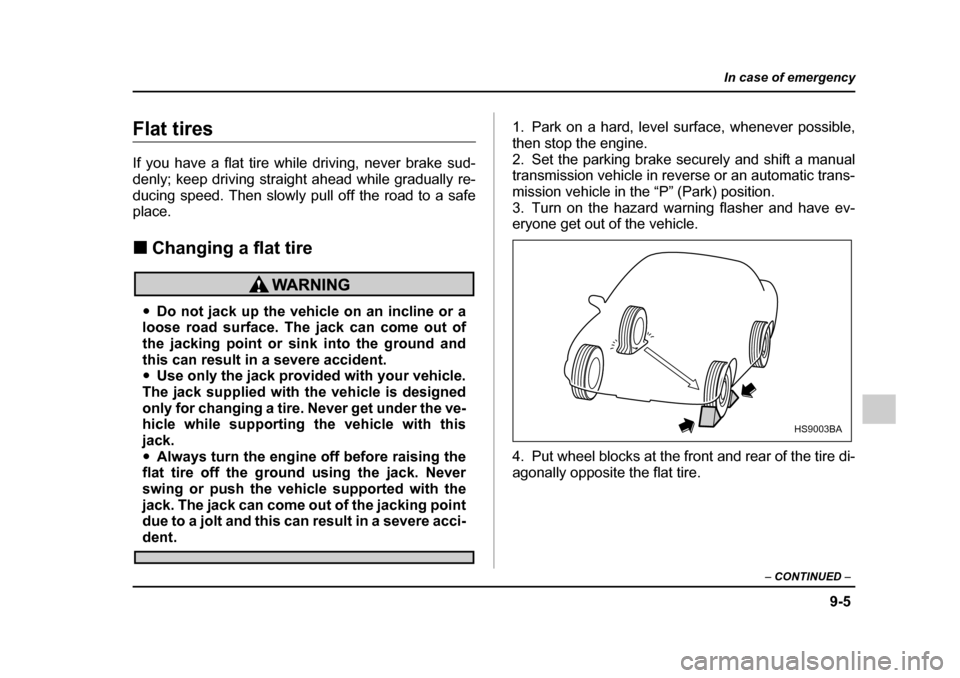
4. Put wheel blocks at the front and rear of the tire di-
agonally opposite the flat tire.
HS9003BA
Page 464 of 627
9-9
In case of emergency
– CONTINUED –
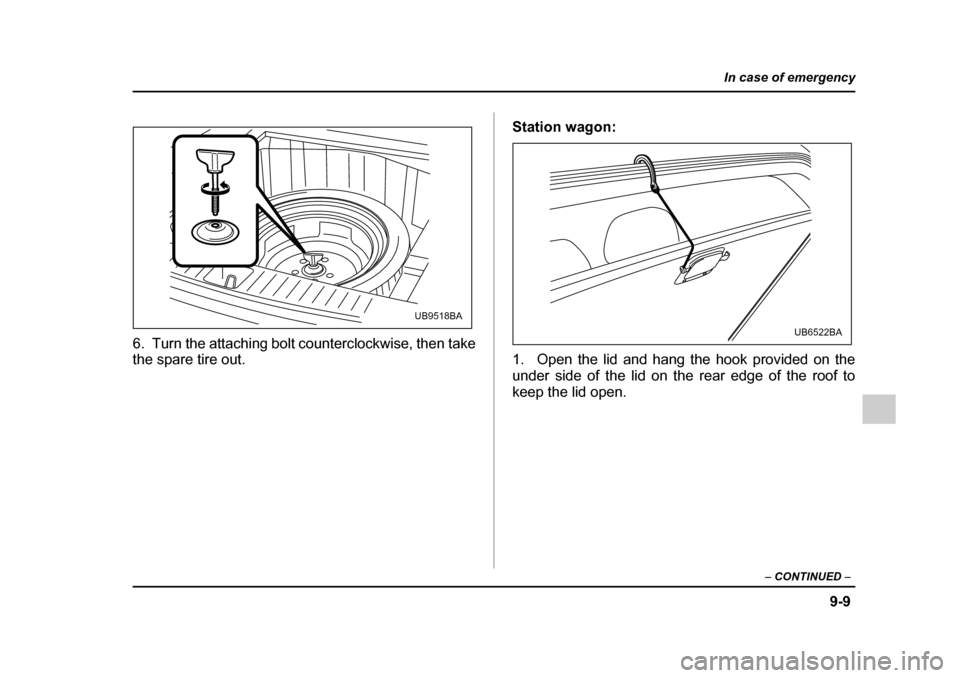
6. Turn the attaching bolt counterclockwise, then take
the spare tire out. Station wagon:
1. Open the lid and hang the hook provided on the
under side of the lid on the rear edge of the roof to
keep the lid open.
UB9518BA
UB6522BA
Page 467 of 627
9-12
In case of emergency
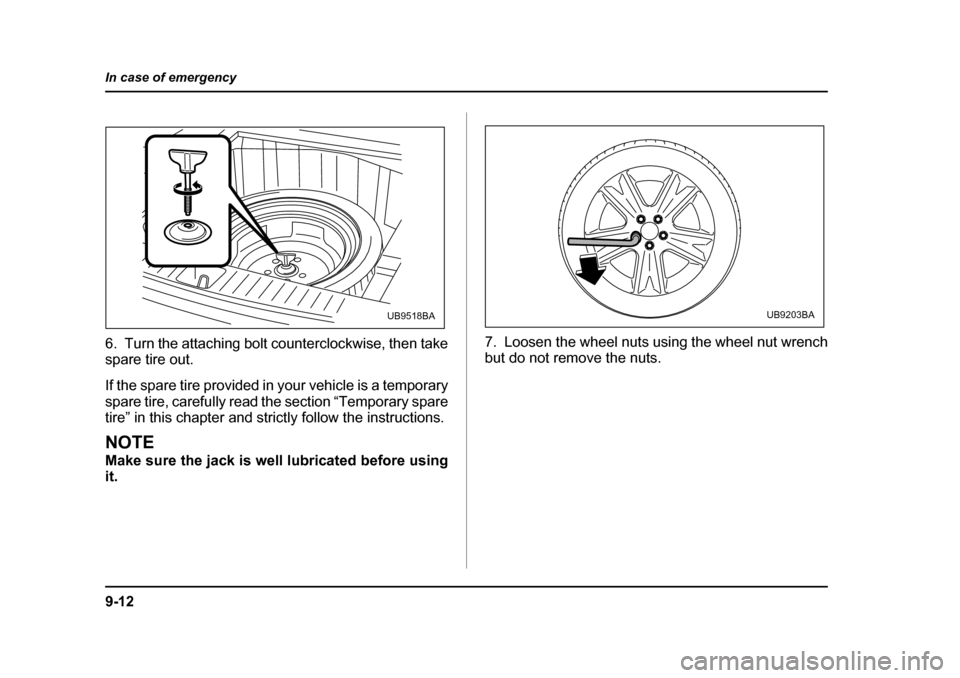
6. Turn the attaching bolt counterclockwise, then take
spare tire out.
If the spare tire provided in your vehicle is a temporary
spare tire, carefully read the section “Temporary spare
tire” in this chapter and strictly follow the instructions.
NOTE
Make sure the jack is well lubricated before using
it.
7. Loosen the wheel nuts using the wheel nut wrench
but do not remove the nuts.
UB9518BAUB9203BA
Page 470 of 627
9-15
In case of emergency
– CONTINUED –
surface of the wheel and hub with a cloth.
12.Put on the spare tire. Replace the wheel nuts.
Tighten them by hand.
Do not use oil or grease on the wheel studs or
nuts when the spare tire is installed. This could
cause the nuts to become loose and lead to an
accident.
13.Turn the jack handle counterclockwise to lower the vehicle. 14.Use the wheel nut wrench to securely tighten the
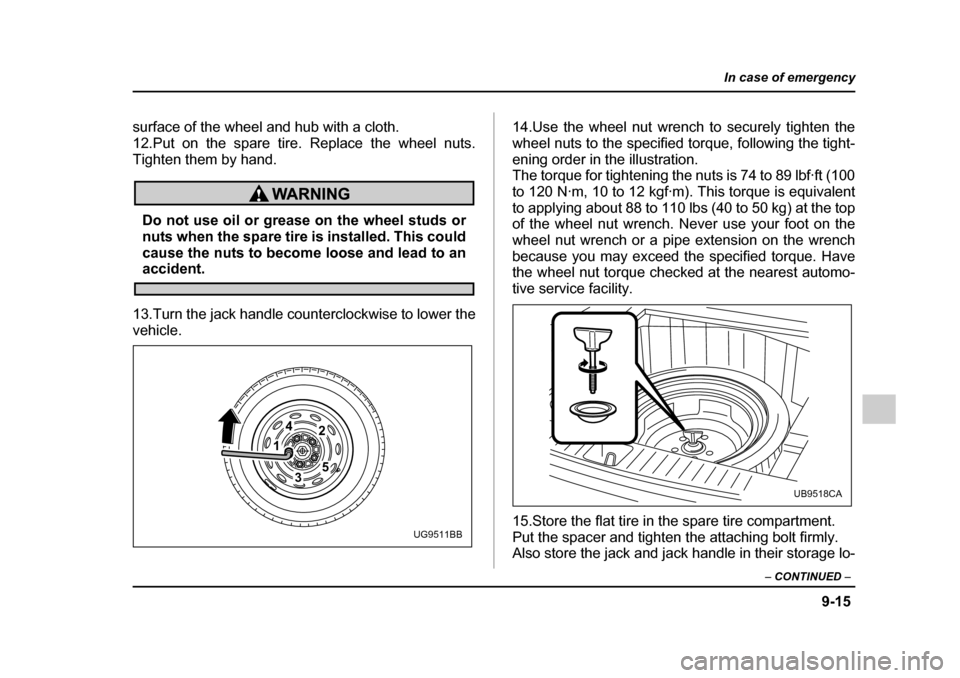
wheel nuts to the specified torque, following the tight-
ening order in the illustration.
The torque for tightening the nuts is 74 to 89 lbf·ft (100
to 120 N·m, 10 to 12 kgf·m). This torque is equivalent
to applying about 88 to 110 lbs (40 to 50 kg) at the top
of the wheel nut wrench. Never use your foot on the
wheel nut wrench or a pipe extension on the wrench
because you may exceed the specified torque. Have
the wheel nut torque checked at the nearest automo-
tive service facility.
15.Store the flat tire in the spare tire compartment.
Put the spacer and tighten the attaching bolt firmly.
Also store the jack and jack handle in their storage lo-
1
42
53
UG9511BB
UB9518CA
Page 476 of 627
9-21
In case of emergency
– CONTINUED –
Confirm that the cooling fan is turning. If the fan is not
turning, immediately turn the engine off and contact
your authorized dealer for repair.
3. After the engine coolant temperature has dropped, turn off the engine.
If the temperature gauge stays at the overheated
zone, turn the engine off.
4. After the engine has fully cooled down, check the
coolant level in the reserve tank.
If the coolant level is below the “MIN” mark, add cool-
ant up to the “MAX” mark.
5. If there is no coolant in the reserve tank, add cool-
ant to the reserve tank. Then remove the radiator cap
and fill the radiator with coolant.
If you remove the radiator cap from a hot radiator, first
wrap a thick cloth around the radiator cap, then turn
the cap counterclockwise slowly without pressing
down until it stops. Release the pressure from the ra-
diator. After the pressure has been fully released, re-
move the cap by pressing down and turning it.Towing
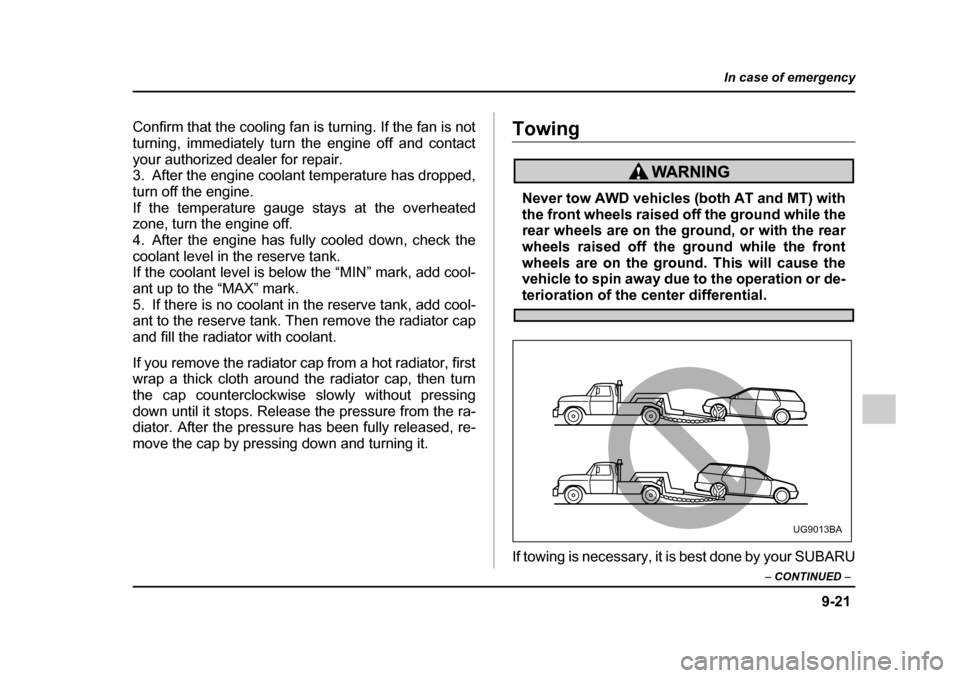
Never tow AWD vehicles (both AT and MT) with
the front wheels raised off the ground while the
rear wheels are on the ground, or with the rear
wheels raised off the ground while the front
wheels are on the ground. This will cause the
vehicle to spin away due to the operation or de-
terioration of the center differential.
If towing is necessary, it is best done by your SUBARU
UG9013BA
Page 483 of 627
9-28
In case of emergency
!
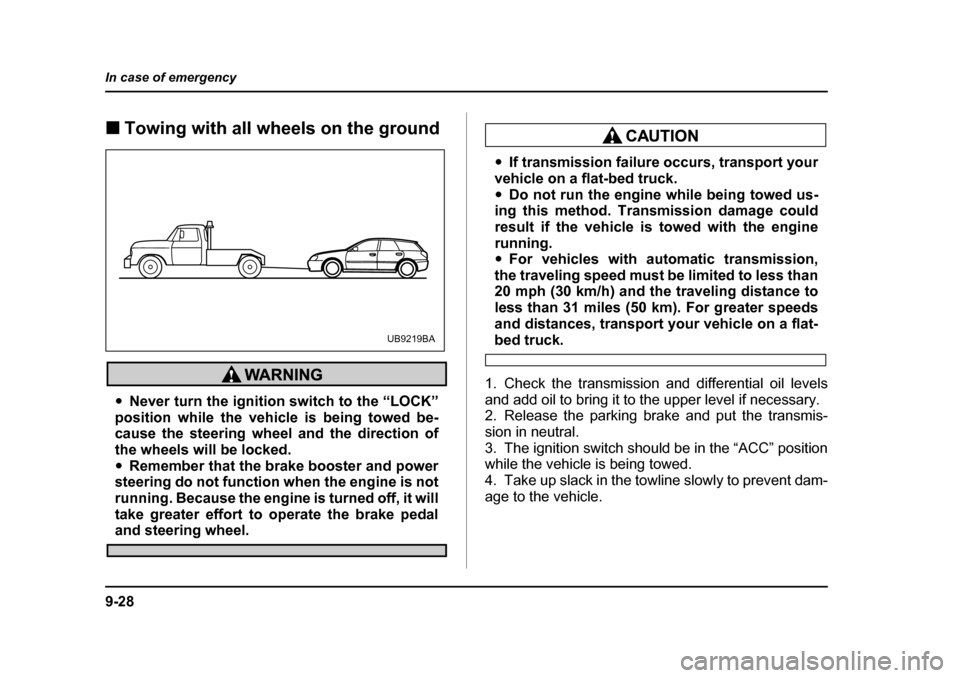
Towing with all wheels on the ground
"Never turn the ignition switch to the “LOCK”
position while the vehicle is being towed be-
cause the steering wheel and the direction of
the wheels will be locked." Remember that the brake booster and power
steering do not function when the engine is not
running. Because the engine is turned off, it will
take greater effort to operate the brake pedal
and steering wheel.
" If transmission failure occurs, transport your
vehicle on a flat-bed truck. " Do not run the engine while being towed us-
ing this method. Transmission damage could
result if the vehicle is towed with the engine
running. " For vehicles with automatic transmission,
the traveling speed must be limited to less than
20 mph (30 km/h) and the traveling distance to
less than 31 miles (50 km). For greater speeds
and distances, transport your vehicle on a flat-
bed truck.
1. Check the transmission and differential oil levels
and add oil to bring it to the upper level if necessary.
2. Release the parking brake and put the transmis-
sion in neutral.
3. The ignition switch should be in the “ACC” position
while the vehicle is being towed.
4. Take up slack in the towline slowly to prevent dam-
age to the vehicle.UB9219BA
Page 484 of 627
9-29
In case of emergency
– CONTINUED –
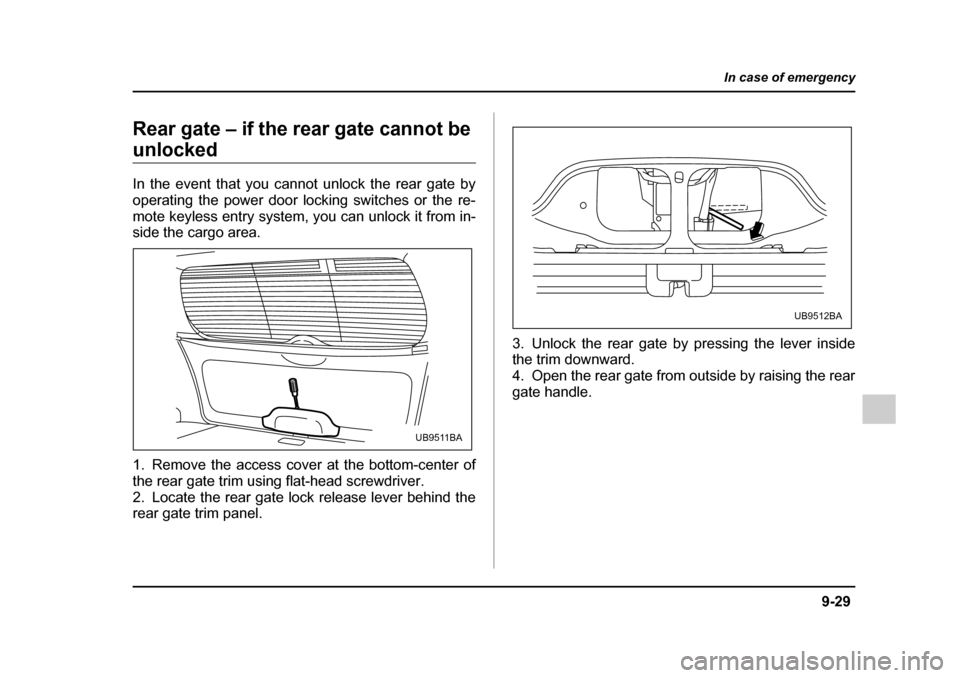
Rear gate – if the rear gate cannot be
unlocked
In the event that you cannot unlock the rear gate by
operating the power door locking switches or the re-
mote keyless entry system, you can unlock it from in-
side the cargo area.
0
1. Remove the access cover at the bottom-center of
the rear gate trim using flat-head screwdriver.
2. Locate the rear gate lock release lever behind the
rear gate trim panel. 3. Unlock the rear gate by pressing the lever inside
the trim downward.
4. Open the rear gate from outside by raising the rear
gate handle.
UB9511BA
UB9512BA