lock SUBARU OUTBACK 2005 4.G User Guide
[x] Cancel search | Manufacturer: SUBARU, Model Year: 2005, Model line: OUTBACK, Model: SUBARU OUTBACK 2005 4.GPages: 627, PDF Size: 6.42 MB
Page 30 of 627

27
–
CONTINUED –
Windshield wiper deicer (if
equipped) Windshield wiper deicer Operation for 15 min. / Continuous
operationOperation for15 min.3-56
Dome light Operation in interlock with remote keyless entry system OFF / Short / Normal / Long Normal 6-2
Battery drainage prevention
function Battery drainage prevention func-tion Operation / Non-operation Operation 2-9
Item Function Possible settings Default set-
tingPage
Page 32 of 627

1-1
1
Seat, seatbelt and SRS airbags
Front seats .................................................... 1-2 Manual seat ....................................................... 1-3
Power seat (if equipped) .................................. 1-5
Reclining the seatback ..................................... 1-6
Head restraint adjustment ................................ 1-8
Active head restraint ........................................ 1-8
Lumbar support (if equipped) .......................... 1-9
Seat heater (if equipped) .............................. 1-10
Rear seats ..................................................... 1-11 Folding down the rear seat – Station wagon .. 1-12
Head restraint adjustment ................................ 1-12
Armrest (if equipped) ................................... 1-14 Loading long objects (Sedan) .......................... 1-15
Seatbelts ....................................................... 1-16 Seatbelt safety tips ........................................... 1-16
Emergency Locking Retractor (ELR) .............. 1-18
Automatic/Emergency Locking Retractor (A/ELR) ............................................................ 1-18
Seatbelt warning light and chime .................... 1-19
Fastening the seatbelt ...................................... 1-21
Seatbelt maintenance ....................................... 1-33
Front seatbelt pretensioners ....................... 1-33 System monitors ............................................... 1-35
System servicing .............................................. 1-36
Precautions against vehicle modification ...... 1-37
Child restraint systems ................................ 1-38 Where to place a child restraint system ......... 1-40
Choosing a child restraint system .................. 1-41
Installing child restraint systems with A/ELR seatbelt ............................................................ 1-42 Installing a booster seat ................................... 1-47
Installation of child restraint systems by use
of lower and tether anchorages (LATCH) .... 1-49
Top tether anchorages ..................................... 1-55
*SRS airbag (Supplemental Restraint System airbag) ........................................... 1-59Vehicle with SRS airbags and lap/shoulder restraints for driver, front passenger, and
window-side rear passengers ....................... 1-59
Subaru advanced frontal airbag system ........ 1-65
SRS side airbag and SRS curtain airbag ........ 1-80
SRS airbag system monitors ........................... 1-89
SRS airbag system servicing .......................... 1-91
Precautions against vehicle modification ...... 1-92
Page 34 of 627
1-3
Seat, seatbelt and SRS airbags
– CONTINUED –
restrained or improperly restrained. Because
children are lighter and weaker than adults,
their risk of being injured from deployment is
greater. For that reason, we strongly recom-
mend that ALL children (including those in
child seats and those that have outgrown child
restraint devices) sit in the REAR seat properly
restrained at all times in a child restraint device
or in a seatbelt, whichever is appropriate for the
child’s age, height and weight.
Secure ALL types of child restraint devices (in-
cluding forward facing child seat) in the REAR
seats at all times.
NEVER INSTALL A REARWARD FACING CHILDSEAT IN THE FRONT SEAT. DOING SO RISKS
SERIOUS INJURY OR DEATH TO THE CHILD
BY PLACING THE CHILD’S HEAD TOO CLOSE
TO THE SRS AIRBAG.
According to accident statistics, children are
safer when properly restrained in the rear seat-
ing positions than in the front seating posi-
tions. For instructions and precautions con-
cerning child restraint systems, see the “Child
restraint systems” section in this chapter. !
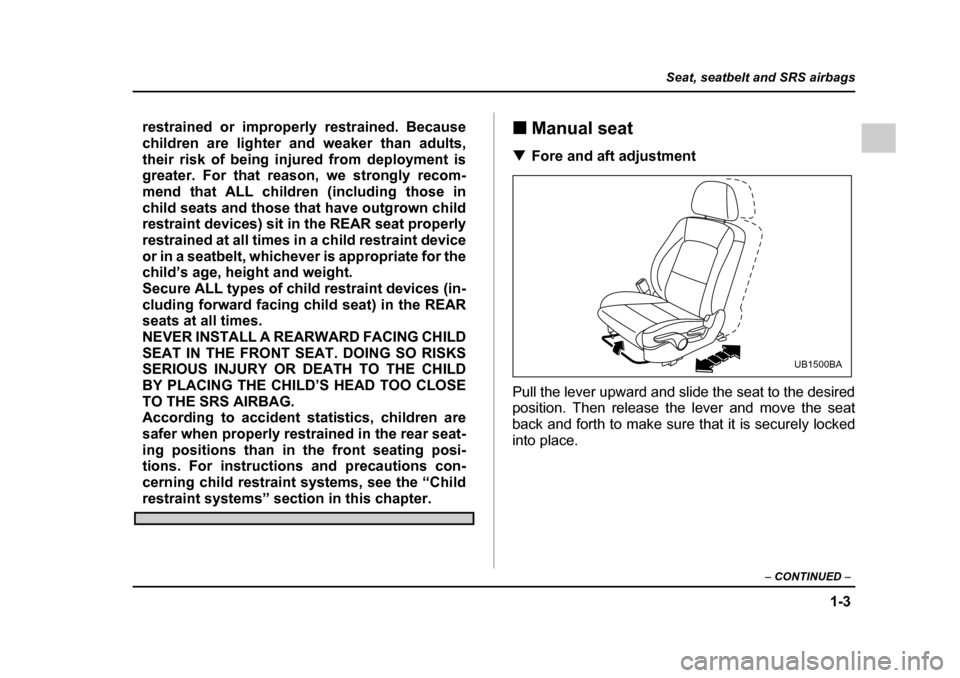
Manual seat
! Fore and aft adjustment
Pull the lever upward and slide the seat to the desired
position. Then release the lever and move the seat
back and forth to make sure that it is securely locked
into place.
UB1500BA
Page 35 of 627
1-4
Seat, seatbelt and SRS airbags
!
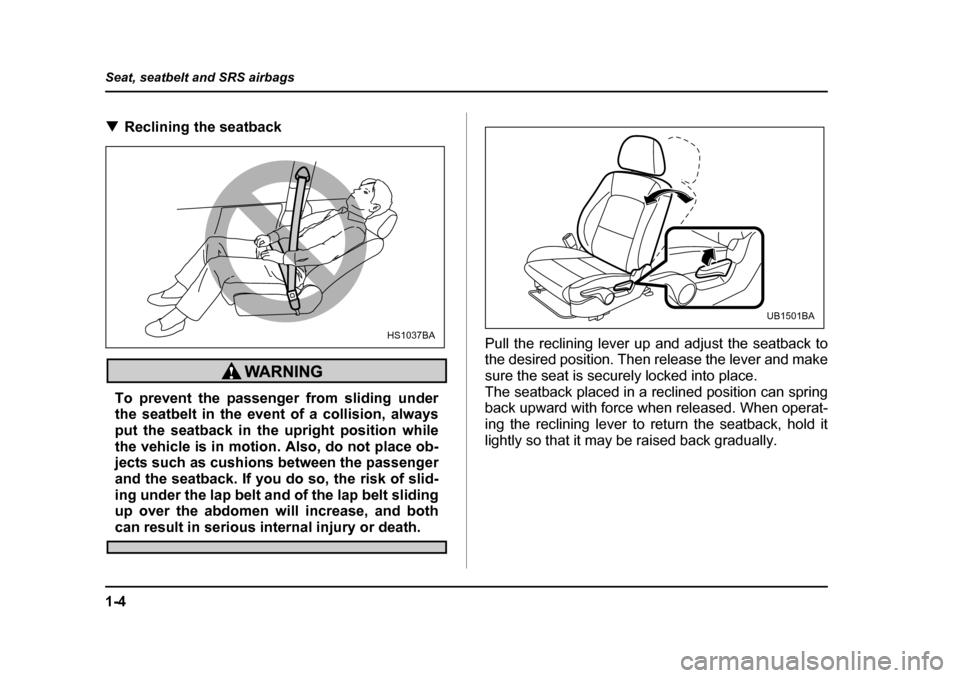
Reclining the seatback
To prevent the passenger from sliding under
the seatbelt in the event of a collision, alwaysput the seatback in the upright position while
the vehicle is in motion. Also, do not place ob-
jects such as cushions between the passenger
and the seatback. If you do so, the risk of slid-
ing under the lap belt and of the lap belt sliding
up over the abdomen will increase, and both
can result in serious internal injury or death. Pull the reclining lever up and adjust the seatback to
the desired position. Then release the lever and make
sure the seat is securely locked into place.
The seatback placed in a reclined position can spring
back upward with force when released. When operat-
ing the reclining lever to return the seatback, hold it
lightly so that it may be raised back gradually.
HS1037BA
UB1501BA
Page 43 of 627
1-12
Seat, seatbelt and SRS airbags
!
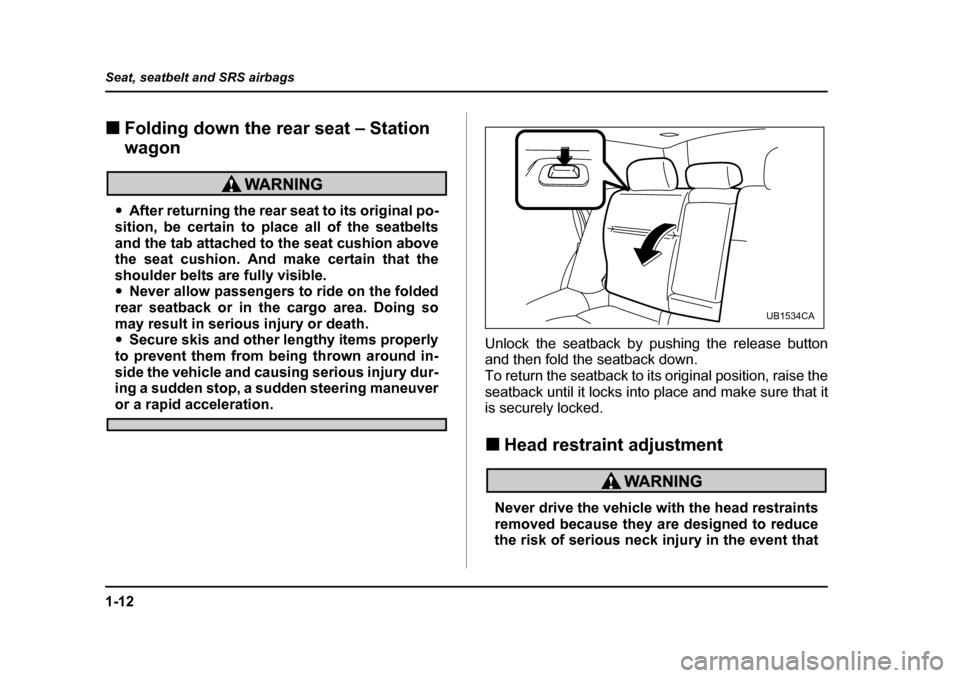
Folding down the rear seat – Station wagon
"After returning the rear seat to its original po-
sition, be certain to place all of the seatbelts
and the tab attached to the seat cushion above
the seat cushion. And make certain that the
shoulder belts are fully visible. " Never allow passengers to ride on the folded
rear seatback or in the cargo area. Doing so
may result in serious injury or death. " Secure skis and other lengthy items properly
to prevent them from being thrown around in-
side the vehicle and causing serious injury dur-
ing a sudden stop, a sudden steering maneuver
or a rapid acceleration. Unlock the seatback by pushing the release button
and then fold the seatback down.
To return the seatback to its original position, raise the
seatback until it locks into place and make sure that it
is securely locked. !
Head restraint adjustment
Never drive the vehicle with the head restraints
removed because they are designed to reduce
the risk of serious neck injury in the event that
UB1534CA
Page 49 of 627
1-18
Seat, seatbelt and SRS airbags
!
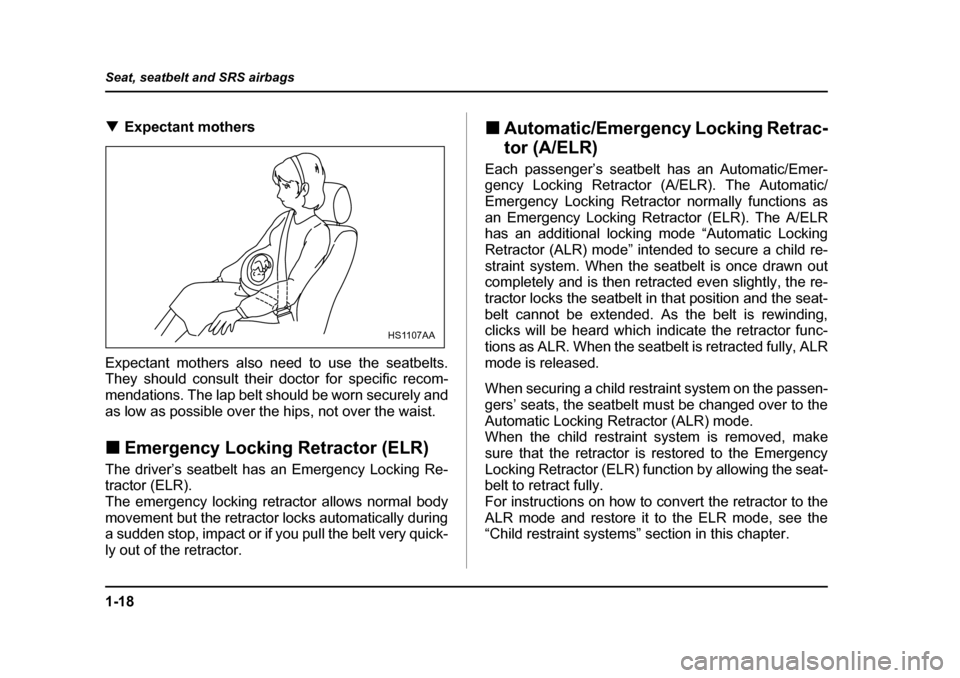
Expectant mothers
Expectant mothers also need to use the seatbelts.
They should consult their doctor for specific recom-
mendations. The lap belt should be worn securely and
as low as possible over the hips, not over the waist. ! Emergency Locking Retractor (ELR)
The driver’s seatbelt has an Emergency Locking Re-
tractor (ELR).
The emergency locking retractor allows normal body
movement but the retractor locks automatically during
a sudden stop, impact or if you pull the belt very quick-
ly out of the retractor. !
Automatic/Emergency Locking Retrac- tor (A/ELR)
Each passenger’s seatbelt has an Automatic/Emer-
gency Locking Retractor (A/ELR). The Automatic/
Emergency Locking Retractor normally functions as
an Emergency Locking Retractor (ELR). The A/ELR
has an additional locking mode “Automatic Locking
Retractor (ALR) mode” intended to secure a child re-
straint system. When the seatbelt is once drawn out
completely and is then retracted even slightly, the re-
tractor locks the seatbelt in that position and the seat-
belt cannot be extended. As the belt is rewinding,
clicks will be heard which indicate the retractor func-
tions as ALR. When the seatbelt is retracted fully, ALR
mode is released.
When securing a child restraint system on the passen-
gers’ seats, the seatbelt must be changed over to the
Automatic Locking Retractor (ALR) mode.
When the child restraint system is removed, make
sure that the retractor is restored to the Emergency
Locking Retractor (ELR) function by allowing the seat-
belt to retract fully.
For instructions on how to convert the retractor to the
ALR mode and restore it to the ELR mode, see the “Child restraint systems” section in this chapter.
HS1107AA
Page 51 of 627
1-20
Seat, seatbelt and SRS airbags
seconds later (21 seconds after turning ON the ignition
switch), the warning lights will alternate between flash-
ing and steady illumination at 15-second intervals, and
the chime will sound while the warning light(s) is/are
flashing.
Alternate flashing and steady illumination of the warn-
ing lights and sounding of the chime will continue until
both driver and front passenger fasten their seatbelts.
NOTE "
If the driver and/or front passenger unfasten(s)
the seatbelt(s) after fastening, the seatbelt warn-
ing device operates as follows according to the
vehicle speed. "At speeds lower than approximately 9 mph (15
km/h)The warning light(s) for unfastened seatbelt(s)
will alternate between flashing and steady illu-
mination at 15-second intervals. The chime will
not sound. " At approximately 9 mph (15 km/h) or higher
speeds The warning light(s) for unfastened seatbelt(s)
will alternate between flashing and steady illu-
mination at 15-second intervals and the chime
will sound while the warning light(s) is/are flash-
ing.
" It is possible to cancel the warning operation that follows the 6-second warning after turning ON
the ignition switch by unfastening and refastening
the driver’s seatbelt. When the ignition switch is
turned ON next time, however, the complete se-
quence of warning operation resumes. For further
details about canceling the warning operation,
please contact your SUBARU dealer.
If there is no passenger on the front passenger’s seat,
the seatbelt warning device for front passenger’s seat
will be deactivated. The front passenger’s occupant
detection system monitors whether or not there is a
passenger on the front passenger’s seat.
Observe the following precautions. Failure to do so
may prevent the device from functioning correctly or
cause the device to fail. "
Do not install any accessory such as a table or TV
onto the seatback. " Do not store a heavy load in the seatback pocket.
" Do not allow the rear seat occupant to place his/her
hands or legs on the front passenger’s seatback, or al-
low him/her to pull the seatback. " Do not use front seats with their backward-forward
position and seatback not being locked into place se-
curely. If any of them are not locked securely, adjust
them again. For adjusting procedure, refer to the
“Manual seat” in the front seats section in Chapter 1 in
this owner’s manual. (Models equipped with manual
Page 52 of 627
1-21
Seat, seatbelt and SRS airbags
– CONTINUED –
seats only)
If the seatbelt warning device for front passenger’s
seat does not function correctly (e.g., it is activated
even when the front passenger’s seat is empty or it is
deactivated even when the front passenger has not
fastened his/her seatbelt), take the following actions. "Ensure that no article is placed on the seat other
than the child restraint system and the child occupant. " Ensure that there is no article left in the seatback
pocket." Ensure that the backward-forward position and
seatback of front passenger’s seat are locked into
place securely by moving the seat back and forth.
(Models equipped with manual seats only)
If still the seatbelt warning device for front passenger’s
seat does not function correctly after taking relevant
corrective actions described above, immediately con-
tact your SUBARU dealer for an inspection. ! Fastening the seatbelt
"Never use a belt that is twisted or reversed. In
an accident, this can increase the risk or sever-
ity of injury. "
Keep the lap belt as low as possible on your
hips. In a collision, this spreads the force of the
lap belt over stronger hip bones instead of
across the weaker abdomen. " Seatbelts provide maximum restraint when
the occupant sits well back and upright in the
seat. To reduce the risk of sliding under the
seatbelt in a collision, the front seatbacks
should be always used in the upright position
while the vehicle is running. If the front seat-
backs are not used in the upright position in a
collision, the risk of sliding under the lap belt
and of the lap belt sliding up over the abdomen
will increase, and both can result in serious in-
ternal injury or death. " Do not put cushions or any other materials
between occupants and seatbacks or seat
cushions. If you do so, the risk of sliding under
the lap belt and of the lap belt sliding up over
the abdomen will increase, and both can result
in serious internal injury or death.
Page 53 of 627
1-22
Seat, seatbelt and SRS airbags
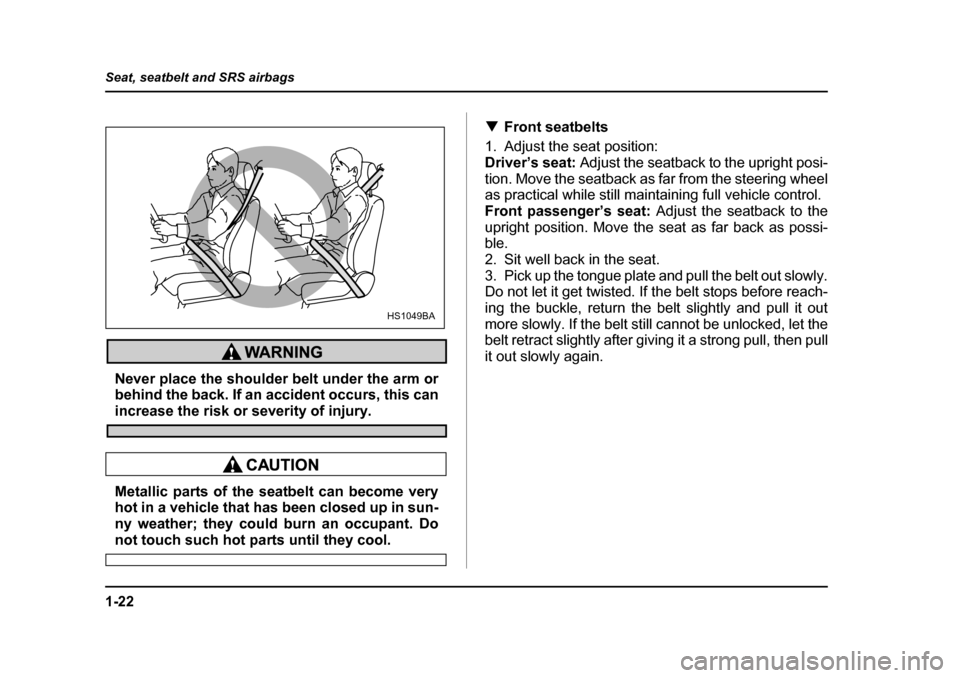
Never place the shoulder belt under the arm or
behind the back. If an accident occurs, this can
increase the risk or severity of injury.
Metallic parts of the seatbelt can become very
hot in a vehicle that has been closed up in sun-
ny weather; they could burn an occupant. Do
not touch such hot parts until they cool.
!
Front seatbelts
1. Adjust the seat position:
Driver’s seat: Adjust the seatback to the upright posi-
tion. Move the seatback as far from the steering wheel
as practical while still maintaining full vehicle control.
Front passenger’s seat: Adjust the seatback to the
upright position. Move the seat as far back as possi-
ble.
2. Sit well back in the seat.
3. Pick up the tongue plate and pull the belt out slowly.
Do not let it get twisted. If the belt stops before reach-
ing the buckle, return the belt slightly and pull it out
more slowly. If the belt still cannot be unlocked, let the
belt retract slightly after giving it a strong pull, then pull
it out slowly again.
HS1049BA
Page 55 of 627
1-24
Seat, seatbelt and SRS airbags
"
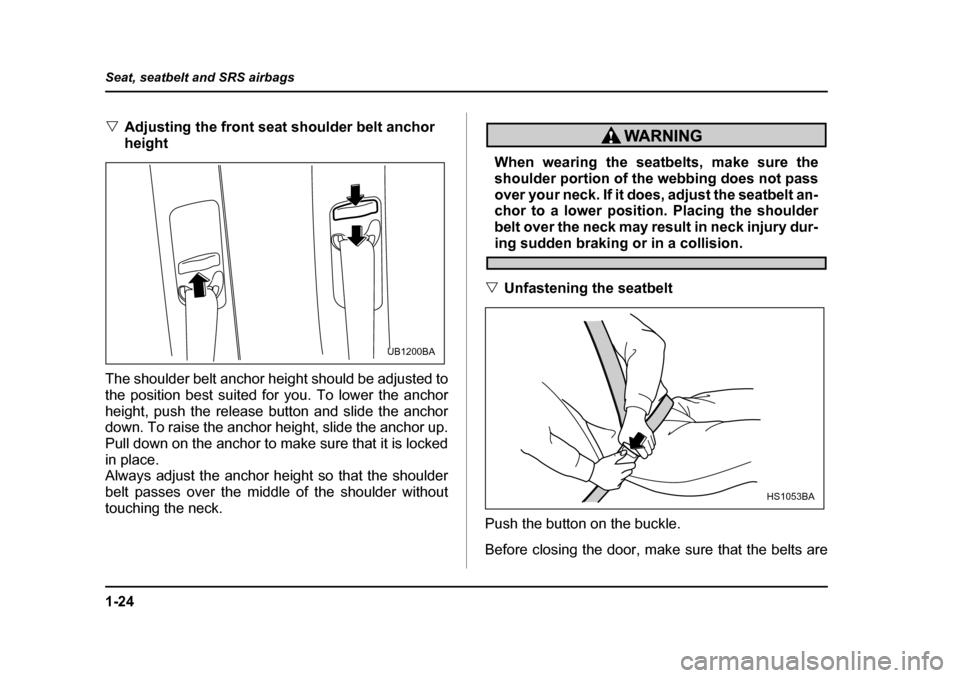
Adjusting the front seat shoulder belt anchor
height
The shoulder belt anchor height should be adjusted to
the position best suited for you. To lower the anchor
height, push the release button and slide the anchor
down. To raise the anchor height, slide the anchor up.
Pull down on the anchor to make sure that it is locked
in place.
Always adjust the anchor height so that the shoulder
belt passes over the middle of the shoulder without
touching the neck.
When wearing the seatbelts, make sure the
shoulder portion of the webbing does not pass
over your neck. If it does, adjust the seatbelt an-
chor to a lower position. Placing the shoulder
belt over the neck may result in neck injury dur-
ing sudden braking or in a collision.
" Unfastening the seatbelt
Push the button on the buckle.
Before closing the door, make sure that the belts are
UB1200BA
HS1053BA