tire size SUBARU OUTBACK 2005 4.G User Guide
[x] Cancel search | Manufacturer: SUBARU, Model Year: 2005, Model line: OUTBACK, Model: SUBARU OUTBACK 2005 4.GPages: 627, PDF Size: 6.42 MB
Page 430 of 627
8-17
Driving tips
– CONTINUED –
!Tire chains
Tire chains cannot be used on tires listed below
because of lack of clearance between the tires
and vehicle body. "2.5-liter non-turbo models (except OUT-
BACK): P205/55R16 tires " 2.5-liter turbo models (except OUTBACK):
215/45ZR17 tires " 2.5-liter non-turbo models (OUTBACK): P225/
60R16 tires" 2.5-liter turbo and 3.0-liter models (OUT-
BACK): P225/55R17 tires " 2.5-liter non-turbo and 3.0-liter models (OUT-
BACK): P225/60R16 winter (snow) tires " 2.5-liter non-turbo and 3.0-liter models (OUT-
BACK): P215/60R16 winter (snow) tires " 2.5-liter turbo and 3.0-liter models (OUT-
BACK): P215/55R17 winter (snow) tires
Driving on snowy grades or icy roads may require the
use of tire chains, in which case put the chains on the
front wheels only. Use only SAE class S type chains
that are of the correct size for your tires so as not to
damage the vehicle body or suspension. When driving with tire chains, drive at speeds below
19 mph (30 km/h). When a temporary spare tire is on
a front wheel, replace the temporary spare tire with the
rear tire on the same side of the vehicle, and then fit
chains on the front tires.
Always use the utmost care when driving with tire
chains – overconfidence because you are driving with
tire chains could easily lead to a serious accident. !
Rocking the vehicle
If you must rock the vehicle to free it from snow, sand,
or mud, depress the accelerator pedal slightly and
move the selector lever back and forth between “D”
and “R” repeatedly. Do not race the engine. For the
best possible traction, avoid spinning the wheels when
trying to free the vehicle.
When the road surface is extremely slippery, you can
obtain better traction by starting the vehicle with the
transmission in 2nd than 1st (both for MT and AT).
Refer to the “Automatic transmission” section in chap-
ter 7 for information on holding the transmission in 2nd
position.
Page 444 of 627
8-31
Driving tips
– CONTINUED –
Trailer towing
Your vehicle is designed and intended to be used pri-
marily as a passenger-carrying vehicle. Towing a trail-
er puts additional loads on your vehicle’s engine, driv-
etrain, brakes, tires and suspension and has an ad-
verse effect on fuel economy.
If you do decide to tow a trailer, your safety and satis-
faction depend upon proper use of correct equipment
and cautious operation of your vehicle. Seek the ad-
vice of your SUBARU dealer to assist you in purchas-
ing a hitch and other necessary towing equipment ap-
propriate for your vehicle. In addition, be sure to follow
the instructions on correct installation and use provid-
ed by the trailer and other towing equipment manufac-
turers.
SUBARU assumes no responsibility for injuries or ve-
hicle damage that result from trailer towing equipment,
or from any errors or omissions in the instructions ac-
companying such equipment or for your failure to fol-
low the proper instructions. !Warranties and maintenance
SUBARU warranties do not apply to vehicle damage
or malfunction caused by trailer towing. If you use your
vehicle to tow a trailer, more frequent maintenance will
be required due to the additional load. (Refer to “Main- tenance schedule under severe driving conditions” in
the “Warranty and Maintenance Booklet”.)
Under no circumstances should a trailer be towed with
a new vehicle or a vehicle with any new powertrain
component (engine, transmission, differential, wheel
bearings, etc.) for the first 1,000 miles (1,600 km) of
driving. !
Maximum load limits
Never exceed the maximum load limits ex-
plained below. Exceeding the maximum load
limits could cause personal injury and/or vehi-
cle damage.
"Adequate size trailer brakes are required
when the trailer and its cargo exceed 1,000 lbs
(453 kg) total weight. " Before towing a trailer, check the trailer total
weight, GVW, GAWs and tongue load. Make
sure the load and its distribution in your vehicle
Page 453 of 627
8-40
Driving tips
and in “GAS STATION REFERENCE” at the end of
this manual. Adjust the rear tire pressure to the recom-
mended pressure when the tires are cold. Normal
pressure should be maintained in the front tires.
Trailer tire condition, size, load rating and proper infla-
tion pressure should be in accordance with the trailer
manufacturer’s specifications.
In the event your vehicle gets a flat tire when towing a
trailer, ask a commercial road service to repair the flat tire.
If you carry a regular size spare tire in your vehicle or
trailer as a precaution against getting a flat tire, be
sure that the spare tire is firmly secured. !
Trailer towing tips
"Never exceed 45 mph (72 km/h) when towing
a trailer in hilly country on hot days. " When towing a trailer, steering, stability,
stopping distance and braking performance
will be different from normal operation. For
safety’s sake, you should employ extra caution
when towing a trailer and you should never speed. You should also keep the following tips
in mind:
! Before starting out on a trip
" Check that the vehicle and vehicle-to-hitch mount-
ing are in good condition. If any problems are appar-
ent, do not tow the trailer." Check that the vehicle sits horizontally with the trail-
er attached. If the vehicle is tipped sharply up at the
front and down at the rear, check the total trailer
weight, GVW, GAWs and tongue load again, then con-
firm that the load and its distribution are acceptable. " Check that the tire pressures are correct.
" Check that the vehicle and trailer are connected
properly. Confirm that.
– the trailer tongue is connected properly to the
hitch ball.
– the trailer lights connector is connected properly
and trailer’s brake lights illuminate when the vehi-
cle’s brake pedal is pressed, and that the trailer’s
turn signal lights flash when the vehicle’s turn signal
lever is operated.
– the safety chains are connected properly.
– all cargo in the trailer is secured safety in position.
– the side mirrors provide a good rearward field of
view without a significant blind spot.
Page 458 of 627
9-3
In case of emergency
– CONTINUED –
Temporary spare tire
"Never tow a trailer when the temporary spare
tire is used. The temporary spare tire is not de-
signed to sustain the towing load. Use of the
temporary spare tire when towing can result in
failure of the spare tire and/or less stability of
the vehicle and may lead to an accident. " When a spare tire is mounted or a wheel rim
is replaced without the original pressure sen-
sor/transmitter being transferred, the low tire
pressure warning light will flash. This indicates
the tire pressure monitoring system (TPMS) is
unable to monitor all four road wheels. Contact
your SUBARU dealer as soon as possible for
tire and sensor replacement and/or system re-
setting.
Never use any temporary spare tire other than
the original. Using other sizes may result in se-
vere mechanical damage to the drive train of
your vehicle.
The temporary spare tire is smaller and lighter than a
conventional tire and is designed for emergency use
only. Remove the temporary spare tire and re-install
the conventional tire as soon as possible because the
spare tire is designed only for temporary use.
Check the inflation pressure of the temporary spare
tire periodically to keep the tire ready for use. The cor-
rect pressure is 60 psi (420 kPa, 4.2 kgf/cm 2
).
When using the temporary spare tire, note the follow-
ing: " Do not exceed 50 mph (80 km/h).
" Do not put a tire chain on the temporary spare tire.
Because of the smaller tire size, a tire chain will not fit
properly. " Do not use two or more temporary spare tires at the
same time. " Do not drive over obstacles. This tire has a smaller
diameter, so road clearance is reduced.
Page 555 of 627
11 - 5 6
Maintenance and service
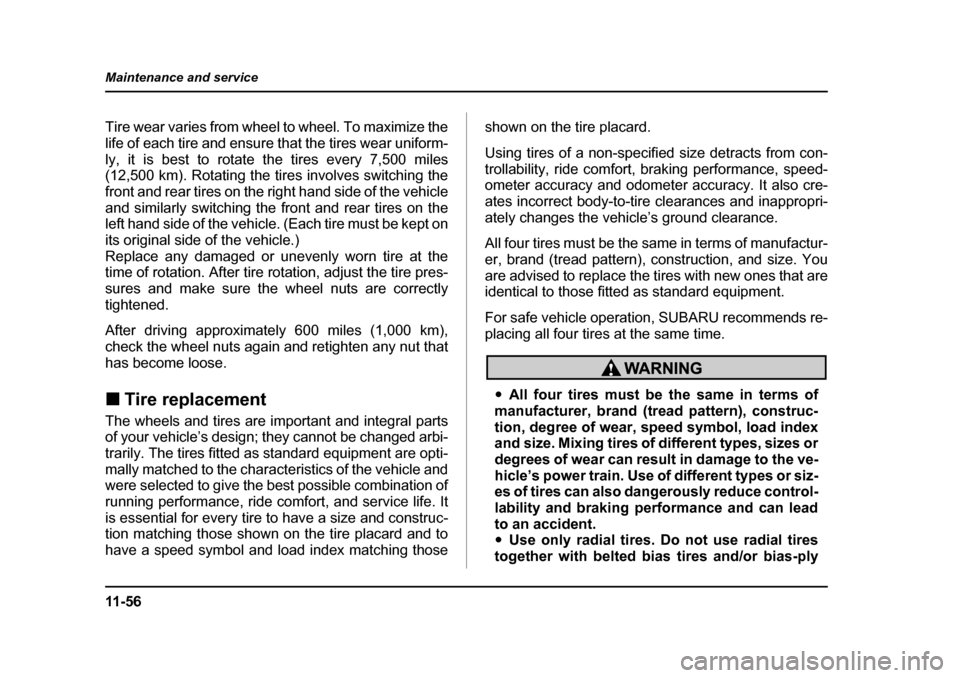
Tire wear varies from wheel to wheel. To maximize the
life of each tire and ensure that the tires wear uniform-
ly, it is best to rotate the tires every 7,500 miles
(12,500 km). Rotating the tires involves switching the
front and rear tires on the right hand side of the vehicle
and similarly switching the front and rear tires on the
left hand side of the vehicle. (Each tire must be kept on
its original side of the vehicle.)
Replace any damaged or unevenly worn tire at the
time of rotation. After tire rotation, adjust the tire pres-
sures and make sure the wheel nuts are correctly
tightened.
After driving approximately 600 miles (1,000 km),
check the wheel nuts again and retighten any nut that
has become loose. !
Tire replacement
The wheels and tires are important and integral parts
of your vehicle’s design; they cannot be changed arbi-
trarily. The tires fitted as standard equipment are opti-
mally matched to the characteristics of the vehicle and
were selected to give the best possible combination of
running performance, ride comfort, and service life. It
is essential for every tire to have a size and construc-
tion matching those shown on the tire placard and to
have a speed symbol and load index matching those shown on the tire placard.
Using tires of a non-specified size detracts from con-
trollability, ride comfort, braking performance, speed-
ometer accuracy and odometer accuracy. It also cre-
ates incorrect body-to-tire clearances and inappropri-
ately changes the vehicle’s ground clearance.
All four tires must be the same in terms of manufactur-
er, brand (tread pattern), construction, and size. You
are advised to replace the tires with new ones that are
identical to those fitted as standard equipment.
For safe vehicle operation, SUBARU recommends re-
placing all four tires at the same time.
"
All four tires must be the same in terms of
manufacturer, brand (tread pattern), construc-
tion, degree of wear, speed symbol, load index
and size. Mixing tires of different types, sizes or
degrees of wear can result in damage to the ve-
hicle’s power train. Use of different types or siz-
es of tires can also dangerously reduce control-
lability and braking performance and can lead
to an accident. " Use only radial tires. Do not use radial tires
together with belted bias tires and/or bias-ply
Page 590 of 627
12-5
Specifications
– CONTINUED –
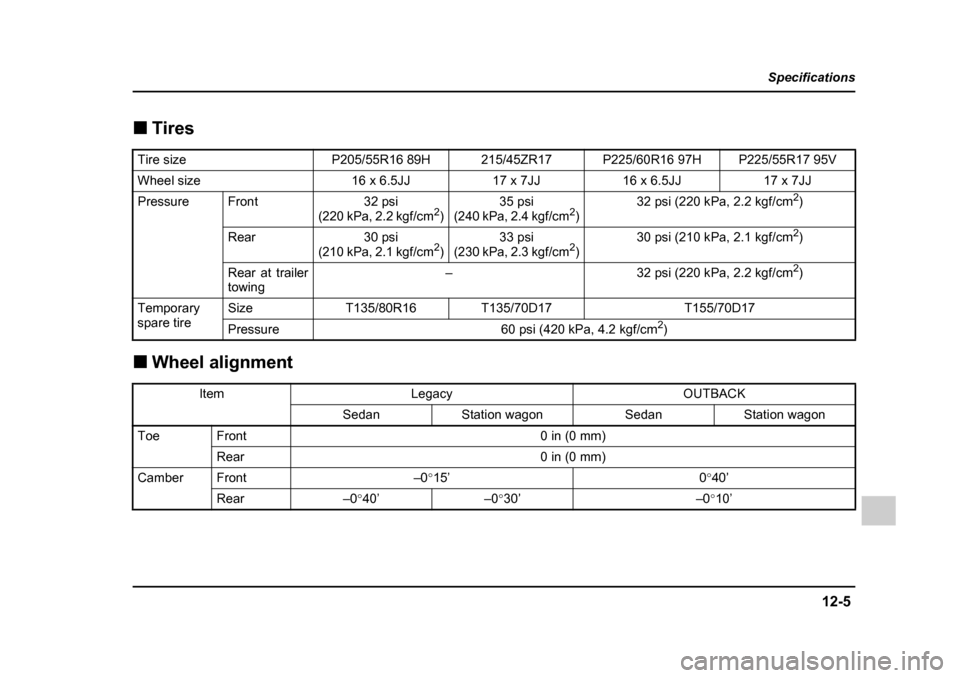
!Tires
! Wheel alignment
Tire sizeP205/55R16 89H215/45ZR17P225/60R16 97HP225/55R17 95V
Wheel size16 x 6.5JJ17 x 7JJ16 x 6.5JJ17 x 7JJ
PressureFront32 psi
(220 kPa, 2.2 kgf/cm 2
)35 psi
(240 kPa, 2.4 kgf/cm 2
)32 psi (220 kPa, 2.2 kgf/cm 2
)
Rear30 psi
(210 kPa, 2.1 kgf/cm 2
)33 psi
(230 kPa, 2.3 kgf/cm 2
)30 psi (210 kPa, 2.1 kgf/cm 2
)
Rear at trailer
towing–32 psi (220 kPa, 2.2 kgf/cm 2
)
Temporary
spare tireSizeT135/80R16T135/70D17T155/70D17
Pressure60 psi (420 kPa, 4.2 kgf/cm 2
)
ItemLegacyOUTBACK
SedanStation wagonSedanStation wagon
ToeFront0 in (0 mm)
Rear0 in (0 mm)
CamberFront–0 °15’0 °40’
Rear–0 °40’–0 °30’–0 °10’
Page 599 of 627
13-2
Consumer information and Reporting safety defects
Consumer information and Reporting safety defectsFor U.S.A.
The following information has been compiled accord-
ing to Code of Federal Regulations “Title 49, Part
575”.
Tire information !
Tire labeling
Many markings (e.g. Tire size, Tire Identification
Number or TIN) are placed on the sidewall of a
tire by tire manufacturers. These marking can
provide you with useful information on the tire. ! Tire size
Your vehicle comes equipped with P-Metric tire
size. It is important to understand the sizing sys-
tem in selecting the proper tire for your vehicles.
Here is a brief review of the tire sizing system
with a breakdown of its individual elements. " P Metric
With the P-Metric system, Section Width is mea-
sured in millimeters. To convert millimeters into
inches, divide by 25.4. The Aspect Ratio (Sec-
tion Height divided by Section Width) helps pro- vide more dimensional information about the tire
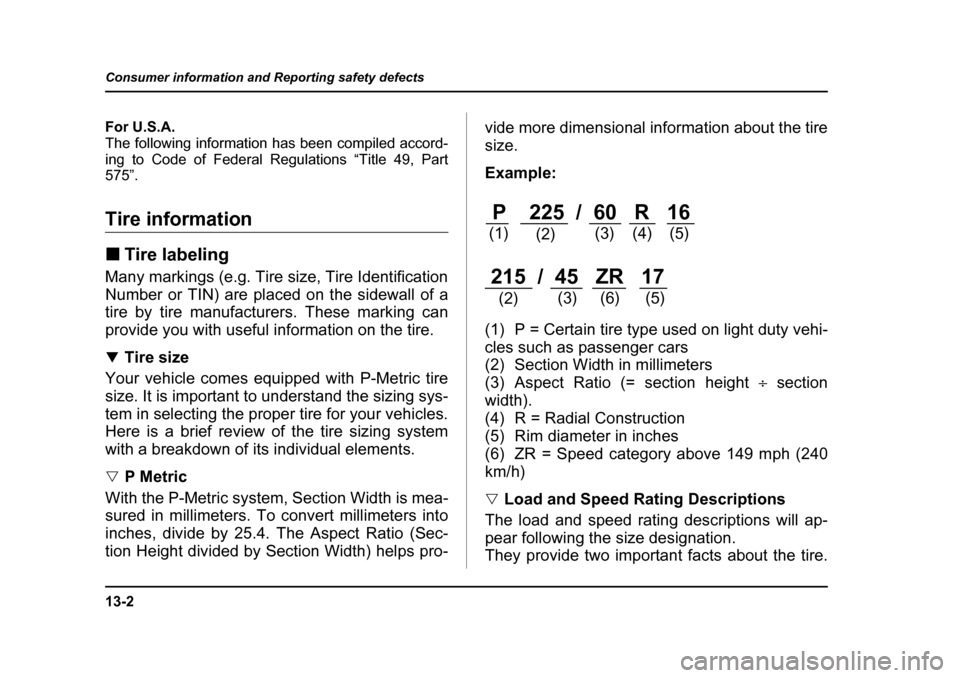
size. Example:
(1) P = Certain tire type used on light duty vehi-
cles such as passenger cars
(2) Section Width in millimeters
(3) Aspect Ratio (= section height
÷ section
width).
(4) R = Radial Construction
(5) Rim diameter in inches
(6) ZR = Speed category above 149 mph (240
km/h) " Load and Speed Rating Descriptions
The load and speed rating descriptions will ap-
pear following the size designation.
They provide two important facts about the tire.P 225 / 60 R 16
(1) (2) (3) (4) (5)
215 / 45 ZR 17
(2) (3) (6) (5)
Page 600 of 627

13-3
Consumer information and Reporting safety defects
– CONTINUED –
First, the number designation is its load index.
Second, the letter designation indicates the tire’s
speed rating.
Example:
(7) Load Index: A numerical code which speci-
fies the maximum load a tire can carry at the
speed indicated by its speed symbol, at maxi-
mum inflation pressure.
For example, “97” means 1,609 lbs (730 kg), “90”
means 1,323 lbs (600 kg), “89” means 1,278 lbs (580 kg)
Load indices apply only to the tire, not to
the vehicle. Putting a load rated tire on any
vehicle does not mean the vehicle can be
loaded up to the tire’s rated load.
(8) Speed Rating: An alphabetical system de- scribing a tire’s capability to travel at established
and predetermined speeds.
For example, “H” means 130 mph (210 km/h)
"
Speed ratings apply only to the tire, not
to the vehicle. Putting a speed rated tire on
any vehicle does not mean the vehicle can
be operated at the tire’s rated speed. " The speed rating is void if the tires are
worn out, damaged, repaired, retreaded, or
otherwise altered from their original condi-
tion. If tires are repaired, retreaded, or oth-
erwise altered, they may not be suitable for
original equipment tire designed loads and
speeds.
! Tire Identification Number (TIN)
Tire Identification Number (TIN) is marked on the
intended outboard sidewall. The TIN is com-
posed of four groups. Here is a brief review of the
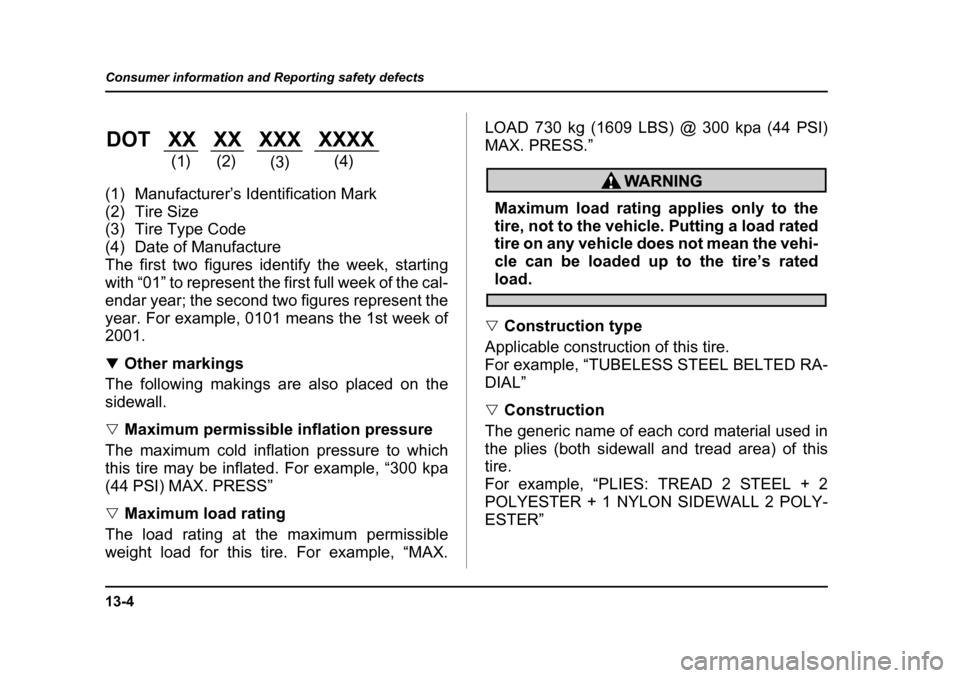
TIN with a breakdown of its individual elements.
P 225 / 60 R 16 97 H Size designation (6) (7)
Page 601 of 627
13-4
Consumer information and Reporting safety defects
(1) Manufacturer’s Identification Mark
(2) Tire Size
(3) Tire Type Code
(4) Date of Manufacture
The first two figures identify the week, starting
with “01” to represent the first full week of the cal-
endar year; the second two figures represent the
year. For example, 0101 means the 1st week of
2001. !
Other markings
The following makings are also placed on the
sidewall. " Maximum permissible inflation pressure
The maximum cold inflation pressure to which
this tire may be inflated. For example, “300 kpa
(44 PSI) MAX. PRESS” " Maximum load rating
The load rating at the maximum permissible
weight load for this tire. For example, “MAX. LOAD 730 kg (1609 LBS) @ 300 kpa (44 PSI)
MAX. PRESS.”Maximum load rating applies only to the
tire, not to the vehicle. Putting a load rated
tire on any vehicle does not mean the vehi-
cle can be loaded up to the tire’s rated
load.
" Construction type
Applicable construction of this tire.
For example, “TUBELESS STEEL BELTED RA-
DIAL” " Construction
The generic name of each cord material used in
the plies (both sidewall and tread area) of this
tire.
For example, “PLIES: TREAD 2 STEEL + 2
POLYESTER + 1 NYLON SIDEWALL 2 POLY-
ESTER”
DOT XX XX XXX XXXX (1) (2) (3)(4)
Page 603 of 627
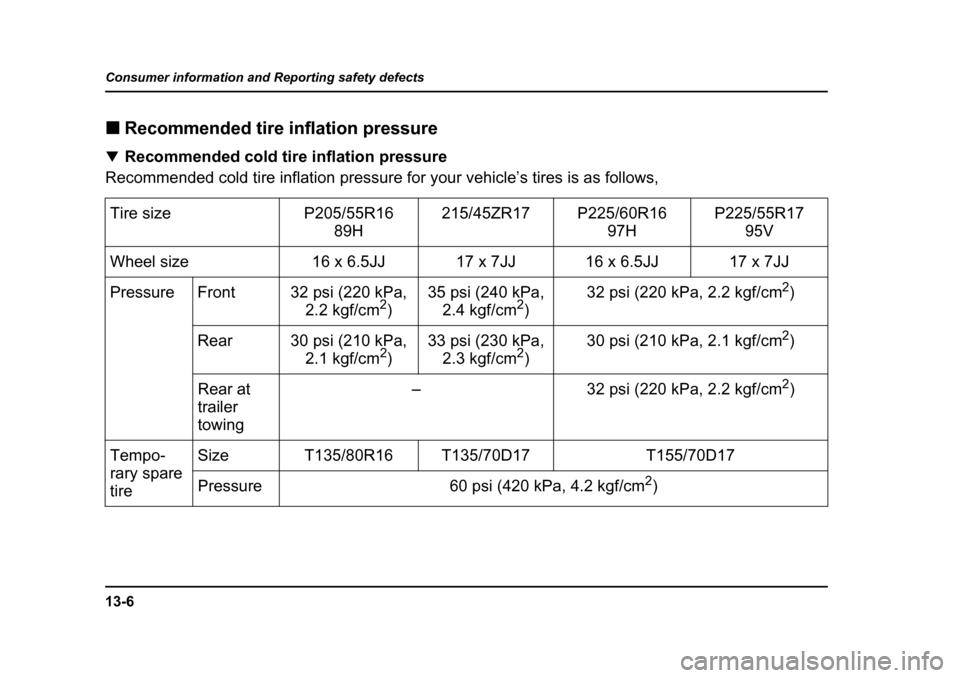
13-6
Consumer information and Reporting safety defects !
Recommended tire inflation pressure
! Recommended cold tire inflation pressure
Recommended cold tire inflation pressure for your vehicle’s tires is as follows,
Tire size P205/55R16 89H215/45ZR17 P225/60R16
97HP225/55R17
95V
Wheel size 16 x 6.5JJ 17 x 7JJ 16 x 6.5JJ 17 x 7JJ
Pressure Front 32 psi (220 kPa, 2.2 kgf/cm2
) 35 psi (240 kPa,
2.4 kgf/cm 2
) 32 psi (220 kPa, 2.2 kgf/cm
2
)
Rear 30 psi (210 kPa, 2.1 kgf/cm2
) 33 psi (230 kPa,
2.3 kgf/cm 2
) 30 psi (210 kPa, 2.1 kgf/cm
2
)
Rear at trailer towing – 32 psi (220 kPa, 2.2 kgf/cm
2
)
Tempo-
rary spare tire Size T135/80R16 T135/70D17 T155/70D17
Pressure 60 psi (420 kPa, 4.2 kgf/cm
2
)