tow SUBARU OUTBACK 2005 4.G User Guide
[x] Cancel search | Manufacturer: SUBARU, Model Year: 2005, Model line: OUTBACK, Model: SUBARU OUTBACK 2005 4.GPages: 627, PDF Size: 6.42 MB
Page 170 of 627
2-45
Keys and doors
– CONTINUED –
approximately 6.7 in (17 cm) from its fully closed posi- tion.
After confirming safety, pull the switch to the “OPEN”
side again and quickly release it. The rear moonroof
will open to its fully open position. To stop the rear
moonroof at some selected mid-way point while it is
moving toward its fully open position, momentarily
push the switch to the “CLOSE” or “OPEN” side.
To fully close the rear moonroof, push the switch to the
“CLOSE” side then quickly release it.
The rear moonroof will stop at a position approximate-
ly 5.9 in (15 cm) before its fully closed position. After
confirming safety, pull the switch to the “CLOSE” side
again and quickly release it. The rear moonroof will ful-
ly close. The front moonroof can then be fully closed. !Anti-entrapment function
When the moonroof senses an object trapped be-
tween its glass and during closure, it automatically
moves back by 5.9 in (15 cm) from that point and then
stops. The anti-entrapment function may also be acti-
vated by a strong shock on the moonroof even when
there is nothing trapped.
NOTE " For the sake of safety, it is recommended that
you avoid driving with the moonroof fully opened. " Driving with the moonroof fully open can cause an annoying sound to generate at high speeds. If
such a condition has been encountered, use the
moonroof at the initial stop position of 6.7 in (17 cm). "
If the moonroof cannot be closed through
switch operation because of system failure, it can
be closed manually using a hex-head wrench. For
the procedure, refer to “Moonroof – if the moon-
roof cannot be closed” in Chapter 9. ! Sun shades
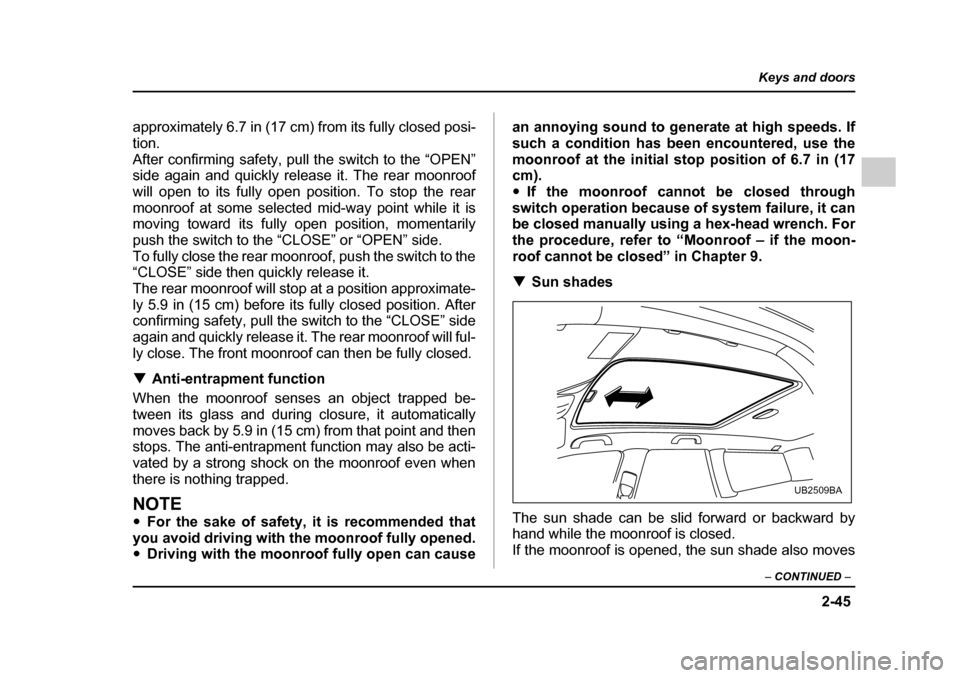
The sun shade can be slid forward or backward by
hand while the moonroof is closed.
If the moonroof is opened, the sun shade also movesUB2509BA
Page 174 of 627
3-3
Instruments and controls
– CONTINUED –
Instruments and controlsIgnition switch
"Never turn the ignition switch to “LOCK”
while the vehicle is being driven or towed be-
cause that will lock the steering wheel, prevent-
ing steering control. And when the engine is
turned off, it takes a much greater effort than
usual to steer. " Before leaving the vehicle, always remove
the key from the ignition switch for safety and
never allow an unattended child to remains in
the vehicle. Failure to follow this procedure
could result in injury to a child or others. They
could operate the power windows, the sunroof
or other controls or even make the vehicle
move.
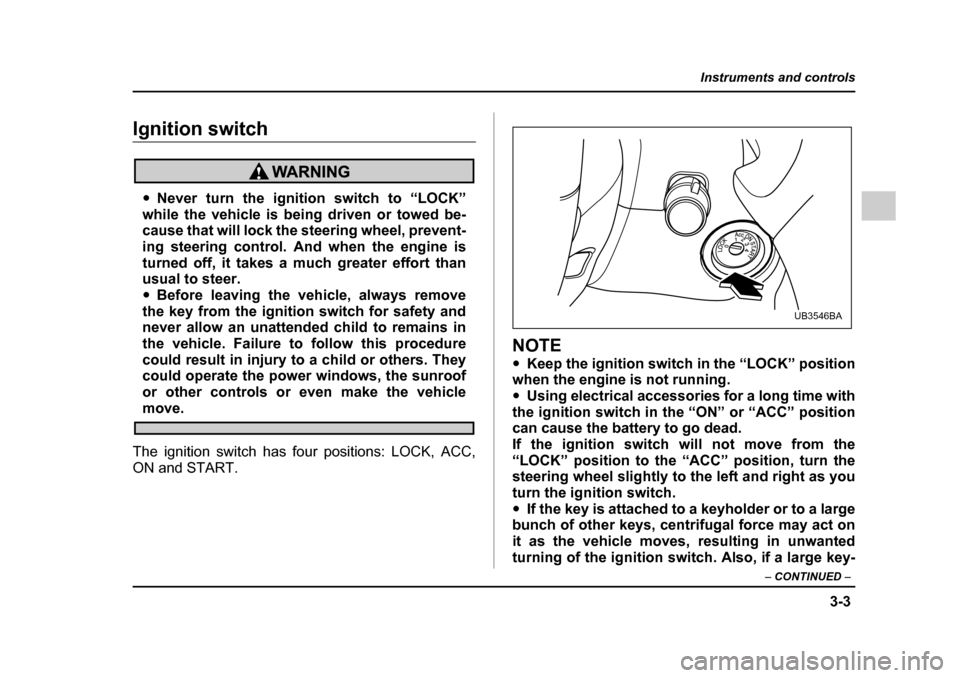
The ignition switch has four positions: LOCK, ACC,
ON and START.
NOTE " Keep the ignition switch in the “LOCK” position
when the engine is not running. " Using electrical accessories for a long time with
the ignition switch in the “ON” or “ACC” position
can cause the battery to go dead.
If the ignition switch will not move from the“LOCK” position to the “ACC” position, turn the
steering wheel slightly to the left and right as you turn the ignition switch." If the key is attached to a keyholder or to a large
bunch of other keys, centrifugal force may act on
it as the vehicle moves, resulting in unwanted
turning of the ignition switch. Also, if a large key-
UB3546BA
Page 197 of 627
3-26
Instruments and controls
NOTE
This light also comes on when the fuel filler cap is
not tightened until it clicks.
If you have recently refueled your vehicle, the cause of
the CHECK ENGINE warning light/malfunction indica-
tor lamp coming on could be a loose or missing fuel fill-
er cap. Remove the cap and retighten it until it clicks.
Make sure nothing is interfering with the sealing of the
cap. Tightening the cap will not make the CHECK EN-
GINE warning light turn off immediately. It may take
several driving trips. If the light does not go out, take
your vehicle to your authorized SUBARU dealer im-
mediately. !
If the light is blinking:
If the light is blinking while driving, an engine misfire
condition has been detected which may damage the
emission control system.
To prevent serious damage to the emission control
system, you should do the following:" Reduce vehicle speed.
" Avoid hard acceleration.
" Avoid steep uphill grades.
" Reduce the amount of cargo, if possible.
" Stop towing a trailer as soon as possible.
The CHECK ENGINE warning light may stop blinking and come on steadily after several driving trips. You
should have your vehicle checked by an authorized
SUBARU dealer immediately. !
Charge warning light
If this light comes on when the engine is running, it
may indicate that the charging system is not working
properly.
If the light comes on while driving or does not go out
after the engine starts, stop the engine at the first safe
opportunity and check the alternator belt. If the belt is
loose, broken or if the belt is in good condition but the
light remains on, contact your nearest SUBARU deal-
er immediately. ! Oil pressure warning light
Do not operate the engine with the oil pressure
warning light on. This may cause serious en-
gine damage.
If this light comes on when the engine is running, it
may indicate that the engine oil pressure is low and the
Page 200 of 627

3-29
Instruments and controls
– CONTINUED –
"The warning light does not come on when the
ignition switch is turned to the “ON” position. " The warning light comes on when the ignition
switch is turned to the “ON” position, but it
does not go out even when the vehicle speed
exceeds approximately 8 mph (12 km/h). " The warning light comes on during driving.
If these occur, have the ABS system repaired at
the first available opportunity by your SUBARU
dealer.
The ABS warning light comes on together with the
brake system warning light if the EBD system be-
comes faulty. For further details of the EBD system
fault warning, refer to “Brake system warning light”.
NOTE
If the warning light behavior is as described be-
low, the ABS system may be considered normal." The warning light comes on right after the en-
gine is started but goes out immediately, remain-
ing off." The warning light remains on after the engine
has been started, but it goes out when the vehicle
speed reaches about 8 mph (12 km/h)." The warning light comes on during driving, but
it goes out immediately and remains off. When driving with an insufficient battery voltage suchas when the engine is jump started, the ABS warning
light may come on. This is due to the low battery volt-
age and does not indicate a malfunction. When the
battery becomes fully charged, the light will go out. !
Brake system warning light
"Driving with the brake system warning light
on is dangerous. This indicates your brake sys-
tem may not be working properly. If the light re-
mains on, have the brakes inspected by a SUB-
ARU dealer immediately." If at all in doubt about whether the brakes are
operating properly, do not drive the vehicle.
Have your vehicle towed to the nearest SUBA-
RU dealer for repair.
This light has the following two functions: ! Parking brake warning
The light comes on with the parking brake applied
while the ignition switch is in the “ON” position. It goes
out when the parking brake is fully released.
(U.S.) (Canada)
Page 201 of 627

3-30
Instruments and controls
!
Brake fluid level warning
This light comes on when the brake fluid level has
dropped to near the “MIN” level of the brake fluid res-
ervoir with the ignition switch in the “ON” position and
with the parking brake fully released. If the brake system warning light should come on while
driving (with the parking brake fully released and with
the ignition switch positioned in “ON”), it could be an
indication of leaking of brake fluid or worn brake pads.
If this occurs, immediately stop the vehicle at the near-
est safe place and check the brake fluid level. If the flu-
id level is below the “MIN” mark in the reservoir, do not
drive the vehicle. Have the vehicle towed to the near-
est SUBARU dealer for repair. ! Electronic Brake Force Distribution (EBD) sys-
tem warning
The brake system warning light also illuminates if a
malfunction occurs in the EBD system. In that event, it
comes on together with the ABS warning light.
The EBD system may be faulty if the brake system
warning light and ABS warning light illuminate simulta-
neously during driving.
Even if the EBD system fails, the conventional braking
system will still function. However, the rear wheels will
be more prone to locking when the brakes are applied
harder than usual and the vehicle’s motion may there- fore become somewhat harder to control.
If the brake system warning light and ABS warning
light illuminate simultaneously, take the following steps:
1. Stop the vehicle in the nearest safe, flat place.
2. Shut down the engine, then restart it.
3. Release the parking brake. If both warning lights go
out, the EBD system may be faulty.
Drive carefully to the nearest SUBARU dealer and
have the system inspected.
4. If both warning lights come on again and stay illu-
minated after the engine has been restarted, shut
down the engine again, apply the parking brake, and
check the brake fluid level.
5. If the brake fluid level is not below the “MIN” mark,
the EBD system may be faulty. Drive carefully to the
nearest SUBARU dealer and have the system inspect-
ed.
6. If the brake fluid level is below the “MIN” mark, DO
NOT drive the vehicle. Instead, have the vehicle towed
to the nearest SUBARU dealer for repair. !
Low fuel warning light
The low fuel warning light comes on when the tank is
nearly empty about 2.6 US gal (10.0 liters, or 2.2 Imp
gal). It only operates when the ignition switch is in the“ON” position.
Page 217 of 627
3-46
Instruments and controls
!
Headlight flasher
Do not hold the lever in the flashing position for
more than just a few seconds.
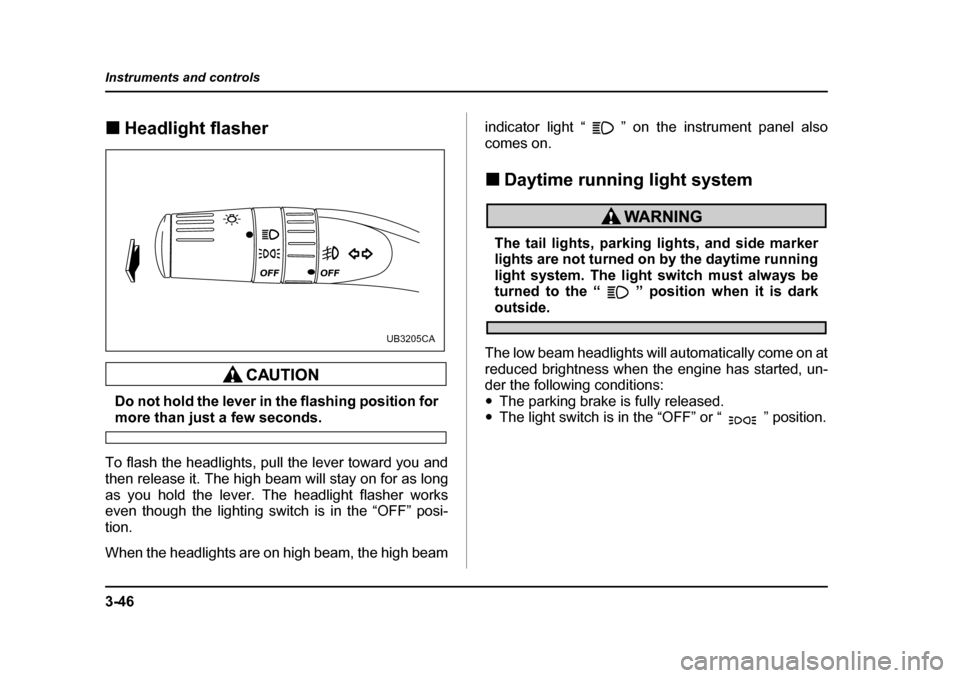
To flash the headlights, pull the lever toward you and
then release it. The high beam will stay on for as long
as you hold the lever. The headlight flasher works
even though the lighting switch is in the “OFF” posi-tion.
When the headlights are on high beam, the high beam indicator light “ ” on the instrument panel also
comes on. !
Daytime running light system
The tail lights, parking lights, and side marker
lights are not turned on by the daytime running
light system. The light switch must always be
turned to the “ ” position when it is dark
outside.
The low beam headlights will automatically come on at
reduced brightness when the engine has started, un-
der the following conditions:" The parking brake is fully released.
" The light switch is in the “OFF” or “ ” position.
UB3205CA
Page 224 of 627
3-53
Instruments and controls
– CONTINUED –
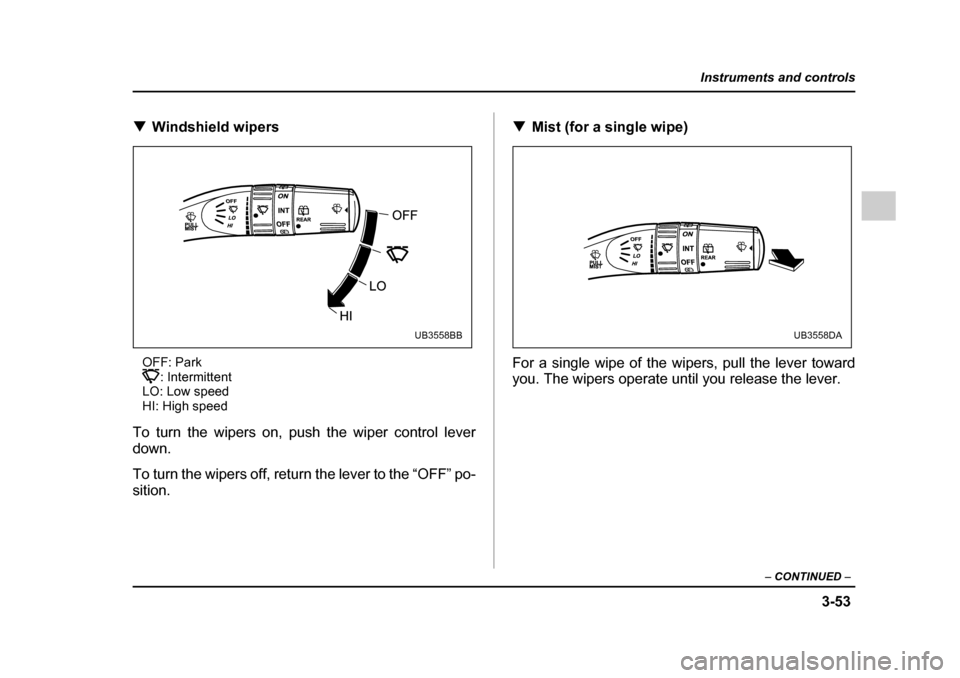
!Windshield wipers
OFF: Park : Intermittent
LO: Low speed
HI: High speed
To turn the wipers on, push the wiper control lever
down.
To turn the wipers off, return the lever to the “OFF” po- sition. !
Mist (for a single wipe)
For a single wipe of the wipers, pull the lever toward
you. The wipers operate until you release the lever.
UB3558BBUB3558DA
Page 230 of 627
3-59
Instruments and controls
– CONTINUED –
Mirrors
Always check that the inside and outside mirrors are
properly adjusted before you start driving. !Inside mirror
The inside mirror has a day and night position. Pull the
tab at the bottom of the mirror toward you for the night
position. Push it away for the day position. The night
position reduces glare from headlights. !
Auto-dimming mirror/compass (if
equipped)
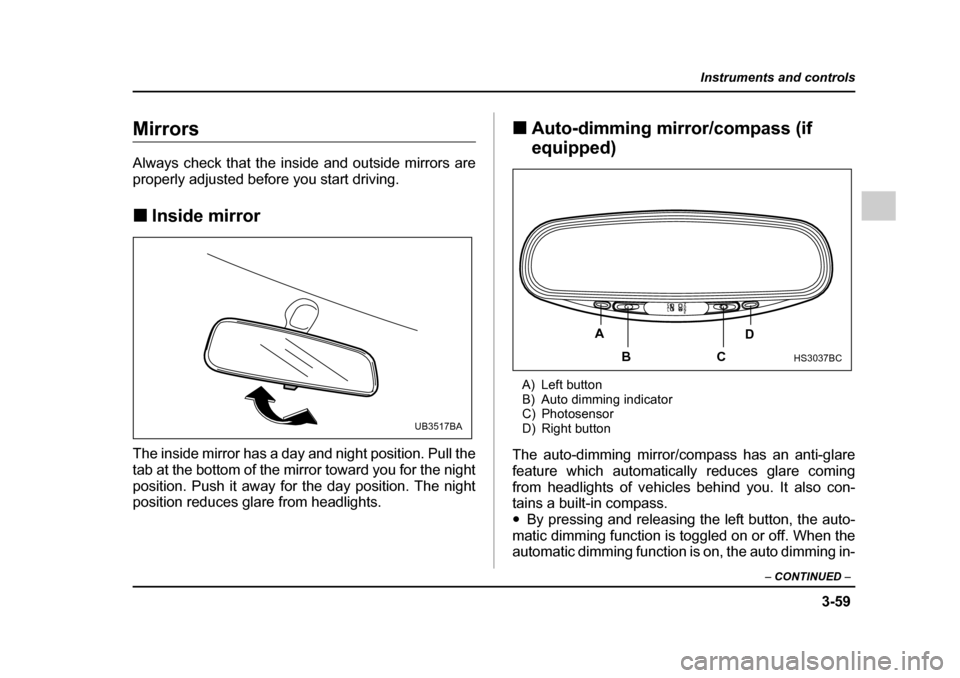
A) Left button
B) Auto dimming indicator
C) Photosensor
D) Right button
The auto-dimming mirror/compass has an anti-glare
feature which automatically reduces glare coming
from headlights of vehicles behind you. It also con-
tains a built-in compass. " By pressing and releasing the left button, the auto-
matic dimming function is toggled on or off. When the
automatic dimming function is on, the auto dimming in-
UB3517BA
A
BC D
HS3037BC
Page 243 of 627
4-8
Climate control
er button will not come on. At the same time, the
air inlet selection is automatically set to “outsideair” mode.
In this state, you cannot select “recirculation”
mode by manually pressing the air inlet selectionbutton.
Also, you cannot stop the air conditioner com-
pressor by pressing the air conditioner button."
Warm air also comes out from the right and left
air outlets. To stop warm air flow from these out-
lets, turn the corresponding wheel to the “ ”
position. ! Heating and defrosting
To direct warm air toward the floor and the windshield:
1. Set the air inlet selection lever to the “OFF” posi-tion.
2. Set the air flow control dial to the “ ”position.
3. Set the temperature control dial to the most com-
fortable level.
4. Set the fan speed control dial to the desired speed.
NOTE " In a vehicle equipped with an air conditioner,
when the dial is placed in the “ ” position or
“ ” position the air conditioner compressor au-
tomatically operates to quickly defog the wind-
shield. However the indicator on the air condition- er button will not come on. At the same time, the
air inlet selection is automatically set to “outside
air” mode.
In this state, you cannot select “recirculation”
mode by manually pressing the air inlet selectionbutton.
Also, you cannot stop the air conditioner com-
pressor by pressing the air conditioner button."
Warm air also comes out from the right and left
air outlets. To stop warm air flow from these out-
lets, turn the corresponding wheel to the “ ”
position. ! Heating
To direct warm air toward the floor:
1. Set the air inlet selection button to the OFF posi-tion.
2. Set the air flow control dial to the “ ” position.
3. Set the temperature control dial to the most com-
fortable level.
4. Set the fan speed control dial to the desired speed.NOTE
Warm air also comes out from the right and left air
outlets. To stop warm air flow from these outlets,
turn the corresponding wheel to the “ ” posi- tion.
Page 248 of 627
4-13
Climate control
– CONTINUED –
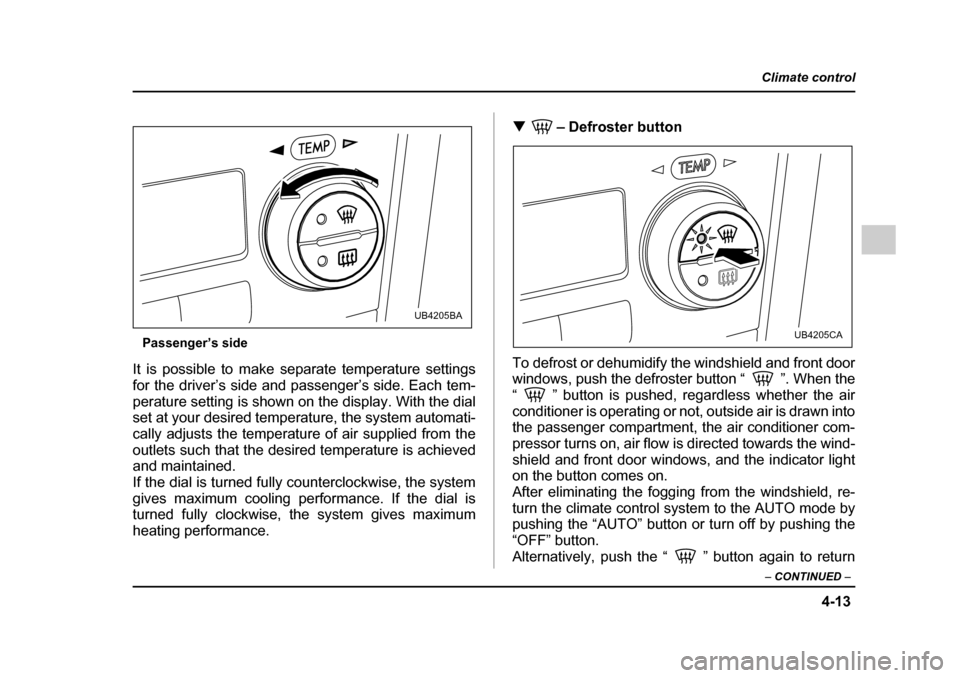
Passenger’s side
It is possible to make separate temperature settings
for the driver’s side and passenger’s side. Each tem-
perature setting is shown on the display. With the dial
set at your desired temperature, the system automati-
cally adjusts the temperature of air supplied from the
outlets such that the desired temperature is achieved
and maintained.
If the dial is turned fully counterclockwise, the system
gives maximum cooling performance. If the dial is
turned fully clockwise, the system gives maximum
heating performance. !
– Defroster button
To defrost or dehumidify the windshield and front door
windows, push the defroster button “ ”. When the
“ ” button is pushed, regardless whether the air
conditioner is operating or not, outside air is drawn into
the passenger compartment, the air conditioner com-
pressor turns on, air flow is directed towards the wind-
shield and front door windows, and the indicator light
on the button comes on.
After eliminating the fogging from the windshield, re-turn the climate control system to the AUTO mode by
pushing the “AUTO” button or turn off by pushing the
“OFF” button.
Alternatively, push the “ ” button again to return
UB4205BA
UB4205CA