transmission SUBARU OUTBACK 2005 4.G User Guide
[x] Cancel search | Manufacturer: SUBARU, Model Year: 2005, Model line: OUTBACK, Model: SUBARU OUTBACK 2005 4.GPages: 627, PDF Size: 6.42 MB
Page 365 of 627
7-10
Starting and operating
Preparing to drive
You should perform the following checks and adjust-
ments every day before you start driving.
1. Check that all windows, mirrors, and lights are
clean and unobstructed.
2. Check the appearance and condition of the tires.
Also check tires for proper inflation.
3. Look under the vehicle for any sign of leaks.
4. Check that the hood, trunk and rear gate are fullyclosed.
5. Check the adjustment of the seat.
6. Check the adjustment of the inside and outside mir-rors.
7. Fasten your seatbelt. Check that your passengers
have fastened their seatbelts.
8. Check the operation of the warning and indicator
lights when the ignition switch is turned to the “ON” po- sition.
9. Check the gauges, indicator and warning lights af-
ter starting the engine.
NOTE
Engine oil, engine coolant, brake fluid, washer flu-
id and other fluid levels should be checked daily,
weekly or at fuel stops.
Starting the engine
Do not operate the starter motor continuously
for more than ten seconds. If the engine fails to
start after operating the starter for five to ten
seconds, wait for ten seconds or more before
trying again.
! Manual transmission vehicle
1. Apply the parking brake.
2. Turn off unnecessary lights and accessories.
3. Press the clutch pedal to the floor and shift the shift
lever into neutral.
Hold the clutch pedal to the floor while starting the en-
gine. The starter motor will only operate when the
clutch pedal is pressed fully to the floor.
4. Turn the ignition switch to the “ON” position and
check the operation of the warning and indicator lights.
Refer to the “Warning and indicator lights” section
(chapter 3).
5. Turn the ignition switch to the “START” position
without depressing the accelerator pedal. Release
the key immediately after the engine has started.
Page 366 of 627
7-11
Starting and operating
– CONTINUED –
If the engine does not start, try the following:
1) Turn the ignition switch to the “OFF” position and
wait for at least 10 seconds. After checking that the
parking brake is firmly set, turn the ignition switch to
the “START” position while depressing the acceler-
ator pedal slightly (about a quarter of the full stroke).
Release the accelerator pedal as soon as the en-
gine starts.
2) If this fails to start the engine, turn the ignition
switch back to the “OFF” position and wait for at
least 10 seconds. Then fully depress the accelerator
pedal and turn the ignition switch to the “START”
position. If the engine starts, quickly release the ac-
celerator pedal.
3) If this fails to start the engine, turn the ignition
switch again to the “OFF” position. After waiting for
10 seconds or longer, turn the ignition switch to the
“START” position without depressing the accelera-
tor pedal.
4) If the engine still refuses to start, contact your
nearest SUBARU dealer for assistance.
6. Confirm that all warning and indicator lights have
gone off after the engine has started. The fuel injection
system automatically lowers the idle speed as the en-
gine warms up. !
Automatic transmission vehicle
If you restart the engine while the vehicle is
moving, shift the selector lever into the “N” po-
sition. Do not attempt to place the selector lever
of a moving vehicle into the “P” position.
1. Apply the parking brake.
2. Turn off unnecessary lights and accessories.
3. Shift the selector lever to the “P” or “N” position
(preferably “P” position). The starter will only operate
when the select lever is at the “P” or “N” position.
4. Turn the ignition switch to the “ON” position and
check the operation of the warning and indicator lights.
Refer to the “Warning and indicator lights” section (chapter 3).
5. Turn the ignition switch to the “START” position
without depressing the accelerator pedal. Release
the key immediately after the engine has started.
If the engine does not start, try the following: 1) Turn the ignition switch to the “OFF” position and
wait for at least 10 seconds. After checking that the
parking brake is firmly set, turn the ignition switch to
the “START” position while depressing the acceler-
ator pedal slightly (about a quarter of the full stroke).
Page 368 of 627
7-13
Starting and operating
– CONTINUED –
Manual transmission
Do not drive the vehicle with the clutch disen-
gaged (i.e., when the clutch pedal is depressed)
or with the shift lever in the neutral position.
Engine braking has no effect in either of these
conditions and the risk of an accident is conse-
quently increased.
Shift into reverse ONLY when the vehicle has
completely stopped. It may cause damage to
the transmission to try shifting into reverse
when the vehicle is moving.
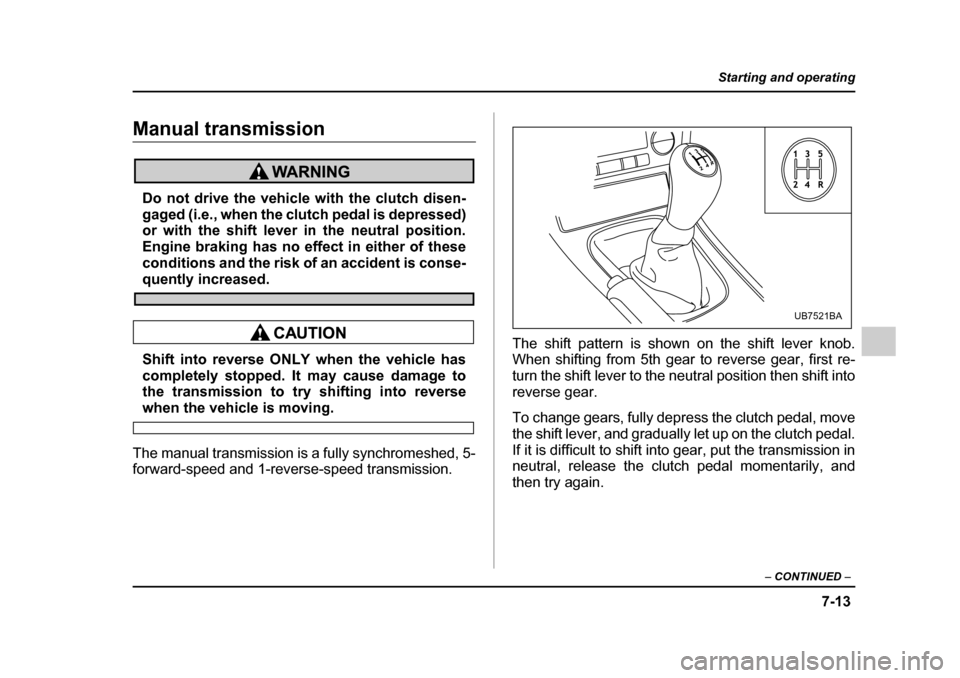
The manual transmission is a fully synchromeshed, 5-
forward-speed and 1-reverse-speed transmission. The shift pattern is shown on the shift lever knob.
When shifting from 5th gear to reverse gear, first re-
turn the shift lever to the neutral position then shift intoreverse gear.
To change gears, fully depress the clutch pedal, move
the shift lever, and gradually let up on the clutch pedal.
If it is difficult to shift into gear, put the transmission in
neutral, release the clutch pedal momentarily, and
then try again.
UB7521BA
Page 370 of 627

7-15
Starting and operating
– CONTINUED –
Turbo models
mph (km/h)
Never exceed posted speed limits.
! Driving tips
Do not drive with your foot resting on the clutch pedal
and do not use the clutch to hold your vehicle at a
standstill on an upgrade. Either of those actions may
cause clutch damage.
Do not drive with your hand resting on the shift lever.
This may cause wear on the transmission compo-
nents.
When it is necessary to reduce vehicle speed due to
slow traffic, turning corners, or driving up steep hills,
downshift to a lower gear before the engine starts to
labor.
On steep downgrades, downshift the transmission to 4th, 3rd or 2nd gear as necessary; this helps to main-
tain a safe speed and to extend brake pad life.
In this way, the engine provides a braking effect. Re-
member, if you “ride” (over use) the brakes while de-
scending a hill, they may overheat and not work prop-erly.
The engine may, on rare occasions, knock when the
vehicle rapidly accelerates or rapidly pulls away from
a standstill. This phenomenon does not indicate a
fault.
A slight reduction in output torque may occur in the
models with a 3.0-liter or 2.5-liter turbo engine before
the engine warms up.
Gear Except
OUTBACKOUTBACK
1st 32 (52) 32 (52)
2nd 54 (88) 54 (88)
3rd 80 (129) 78 (127)
Page 371 of 627
7-16
Starting and operating
Automatic transmission – 4 speed
The automatic transmission is electronically controlled
and provides 4 forward speeds and 1 reverse speed.
Also, it has a manual mode and a SPORT mode.
Do not shift from the “P” or “N” position into
the “D” or “R” position while depressing the ac-
celerator pedal. This may cause the vehicle to
jump forward or backward.
"
Shift into the “P” or “R” position only after
the vehicle is completely stopped. Shifting
while the vehicle is moving may cause damage
to the transmission. " Do not race the engine for more than five sec-
onds in any position except the “N” or “P” po-
sition when the brake is set or when wheels are
used blocks. This may cause the automatic
transmission fluid to overheat." Avoid shifting from one of the forward driving
positions into the “R” position or vice versa un- til the vehicle has completely stopped. Such
shifting may cause damage to the transmis-
sion.
NOTE
Immediately after ATF (automatic transmission
fluid) is replaced, you may feel that the automatic
transmission operation is somewhat unusual.
This results from invalidation of data which the
on-board computer has collected and stored inmemory to allow the transmission to shift at the
most appropriate times for the current condition
of your vehicle. Optimized shifting will be restored
as the vehicle continues to be driven for a while.
Page 372 of 627
7-17
Starting and operating
– CONTINUED –
!Selector lever
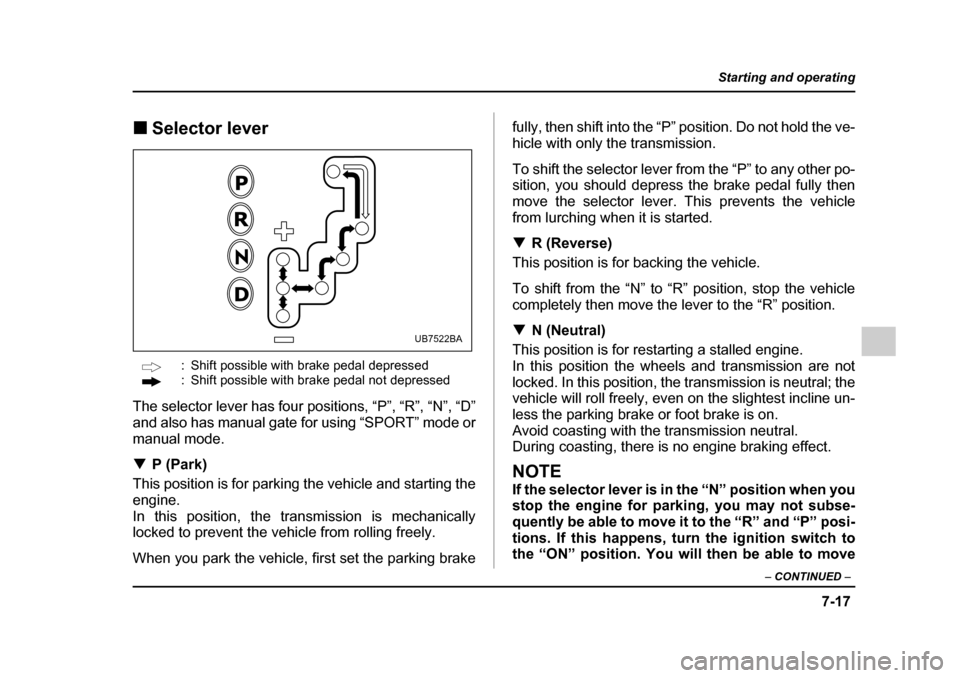
: Shift possible with brake pedal depressed
: Shift possible with brake pedal not depressed
The selector lever has four positions, “P”, “R”, “N”, “D”
and also has manual gate for using “SPORT” mode or
manual mode. ! P (Park)
This position is for parking the vehicle and starting the
engine.
In this position, the transmission is mechanically
locked to prevent the vehicle from rolling freely.
When you park the vehicle, first set the parking brake fully, then shift into the “P” position. Do not hold the ve-
hicle with only the transmission.
To shift the selector lever from the “P” to any other po-
sition, you should depress the brake pedal fully then
move the selector lever. This prevents the vehicle
from lurching when it is started. !
R (Reverse)
This position is for backing the vehicle.
To shift from the “N” to “R” position, stop the vehicle
completely then move the lever to the “R” position. ! N (Neutral)
This position is for restarting a stalled engine.
In this position the wheels and transmission are not
locked. In this position, the transmission is neutral; the
vehicle will roll freely, even on the slightest incline un-
less the parking brake or foot brake is on.
Avoid coasting with the transmission neutral.
During coasting, there is no engine braking effect.
NOTE
If the selector lever is in the “N” position when you
stop the engine for parking, you may not subse-
quently be able to move it to the “R” and “P” posi-tions. If this happens, turn the ignition switch to
the “ON” position. You will then be able to move
UB7522BA
Page 373 of 627
7-18
Starting and operating
the selector lever to the “P” position.
Do not drive the vehicle with the selector lever
in the “N” (neutral) position. Engine braking
has no effect in this condition and the risk of an
accident is consequently increased.
! D (Drive)
This position is for normal driving.
The transmission automatically shifts into a suitable
gear from 1st to 4th according to the vehicle speed
and the acceleration you require.
When more acceleration is required in this position,
press the accelerator pedal fully to the floor and hold
that position. The transmission will automatically
downshift to 3rd, 2nd or 1st gear. When you release
the pedal, the transmission will return to the original
gear position.
To use the “SPORT” mode, move the lever from this
position into the manual gate.
To use the manual mode, move the lever from this po-
sition into the manual gate then move it toward the “+”
and “–” ends. "
While climbing a grade
When driving up a hill, undesired upshift to 4th gear is
prevented from taking place when the accelerator is
released. This minimizes the chance of subsequent
downshifting to a lower gear when accelerating again.
This prevents repeated upshifting and downshifting re-
sulting in a smoother operation of the vehicle.
NOTE
The transmission may downshift to 2nd or 1st
gear, depending on the way the accelerator pedal
is pressed to accelerate the vehicle again. " While going down a hill
When descending a steep hill, depressing the brake
pedal will cause the transmission to downshift to 3rd or
2nd gear, thus applying engine braking. Reaccelera-
tion for a short time will cause the transmission to up-shift normally.
NOTE
In some cases, depressing the brake pedal on a
downhill grade does not result in an automatic
downshift to 3rd or 2nd gear. This can happen
when the automatic transmission fluid tempera-
ture is very low, for example, during driving short-
ly after the vehicle has been parked for an extend-
ed period of time. When the ATF temperature has
Page 376 of 627
7-21
Starting and operating
– CONTINUED –
goes off.
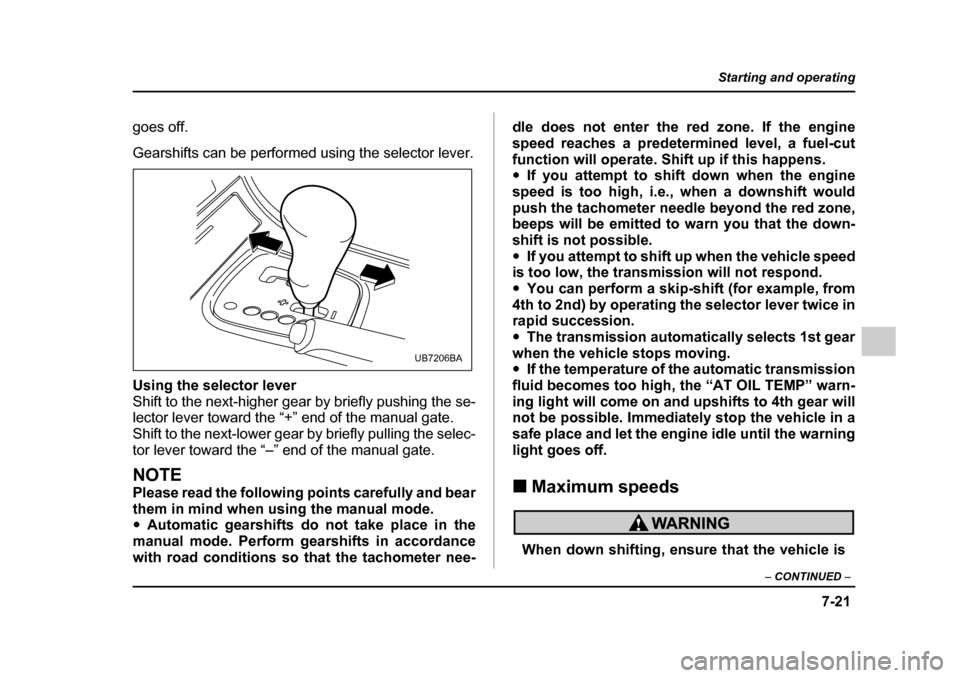
Gearshifts can be performed using the selector lever.
Using the selector lever
Shift to the next-higher gear by briefly pushing the se-
lector lever toward the “+” end of the manual gate.
Shift to the next-lower gear by briefly pulling the selec-
tor lever toward the “–” end of the manual gate.
NOTE
Please read the following points carefully and bear
them in mind when using the manual mode. "Automatic gearshifts do not take place in the
manual mode. Perform gearshifts in accordance
with road conditions so that the tachometer nee- dle does not enter the red zone. If the engine
speed reaches a predetermined level, a fuel-cut
function will operate. Shift up if this happens. "
If you attempt to shift down when the engine
speed is too high, i.e., when a downshift would
push the tachometer needle beyond the red zone,
beeps will be emitted to warn you that the down-
shift is not possible." If you attempt to shift up when the vehicle speed
is too low, the transmission will not respond." You can perform a skip-shift (for example, from
4th to 2nd) by operating the selector lever twice in
rapid succession. " The transmission automatically selects 1st gear
when the vehicle stops moving. " If the temperature of the automatic transmission
fluid becomes too high, the “AT OIL TEMP” warn-
ing light will come on and upshifts to 4th gear will
not be possible. Immediately stop the vehicle in a
safe place and let the engine idle until the warning
light goes off. ! Maximum speeds
When down shifting, ensure that the vehicle is
UB7206BA
Page 377 of 627
7-22
Starting and operating
not travelling at a speed exceeding the Maxi-
mum Allowable Speed for the gear which is
about to be selected. Failure to observe this
precaution can lead to engine over-revving and
this in turn can result in engine damage.
In addition, sudden application of engine brak-
ing caused by down shifting when the vehicle is
travelling on a slippery surface can lead to
wheel locking; as a consequence, control of the
vehicle may be lost and the risk of an accident
increased.
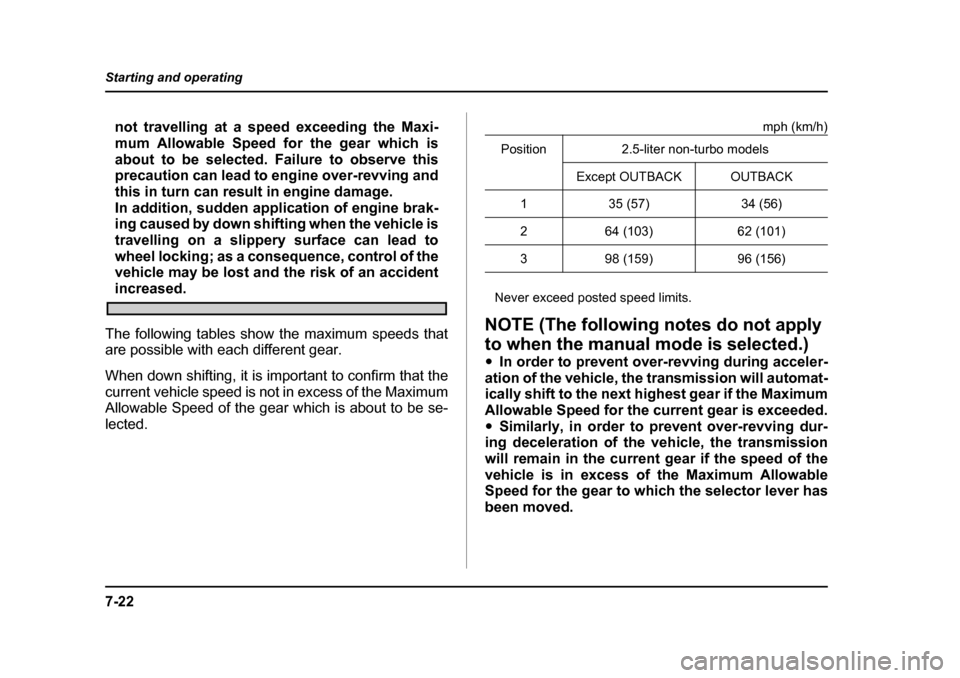
The following tables show the maximum speeds that
are possible with each different gear.
When down shifting, it is important to confirm that the
current vehicle speed is not in excess of the Maximum
Allowable Speed of the gear which is about to be se-
lected. mph (km/h)
Never exceed posted speed limits.
NOTE (The following notes do not apply
to when the manual mode is selected.) " In order to prevent over-revving during acceler-
ation of the vehicle, the transmission will automat-
ically shift to the next highest gear if the Maximum
Allowable Speed for the current gear is exceeded. " Similarly, in order to prevent over-revving dur-
ing deceleration of the vehicle, the transmission
will remain in the current gear if the speed of the
vehicle is in excess of the Maximum Allowable
Speed for the gear to which the selector lever has
been moved. Position 2.5-liter non-turbo models
Except OUTBACK OUTBACK
1 35 (57) 34 (56)
2 64 (103) 62 (101)
3 98 (159) 96 (156)
Page 379 of 627
7-24
Starting and operating
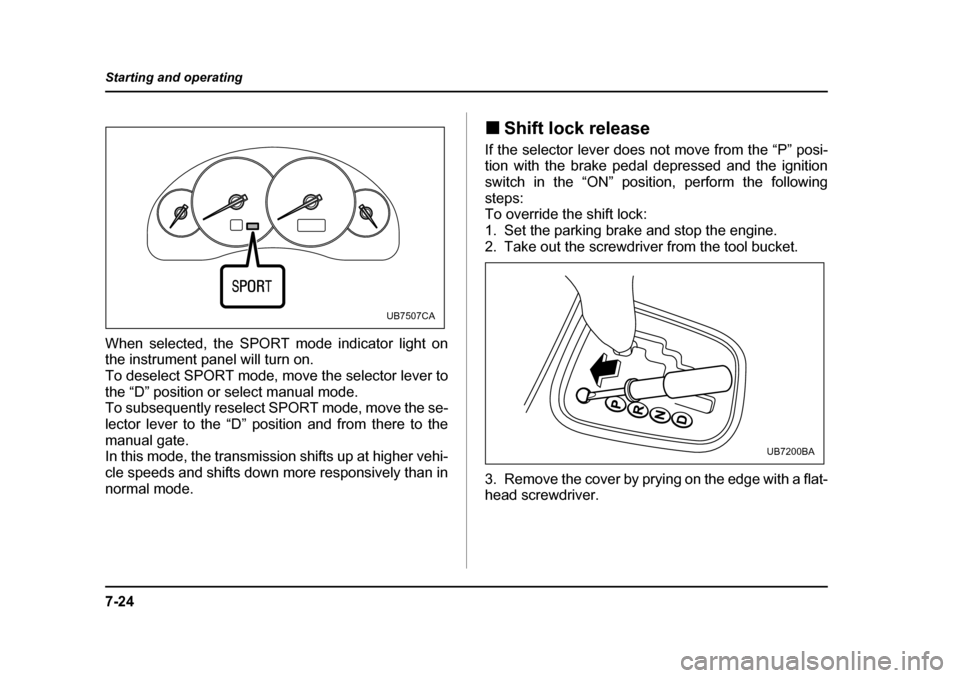
When selected, the SPORT mode indicator light on
the instrument panel will turn on.
To deselect SPORT mode, move the selector lever to
the “D” position or select manual mode.
To subsequently reselect SPORT mode, move the se-
lector lever to the “D” position and from there to the
manual gate.
In this mode, the transmission shifts up at higher vehi-
cle speeds and shifts down more responsively than in
normal mode.
!
Shift lock release
If the selector lever does not move from the “P” posi-
tion with the brake pedal depressed and the ignition
switch in the “ON” position, perform the followingsteps:
To override the shift lock:
1. Set the parking brake and stop the engine.
2. Take out the screwdriver from the tool bucket.
3. Remove the cover by prying on the edge with a flat-
head screwdriver.
UB7507CA
UB7200BA