wiper SUBARU OUTBACK 2005 4.G User Guide
[x] Cancel search | Manufacturer: SUBARU, Model Year: 2005, Model line: OUTBACK, Model: SUBARU OUTBACK 2005 4.GPages: 627, PDF Size: 6.42 MB
Page 225 of 627
3-54
Instruments and controls
!
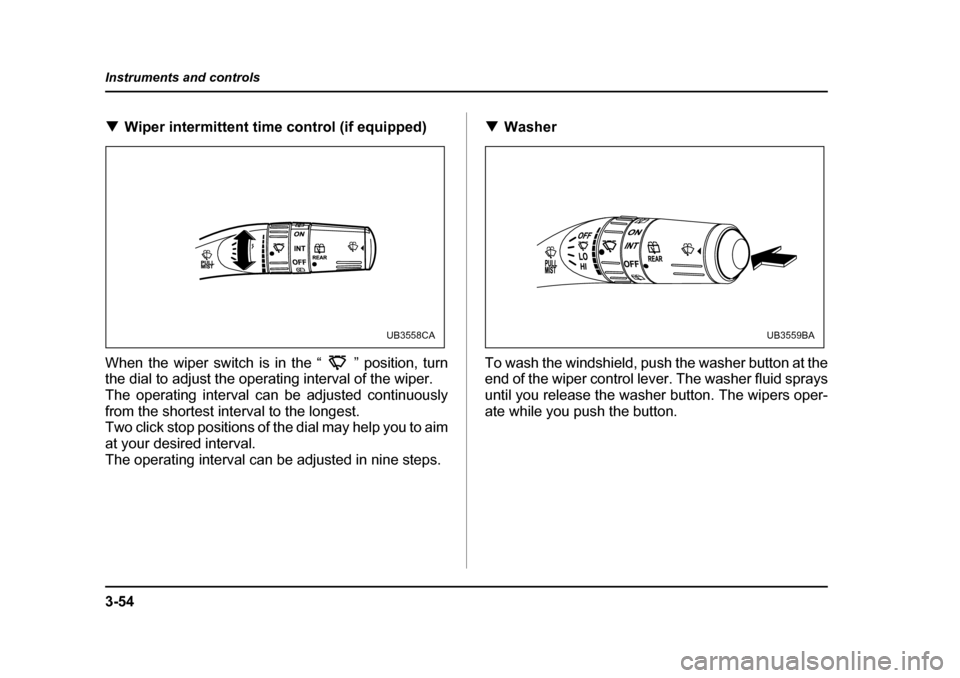
Wiper intermittent time control (if equipped)
When the wiper switch is in the “ ” position, turn
the dial to adjust the operating interval of the wiper.
The operating interval can be adjusted continuously
from the shortest interval to the longest.
Two click stop positions of the dial may help you to aim
at your desired interval.
The operating interval can be adjusted in nine steps. !
Washer
To wash the windshield, push the washer button at the
end of the wiper control lever. The washer fluid sprays
until you release the washer button. The wipers oper-
ate while you push the button.
UB3558CAUB3559BA
Page 226 of 627
3-55
Instruments and controls
– CONTINUED –
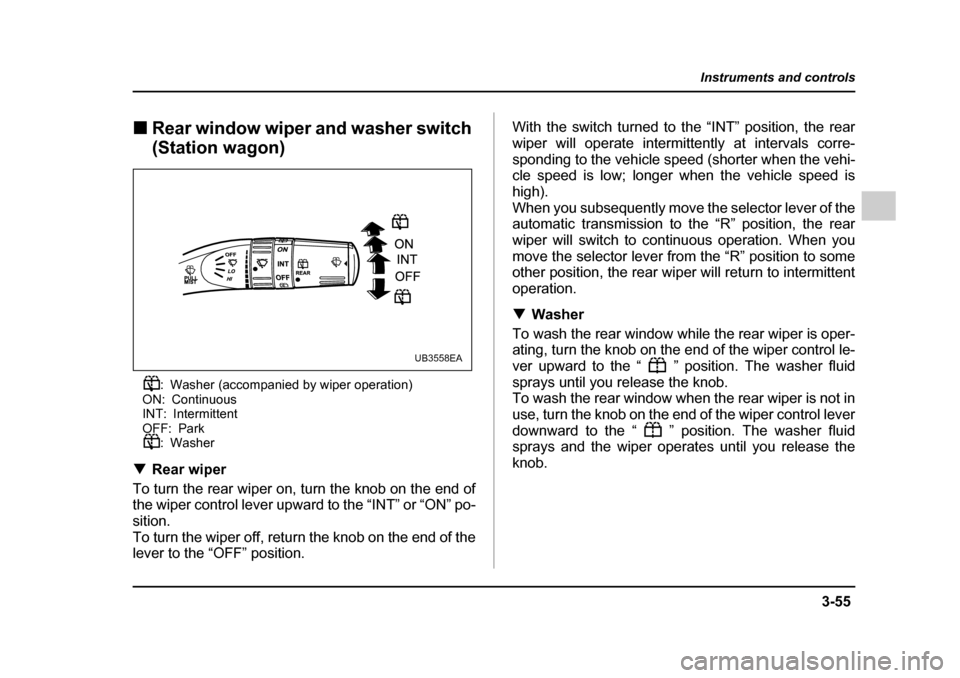
!Rear window wiper and washer switch
(Station wagon)
: Washer (accompanied by wiper operation)
ON: Continuous
INT: Intermittent
OFF: Park : Washer
! Rear wiper
To turn the rear wiper on, turn the knob on the end of
the wiper control lever upward to the “INT” or “ON” po- sition.
To turn the wiper off, return the knob on the end of the
lever to the “OFF” position. With the switch turned to the “INT” position, the rear
wiper will operate intermittently at intervals corre-
sponding to the vehicle speed (shorter when the vehi-
cle speed is low; longer when the vehicle speed is
high).
When you subsequently move the selector lever of the
automatic transmission to the “R” position, the rear
wiper will switch to continuous operation. When you
move the selector lever from the “R” position to some
other position, the rear wiper will return to intermittent
operation. !
Washer
To wash the rear window while the rear wiper is oper-
ating, turn the knob on the end of the wiper control le-
ver upward to the “ ” position. The washer fluid
sprays until you release the knob.
To wash the rear window when the rear wiper is not in
use, turn the knob on the end of the wiper control lever
downward to the “ ” position. The washer fluid
sprays and the wiper operates until you release the
knob.
UB3558EA
Page 227 of 627
3-56
Instruments and controls
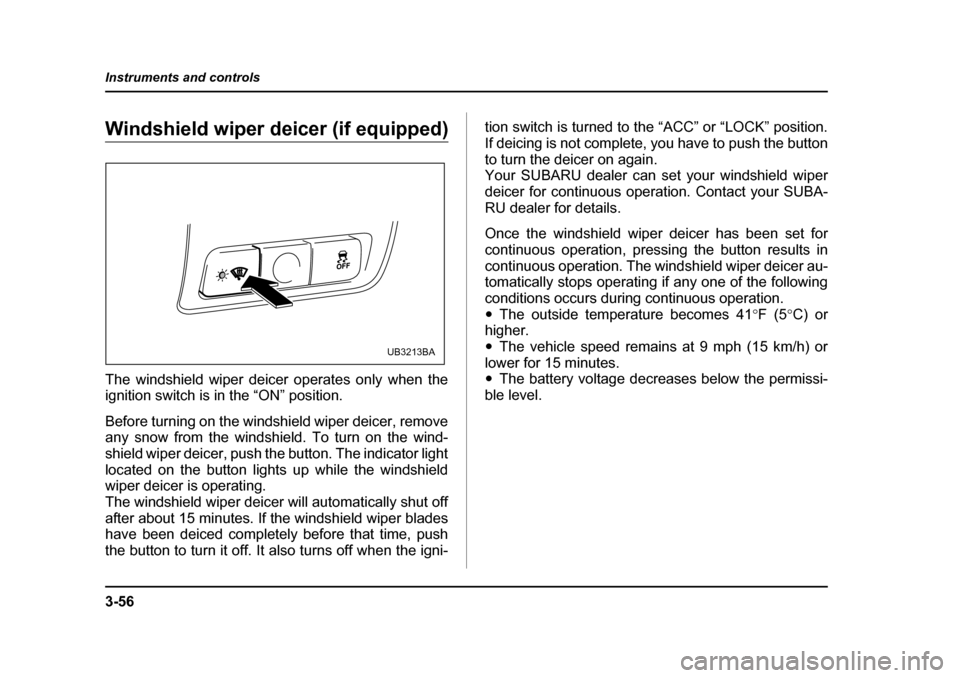
Windshield wiper deicer (if equipped)
The windshield wiper deicer operates only when the
ignition switch is in the “ON” position.
Before turning on the windshield wiper deicer, remove
any snow from the windshield. To turn on the wind-
shield wiper deicer, push the button. The indicator light
located on the button lights up while the windshield
wiper deicer is operating.
The windshield wiper deicer will automatically shut off
after about 15 minutes. If the windshield wiper blades
have been deiced completely before that time, push
the button to turn it off. It also turns off when the igni-
tion switch is turned to the “ACC” or “LOCK” position.
If deicing is not complete, you have to push the button
to turn the deicer on again.
Your SUBARU dealer can set your windshield wiper
deicer for continuous operation. Contact your SUBA-
RU dealer for details.
Once the windshield wiper deicer has been set for
continuous operation, pressing the button results in
continuous operation. The windshield wiper deicer au-
tomatically stops operating if any one of the following
conditions occurs during continuous operation."
The outside temperature becomes 41 °F (5 °C) or
higher." The vehicle speed remains at 9 mph (15 km/h) or
lower for 15 minutes. " The battery voltage decreases below the permissi-
ble level.
UB3213BA
Page 426 of 627
8-13
Driving tips
– CONTINUED –
!Parking in cold weather
Snow can trap dangerous exhaust gases under
your vehicle. Keep snow clear of the exhaust
pipe and from around your vehicle if you park
the vehicle in snow with the engine running.
Do not use the parking brake when parking for long
periods in cold weather since it could freeze in that po-
sition. Instead, observe the following:
1. Place the shift lever in “1” or “R” for manual trans-
mission vehicles, and in “P” for automatic transmissionvehicles.
2. Use tire stops under the tires to prevent the vehicle
from moving.
When the vehicle is parked in snow or when it snows,
raise the wiper blades off the glass to prevent damage to them.
When the vehicle has been left parked after use on
roads heavily covered with snow, or has been left
parked during a snowstorm, icing may develop on the
brake system, which could cause poor braking action.
Check for snow or ice buildup on the suspension, disc
brakes and brake hoses underneath the vehicle. If there is caked snow or ice, remove it, being careful
not to damage the disc brakes and brake hoses andABS harness. !
Refueling in cold weather
To help prevent moisture from forming in the fuel sys-
tem and the risk of its freezing, use of an antifreeze ad-
ditive in the fuel tank is recommended during cold
weather.
Use only additives that are specifically designed for
this purpose. When an antifreeze additive is used, its
effect lasts longer if the tank is refilled whenever the
fuel level reaches half empty.
If your SUBARU is not going to be used for an extend-
ed period, it is best to have the fuel tank filled to capac- ity. ! Driving on snowy and icy roads
Do not use the cruise control on slippery roads
such as snowy or icy roads. This may cause
loss of vehicle control.
To prevent skidding and slipping, avoid sudden brak-
Page 427 of 627

8-14
Driving tips
ing, abrupt acceleration, high-speed driving, and
sharp turning when driving on snowy or icy roads.
Always maintain ample distance between your vehicle
and the vehicle ahead of you to avoid the need for sud-
den braking.
To supplement the foot brake, use the engine brake
effectively to control the vehicle speed. (Shift into a
lower gear when necessary.)
Avoid shifting down abruptly. Such behavior can
cause the wheels to lock, possibly leading to loss of
vehicle control.
An anti-lock brake system (ABS) enhances your vehi-
cle’s braking performance on snowy and icy roads.
Refer to the “ABS (Anti-lock Brake System)” and “Ve-
hicle Dynamics Control system (if equipped)” section
in chapter 7 for information on braking on slippery sur- faces. !
Wiper operation when snowing
Before driving in cold weather, make sure the wiper
blades are not frozen to the windshield or rear window.
If the wiper blades are frozen to the windshield or rear
window, use the defroster with the airflow control but-
ton/dial in the “ ” position and the temperature
control dial set for maximum warmth until the wiper
blades are completely thawed out. If your vehicle is
equipped with a wiper deicer, it is helpful to thaw the windshield wiper blades. To thaw out the rear wiper
blade, use the rear window defogger.
When driving in snow, if frozen snow starts to stick on
the surface of the windshield despite wiper operation,
use the defroster with the airflow control button/dial in
“ ” and the temperature control dial set for maxi-
mum warmth. After the windshield gets warmed
enough to melt the frozen snow on it, wash it away us-
ing the windshield washer.
Snow stuck on the wiper arm prevents the wiper from
working effectively. If snow is stuck on the wiper arm,
pull off the road to a safe place, then remove it. If you
stop the vehicle at road side, use the hazard warning
flasher to alert other drivers.
We recommend use of non-freezing type wiper blades
(winter blades) during the seasons you could have
snow and sub-zero temperatures. Blades of this type
give superior wiping performance in snowy conditions.
Be sure to use blades that are suitable for your vehi- cle. !
Corrosion protection
Refer to the “Corrosion protection” section (chapter
10).
Page 493 of 627
10-2
Appearance care
Appearance careExterior care !
Washing
"When washing the vehicle, the brakes may
get wet. As a result, the brake stopping dis-
tance will be longer. To dry the brakes, drive the
vehicle at a safe speed while lightly pressing
the brake pedal to heat up the brakes." Do not wash the engine compartment and ar-
eas adjacent to it. If water enters the engine air
intake, electrical parts or the power steering flu-
id reservoir, it will cause engine trouble or
faulty power steering respectively.
The best way to preserve your vehicle’s beauty is fre-
quent washing. Wash the vehicle at least once a
month to avoid contamination by road grime.
Wash dirt off with a wet sponge and plenty of luke-
warm or cold water. Do not wash the vehicle with hot
water and in direct sunlight.
Salt, chemicals, insects, tar, soot and bird droppings
should be washed off by using a light detergent, as re- quired. If you use a light detergent, make certain that
it is a neutral detergent. Do not use strong soap or
chemical detergents. All cleaning agents should be
promptly flushed from the surface and not allowed to
dry there. Rinse the vehicle thoroughly with plenty of
lukewarm water. Wipe the remaining water off with a
chamois or soft cloth.
NOTE
When having your vehicle washed in an automatic
car wash, make sure beforehand that the car wash
is of suitable type. Automatic car wash brushes or
other equipment may damage the rear wiper and
rear/roof spoiler (if equipped). !
Washing the underbody
Chemicals, salts and gravel used for deicing road sur-
faces are extremely corrosive, accelerating the corro-
sion of underbody components, such as the exhaust
system, fuel and brake lines, brake cables, floor pan
and fenders, and suspension.
Thoroughly flush the underbody and inside of the
fenders with lukewarm or cold water at frequent inter-
vals to reduce the harmful effects of such agents.
Mud and sand adhering to the underbody components may accelerate their corrosion.
After driving off-road or muddy or sandy roads, wash
Page 501 of 627

11 - 2
Maintenance and service
Breaking-in of new brake pads and linings ... 11-47
Parking brake stroke .................................... 11-48
Tires and wheels .......................................... 11-49 Types of tires .................................................... 11-49
Tire pressure monitoring system (TPMS) (if equipped) ................................................... 11-49
Tire inspection .................................................. 11-51
Tire pressures and wear .................................. 11-52
Wheel balance ................................................... 11-54
Wear indicators ................................................. 11-55
Tire rotation ....................................................... 11-55
Tire replacement ............................................... 11-56
Wheel replacement ........................................... 11-57
Aluminum wheels ......................................... 11-57
Windshield washer fluid .............................. 11-58
Replacement of wiper blades ...................... 11-60 Windshield wiper blades assembly ................ 11-60
Windshield wiper blade rubber ....................... 11-61
Rear window wiper blade assembly ............... 11-63
Rear window wiper blade rubber .................... 11-64
Battery ........................................................... 11-67
Fuses ............................................................. 11-68
Main fuse ....................................................... 11-71
Installation of accessories .......................... 11-72
Replacing bulbs ............................................ 11-73 Headlight ........................................................... 11-74
Parking light ...................................................... 11-76
Front turn signal light ...................................... 11-76
Front fog light (if equipped) ............................. 11-76
Rear combination lights ................................... 11-76
Backup light (Station wagon) .......................... 11-79
License plate light ............................................ 11-80 Dome light ......................................................... 11-82
Map light ............................................................ 11-83
Door step light .................................................. 11-84
Cargo area light ................................................ 11-85
Trunk light ......................................................... 11-86
High mount stop light ...................................... 11-86
Page 504 of 627
11 - 5
Maintenance and service
– CONTINUED –
even when the engine is stopped.
! When you do checking or servicing in
the engine compartment while the en-
gine is running
A running engine can be dangerous. Keep your
fingers, hands, clothing, hair and tools away
from the cooling fan, belts and any other mov-
ing engine parts. Removing rings, watches and
ties is advisable.
Engine hood
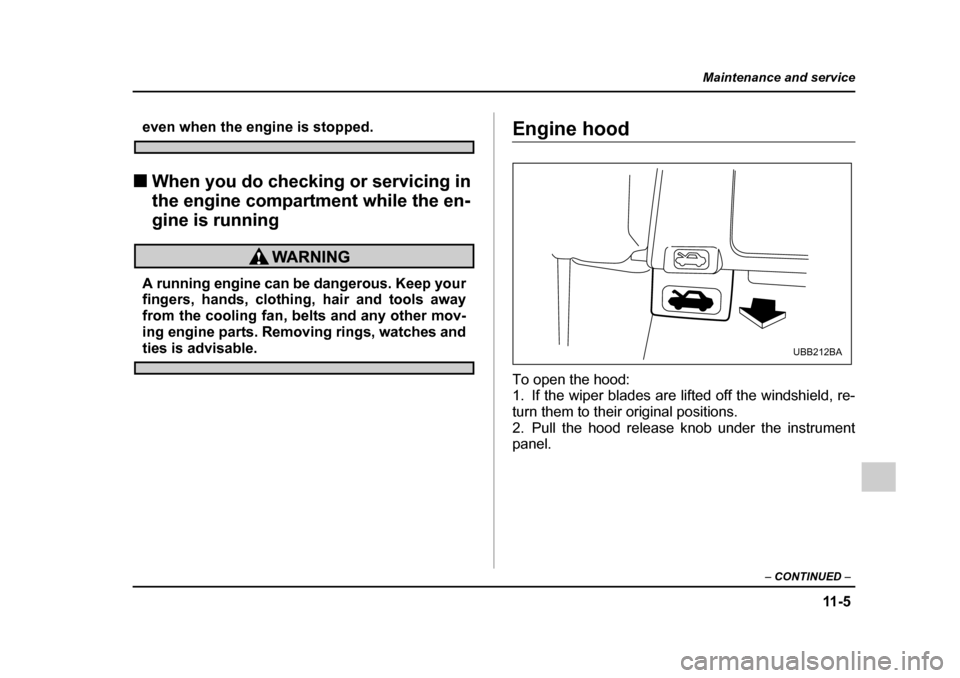
To open the hood:
1. If the wiper blades are lifted off the windshield, re-
turn them to their original positions.
2. Pull the hood release knob under the instrument
panel.
UBB212BA
Page 559 of 627
11 - 6 0
Maintenance and service
Replacement of wiper blades
Grease, wax, insects, or other materials on the wind-
shield or the wiper blade results in jerky wiper opera-
tion and streaking on the glass. If you cannot remove
the streaks after operating the windshield washer or if
the wiper operation is jerky, clean the outer surface of
the windshield (or rear window) and the wiper blades
using a sponge or soft cloth with a neutral detergent or
mild-abrasive cleaner. After cleaning, rinse the wind-
shield and wiper blades with clean water. The wind-
shield is clean if beads do not form when you rinse the
windshield with water.
"
Do not clean the wiper blades with gasoline
or a solvent, such as paint thinner or benzene.
This will cause deterioration of the wiper
blades. " When you wish to raise the passenger-side
wiper arm, first raise the driver-side wiper arm.
Otherwise, the passenger-side wiper assembly
and driver-side wiper assembly will touch each
other, possibly resulting in scratches." Return the passenger-side wiper arm to its
original position before returning the driver- side wiper arm to its original position. Other-
wise, the passenger-side wiper assembly and
driver-side wiper assembly will touch each oth-
er, possibly resulting in scratches.
If you cannot eliminate the streaking even after follow-
ing this method, replace the wiper blades using the fol-
lowing procedures: ! Windshield wiper blades assembly
1. Raise the windshield wiper arm on the driver’s side.
2. Next, raise the windshield wiper arm on the pas-
senger’s side.
Page 560 of 627
11 -6 1
Maintenance and service
– CONTINUED –
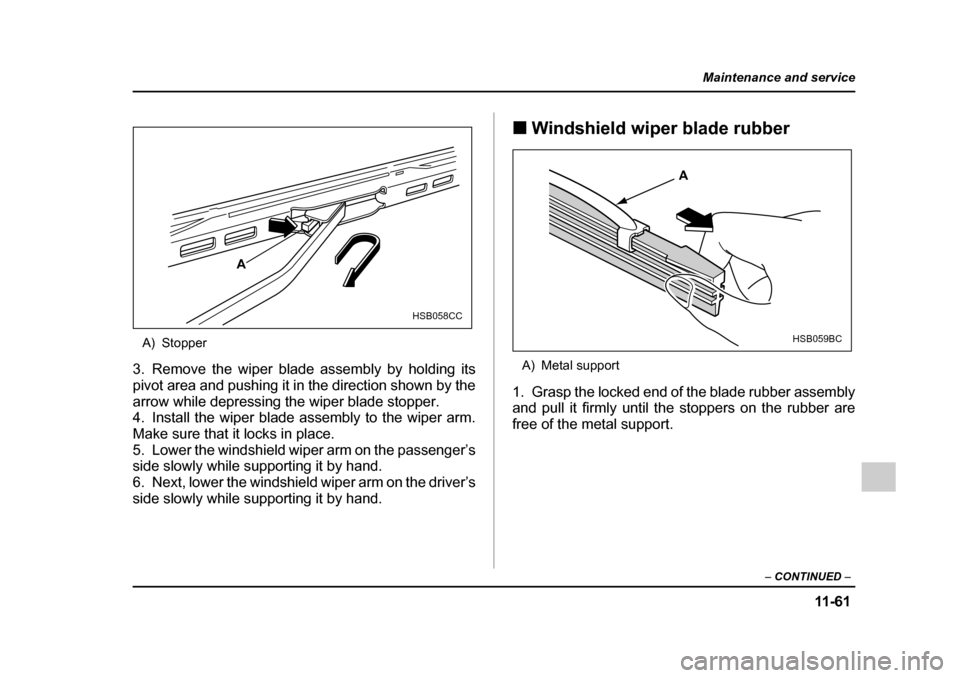
A) Stopper
3. Remove the wiper blade assembly by holding its
pivot area and pushing it in the direction shown by the
arrow while depressing the wiper blade stopper.
4. Install the wiper blade assembly to the wiper arm.
Make sure that it locks in place.
5. Lower the windshield wiper arm on the passenger’s
side slowly while supporting it by hand.
6. Next, lower the windshield wiper arm on the driver’s
side slowly while supporting it by hand. !
Windshield wiper blade rubber
A) Metal support
1. Grasp the locked end of the blade rubber assembly
and pull it firmly until the stoppers on the rubber are
free of the metal support.
A
HSB058CC
A
HSB059BC