check engine light SUBARU OUTBACK 2005 4.G Owner's Manual
[x] Cancel search | Manufacturer: SUBARU, Model Year: 2005, Model line: OUTBACK, Model: SUBARU OUTBACK 2005 4.GPages: 627, PDF Size: 6.42 MB
Page 399 of 627
7-44
Starting and operating
spinning of the driving wheels on slippery road surfac-
es, thereby helping to maintain traction and directional
control. Activation of this function is shown by steady
illumination of the Vehicle Dynamics Control operation
indicator light. "
Skid Suppression Function
The skid suppression function is designed to help
maintain directional stability by suppressing the
wheels’ tendency to slide sideways during steering op-
erations. Activation of this function is shown by flash-
ing of the Vehicle Dynamics Control operation indica-
tor light.
NOTE " Slight twitching of the brake pedal may be felt
when the Vehicle Dynamics Control system oper-
ates; a small degree of vehicle or steering wheel
shaking may also be noticed in this situation.
These are normal characteristics of Vehicle Dy-
namics Control operation and are no cause for
alarm. " When driving off immediately after starting the
engine, a short-lived operation noise may be no-
ticed coming from the engine compartment. This
noise is generated as a result of a check being per-
formed on the Vehicle Dynamics Control system
and is normal. "
Depending on the timing of activation of the
brakes, certain situations may occur just after
driving off where the brake pedal seems to exhibit
a jolting motion. This too is a consequence of the
Vehicle Dynamics Control operational check and
is normal. " In the circumstances listed below, the vehicle
may be more unstable than it feels to the driver.
The Vehicle Dynamics Control System may there-
fore operate. Such operation does not indicate a
system fault. "on gravel-covered or rutted roads
" on unfinished roads
" when the vehicle is towing a trailer
" when the vehicle is fitted with snow tires or
winter tires
" Activation of the Vehicle Dynamics Control sys-
tem will cause operation of the steering wheel to
feel slightly different compared to that for normal
conditions." Even if the vehicle is equipped with a Vehicle
Dynamics Control system, it is important that win-
ter tires be used when driving on snow-covered or
icy roads. (All four wheels should be fitted with
tires of the same size and brand). Furthermore, if
snow chains are to be used, they should be fitted
on the front wheels. When a vehicle is fitted with
Page 424 of 627

8-11
Driving tips
– CONTINUED –
"Always check your brakes for effectiveness immedi-
ately after driving in sand, mud or water. Do this by
driving slowly and stepping on the brake pedal. Re-
peat that process several times to dry out the brake
discs and brake pads." Do not drive or park over or near flammable materi-
als such as dry grass or fallen leaves, as they may
burn easily. The exhaust system is very hot while the
engine is running and right after engine stops. This
could create a fire hazard. " After driving through tall grass, mud, rocks, sand,
rivers, etc., check that there is no grass, bush, paper,
rags, stones, sand, etc. adhering to or trapped on the
underbody. Clear off any such matter from the under-
body. If the vehicle is used with these materials
trapped or adhering to the underbody, a mechanical
breakdown or fire could occur." Secure all cargo carried inside the vehicle and make
certain that it is not piled higher than the seatbacks.
During sudden stops or jolts, unsecured cargo could
be thrown around in the vehicle and cause injury. Do
not pile heavy loads on the roof. Those loads raise the
vehicle’s center of gravity and make it more prone to
tip over. " If you must rock the vehicle to free it from sand or
mud, depress the accelerator pedal slightly and move
the selector lever back and forth between “D” and “R” repeatedly. Do not race the engine. For the best pos-
sible traction, avoid spinning the wheels when trying to
free the vehicle. "
When the road surface is extremely slippery, you
can obtain better traction by starting the vehicle with
the transmission in 2nd than 1st (both for MT and AT). " Never equip your vehicle with tires larger than those
specified in this manual. " Wash the vehicle’s underbody after off-road driving.
Suspension components are particularly prone to dirt
buildup, so they need to be washed thoroughly." Frequent driving of an AWD vehicle under hard-driv-
ing conditions such as rough roads or off roads will ne-
cessitate more frequent replacement of engine oil,
brake fluid and transmission oil than that specified in
the maintenance schedule described in the “Warranty
and Maintenance Booklet”.
Remember that damage done to your SUBARU while
operating it off-road and not using common sense pre-
cautions such as those listed above is not eligible forwarranty coverage.
Page 514 of 627
11 -1 5
Maintenance and service
– CONTINUED –
washer after the oil has completely drained out.
6. Remove the under cover.
7. Remove the oil filter with an oil filter wrench.
8. Before installing a new oil filter, apply a thin coat of
engine oil to the seal.
9. Clean the rubber seal seating area of the bottom of
engine and install the oil filter by hand turning. Be
careful not to twist or damage the seal.
10.Tighten the oil filter by the amount indicated in the
following table after the seal makes contact with the
bottom of engine.
Never over tighten the oil filter because that can
result in an oil leak.
11.Reinstall the cover under the oil filter.
12.Pour engine oil through the filler neck.
Oil capacity (Guideline): 2.5-liter models: 4.2 US qt (4.0 liters, 3.5 Imp qt)
3.0-liter models: 5.8 US qt (5.5 liters, 4.8 Imp qt)
The oil quantity indicated above is only a guideline.
The necessary quantity of oil depends on the quantity
of oil that has been drained. The quantity of drained oil
differs slightly depending on the temperature of the oil
and the time the oil is left flowing out. After refilling the
engine with oil, therefore, you must use the dipstick to
confirm that the level is correct.
13.Start the engine and make sure that no oil leaks ap-
pear around the filter’s rubber seal and drain plug.
14.Run the engine until it reaches the normal operat-
ing temperature. Then stop the engine and wait a few
minutes to allow the oil drain back. Check the oil level
again and if necessary, add more engine oil.
Model Oil filter color Part number Amount of
rotation
2.5-liter
non-turbo
models Black 15208AA080 1 rotation
White 15208AA060 15208AA09A 2/3 – 3/4
rotation
2.5-liter
turbo models Black 15208AA080 1 rotation
White 15208AA09A 2/3 – 3/4 rotation
3.0-liter
models Black 15208AA031 3/4 rotation
Page 543 of 627
11 - 4 4
Maintenance and service
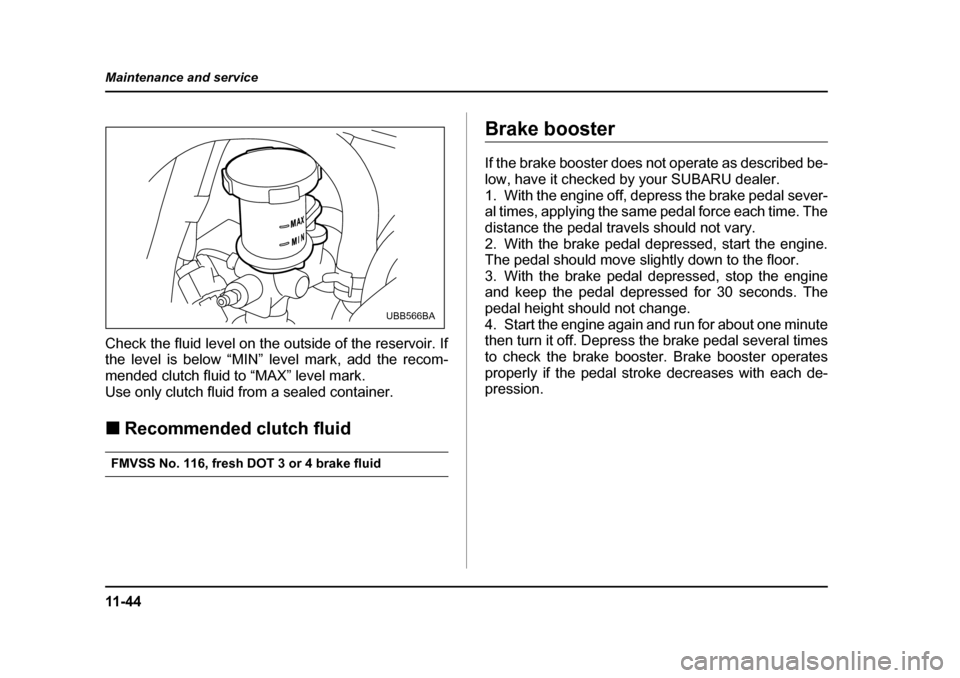
Check the fluid level on the outside of the reservoir. If
the level is below “MIN” level mark, add the recom-
mended clutch fluid to “MAX” level mark.
Use only clutch fluid from a sealed container. !
Recommended clutch fluid
FMVSS No. 116, fresh DOT 3 or 4 brake fluid
Brake booster
If the brake booster does not operate as described be-
low, have it checked by your SUBARU dealer.
1. With the engine off, depress the brake pedal sever-
al times, applying the same pedal force each time. The
distance the pedal travels should not vary.
2. With the brake pedal depressed, start the engine.
The pedal should move slightly down to the floor.
3. With the brake pedal depressed, stop the engine
and keep the pedal depressed for 30 seconds. The
pedal height should not change.
4. Start the engine again and run for about one minute
then turn it off. Depress the brake pedal several times
to check the brake booster. Brake booster operates
properly if the pedal stroke decreases with each de-
pression.
UBB566BA
Page 544 of 627
11 -4 5
Maintenance and service
– CONTINUED –
Brake pedal
Check the brake pedal free play and reserve distance
according to the maintenance schedule in the “War-
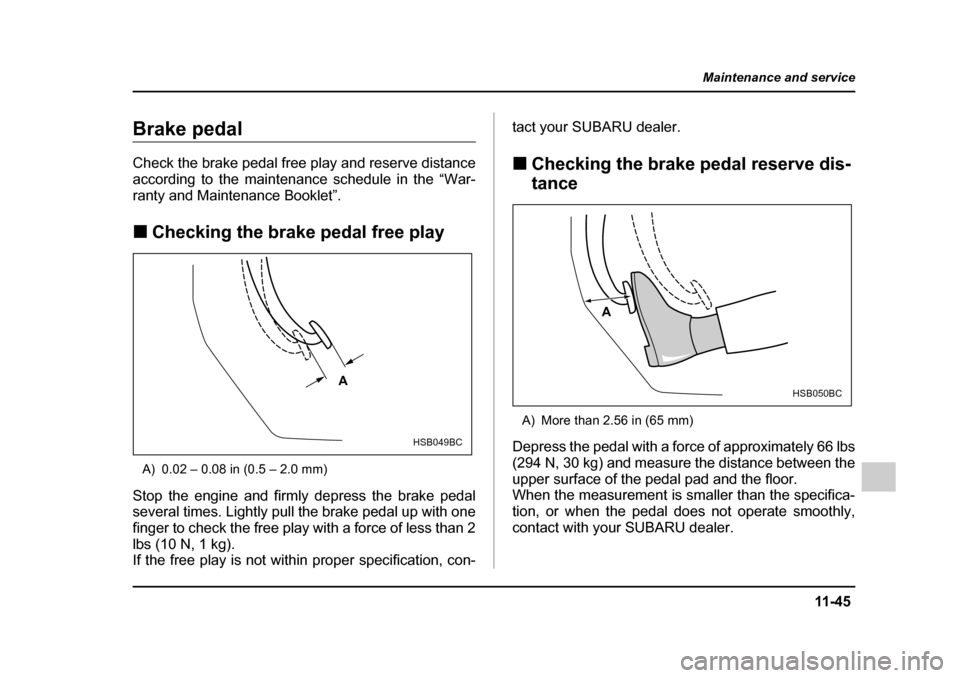
ranty and Maintenance Booklet”. !Checking the brake pedal free play
A) 0.02 – 0.08 in (0.5 – 2.0 mm)
Stop the engine and firmly depress the brake pedal
several times. Lightly pull the brake pedal up with one
finger to check the free play with a force of less than 2
lbs (10 N, 1 kg).
If the free play is not within proper specification, con- tact your SUBARU dealer. !
Checking the brake pedal reserve dis-
tance
A) More than 2.56 in (65 mm)
Depress the pedal with a force of approximately 66 lbs
(294 N, 30 kg) and measure the distance between the
upper surface of the pedal pad and the floor.
When the measurement is smaller than the specifica-
tion, or when the pedal does not operate smoothly,
contact with your SUBARU dealer.
A
HSB049BC
A
HSB050BC
Page 545 of 627
11 - 4 6
Maintenance and service
Clutch pedal (Manual transmission
vehicles)
Check the clutch pedal free play and reserve distance
according to the maintenance schedule in the “War-
ranty and Maintenance Booklet”. !
Checking the clutch function
Check the clutch engagement and disengagement.
1. With the engine idling, check that there are no ab-
normal noises when the clutch pedal is depressed,
and that shifting into 1st or reverse feels smooth.
2. Start the vehicle by releasing the pedal slowly to
check that the engine and transmission smoothly cou-
ple without any sign of slippage. !
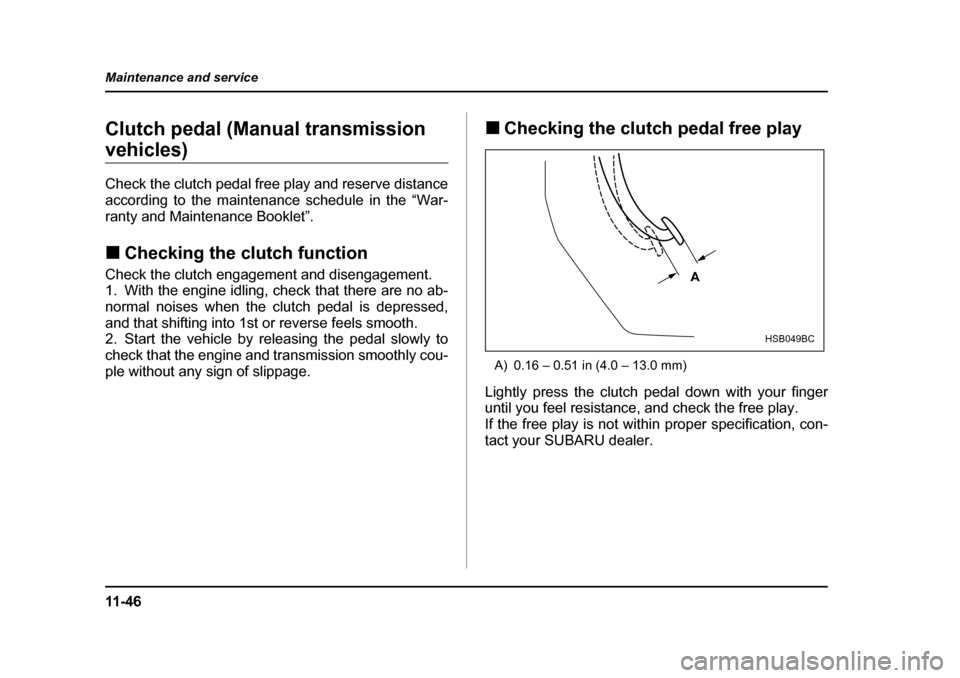
Checking the clutch pedal free play
A) 0.16 – 0.51 in (4.0 – 13.0 mm)
Lightly press the clutch pedal down with your finger
until you feel resistance, and check the free play.
If the free play is not within proper specification, con-
tact your SUBARU dealer.
A
HSB049BC
Page 618 of 627

14-3
Index
Bulb
Chart ........................................................... 12-10
Replacing .................................................... 11-73
C
Capacities .......................................................... 12-4
Cargo area Cover ............................................................ 6-23
Light ................................................................ 6-3
Tie-down hooks ............................................ 6-29
Catalytic converter ............................................... 8-4
Center Console .......................................................... 6-8
Ventilators ....................................................... 4-3
Changing
Flat tire ............................................................ 9-5
Oil and oil filter ............................................ 11-13
Charge warning light ......................................... 3-26CHECK ENGINE warning light/Malfunction
indicator lamp ................................................ 3-25
Checking
Brake pedal free play .................................. 11-45
Brake pedal reserve distance ..................... 11-45
Clutch function ............................................ 11-46
Clutch pedal free play ................................. 11-46
Engine oil level ........................................... 11-12
Fluid level ................. 11-33, 11-41, 11-42, 11-43 Gear oil level ............................................... 11-37
Child restraint systems ...................................... 1-38
Installation with seatbelt ............................... 1-42
Lower and tether anchorages ....................... 1-49
Child safety ............................................................. 7
Locks ............................................................ 2-30
Chime
Key ................................................................. 3-6
Seatbelt ........................................................ 1-19
Cigarette lighter socket ...................................... 6-16
Cleaning
Aluminum wheels ......................................... 10-4
Interior .......................................................... 10-6
Ventilator grille .............................................. 4-17
Climate control system Automatic ...................................................... 4-10
Manual ............................................................ 4-4
Clock ................................................................. 3-36
Clutch Fluid ............................................................ 11-43
Pedal .......................................................... 11-46
Coat hook .......................................................... 6-20
Cooling system ................................................ 11-18
Corrosion protection ................................. 8-14, 10-4
Cruise control .................................................... 7-53
Set indicator light .......................................... 3-35