climate control SUBARU OUTBACK 2005 4.G Owner's Manual
[x] Cancel search | Manufacturer: SUBARU, Model Year: 2005, Model line: OUTBACK, Model: SUBARU OUTBACK 2005 4.GPages: 627, PDF Size: 6.42 MB
Page 251 of 627
4-16
Climate control
ed, a “ ” indicator light appears on the display.
(Outside air): Outside air is drawn into the pas-
senger compartment. When the climate control sys-
tem is operated in the “AUTO” mode, this position is
selected automatically. (There is one exception: When
the temperature control dial is turned fully counter-
clockwise, the recirculation mode is automatically se-
lected.) When the outside air mode is selected, a
“ ” indicator light appears on the display.
Continued operation in the “ ” position
may fog up the windows. Switch to the
“ ” position as soon as the outside dusty
condition clears.
NOTE
When driving on a dusty road or behind a vehicle
that emits unpleasant exhaust gases, set the air
inlet selection button to the “ ” position.
From time to time, return the air inlet selection but-
ton to the “ ” position to draw outside air
into the passenger compartment. !
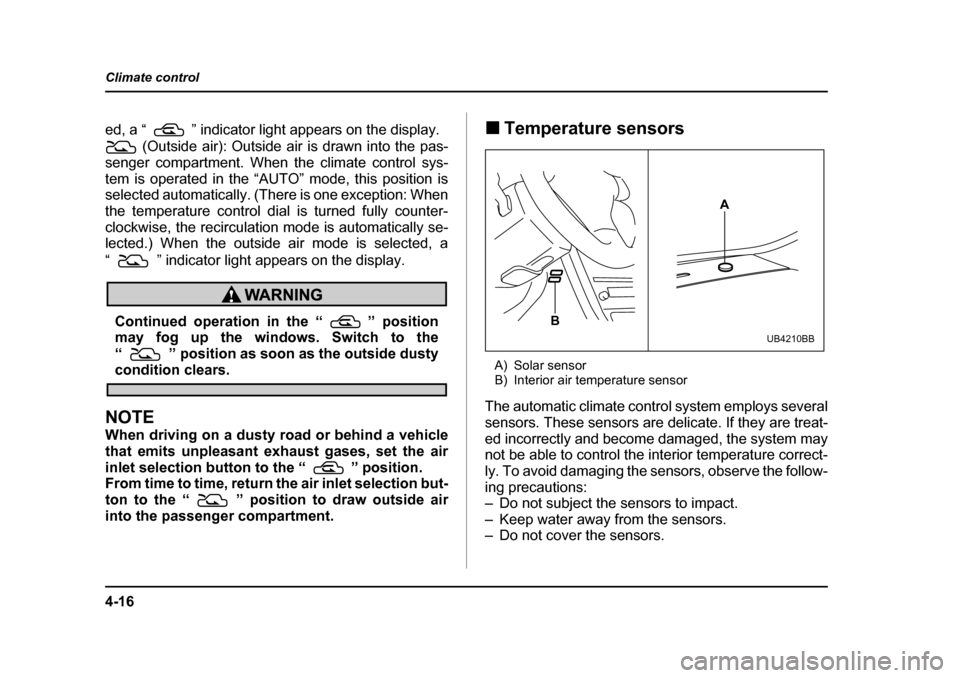
Temperature sensors
A) Solar sensor
B) Interior air temperature sensor
The automatic climate control system employs several
sensors. These sensors are delicate. If they are treat-
ed incorrectly and become damaged, the system may
not be able to control the interior temperature correct-
ly. To avoid damaging the sensors, observe the follow-
ing precautions:
– Do not subject the sensors to impact.
– Keep water away from the sensors.
– Do not cover the sensors.
A
B
UB4210BB
Page 252 of 627
4-17
Climate control
– CONTINUED –
The sensors are located as follows:
– Solar sensor: beside windshield defroster grille
– Interior air temperature sensor: on the side of the
driver-side part of the center panel
– Outside temperature sensor: behind front grille. Operating tips for heater and air con-
ditioner !
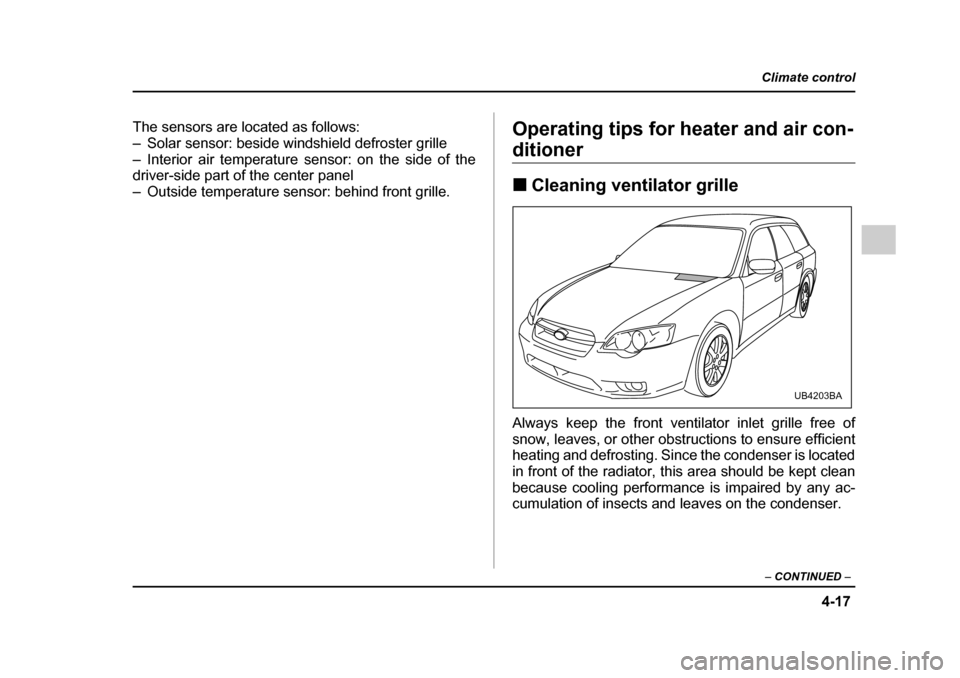
Cleaning ventilator grille
Always keep the front ventilator inlet grille free of
snow, leaves, or other obstructions to ensure efficient
heating and defrosting. Since the condenser is located
in front of the radiator, this area should be kept clean
because cooling performance is impaired by any ac-
cumulation of insects and leaves on the condenser.
UB4203BA
Page 253 of 627

4-18
Climate control
!
Efficient cooling after parking in direct
sunlight
After parking in direct sunlight, drive with the windows
open for a few minutes to allow outside air to circulate
into the heated interior. This results in quicker cooling
by the air conditioner. Keep the windows closed during
the operation of the air conditioner for maximum cool- ing efficiency. ! Lubrication oil circulation in the refrig-
erant circuit
Operate the air conditioner compressor at a low en-
gine speed (at idle or low driving speeds) a few min-
utes each month during the off-season to circulate its
oil. ! Checking air conditioning system be-
fore summer season
Check the air conditioner unit for refrigerant leaks,
hose conditions, and proper operation each spring.
Have your SUBARU dealer perform this check. !
Cooling and dehumidifying in high hu-
midity and low temperature weather condition
Under certain weather conditions (high relative humid-
ity, low temperatures, etc.) a small amount of water
vapor emission from the air outlets may be noticed.
This condition is normal and does not indicate any
problem with the air conditioning system. ! Air conditioner compressor shut-off
when engine is heavily loaded
To improve acceleration and gas mileage, the air con-
ditioner compressor is designed to temporarily shut off
during air conditioner operation whenever the acceler-
ator is fully depressed such as during rapid accelera-
tion or when driving on a steep upgrade. ! Refrigerant for your climate control system
Your air conditioner uses ozone friendly refrigerant
HFC134a. Therefore, the method of adding, changing
or checking the refrigerant is different from the method
for CFC12 (freon). Consult your SUBARU dealer for
service. Repairs needed as a result of using the wrong
refrigerant are not covered under warranty.
Page 254 of 627
4-19
Climate control
– CONTINUED –
Air filtration system (if equipped)
If your vehicle’s air conditioning system is equipped
with an air filtration system, replace the filter element
according to the replacement schedule shown below.
This schedule should be followed to maintain the fil-
ter’s dust collection ability. Under extremely dusty con-
ditions, the filter should be replaced more frequently.
Have your filter checked or replaced by your SUBARU
dealer. For replacement, we recommend the use of a
genuine SUBARU air filter kit.
Replacement schedule:
Every 12 months or 7,500 miles (12,000 km) whichev-
er comes first
Contact your SUBARU dealer if the following
occurs, even if it is not yet time to change the
filter:
– Reduction of the air flow through the vents.
– Windshield gets easily fogged or misted.
NOTE
The filter can influence the air conditioning, heat- ing and defroster performance if not properly
maintained.
Page 333 of 627
6-16
Interior equipment
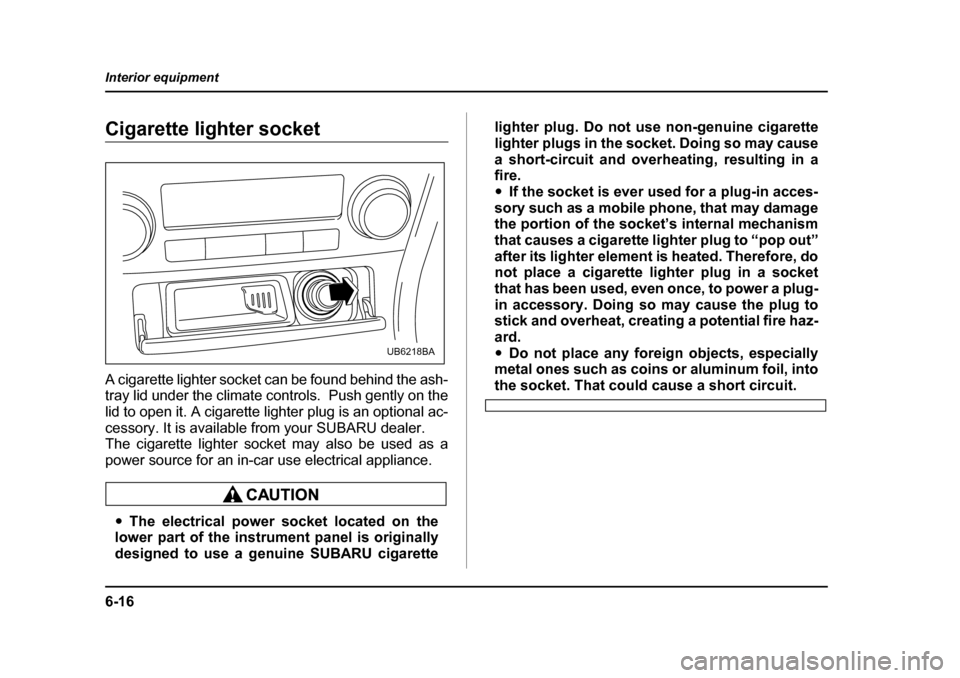
Cigarette lighter socket
A cigarette lighter socket can be found behind the ash-
tray lid under the climate controls. Push gently on the
lid to open it. A cigarette lighter plug is an optional ac-
cessory. It is available from your SUBARU dealer.
The cigarette lighter socket may also be used as a
power source for an in-car use electrical appliance.
"
The electrical power socket located on the
lower part of the instrument panel is originally
designed to use a genuine SUBARU cigarette lighter plug. Do not use non-genuine cigarette
lighter plugs in the socket. Doing so may cause
a short-circuit and overheating, resulting in a fire. "
If the socket is ever used for a plug-in acces-
sory such as a mobile phone, that may damage
the portion of the socket’s internal mechanism
that causes a cigarette lighter plug to “pop out”
after its lighter element is heated. Therefore, do
not place a cigarette lighter plug in a socket
that has been used, even once, to power a plug-
in accessory. Doing so may cause the plug to
stick and overheat, creating a potential fire haz-
ard." Do not place any foreign objects, especially
metal ones such as coins or aluminum foil, into
the socket. That could cause a short circuit.
UB6218BA
Page 334 of 627
6-17
Interior equipment
– CONTINUED –
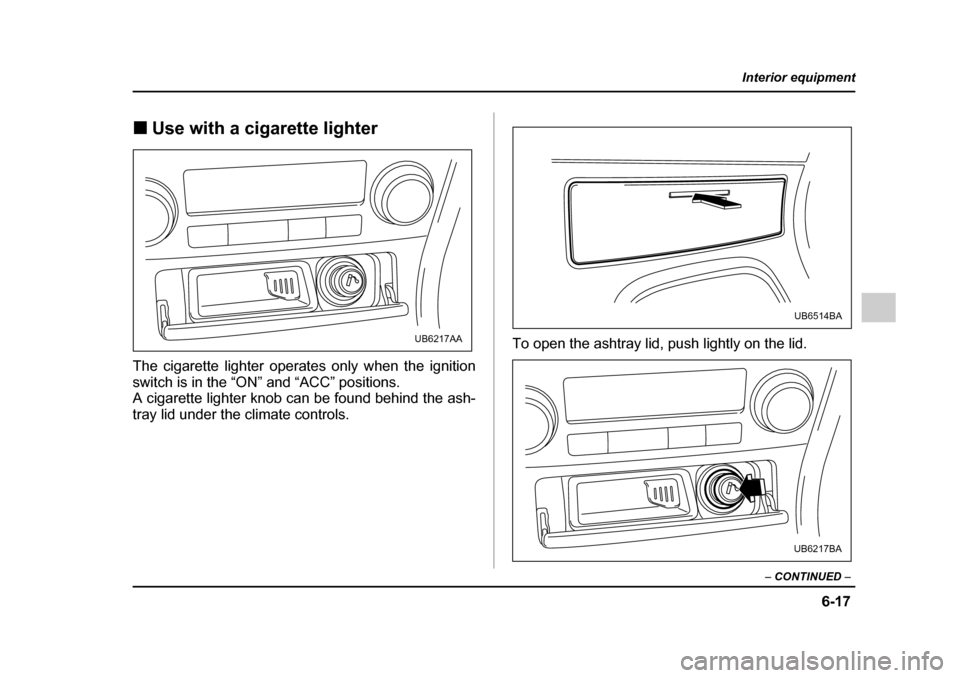
!Use with a cigarette lighter
The cigarette lighter operates only when the ignition
switch is in the “ON” and “ACC” positions.
A cigarette lighter knob can be found behind the ash-
tray lid under the climate controls. To open the ashtray lid, push lightly on the lid.
UB6217AA
UB6514BA
UB6217BA
Page 337 of 627
6-20
Interior equipment
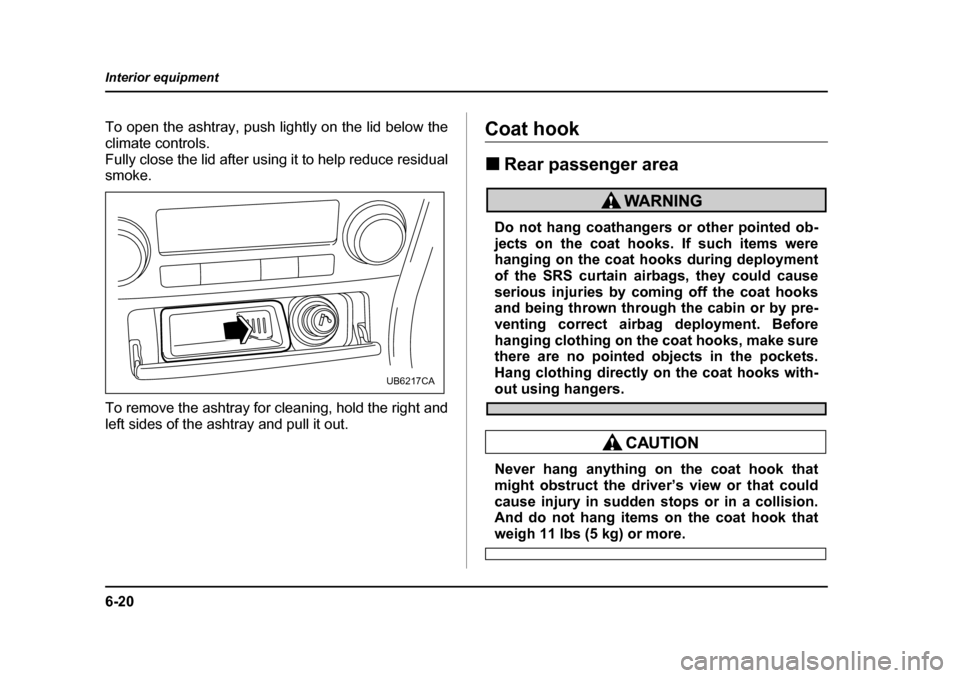
To open the ashtray, push lightly on the lid below the
climate controls.
Fully close the lid after using it to help reduce residual smoke.
To remove the ashtray for cleaning, hold the right and
left sides of the ashtray and pull it out.Coat hook !
Rear passenger area
Do not hang coathangers or other pointed ob-
jects on the coat hooks. If such items were
hanging on the coat hooks during deployment
of the SRS curtain airbags, they could cause
serious injuries by coming off the coat hooks
and being thrown through the cabin or by pre-
venting correct airbag deployment. Before
hanging clothing on the coat hooks, make sure
there are no pointed objects in the pockets.
Hang clothing directly on the coat hooks with-
out using hangers.
Never hang anything on the coat hook that
might obstruct the driver’s view or that could
cause injury in sudden stops or in a collision.
And do not hang items on the coat hook that
weigh 11 lbs (5 kg) or more.
UB6217CA
Page 492 of 627

10-1
10
Appearance care
Exterior care .................................................. 10-2 Washing ............................................................. 10-2
Waxing and polishing ....................................... 10-3
Cleaning aluminum wheels .............................. 10-4
Corrosion protection .................................... 10-4 Most common causes of corrosion ................ 10-4
To help prevent corrosion ............................... 10-5
Cleaning the interior ..................................... 10-6 Seat fabric ......................................................... 10-6
Leather seat materials ...................................... 10-6
Synthetic leather upholstery ........................... 10-6
Climate control panel, audio panel, instrument panel, console panel, switches,
combination meter, and other plastic
surface ............................................................ 10-7
Page 498 of 627

10-7
Appearance care
– CONTINUED –
NOTE
Strong cleaning agents such as solvents, paint
thinners, window cleaner or gasoline must never
be used on leather or synthetic interior materials. !Climate control panel, audio panel, in-
strument panel, console panel, switch-
es, combination meter, and other plas-tic surface
Gently wipe away contamination using a clean, soft
cloth moistened with cold or lukewarm water.
NOTE
Do not use organic solvents such as paint thin-
ners or gasoline, or strong cleaning agents that
contain those solvents.
Page 613 of 627
13-16
Consumer information and Reporting safety defects
Uniform tire quality grading stan-
dards
This information indicates the relative perfor-
mance of passenger car tires in the area of
treadwear, traction, and temperature resistance.
This is to aid the consumer in making an in-
formed choice in the purchase of tires.
Quality grades can be found where applicable on
the tire sidewall between tread shoulder and
maximum section width. For example:
Treadwear 200 Traction AA Temperature A
The quality grades apply to new pneumatic tires
for use on passenger cars. However, they do not
apply to deep tread, winter type snow tires,
space-saver or temporary use spare tires, tires
with nominal rim diameters of 12 inches or less,
or to some limited production tires.
All passenger car tires must confirm to Federal
Safety Requirements in addition to these grades. !
Treadwear
The treadwear grade is a comparative rating based on the wear rate of the tire when tested
under controlled conditions on a specified gov- ernment test course.
For example, a tire graded 150 would wear one
and one-half (1-1/2) times as well on the govern-
ment course as a tire graded 100. The relative
performance of tires depends upon the actual
conditions of their use, however, and may depart
significantly from the norm due to variations in
driving habits, service practices and differences
in road characteristics and climate. !
Traction AA, A, B, C
The traction grades, from highest to lowest, are
AA, A, B and C. Those grades represent the
tire’s ability to stop on wet pavement as mea-
sured under controlled conditions on specified
government test surfaces of asphalt and con-
crete. A tire marked C may have poor traction
performance.
The traction grade assigned to this tire is
based on straight-ahead braking traction