steering SUBARU OUTBACK 2005 4.G Owner's Manual
[x] Cancel search | Manufacturer: SUBARU, Model Year: 2005, Model line: OUTBACK, Model: SUBARU OUTBACK 2005 4.GPages: 627, PDF Size: 6.42 MB
Page 367 of 627
7-12
Starting and operating
Release the accelerator pedal as soon as the en-
gine starts.
2) If this fails to start the engine, turn the ignition
switch back to the “OFF” position and wait for at
least 10 seconds. Then fully depress the accelerator
pedal and turn the ignition switch to the “START”
position. If the engine starts, quickly release the ac-
celerator pedal.
3) If this fails to start the engine, turn the ignition
switch again to the “OFF” position. After waiting for
10 seconds or longer, turn the ignition switch to the
“START” position without depressing the accelera-
tor pedal.
4) If the engine still refuses to start, contact your
nearest SUBARU dealer for assistance.
6. Confirm that all warning and indicator lights have
gone out after the engine has started. The fuel injec-
tion system automatically lowers the idle speed as the
engine warms up.
While the engine is warming up, make sure that the
selector lever is at the “P” or “N” position and that the
parking brake is applied.Stopping the engine
Do not stop the engine when the vehicle is mov-
ing. This will cause loss of power to the power
steering and the brake booster, making steer-
ing and braking more difficult. It could also re-
sult in accidental activation of the “LOCK” po-
sition on the ignition switch, causing the steer-
ing wheel to lock.
The ignition switch should be turned off only when the
engine is idling.
Page 386 of 627
7-31
Starting and operating
– CONTINUED –
goes off.
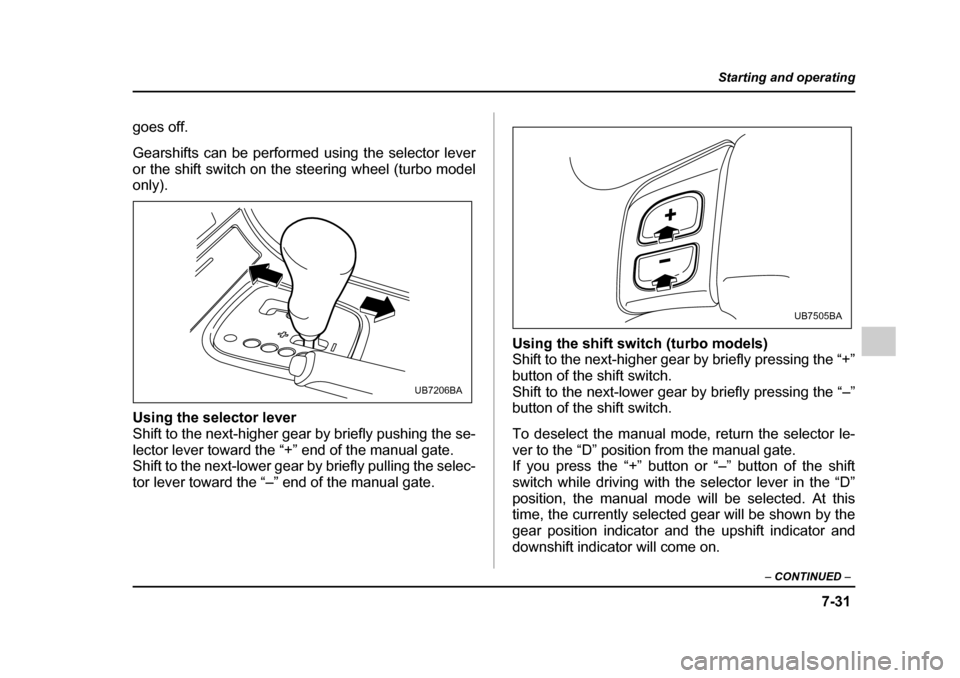
Gearshifts can be performed using the selector lever
or the shift switch on the steering wheel (turbo model
only).
Using the selector lever
Shift to the next-higher gear by briefly pushing the se-
lector lever toward the “+” end of the manual gate.
Shift to the next-lower gear by briefly pulling the selec-
tor lever toward the “–” end of the manual gate. Using the shift switch (turbo models)
Shift to the next-higher gear by briefly pressing the “+”
button of the shift switch.
Shift to the next-lower gear by briefly pressing the “–”
button of the shift switch.
To deselect the manual mode, return the selector le-
ver to the “D” position from the manual gate.
If you press the “+” button or “–” button of the shift
switch while driving with the selector lever in the “D”
position, the manual mode will be selected. At this
time, the currently selected gear will be shown by the
gear position indicator and the upshift indicator and
downshift indicator will come on.
UB7206BA
UB7505BA
Page 387 of 627
7-32
Starting and operating
If you subsequently ease off the accelerator pedal and
then accelerate again, the transmission will automati-
cally switch back from manual mode to normal mode.
NOTE
Please read the following points carefully and bear
them in mind when using the manual mode. "
When the temperature of the automatic trans-
mission fluid is higher than normal, warning
beeps are emitted and the shift position indicator
shows “–”. If these warnings are issued, deselect
the manual mode to protect the automatic trans-
mission from damage. " When the temperature of the engine oil is higher
than normal, warning beeps are emitted and the
shift position indicator shows “–”. If these warn-
ings are issued, deselect the manual mode to pro-
tect the engine from damage. (3.0-liter models
only) " Automatic gearshifts do not take place in the
manual mode. Perform gearshifts in accordance
with road conditions so that the tachometer nee-
dle does not enter the red zone. If the engine
speed reaches a predetermined level, a fuel-cut
function will operate. Shift up if this happens. " If you attempt to shift down when the engine
speed is too high, i.e., when a downshift would
push the tachometer needle beyond the red zone, beeps will be emitted to warn you that the down-
shift is not possible."
If you attempt to shift up when the vehicle speed
is too low, the transmission will not respond." You can perform a skip-shift (for example, from
4th to 2nd) by operating the selector lever or a
steering-wheel switch twice in rapid succession. " The transmission automatically selects 1st gear
when the vehicle stops moving. " If the temperature of the automatic transmission
fluid becomes too high, the “AT OIL TEMP” warn-
ing light will come on and upshifts to 5th gear will
not be possible. Immediately stop the vehicle in a
safe place and let the engine idle until the warning
light goes off. ! Maximum speeds
When down shifting, ensure that the vehicle is
not travelling at a speed exceeding the Maxi-
mum Allowable Speed for the gear which is
about to be selected. Failure to observe this
precaution can lead to engine over-revving and
this in turn can result in engine damage.
In addition, sudden application of engine brak-
Page 391 of 627
7-36
Starting and operating
Rear viscous limited slip differential
(LSD) (if equipped)
"
Never start the engine while a tire on one side
is jacked up, as the vehicle may move. " If one rear tire is spinning in mud, avoid con-
tinued spinning at high speed as this could ad-
versely affect the LSD. " If a different size rear tire is temporarily used
(as in an emergency), it will adversely affect the
LSD. Always replace it with a regular size tire as
soon as possible.
The LSD provides optimum distribution of power ac-
cording to the difference in revolutions between the
right and left rear wheels that may be caused by cer-
tain driving conditions, thereby improving driving sta-
bility on snow-covered, muddy or other slippery roads.
Power steering
Do not hold the steering wheel at the fully
locked position left or right for more than five
seconds. This may damage the power steering
pump.
The power steering system operates only when the
engine is running.
If you lose power steering assist because the engine
stops or the system fails to function, you can steer but
it will take much more effort.
NOTE
Right after the engine has been started and before
it has warmed up, you may hear a noise coming
from areas adjacent to the power steering pump
which is located at the right-front area of the en-
gine compartment. This noise is normal. It does
not indicate power steering system trouble.
Page 394 of 627
7-39
Starting and operating
– CONTINUED –
The ABS system prevents the lock-up of wheels which
may occur during sudden braking or braking on slip-
pery road surfaces. This helps prevent the loss of
steering control and directional stability caused by
wheel lock-up.
When the ABS system is operating, you may hear a
chattering noise or feel a slight vibration in the brake
pedal. This is normal when the ABS operates.
The ABS system will not operate when the vehicle
speed is below approximately 6 mph (10 km/h). !ABS system self-check
You may feel a slight shock in the brake pedal and hear the operating sound of ABS from the engine com-
partment just after the vehicle is started. This is
caused by an automatic functional test of the ABS sys-
tem being carried out and does not indicate any abnor-
mal condition. !
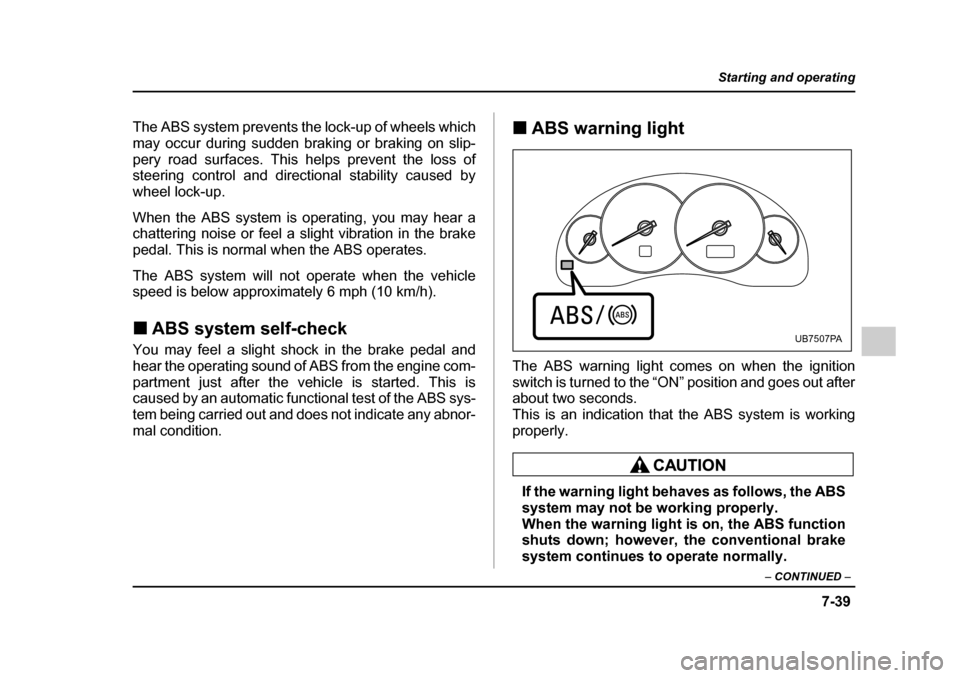
ABS warning light
The ABS warning light comes on when the ignition
switch is turned to the “ON” position and goes out after
about two seconds.
This is an indication that the ABS system is working
properly.
If the warning light behaves as follows, the ABS
system may not be working properly.
When the warning light is on, the ABS function
shuts down; however, the conventional brake
system continues to operate normally.
UB7507PA
Page 398 of 627
7-43
Starting and operating
– CONTINUED –
Vehicle Dynamics Control system (if
equipped)
Always use the utmost care in driving – over-
confidence because you are driving with a Ve-
hicle Dynamics Control system equipped vehi-
cle could easily lead to a serious accident.
"Even if your vehicle is equipped with Vehicle
Dynamics Control, winter tires or snow chains
should be used when driving on snow-covered
or icy roads; in addition, vehicle speed should
be reduced considerably. Simply having a Vehi-
cle Dynamics Control system does not guaran-
tee that the vehicle will be able to avoid acci-
dents in any situation." Activation of the Vehicle Dynamics Control
system is an indication that the road being trav-
elled on has a slippery surface; since having
Vehicle Dynamics Control is no guarantee that
full vehicle control will be maintained at all
times and under all conditions, its activation should be seen as a sign that the speed of the
vehicle should be reduced considerably."
Whenever suspension components, steering
components, or an axle are removed from a ve-
hicle equipped with Vehicle Dynamics Control,
have an authorized SUBARU dealer perform an
inspection of that system. " The following precautions should be ob-
served in order to ensure that the Vehicle Dy-
namics Control system is operating properly: – All four wheels should be fitted with tires of
the same size, type, and brand. Furthermore,
the amount of wear should be the same for all four tires.
– Keep the tire pressure at the proper level as
shown on the vehicle placard attached to the
driver’s side door pillar.
In the event of wheelspin and/or skidding on a slippery
road surface and/or during cornering and/or an eva-
sive maneuver, the Vehicle Dynamics Control system
adjusts the engine’s output and the wheels’ respective
braking forces to help maintain traction and directional control. " Traction Control Function
The traction control function is designed to prevent
Page 399 of 627

7-44
Starting and operating
spinning of the driving wheels on slippery road surfac-
es, thereby helping to maintain traction and directional
control. Activation of this function is shown by steady
illumination of the Vehicle Dynamics Control operation
indicator light. "
Skid Suppression Function
The skid suppression function is designed to help
maintain directional stability by suppressing the
wheels’ tendency to slide sideways during steering op-
erations. Activation of this function is shown by flash-
ing of the Vehicle Dynamics Control operation indica-
tor light.
NOTE " Slight twitching of the brake pedal may be felt
when the Vehicle Dynamics Control system oper-
ates; a small degree of vehicle or steering wheel
shaking may also be noticed in this situation.
These are normal characteristics of Vehicle Dy-
namics Control operation and are no cause for
alarm. " When driving off immediately after starting the
engine, a short-lived operation noise may be no-
ticed coming from the engine compartment. This
noise is generated as a result of a check being per-
formed on the Vehicle Dynamics Control system
and is normal. "
Depending on the timing of activation of the
brakes, certain situations may occur just after
driving off where the brake pedal seems to exhibit
a jolting motion. This too is a consequence of the
Vehicle Dynamics Control operational check and
is normal. " In the circumstances listed below, the vehicle
may be more unstable than it feels to the driver.
The Vehicle Dynamics Control System may there-
fore operate. Such operation does not indicate a
system fault. "on gravel-covered or rutted roads
" on unfinished roads
" when the vehicle is towing a trailer
" when the vehicle is fitted with snow tires or
winter tires
" Activation of the Vehicle Dynamics Control sys-
tem will cause operation of the steering wheel to
feel slightly different compared to that for normal
conditions." Even if the vehicle is equipped with a Vehicle
Dynamics Control system, it is important that win-
ter tires be used when driving on snow-covered or
icy roads. (All four wheels should be fitted with
tires of the same size and brand). Furthermore, if
snow chains are to be used, they should be fitted
on the front wheels. When a vehicle is fitted with
Page 407 of 627
7-52
Starting and operating
“Warning and indicator lights” section (chapter 3).
When parking your vehicle, always set the parking
brake firmly and put the shift lever in the “1” (1st) for an
upgrade or “R” (Reverse) for a downgrade for manual
transmission vehicles, or in the “P” (Park) position for
automatic transmission vehicles. Always set the park-
ing brake firmly when parking your vehicle. Never rely
on the transmission alone to hold the vehicle.
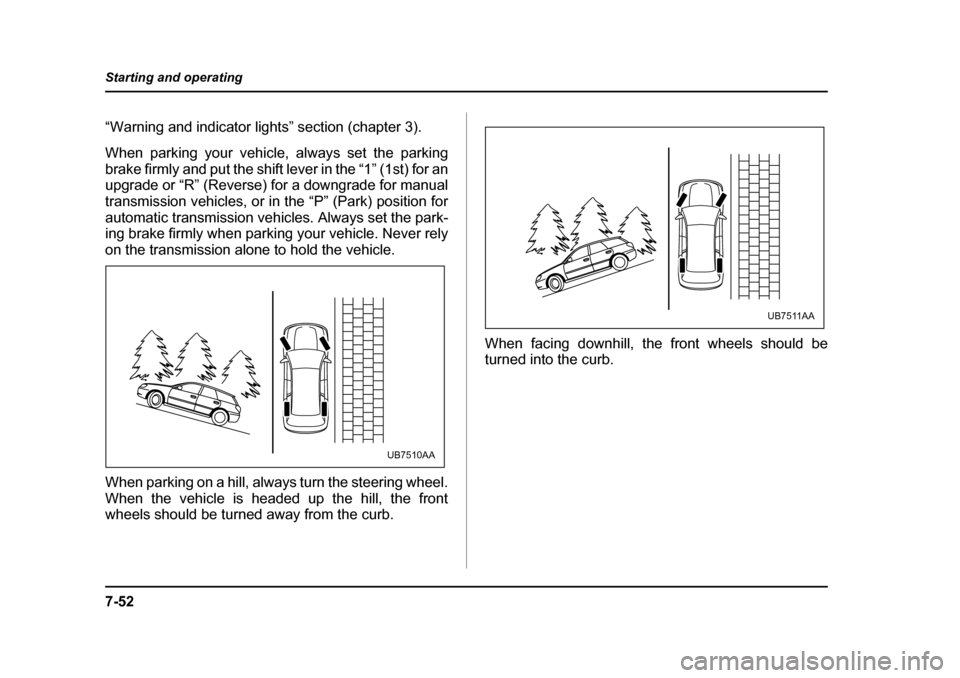
When parking on a hill, always turn the steering wheel.
When the vehicle is headed up the hill, the front
wheels should be turned away from the curb.
When facing downhill, the front wheels should be
turned into the curb.
UB7510AA
UB7511AA
Page 423 of 627

8-10
Driving tips
next section (applicable to the OUTBACK) for general
guidance. But please keep in mind that your vehicle’s
off-road capabilities are more limited than those of the OUTBACK.
Never attempt to drive through pools and puddles, or
roads flooded with water. Water entering the engine
air intake or the exhaust pipe or water splashing onto
electrical parts may damage your vehicle and may
cause it to stall. !
OUTBACK
Because of the AWD feature and higher ground clear-
ance, your SUBARU can be driven on ordinary roads
or off-road. But please keep in mind that an AWD
SUBARU is a passenger car and is neither a conven-
tional off-road vehicle nor an all-terrain vehicle. If you
do take your SUBARU off-road, certain common
sense precautions such as the following should be taken: " Make certain that you and all of your passengers
are wearing seatbelts. " Carry some emergency equipment, such as a tow-
ing rope or chain, a shovel, wheel blocks, first aid kit
and cell phone or citizens band radio. " Drive carefully. Do not take unnecessary risks by
driving in dangerous areas or over rough terrain. " Slow down and employ extra caution at all times. When driving off-road, you will not have the benefit of
marked traffic lanes, banked curves, traffic signs andthe like. "
Do not drive across steep slopes. Instead, drive ei-
ther straight up or straight down the slopes. A vehicle
can much more easily tip over sideways than it can
end over end. Avoid driving straight up or down slopes
that are too steep." Avoid sharp turning maneuvers, especially at higher
speeds. " Do not grip the inside or spokes of the steering
wheel. A bad bump could jerk the wheel and injure
your hands. Instead drive with your fingers and
thumbs on the outside of the rim." If driving through water, such as when crossing
shallow streams, first check the depth of the water and
the bottom of the stream bed for firmness and ensure
that the bed of the stream is flat. Drive slowly and com-
pletely through the stream. The water should be shal-
low enough that it does not reach the vehicle’s under-
carriage. Water entering the engine air intake or the
exhaust pipe or water splashing onto electrical parts
may damage your vehicle and may cause it to stall.
Never attempt to drive through rushing water; regard-
less of its depth, it can wash away the ground from un-
der your tires, resulting in possible loss of traction and
even vehicle rollover.
Page 425 of 627
8-12
Driving tips
Winter driving !
Operation during cold weather
Carry some emergency equipment, such as tire
chains, a window scraper, a bag of sand, flares, a
small shovel, and jumper cables.
Check the battery and cables. Cold temperatures re-
duce battery capacity. The battery must be in good
condition to provide enough power for cold winterstarts.
Use an engine oil of proper grade and viscosity for
cold weather. Heavy summer oil will cause harder starting.
Keep the door locks from freezing by squirting them
with deicer or glycerin.
Forcing a frozen door open may damage or separate
the rubber weather strips around the door. If the door
is frozen, use hot water to melt the ice, and afterwards
thoroughly wipe the water away.
Use a windshield washer fluid that contains an anti-
freeze solution. Do not use engine antifreeze or other
substitutes because they may damage the paint of the vehicle. !
Before driving your vehicle
Before entering the vehicle, remove any snow or ice
from your shoes because that could make the pedals
slippery and dangerous.
While warming up the vehicle before driving, check
that the accelerator pedal, brake pedal, and all other
controls operate smoothly.
Clear away ice and snow that has accumulated under
the fenders to avoid making steering difficult. During
severe winter driving, stop when and where it is safe
to do so and check under the fenders periodically.
UB8500AA