trunk SUBARU OUTBACK 2005 4.G Owner's Manual
[x] Cancel search | Manufacturer: SUBARU, Model Year: 2005, Model line: OUTBACK, Model: SUBARU OUTBACK 2005 4.GPages: 627, PDF Size: 6.42 MB
Page 162 of 627
2-37
Keys and doors
– CONTINUED –
!Internal trunk lid release handle
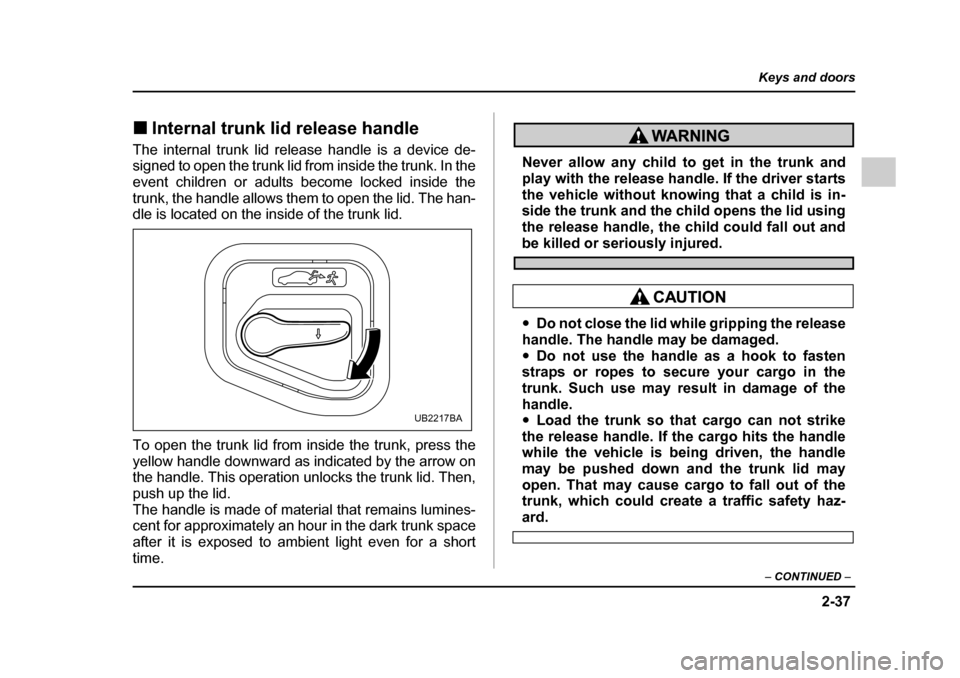
The internal trunk lid release handle is a device de-
signed to open the trunk lid from inside the trunk. In the
event children or adults become locked inside the
trunk, the handle allows them to open the lid. The han-
dle is located on the inside of the trunk lid.
To open the trunk lid from inside the trunk, press the
yellow handle downward as indicated by the arrow on the handle. This operation unlocks the trunk lid. Then,
push up the lid.
The handle is made of material that remains lumines-
cent for approximately an hour in the dark trunk space
after it is exposed to ambient light even for a short time.
Never allow any child to get in the trunk and
play with the release handle. If the driver starts
the vehicle without knowing that a child is in-
side the trunk and the child opens the lid using
the release handle, the child could fall out and
be killed or seriously injured.
" Do not close the lid while gripping the release
handle. The handle may be damaged. " Do not use the handle as a hook to fasten
straps or ropes to secure your cargo in the
trunk. Such use may result in damage of the
handle." Load the trunk so that cargo can not strike
the release handle. If the cargo hits the handle
while the vehicle is being driven, the handle
may be pushed down and the trunk lid may
open. That may cause cargo to fall out of the
trunk, which could create a traffic safety haz-
ard.
UB2217BA
Page 163 of 627
2-38
Keys and doors
!
Inspection
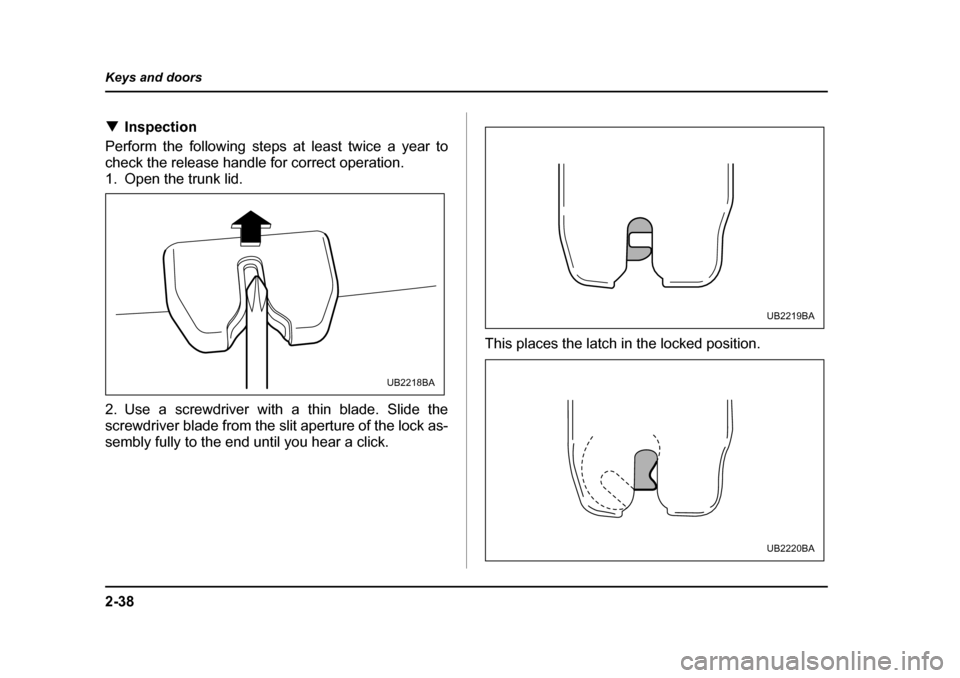
Perform the following steps at least twice a year to
check the release handle for correct operation.
1. Open the trunk lid.
2. Use a screwdriver with a thin blade. Slide the
screwdriver blade from the slit aperture of the lock as-
sembly fully to the end until you hear a click. This places the latch in the locked position.
UB2218BA
UB2219BA
UB2220BA
Page 164 of 627
2-39
Keys and doors
– CONTINUED –
3. Move the release handle, from outside the vehicle,
in the direction of the arrow to check if the latch is re-
leased.
If the latch is not released, contact your SUBARU
dealer.
In that case, use the key to release the latch, then
close the trunk lid.
Also, if the movement of the release handle feel re-
stricted or not entirely smooth during operation, or the
handle and/or handle base is cracked, contact your
SUBARU dealer.Rear gate (Station wagon)
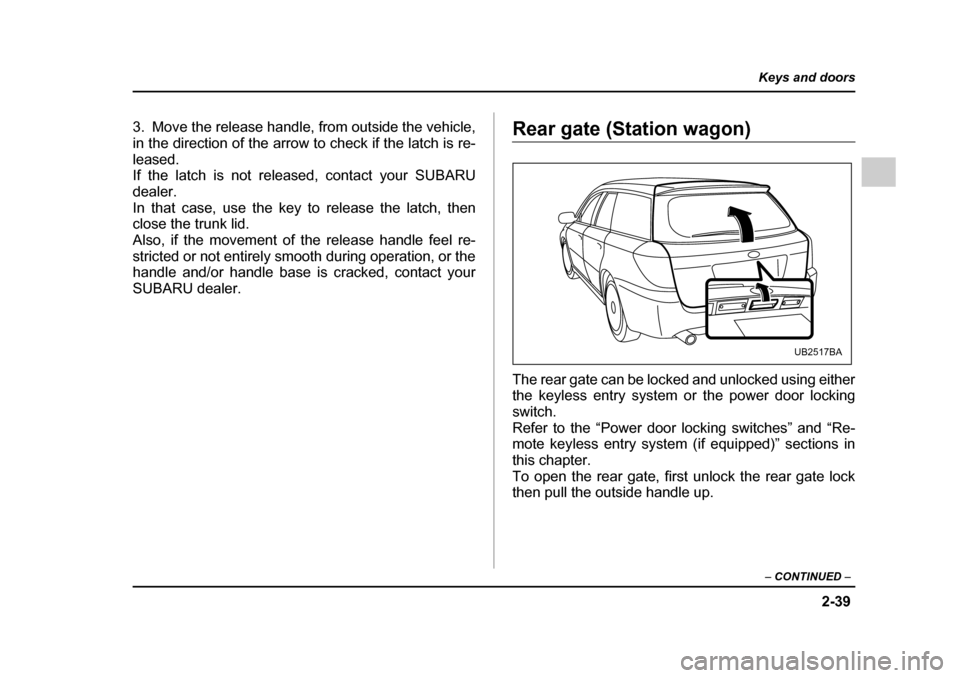
The rear gate can be locked and unlocked using either
the keyless entry system or the power door locking switch.
Refer to the “Power door locking switches” and “Re-
mote keyless entry system (if equipped)” sections in
this chapter.
To open the rear gate, first unlock the rear gate lock
then pull the outside handle up.
UB2517BA
Page 202 of 627
3-31
Instruments and controls
– CONTINUED –
NOTE
This light does not go out unless the tank is re-
plenished up to an internal fuel quantity of about
3.7 US gal (14 liters, 3.1 Imp gal). !Door open warning light
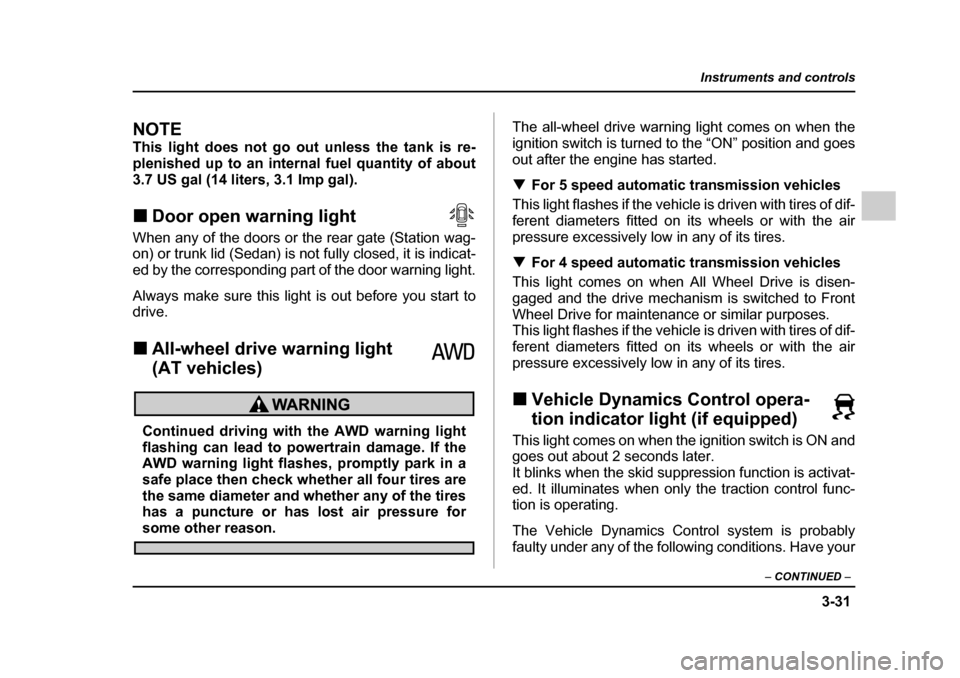
When any of the doors or the rear gate (Station wag-
on) or trunk lid (Sedan) is not fully closed, it is indicat-
ed by the corresponding part of the door warning light.
Always make sure this light is out before you start to
drive. ! All-wheel drive warning light
(AT vehicles)
Continued driving with the AWD warning light
flashing can lead to powertrain damage. If the
AWD warning light flashes, promptly park in a
safe place then check whether all four tires are
the same diameter and whether any of the tires
has a puncture or has lost air pressure for
some other reason. The all-wheel drive warning light comes on when the
ignition switch is turned to the “ON” position and goes
out after the engine has started. !
For 5 speed automatic transmission vehicles
This light flashes if the vehicle is driven with tires of dif-
ferent diameters fitted on its wheels or with the air
pressure excessively low in any of its tires. ! For 4 speed automatic transmission vehicles
This light comes on when All Wheel Drive is disen-
gaged and the drive mechanism is switched to Front
Wheel Drive for maintenance or similar purposes.
This light flashes if the vehicle is driven with tires of dif-
ferent diameters fitted on its wheels or with the air
pressure excessively low in any of its tires. ! Vehicle Dynamics Control opera-
tion indicator light (if equipped)
This light comes on when the ignition switch is ON and
goes out about 2 seconds later.
It blinks when the skid suppression function is activat-
ed. It illuminates when only the traction control func-
tion is operating.
The Vehicle Dynamics Control system is probably
faulty under any of the following conditions. Have your
Page 338 of 627
6-21
Interior equipment
– CONTINUED –
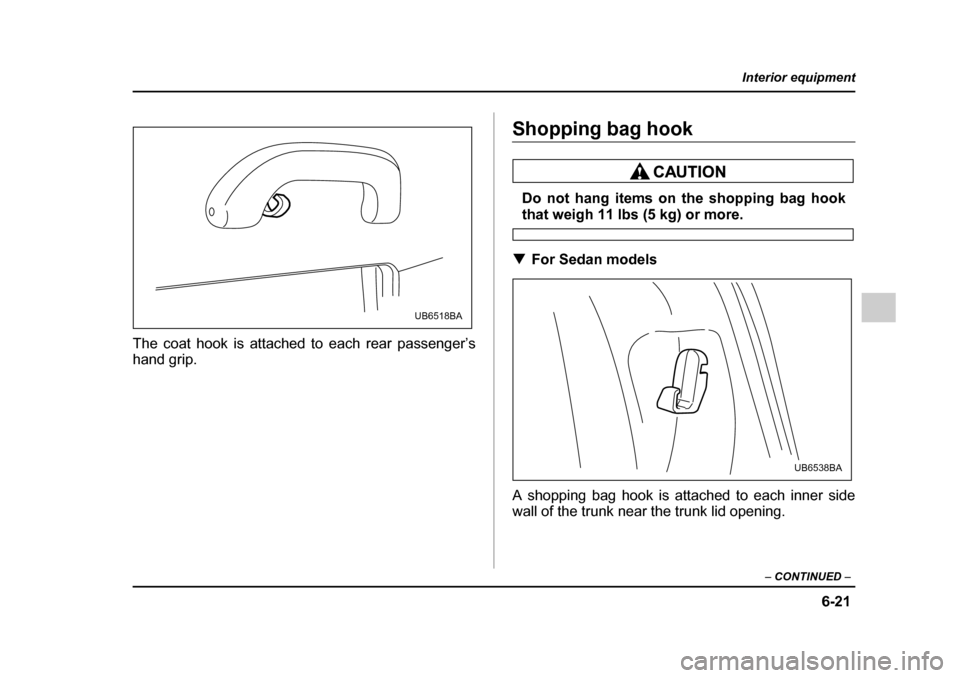
The coat hook is attached to each rear passenger’s
hand grip.
Shopping bag hook
Do not hang items on the shopping bag hook
that weigh 11 lbs (5 kg) or more.
! For Sedan models
A shopping bag hook is attached to each inner side
wall of the trunk near the trunk lid opening.
UB6518BA
UB6538BA
Page 347 of 627
6-30
Interior equipment
Under-floor storage compartment
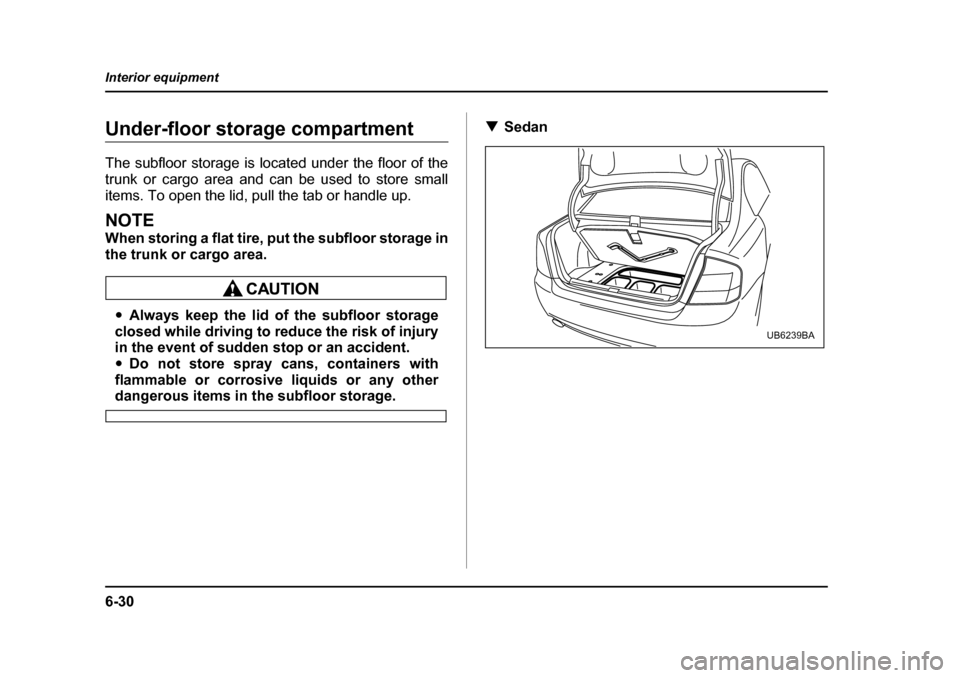
The subfloor storage is located under the floor of the
trunk or cargo area and can be used to store small
items. To open the lid, pull the tab or handle up.
NOTE
When storing a flat tire, put the subfloor storage in
the trunk or cargo area.
"
Always keep the lid of the subfloor storage
closed while driving to reduce the risk of injury
in the event of sudden stop or an accident. " Do not store spray cans, containers with
flammable or corrosive liquids or any other
dangerous items in the subfloor storage. !
Sedan
UB6239BA
Page 365 of 627
7-10
Starting and operating
Preparing to drive
You should perform the following checks and adjust-
ments every day before you start driving.
1. Check that all windows, mirrors, and lights are
clean and unobstructed.
2. Check the appearance and condition of the tires.
Also check tires for proper inflation.
3. Look under the vehicle for any sign of leaks.
4. Check that the hood, trunk and rear gate are fullyclosed.
5. Check the adjustment of the seat.
6. Check the adjustment of the inside and outside mir-rors.
7. Fasten your seatbelt. Check that your passengers
have fastened their seatbelts.
8. Check the operation of the warning and indicator
lights when the ignition switch is turned to the “ON” po- sition.
9. Check the gauges, indicator and warning lights af-
ter starting the engine.
NOTE
Engine oil, engine coolant, brake fluid, washer flu-
id and other fluid levels should be checked daily,
weekly or at fuel stops.
Starting the engine
Do not operate the starter motor continuously
for more than ten seconds. If the engine fails to
start after operating the starter for five to ten
seconds, wait for ten seconds or more before
trying again.
! Manual transmission vehicle
1. Apply the parking brake.
2. Turn off unnecessary lights and accessories.
3. Press the clutch pedal to the floor and shift the shift
lever into neutral.
Hold the clutch pedal to the floor while starting the en-
gine. The starter motor will only operate when the
clutch pedal is pressed fully to the floor.
4. Turn the ignition switch to the “ON” position and
check the operation of the warning and indicator lights.
Refer to the “Warning and indicator lights” section
(chapter 3).
5. Turn the ignition switch to the “START” position
without depressing the accelerator pedal. Release
the key immediately after the engine has started.
Page 416 of 627
8-3
Driving tips
– CONTINUED –
Engine exhaust gas (Carbon monox-
ide)
"Never inhale engine exhaust gas. Engine ex-
haust gas contains carbon monoxide, a color-
less and odorless gas which is dangerous, or
even lethal, if inhaled." Always properly maintain the engine exhaust
system to prevent engine exhaust gas from en-
tering the vehicle." Never run the engine in a closed space, such
as a garage, except for the brief time needed to
drive the vehicle in or out of it." Avoid remaining in a parked vehicle for a
lengthy time while the engine is running. If that
is unavoidable, then use the ventilation fan to
force fresh air into the vehicle. " Always keep the front ventilator inlet grille
free from snow, leaves or other obstructions to
ensure that the ventilation system always
works properly. " If at any time you suspect that exhaust fumes
are entering the vehicle, have the problem
checked and corrected as soon as possible. If
you must drive under these conditions, drive only with all windows fully open."
Keep the trunk lid or rear gate closed while
driving to prevent exhaust gas from entering
the vehicle.
NOTE
Due to the expansion and contraction of the met-
als used in the manufacture of the exhaust sys-
tem, you may hear a crackling sound coming from
the exhaust system for a short time after the en-
gine has been shut off. This sound is normal.
Page 431 of 627
8-18
Driving tips
Loading your vehicle
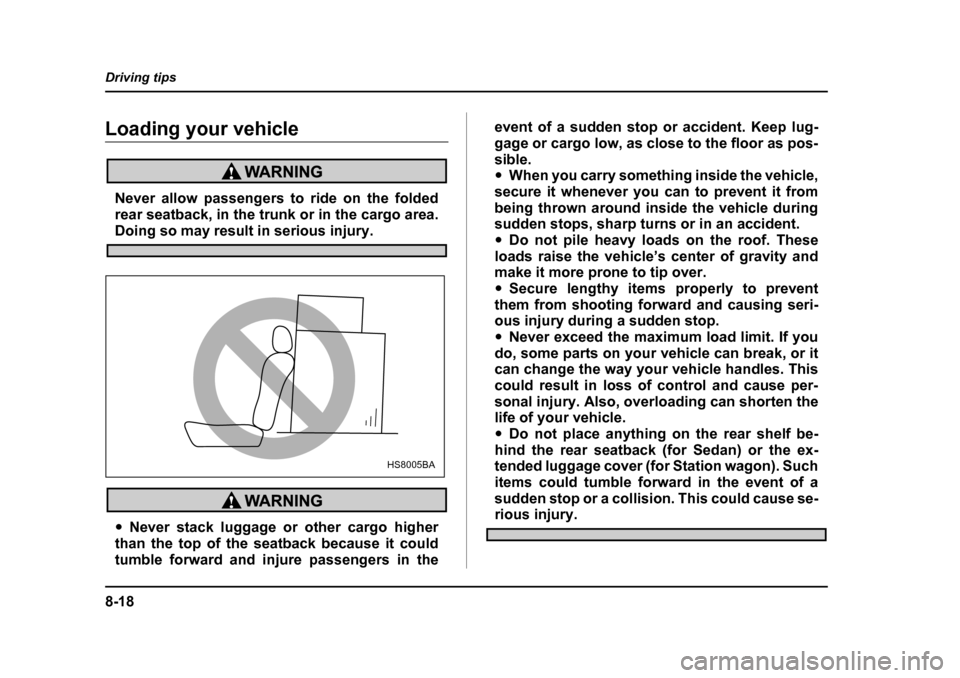
Never allow passengers to ride on the folded
rear seatback, in the trunk or in the cargo area.
Doing so may result in serious injury.
"
Never stack luggage or other cargo higher
than the top of the seatback because it could
tumble forward and injure passengers in the event of a sudden stop or accident. Keep lug-
gage or cargo low, as close to the floor as pos-
sible. "
When you carry something inside the vehicle,
secure it whenever you can to prevent it from
being thrown around inside the vehicle during
sudden stops, sharp turns or in an accident. " Do not pile heavy loads on the roof. These
loads raise the vehicle’s center of gravity and
make it more prone to tip over. " Secure lengthy items properly to prevent
them from shooting forward and causing seri-
ous injury during a sudden stop. " Never exceed the maximum load limit. If you
do, some parts on your vehicle can break, or it
can change the way your vehicle handles. This
could result in loss of control and cause per-
sonal injury. Also, overloading can shorten the
life of your vehicle. " Do not place anything on the rear shelf be-
hind the rear seatback (for Sedan) or the ex-
tended luggage cover (for Station wagon). Such
items could tumble forward in the event of a
sudden stop or a collision. This could cause se-rious injury.
HS8005BA
Page 461 of 627
9-6
In case of emergency
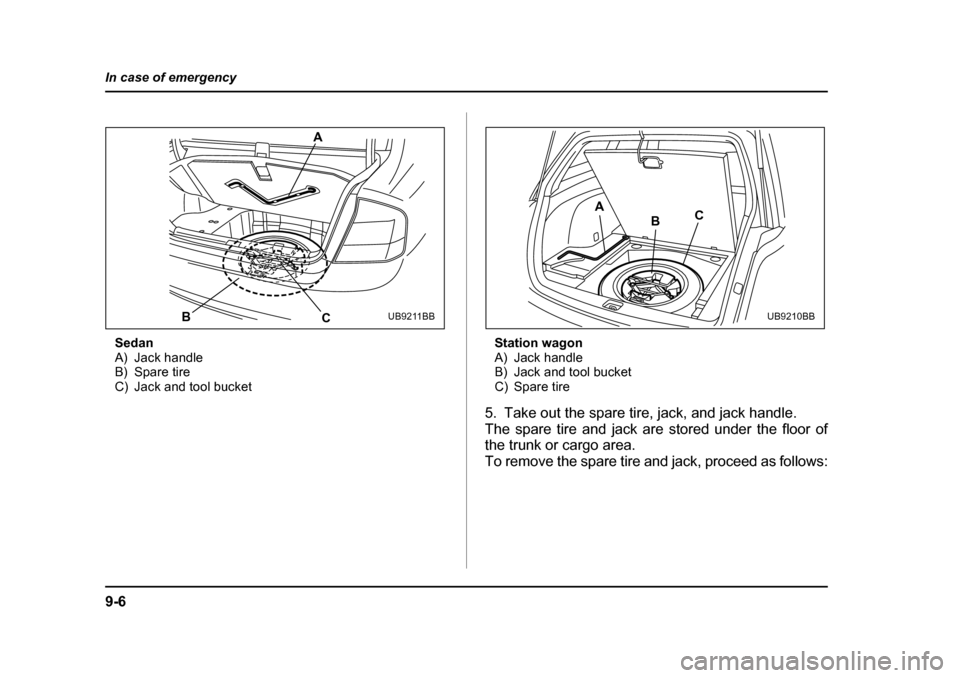
Sedan
A) Jack handle
B) Spare tire
C) Jack and tool bucket
Station wagon
A) Jack handle
B) Jack and tool bucket
C) Spare tire
5. Take out the spare tire, jack, and jack handle.
The spare tire and jack are stored under the floor of
the trunk or cargo area.
To remove the spare tire and jack, proceed as follows:
B C
AUB9211BB
A
C
B
UB9210BB