weight SUBARU OUTBACK 2005 4.G Owner's Manual
[x] Cancel search | Manufacturer: SUBARU, Model Year: 2005, Model line: OUTBACK, Model: SUBARU OUTBACK 2005 4.GPages: 627, PDF Size: 6.42 MB
Page 444 of 627
8-31
Driving tips
– CONTINUED –
Trailer towing
Your vehicle is designed and intended to be used pri-
marily as a passenger-carrying vehicle. Towing a trail-
er puts additional loads on your vehicle’s engine, driv-
etrain, brakes, tires and suspension and has an ad-
verse effect on fuel economy.
If you do decide to tow a trailer, your safety and satis-
faction depend upon proper use of correct equipment
and cautious operation of your vehicle. Seek the ad-
vice of your SUBARU dealer to assist you in purchas-
ing a hitch and other necessary towing equipment ap-
propriate for your vehicle. In addition, be sure to follow
the instructions on correct installation and use provid-
ed by the trailer and other towing equipment manufac-
turers.
SUBARU assumes no responsibility for injuries or ve-
hicle damage that result from trailer towing equipment,
or from any errors or omissions in the instructions ac-
companying such equipment or for your failure to fol-
low the proper instructions. !Warranties and maintenance
SUBARU warranties do not apply to vehicle damage
or malfunction caused by trailer towing. If you use your
vehicle to tow a trailer, more frequent maintenance will
be required due to the additional load. (Refer to “Main- tenance schedule under severe driving conditions” in
the “Warranty and Maintenance Booklet”.)
Under no circumstances should a trailer be towed with
a new vehicle or a vehicle with any new powertrain
component (engine, transmission, differential, wheel
bearings, etc.) for the first 1,000 miles (1,600 km) of
driving. !
Maximum load limits
Never exceed the maximum load limits ex-
plained below. Exceeding the maximum load
limits could cause personal injury and/or vehi-
cle damage.
"Adequate size trailer brakes are required
when the trailer and its cargo exceed 1,000 lbs
(453 kg) total weight. " Before towing a trailer, check the trailer total
weight, GVW, GAWs and tongue load. Make
sure the load and its distribution in your vehicle
Page 445 of 627
8-32
Driving tips
and trailer are acceptable.
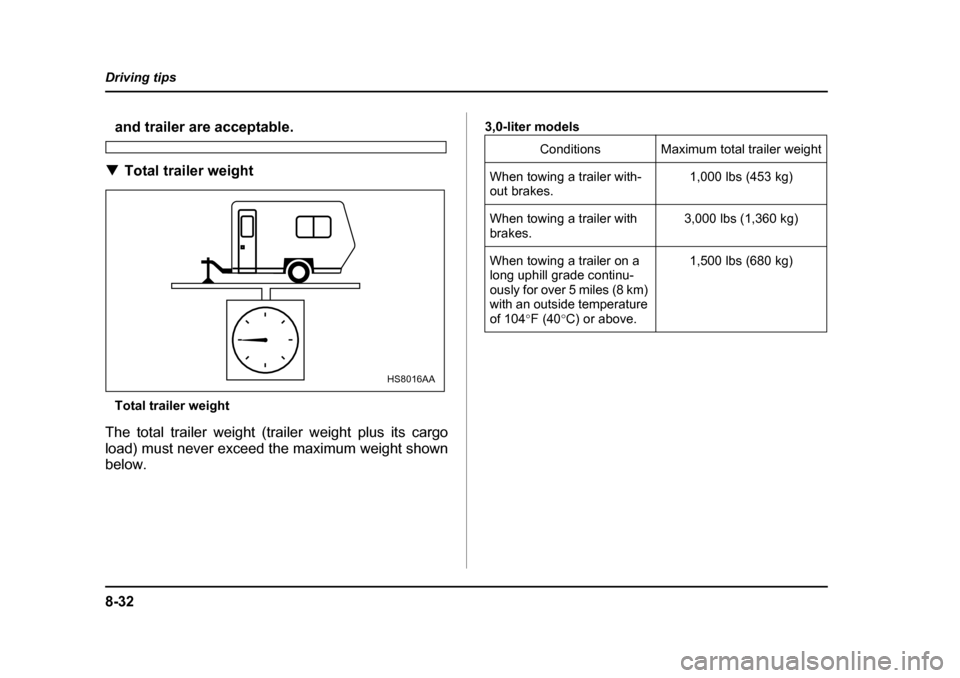
! Total trailer weight
Total trailer weight
The total trailer weight (trailer weight plus its cargo
load) must never exceed the maximum weight shown
below. 3,0-liter models
HS8016AA
Conditions Maximum total trailer weight
When towing a trailer with-
out brakes. 1,000 lbs (453 kg)
When towing a trailer with
brakes. 3,000 lbs (1,360 kg)
When towing a trailer on a
long uphill grade continu-
ously for over 5 miles (8 km)
with an outside temperature
of 104 °F (40 °C) or above. 1,500 lbs (680 kg)
Page 446 of 627
8-33
Driving tips
– CONTINUED –
All models other than 3.0-liter models
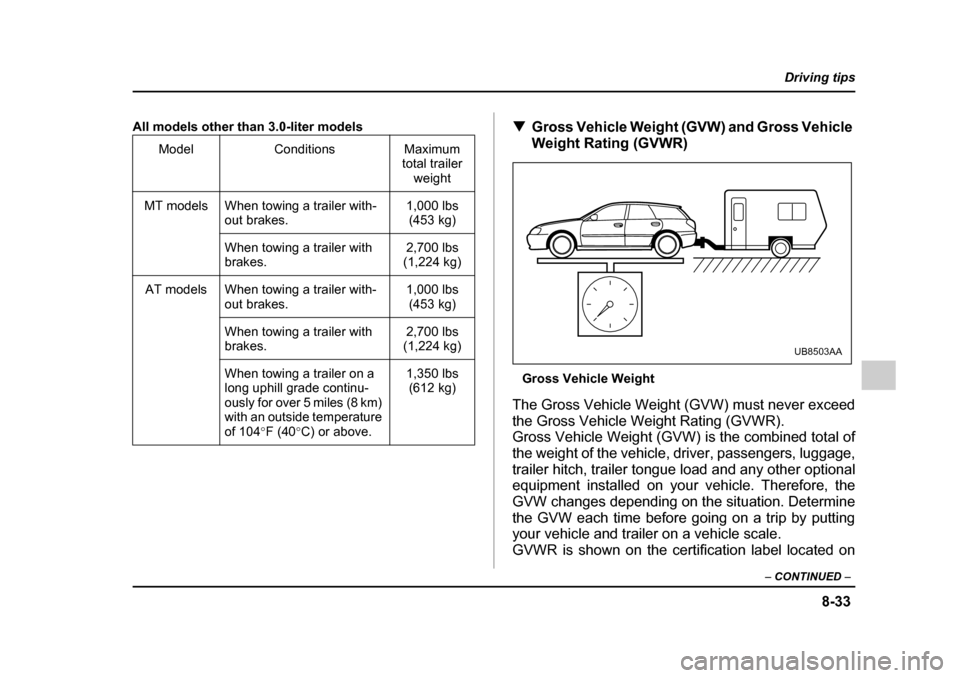
!Gross Vehicle Weight (GVW) and Gross Vehicle
Weight Rating (GVWR)
Gross Vehicle Weight
The Gross Vehicle Weight (GVW) must never exceed
the Gross Vehicle Weight Rating (GVWR).
Gross Vehicle Weight (GVW) is the combined total of
the weight of the vehicle, driver, passengers, luggage,
trailer hitch, trailer tongue load and any other optional
equipment installed on your vehicle. Therefore, the
GVW changes depending on the situation. Determine
the GVW each time before going on a trip by putting
your vehicle and trailer on a vehicle scale.
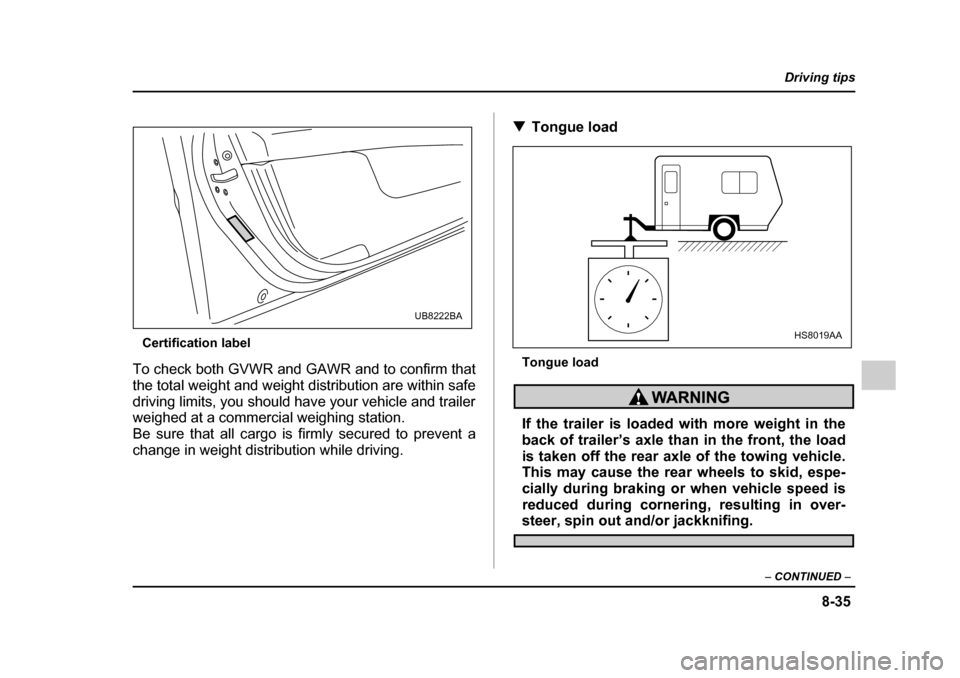
GVWR is shown on the certification label located on
Model Conditions Maximum
total trailer weight
MT models When towing a trailer with- out brakes. 1,000 lbs
(453 kg)
When towing a trailer with
brakes. 2,700 lbs
(1,224 kg)
AT models When towing a trailer with- out brakes. 1,000 lbs
(453 kg)
When towing a trailer with
brakes. 2,700 lbs
(1,224 kg)
When towing a trailer on a
long uphill grade continu-
ously for over 5 miles (8 km)
with an outside temperature
of 104 °F (40 °C) or above. 1,350 lbs
(612 kg)
UB8503AA
Page 447 of 627
8-34
Driving tips
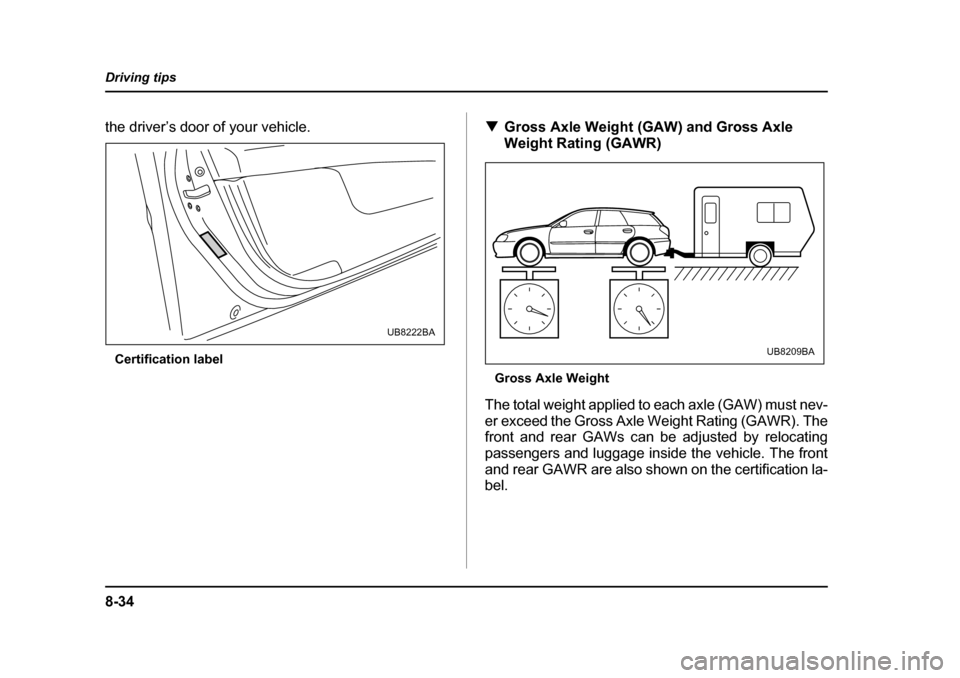
the driver’s door of your vehicle.
Certification label !
Gross Axle Weight (GAW) and Gross Axle
Weight Rating (GAWR)
Gross Axle Weight
The total weight applied to each axle (GAW) must nev-
er exceed the Gross Axle Weight Rating (GAWR). The
front and rear GAWs can be adjusted by relocating
passengers and luggage inside the vehicle. The front
and rear GAWR are also shown on the certification la-
bel.
UB8222BA
UB8209BA
Page 448 of 627
8-35
Driving tips
– CONTINUED –
Certification label
To check both GVWR and GAWR and to confirm that
the total weight and weight distribution are within safe
driving limits, you should have your vehicle and trailer
weighed at a commercial weighing station.
Be sure that all cargo is firmly secured to prevent a
change in weight distribution while driving. !
Tongue load
Tongue load
If the trailer is loaded with more weight in the
back of trailer’s axle than in the front, the load
is taken off the rear axle of the towing vehicle.
This may cause the rear wheels to skid, espe-
cially during braking or when vehicle speed is
reduced during cornering, resulting in over-
steer, spin out and/or jackknifing.
UB8222BA
HS8019AA
Page 449 of 627
8-36
Driving tips
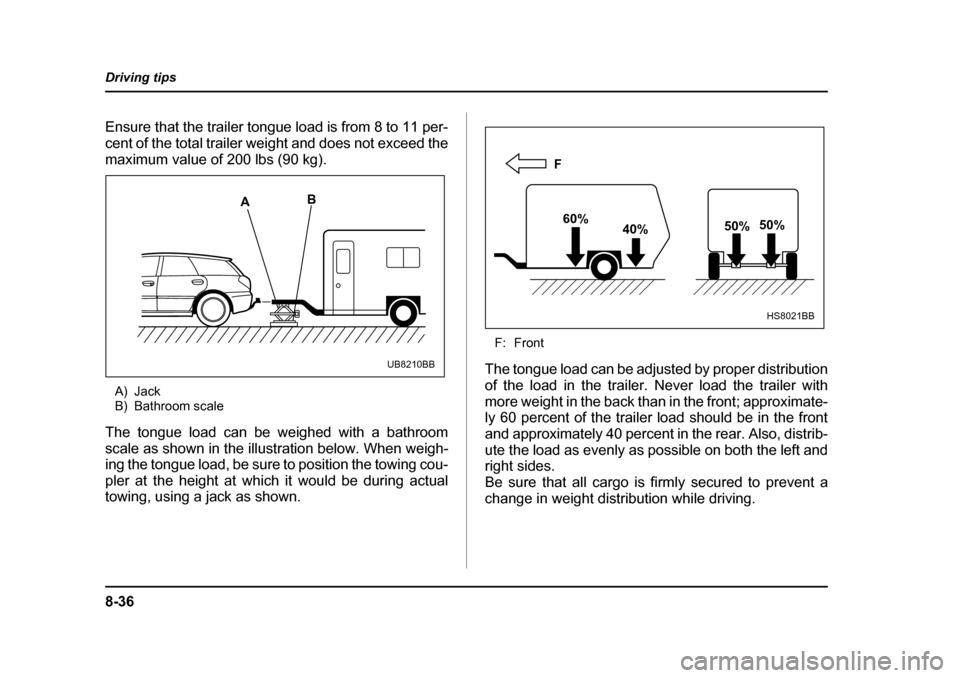
Ensure that the trailer tongue load is from 8 to 11 per-
cent of the total trailer weight and does not exceed the
maximum value of 200 lbs (90 kg).
A) Jack
B) Bathroom scale
The tongue load can be weighed with a bathroom
scale as shown in the illustration below. When weigh-
ing the tongue load, be sure to position the towing cou-
pler at the height at which it would be during actual
towing, using a jack as shown. F: Front
The tongue load can be adjusted by proper distribution
of the load in the trailer. Never load the trailer with
more weight in the back than in the front; approximate-
ly 60 percent of the trailer load should be in the front
and approximately 40 percent in the rear. Also, distrib-
ute the load as evenly as possible on both the left and
right sides.
Be sure that all cargo is firmly secured to prevent a
change in weight distribution while driving.
A B
UB8210BB
F
60% 40% 50%
50%
HS8021BB
Page 451 of 627
8-38
Driving tips
!
Connecting a trailer
! Trailer brakes
"Adequate size trailer brakes are required
when the trailer and its cargo exceed 1,000 lbs
(453 kg) total weight." Do not directly connect your trailer’s hydrau-
lic brake system to the hydraulic brake system
in your vehicle. Direct connection would cause
the vehicle’s brake performance to deteriorate
and could lead to an accident.
If your trailer’s total weight (trailer weight plus its cargo
weight) exceeds 1,000 lbs (453 kg), the trailer is re-
quired to be equipped with its own brake system. Elec-
tric brakes or surge brakes are recommended, and
must be installed properly. Check that your trailer’s
brakes conform with Federal, state/province and/or
other applicable regulations. Your SUBARU’s brake
system is not designed to be tapped into the trailer’s
hydraulic brake system. Please ask your SUBARU
dealer and professional trailer supplier for more infor-
mation about the trailer’s brake system. !
Trailer safety chains
Always use safety chains between your vehicle
and the trailer. Towing trailer without safety
chains could create a traffic safety hazard if the
trailer separates from the hitch due to coupling
damage or hitch ball damage.
In case the trailer hitch connector or hitch ball should
break or become disconnected, the trailer could get
loose and create a traffic safety hazard.
For safety, always connect the towing vehicle and
trailer with trailer safety chains. Pass the chains cross-
ing each other under the trailer tongue to prevent the
trailer from dropping onto the ground in case the trailer
tongue should disconnect from the hitch ball. Allow
sufficient slack in the chains taking tight-turn situations
into account; however, be careful not to let them drag
on the ground.
For more information about the safety chain connec-
tion, refer to the instructions for your hitch and trailer.
Page 453 of 627
8-40
Driving tips
and in “GAS STATION REFERENCE” at the end of
this manual. Adjust the rear tire pressure to the recom-
mended pressure when the tires are cold. Normal
pressure should be maintained in the front tires.
Trailer tire condition, size, load rating and proper infla-
tion pressure should be in accordance with the trailer
manufacturer’s specifications.
In the event your vehicle gets a flat tire when towing a
trailer, ask a commercial road service to repair the flat tire.
If you carry a regular size spare tire in your vehicle or
trailer as a precaution against getting a flat tire, be
sure that the spare tire is firmly secured. !
Trailer towing tips
"Never exceed 45 mph (72 km/h) when towing
a trailer in hilly country on hot days. " When towing a trailer, steering, stability,
stopping distance and braking performance
will be different from normal operation. For
safety’s sake, you should employ extra caution
when towing a trailer and you should never speed. You should also keep the following tips
in mind:
! Before starting out on a trip
" Check that the vehicle and vehicle-to-hitch mount-
ing are in good condition. If any problems are appar-
ent, do not tow the trailer." Check that the vehicle sits horizontally with the trail-
er attached. If the vehicle is tipped sharply up at the
front and down at the rear, check the total trailer
weight, GVW, GAWs and tongue load again, then con-
firm that the load and its distribution are acceptable. " Check that the tire pressures are correct.
" Check that the vehicle and trailer are connected
properly. Confirm that.
– the trailer tongue is connected properly to the
hitch ball.
– the trailer lights connector is connected properly
and trailer’s brake lights illuminate when the vehi-
cle’s brake pedal is pressed, and that the trailer’s
turn signal lights flash when the vehicle’s turn signal
lever is operated.
– the safety chains are connected properly.
– all cargo in the trailer is secured safety in position.
– the side mirrors provide a good rearward field of
view without a significant blind spot.
Page 454 of 627
8-41
Driving tips
– CONTINUED –
"Sufficient time should be taken to learn the “feel” of
the vehicle/trailer combination before starting out on a
trip. In an area free of traffic, practice turning, stopping
and backing up. ! Driving with a trailer
" You should allow for considerably more stopping
distance when towing a trailer. Avoid sudden braking because it may result in skidding or jackknifing and
loss of control." Avoid abrupt starts and sudden accelerations. If
your vehicle has a manual transmission, always start
out in first gear and release the clutch at moderate en-
gine revolution. " Avoid uneven steering, sharp turns and rapid lane
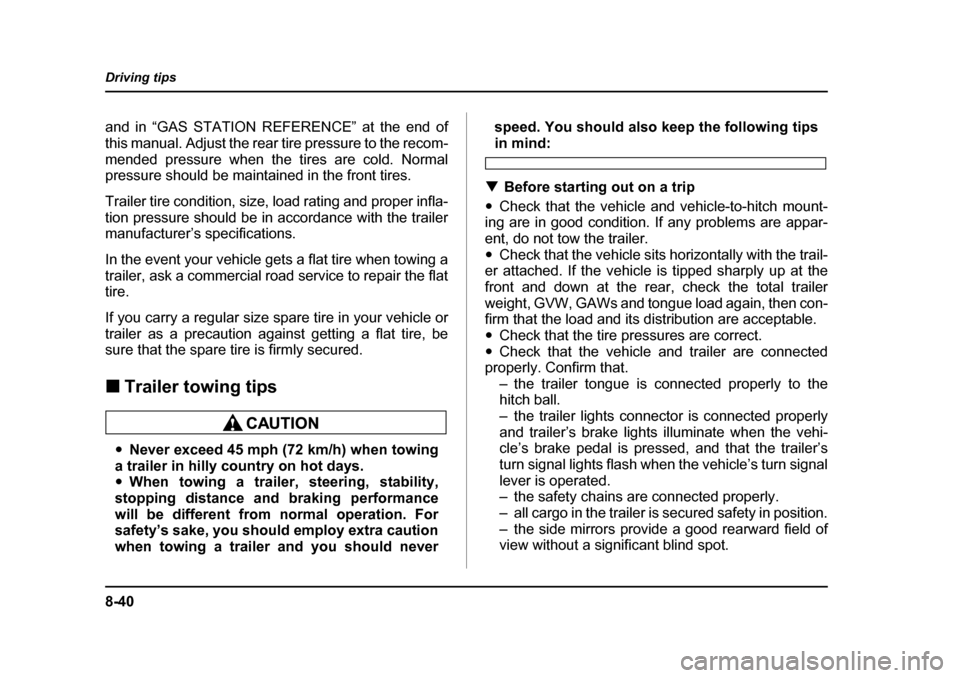
changes. " Slow down before turning. Make a longer than nor-
mal turning radius because the trailer wheels will be
closer than the vehicle wheels to the inside of the turn.
In a tight turn, the trailer could hit your vehicle. " Crosswinds will adversely affect the handling of
your vehicle and trailer, causing sway. Crosswinds
can be due to weather conditions or the passing of large trucks or buses. If swaying occurs, firmly grip the
steering wheel and slow down immediately but gradu-
ally. " When passing other vehicles, considerable dis-
tance is required because of the added weight and length caused by attaching the trailer to your vehicle.
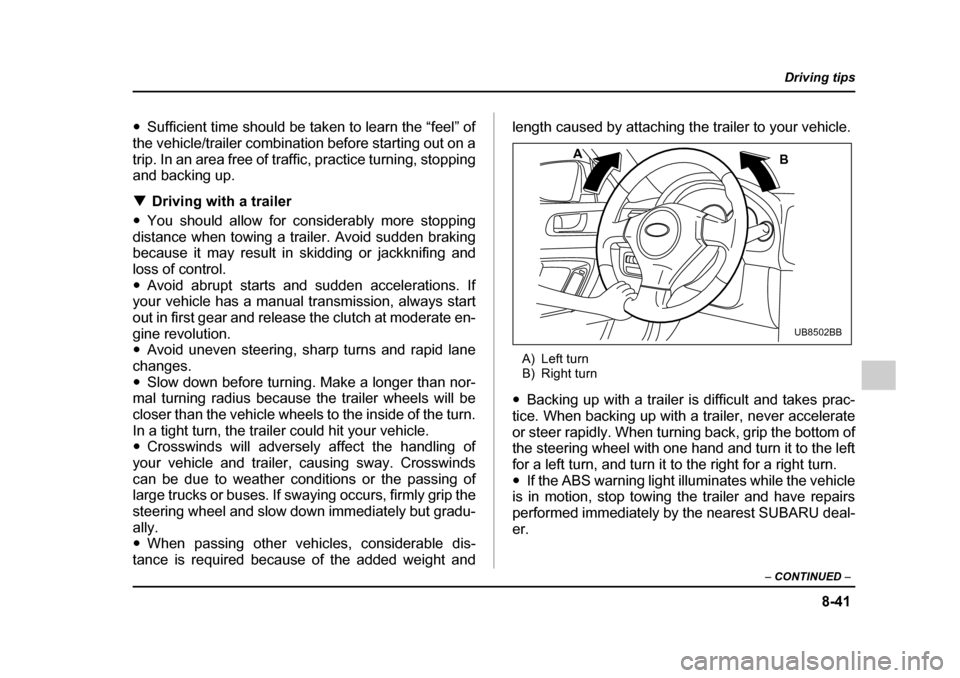
A) Left turn
B) Right turn
" Backing up with a trailer is difficult and takes prac-
tice. When backing up with a trailer, never accelerate
or steer rapidly. When turning back, grip the bottom of
the steering wheel with one hand and turn it to the left
for a left turn, and turn it to the right for a right turn. " If the ABS warning light illuminates while the vehicle
is in motion, stop towing the trailer and have repairs
performed immediately by the nearest SUBARU deal- er.
A B
UB8502BB
Page 556 of 627
11 -5 7
Maintenance and service
– CONTINUED –
tires. Doing so can dangerously reduce control-
lability, resulting in an accident.
! Wheel replacement
When replacing wheels due, for example, to damage,
make sure the replacement wheels match the specifi-
cations of the wheels that are fitted as standard equip-
ment. Replacement wheels are available from SUBA-
RU dealers.
Use only those wheels that are specified for
your vehicle. Wheels not meeting specifica-
tions could interfere with brake caliper opera-
tion and may cause the tires to rub against the
wheel well housing during turns. The resulting
loss of vehicle control could lead to an acci-
dent.
Aluminum wheels
Aluminum wheels can be scratched and damaged
easily. Handle them carefully to maintain their appear-
ance, performance, and safety. " When any of the wheels is removed and replaced
for tire rotation or to change a flat, always check the
tightness of the wheel nuts after driving approximately
600 miles (1,000 km). If any nut is loose, tighten it to
the specified torque." Never apply oil to the threaded parts, wheel nuts, or
tapered surface of the wheel." Never let the wheel rub against sharp protrusions or
curbs. " Be sure to fit tire chains on uniformly and completely
around the tire, otherwise the chains may scratch the
wheel." When wheel nuts, balance weights, or the center
cap is replaced, be sure to replace them with genuine
SUBARU parts designed for aluminum wheels.