tow SUBARU OUTBACK 2005 4.G Repair Manual
[x] Cancel search | Manufacturer: SUBARU, Model Year: 2005, Model line: OUTBACK, Model: SUBARU OUTBACK 2005 4.GPages: 627, PDF Size: 6.42 MB
Page 490 of 627
9-35
In case of emergency
– CONTINUED –
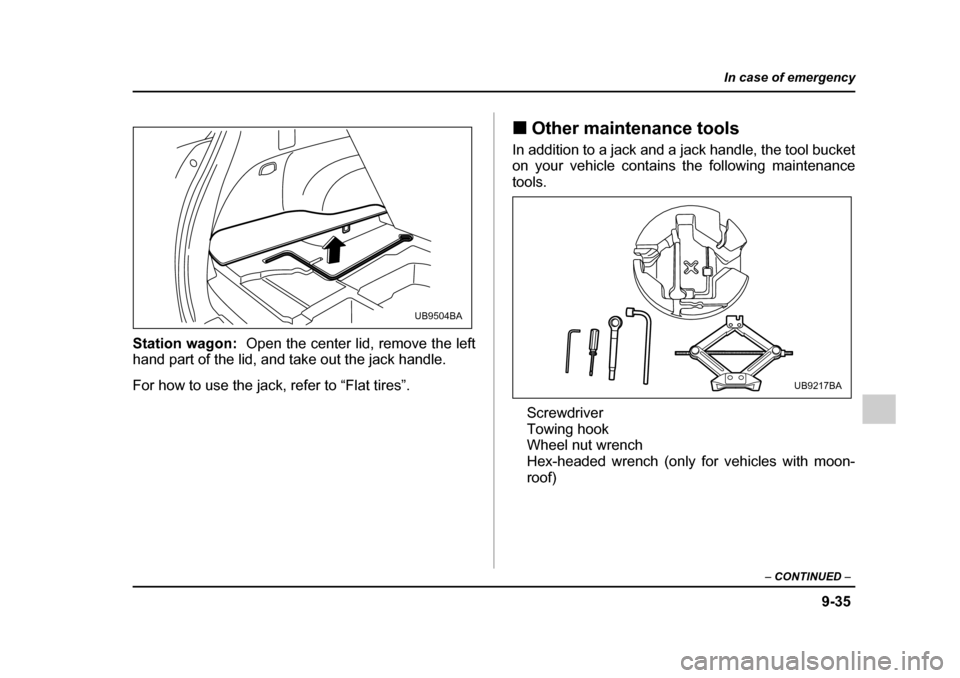
Station wagon: Open the center lid, remove the left
hand part of the lid, and take out the jack handle.
For how to use the jack, refer to “Flat tires”. !
Other maintenance tools
In addition to a jack and a jack handle, the tool bucket
on your vehicle contains the following maintenance
tools.
Screwdriver
Towing hook
Wheel nut wrench
Hex-headed wrench (only for vehicles with moon- roof)
UB9504BA
UB9217BA
Page 505 of 627
11 - 6
Maintenance and service
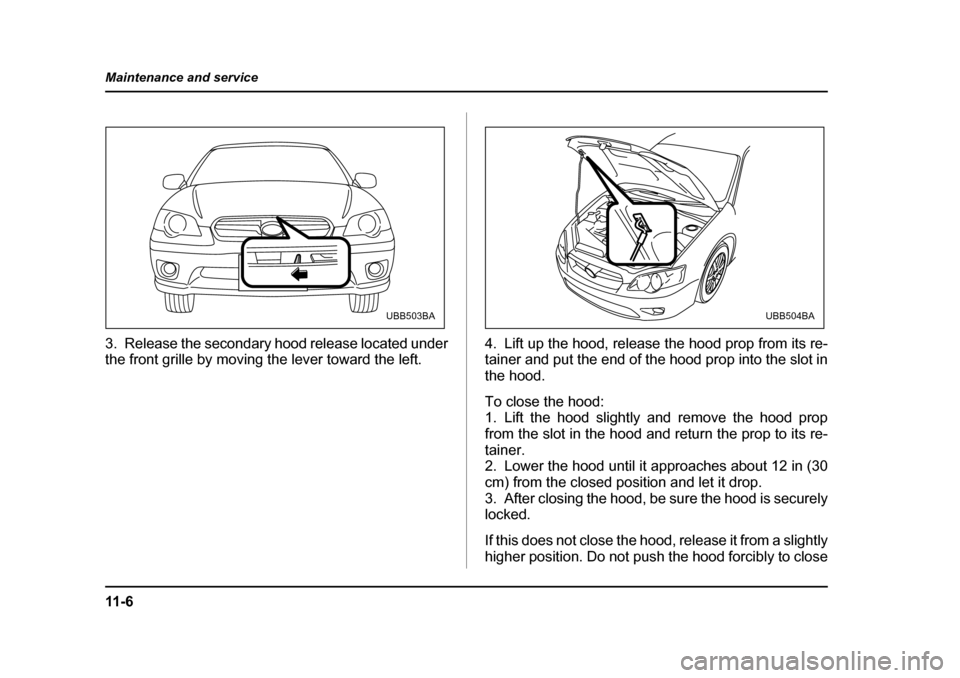
3. Release the secondary hood release located under
the front grille by moving the lever toward the left.
4. Lift up the hood, release the hood prop from its re-
tainer and put the end of the hood prop into the slot in
the hood.
To close the hood:
1. Lift the hood slightly and remove the hood prop
from the slot in the hood and return the prop to its re-
tainer.
2. Lower the hood until it approaches about 12 in (30
cm) from the closed position and let it drop.
3. After closing the hood, be sure the hood is securely
locked.
If this does not close the hood, release it from a slightly
higher position. Do not push the hood forcibly to close
UBB503BAUBB504BA
Page 516 of 627
11 -1 7
Maintenance and service
– CONTINUED –
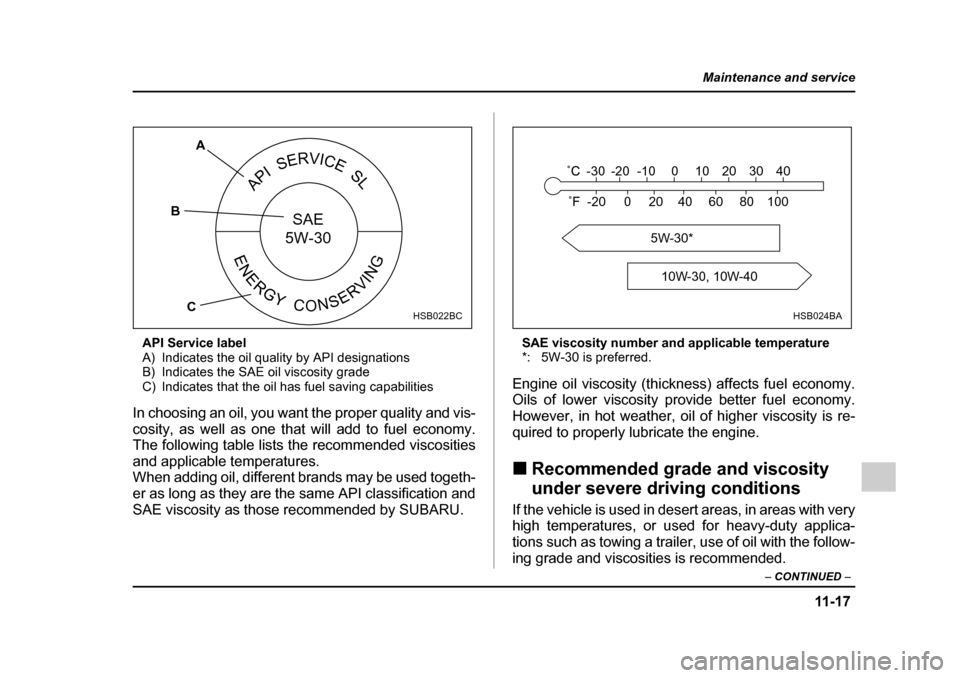
API Service label
A) Indicates the oil quality by API designations
B) Indicates the SAE oil viscosity grade
C) Indicates that the oil has fuel saving capabilities
In choosing an oil, you want the proper quality and vis-
cosity, as well as one that will add to fuel economy.
The following table lists the recommended viscosities
and applicable temperatures.
When adding oil, different brands may be used togeth-
er as long as they are the same API classification and
SAE viscosity as those recommended by SUBARU. SAE viscosity number and applicable temperature
*: 5W-30 is preferred.
Engine oil viscosity (thickness) affects fuel economy.
Oils of lower viscosity provide better fuel economy.
However, in hot weather, oil of higher viscosity is re-
quired to properly lubricate the engine. ! Recommended grade and viscosity
under severe driving conditions
If the vehicle is used in desert areas, in areas with very
high temperatures, or used for heavy-duty applica-
tions such as towing a trailer, use of oil with the follow-
ing grade and viscosities is recommended.
APISERVICESL
ENERGYCONSERVING
SAE
5W-30
A
B
C
HSB022BC
5W-30*10W-30, 10W-40
-30 -20 -10 0 10 20 30 40
-20
06 0
20 80 100 40
HSB024BA
Page 563 of 627
11 - 6 4
Maintenance and service
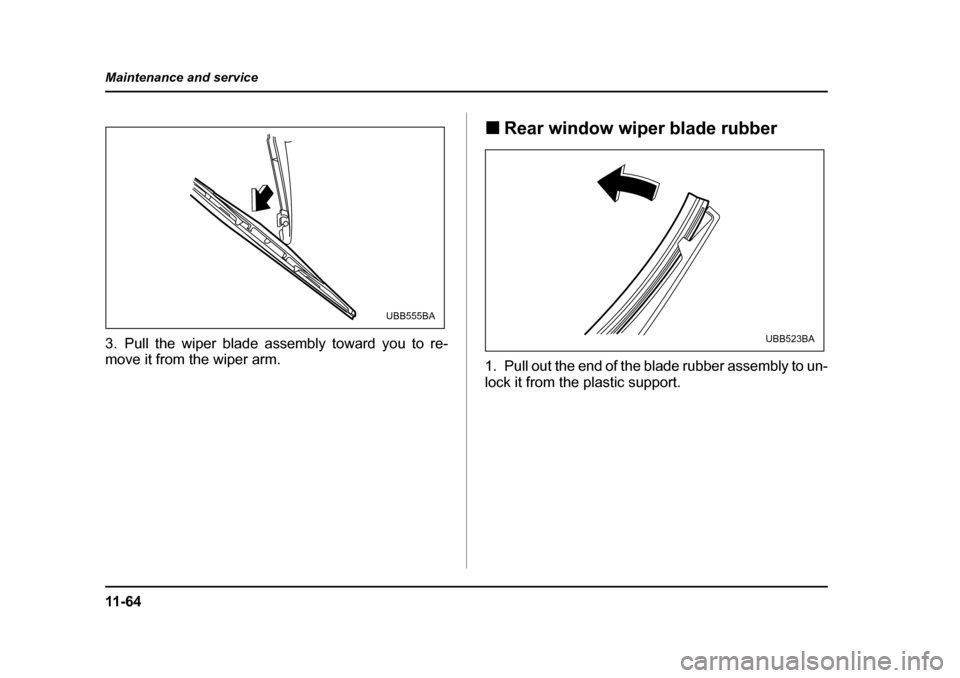
3. Pull the wiper blade assembly toward you to re-
move it from the wiper arm.
!
Rear window wiper blade rubber
1. Pull out the end of the blade rubber assembly to un-
lock it from the plastic support.
UBB555BA
UBB523BA
Page 567 of 627
11 - 6 8
Maintenance and service
Fuses
Never replace a fuse with one having a higher
rating or with material other than a fuse be-
cause serious damage or a fire could result.
The fuses are designed to melt during an overload to
prevent damage to the wiring harness and electrical
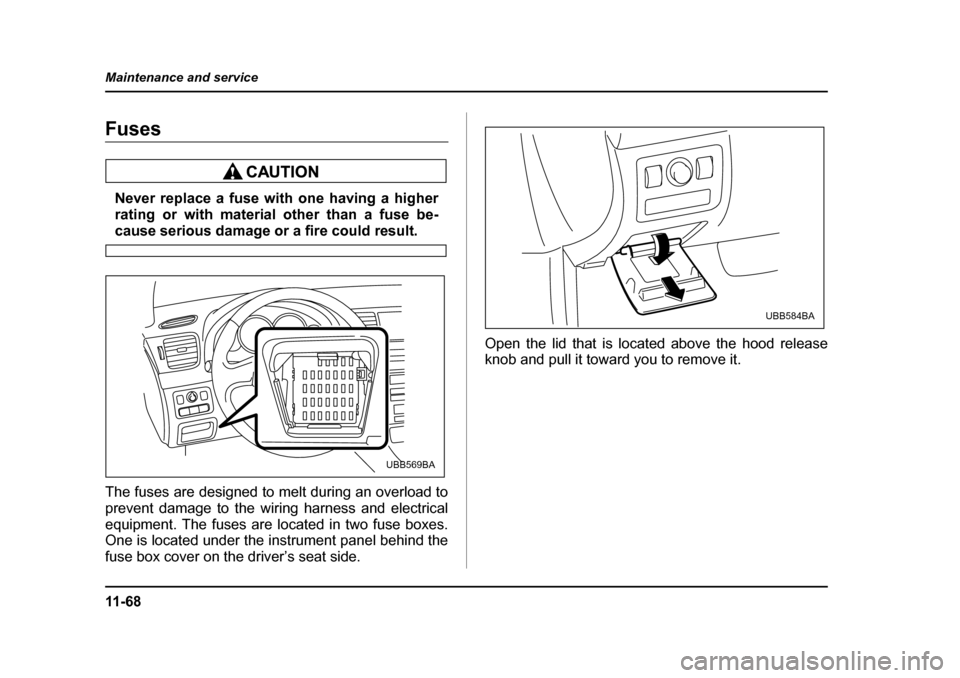
equipment. The fuses are located in two fuse boxes.
One is located under the instrument panel behind the
fuse box cover on the driver’s seat side. Open the lid that is located above the hood release
knob and pull it toward you to remove it.
UBB569BA
UBB584BA
Page 590 of 627
12-5
Specifications
– CONTINUED –
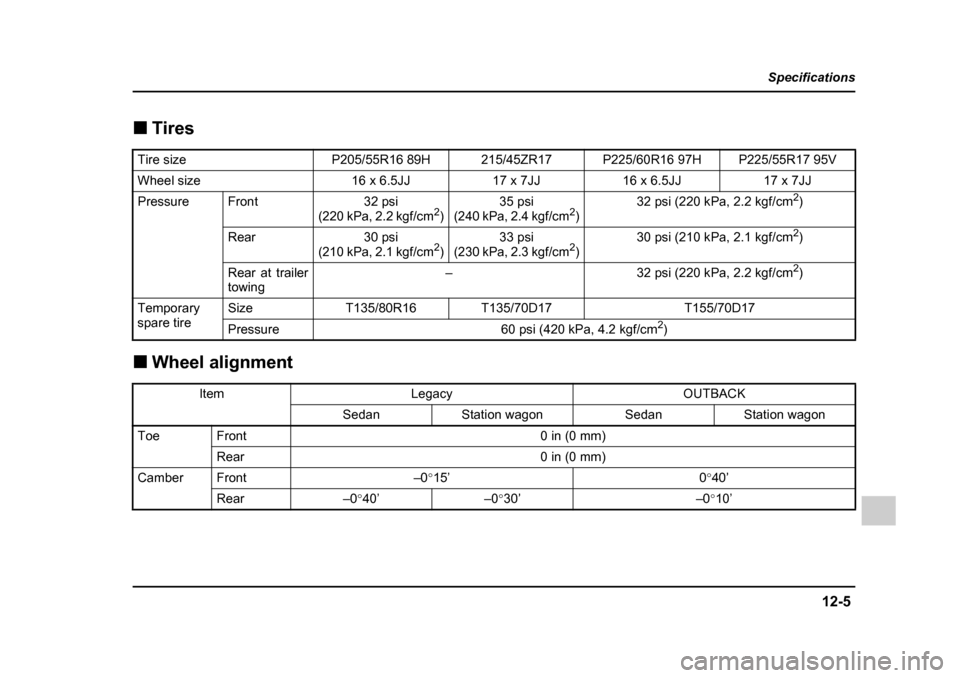
!Tires
! Wheel alignment
Tire sizeP205/55R16 89H215/45ZR17P225/60R16 97HP225/55R17 95V
Wheel size16 x 6.5JJ17 x 7JJ16 x 6.5JJ17 x 7JJ
PressureFront32 psi
(220 kPa, 2.2 kgf/cm 2
)35 psi
(240 kPa, 2.4 kgf/cm 2
)32 psi (220 kPa, 2.2 kgf/cm 2
)
Rear30 psi
(210 kPa, 2.1 kgf/cm 2
)33 psi
(230 kPa, 2.3 kgf/cm 2
)30 psi (210 kPa, 2.1 kgf/cm 2
)
Rear at trailer
towing–32 psi (220 kPa, 2.2 kgf/cm 2
)
Temporary
spare tireSizeT135/80R16T135/70D17T155/70D17
Pressure60 psi (420 kPa, 4.2 kgf/cm 2
)
ItemLegacyOUTBACK
SedanStation wagonSedanStation wagon
ToeFront0 in (0 mm)
Rear0 in (0 mm)
CamberFront–0 °15’0 °40’
Rear–0 °40’–0 °30’–0 °10’
Page 603 of 627

13-6
Consumer information and Reporting safety defects !
Recommended tire inflation pressure
! Recommended cold tire inflation pressure
Recommended cold tire inflation pressure for your vehicle’s tires is as follows,
Tire size P205/55R16 89H215/45ZR17 P225/60R16
97HP225/55R17
95V
Wheel size 16 x 6.5JJ 17 x 7JJ 16 x 6.5JJ 17 x 7JJ
Pressure Front 32 psi (220 kPa, 2.2 kgf/cm2
) 35 psi (240 kPa,
2.4 kgf/cm 2
) 32 psi (220 kPa, 2.2 kgf/cm
2
)
Rear 30 psi (210 kPa, 2.1 kgf/cm2
) 33 psi (230 kPa,
2.3 kgf/cm 2
) 30 psi (210 kPa, 2.1 kgf/cm
2
)
Rear at trailer towing – 32 psi (220 kPa, 2.2 kgf/cm
2
)
Tempo-
rary spare tire Size T135/80R16 T135/70D17 T155/70D17
Pressure 60 psi (420 kPa, 4.2 kgf/cm
2
)
Page 607 of 627
13-10
Consumer information and Reporting safety defects
left hand side of the vehicle. (Each tire must be
kept on its original side of the vehicle.) Replace
any damaged or unevenly worn tire at the time of
rotation. After tire rotation, adjust the tire pres-
sures and make sure the wheel nuts are correct-
ly tightened. A tightening torque specification
and a tightening sequence specification for the
wheel nuts can be found “Flat tires” in Chapter 9. !
Vehicle load limit – how to determine
The load capacity of your vehicle is determined
by weight, not by available cargo space. The
load limit of your vehicle is shown on the vehicle
placard attached to the driver’s side B-pillar. Lo-
cate the statement “The combined weight of oc-
cupants and cargo should never exceed XXX kg
or XXX lbs” on your vehicle’s placard.
The vehicle placard also shows seating capacity
of your vehicle.
The total load capacity includes the total weight
of driver and all passengers and their belong-
ings, any cargo, any optional equipment such as
a trailer hitch, roof rack or bike carrier, etc., and
the tongue load of a trailer. Therefore cargo ca- pacity can be calculated by the following method.
Cargo capacity = Load limit – (total weight of oc-
cupants + total weight of optional equipment +
tongue load of a trailer (if applicable))
For towing capacity information and weight lim-
its, refer to “Trailer towing” in Chapter 8. !
Calculating total and load capacities vary-
ing seating configurations
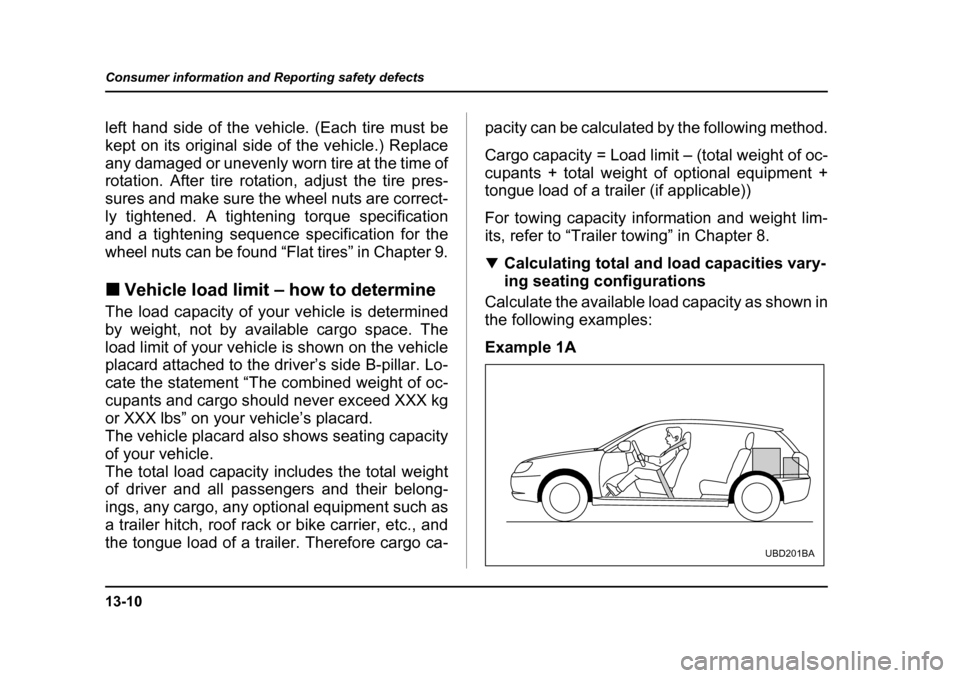
Calculate the available load capacity as shown in
the following examples:
Example 1A
UBD201BA
Page 612 of 627

13-15
Consumer information and Reporting safety defects
– CONTINUED –
!Adverse safety consequences of over-
loading on handling and stopping and on tires
Overloading could affect vehicle handling, stop-
ping distance, vehicle and tire as shown below.
This could lead to an accident and possibly result
in severe personal injury. " Vehicle stability will deteriorate.
" Heavy and/or high-mounted loads could in-
crease the risk of rollover." Stopping distance will increase.
" Brakes could overheat and fail.
" Suspension, bearings, axles and other body
parts could break or experience accelerated
wear that will shorten vehicle life. " Tires could fail.
" Tread separation could occur.
" Tire could separate from its rim.
! Steps for Determining Correct Load Limit
1. Locate the statement “The combined weight
of occupants and cargo should never exceed
XXX pounds” on your vehicle’s placard. 2. Determine the combined weight of the driver
and passengers that will be riding in your vehicle.
3. Subtract the combined weight of the driver
and passengers from XXX kilograms or XXX
pounds.
4. The resulting figure equals the available
amount of cargo and luggage load capacity. For
example, if the “XXX” amount equals 1,400 lbs
(635kg). and there will be five- 150 lbs (68 kg)
passengers in your vehicle, the amount of avail-
able cargo and luggage load capacity is 650 lbs.
(1,400 – 750 (5 x 150) = 650 lbs.)
5. Determine the combined weight of luggage
and cargo being loaded on the vehicle. That
weight may not safely exceed the available car-
go and luggage load capacity calculated in Step 4.
6. If your vehicle will be towing a trailer, load
from your trailer will be transferred to your vehi-
cle. Consult this manual to determine how this
reduces the available cargo and luggage load
capacity of your vehicle.
Page 624 of 627

14-9
Index
Tilt steering wheel ............................................. 3-63 Tire
Chains .......................................................... 8-17
Inspection ................................................... 11-51
Pressures and wear .................................... 11-52
Replacement .............................................. 11-56
Rotation ...................................................... 11-55
Tires .................................................................. 12-5
Types .......................................................... 11-49
Tires and wheels ............................................. 11-49
Top tether anchorages ...................................... 1-55
Towing ............................................................... 9-21 All wheels on the ground .............................. 9-28
Flat-bed truck ................................................ 9-27
Tie-down hooks ............................................ 9-22
Weight .......................................................... 8-31
Trailer
Hitch ............................................................. 8-27
Hitches .......................................................... 8-37
Towing .......................................................... 8-31
Towing tips ................................................... 8-40
Trip meter ................................................. 3-10, 3-16
Trunk lid ............................................................. 2-35
Release handle ............................................. 2-37
Trunk light ........................................................ 11-86
Turn signal
Indicator lights .............................................. 3-34 Lever ............................................................. 3-47
U
Under-floor storage compartment ..................... 6-30 V
Valet mode ........................................................ 2-27
Vanity mirror ........................................................ 6-6
Vehicle Capacity weight ............................................ 8-19
Identification ............................................... 12-11
Vehicle Dynamics Control
OFF indicator light ........................................ 3-32
OFF switch ................................................... 7-48
Operation indicator light ................................ 3-31
System .......................................................... 7-43
Warning light ................................................. 3-32
Ventilator ............................................................. 4-2 W
Warning and indicator lights .............................. 3-20
Warning lights ABS .............................................................. 3-28
All-wheel drive .............................................. 3-31
Anti-lock Brake system ................................. 3-28
AT OIL TEMPerature .................................... 3-27