light SUBARU OUTBACK 2006 Owners Manual
[x] Cancel search | Manufacturer: SUBARU, Model Year: 2006, Model line: OUTBACK, Model: SUBARU OUTBACK 2006Pages: 425, PDF Size: 10.36 MB
Page 244 of 425
Starting and operating
7-5
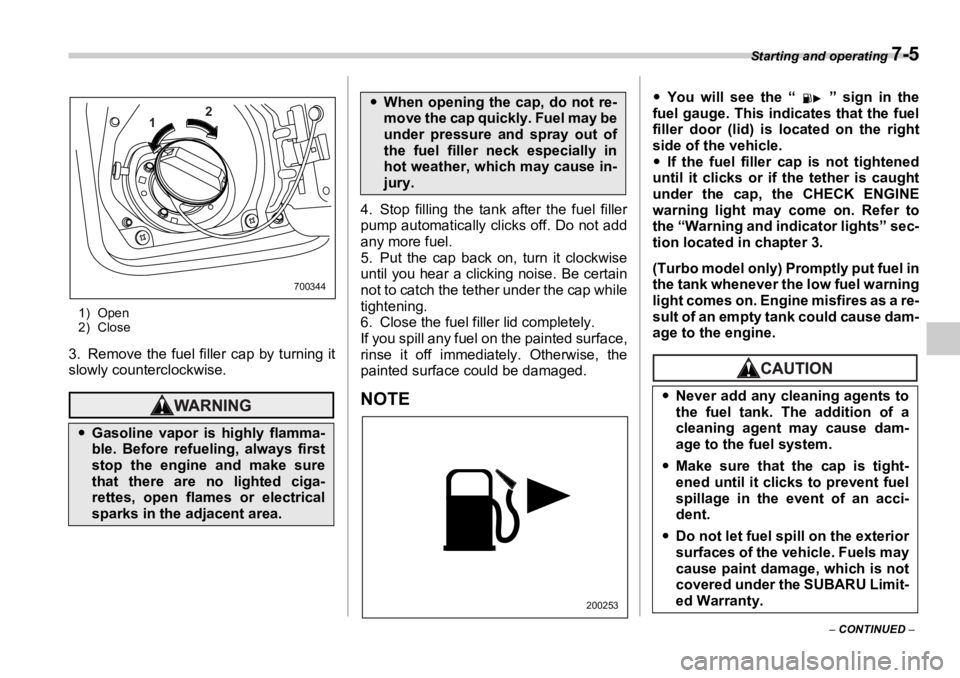
– CONTINUED –1) Open
2) Close
3. Remove the fuel filler cap by turning it
slowly counterclockwise. 4. Stop filling the tank after the fuel filler
pump automatically cl icks off. Do not add
any more fuel.
5. Put the cap back on, turn it clockwise
until you hear a clicking noise. Be certain
not to catch the tether under the cap while
tightening.
6. Close the fuel filler lid completely.
If you spill any fuel on the painted surface,
rinse it off immediately. Otherwise, the
painted surface could be damaged.
NOTE y You will see the “ ” sign in the
fuel gauge. This indicates that the fuel
filler door (lid) is located on the right
side of the vehicle.
y If the fuel filler cap is not tightened
until it clicks or if the tether is caught
under the cap, the CHECK ENGINE
warning light may come on. Refer to
the “Warning and indicator lights” sec-
tion located in chapter 3.
(Turbo model only) Promptly put fuel in
the tank whenever the low fuel warning
light comes on. Engine misfires as a re-
sult of an empty tank could cause dam-
age to the engine.
y Gasoline vapor is highly flamma-
ble. Before refueling, always first
stop the engine and make sure
that there are no lighted ciga-
rettes, open flames or electrical
sparks in the adjacent area. 1 2
700344
y When opening the cap, do not re-
move the cap quickly. Fuel may be
under pressure and spray out of
the fuel filler neck especially in
hot weather, which may cause in-
jury.
200253y Never add any cleaning agents to
the fuel tank. The addition of a
cleaning agent may cause dam-
age to the fuel system.
y Make sure that the cap is tight-
ened until it clicks to prevent fuel
spillage in the event of an acci-
dent.
y Do not let fuel sp ill on the exterior
surfaces of the vehicle. Fuels may
cause paint damage, which is not
covered under the SUBARU Limit-
ed Warranty.
Page 246 of 425
Starting and operating
7-7Under no circumstances should the rear
wheels be jacked off the ground, nor
should the driveshaft be disconnected for
state emission testing.
The EPA has issued regulations for in-
specting the On-Board Diagnostic (OBD)
system as part of the state emissions in-
spection. The OBD system is designed to
detect engine and transmission problems
that might cause vehicle emissions to ex-
ceed allowable limits. These inspections
apply to all 1996 model year and newer
passenger cars and li ght trucks. Over 30
states plus the Distr ict of Columbia have
implemented the OBD system inspection.
y The inspection of the OBD system con-
sists of a visual operational check of the
“ CHECK ENGINE ” warning light/malfunc-
tion indicator lamp (MIL) and an examina-
tion of the OBD system with an electronic
scan tool while the engine is running.
y A vehicle passes
the OBD system in-
spection if proper the “ CHECK ENGINE ”
warning light/MIL illumination is observed,
there is no stored diagnostic trouble
codes, and the OBD system readiness
monitors are complete.
y A vehicle fails
the OBD inspection if the
“ CHECK ENGINE ” warning light/MIL is
not properly operating or there is one or
more diagnostic trouble codes stored in vehicle’s computer with the “ CHECK EN-
GINE ” warning light/MIL illuminated.
y A state emission inspection may reject
(not pass or fail) a vehicle if the number of
OBD system readiness monitors “ Not
Ready ” is greater than one. Under this
condition, the vehicle operator should be
instructed to drive his/her vehicle for a few
days to set the monitors and return for an
emission re-inspection.
y Owners of rejected or failing vehicles
should contact their SUBARU Dealer for
service. Preparing to drive You should perform the following checks
and adjustments every day before you
start driving.
1. Check that all windows, mirrors, and
lights are clean and unobstructed.
2. Check the appearance and condition of
the tires. Also check tires for proper infla-
tion.
3. Look under the vehicle for any sign of
leaks.
4. Check that the hood, trunk (Sedan)
and rear gate (Station wagon) are fully
closed.
5. Check the adjustment of the seat.
6. Check the adjustment of the inside and
outside mirrors.
7. Fasten your seatbelt. Check that your
passengers have fastened their seatbelts.
8. Check the operation of the warning and
indicator lights when the ignition switch is
turned to the “ON” position.
9. Check the gauges, indicator and warn-
ing lights after starting the engine.
NOTE Engine oil, engine coolant, brake fluid,
washer fluid and other fluid levels
should be checked daily, weekly or at
fuel stops.
Page 247 of 425
7-8 Starting and operating
Starting the engine
„ Manual transmission vehicle1. Apply the parking brake.
2. Turn off unnecessary lights and acces-
sories.
3. Press the clutch pedal to the floor and
shift the shift leve r into neutral.
Hold the clutch pedal to the floor while
starting the engine. The starter motor will
only operate when the clutch pedal is
pressed fully to the floor.
4. Turn the ignition switch to the “ON” po-
sition and check the operation of the warn-
ing and indicator lights. Refer to the
“Warning and indicator lights” section
(chapter 3).
5. Turn the ignition sw itch to the “START”
position without depressing the accelera-
tor pedal. Release the key immediately af-
ter the engine has started. If the engine does not start, try the follow-
ing.
1) Turn the ignition switch to the “OFF”
position and wait for at least 10 sec-
onds. After checking that the parking
brake is firmly set, turn the ignition
switch to the “START” position while de-
pressing the accelerator pedal slightly
(approximately a quarter of the full
stroke). Release th e accelerator pedal
as soon as the engine starts.
2) If this fails to start the engine, turn the
ignition switch back to the “OFF” posi-
tion and wait for at least 10 seconds.
Then fully depress the accelerator ped-
al and turn the ignition switch to the
“START” position. If the engine starts,
quickly release the accelerator pedal.
3) If this fails to start the engine, turn the
ignition switch again to the “OFF” posi-
tion. After waiting for 10 seconds or
longer, turn the ignition switch to the
“START” position without depressing
the accelerator pedal.
4) If the engine still refuses to start, con-
tact your nearest SUBARU dealer for
assistance.
6. Confirm that all warning and indicator
lights have gone off after the engine has
started. The fuel injection system auto-
matically lowers the idle speed as the en-
gine warms up. „ Automatic transmission vehi-
cle
1. Apply the parking brake.
2. Turn off unnecessary lights and acces-
sories.
3. Shift the selector lever to the “P” or “N”
position (preferably “P” position). The
starter will only operate when the select
lever is at the “P” or “N” position.
4. Turn the ignition switch to the “ON” po-
sition and check the operation of the warn-
ing and indicator li ghts. Refer to the
“Warning and indicator lights” section
(chapter 3).
5. Turn the ignition switch to the “START”
position without depressing the accelera-
tor pedal. Release the key immediately af-
ter the engine has started.
If the engine does not start, try the follow-
ing.
1) Turn the ignition switch to the “OFF”
position and wait for at least 10 sec-Do not operate the starter motor
continuously for more than ten sec-
onds. If the engine fails to start after
operating the starte r for five to ten
seconds, wait for ten seconds or
more before trying again. If you restart the engine while the
vehicle is moving, shift the selector
lever into the “N” position. Do not
attempt to place the selector lever of
a moving vehicle into the “P” posi-
tion.
Page 248 of 425
Starting and operating
7-9
– CONTINUED –onds. After checking that the parking
brake is firmly set, turn the ignition
switch to the “START” position while de-
pressing the accelerator pedal slightly
(approximately a quarter of the full
stroke). Release the accelerator pedal
as soon as the engine starts.
2) If this fails to start the engine, turn the
ignition switch back to the “OFF” posi-
tion and wait for at least 10 seconds.
Then fully depress the accelerator ped-
al and turn the ignition switch to the
“START” position. If the engine starts,
quickly release the accelerator pedal.
3) If this fails to start the engine, turn the
ignition switch again to the “OFF” posi-
tion. After waiting for 10 seconds or
longer, turn the ignition switch to the
“START” position without depressing
the accelerator pedal.
4) If the engine still refuses to start, con-
tact your nearest SUBARU dealer for
assistance.
6. Confirm that all warning and indicator
lights have gone out after the engine has
started. The fuel in jection syst em auto-
matically lowers the idle speed as the en-
gine warms up.
While the engine is warming up, make
sure that the selector lever is at the “P” or
“N” position and that the parking brake is
applied. Stopping the engine
The ignition switch should be turned off
only when the vehicle is stopped and the
engine is idling. Manual transmission
The manual transmission is a fully syn-
chromeshed, 5-forward-speed and 1-re-
verse-speed transmission.Do not stop the engine when the ve-
hicle is moving. This will cause loss
of power to the power steering and
the brake booster, making steering
and braking more difficult. It could
also result in a ccidental activation
of the “LOCK” position on the igni-
tion switch, causing the steering
wheel to lock. Do not drive the vehicle with the
clutch disengaged (i.e., when the
clutch pedal is depressed) or with
the shift lever in the neutral posi-
tion. Engine braking has no effect in
either of these conditions and the
risk of an accident is consequently
increased.
Shift into reverse ONLY when the
vehicle has completely stopped. It
may cause damage to the transmis-
sion to try shifti ng into reverse
when the vehicle is moving.
Page 250 of 425
Starting and operating
7-11
– CONTINUED –Never exceed posted speed limits.
„ Driving tipsDo not drive with your foot resting on the
clutch pedal and do not use the clutch to
hold your vehicle at a standstill on an up-
grade. Either of those actions may cause
clutch damage.
Do not drive with your hand resting on the
shift lever. This may cause wear on the
transmission components.
When it is necessary to reduce vehicle
speed due to slow traffic, turning corners,
or driving up steep hills, downshift to a
lower gear before the engine starts to la-
bor.
y On steep downgrades, downshift the
transmission to 4th, 3rd or 2nd gear as
necessary; this helps to maintain a safe
speed and to extend brake pad life.
In this way, the engine provides a braking
effect. Remember, if you “ride” (over use)
the brakes while descending a hill, they
may overheat and not work properly.
y The engine may, on rare occasions,
knock when the vehicle rapidly acceler-
ates or rapidly pulls away from a standstill.
This phenomenon does not indicate a
fault.
y A slight reduction in output torque may occur in the models with a 2.5-liter turbo
engine before the engine warms up.
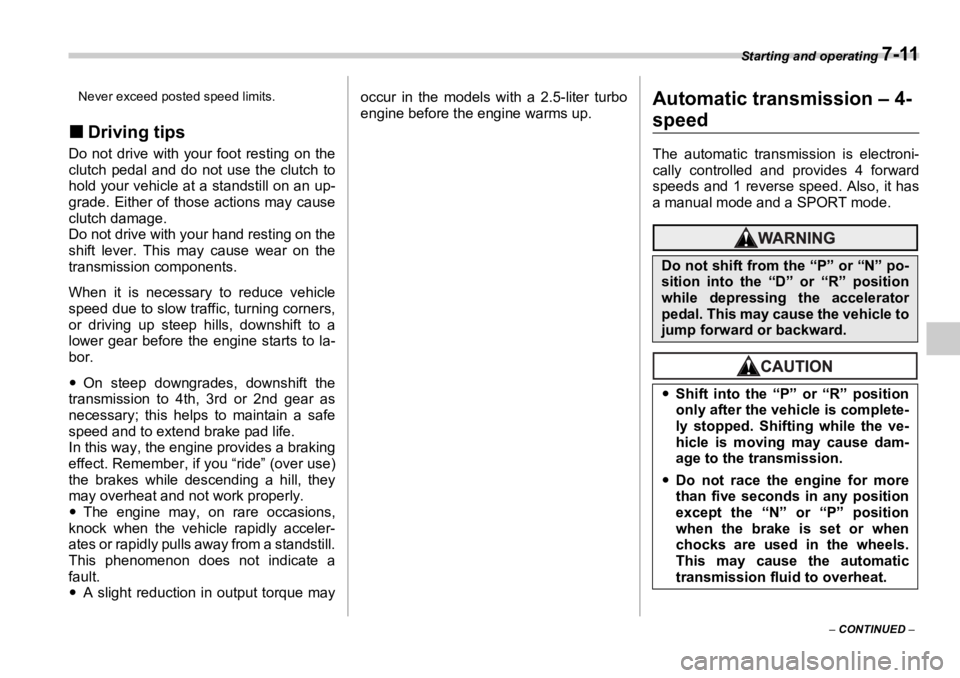
Automatic transmission – 4-
speed The automatic transmission is electroni-
cally controlled and provides 4 forward
speeds and 1 reverse speed. Also, it has
a manual mode and a SPORT mode.
Do not shift from the “P” or “N” po-
sition into the “D ” or “R” position
while depressing the accelerator
pedal. This may cause the vehicle to
jump forward or backward.
y Shift into the “P” or “R” position
only after the vehic le is complete-
ly stopped. Shifting while the ve-
hicle is moving may cause dam-
age to the transmission.
y Do not race the engine for more
than five seconds in any position
except the “N” or “P” position
when the brake is set or when
chocks are used in the wheels.
This may cause the automatic
transmission fluid to overheat.
Page 251 of 425
7-12 Starting and operating
NOTE y When the engine coolant tempera-
ture is still low, your vehicle’s automat-
ic transmission will up-shift at higher
engine speeds than when the coolant
temperature is sufficiently high in or-
der to shorten the warm-up time and
improve driveability. The gearshift tim-
ing will automatically shift to the nor-
mal timing after the engine has warmed
up.
y Immediately after ATF (automatic
transmission fluid) is replaced, you
may feel that the automatic transmis-
sion operation is somewhat unusual.
This results from invalidation of data
which the on-board computer has col-
lected and stored in memory to allow the transmission to shift at the most
appropriate times for the current con-
dition of your vehicle. Optimized shift-
ing will be restored as the vehicle con-
tinues to be driven for a while.
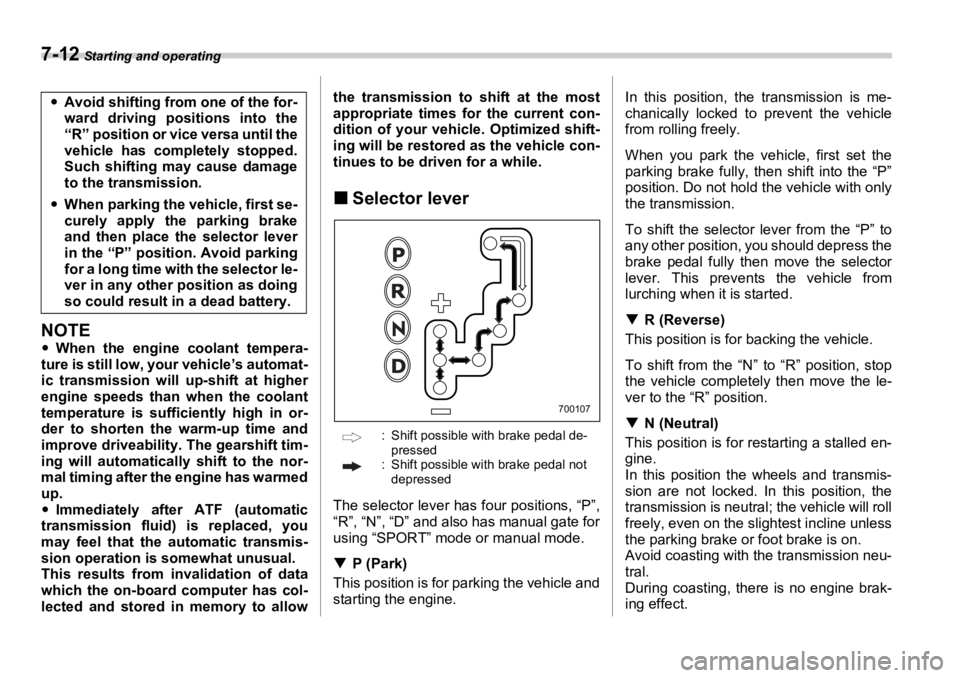
„ Selector lever
: Shift possible with brake pedal de-
pressed
: Shift possible with brake pedal not
depressed
The selector lever has four positions, “P”,
“R”, “N”, “D” and also has manual gate for
using “SPORT” mode or manual mode.
T P (Park)
This position is for parking the vehicle and
starting the engine. In this position, the transmission is me-
chanically locked to prevent the vehicle
from rolling freely.
When you park the vehicle, first set the
parking brake fully, then shift into the “P”
position. Do not hold the vehicle with only
the transmission.
To shift the selector lever from the “P” to
any other position, you should depress the
brake pedal fully then move the selector
lever. This prevents the vehicle from
lurching when it is started.
T R (Reverse)
This position is for backing the vehicle.
To shift from the “N” to “R” position, stop
the vehicle completely then move the le-
ver to the “R” position.
T N (Neutral)
This position is for restarting a stalled en-
gine.
In this position the wheels and transmis-
sion are not locked. In this position, the
transmission is neutral; the vehicle will roll
freely, even on the slightest incline unless
the parking brake or foot brake is on.
Avoid coasting with the transmission neu-
tral.
During coasting, there is no engine brak-
ing effect.y Avoid shifting from one of the for-
ward driving positions into the
“R” position or vice versa until the
vehicle has completely stopped.
Such shifting may cause damage
to the transmission.
y When parking the vehicle, first se-
curely apply the parking brake
and then place the selector lever
in the “P” position. Avoid parking
for a long time with the selector le-
ver in any other position as doing
so could result in a dead battery. 700107
Page 254 of 425
Starting and operating
7-15
– CONTINUED –Gearshifts can be performed using the se-
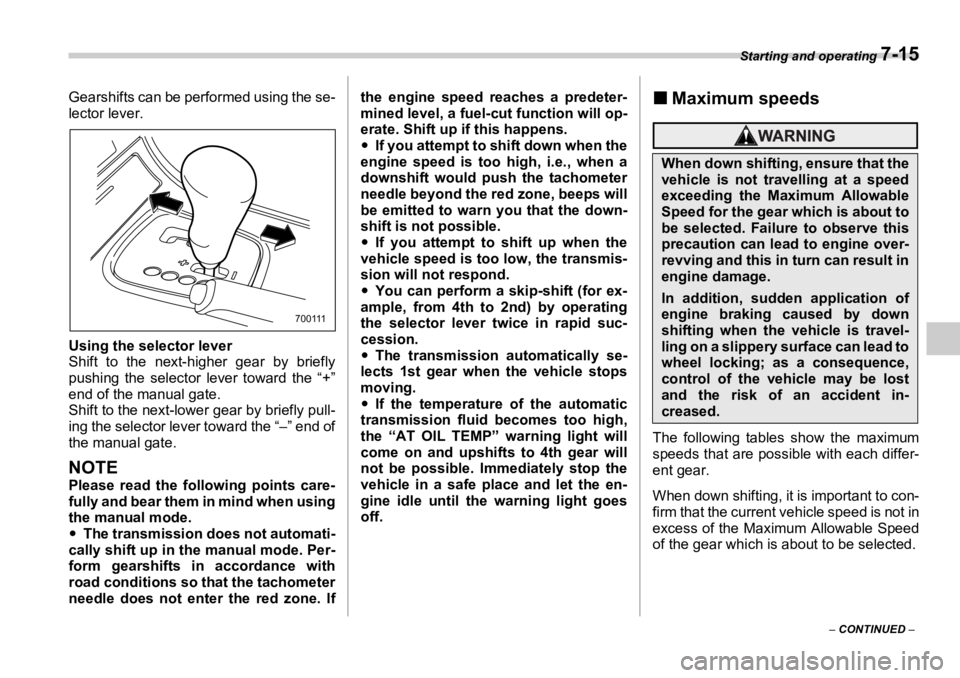
lector lever.
Using the selector lever
Shift to the next-higher gear by briefly
pushing the selector lever toward the “+”
end of the manual gate.
Shift to the next-lower gear by briefly pull-
ing the selector lever toward the “–” end of
the manual gate.
NOTE Please read the following points care-
fully and bear them in mind when using
the manual mode.
y The transmission does not automati-
cally shift up in the manual mode. Per-
form gearshifts in accordance with
road conditions so that the tachometer
needle does not enter the red zone. If the engine speed reaches a predeter-
mined level, a fuel-cut function will op-
erate. Shift up if this happens.
y If you attempt to sh ift down when the
engine speed is too high, i.e., when a
downshift would push the tachometer
needle beyond the red zone, beeps will
be emitted to warn you that the down-
shift is not possible.
y If you attempt to shift up when the
vehicle speed is too low, the transmis-
sion will not respond.
y You can perform a skip-shift (for ex-
ample, from 4th to 2nd) by operating
the selector lever twice in rapid suc-
cession.
y The transmission automatically se-
lects 1st gear when the vehicle stops
moving.
y If the temperature of the automatic
transmission fluid becomes too high,
the “AT OIL TEMP” warning light will
come on and upshifts to 4th gear will
not be possible. Immediately stop the
vehicle in a safe place and let the en-
gine idle until the warning light goes
off. „ Maximum speeds
The following tables show the maximum
speeds that are possible with each differ-
ent gear.
When down shifting, it is important to con-
firm that the current vehicle speed is not in
excess of the Maximum Allowable Speed
of the gear which is about to be selected.700111
When down shifting, ensure that the
vehicle is not travelling at a speed
exceeding the Maximum Allowable
Speed for the gear which is about to
be selected. Failure to observe this
precaution can lead to engine over-
revving and this in turn can result in
engine damage.
In addition, sudden application of
engine braking caused by down
shifting when the vehicle is travel-
ling on a slippery surface can lead to
wheel locking; as a consequence,
control of the vehicle may be lost
and the risk of an accident in-
creased.
Page 255 of 425
7-16 Starting and operating
mph (km/h)
Never exceed posted speed limits.
„ Driving tipsy On a road surface where there is a risk
of wheelspin (for example, a snow- or
gravel-covered road), you can pull away
from a standstill (safely and easily) by first
selecting the 2nd gear of the manual
mode.
y Always apply the foot or parking brake
when the vehicle is stopped in the “D” or
“R” position.
y Always set the parking brake when
parking your vehicle. Do not hold the vehi-
cle with only the transmission.
y Do not keep the vehicle in a stationary
position on an uphill grade by using the
“D” position. Use the brake instead.
y The engine may, on rare occasions,
knock when the vehicle rapidly acceler-
ates or rapidly pulls away from a standstill.
This phenomenon does not indicate a
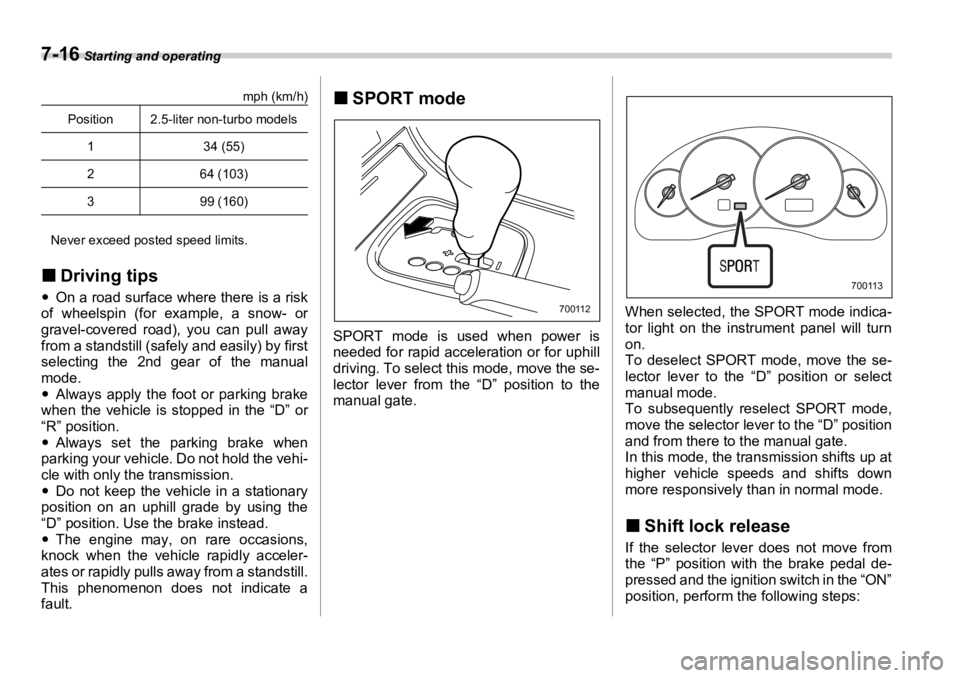
fault. „ SPORT mode
SPORT mode is used when power is
needed for rapid acceleration or for uphill
driving. To select this mode, move the se-
lector lever from the “D” position to the
manual gate. When selected, the SPORT mode indica-
tor light on the instrument panel will turn
on.
To deselect SPORT mode, move the se-
lector lever to the “D” position or select
manual mode.
To subsequently reselect SPORT mode,
move the selector lever to the “D” position
and from there to the manual gate.
In this mode, the transmission shifts up at
higher vehicle speeds and shifts down
more responsively than in normal mode.
„ Shift lock release If the selector lever does not move from
the “P” position with the brake pedal de-
pressed and the ignition switch in the “ON”
position, perform the following steps:Position 2.5-liter non-turbo models
1 34 (55)
2 64 (103)
3 99 (160) 700112 700113
Page 258 of 425
Starting and operating
7-19
– CONTINUED –transmission is neutral; the vehicle will roll
freely, even on the slightest incline unless
the parking brake or foot brake is on.
Avoid coasting with the transmission neu-
tral.
During coasting, there is no engine brak-
ing effect.
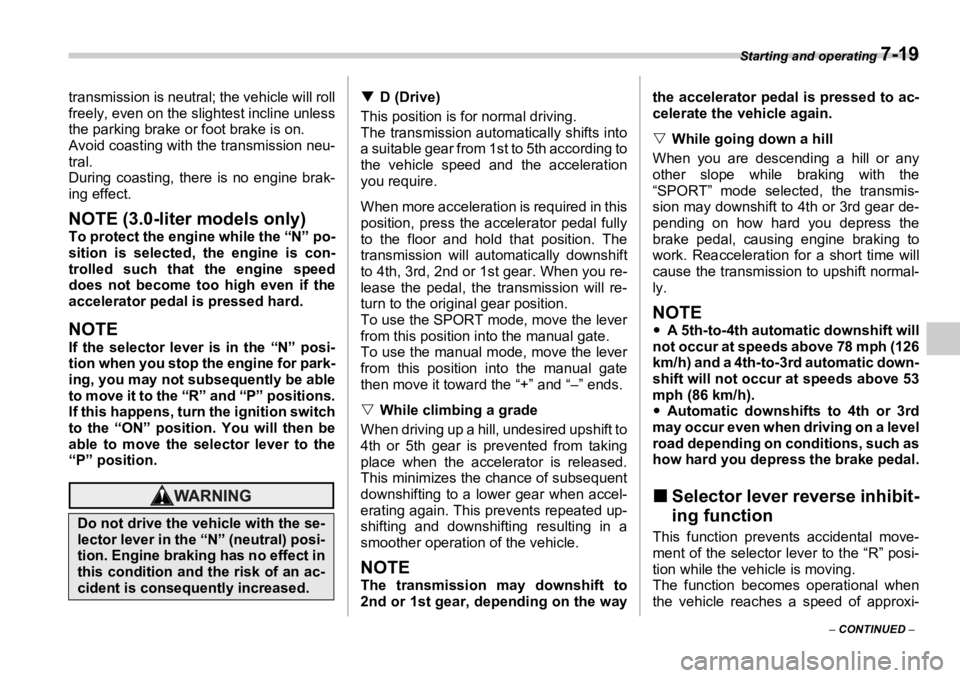
NOTE (3.0-liter models only) To protect the engine while the “N” po-
sition is selected, the engine is con-
trolled such that the engine speed
does not become too high even if the
accelerator pedal is pressed hard.
NOTE If the selector lever is in the “N” posi-
tion when you stop the engine for park-
ing, you may not subsequently be able
to move it to the “R” and “P” positions.
If this happens, turn the ignition switch
to the “ON” position. You will then be
able to move the selector lever to the
“P” position. T D (Drive)
This position is for normal driving.
The transmission automatically shifts into
a suitable gear from 1st to 5th according to
the vehicle speed and the acceleration
you require.
When more acceleration is required in this
position, press the accelerator pedal fully
to the floor and hold that position. The
transmission will automatically downshift
to 4th, 3rd, 2nd or 1st gear. When you re-
lease the pedal, the transmission will re-
turn to the original gear position.
To use the SPORT mode, move the lever
from this position into the manual gate.
To use the manual mode, move the lever
from this position into the manual gate
then move it toward the “+” and “–” ends.
V While climbing a grade
When driving up a hill, undesired upshift to
4th or 5th gear is prevented from taking
place when the accelerator is released.
This minimizes the chance of subsequent
downshifting to a lower gear when accel-
erating again. This prevents repeated up-
shifting and downshifting resulting in a
smoother operation of the vehicle.
NOTE The transmission may downshift to
2nd or 1st gear, depending on the way the accelerator pedal is pressed to ac-
celerate the vehicle again.
V While going down a hill
When you are descending a hill or any
other slope while braking with the
“SPORT” mode selected, the transmis-
sion may downshift to 4th or 3rd gear de-
pending on how hard you depress the
brake pedal, causing engine braking to
work. Reacceleration for a short time will
cause the transmission to upshift normal-
ly.
NOTE y A 5th-to-4th automa tic downshift will
not occur at speeds above 78 mph (126
km/h) and a 4th-to-3rd automatic down-
shift will not occur at speeds above 53
mph (86 km/h).
y Automatic down shifts to 4th or 3rd
may occur even when driving on a level
road depending on conditions, such as
how hard you depress the brake pedal.
„ Selector lever reverse inhibit-
ing function This function prevents accidental move-
ment of the selector lever to the “R” posi-
tion while the vehicle is moving.
The function becomes operational when
the vehicle reaches a speed of approxi-Do not drive the vehicle with the se-
lector lever in the “N” (neutral) posi-
tion. Engine braking has no effect in
this condition and the risk of an ac-
cident is consequently increased.
Page 261 of 425
7-22 Starting and operating
transmission will automatically switch
back from manual mode to normal mode.
NOTE Please read the following points care-
fully and bear them in mind when using
the manual mode.
y When the temperature of the auto-
matic transmission fluid is higher than
normal, warning beeps are emitted and
the shift position in dicator shows “–”.
If these warnings are issued, deselect
the manual mode to protect the auto-
matic transmission from damage.
y When the temperature of the engine
oil is higher than normal, warning
beeps are emitted and the shift posi-
tion indicator shows “–”. If these warn-
ings are issued, deselect the manual
mode to protect th e engine from dam-
age. (3.0-liter models only)
y The transmission does not automati-
cally shift up in the manual mode. Per-
form gearshifts in accordance with
road conditions so that the tachometer
needle does not enter the red zone. If
the engine speed reaches a predeter-
mined level, a fuel-cut function will op-
erate. Shift up if this happens. (Also, in
the case of a 3.0-liter model, the trans-
mission may automatically shift up to
protect the engine.)
y If you attempt to shift down when the engine speed is too high, i.e., when a
downshift would push the tachometer
needle beyond the red zone, beeps will
be emitted to warn you that the down-
shift is not possible.
y If you attempt to shift up when the
vehicle speed is too low, the transmis-
sion will not respond.
y You can perform a skip-shift (for ex-
ample, from 4th to 2nd) by operating
the selector lever or a steering-wheel
switch twice in rapid succession.
y The transmission automatically se-
lects 1st gear when the vehicle stops
moving.
y If the temperature of the automatic
transmission fluid becomes too high,
the “AT OIL TEMP” warning light will
come on and upshifts to 5th gear will
not be possible. Immediately stop the
vehicle in a safe place and let the en-
gine idle until the warning light goes
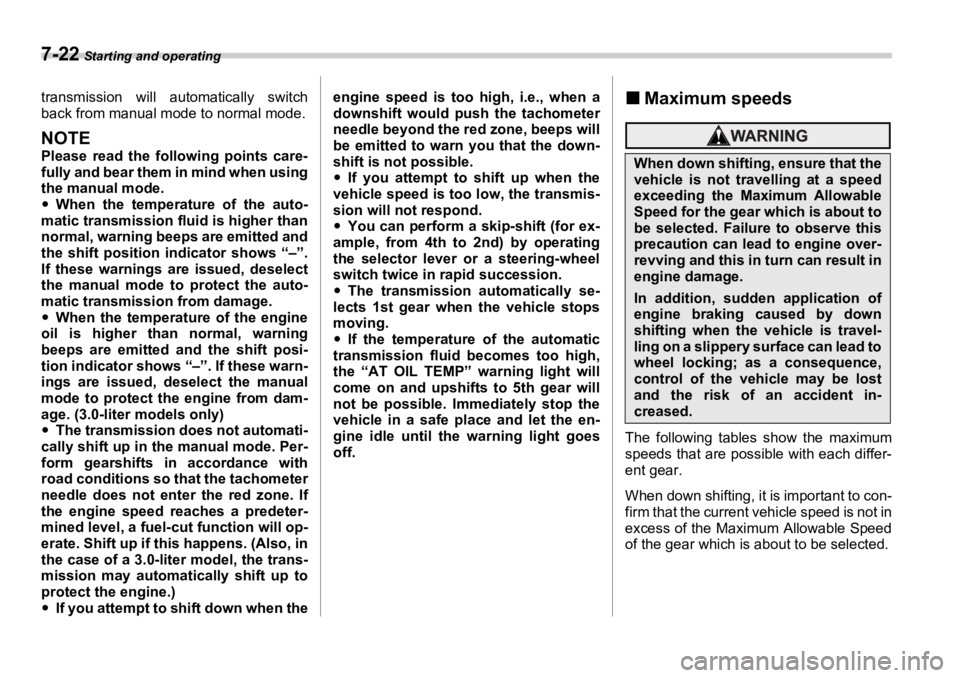
off. „ Maximum speeds
The following tables show the maximum
speeds that are possible with each differ-
ent gear.
When down shifting, it is important to con-
firm that the current vehicle speed is not in
excess of the Maximum Allowable Speed
of the gear which is about to be selected. When down shifting, ensure that the
vehicle is not travelling at a speed
exceeding the Maximum Allowable
Speed for the gear which is about to
be selected. Failure to observe this
precaution can lead to engine over-
revving and this in turn can result in
engine damage.
In addition, sudden application of
engine braking caused by down
shifting when the vehicle is travel-
ling on a slippery surface can lead to
wheel locking; as a consequence,
control of the vehicle may be lost
and the risk of an accident in-
creased.