fuel pressure SUBARU OUTBACK 2006 User Guide
[x] Cancel search | Manufacturer: SUBARU, Model Year: 2006, Model line: OUTBACK, Model: SUBARU OUTBACK 2006Pages: 425, PDF Size: 10.36 MB
Page 346 of 425
Maintenance and service
11 - 1 3
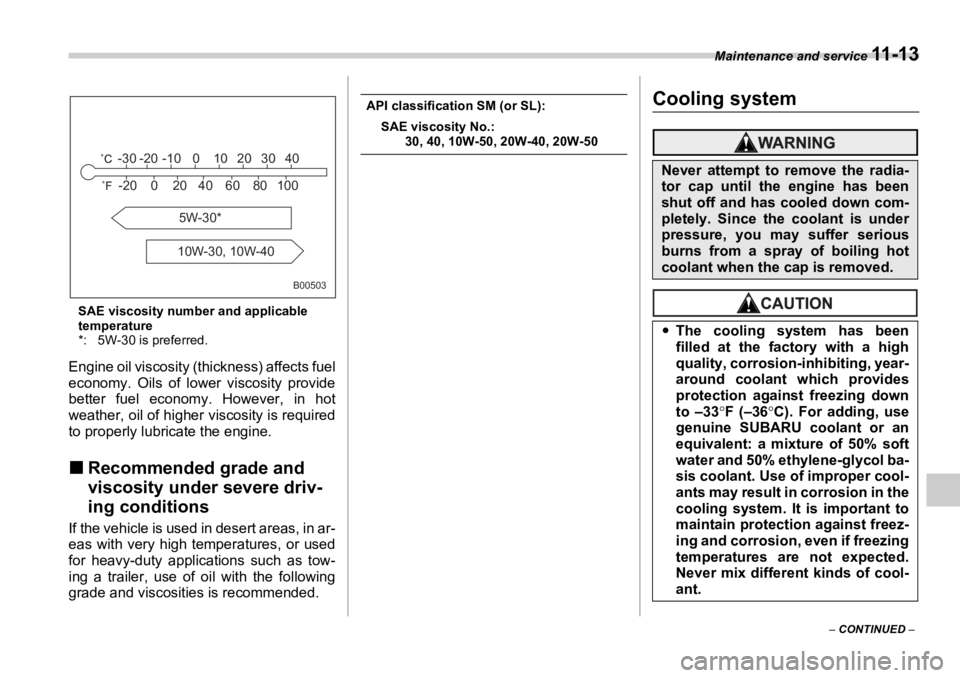
– CONTINUED –SAE viscosity number and applicable
temperature
*: 5W-30 is preferred.
Engine oil viscosity (t hickness) affects fuel
economy. Oils of lower viscosity provide
better fuel economy. However, in hot
weather, oil of higher viscosity is required
to properly lubricate the engine.
„ Recommended grade and
viscosity under severe driv-
ing conditionsIf the vehicle is used in desert areas, in ar-
eas with very high temperatures, or used
for heavy-duty applications such as tow-
ing a trailer, use of oil with the following
grade and viscosities is recommended. API classification SM (or SL):
SAE viscosity No.:
30, 40, 10W-50, 20W-40, 20W-50
Cooling systemB00503
5W-30*
10W-30, 10W-40-30 -20 -10 0 10 20 30 40
-20 06 020 80 10040
Never attempt to remove the radia-
tor cap until the engine has been
shut off and has cooled down com-
pletely. Since the coolant is under
pressure, you may suffer serious
burns from a spray of boiling hot
coolant when the cap is removed.
y The cooling system has been
filled at the factory with a high
quality, corrosion-inhibiting, year-
around coolant which provides
protection against freezing down
to –33 ° F (–36 ° C). For adding, use
genuine SUBARU coolant or an
equivalent: a mixture of 50% soft
water and 50% ethylene-glycol ba-
sis coolant. Use of improper cool-
ants may result in corrosion in the
cooling system. It is important to
maintain protection against freez-
ing and corrosion, even if freezing
temperatures are not expected.
Never mix different kinds of cool-
ant.
Page 368 of 425
Maintenance and service
11 - 3 5
– CONTINUED –curbs or are subjected to harsh treat-
ment as when the vehicle is driven on a
rough surface, they can suffer damage
that cannot be seen with the naked eye.
This type of damage does not become
evident until time has passed. Try not
to drive over curbs, potholes or on oth-
er rough surfaces. If doing so is un-
avoidable, keep the vehicle’s speed
down to a walking pace or less, and ap-
proach the curbs as squarely as possi-
ble. Also, make sure the tires are not
pressed against the curb when you
park the vehicle.
y If you feel unusual vibration while
driving or find it difficult to steer the ve-
hicle in a straight line, one of the tires
and/or wheels may be damaged. Drive
slowly to the nearest authorized
SUBARU dealer and have the vehicle
inspected.
„ Tire pressures and wearMaintaining the correct tire pressures
helps to maximize the tires’ service lives
and is essential for good running perfor-
mance. Check and, if necessary, adjust
the pressure of each tire (including the
spare) at least once a month (for example,
during a fuel stop) and before any long
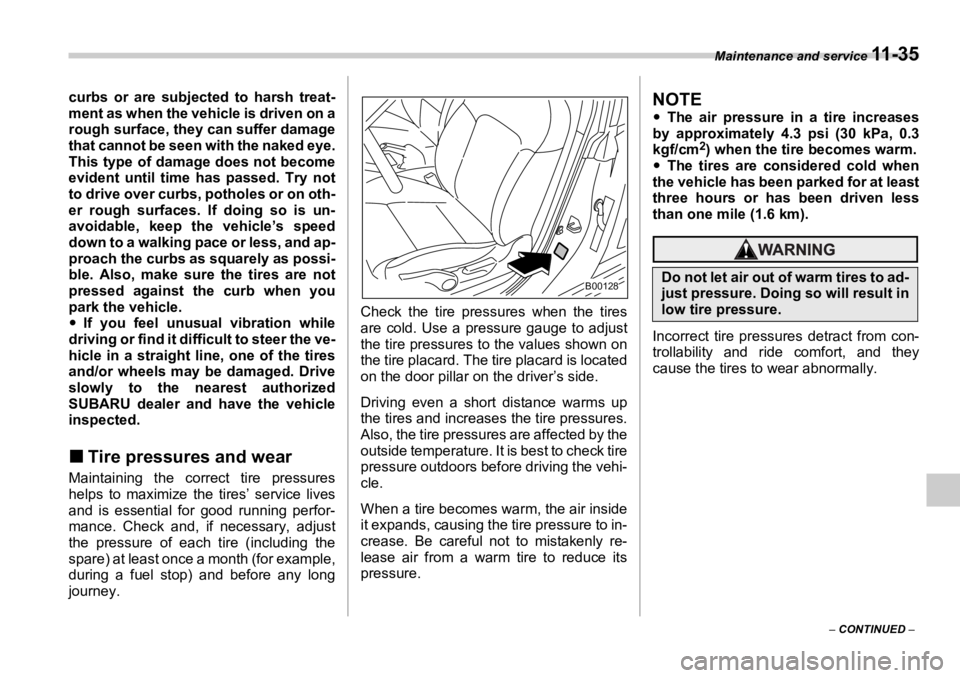
journey. Check the tire pressures when the tires
are cold. Use a pressure gauge to adjust
the tire pressures to the values shown on
the tire placard. The tire placard is located
on the door pillar on the driver’s side.
Driving even a short distance warms up
the tires and increases the tire pressures.
Also, the tire pressures are affected by the
outside temperature. It is best to check tire
pressure outdoors before driving the vehi-
cle.
When a tire becomes warm, the air inside
it expands, causing the tire pressure to in-
crease. Be careful no t to mistakenly re-
lease air from a warm tire to reduce its
pressure. NOTE y The air pressure in a tire increases
by approximately 4.3 psi (30 kPa, 0.3
kgf/cm 2
) when the tire becomes warm.
y The tires are considered cold when
the vehicle has been parked for at least
three hours or has been driven less
than one mile (1.6 km).
Incorrect tire pressures detract from con-
trollability and ride comfort, and they
cause the tires to wear abnormally. B00128
Do not let air out of warm tires to ad-
just pressure. Doing so will result in
low tire pressure.
Page 369 of 425
11 - 3 6 Maintenance and service
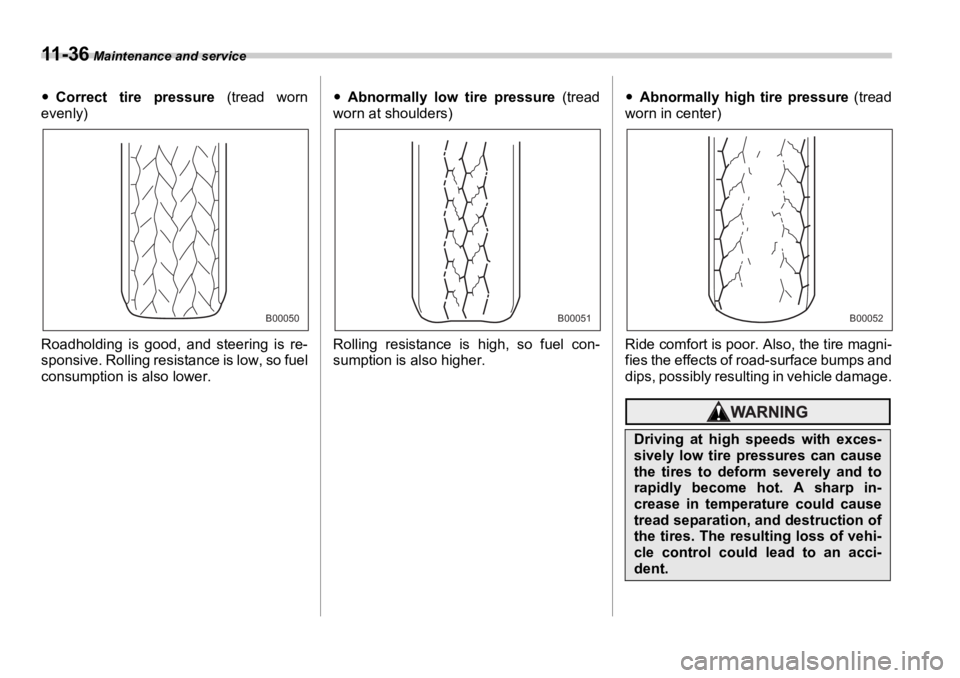
y Correct tire pressure (tread worn
evenly)
Roadholding is good, and steering is re-
sponsive. Rolling resistance is low, so fuel
consumption is also lower. y Abnormally low tire pressure (tread
worn at shoulders)
Rolling resistance is high, so fuel con-
sumption is also higher. y Abnormally high tire pressure (tread
worn in center)
Ride comfort is poor. Also, the tire magni-
fies the effects of road-surface bumps and
dips, possibly resulting in vehicle damage.B00050 B00051
Driving at high speeds with exces-
sively low tire pressures can cause
the tires to deform severely and to
rapidly become hot. A sharp in-
crease in temperature could cause
tread separation, and destruction of
the tires. The resulting loss of vehi-
cle control could lead to an acci-
dent. B00052
Page 399 of 425
12-10 Specifications
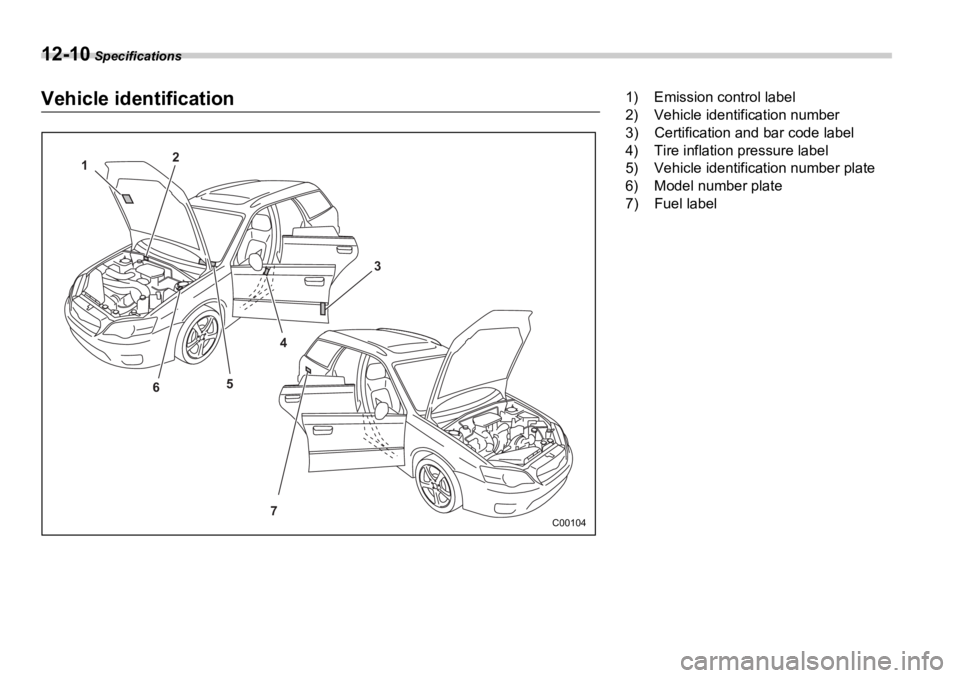
Vehicle identification
C001041 2
76 5 4 3 1) Emission control label
2) Vehicle identification number
3) Certification and bar code label
4) Tire inflation pressure label
5) Vehicle identification number plate
6) Model number plate
7) Fuel label
Page 406 of 425

Consumer information and Reporting safety defects
13-7
– CONTINUED –asymmetrical tire that has a particu-
lar side that must always face out-
ward when mounting on a vehicle.y
Accessory weight
The combined weight (in excess of
those standard items which may be
replaced) of floor mats, leather seats
and cross bars to the extent that these
items are available as factory-in-
stalled equipment (whether installed
or not). y
Curb weight
The weight of a motor vehicle with
standard equipment including the
maximum capacity of fuel, oil, and
coolant and air conditioning. y
Maximum loaded vehicle weight
The sum of curb weight, accessory
weight, vehicle capacity weight and
production options weight. y
Normal occupant weight
150 lbs (68 kg) times the number of
occupants (3 occupants).
y
Occupant distribution
Distribution of occupants in a vehicle,
2 in front, 1 in rear seat.
y
Production options weight
The combined weight of those in-
stalled regular production options weighing over 5.1 lbs (2.3 kg) in ex-
cess of those standards items which
they replace, not previously consid-
ered in curb weight or accessory
weight. y
Vehicle capacity weight
The total weight of cargo, luggage
and occupants that can be added to
the vehicle. y
Vehicle maximum load on a tire
Load on an individual tire that is deter-
mined by distributing to each axle its
share of the maximum loaded vehicle
weight and dividing by two. y
Vehicle normal load on a tire
Load on an individual tire that is deter-
mined by distributing to each axle its
share of the curb weight, accessory
weight, and normal occupant weight
and dividing by two.
„ Tire care – maintenance and
safety practices y
Check on a daily basis that the tires
are free from serious damage, nails,
and stones. At the same time, check
the tires for abnormal wear.
y
Inspect the tire tread regularly and
replace the tires before their tread wear indicators become visible. When
a tire’s tread wear indicator becomes
visible, the tire is worn beyond the ac-
ceptable limit and must be replaced
immediately. With a tire in this condi-
tion, driving at even low speeds in wet
weather can cause the vehicle to hy-
droplane. Possible resulting loss of
vehicle control can lead to an acci-
dent. y
To maximize the life of each tire and
ensure that the tires wear uniformly, it
is best to rotate the tires every 7,500
miles (12,500 km). Rotating the tires
involves switching the front and rear
tires on the right-hand side of the ve-
hicle and similarly switching the front
and rear tires on the left-hand side of
the vehicle. (Each tire must be kept on
its original side of the vehicle.) Re-
place any damaged or unevenly worn
tire at the time of ro tation. After tire ro-
tation, adjust the tire pressures and
make sure the wheel nuts are correct-
ly tightened. A tightening torque spec-
ification and a tightening sequence
specification for the wheel nuts can be
found “Flat tires” section in chapter 9.
Page 421 of 425

14-8 Index
Rotation ..................................................................... 11-37
Tires ................................................................................. 12-5
Types ......................................................................... 11-33
Tires and wheels ............................................................ 11-33
Top tether anchorages ..................................................... 1-36
Towing .............................................................................. 9-13
All wheels on the ground ............................................. 9-16
Flat-bed truck ............................................................... 9-16
Tie-down hooks ........................................................... 9-13
Weight ......................................................................... 8-21
Trailer
Hitch ............................................................................ 8-18
Hitches ........................................................................ 8-24
Towing ......................................................................... 8-20
Towing tips .................................................................. 8-26
Trip meter .................................................................. 3-7, 3-11
Trunk lid ........................................................................... 2-21
Release handle ........................................................... 2-22
Trunk light ...................................................................... 11-55
Turn signal
Indicator lights ............................................................. 3-24
Lever ........................................................................... 3-32
U
Under-floor storage compartment .................................... 6-16
V
Valet mode ....................................................................... 2-16
Vanity mirror ....................................................................... 6-4
Vehicle
Capacity weight ........................................................... 8-13 Identification ............................................................... 12-10
Vehicle Dynamics Control
OFF indicator light ....................................................... 3-22
OFF switch ................................................................... 7-32
Operation indicator light .......... ..................................... 3-22
System ......................................................................... 7-29
Warning light ................................................................ 3-22
Ventilator ............................................................................ 4-2
W
Warning and indicator lights ............................................. 3-14
Warning lights
ABS ............. ....................................... ............ .............. 3-20
All-Wheel Drive ............................................................ 3-22
Anti-lock Brake System ................................................ 3-20
AT OIL TEMPerature ................................................... 3-18
Brake system ............ ......................... ............ .............. 3-20
Charge ......................................................................... 3-18
CHECK ENGINE ......................................................... 3-17
Door open ................. ......................... ............ .............. 3-22
Low fuel ....................................................... 3-9, 3-13, 3-21
Oil pressure ................................................................. 3-18
Seatbelt ........................................................................ 3-14
SRS airbag system ...... .......................................... ...... 3-16
Vehicle Dynamics Control ................................... 3-22, 7-31
Warranties and maintenance ............................................ 8-20
Washing ............................................................................ 10-2
Waxing and polishing .... ......................... ............ .............. 10-3
Wear indicators ......................... ...................................... 11-37
Wheel
Alignment ..................................................................... 12-5
Balance ...................................................................... 11-37
Page 425 of 425

GAS STATION REFERENCE
Fuel: T 2.5-liter non-turbo models
Use only unleaded gasoline with an octane rating of 87 AKI or
higher.
T 2.5-liter turbo models and 3.0-liter models
Use premium unleaded gasoline with an octane rating of 91 AKI or
higher. For temporary purposes if premium unleaded gasoline is
not available, you may use regular unleaded gasoline with an oc-
tane rating of 87 AKI or higher. For optimum engine performance
and driveability, it is required (for 2.5-liter turbo models), and rec-
ommended (for 3.0-liter models) that you use premium grade un-
leaded gasoline.
„ Fuel octane ratingThis octane rating is the average of the Research Octane and Mo- tor Octane numbers and is commonly referred to as the Anti Knock
Index (AKI). Refer to “Fuel ” section in this manual.
Fuel capacity: 16.9 US gal (64 liters, 14.1 Imp gal)
Engine oil: Use only API classification SM with the words “ENERGY CON-
SERVING” and the ILSAC certification mark (s tarburst mark) dis-
played on the container.
Engine oil capacity: 2.5-liter models: 4.2 US qt (4.0 liters, 3.5 Imp qt)
3.0-liter models: 5.8 US qt (5.5 liters, 4.8 Imp qt)
Cold tire pressure: Tire size P205/50R17 88V 215/45ZR17 P225/55R17 95V
Wheel size 17 x 7 JJ
Pressure Front 33 psi (230 kPa, 2.3 kgf/cm 2
) 35 psi (240 kPa, 2.4 kgf/cm 2
) 32 psi (220 kPa, 2.2 kgf/cm 2
)
Rear 32 psi (220 kPa, 2.2 kgf/cm 2
) 33 psi (230 kPa, 2.3 kgf/cm 2
) 30 psi (210 kPa, 2.1 kgf/cm 2
)
Rear at trailer
towing – 32 psi (220 kPa, 2.2 kgf/cm 2
)
Temporary
spare tire Size T135/80R16 T135/70D17 T155/70D17
Pressure 60 psi (420 kPa, 4.2 kgf/cm 2
)