tow SUBARU OUTBACK 2006 Owner's Manual
[x] Cancel search | Manufacturer: SUBARU, Model Year: 2006, Model line: OUTBACK, Model: SUBARU OUTBACK 2006Pages: 425, PDF Size: 10.36 MB
Page 231 of 425
6-14 Interior equipment
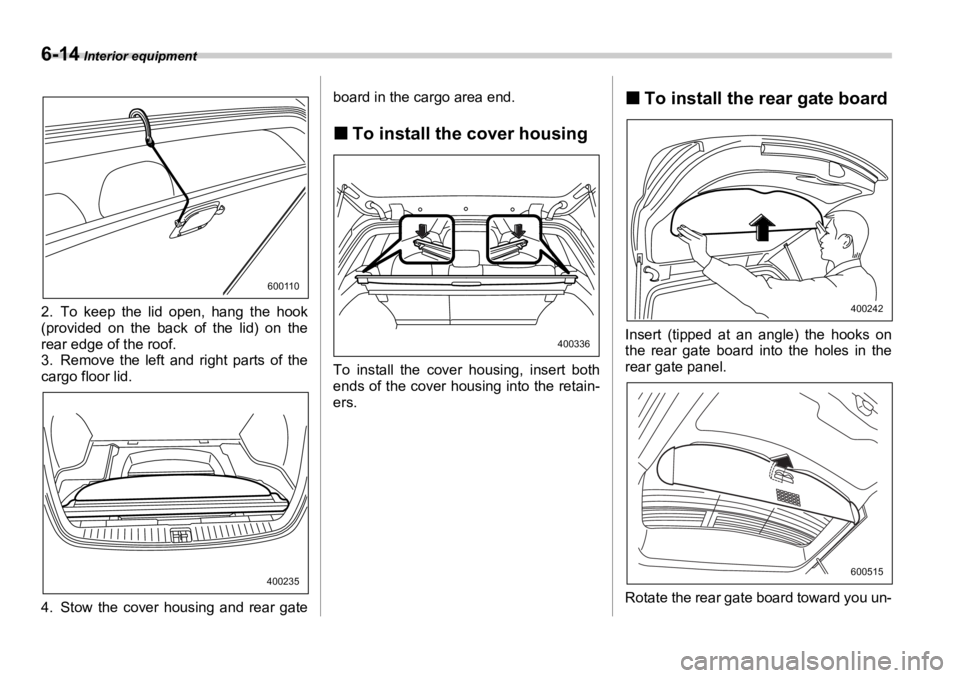
2. To keep the lid open, hang the hook
(provided on the back of the lid) on the
rear edge of the roof.
3. Remove the left and right parts of the
cargo floor lid.
4. Stow the cover housing and rear gate board in the cargo area end.
„ To install the cover housing
To install the cover housing, insert both
ends of the cover housing into the retain-
ers. „ To install the rear gate board
Insert (tipped at an angle) the hooks on
the rear gate board into the holes in the
rear gate panel.
Rotate the rear gate board toward you un-600110
400235 400336 400242
600515
Page 232 of 425
Interior equipment
6-15
– CONTINUED –til its top touches the rear gate panel.
Fit the top of the rear gate board into the
groove in the rear gate panel. Stowage boxes (Station wag-
on)
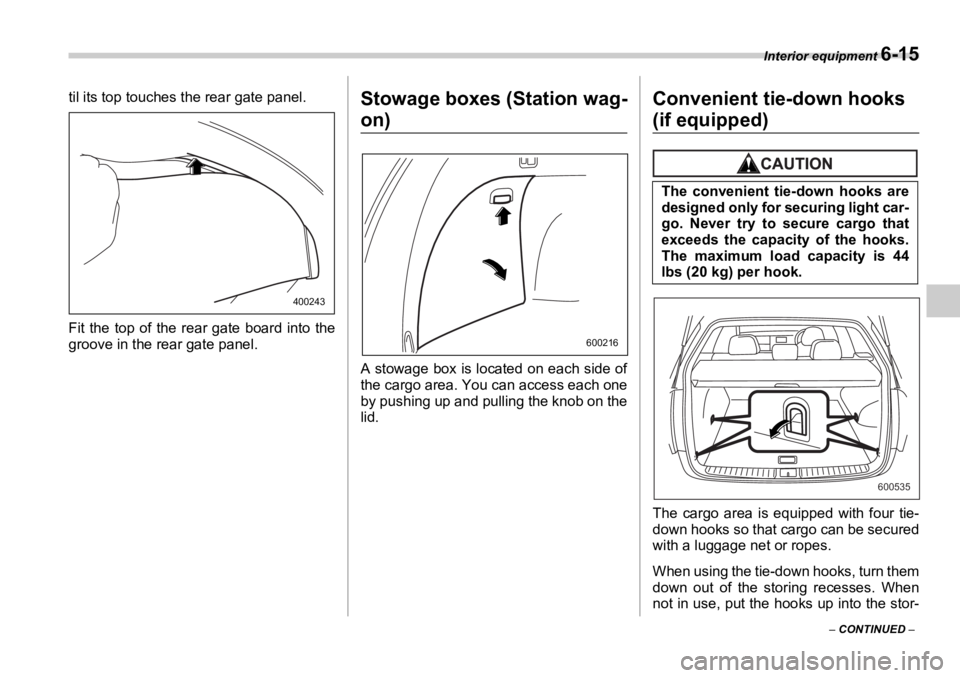
A stowage box is located on each side of
the cargo area. You can access each one
by pushing up and pulling the knob on the
lid. Convenient tie-down hooks
(if equipped)
The cargo area is equipped with four tie-
down hooks so that cargo can be secured
with a luggage net or ropes.
When using the tie-down hooks, turn them
down out of the storing recesses. When
not in use, put the hoo ks up into the stor-400243
600216
The convenient tie-down hooks are
designed only for securing light car-
go. Never try to secure cargo that
exceeds the capacity of the hooks.
The maximum load capacity is 44
lbs (20 kg) per hook.
600535
Page 252 of 425
Starting and operating
7-13
– CONTINUED –NOTE If the selector lever is in the “N” posi-
tion when you stop the engine for park-
ing, you may not subsequently be able
to move it to the “R” and “P” positions.
If this happens, turn the ignition switch
to the “ON” position. You will then be
able to move the selector lever to the
“P” position.
T D (Drive)
This position is for normal driving.
The transmission automa tically shifts into
a suitable gear from 1st to 4th according to
the vehicle speed and the acceleration
you require.
When more acceleration is required in this
position, press the a ccelerator pedal fully
to the floor and hold that position. The
transmission will automatically downshift
to 3rd, 2nd or 1st gear. When you release
the pedal, the transmission will return to
the original gear position.
To use the “SPORT” mode, move the le- ver from this position into the manual gate.
To use the manual mode, move the lever
from this position into the manual gate
then move it toward the “+” and “–” ends.
V While climbing a grade
When driving up a hill, undesired upshift to
4th gear is prevented from taking place
when the accelerator is released. This
minimizes the chance of subsequent
downshifting to a lower gear when accel-
erating again. This prevents repeated up-
shifting and downshifting resulting in a
smoother operation of the vehicle.
NOTE The transmission may downshift to
2nd or 1st gear, depending on the way
the accelerator pedal is pressed to ac-
celerate the vehicle again.
V While going down a hill
When you are descending a hill or any
other slope while braking with the
“SPORT” mode selected, the transmis-
sion may downshift to 3rd or 2nd gear de-
pending on how hard you depress the
brake pedal, causing engine braking to
work. Reacceleration for a short time will
cause the transmission to upshift normal-
ly. NOTE y A 4th-to-3rd automa tic downshift will
not occur at speeds above 50 mph (80
km/h) and a 3rd-to-2nd automatic
downshift will not occur at speeds
above 24 mph (38 km/h).
y Automatic downshifts to 3rd or 2nd
may occur even when driving on a level
road depending on conditions, such as
how hard you depress the brake pedal.
„ Selector lever reverse inhibit-
ing function This function prevents accidental move-
ment of the selector lever to the “R” posi-
tion while the vehicle is moving.
The function becomes operational when
the vehicle reaches a speed of approxi-
mately 6 mph (10 km/h). Once operation-
al, it prevents the selector lever from being
moved from the “N” position to the “R” po-
sition. When the vehicle speed drops be-
low 6 mph (10 km/h), the function is can-
celed. The selector lever can then be
moved to the “R” and “P” positions.
When the ignition switch has been turned
to the “OFF” position, movement of the se-
lector lever from the “N ” position to the “R”
position is possible for a limited time peri-
od and then becomes impossible. Also,
the selector lever cannot be moved to theDo not drive the vehicle with the se-
lector lever in the “N” (neutral) posi-
tion. Engine braking has no effect in
this condition and the risk of an ac-
cident is consequently increased.
Page 254 of 425
Starting and operating
7-15
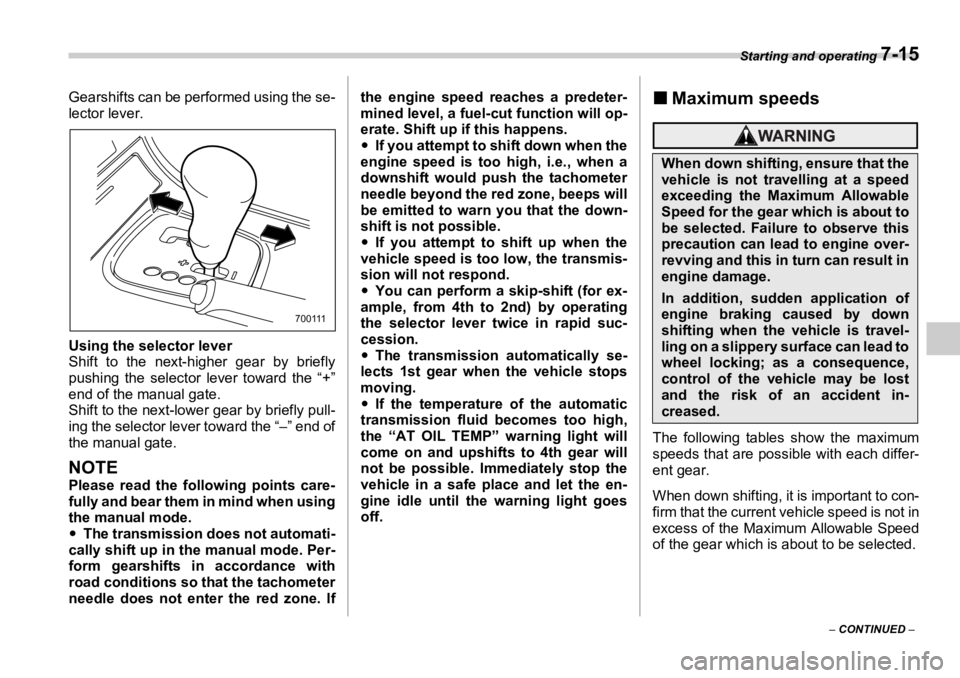
– CONTINUED –Gearshifts can be performed using the se-
lector lever.
Using the selector lever
Shift to the next-higher gear by briefly
pushing the selector lever toward the “+”
end of the manual gate.
Shift to the next-lower gear by briefly pull-
ing the selector lever toward the “–” end of
the manual gate.
NOTE Please read the following points care-
fully and bear them in mind when using
the manual mode.
y The transmission does not automati-
cally shift up in the manual mode. Per-
form gearshifts in accordance with
road conditions so that the tachometer
needle does not enter the red zone. If the engine speed reaches a predeter-
mined level, a fuel-cut function will op-
erate. Shift up if this happens.
y If you attempt to sh ift down when the
engine speed is too high, i.e., when a
downshift would push the tachometer
needle beyond the red zone, beeps will
be emitted to warn you that the down-
shift is not possible.
y If you attempt to shift up when the
vehicle speed is too low, the transmis-
sion will not respond.
y You can perform a skip-shift (for ex-
ample, from 4th to 2nd) by operating
the selector lever twice in rapid suc-
cession.
y The transmission automatically se-
lects 1st gear when the vehicle stops
moving.
y If the temperature of the automatic
transmission fluid becomes too high,
the “AT OIL TEMP” warning light will
come on and upshifts to 4th gear will
not be possible. Immediately stop the
vehicle in a safe place and let the en-
gine idle until the warning light goes
off. „ Maximum speeds
The following tables show the maximum
speeds that are possible with each differ-
ent gear.
When down shifting, it is important to con-
firm that the current vehicle speed is not in
excess of the Maximum Allowable Speed
of the gear which is about to be selected.700111
When down shifting, ensure that the
vehicle is not travelling at a speed
exceeding the Maximum Allowable
Speed for the gear which is about to
be selected. Failure to observe this
precaution can lead to engine over-
revving and this in turn can result in
engine damage.
In addition, sudden application of
engine braking caused by down
shifting when the vehicle is travel-
ling on a slippery surface can lead to
wheel locking; as a consequence,
control of the vehicle may be lost
and the risk of an accident in-
creased.
Page 258 of 425
Starting and operating
7-19
– CONTINUED –transmission is neutral; the vehicle will roll
freely, even on the slightest incline unless
the parking brake or foot brake is on.
Avoid coasting with the transmission neu-
tral.
During coasting, there is no engine brak-
ing effect.
NOTE (3.0-liter models only) To protect the engine while the “N” po-
sition is selected, the engine is con-
trolled such that the engine speed
does not become too high even if the
accelerator pedal is pressed hard.
NOTE If the selector lever is in the “N” posi-
tion when you stop the engine for park-
ing, you may not subsequently be able
to move it to the “R” and “P” positions.
If this happens, turn the ignition switch
to the “ON” position. You will then be
able to move the selector lever to the
“P” position. T D (Drive)
This position is for normal driving.
The transmission automatically shifts into
a suitable gear from 1st to 5th according to
the vehicle speed and the acceleration
you require.
When more acceleration is required in this
position, press the accelerator pedal fully
to the floor and hold that position. The
transmission will automatically downshift
to 4th, 3rd, 2nd or 1st gear. When you re-
lease the pedal, the transmission will re-
turn to the original gear position.
To use the SPORT mode, move the lever
from this position into the manual gate.
To use the manual mode, move the lever
from this position into the manual gate
then move it toward the “+” and “–” ends.
V While climbing a grade
When driving up a hill, undesired upshift to
4th or 5th gear is prevented from taking
place when the accelerator is released.
This minimizes the chance of subsequent
downshifting to a lower gear when accel-
erating again. This prevents repeated up-
shifting and downshifting resulting in a
smoother operation of the vehicle.
NOTE The transmission may downshift to
2nd or 1st gear, depending on the way the accelerator pedal is pressed to ac-
celerate the vehicle again.
V While going down a hill
When you are descending a hill or any
other slope while braking with the
“SPORT” mode selected, the transmis-
sion may downshift to 4th or 3rd gear de-
pending on how hard you depress the
brake pedal, causing engine braking to
work. Reacceleration for a short time will
cause the transmission to upshift normal-
ly.
NOTE y A 5th-to-4th automa tic downshift will
not occur at speeds above 78 mph (126
km/h) and a 4th-to-3rd automatic down-
shift will not occur at speeds above 53
mph (86 km/h).
y Automatic down shifts to 4th or 3rd
may occur even when driving on a level
road depending on conditions, such as
how hard you depress the brake pedal.
„ Selector lever reverse inhibit-
ing function This function prevents accidental move-
ment of the selector lever to the “R” posi-
tion while the vehicle is moving.
The function becomes operational when
the vehicle reaches a speed of approxi-Do not drive the vehicle with the se-
lector lever in the “N” (neutral) posi-
tion. Engine braking has no effect in
this condition and the risk of an ac-
cident is consequently increased.
Page 260 of 425
Starting and operating
7-21
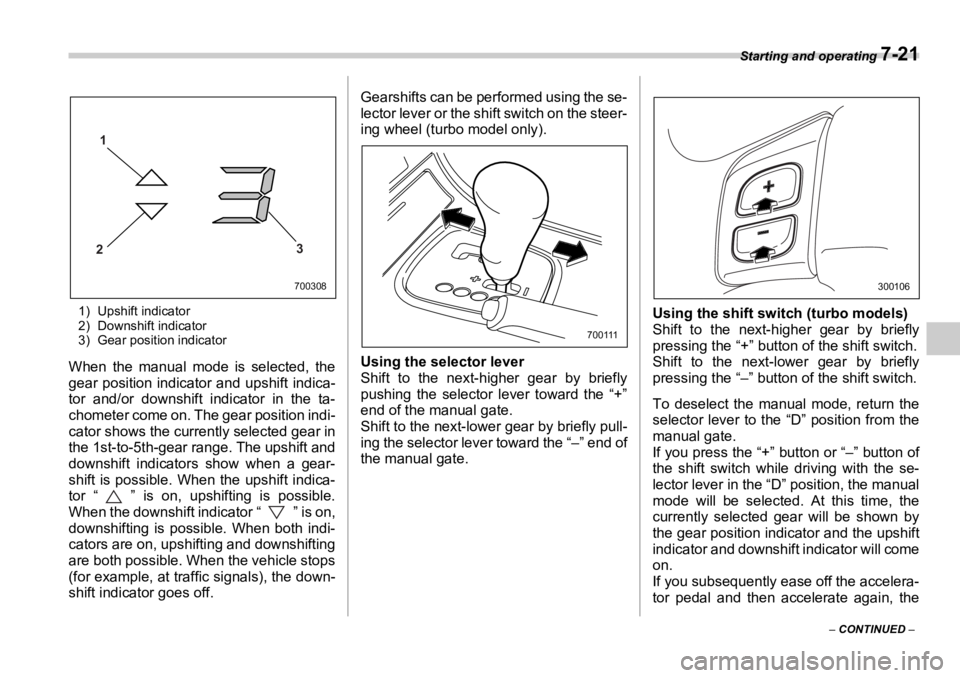
– CONTINUED –1) Upshift indicator
2) Downshift indicator
3) Gear position indicator
When the manual mode is selected, the
gear position indicator and upshift indica-
tor and/or downshift indicator in the ta-
chometer come on. The gear position indi-
cator shows the currently selected gear in
the 1st-to-5th-gear range. The upshift and
downshift indicators show when a gear-
shift is possible. When the upshift indica-
tor “ ” is on, upshifting is possible.
When the downshift indicator “ ” is on,
downshifting is possible. When both indi-
cators are on, upshifting and downshifting
are both possible. When the vehicle stops
(for example, at traffic signals), the down-
shift indicator goes off. Gearshifts can be performed using the se-
lector lever or the sh ift switch on the steer-
ing wheel (turbo model only).
Using the selector lever
Shift to the next-higher gear by briefly
pushing the selector lever toward the “+”
end of the manual gate.
Shift to the next-lower gear by briefly pull-
ing the selector lever toward the “–” end of
the manual gate. Using the shift swit ch (turbo models)
Shift to the next-higher gear by briefly
pressing the “+” button of the shift switch.
Shift to the next-lower gear by briefly
pressing the “–” button of the shift switch.
To deselect the manual mode, return the
selector lever to the “D” position from the
manual gate.
If you press the “+” button or “–” button of
the shift switch while driving with the se-
lector lever in the “D” position, the manual
mode will be selected. At this time, the
currently selected gear will be shown by
the gear position indicator and the upshift
indicator and downshift indicator will come
on.
If you subsequently ease off the accelera-
tor pedal and then accelerate again, the1
2 3 700308
700111 300106
Page 267 of 425
7-28 Starting and operating
Electronic Br ake Force Dis-
tribution (EBD) system The EBD system maximizes the effective-
ness of the brakes by allowing the rear
brakes to supply a greater proportion of
the braking force. It functions by adjusting
the distribution of brak ing force to the rear
wheels in accordance with the vehicle’s
loading condition and speed.
The EBD system is an integral part of the
ABS system and uses some of the ABS
system’s components to perform its func-
tion of optimizing the distribution of brak-
ing force. If any of the ABS components
used by the EBD function fails, the EBD
system also stops working.
When the EBD system is operating, you
may hear a chattering noise or feel a slight
vibration in the brake pedal. This is normal
and does not indicate a malfunction. „ Steps to take if EBD system
fails
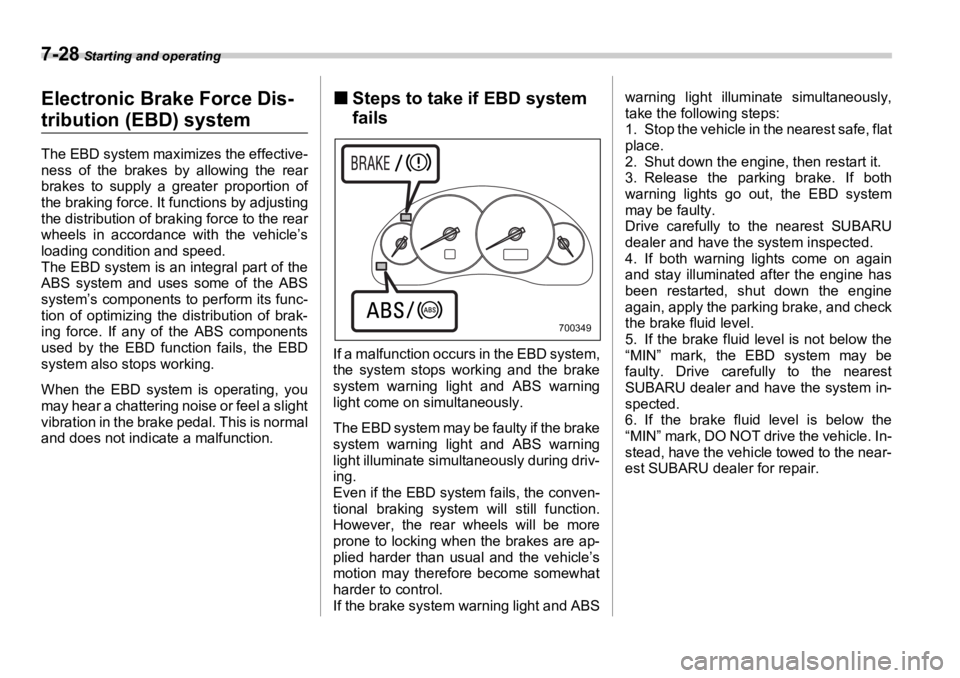
If a malfunction occu rs in the EBD system,
the system stops working and the brake
system warning light and ABS warning
light come on simultaneously.
The EBD system may be faulty if the brake
system warning light and ABS warning
light illuminate simultaneously during driv-
ing.
Even if the EBD system fails, the conven-
tional braking system will still function.
However, the rear wheels will be more
prone to locking when the brakes are ap-
plied harder than usual and the vehicle’s
motion may therefore become somewhat
harder to control.
If the brake system warning light and ABS warning light illuminate simultaneously,
take the following steps:
1. Stop the vehicle in the nearest safe, flat
place.
2. Shut down the engine, then restart it.
3. Release the parking brake. If both
warning lights go out, the EBD system
may be faulty.
Drive carefully to the nearest SUBARU
dealer and have the system inspected.
4. If both warning lights come on again
and stay illuminated after the engine has
been restarted, shut down the engine
again, apply the parking brake, and check
the brake fluid level.
5. If the brake fluid level is not below the
“MIN” mark, the EBD system may be
faulty. Drive carefully to the nearest
SUBARU dealer and have the system in-
spected.
6. If the brake fluid level is below the
“MIN” mark, DO NOT drive the vehicle. In-
stead, have the vehicle towed to the near-
est SUBARU dealer for repair. 700349
Page 268 of 425
Starting and operating
7-29
– CONTINUED –Vehicle Dynamics Control
system (if equipped)y Driving with the brake system
warning light on is dangerous.
This indicates your brake system
may not be working properly. If
the light remains on, have the
brakes inspected by a SUBARU
dealer immediately.
y If at all in doubt about whether the
brakes are operating properly, do
not drive the vehicle. Have your
vehicle towed to the nearest
SUBARU dealer for repair. Always use the utmost care in driv-
ing – overconfidence because you
are driving with a Vehicle Dynamics
Control system equipped vehicle
could easily lead to a serious acci-
dent.
y Even if your vehicle is equipped
with Vehicle Dynamics Control,
winter tires or snow chains
should be used when driving on
snow-covered or icy roads; in ad-
dition, vehicle speed should be re-
duced considerably. Simply hav-
ing a Vehicle Dynamics Control
system does not guarantee that
the vehicle will be able to avoid
accidents in any situation. y Activation of the Vehicle Dynam-
ics Control system is an indica-
tion that the ro ad being travelled
on has a slippery surface; since
having Vehicle Dynamics Control
is no guarantee that full vehicle
control will be maintained at all
times and under all conditions, its
activation should be seen as a
sign that the speed of the vehicle
should be reduced considerably.
y Whenever suspension compo-
nents, steering components, or an
axle are removed from a vehicle
equipped with Vehicle Dynamics
Control, have an authorized
SUBARU dealer perform an in-
spection of that system.
y The following precautions should
be observed in order to ensure
that the Vehicle Dynamics Control
system is operating properly:
– All four wheels should be fitted
with tires of the same size, type,
and brand. Furthermore, the
amount of wear should be the
same for all four tires.
Page 269 of 425
7-30 Starting and operating
In the event of wheelspin and/or skidding
on a slippery road surface and/or during
cornering and/or an evasive maneuver,
the Vehicle Dynamics Control system ad-
justs the engine’s output and the wheels’
respective braking forces to help maintain
traction and directional control.
y Traction Control Function
The traction control function is designed to
prevent spinning of the driving wheels on
slippery road surfaces, thereby helping to
maintain traction and directional control.
Activation of this function is shown by
steady illumination of the Vehicle Dynam-
ics Control operation indicator light.
y Skid Suppression Function
The skid suppression function is designed
to help maintain directional stability by
suppressing the wheels’ tendency to slide
sideways during steering operations. Acti-
vation of this function is shown by flashing
of the Vehicle Dynamics Control operation
indicator light.
NOTE
y Slight twitching of the brake pedal may be felt when the Vehicle Dynamics
Control system operates; a small de-
gree of vehicle or st eering wheel shak-
ing may also be noticed in this situa-
tion. These are normal characteristics
of Vehicle Dynamics Control operation
and are no cause for alarm.
y When driving off immediately after
starting the engine, a short-lived oper-
ation noise may be noticed coming
from the engine compartment. This
noise is generated as a result of a
check being performed on the Vehicle
Dynamics Control system and is nor-
mal.
y Depending on the timing of activa-
tion of the brakes, certain situations
may occur just after driving off where
the brake pedal seems to exhibit a jolt-
ing motion. This too is a consequence
of the Vehicle Dynamics Control opera-
tional check and is normal.
y In the circumstances listed in the fol-
lowing, the vehicle may be more unsta-
ble than it feels to the driver. The Vehi-
cle Dynamics Control System may
therefore operate. Such operation does
not indicate a system fault.
y on gravel-covered or rutted roads
y on unfinished roads
y when the vehicle is towing a trailer
y when the vehicle is fitted with snow tires or winter tires
y Activation of the Vehicle Dynamics
Control system will cause operation of
the steering wheel to feel slightly dif-
ferent compared to that for normal con-
ditions.
y Even if the vehicle is equipped with a
Vehicle Dynamics Control system, it is
important that winter tires be used
when driving on snow-covered or icy
roads. (All four wheels should be fitted
with tires of the same size and brand).
Furthermore, if snow chains are to be
used, they should be fitted on the front
wheels. When a vehicle is fitted with
snow chains, however, the effective-
ness of the Vehicle Dynamics Control
system is reduced and this should be
taken into account when driving the ve-
hicle in such a condition.
y It is always important to reduce
speed when approaching a corner,
even if the vehicle is equipped with Ve-
hicle Dynamics Control.
y All four wheels shou ld be fitted with
tires of the same size, type, and brand;
furthermore, the amount of wear
should be the same for all four tires. If
these precautions are not observed
and non-matching tires are used, it is
quite possible that the Vehicle Dynam-
ics Control system will be unable to op-– Keep the tire pressure at the
proper level as shown on the
vehicle placard attached to the
driver’s side door pillar.
Page 280 of 425

8Driving tipsNew vehicle break-in driving – the first 1,000
miles (1,600 km) ............. ................................. 8-2
Fuel economy hints ............. .......................... .... 8-2
Engine exhaust gas (Carbon monoxide) ......... 8-2
Catalytic converter ............................................. 8-3
Periodic inspections .......................................... 8-4
Driving in foreign countries .............................. 8-4
Driving tips for AWD vehicles ........................... 8-5
Off road driving .................................................. 8-6
Winter driving ..................................................... 8-7 Operation during cold weather .............................. 8-7
Driving on snowy and icy roads ............................ 8-9
Corrosion protection .............................................. 8-10
Snow tires ............................................................... 8-10
Tire chains ............................................................... 8-11
Rocking the vehicle ................................................ 8-12
Loading your vehicle ......................................... 8-12 Vehicle capacity weight ......................................... 8-13
GVWR and GAWR (Gross Vehicle Weight Rating
and Gross Axle Weight Rating) ........................... 8-14
Roof rail and crossbar (if equipped) ..................... 8-14
Trailer hitch (if equipped) .................................. 8-18
Connecting a trailer ................................................ 8-19
When you do not tow a trailer ............................... 8-20
Trailer towing ...................................................... 8-20
Warranties and maintenance ................................. 8-20
Maximum load limits .............................................. 8-21 Trailer hitches ......................................................... 8-24
Connecting a trailer ................................................ 8-25
Trailer towing tips ................................................... 8-26