egr SUBARU OUTBACK 2006 Owners Manual
[x] Cancel search | Manufacturer: SUBARU, Model Year: 2006, Model line: OUTBACK, Model: SUBARU OUTBACK 2006Pages: 425, PDF Size: 10.36 MB
Page 90 of 425

Keys and doors
2-3
– CONTINUED –Immobilizer The immobilizer system is designed to
prevent an unauthorized person from
starting the engine. Only keys registered
with your vehicle’s immobilizer system
can be used to operate your vehicle. Even
if an unregistered key fits into the ignition
switch and can be turned to the “START”
position, the engine will automatically stop
after several seconds.
Each immobilizer key contains a tran-
sponder in which the key’s ID code is
stored. When a key is inserted into the ig-
nition switch and turned to the “ON” posi-
tion, the transponder transmits the key’s
ID code to the imm obilizer system’s re-
ceiver. If the transmitt ed ID code matches
the ID code registered in the immobilizer
system, the system allo ws the engine to
be started. Since the ID code is transmit-
ted and acted upon almost instantly, the
immobilizer system does not impede nor-
mal starting of the engine.
If the engine fails to start, pull out the key
once before trying again. (Refer to the “Ig-
nition switch” section [chapter 3].)
This device complies with Part 15 of
the FCC Rules and with RSS-210 of In-
dustry Canada. Operation is subject to
the following two co nditions: (1) This device may not cause harmful interfer-
ence, and (2) this device must accept
any interference received, including in-
terference that may cause undesired
operation.
Changes or modifications not express-
ly approved by the party responsible
for compliance could void the user’s
authority to operate the equipment.
NOTE To protect your veh icle from theft,
please pay close attention to the fol-
lowing security precautions:
y Never leave your vehicle unattended
with its keys inside.
y Before leaving your vehicle, close all
windows and lock the doors and rear
gate (Stati on wagon).
y Do not leave spare keys or any
record of your key number in the vehi-
cle. „ Security ID plate
1) Key number plate
2) Security ID plate
The security ID is stamped on the security
ID plate attached to the key set. Write
down the security ID and keep it in another
safe place, not in the vehicle. This number
is needed to make a replacement key if
you lose your key or lock it inside the vehi-
cle.
This number is also needed for replace-
ment or repair of the engine control unit,
integrated unit, and combination meter.y Do not place the key under direct
sunlight or anywhere it may be-
come hot.
y Do not get the key wet. If the key
gets wet, wipe it dry with a cloth
immediately. 12 200701
Page 267 of 425
7-28 Starting and operating
Electronic Br ake Force Dis-
tribution (EBD) system The EBD system maximizes the effective-
ness of the brakes by allowing the rear
brakes to supply a greater proportion of
the braking force. It functions by adjusting
the distribution of brak ing force to the rear
wheels in accordance with the vehicle’s
loading condition and speed.
The EBD system is an integral part of the
ABS system and uses some of the ABS
system’s components to perform its func-
tion of optimizing the distribution of brak-
ing force. If any of the ABS components
used by the EBD function fails, the EBD
system also stops working.
When the EBD system is operating, you
may hear a chattering noise or feel a slight
vibration in the brake pedal. This is normal
and does not indicate a malfunction. „ Steps to take if EBD system
fails
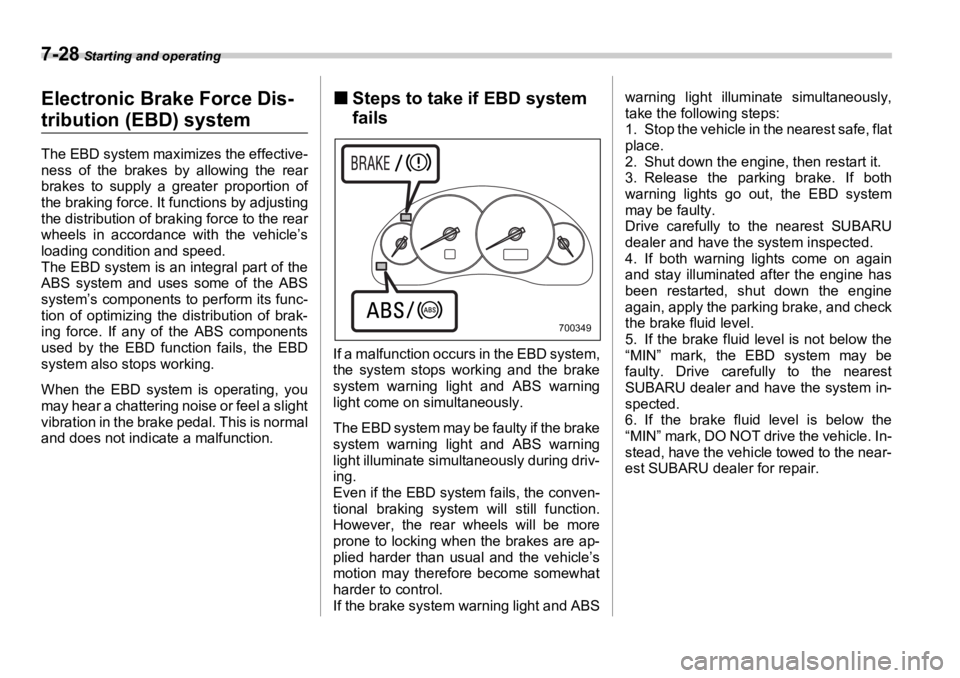
If a malfunction occu rs in the EBD system,
the system stops working and the brake
system warning light and ABS warning
light come on simultaneously.
The EBD system may be faulty if the brake
system warning light and ABS warning
light illuminate simultaneously during driv-
ing.
Even if the EBD system fails, the conven-
tional braking system will still function.
However, the rear wheels will be more
prone to locking when the brakes are ap-
plied harder than usual and the vehicle’s
motion may therefore become somewhat
harder to control.
If the brake system warning light and ABS warning light illuminate simultaneously,
take the following steps:
1. Stop the vehicle in the nearest safe, flat
place.
2. Shut down the engine, then restart it.
3. Release the parking brake. If both
warning lights go out, the EBD system
may be faulty.
Drive carefully to the nearest SUBARU
dealer and have the system inspected.
4. If both warning lights come on again
and stay illuminated after the engine has
been restarted, shut down the engine
again, apply the parking brake, and check
the brake fluid level.
5. If the brake fluid level is not below the
“MIN” mark, the EBD system may be
faulty. Drive carefully to the nearest
SUBARU dealer and have the system in-
spected.
6. If the brake fluid level is below the
“MIN” mark, DO NOT drive the vehicle. In-
stead, have the vehicle towed to the near-
est SUBARU dealer for repair. 700349
Page 371 of 425

11 - 3 8 Maintenance and service
Tire wear varies from wheel to wheel. To
maximize the life of each tire and ensure
that the tires wear uniformly, it is best to
rotate the tires every 7,500 miles (12,500
km). Rotating the tires involves switching
the front and rear ti res on the right-hand
side of the vehicle and similarly switching
the front and rear tires on the left-hand
side of the vehicle. (Each tire must be kept
on its original side of the vehicle.)
Replace any damaged or unevenly worn
tire at the time of rotation. After tire rota-
tion, adjust the tire pressures and make
sure the wheel nuts are correctly tight-
ened.
After driving approximately 600 miles
(1,000 km), check the wheel nuts again
and retighten any nut that has become
loose.
„ Tire replacementThe wheels and tires are important and in-
tegral parts of your vehicle’s design; they
cannot be changed arbitrarily. The tires fit-
ted as standard equipment are optimally
matched to the characteristics of the vehi-
cle and were selected to give the best pos-
sible combination of running performance,
ride comfort, and service life. It is essential
for every tire to have a size and construc-
tion matching those shown on the tire placard and to have a speed symbol and
load index matching those shown on the
tire placard.
Using tires of a non-specified size detracts
from controllability, ride comfort, braking
performance, speedometer accuracy and
odometer accuracy. It also creates incor-
rect body-to-tire clearances and inappro-
priately changes the vehicle’s ground
clearance.
All four tires must be the same in terms of
manufacturer, brand (tread pattern), con-
struction, and size. You are advised to re-
place the tires with new ones that are
identical to those fitted as standard equip-
ment.
For safe vehicle operation, SUBARU rec-
ommends replacing all four tires at the
same time.
„ Wheel replacement When replacing wheels due, for example,
to damage, make sure the replacement
wheels match the specifications of the
wheels that are fitted as standard equip-
ment. Replacement wheels are available
from SUBARU dealers. y All four tires must be the same in
terms of manufacturer, brand
(tread pattern), construction, de-
gree of wear, speed symbol, load
index and size. Mixing tires of dif-
ferent types, sizes or degrees of
wear can result in damage to the
vehicle’s power train. Use of dif-
ferent types or si zes of tires can
also dangerously reduce control-
lability and braking performance
and can lead to an accident.
y Use only radial tires. Do not use
radial tires together with belted
bias tires and/or bias-ply tires. Do-
ing so can dangerously reduce
controllability, resulting in an ac-
cident.
Page 395 of 425

12-6 Specifications
Fuses and circuits „ Fuse panel located in the passenger compart-
ment
27 28 29 30 31 32 3320 21 22 23 24 25 2613 14 15 16 17 18 19 6789101112 12345
C00004Fuse panel Fuse rating Circuit
1 20A
y Cargo fan
y Trailer hitch connector
2 Empty
3 15A
y Door locking
4 15A
y Front wiper deicer relay
y Moonroof
5 15A
y Combination meter
6 7.5A
y Remote control rear view mirrors
y Seat heater relay
y Vanity mirror light
7 15A
y Combination meter
y Integrated unit
8 20A
y Stop light
9 20A
y Mirror heater
y Front wiper deicer
10 7.5A
y Power supply (Battery)
11 7.5A
y Turn signal unit
y Clock
12 15A
y Automatic transmission unit
y SRS airbag system (Sub)
y Engine control unit
y Integrated unit
Page 396 of 425

Specifications
12-7
– CONTINUED –13 20A
y Cargo socket
14 15A
y Position light
y Tail light
y Rear combination light
15 Empty
16 15A
y Illumination
17 15A
y Seat heaters
18 10A
y Backup light
19 7.5A
y Headlight right side relay
20 10A
y Cigarette lighter socket
21 7.5A
y Starter relay
22 15A
y Air conditioner
y Rear window defogger relay coil
23 15A
y Rear wiper
y Rear window washer
24 15A
y Audio unit
y Clock
25 15A
y SRS airbag system (Main)
26 15A
y Power window relay
27 15A
y Blower fanFuse panel Fuse rating Circuit
28 15A
y Blower fan
29 15A
y Fog light
30 30A
y Front wiper
y Front wiper washer
31 7.5A
y Auto air conditioner unit
y Integrated unit
32 7.5A
y Headlight left side relay
33 7.5A
y ABS/Vehicle dynamics control unitFuse panel Fuse rating Circuit