time SUBARU OUTBACK 2007 4.G Owners Manual
[x] Cancel search | Manufacturer: SUBARU, Model Year: 2007, Model line: OUTBACK, Model: SUBARU OUTBACK 2007 4.GPages: 442, PDF Size: 13.39 MB
Page 383 of 442
11-40Maintenance and service
&Tire replacement
The wheels and tires are important and
integral parts of your vehicle ’s design;
they cannot be changed arbitrarily. The
tires fitted as standard equipment are
optimally matched to the characteristics
of the vehicle and were selected to give
the best possible combination of running
performance, ride comfort, and service
life. It is essential for every tire to have a
size and construction matching those
shown on the tire placard and to have a
speed symbol and load index matching
those shown on the tire placard.
Using tires of a non-specified size detracts
from controllability, ride comfort, braking
performance, speedometer accuracy and
odometer accuracy. It also creates incor-
rect body-to-tire clearances and inappro-
priately changes the vehicle ’sground
clearance.
All four tires must be the same in terms of
manufacturer, brand (tread pattern), con-
struction, and size. You are advised to
replace the tires with new ones that are
identical to those fitted as standard equip-ment.
For safe vehicle operation, SUBARU
recommends replacing all four tires at
the same time.WARNING
. All four tires must be the same in
terms of manufacturer, brand
(tread pattern), construction, de-
gree of wear, speed symbol, load
index and size. Mixing tires of
different types, sizes or degrees
of wear can result in damage to
the vehicle ’s power train. Use of
different types or sizes of tires
can also dangerously reduce
controllability and braking per-
formance and can lead to anaccident.
. Use only radial tires. Do not use
radial tires together with belted
bias tires and/or bias-ply tires.
Doing so can dangerously re-
duce controllability, resulting in
an accident.
& Wheel replacement
When replacing wheels due, for example,
to damage, make sure the replacement
wheels match the specifications of the
wheels that are fitted as standard equip-
ment. Replacement wheels are available
from SUBARU dealers.WARNING
Use only those wheels that are
specified for your vehicle. Wheels
not meeting specifications could
interfere with brake caliper opera-
tion and may cause the tires to rub
against the wheel well housing dur-
ing turns. The resulting loss of
vehicle control could lead to anaccident.
Page 385 of 442

11-42Maintenance and service
level gauge or the “Full ”mark on the tank.
Use windshield washer fluid. If windshield
washer fluid is unavailable use clean
water.
In areas where water freezes in winter,
use an anti-freeze type windshield washer
fluid. SUBARU Windshield Washer Fluid
contains 58.5% methyl alcohol and 41.5%
surfactant, by volume. Its freezing tem-
perature varies according to how much it
is diluted, as indicated in the followingtable.
Washer Fluid
Concentration Freezing
Temperature
30% 10.48F( 12 8C)
50% 48F( 20 8C)
100% 49 8F( 45 8C)
In order to prevent freezing of washer
fluid, check the freezing temperatures in
the table above when adjusting the fluid
concentration to the outside temperature.
If you fill the reservoir tank with a fluid with
a different concentration from the one
used previously, purge the old fluid from
the piping between the reservoir tank and
washer nozzles by operating the washer
for a certain period of time. Otherwise, if
the concentration of the fluid remaining in
thepipingistoolowfortheoutside temperature, it may freeze and block thenozzles.
CAUTION
Adjust the washer fluid concentra-
tion appropriately for the outside
temperature. If the concentration is
inappropriate, sprayed washer fluid
may freeze on the windshield and
obstruct your view, and the fluid
may freeze in the reservoir tank. Replacement of wiper blades
Grease, wax, insects, or other materials
on the windshield or the wiper blade
results in jerky wiper operation and streak-
ing on the glass. If you cannot remove the
streaks after operating the windshield
washer or if the wiper operation is jerky,
clean the outer surface of the windshield
(or rear window) and the wiper blades
using a sponge or soft cloth with a neutral
detergent or mild-abrasive cleaner. After
cleaning, rinse the windshield and wiper
blades with clean water. The windshield is
clean if beads do not form when you rinse
the windshield with water.
CAUTION
. Do not clean the wiper blades
with gasoline or a solvent, such
as paint thinner or benzene. This
will cause deterioration of the
wiper blades.
. When you wish to raise the
passenger-side wiper arm, first
raise the driver-side wiper arm.
Otherwise, the passenger-side
wiper assembly and driver-side
wiper assembly will touch each
other, possibly resulting inscratches.
Page 390 of 442
remove rings, metal watchbands,
and other metal jewelry. Never
allow metal tools to contact the
positive battery terminal and any-
thing connected to it WHILE you
are at the same time in contact
with any other metallic portion of
the vehicle because a short cir-
cuit will result.
. Keep everyone including children
away from the battery.
. Charge the battery in a well-
ventilated area.
. Battery posts, terminals, and re-
lated accessories contain lead
and lead compounds, chemicals
known to the State of California
to cause cancer and reproductive
harm. Batteries also contain
other chemicals known to the
State of California to cause can-
cer. Wash hands after handling.
CAUTION
Never use more than 10 amperes
when charging the battery because
it will shorten battery life.
It is unnecessary to periodically check the
battery fluid level or periodically refill with distilled water.
Fuses
CAUTION
Never replace a fuse with one hav-
ing a higher rating or with material
other than a fuse because serious
damage or a fire could result.
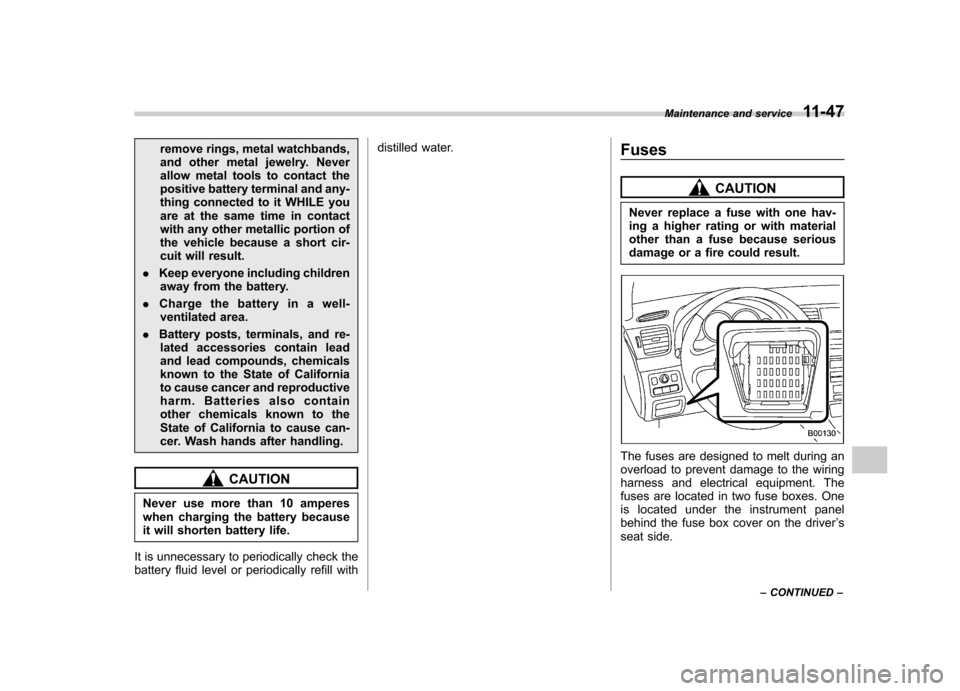
The fuses are designed to melt during an
overload to prevent damage to the wiring
harness and electrical equipment. The
fuses are located in two fuse boxes. One
is located under the instrument panel
behind the fuse box cover on the driver ’s
seat side. Maintenance and service
11-47
– CONTINUED –
Page 396 of 442

!High beam light bulbs
Right-hand side
1. Use a screwdriver to undo the clips on
the air intake duct, then remove the air
intake duct. (right-hand side)
Left-hand side 2. Use a screwdriver to remove the
secured clip of the washer tank. To make
it easy to access the bulb, move the
washer tank to the horizontal direction.
(left-hand side)
3. Disconnect the electrical connector
from the bulb.
4. Remove the bulb from the headlight
assembly by turning it counterclockwise.
5. Replace the bulb with new one.
6. Reconnect the electrical connector. At
this time, use care not to touch the bulbsurface.
7. To install the bulb to the headlight
assembly, turn it clockwise until it clicks.
8. Install the air intake duct with clip.
(right-hand side)
9. Set the washer tank to the original
place and secure it by clip. (left-hand side) &
Parking light
It may be difficult to replace the bulbs.
Have your SUBARU dealer replace the
bulbs if necessary. & Front turn signal light
It may be difficult to replace the bulbs.
Have your SUBARU dealer replace the
bulbs if necessary. & Front fog light (if equipped)
It may be difficult to replace the bulbs.
Have your SUBARU dealer replace the
bulbs if necessary. Maintenance and service
11-53
– CONTINUED –
Page 422 of 442

an asymmetrical tire that has a
particular side that must always
face outward when mounting on a
vehicle.
. Accessory weight
The combined weight (in excess of
those standard items which may be
replaced) of floor mats, leather seats
and cross bars to the extent that these
items are available as factory-in-
stalled equipment (whether installed
or not). . Curb weight
The weight of a motor vehicle with
standard equipment including the
maximum capacity of fuel, oil, and
coolant and air conditioning. . Maximum loaded vehicle weight
The sum of curb weight, accessory
weight, vehicle capacity weight and
production options weight. . Normal occupant weight
150 lbs (68 kg) times the number of
occupants (3 occupants). . Occupant distribution
Distribution of occupants in a vehicle,
2 in front, 1 in rear seat. . Production options weight The combined weight of those in-
stalled regular production options
weighing over 5.1 lbs (2.3 kg) in
excess of those standards items
which they replace, not previously
considered in curb weight or acces-
sory weight. .
Vehicle capacity weight
The total weight of cargo, luggage
and occupants that can be added to
the vehicle. . Vehicle maximum load on a tire
Load on an individual tire that is
determined by distributing to each
axle its share of the maximum loaded
vehicle weight and dividing by two. . Vehicle normal load on a tire
Load on an individual tire that is
determined by distributing to each
axle its share of the curb weight,
accessory weight, and normal occu-
pant weight and dividing by two. & Tire care –maintenance and
safety practices
. Check on a daily basis that the tires
are free from serious damage, nails,
and stones. At the same time, check
the tires for abnormal wear. .
Inspect the tire tread regularly and
replace the tires before their tread
wear indicators become visible. When
a tire ’s tread wear indicator becomes
visible, the tire is worn beyond the
acceptable limit and must be replaced
immediately. With a tire in this condi-
tion, driving at even low speeds in wet
weather can cause the vehicle to
hydroplane. Possible resulting loss
of vehicle control can lead to an
accident. . To maximize the life of each tire
and ensure that the tires wear uni-
formly, it is best to rotate the tires
every 7,500 miles (12,500 km). Rotat-
ing the tires involves switching the
front and rear tires on the right-hand
side of the vehicle and similarly
switching the front and rear tires on
the left-hand side of the vehicle.
(Each tire must be kept on its original
side of the vehicle.) Replace any
damaged or unevenly worn tire at
the time of rotation. After tire rotation,
adjust the tire pressures and make
sure the wheel nuts are correctly
tightened. A tightening torque specifi-
cation and a tightening sequence
Consumer information and Reporting safety defects
13-7
– CONTINUED –
Page 427 of 442
13-12Consumer information and Reporting safety defects
Uniform tire quality grading standards
This information indicates the relative
performance of passenger car tires in
the area of treadwear, traction, and
temperature resistance. This is to aid
the consumer in making an informed
choice in the purchase of tires.
Quality grades can be found where
applicable on the tire sidewall be-
tween tread shoulder and maximum
section width. For example:
Treadwear 200 Traction AA Tem-
perature A
The quality grades apply to new
pneumatic tires for use on passenger
cars. However, they do not apply to
deep tread, winter type snow tires,
space-saver or temporary use spare
tires, tires with nominal rim diameters
of 12 inches or less, or to some limited
production tires.
All passenger car tires must conform
to Federal Safety Requirements in
addition to these grades. &
Treadwear
The treadwear grade is a comparative
rating based on the wear rate of the
tire when tested under controlled
conditions on a specified government
test course.
For example, a tire graded 150 would
wear one and one-half (1-1/2) times
as well on the government course as
a tire graded 100. The relative perfor-
mance of tires depends upon the
actual conditions of their use, how-
ever, and may depart significantly
from the norm due to variations in
driving habits, service practices and
differences in road characteristics and
climate. & Traction AA, A, B, C
The traction grades, from highest to
lowest, are AA, A, B and C. Those
grades represent the tire ’s ability to
stop on wet pavement as measured
under controlled conditions on speci-
fied government test surfaces of
asphalt and concrete. A tire marked
C may have poor traction perfor- mance.WARNING
The traction grade assigned to
this tire is based on straight-
ahead braking traction tests,
and does not include accelera-
tion, cornering, hydroplaning, or
peak traction characteristics.
& Temperature A, B, C
The temperature grades are A (the
highest), B, and C, representing thetire ’s resistance to the generation of
heat and its ability to dissipate heat
when tested under controlled condi-
tions on a specified indoor laboratory
test wheel. Sustained high tempera-
ture can cause the material of the tire
to degenerate and reduce tire life, and
excessive temperature can lead to
sudden tire failure. The grade C
corresponds to a level of performance
which all passenger car tires must
meet under the Federal Motor Vehicle
Safety Standards No. 109. Grades B
and A represent higher levels of
performance on the laboratory test
wheel than the minimum required by
Page 432 of 442

Tie-down hooks..................................................... 6-16
Catalytic converter ....................................................... 8-3
Center
Console .................................................................. 6-5
Ventilators ............................................................... 4-3
Center and side ventilators ............................................ 4-3
Changing Flat tire ................................................................... 9-4
Oil and oil filter ..................................................... 11-10
Charge warning light .................................................. 3-26
CHECK ENGINE warning light/Malfunction indicator lamp ...................................................................... 3-25
Checking
Brake pedal free play ............................................ 11-31
Brake pedal reserve distance ................................. 11-31
Clutch function ...................................................... 11-32
Clutch pedal free play ............................................ 11-32
Engine oil level ...................................................... 11-9
Fluid level ............................... 11-22, 11-28, 11-29, 11-30
Gear oil level ........................................................ 11-25
Child restraint systems ............................................... 1-27
Installation with A/ELR seatbelt ................................ 1-30
Lower and tether anchorages .................................. 1-35
Child safety .................................................................... 5
Locks ................................................................... 2-19
Chime Key ........................................................................ 3-5 Seatbelt ........................................................ 1-14, 3-22
Cleaning
Aluminum wheels ................................................... 10-3
Interior .................................................................. 10-5 Ventilator grille
....................................................... 4-12
Climate control system Automatic ............................................................... 4-8
Manual ................................................................... 4-3
Clock ........................................................................ 3-34
Clutch Fluid ................................................................... 11-30
Pedal .................................................................. 11-32
Coat hook. ................................................................. 6-10
Cooling system ........................................................ 11-13
Corrosion protection ............................................ 8-10, 10-4
Cruise control ............................................................ 7-46
Set indicator light .................................................... 3-33
Cruise control indicator light ......................................... 3-33
Cup holder ................................................................. 6-7
Front passenger ’s.................................................... 6-8
Rear passenger ’s .................................................... 6-8
D
Daytime running light system ....................................... 3-40
Differential gear oil
Front ................................................................... 11-24
Rear ................................................................... 11-25
Dimensions ................................................................ 12-2
Disarming the system ................................................. 2-17
Disc brake pad wear warning indicators ........................ 7-34
Dome light ......................................................... 6-2, 11-56
Door
Locks ..................................................................... 2-5
Door open warning light .............................................. 3-29
Drive belts ............................................................... 11-20 Index
14-3